A World Record on Lake of the Isles Ice
At a time when ICE is deservedly getting a bad name in Minnesota and around the world, I wanted to direct attention to some uses of ice in Minneapolis that were not immoral, unConstitutional, or unChristian.
While researching another topic recently I came across this illustration in a Bartlesville, Oklahoma newspaper from 1936. I had to investigate further.
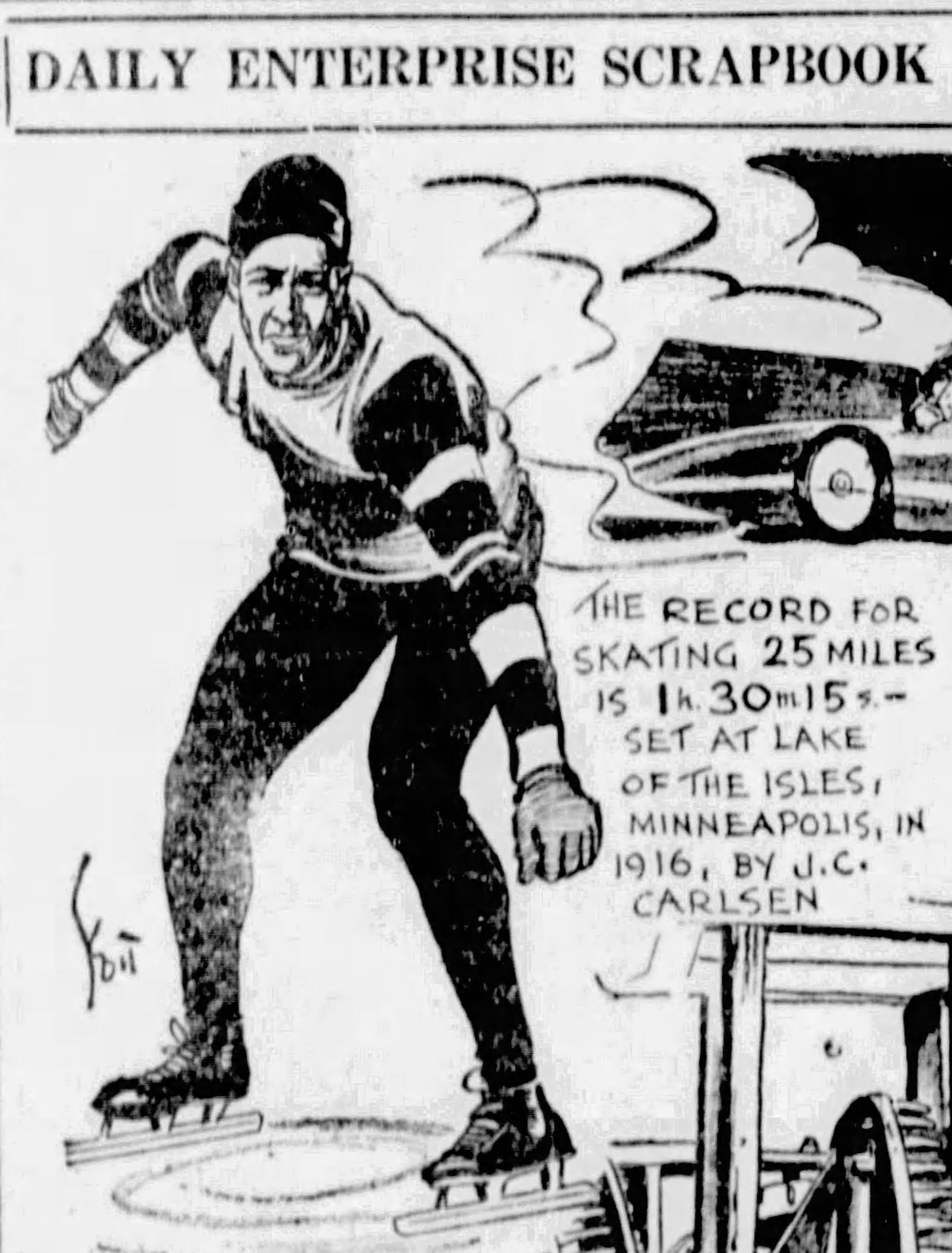
The record, listed as a world record for the distance, was recorded on February 6, 1916 on a quarter-mile skating oval on Lake of the Isles. The man who set that record was John Karlsen, a 41-year-old resident of Minneapolis, who also claimed the world records for distances of 20 miles, 52 miles and 100 miles set at races in Duluth, Winnipeg and Minneapolis respectively.
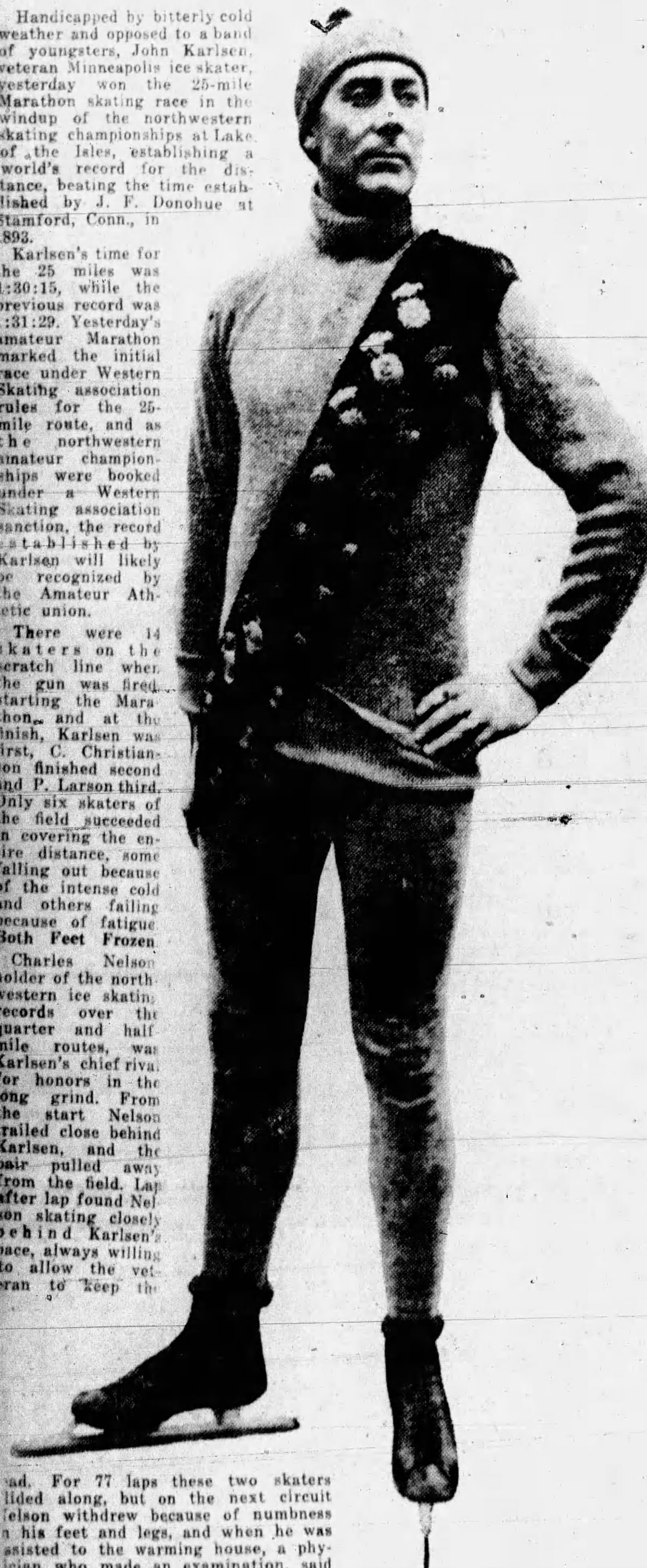
Karlsen set his record on a frigid Sunday afternoon. Temperature at race time was barely above zero but dropped to -9 that night. The wind was gusting up to 26 miles an hour, which made a world record, even at a seldom-skated distance, that much more impressive. Karlsen’s closest pursuer for much of the race withdrew at just under the twenty-mile mark with severely frostbitten feet.
Karlsen had come out of a five-year retirement the day before when he entered a three-mile race as part of a two-day competition sanctioned by the Western Skating Association. In that race he was still lacing up his skates when he was informed the race had just started. He threw off his coat, jumped onto the ice and raced to catch the pack of skaters already half a lap ahead. American speed skating then featured pack races, instead of individual time trials which was the European standard. Karlsen caught the pack within a few laps and won the race easily. He then lost the five-mile race by three feet.
Karlsen was one of three Minneapolis skaters who together held half of the world’s 32 records at various mile-related distances. (European competitions were measured in meters, not miles or fractions thereof, but some of the top European skaters did race at mile distances in the U.S.) In the late 1800s John S. Johnson, of Minneapolis was one of the world’s fastest skaters at distances from one to ten miles and he also held speed records on a bicycle! He was succeeded in the early 1900s by John Nilson who skated to world records at two, three, and four miles.
But it was John Karlsen who was the champion marathon skater. And he was remembered for it, even in Oklahoma 20 years after breaking the world 25-mile record on a freezing Sunday afternoon on Lake of the Isles.
The skaters from across the northwest were not the only racers on Lake of the Isles ice that winter. There were horse races — trotters — on Saturday afternoons on a half-mile track on the other side of the lake.
Speedskaters continued to compete at Isles until 1929 when the first speedskating oval was created at Powderhorn Lake. That racetrack soon became the premier speedskating venue in the United States and produced many of the United States’ Olympic speedskaters after World War II through the 1950s.
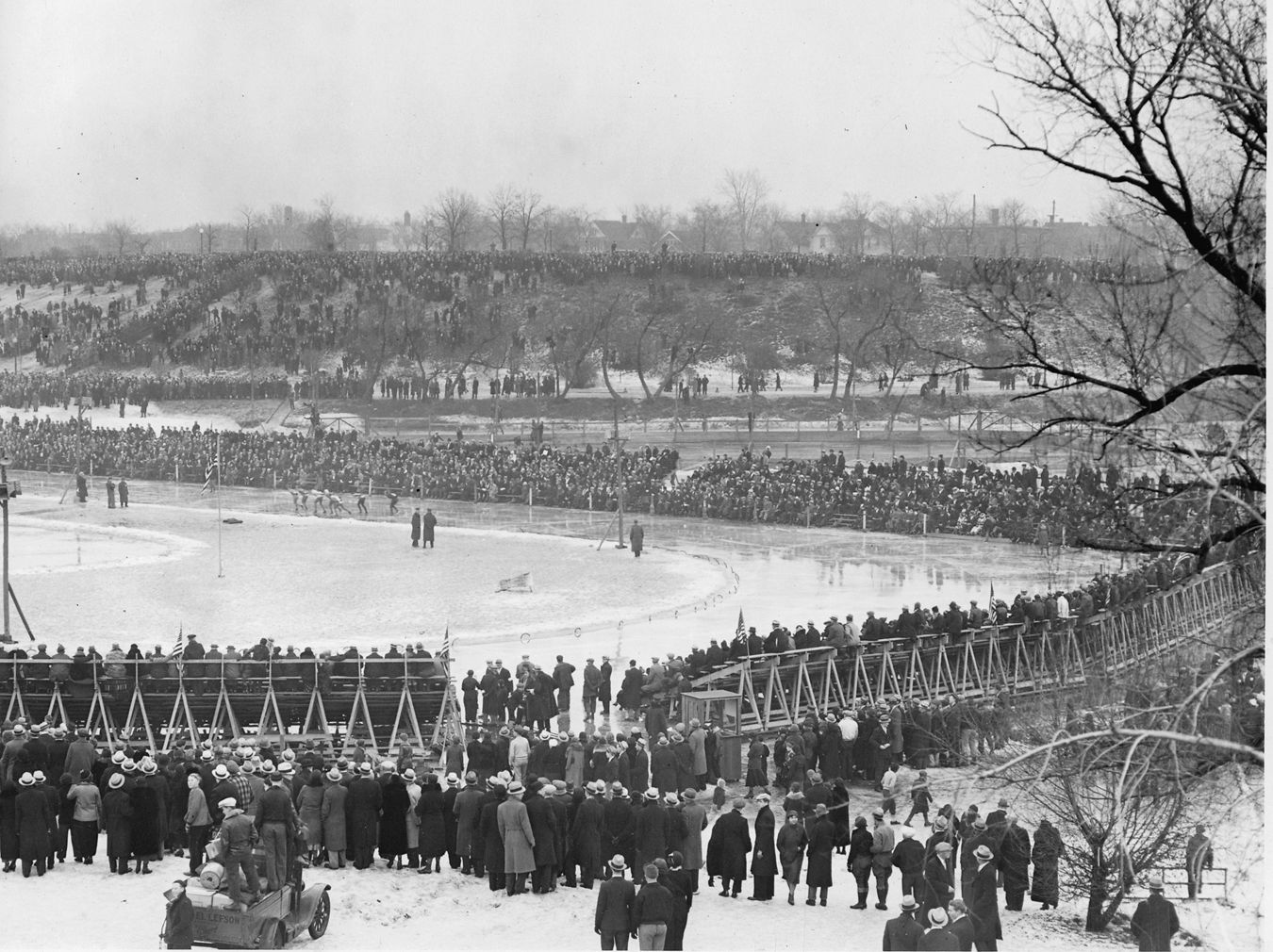
For a more complete history of speedskating in Minnesota, see “Aces of Ice” in Twin Cities Sports: Games for All Seasons from The University of Arkansas Press.
David Carpentier Smith

 Minneapolis Park History
Leave a comment