Archive for the ‘John Werket’ Tag
CIDNA Presentation and Minneapolis Winter Olympics Nuggets
Filed under: Minneapolis Parks: General | Tags: Augsburg Hockey, Cedar Lake, CIDNA, John Werket, Minneapolis Olympic BIds, Winter Olympics
 Leave a comment
 You’re all invited to my next public presentation Sunday, February 25, 3:00 p.m. at Jones-Harrison Residence, 3700 Cedar Lake Avenue. My talk, which I’ve entitled “Linking Shrinking Lakes, a Deadly Railroad Crossing, and the Northwest Passage: CIDNA’s Rich Park History” is part of the CIDNA Speaker Series. CIDNA is the Cedar-Isles-Dean Neighborhood Association, which encompasses parts of Cedar Lake, Lake of the Isles and Lake Calhoun. It’s free and open to anyone, not only CIDNA residents.
I’ll talk mostly about the history of parks in that neighborhood, but as always I would be happy to entertain questions about park history throughout the city.
To relieve any apprehension of controversy and fisticuffs, my reference to a “deadly railroad crossing” has nothing to do with SWLRT, but rather goes back about 10 park superintendents. Perhaps you’ve heard of the “missing link” in the Grand Rounds parkway system. Historically that refers to the gap in the Grand Rounds from St. Anthony Parkway (and Stinson Boulevard at one time) in Northeast Minneapolis through the U of M campus back to East River Parkway. But there was once, technically, another gap in Minneapolis parkways right in the middle of the CIDNA neighborhood.
Winter Olympics and Minneapolis
To elevate this post above crass self-promotion, I’m including some wildly entertaining and illuminating Minneapolis historical info that relates to the Olympic games which many of us are watching this week.
The trials for the U.S. Ski Team for the 1924 Winter Olympics were held in Minneapolis. The ski jump at what was then Glenwood, now Theodore Wirth, Park was one of the best in the country. Olympic skiing did not include any Alpine events then. Skiing meant “ski-running” — cross country — or ski-jumping, the traditional Nordic events. (Alpine events, such as downhill and slalom, weren’t included in the Olympics until 1936.) Based on the success of the ski trials here in 1924, park superintendent Theodore Wirth speculated that Minneapolis would host the 1928 or 1932 Winter Olympics. Also based partly on that success, Minneapolis Mayor George Leach, an avid sportsman, was named the manager of the U.S. Ski Team for the 1924 Olympics in Chamonix. Mayor Leach was later the man who formally applied to the International Olympic Committee (IOC) for Minneapolis to host the 1932 winter games. Instead, Lake Placid was chosen to host the Games that year. In those days the nation that hosted the Summer Olympics was also given the first chance to host the Winter Games. Because Los Angeles was hosting the 1932 Summer Olympics, the Winter Games were expected to be held in the U.S. too. Seven American cities officially applied to host the 1932 Winter Games, including Duluth and Minneapolis.
Please, Please Come!
That was far from the last time that Minneapolis put in a bid to host the Olympics. Minneapolis mounted serious efforts to host the Summer Games in 1948, 1952 and 1956. (When downhill ski events and more sledding events were added to the Olympic agenda, and ski-jumping techniques outgrew our hills, we flatlanders had no more chance to host the Winter Olympics.) Minneapolis came close in 1952, finishing tied for second — with LA — behind Helsinki in IOC voting to host the Summer Olympics. The effort to win the 1952 games was complicated by bids from Detroit, Chicago and Philadelphia in addition to Minneapolis and Los Angeles. IOC representatives from the rest of the world were a bit puzzled and not impressed by the infighting among American cities to host the games.
Another major effort was made in 1988 to host the 1996 Summer Olympics. By that time the U.S. Olympic Committee would approve only one American bid for consideration by the IOC and the USOC chose Atlanta’s bid over Minneapolis’s. To the surprise of many, Atlanta’s bid won that year over the bid by Athens to host the centennial of the modern revival of the Olympic Games where they had begun.
Think how much more impressed the world would be by Minneapolis if visitors saw our summers instead of only our Super Bowl and Final Four winters!
Didn’t MacArthur Like Lutherans?
1928 was a cruel year for some Minneapolis Lutherans. When the American amateur hockey establishment was looking for a hockey team to represent the U.S. at the Olympics in St. Moritz four teams emerged as favorites: Eveleth Junior College, University of Minnesota, Harvard and Augsburg. For various reasons three of the teams withdrew from consideration, mostly due to the long time scholar-athletes would be away from classes and the travel expense. The U of M administration determined that Olympic play was outside the scope of interscholastic sports and withdrew the Gopher hockey team from consideration. Olympic athletes or their home towns were expected to pay most of the expenses of competing. The only team that agreed to play — and pay — was Augsburg and the team was duly named by the amateur hockey authorities to represent the U.S. in St. Moritz. Augsburg was coming off a championship season in the first official season of hockey competition in the Minnesota Intercollegiate Athletic Conference.
A fund drive was launched in Minneapolis to raise $4,500 to underwrite the Auggie’s expenses. After $2,000 had been raised, S.O. Severson, former athletic director at Augsburg and then principal of Franklin Junior High School in Minneapolis, pledged to cover any of the remaining amount. Augsburg was in!
Except the U.S. Olympic Committee and its president, Douglas MacArthur, had other ideas. When MacArthur looked at the Augsburg team he saw something he didn’t like and he declared that Augsburg would not go to the Olympics as the U.S. team. Augsburg’s hockey team, he declared, was not representative of American hockey. Perhaps this was the catch: Augsburg’s five starting skaters were the Hanson brothers and while the Hansons were Americans they had grown up partly in Canada. The U.S. was not represented in hockey at the 1928 Olympics by Augsburg — five Hansons and a goalie — or anyone else.
Of the 11 countries that did enter hockey teams in the 1928 Games, 10 were divided into three pools for round-robin play. The three winners of those groups were joined by Canada in a final round-robin tourney. Canada’s extraordinary bye into the final group was apparently well-deserved because in their three games in the medal round the Canadian team, the University of Toronto Grads, won by an average score of 13-0 to claim the gold medal.
Imagine this: Just prior to the Olympics, the body that governed international hockey allowed several rule changes proposed by the Canadian association. But the international authorities declined to approve two changes: defenseman still would not be allowed to kick the puck in the defensive end and goalies would not be permitted to drop to their knees to stop the puck. Imagine if goaltenders today had to stay on their skates to make a save. What a different game it would be.
There are so many more stories involving Minneapolis and the Winter Olympics that I hope to tell one day. Nearly all involve ski jumping and speed skating, but Minneapolis also had some notable figure or “fancy” skaters and cross-country skiers.
Our compatriots have not performed well in the more military-oriented Olympic shooting events. Odd isn’t it that a country like ours with such an entrenched history of gun ownership doesn’t perform better in shooting events in both Winter and Summer Games? The overlay of the Parkland school shooting last week with various shooting and skiing competitions in the South Korean snow was striking. The U.S. has more guns and more shooters, but apparently fewer marksmen and women than other countries.
Epilogue: An Augsburg athlete finally made it to the Winter Olympics 20 years after the hockey team was denied its chance. John Werket, an Augsburg student, made the U.S. Olympic speed skating team in 1948 and, after he graduated, again in 1952 and 1956. Werket also qualified for the 1960 games but withdrew because he said he couldn’t afford to take two months off work to train and compete. While Werket’s best Olympic finish was a sixth place in 1948, he won several medals in world championships from 1948 to 1952.
U of M Hockey and Minneapolis Parks
One more hockey story. The University of Minnesota made an effort to put a varsity hockey team on the ice in 1903, but hockey history really begins at the U in 1921 when varsity hockey got its true start. However — in 1914 the regents awarded $25 to a group of students that wanted to form a hockey team, although it wasn’t given varsity status. The elated student hockey promoters immediately announced their first hockey team tryouts would be held at the nearest hockey rink — in Van Cleve Park.
I hope to see you Sunday afternoon.
David C. Smith
A premier speed skating track in a Minneapolis park
Filed under: Powderhorn Park, Winter Sports | Tags: Gene Sandvig, John Werket, Ken Bartholomew, Minneapolis parks, Powderhorn Park, Speed Skating
Comments (15) A scrapbook of newspaper clippings about speed skating from 1953 to 1956 was recently given to Dave Garmany the recreation coordinator at Powderhorn Park in Minneapolis. The scrapbook features articles on the speed skating scene in Minneapolis, the U.S. and the world in those years and includes several articles from Norwegian newspapers.
In addition to the newspaper clips were several programs from international speed skating events at the Powderhorn Park speed skating track, such as this one in 1953.

A cropped version of the cover photo, showing a massive crowd at a 1930s event at Powderhorn Park—likely the national championships in 1934, which were reportedly attended by 50,000 in two days—is in the collection of the Minnesota Historical Society.
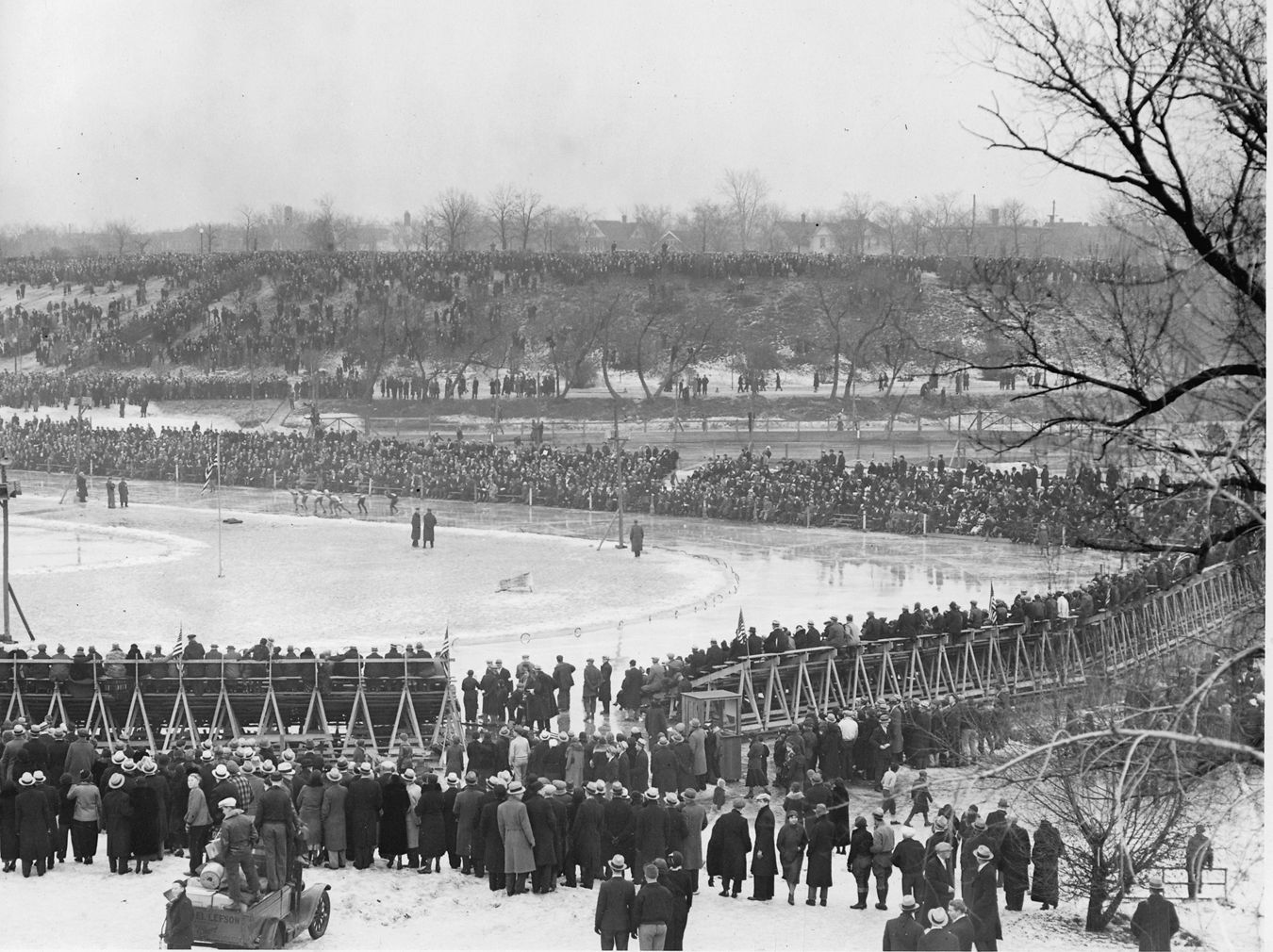
Huge crowds attended the National Speed Skating Championships held at Powderhorn Park in the 1930s and 1940s. (Minnesota Historical Society)
Most of the clips in the scrapbook were about the rivalry between Minneapolis skaters Ken Bartholomew and Gene Sandvig. Bartholomew won 14 National Outdoor Championships from 1939-1960. Sandvig was often runner-up in the 1950s after he had gotten out of the Army and enrolled at Gustavus Adolphus College. Bartholomew was a silver medalist for the U.S. in the Winter Olympics at St. Moritz in 1948. Sandvig skated for the U. S. in the 1952 Winter Games in Oslo and the 1956 Games at Cortina d’Ampezzo.

Planert skates were advertised in the 1953 speed skating program pictured above. The skates were not cheap. The list price for a pair of Planert’s “Olympic Model” skates in a 1955 ad was $60.
The skater featured in Planert’s ad, Leo Friesinger, was the bronze medalist for the U.S. in the 500 meters at the 1936 Olympics in Garmisch-Partenkirchen, Germany. Friesinger was from Chicago, which was also home to Planert.
Among other bits of info that caught my eye in news clips from Minneapolis Star and Minneapolis Tribune.
- Minneapolis high school athletic director Giffy O’Dell hopes to bring back speed skating as a regular sport in the Minneapolis high school sports program. January, 1954. (I never knew it ever had been part of that program.)
- Top Minneapolis skaters Ken Bartholomew and Gene Sandvig will not be challenged locally by two other elite Minneapolis skaters. Pat McNamara will return to Norway or will train in Japan. Johnny Werket is considering spending the winter in Japan. January, 1954.
- Werket and McNamara have created a new practice track early in the season on Augusta Lake in Mendota. They do not train at Powderhorn Lake. They prefer the European style of speed skating used in the Olympics. The European track is 400 meters compared to the standard American track (including the Powderhorn track) of 293 yards, four laps to a mile instead of six. Also in European skating all competitors race against the clock instead of against other skaters in a pack. (American-style speed skating at the time was in between the long-track and short-track skating in today’s Olympics. The Winter Olympics tried the North American pack-style of speed skating at the 1932 games in Lake Placid, New York. Canada and the U.S. won 10 of 12 medals skating that way. The 1936 games in Germany reverted to European-style racing against the clock — and Norway and Finland won 10 of the 12 medals. Pack speed skating returned to the Olympics as a separate demonstration sport, short track skating, in 1988 at Calgary and became a regular Olympic event in 1992 at Albertville.)
- Ken Bartholomew was a 14-time U.S. champion, but he skated for the U.S. Olympic team only once, winning a silver medal in 1948 at St. Moritz. He did not make the Olympic team again despite dominating the National Outdoor Championships for years. Werket was on the U. S. Olympic team in 1948, 1952 and 1956. McNamara skated in the Olympics for the U.S. in 1952 and 1956. Their greater success in making Olympic teams may have been partially due to training in the Olympic style of racing—although Gene Sandvig also made the Olympic team in 1952 and 1956. All three were also much younger than Bartholomew. A commentary in the Minneapolis Tribune after the Winter Games in Cortina d’Ampezzo in 1956 had this to say about the different styles: “The U.S. should adopt the Olympic system of competition—that is, a competition against time. True, it’s pretty dull for young Americans, as well as the few spectators who turn out. They (presumably young Americans and spectators) love the free-for-all scramble with all of its pushing, tugging, elbowing and the like such as popped up in the Nationals at Como over the weekend.” (The reference was to the races at Lake Como in St. Paul won by Bartholomew, in which Bartholomew and another skater got into a fight after the other accused Bartholomew of knocking him down. Bartholomew was obviously a racer, a strategist, not a time-trial expert that the Olympic style required. In other words, he was more Apolo Anton Ohno than Shani Davis, Eric Heiden or Dan Jansen.)
- One reason the Tribune advocated changing American racing to the Olympic style: the Russians had started to dominate international speed skating. It had begun with a surprise victory by the Russians at the world championships in Sapporo, Japan in 1954. The U.S. had failed to send a team. The U.S. State Department had declined to pay the travel costs of John Werket, Pat McNamara and a third skater from Chicago, Ken Henry, who was an Olympic gold medalist in 1952. The State Department determined that the request for funds was “not meritorious.” (Tribune, January 31, 1954) The Russian victory elicited this comment on the sports page: “The time is at hand when the athletic leaders of the free world had better take Russia’s bid for international supremacy seriously. The Commies proved in the last Olympic Games they have made greater strides in track and field than any other nation in the world. Over the week-end Russia did the unexpected by winning the world’s speed skating championships rather decisively, beating the best Norway and some other Scandinavian countries have to offer.” Russian dominance had grown at the 1956 Winter Games.
- The 1955 world championships were held in Moscow and Johnny Werket was one of three skaters to represent the U.S. after friends raised $700 to pay his expenses. Those three skaters were the first American athletes to compete in Russia after World War II, according to a February, 1955 Tribune article. Werket had high praise for the Russians. “Russians were tops,” said Werket, “as athletes, as hosts and as fans. It would be hard to find a fairer audience anywhere in the world.”
- Nearly all Minneapolis speed skating teams in the 1950s were sponsored by American Legion posts. Wenell, Laidlaw, Bearcat and Falldin posts all sponsored teams.

The 1955-1956 program for the Minnesota Speed Skating Association
Finally this item from the annual program of the Minnesota Speed Skating Association, 1955-1956:
Missing Skater News
- Tom Miller and Colleen Burke (Falldin American Legion Post team) married last June, Tom in U. S. Army, stationed in California
- Gene Sandvig (Bearcat) on Olympic Team
- Tom Hadley (Wenell) concentrating on studies, U of M on Evans Scholarship (Based on scholarship and golf proficiency)
- Janet Koch (Laidlaw) is now Mrs. Vasatka
- David Kahn (Wenell) out with knee injury suffered in football at Roosevelt Hi
- Dennis Boike (Laidlaw) at Nazareth Hall Prep Seminary studying for priesthood
- Tom Romfo (Wenell) recuperating from a bout with polio
For some reason, perhaps the mention of polio, the list seemed so 1950s. Poignant, too.
David C. Smith
© David C. Smith

 Minneapolis Park History