Archive for February, 2011|Monthly archive page
Minneapolis Park History Resources: Maps
Filed under: Minneapolis Park History Resources | Tags: John R. Borchert Map Library, Minneapolis Maps
 Comments (3)
 If you love history, you probably love maps. For students of Minneapolis history, including the history of the park system, two of the most fascinating maps are found at the website of the John R. Borchert Map Library at the University of Minnesota. Have a look at the digitized 1892 Minneapolis plat book and the 1903 Minneapolis plat book. Compare them to the city map at right that Horace Cleveland used to illustrate his “suggestions” for the Minneapolis park system in 1883. Search for your home, park, church, school; see how your neighborhood was created or has changed.
While your at the Borchert Libreary site be sure to investigate the aerial photos. Many excellent images of Minneapolis as it’s grown.
Warning: you could spend hours with these maps and photos. For me, they have the addicting power of video games. But the things you’ll discover! Such as: H. W. S. Cleveland owned a half-block of land in south Minneapolis in 1892. I know! Nobody cares! But it’s endlessly interesting for those curious about their surroundings and the people who created them.
If you have a favorite research tool or resource, let us know. Especially if it’s accessible while in pajamas.
David C. Smith
Lost Minneapolis Parks: Virginia Triangle
Filed under: Lost Minneapolis Parks, Minneapolis Parks: General | Tags: Loring Park, Minneapolis parks, Smith Triangle, The Parade, Thomas Lowry, Virginia Triangle
Comments (3) Can you tell where this photo was taken? The land in the foreground is a lost Minneapolis park: Virginia Triangle.
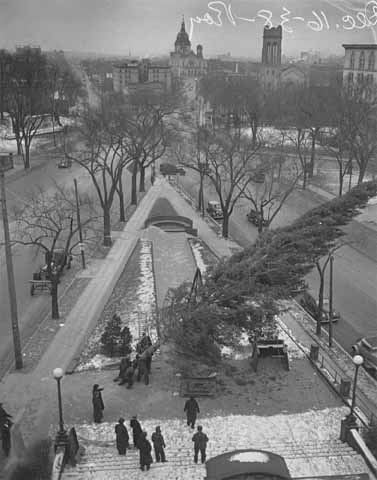
Virginia Triangle 1938 (Minnesota Historical Society)
Virginia Triangle was at the intersection of Hennepin and Lyndale avenues; the cross street is Groveland Avenue. Hennepin crosses left to right and Lyndale right to left. The photographer was facing north. That’s the Basilica straight ahead, St. Mark’s to the right, with the trees in Loring Park between them. To your immediate right (out of the picture) is Hennepin Avenue Methodist Church. On your left, just past the cross street, is Walker Art Center. Beyond that is The Parade, athletic fields when this picture was taken, but now the home of the Sculpture Garden.
Isn’t this view lovely compared to the freeway interchanges, tunnels, etc. of today? The park board put up and decorated a huge Christmas tree in the triangle each year. I don’t know when that practice began or ended, but I’ll try to find out. If you know, send me a note.
An important memorial was installed at Virginia Triangle in 1915. The park board did not pay for the memorial but agreed that it could be placed in the park triangle. Whose memorial was it? This photo was taken at the dedication. ( That’s Hennepin Methodist church across Lyndale Avenue in the background, Hennepin Avenue in foreground.)
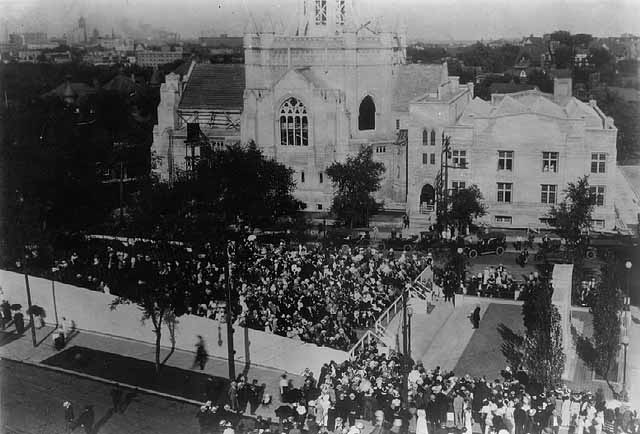
Virginia Triangle in 1915
He had something to do with urban transit and his mansion was immediately to the left of the photographer when this picture was taken. An avenue in north Minneapolis is named for him. He donated part of the land for The Parade and paid to have it developed into a park.
Here is his statue as part of the memorial that was put on the triangle.
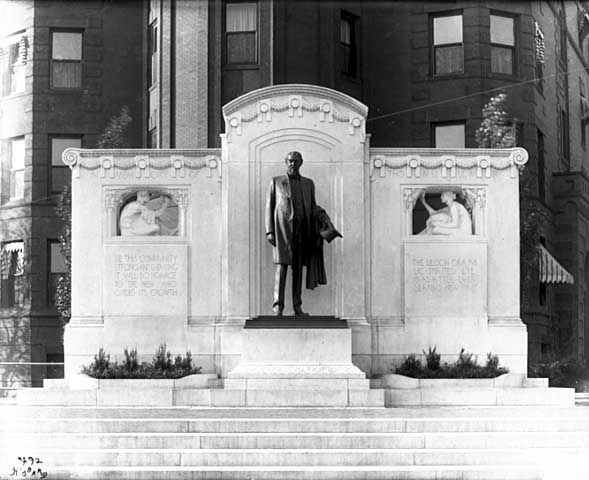
Virginia Triangle Memorial (Charles Hibbard, Minnesota Historical Society)
This is what Rev. Dr. Marion Shutter said when he spoke to the crowd gathered at the dedication above:
How grandly has the sculptor done his work! This heroic figure needs no emblazoned name to identify the original. It seems almost as if Karl Bitter (the sculptor) had stood by the door of that little Greek temple at Lakewood (cemetery), and had said: ‘Thomas Lowry, come forth.’
Virginia Triangle was acquired by the Minneapolis park board on the first day of the last century. A.W. French and his wife donated the property to the park board in a swap. The Frenches had originally donated a piece of land for Hennepin Avenue Parkway, but apparently wanted that piece back and offered what became Virginia Triangle instead. The park board accepted on January 1, 1900. The best guess is that the name of the triangle comes from “Virginia Flats,” the apartment building behind the memorial in the photo above according to a 1903 plat map.
Thomas Lowry was joined on the triangle by another statue for a time during the summer of 1931. The Knights Templar held their conclave in Minneapolis that year and requested permission to erect life-sized statues of knights on horses throughout the city. The request was approved by the park board on the condition that all park properties be returned to their original condition without cost to the park board at the conclusion of the conclave.

Knights Templar statue at The Gateway, 1931 (Minnesota Historical Society)
The statue at Virginia Triangle was probably similar to this one placed at The Gateway during the conclave. Other statues were placed at The Parade and Lyndale Park.
Virginia Triangle was eventually lost to freeway construction when I-94 was built through the city. With freeway entrances and exits needed for Hennepin and Lyndale, the triangle had to be removed even though the freeway itself was put underground below Lowry Hill and Virginia Triangle.
The state highway department paid the park board $24,300 for the triangle in 1966, plus the actual cost of relocating the Lowry Memorial. The park board chose another triangle about a half-mile south on Hennepin Avenue at 24th Street as the new site for Thomas Lowry. The low bid for moving the memorial to the new site at Smith Triangle in 1967 was $38,880.
The inscription on Lowry’s memorial reads:
Be this community strong and enduring — it will do homage to the men who guided its youth.
David C. Smith
© David C. Smith
Elusive Minneapolis Ski Jumps: Keegan’s Lake, Mount Pilgrim and Glenwood (Theodore Wirth) Park
Filed under: Minneapolis parks, Winter Sports | Tags: Bryn Mawr, Glenwood Park, Ski Jumps, Skiing, Theodore Wirth Park
Comments (35) The Norwegians of Minneapolis had greater success getting their music recognized in a Minneapolis park than they did their sport. A statue of violinist and composer Ole Bull was erected in Loring Park in 1897.
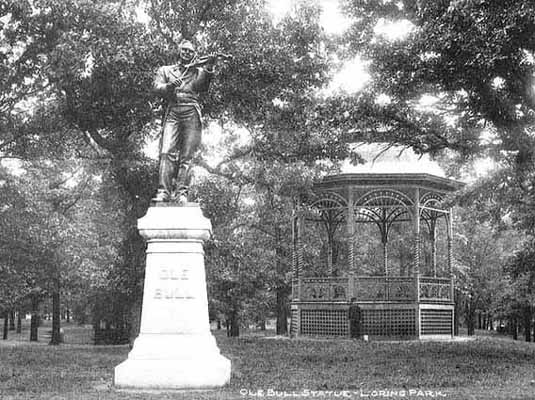
This statue of Norwegian violinist and composer Ole Bull was placed in Loring Park in 1897, shown here about 1900 (Minnesota Historical Society)
A ski jump was located in a Minneapolis park only when the park board expanded Glenwood (Theodore Wirth) Park in 1909 by buying the land on which a ski jump had already been built by a private skiing club. The photo and caption below are as they appear in the annual report of the Minneapolis Board of Park Commissioners for 1911.* While the park board included these photos in its annual report, they are a bit misleading. Park board records indicate that it didn’t really begin to support skiing in parks until 1920 — 35 years after the first ski clubs were created in the city.

Minneapolis, the American city with the largest population of Scandinavians, was not a leader in adopting or promoting the ski running and ski jumping that originated in that part of the world. Skiing had been around for millenia, but it had been transformed into sport only in the mid-1800s, around the time Minneapolis was founded. Ski competitions then included only cross-country skiing, often called ski running, and ski jumping — the Nordic combined of today’s Winter Olympics. Alpine or downhill skiing didn’t become a sport until the 1900s. Even the first Winter Olympics at Chamonix, France in 1924 included only Nordic events and — duh! — Norway won 11 of 12 gold medals.
The first mention of skiing in Minneapolis I can find is a brief article in the Minneapolis Tribune of February 4, 1886 about a Minneapolis Ski Club, which, the paper claimed, had been organized by “Christian Ilstrup two years ago.” That article said the club “is still flourishing.” Eight days later the Tribune noted that the Scandinavian Turn and Ski Club was holding its final meeting of the year. The two clubs may have been the same.
Ilstrup was one of the organizers two years later of one of the first skiing competitions recorded in Minneapolis, which was described by the Tribune, January 29, 1888, in glowing and self-congratulatory terms.
Tomorrow will witness the greatest ski contest that ever took place in this country. For several years our Norwegian cultivators of the noble ski-sport have worked assiduously to introduce their favorite sport in this country, but their efforts although crowned with success, did not experience a real boom until the Tribune interested itself in the matter and gave the boys a lift.
The Tribune mentioned the participation in the competition of the Norwegian Turn and Ski Club, “Vikings club” and “Der Norske Twin Forening.” The Tribune estimated that 3,000 spectators watched the competition held on the back of Kenwood Hill facing the St. Louis Railroad yard. Every tree had a dozen or so men and boys clinging to the branches, while others found that perches on freight cars in the rail yard provided the best vantage point.

The caption for this photo from the Minnesota Historical Society Visual Resource Database claims the photo is from the winter of 1887, but was almost certainly taken at the ski tournament held on Kenwood Hill late that winter in February, 1888.
The competition consisted of skiers taking turns speeding downhill and soaring off a jump or “bump” made of snow on the hill. Points were awarded for distance and for style points from judges.
The winners of the competition were reported as M. Himmelsvedt, St. Croix Falls, whose best jump was 72 feet, and 14-year-old crowd favorite Oscar Arntson, Red Wing, who didn’t jump nearly as far, but jumped three times without falling. Red Wing was a hot bed of ski-jumping, along with Duluth and towns on the Iron Range. (The winner was perhaps Mikkjel Hemmestveit, who along with his brother, Torger, came from Norway to manufacture skis using highly desirable U.S. hickory. The Hemmestveit brothers are usually associated with Red Wing skiing, however, not St. Croix Falls.)
A Rocky Start
Despite the enthusiasm of the Tribune and the crowds, skiing then disappeared from the pages of the Tribune until 1891, when on March 2, the paper reported on a gathering of thirty members of the Minneapolis Ski Club at Prospect (Farview) Park. “This form of amusement is as distinctively Scandinavian as lutefisk, groet, kringles and shingle bread,” the Tribune reported. “With skis on his feet a man can skim swiftly over the soft snow in level places, and when a slope is convenient the sport resembles coasting in a wildly exhilarating and exciting form,” the report continued. The article also described the practice of building snow jumps on the hill, noting that “one or two of the contestants were skilful enough to retain their equilibrium on reaching terra firma again, and slid on to the end of the course, arousing the wildest enthusiasm.”
The enthusiasm didn’t last once again. The Tribune’s next coverage of skiing appeared nearly eight years later — but it came with an explanation:
During recent winters snow has been a rather scarce article. A few flakes, now and then, have made strenuous efforts to organize a storm, but generally the effort has proven a failure. The heavy snow of yesterday was so unusual that it is hardly to be wondered at that there arose in the breasts of local descendants of the Viking race a longing for the old national pastime, skiing…The sport of skiing was fostered to a considerable extent in the Northwest, and particularly in this city, a few years ago, but the snow famine of late winters put a damper on it.
— Minneapolis Tribune, November 11, 1898
The paper further reported that the “storm of yesterday had a revivifying effect upon the number of enthusiasts” and that the persistent Christian Ilstrup of the Minneapolis Ski Club was arranging a skiing outing on the hills near the “Washburn home” (presumably the orphanage at 50th and Nicollet). The paper also reported that while promoters of the club were Norwegian-Americans, “they do not propose to be clannish in the matter.”
Within a week of that first friendly ski, Continue reading

 Minneapolis Park History