Archive for March, 2011|Monthly archive page
Minneapolis Park Hero: Maude Armatage
Filed under: Minneapolis Park Hero, Minneapolis parks | Tags: Armatage Park, Maude Armatage
 Leave a comment
 Dan Greenwood recently produced a report on KFAI radio about Maude Armatage, the first woman on the Minneapolis Board of Park Commissioners. Armatage, for whom a park and school in south Minneapolis are named, served on the park board from 1921 until 1951, the longest continuous service on the board in its history. (Francis Gross, nicknamed “Mr. Park Board,” served more years, but his service was divided into several terms.) I appreciated the opportunity to tell Dan and his listeners some of what I know about this extraordinary public servant. She is also the namesake of Cafe Maude, a popular cafe near the park and school on Penn Avenue South.
I hope to write more about Armatage and her role on the park board in the near future. Until then, read this very informative article by Caitlin Pine, which originally appeared in the Southwest Journal in 2003, I believe, and has since been reprinted.
David C. Smith
Minneapolis Park History Resources: Hathitrust
Filed under: Minneapolis Park History Resources, Minneapolis Parks: General | Tags: Hathitrust.org, Warren Manning, William Watts Folwell
Comments (2) If you’re researching early Minneapolis history, particularly parks, you absolutely must know about this resource: hathitrust.org.
HathiTrust is a digital library that has millions of books from university and public libraries. Most of the books are no longer copyrighted so they are in the public domain. (This includes most books published before 1923.)
What is most useful is that the volumes are searchable. Fortunately the annual reports and the proceedings of the Minneapolis Board of Park Commissioners were widely sought after nationally and widely distributed. In old park board files, there are many cards and letters from individuals and institutions around the country requesting copies of the annual reports. Hathitrust has scanned most years of the park board’s annual reports and some proceedings up to 1923 either from the collections of the New York Public Library or the University of Michigan. The University of Minnesota also participates in Hathitrust.
“No other city gets out such artistic and complete records of its park work as does Minneapolis.”
Warren Manning’s magazine, Billerica (“The Fugitive Literature of the Landscape Art,” Vol. IV, March 1916, No. 10, Part 2), singled out the annual reports of the Minneapolis Board of Park Commissioners for praise. The article particularly recommended the Fourteenth (1896) and Eighteenth (1900) annual reports, which were “notable for their illustrations.”
Both reports were produced while William Watts Folwell was president of the park board. As a historian Folwell understood well the value of documenting the efforts of an organization such as the park board.
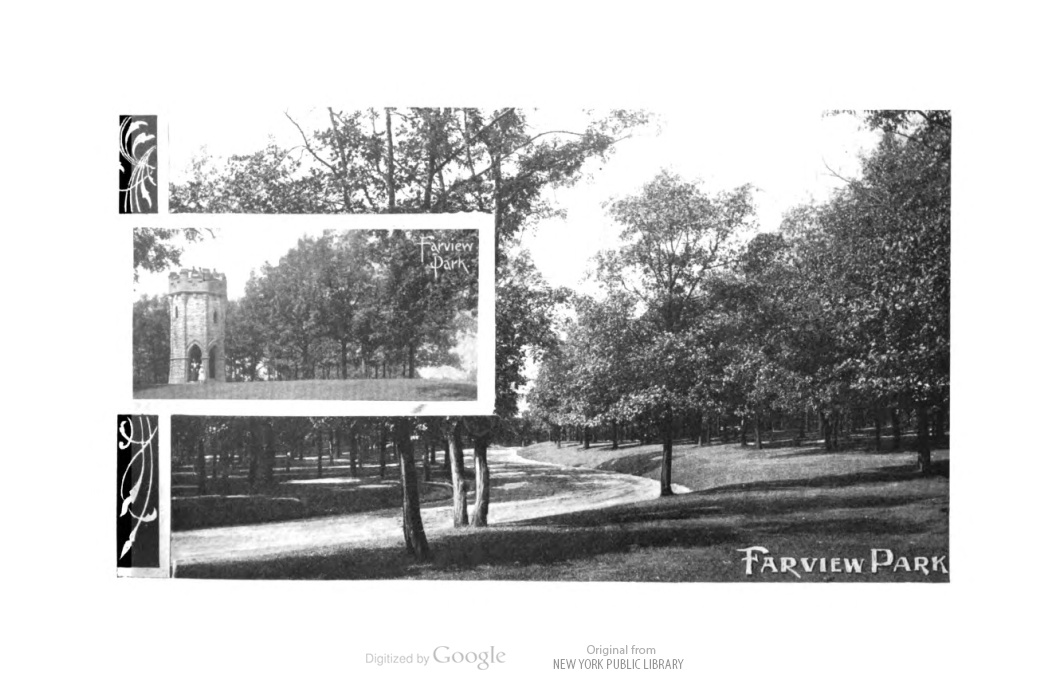
An illustration from the 1896 annual report praised by Manning
HathiTrust also allows you to create an account and establish your own “collections” from its vast catalog. It’s easy to set up a guest account. Here’s what I did: I put all available issues of the park board’s annual reports and proceedings, as well as most of the early books about Minneapolis history, such as Isaac Atwater’s and Horace Hudson’s histories, into a single “collection.” I can then search the collection for any terms I want. That means I can search for Lake Harriet or Powderhorn Park and find every reference to those park properties in park board documents—and other books—over many years. Such a capability saves hours of research because the park board annual reports and proceedings in the early years did not have indexes.
Annual reports are not available for some years in the Minneapolis park board’s first decade, but all annual reports 1895-1922 are available. HathiTrust also has many issues of the Minneapolis City Council proceedings, which provides for another layer of research. HathiTrust has also scanned many park board annual reports from 1923-1960. Due to copyright restrictions the full text of those reports is not available online, but a search will reveal if and how often terms do appear in those volumes. Not as helpful as full-view text searches, but still a big time-saver. You can then go straight to the pages you want in a library.
Give hathitrust.org a try. You’ll be amazed at what you’ll be able to find. The digitization for HathiTrust was done by Google, but the collection is far more extensive than what is available at Google Books.
David C. Smith
Keep Your Thomas Lowrys Straight
Filed under: Lost Minneapolis Parks, Minneapolis parks | Tags: Audubon Park, Douglas Triangle, Fremont Triangle, Lowry Place, Mt. Curve Triangle, Phelps Wyman, Seven Pools, Smith Triangle, Thomas Lowry, Thomas Lowry Park, Virginia Triangle
Comments (4) Just to be clear: the Thomas Lowry Memorial is not in Thomas Lowry Park. Neither is it in Lowry Place. (See February 25 post: Lost Minneapolis Parks: Virginia Triangle.)
The Thomas Lowry Memorial, with his statue, was originally erected in 1915 on Virginia Triangle across Hennepin Avenue and a bit south from Thomas Lowry’s mansion on Lowry Hill. Thomas Lowry’s mansion was eventually purchased by Thomas Walker who then created the Walker Art Center on the site.
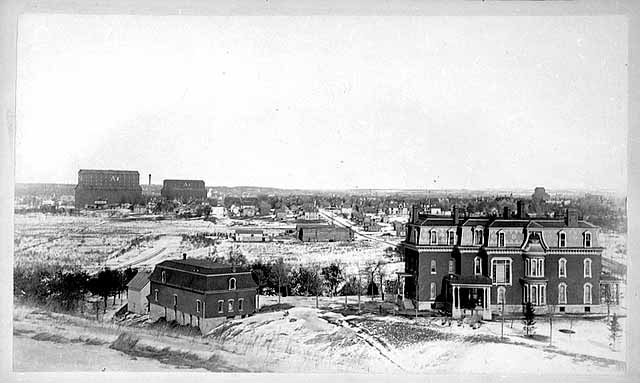
Thomas Lowry’s home in 1886 looking north over what is now The Parade and the Sculpture Garden. (Minnesota Historical Society)
When Virginia Triangle was erased in 1967 by freeway plans, Thomas Lowry’s statue was not moved to Thomas Lowry Park, because it didn’t exist yet, at least by that name. And it wasn’t moved to Lowry Place, also called Lowry Triangle, another lost park property, because it had already ceased to exist. Virginia Triangle was where northbound Lyndale and Hennepin avenues met at Groveland; Lowry Place was where they parted again at Vineland and Oak Grove.

Lowry Triangle is on the immediate left as you look north on Hennepin Avenue toward the Basilica. Oak Grove Street and Loring Park are on the right. Vineland Avenue, leading to the Walker Art Center, is on the left. Virginia Triangle and Thomas Lowry’s Memorial are directly behind you in 1956. (Norton and Peel, Minnesota Historical Society)
Lowry Triangle, officially named Lowry Place on May 15, 1893, was acquired by the park board from the city in 1892. The park board asked the city to hand over the triangle on November 2, 1891. It was slightly smaller than Virginia Triangle to the south. Lowry Place was at one time intended to be the home of the statue of Ole Bull that in 1897 ended up in Loring Park. Park board president William Folwell wrote to Thomas Lowry to ask if he objected to Ole Bull’s statue being placed across Lyndale Avenue from Lowry’s house on a park property that bore his name. Lowry replied that he appreciated the courtesy of being asked and had no objection. I don’t know why the statue was then placed in Loring Park instead. If you do, please tell. That’s not all I don’t know: I also don’t know why Lowry’s memorial was placed originally on Virginia Triangle instead of Lowry Triangle.
By the time the Lowry Memorial had to be moved in 1967 it was too late to shift it to the Lowry Triangle; that little patch of ground (0.16 acres) had already been acquired by the State of Minnesota in 1964 in anticipation of reconfiguring streets for the construction of I-94.
Moving the memorial to Thomas Lowry Park wasn’t an option then because at that time what is now Thomas Lowry Park at Douglas Avenue, Bryant and Mt. Curve was named Mt. Curve Triangles. That isn’t a typo, it was officially named Mt. Curve Triangles, plural, in November 1925 when its name was changed from Douglas Triangle. That was perhaps done to distinguish it from Mt. Curve Triangle, singular, which had been the name of a tiny street triangle at Fremont and Mt. Curve since 1896. That triangle was renamed Fremont Triangle in 1925, when the Mt. Curve name was shifted a few blocks east to Douglas Triangle. Mt. Curve Triangles was nearly 1.5 acres while Fremont Triangle was only .02 acre.

Thomas Lowry Park in 1925 when it was still Douglas Triangle, before it became Mt. Curve Triangles. You can find other images of the property at the Minnesota Historical Society’s Visual Resources Database, but only if you search for Douglas Triangle or Mt. Curve Triangle, not Thomas Lowry Park. (Hibbard Studio, Minnesota Historical Society)
To confuse matters, the popular name for the property was neither Douglas Triangle, nor Mt. Curve Triangles, nor Thomas Lowry Park, but “Seven Pools” after the number of artificial pools designed for the park by park commissioner and landscape architect Phelps Wyman in 1923.
Thomas Lowry and his name had nothing to do with Mt. Curve Triangles, other than the fact it was located on Lowry Hill near his old mansion, until residents in the neighborhood campaigned to have the park renamed for Lowry in 1984. (Lowry did ask the park board to improve and maintain the land in 1899, but his request was refused because the park board didn’t own the land then. It didn’t purchase the land until 1923.)
Given that there was no other place named Lowry to put the memorial to Thomas Lowry the park board chose Smith Triangle at Hennepin and 24th. That’s where it still is. The only connection between Smith and Lowry is that they probably knew each other.
Of course neither the Lowry Memorial nor Lowry Park are anywhere near Lowry Avenue, which is miles away in north and northeast Minneapolis. Lowry Avenue is much closer to the former site in Northeast Minneapolis of the Lowry School, which no longer exists either. Lowry School figured prominently in plans for Audubon Park in the 1910s. When Lowry School was built in 1915, Buchanan Street between the school and Audubon Park was vacated with the idea that the park would serve as the playground for the school.

Thomas Lowry School in 1916 showing Buchanan Street vacated between the school and Audubon Park at left. (Minneapolis Public Schools)
Those plans were never formalized. While the park provided space, it didn’t provide play facilities. Playground facilities weren’t developed at Audubon Park until the late 1950s. By that time Lowry School was already outdated and destined for closure. (For more photos of Lowry School click here.)
You can learn more about all of these park properties and how they were acquired, developed and named at the web site of the Minneapolis Park and Recreation Board.
David C. Smith
© David C. Smith
Lost Minneapolis Parks: Rauen Triangle
Filed under: Lost Minneapolis Parks, Minneapolis Parks: General | Tags: Horace Cleveland, Rauen Triangle
Comments (5) Minneapolis lost one of its only parks named for someone with a German surname in 1939. Given that more Minneapolitans define their ancestry as German than any other nationality — nearly one in four — it seems a bit odd that a city with more than 180 parks would have so few named after people of German descent. As I was looking over a list I compiled of Minneapolis park properties that no longer exist, I was struck by the description of Rauen Triangle; a 1930s park inventory claimed that the triangle was named after “German settler” Peter Rauen. When that triangle was paved over in 1939, the only park property that remained with a German name was Humboldt Triangle in north Minneapolis. Alexander von Humboldt was a German naturalist and explorer who died in 1859. Even Humboldt’s name adorned a park property by default rather than by choice; the triangle took its name from its location on Humboldt Avenue.
Rauen Triangle was a small piece of land (0.03 acre) at the oddly configured intersection of 11th Avenue North, North Fifth Street and North Sixth Street. The park board purchased the land at the request of residents of the neighborhood in 1890 for $3,462 — a price that seems exorbitant for such a small, otherwise useless tract. The entire cost was assessed on property in the neighborhood. It was given the unimaginative name of Fifth Street Triangle.
If the Nomenclature Committee had had its way in May 1893 the triangle would have been renamed Iota Triangle. The committee of Harry Wild Jones, William Folwell and Patrick Ryan had suggested naming most of the small street triangles after letters of the Greek alphabet. The park board approved many other names recommended by the committee that day — Kings Highway, The Beard Plaisance, Logan Park, Windom Park, and Van Cleve Park — but returned the Greek alphabet names to the committee for further consideration. Good choice.
The only suggested park name recommended by the committee that was shot down completely by the board was the name Hiyata Park for Spring Lake Park, the small pond at the foot of Kenwood Hill behind the Parade Ice Arena. The board voted to keep the name Spring Lake. Hiyata, the committee claimed, was an “Indian name meaning Back-By-The-Hill.”
After further deliberation, instead of Iota Triangle the committee returned with a recommendation of Rauen Triangle in honor of Peter Rauen, a German who had arrived at St. Anthony in 1856. The name made sense because Peter Rauen’s home at 1101 North Sixth Street faced the triangle.

Peter Rauen’s house at 1101 North Sixth Street, about 1875. This photo was taken from approximately the site of the future Rauen Triangle. I like the board sidewalk. (Michael Nowack, Minnesota Historical Society)
Rauen operated a successful grocery and general merchandise store at the corner of Plymouth and Washington. He was an alderman on the first city council after the merger of St Anthony and Minneapolis in 1872 and he was mentioned in Horace Hudson’s early history of Minneapolis as a prominent president of the Harmonia Society, one of the more successful musical organizations in the early days of Minneapolis.
The park board gave up Rauen Triangle in 1939 to the city of Minneapolis. On the same lot that Rauen’s home had once stood, the city built Fire Station 4, which still stands on the site. It seems that the triangle got in the way of the long hook and ladder fire engines maneuvering into the station. The triangle was paved over to create a quite wide intersection.
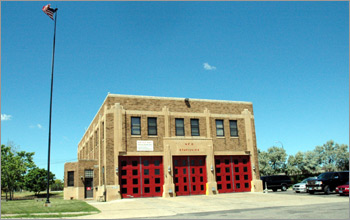
Fire Station 4, 1101 North Sixth Street (City of Minneapolis website)
In Rauen’s time the neighborhood was all residential, but it is now completely industrial and hemmed in by freeways.
Since the demise of Rauen Triangle, two other Minneapolis parks have been named for people with German surnames: Mueller Park (1973) and Gluek Park (1995).
I don’t mention the nationality or ethnicity of park names as something that needs to be addressed; it is simply an observation. The only name missing from a Minneapolis park that really must be added is Horace Cleveland’s.
David C. Smith
© David C. Smith
Minneapolis Park Hero: Alice Dietz
Filed under: Minneapolis Park Hero, Minneapolis Parks: General | Tags: Alice Dietz, Logan Park, Minneapolis parks
Comments (5) Early in my research of Minneapolis park history for City of Parks, Alice Dietz caught my attention. She had a forty-year career in Minneapolis parks, 1916-1957. She rose to prominence in the park system quickly from her start as a recreation director. In January 1918, the park board received a letter from an appreciative mother asking that Dietz be reappointed as recreation director at Maple Hill (Beltrami) Park. She was not reappointed at Maple Hill; in the park board’s annual report for 1918 Dietz was singled out for praise for her work at bigger, busier Bryant Square Park. The next year Dietz moved again, this time to the most visible and important recreation job in the city as the director of the Logan Park field house, the only year-round facility the park board operated.
Dietz needed very little time to establish her reputation at Logan Park. In an article on the opening of the 1920 summer playground season, the Minneapolis Tribune (June 20) commented that Dietz had already “taught the Logan Park neighborhood what a field house was really meant to be.” Apparently in the seven years between its construction in 1912 and Dietz’s arrival the field house had been less successful.
By the end of that summer the Tribune (October 17) provided an unusual glimpse of park life “in a community where there are a dozen nationalities struggling with the intricacies of life in a new country.” In that environment, the paper reported, Mrs. Dietz was trusted by “children and mothers alike.” As a result, Dietz was able to “buoy the self-confidence of the women who are awed by the greater facility of their children in the new tongue and to make the children realize what they owe to their parents.”
Among her responsibilities were teaching drama, dance and arts and craft classes, directing all athletic activities for girls, and putting on plays and pageants. The previous year she had also managed boys athletic activities developing “proficiency in boxing and football that surprised even herself” the Tribune reported. The paper continued that “almost to her regret,” a man had then been brought in to look after the boys and young men. In between all this she “listens to all the troubles that everybody tells her…and never turns a hair through it all.” The Tribune also praised the “Logan Park spirit” she had instilled noting that “the children have come to feel that the place belongs to them and they look over a newcomer with stern eyes. He has to measure up to what they think is proper Logan Park behavior.”
Dietz’s work with pageants and performances at Logan Park led to her being handed responsibility for the citywide playground pageants staged at Lyndale Park at the end of each summer.

The first playground pageant on the hill above the Rose Garden at Lyndale Park attracted a crowd estimated at 10,000. (1918 Annual Report, Minneapolis Board of Park Commissioners)
The first two pageants, “Mother Goose” in 1918 and “The Pied Piper” in 1919, were directed by Julia Beckman, a teacher at North High School, but from 1920 Dietz wrote and directed the playground pageants as they became one of the highlights of the summer playground program. Children from every Minneapolis park were involved in creating costumes and props for the program. Up to 1,500 children appeared in the pageants each year which were staged on the hill overlooking the Rose Garden in Lyndale Park. The two-night performances were attended by up to 40,000 people. The popularity of the pageants caused the park board to consider more than once (first in 1930) the construction of an amphitheater on the site. Except for a brief hiatus during the Depression, the pageants continued through 1941. The pageant was incorporated into the Aquatennial in 1940, the first year of that celebration. With the ascendancy of the Aquatennial, and with the nation at war, the pageant was discontinued a year later.
The pageants were original scripts written by Dietz. While she created small roles in her pageants for park commissioners, she never allowed commissioners to have speaking parts. After her second pageant in 1921, “Weaver of Dreams,” Dietz asked the park board to allow her to retain copyright of the pageant scripts. The park board agreed that she could retain those copyrights as her personal property. (I have seen no indication that Dietz ever licensed those or subsequent scripts for performances by others.)
I recently found in a scrapbook kept by Victor Gallant evidence that Dietz had a background in theater as a performer before she worked for the park board. I had found an item in park board proceedings that Dietz requested a leave of absence for a week in the 1920s to attend a dance workshop in New York at her own expense, which was granted by the board. From that reference I knew Dietz had an interest in dance beyond the classes she taught at Logan Park and the dances she had incorporated into her pageant scripts. But the undated newspaper clip that appeared at the time of her 40th anniversary of employment with the park board (her last year), mentions her own theater performances as a girl.

Alice Dietz in 1957 near the time of her retirement and as a child actor, from an undated newspaper clip.
As the Director of Community Centers in Minneapolis parks, Dietz played a central role in the redefinition of recreation in the park context. The range of activities and classes offered at Logan Park was unprecedented in Minneapolis. In addition to expanding the range of activities provided for both children and adults, Dietz oversaw the conversion in 1922 of the large social room at Logan Park into a gymnasium for sports. The other recreation centers in Minneapolis at that time were little more than warming houses for skaters. They were later criticized by a national park expert as too big for warming houses and too small for anything else. (Weir Report, 1944.) Despite the phenomenal popularity of Logan Park under Dietz’s direction, the park board did not build another similar facility until the 1960s. Perhaps park commissioners feared that while they could replicate the field house they could not replicate Dietz.
Dietz’s role in the development of park programming in the 1920s at Logan Park was significant, but her greatest achievement may have been in training the army of recreation supervisors who worked in parks across the city in the 1930s. With the onset of the Depression in 1930 and the slashing of recreation budgets, Dietz lost her three assistants at Logan. Summer recreation positions in parks across the city were slashed from seventy-five to zero in 1933. When the American Legion tried to fill the void in eleven parks by providing volunteer supervisors, they were sent to Dietz for training.
That was just a glimmer of what would follow. For the 1934 playground season the Works Progress Administration inaugurated a recreation program that at its peak would place more than 240 recreation supervisors in Minneapolis parks and playgrounds. The WPA recreation program continued until 1943. During those ten years, thanks to federal and state work-relief programs, Minneapolis parks offered the most comprehensive, year-round recreation programming in the city’s history. The entire program, including the training of hundreds of new personnel, was coordinated by Alice Dietz from her office at Logan Park.
That experience served her and the city well after WWII when the park board was able to expand recreation programming and offer year-round activities at a handful of parks. Dietz was once again responsible for training the first generation of full-time, year-round recreation supervisors employed by the park board.
These are the outlines of Alice Dietz’s remarkable career in the recreation department of Minneapolis parks. I know little about Alice Dietz beyond what I have related here other than the fact that she was president of the Minnesota Recreation and Park Association in 1947. If you can tell us more about Dietz — or you have another person to nominate as a Minneapolis Park Hero — please comment here or contact me at the e-mail address below.
David C. Smith
© David C. Smith
 Minneapolis Park History