Archive for January, 2012|Monthly archive page
The Preservation Instincts of Charles M. Loring
Filed under: Minneapolis parks, Minnehaha Falls | Tags: Charles M. Loring, Horace Cleveland, Minnehaha Falls
 Comments (2)
 Charles Loring’s view on preserving natural landscapes was so well-known that this anonymous poem appeared in the St. Paul Daily Globe on September 8, 1889 in a humor column, “All of Everything: A Symposium of Gossip About Minneapolis Men and Matters.”
A grasping feature butcher,
With adamantine gall,
Wants to build a gallery
At Minnehaha’s fall.He wants to catch the people
Who come to see the falls,
And sell them Injun moccasins
And beaded overalls.He wants to take their “phizes,”
A dozen at a crack,
With the foliage around them
And the water at the back.But the shade of Hiawatha
No such sacrilege would brook:
And he’d shake the stone foundations
Ere a “picter had been took.”C. M. Loring doesn’t like it,
For he says he’d like to see
The lovely falls, the creek, the woods,
Just as they used to be.
Loring had chaired a commission appointed by the governor to acquire Minnehaha Falls as a state park in 1885. The land was finally acquired, after a long court fight over valuations, in the winter of 1889. (The total paid for the 180-plus acres was about $95,000.) See City of Parks for the story of how George Brackett and Henry Brown took extraordinary action to ensure the falls would be preserved as a park.
The poem in the Daily Globe appeared because the park board was considering permitting construction of a small building beside the falls for the express purpose of taking people’s photos with “the water at the back.” And of course charging them for the privilege.
That proposal elicited a sharp response from landscape architect H. W. S. Cleveland who also opposed having any structure marring the natural beauty of the falls. Cleveland used language much harsher than the reserved Loring likely would have used. In a letter to his friend William W. Folwell, Cleveland wrote on September 5, 1889,
I cannot be silent in view of this proposed vandalism which I am sure you cannot sanction, and which I am equally sure will forever be a stigma upon Minneapolis, and elicit the anathema of every man of sense and taste who visits the place.
If erected it will simply be pandering to the tastes of the army of boobies who think to boost themselves into notoriety by connecting their own stupid features with the representation of one of the most beautiful of God’s works.
The preservation passion of Loring and Cleveland is evident today in the public lakeshores and river banks throughout Minneapolis. The next time you take a stroll around a lake or beside the river, or fight to acquire as parks the sections of the Mississippi River banks that remain in private hands, say a little “thank you” to people like Loring and Cleveland who saw the need to acquire lakes and rivers as parks more than 125 years ago—and nearly got them all.
And the photography shack was never built.
David C. Smith
University of Minnesota Honorary Degrees and Minneapolis Park Names
Filed under: Grand Rounds, Minneapolis Park Names, Minneapolis Parks: General | Tags: Edward Foote Waite, Thomas Sadler Roberts, William Watts Folwell
Comments (2) Here’s an exclusive club: William Watts Folwell, Thomas Sadler Roberts and Edward Foote Waite. Each has had a Minneapolis park property named for him, and each also received an honorary degree from the University of Minnesota.
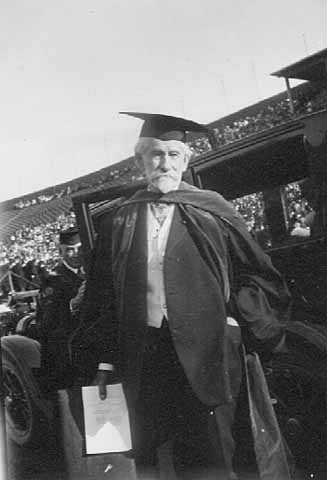
William Watts Folwell
1925 was a big year for Folwell when, at age 92, he received the first honorary Doctor of Laws degree ever awarded by the University of Minnesota and Folwell Park was dedicated in his honor. The name for the park had been chosen in 1917, but it took eight years for the park to be finished and dedicated.
Folwell was hired as the first president of the University of Minnesota in 1869. He was elected to the Minneapolis park board in 1888 and served on the board — many years as its president — until 1906. He was the first to propose the name “Grand Rounds” for the city’s ring of parkways.
He is pictured in 1925 when he received his honorary degree, apparently in ceremonies at Memorial Stadium. Photo: Minnesota Historical Society.
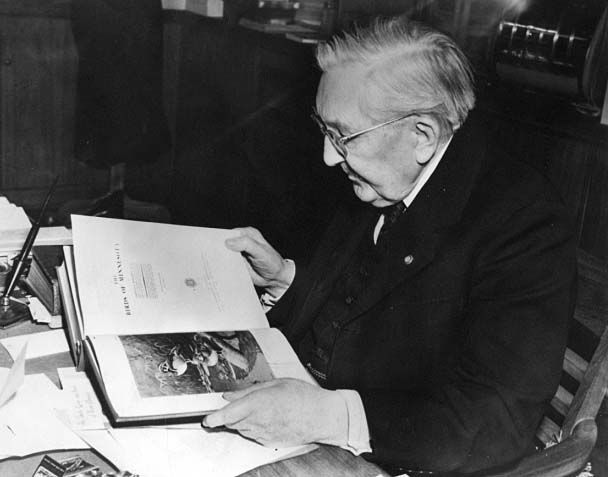 Thomas Sadler Roberts
Roberts was awarded an honorary Doctor of Science degree by the University of Minnesota in 1940, when he was 82. In the photo, taken sometime that year, he is perusing a book of Audubon prints.
The Thomas Sadler Roberts Bird Sanctuary in Lyndale Park near the north shore of Lake Harriet was named in his honor in 1947, a year after his death.
Roberts was a doctor known for his extraordinary capacity to diagnose unusual diseases and illnesses largely due to his prodigious memory. He retired from medicine in his 50s and devoted his time to ornithology. He taught at the University of Minnesota and was a director of the Museum of Natural History. Photo: Minnesota Historical Society.
 Edward Foote Waite
Waite received his honorary degree from the University of Minnesota and had a Minneapolis park named for him in the same year — 1949 — when he was 89. His Doctor of Science degree honored a legal career best known for years of service as a juvenile court judge in Minneapolis. But he was far more than a wise and compassionate judge; he helped shape the field of juvenile law in the United States.
Waite is less well-known for his five-month stint as Minneapolis’s police chief in 1902. It was not an easy job in the wake of a scandal known nationally as the “Shame of Minneapolis,” centered around corrupt Mayor Albert Ames and his brother Fred, whom he had appointed police chief. David P. Jones was appointed mayor to replace the fugitive Mayor Ames and turned to his friend, Waite, an assistant district attorney with no police experience, to clean up a corrupt police force and restore public faith in law enforcement.
Waite Park was developed along with Waite Elementary School as a joint project between the park board and school board from 1949-1951. The park and school opened for the 1950 school year but final improvements to the site were not completed until the following year.
Waite is pictured snowshoeing in about 1945 at the age of 85. Photo: Minnesota Historical Society. (See another photo of Waite at the school named for him.)
From this very exclusive list it would appear that the good do not die young.
David C. Smith

 Minneapolis Park History