Archive for May, 2025|Monthly archive page
Riverside Park Staircase
Filed under: Minneapolis parks | Tags: H.W.S. Cleveland, Riverside Park
 Comments (8)
 I received a question from Elliot about Riverside Park that I can’t answer. Maybe you can.
“There are two limestone structures to the left and right of the main staircase at Riverside Park. They’re pretty overgrown. They look staircase-like, but I wonder if they were cascades for water to go down? I looked but couldn’t find any old pictures. Do you know about these?”
Any thoughts?
Riverside Park was one of four neighborhood parks designated by the first Board of Park Commissioners when the Board was created by the Minnesota Legislature in 1883. They designated a new neighbornood park in each quadrant of the city. The others were Central (Loring) Park, Logan Park and Farview Park. In addition to the neighborhood parks, the board planned to acquire connecting parkways–thanks to H.W.S. Cleveland’s plans–as well as land around one of the distant lakes to the southwest. Before it was officially named, the Park Board refered to it as Sixth Ward Park.
The neighborhood near Riverside Park was the only one that already had a park at that time although it served mostly as a pasture. Murphy Square, which had been donated to the city as a park nearly 30 years earlier, stood only a half-mile to the west of Riverside Park.
You can read a brief history of Riverside Park at the Park Board’s website. Click on the “History” tab.
David Carpentier Smith
See You at the Superintendent’s House
Filed under: Minneapolis parks | Tags: Lyndale Farmstead, Theodore Wirth, Theodore Wirth House
Leave a comment A last-minute notice: Stop by the Superintendent’s House, often called the Wirth House, in Lyndale Farmstead Park today, May 17, and say hello. Park Superintendent Al Bangoura has once again opened the historic house where he lives (he pays rent!) to the public as a part of the Doors Open weekend. The historic home was built by the Minneapolis Board of Park Commissioners as a home and office for Superintendent Theodore Wirth in 1910.
I’ll be there along with Al and others who are knowledgeable about the house history, including some former residents. We’ll be there today only — no Sunday opening this year — from 10 am to 5 pm.
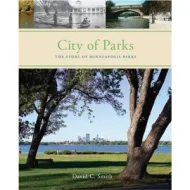
If you still don’t have your copy of City of Parks, or you need one for a gift, you can buy one there and I’ll sign it for you. All proceeds to the park board.
David Carpentier Smith
Forfeited Land, Creative Additions
Filed under: Minneapolis Park Board, Minneapolis parks | Tags: Bossen Field, HI-View Park, Kenny Park, McRae Park, Northeast Athletic Field Park, Peavey Park
Comments (1) I recently received a note from Etch Andrajack about his fond memories of growing up near Hi-View Park in Northeast Minneapolis and what an important part the park played in the lives of his family and friends. His note prompted me to revisit the history tab on the Park Board’s page about Hi-View Park at minneapolisparks.org. (Every park has a history tab. I wrote most of them in 2008, but they are updated by park board staff as new developments warrant.)
In reviewing Hi-View’s history I was reminded of a tool the park board used to create or expand several recreation parks that are likely remembered as fondly as Etch remembers Hi-View. Landowners who don’t pay their property taxes eventually may forfeit their land. That land can be sold by the state or managed for “public benefit.” The Minneapolis Board of Park Commissioners, as the Park Board was once officially called, acquired the land for Hi-View Park–free–under the public benefit provisions. I’ve cited below a section of the history of Hi-View Park, which I wrote for the park board’s website, that mentions other park land acquired through tax forfeiture.
“Hi-View Park was acquired from the state in 1950. The state had acquired the property for non-payment of property taxes. The original park was 3.74 acres, but was expanded by 0.12 acres in 1961 at a cost of $4,900. The park board acquired the land at a time when it was looking to fill gaps in playgrounds identified in a 1944 study of park facilities. While the neighborhood around Hi-View was not on the list of neighborhoods needing playgrounds, the park board seized the opportunity to obtain free land from the state, when it discovered the land was on the state’s list of tax-forfeited properties. The undeveloped land had been used as a playing field by children in the neighborhood for years.
The first instances of the park board seeking land on state tax-forfeiture lists was in 1905 when it acquired several lots to expand Glenwood (Wirth) Park and in 1914, when it acquired Russell Triangle. With the acquisition of four lots to enlarge Peavey Park and the acquisition of Northeast Field partly from the state’s tax forfeiture list in 1941, the park board began looking to the state as a source of cheap land.
In a matter of a few years after World War II, the park board acquired nearly all of Bossen and Perkins Hill parks and portions of McRae and Kenny from the state for no cost. The park board also eventually acquired part of North Mississippi Park from the state. By the late 1940s, the park board routinely scanned lists of land the state had acquired for non-payment of taxes and spotted the Hi-View land on such a list.”
I mention the acquisition of tax-forfeited land because it underscores the many creative methods used to acquire the land that became a celebrated and heavily used park system. Some parks are used primarily by neighborhood kids, others by people from across the entire city, state and beyond.
The park system is the result, in the end, of dedicated, persistent, efficient, and creative public servants. And it is still operated, managed, and adapted to our ever-changing needs and desires by the same type of praise-worthy public servants to whom we all owe a debt of gratitude. At the very least some respect.
David C. Smith
Cloggy’s Hockey at Sibley Field
Filed under: 40th Street Park, Minneapolis parks, Sibley Field | Tags: 40th Street Park, Cloggys, Minneapolis Hockey, Sibley Field
Comments (6) One of the most-commented on posts on this website was written nearly 15 years ago about Sibley Field, now renamed 40th Street Park. (Be sure to read the comments on that post.)
I can now add two excellent photos, with names, of more boys’ hockey teams sponsored by Cloggy’s Bar. I received a note this week from Ken Orum asking if I was interested in the photos that came from a collection from his grandparents James and Nettie Guest. James Guest appears in the photos as the manager of the teams. I presume these teams were based at Sibley Field too.


This was from a time when Minneapolis high schools produced excellent hockey teams, in part due to a vibrant playground hockey program. We don’t know the photographer or source of these images, but if anyone does, I’d be glad to provide further attribution.
Thanks to Ken Orum for providing the photos.
David C. Smith
 Minneapolis Park History