Archive for the ‘Minneapolis Parks: General’ Category
Inspiration, Ideas and Ideals (Courtesy of William Watts Folwell)
Filed under: Minneapolis Parks: General | Tags: Folwell Park, Minneapolis parks, William Watts Folwell
 Comments (1)
 Park history provides more than pretty pictures. Thanks to people such as William Folwell, it also gives us inspiring words. Such inspiration has perhaps never been needed more than now when political discourse is dominated by petty self-interest and shallow swagger.
“We owe it to our children and to all future dwellers in Minneapolis to plan on a great and generous scale. If we fail to accomplish, let them know it was not for lack of ideas or ideals.”
— William W. Folwell, President, Minneapolis Board of Park Commissioners, Eighteenth Annual Report, 1900

William W. Folwell attended the dedication of facilities at Folwell Park, July 4, 1925. He was 92. (Minnesota Historical Society, por 12574 r18)
David C. Smith
Powderhorn Park and Augsburg Stories Converge
Filed under: Minneapolis Parks: General, Powderhorn Park | Tags: Murphy Square, Powderhorn Park, Speed Skating
Leave a comment A reader of recent posts on Murphy Square/Augsburg College and speed skating at Powderhorn Park put the two together and suggested a link to an article featuring U. S. Olympic speed skater Johnny Werket, who attended Augsburg. From the article we learn that a third Minneapolis park also played a role in the story: Longfellow Field was Werket’s home park.
Thanks for the tip.
David C. Smith
Minneapolis Park Memory: A Memorable Silence
Filed under: Minneapolis Park Memory, Minneapolis Parks: General | Tags: Bossen Field, Edward Foote Waite, Minneapolis parks, Minnehikers, Theodore Wirth, Waite Park
Comments (1) I was the editor of the Minneapolis Municipal Hiking Club’s monthly newsletter for many years, up through the last month of the club’s existence in October 2010.
One hike I particularly remember took place on Wednesday, September 12, 2001. The Club had an evening hike scheduled for the neighborhood around Bossen Field in south central Minneapolis. Many planes fly over this area approaching the airport, but this was the day after 9/11 and all U.S. civilian planes were grounded by federal decree. It was quite a sensation walking in this area, expecting to hear planes fly over, but hearing none.
George Bridgman

Minnehikers was a popular club. Annual banquet, 1938. (Norton and Peel, Minnesota Historical Society, GV1.22 p87)
Editor’s note: The Minnehikers, as the club was known, was originally organized by the park board’s recreation staff in 1920. According to Theodore Wirth (Minneapolis Park System 1883-1944), the first hike took place on January 10, 1920. Minneapolis Mayor J. E. Meyers, Judge Edward Foote Waite and Wirth led 83 hikers 3 1/2 miles from Minnehaha Falls to Riverside Park.
Twenty-nine years later, the park board named a park for the juvenile court judge who participated that day: Waite Park in northeast Minneapolis.

Waite Park and Waite Park School, the first joint school/park development in Minneapolis in 1949, were named for Judge Edward F. Waite, pictured here with students and teachers at the school in about 1955, when he was 95. (Newburg Studio, Minnesota Historical Society, por 5807 p8)
The mayor’s name is on a park too, the J.E. Meyers Memorial Park in Mound on Lake Minnetonka. Internet sites list it as both a boy’s camp and a cemetery. A mystery to be solved. Of course, we know that Wirth has a park named for him, too.
I would tell more about the Minnehikers, but I hope former members of the group will do that themselves with first person accounts. The club sponsored its last hike in October. Changing times.
David C. Smith
First shipment of merchandise by air lands in a Minneapolis park
Filed under: Minneapolis Airport, Minneapolis Parks: General | Tags: Minneapolis airport, Minneapolis parks, The Parade
Leave a comment Another first for a Minneapolis park: The nation’s first commercial air shipment landed at The Parade near downtown Minneapolis on May 8, 1920.
This entry in the proceedings, or minutes, of the Minneapolis park board on May 5, 1920, had puzzled me from the time I first saw it a couple of years ago.
Petitions and Communications
From Dayton Company —
Requesting permission to have the two airplanes bringing freight from New York to overcome the embargo to land on The Parade Friday morning.
Commissioner Gross —
Moved that the request be granted under the supervision of the Superintendent of Parks.
Adopted

Dayton’s Express air merchandise shipments arrived from New York at The Parade, May 8, 1920 (Charles J. Hibbard, Minnesota Historical Society, HE1.21 p53)
Only recently did I look up newspapers from the time to see if the event was mentioned. When I read the coverage in the Minneapolis Tribune, I knew I had seen a photo of the event somewhere and went straight to the Minnesota Historical Society’s Photo Collection, one of the most interesting places on the Internet. Sure enough, there were two photos of the event recorded by the superb photographer Charles Hibbard.

Dayton’s air merchandise shipment was unloaded after the plane was towed, minus wings, from The Parade to Dayton’s store on Nicollet Ave., May 8, 1920. The man on the plane is likely Ray S. Miller, the pilot who flew from New York via Buffalo. (Charles J. Hibbard, Minnesota Historical Society, HE1.21 p52)
This is the story of a retail innovation by Dayton’s (now Target) and another small part in history played by Minneapolis parks.
In April 1920, a wildcat strike by railroad switchmen in Chicago eventually spread to railroads and rail yards throughout the country causing a near shutdown of national transportation. Even after the strike had ended goods had piled up around the country threatening food and fuel shortages in a kind of gridlock from New England to the Pacific Northwest. While the Interstate Commerce Commission, White House and Congress grappled with the problem and eventually reinstituted some World War I-era government controls on railroads, the department store of George Draper Dayton developed an innovative plan: it would ship goods from New York City to Minneapolis by airplane.
The Minneapolis Tribune announced Dayton’s intentions April 30, 1920 along with the news that two airplanes had already left the Curtiss airplane plant in Buffalo, New York bound for Roosevelt Field on Long Island. The planes would commence their journey west as soon as they were loaded. The Tribune also noted the interest in the flight by Minneapolis Postmaster E. A. Purdy, who asked the company to give him all particulars on the flight. United States airmail service from Chicago to Minneapolis was scheduled to begin two months later on July 1. And none too soon. The Minneapolis post office had just set a record on April 8: the first time it had handled 100,000 packages in one day.
Dear Target, Thank you. Yours Truly, FedEx and UPS
In the next day’s edition, the Tribune reported that the plan to fly merchandise to Minneapolis had attracted considerable attention. The New York American had carried a story of the flight by which a half-ton of goods was to be transported aboard two Curtiss Oriole airplanes. “The plan is described as a pioneer step in shipments of goods by plane,” the Tribune reported, “and is declared to bear the possibilities of an extensive development of the use of aircraft for freight-carrying purposes.”
On May 2 the Tribune ran photos of the two dapper pilots, Ray Miller and Charles Keyes, who had traveled to New York to pilot the planes back to Minneapolis. In this edition the Tribune claimed that the effort by Dayton’s had attracted the attention of both New York and Chicago retailers.
Perhaps the weather was not good or it took a long time to load 1,000 pounds of merchandise, but the planes didn’t depart New York until May 6. The May 7 Tribune reported that the pilots had flown through a blinding snowstorm over the Mohawk Valley before arriving in Buffalo the night before and were expected to arrive in Minneapolis the morning of May 8.
“Permission for the airplanes to land on The Parade grounds has been granted by the Board of Park Commissioners,” the Tribune reported. “The wings will be removed and the airplanes will be towed through the streets to Dayton’s store.”
And they were — as Charles Hibbard showed us.
While Target’s history website portrays the air shipment as a response to empty shelves in Dayton’s store, and it may have been, it was also a carefully constructed publicity campaign — from the daily press coverage, including photos of the pilots, to painting “Dayton’s Express” on the fusilages. The planes could have landed at the Speedway Airport, later Wold-Chamberlain Field, and the merchandise trucked to the store. Landing the planes in a park in the center of the city and then hauling them wingless into downtown for unloading made a good story that much better. Very clever.
Of course, in later years the park board became heavily involved in aviation. In 1927 the park board acquired the land of the fledgling Wold-Chamberlain Field in Bloomington and built it into a world-class airport. The park board turned the airport over to the Metropolitan Airports Commission in 1944, but retained title to about 600 acres of land at the center of the airport.
This was not George Dayton’s first encounter with the park board. When the Street Railway Company’s pavilion on park land beside Lake Harriet burned down in the spring of 1903, George Dayton was on a committee for the Retailers Association that worked with the park board and Street Railway to build a new pavilion. The Street Railway Company decided not to build a new pavilion itself but to contribute the $15,000 it collected in insurance on the burned building to the park board. The remaining $15,000 the park board needed to build a new pavilion? It was loaned to the park board on attractive terms by Dayton and the other retailers.
(See earlier post on the original plans for The Parade by Warren Manning.)
David C. Smith
© David C. Smith
The Myth of Murphy Square
Filed under: Minneapolis Parks: General | Tags: Minneapolis parks, Murphy Square
Comments (9) In Nimocks’ pamphlet, he tells the story of Edward Murphy who donated the first park to Minneapolis in July 1857—what is now Murphy Square near Riverside Avenue.
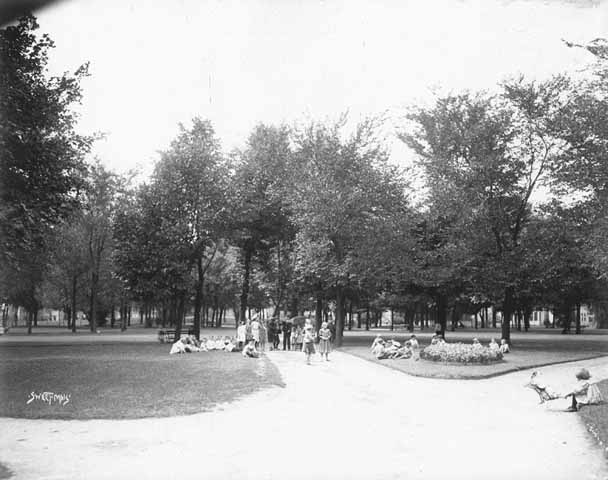
Murphy Square had plenty of trees when this photo was taken about 1905 (Sweet, Minnesota Historical Society)
“For years,” Nimocks wrote, “the land was used as a cow pasture, but on April 16th, 1873, Mr. Murphy secured an appropriation of $500 by the City Council for the purpose of fencing and setting out a row of trees around the park. Mr. Murphy expended this amount and a warrant was drawn on the City Treasurer to pay the same, which Mayor Ames refused to sign and the warrant was never paid.”
While searching early issues of the Minneapolis Tribune recently (thank you, thank you Hennepin County Library) I came across this four-sentence article in the July 3, 1874 edition.
The Murphy Bill
The Council voted on Wednesday to instruct the City Clerk to deliver to Mr. Edward Murphy his order which has been in chancery for the last year or two. Mr. Murphy called and received the order yesterday, and City Treasurer Laraway at once paid him the money thereon, principal and interest. The interest amounted to almost one hundred dollars. Mr. Murphy declares that as the Council has finally done tardy justice to him, he now proposes to improve and care for the park at his own expense.
The article makes little sense without the knowledge that Mr. Murphy had not been paid for his work at Murphy Park a year earlier. And even then, it’s not until the last sentence that we can infer what he may have been paid for: the improvement and care of a park. As Murphy’s park was the only one in the city at the time, the article offers evidence that Murphy was reimbursed for some work he did there.
Perhaps because the article appeared in the Tribune, not his Journal, Nimocks chose to overlook it. Next chance I get at the library I will see if the Journal made a similar report. On the other hand, Nimocks wrote his pamphlet nearly forty years after the event. He may have “misremembered”—at least the resolution of the problem.
There is little doubt however that someone planted trees in the park, because newspaper stories that mention the park in subsequent years refer to it as Murphy’s grove, as in “Swedish Lutheran Sabbath School will have a picnic in Murphy’s grove,” from the Tribune, July 3, 1880.
Still it’s nice to know that Edward Murphy, a civic-minded man with foresight, was not cheated by the city that benefited from his generosity. One other note: Edward Murphy was a member of the City Council that finally did him “tardy justice.” He was not without some influence.
Bravo Augsburg College and Park Board!
For anyone who missed the news in October—I did—Murphy Square will be maintained for the next five years by Augsburg College. The college will provide routine maintenance, such as mowing the grass and shoveling the sidewalks.
The college, which established a campus next to the undeveloped park in 1872, nearly surrounded the park by the 1930s. But what really made the park appear to be a part of the campus was the construction of I-94 in the 1960s. The freeway and its imposing sound wall formed a barrier at the south end of the park and the freeway prevented access from the residential neighborhoods to the south.

Card players at a table in Murphy Square about 1946. Buildings in background do not appear to be Augsburg College. (Phillip Dittes, Minnesota Historical Society)
Does anyone from the Franklin Avenue neighborhood south of Augsburg College — or Augsburg College students before the 1960s — remember the park before the freeway was built? Tell us your story.
David C. Smith
Pershing Field Scrapbooks
Filed under: Minneapolis Parks: General | Tags: Pershing Park, Southwest Activities Council (SWAC)
Leave a comment Pershing Park recreation supervisor Marc Holtey recently pulled out some old scrapbooks at the park. One scrapbook was a collection of “guest books” from the Southwest Activities Council’s (SWAC) Annual Meetings, Open Houses and Winter Carnivals in the 1950s and 1960s. Among those who signed the books were many former park commissioners and park board employees. I noticed that Felix Dhainin and his wife signed the guest book for a few events. Dhainin was the park board’s landscape architect for many years beginning in the 1940s. Many guests added their addresses after their signatures, from which I learned that the Dhainins lived barely a block from the park. Another park board employee, Alice Dietz, one of the leaders of the recreation department since the early 1920s, also attended several 1950s events. If anyone can tell me more about Dhainin or Dietz, please do. They are two of hundreds of park board employees who were instrumental in building our park system.
Another signature that caught my attention in the Guest Book for the 11th Annual SWAC Winter Carnival, January 25 & 26, 1964: Mrs. Ray Rybak and children. We can surmise that the present-day Mayor of Minneapolis was in attendance at about the age of eight.
A second scrap book contained clips about SWAC from 1957-1959 from the Lake Harriet Courier. Some highlights:
- Attendance at 1958 Halloween parties sponsored by SWAC. Linden Hills: 250 children at an afternoon party; 225 teens for a dance that night after the Southwest-Roosevelt football game. Pershing: 350 children.
- Attendance at Pershing Field for a Friday night dance in January 1958: 130 junior teens and 200 senior teens. Live music was provided by the Jazz Knights.
- Attendance at the SWAC football banquet at Mount Olivet Lutheran Church: 320
I suspect that parks across the city had similar, staggering attendance at big events. Those may have been the glory days of park-sponsored activities for children. If you attended events like these in any park in Minneapolis, tell us about it.
Dick Yates was for many years a recreation supervisor at Longfellow, then Lynnhurst Park, before he became the head of special services for the park board in the 1970s. I interviewed Dick when I was researching City of Parks in 2007. When the book came out I asked Dick what he thought of it. He had one complaint: he didn’t think I captured the robustness of the dynamic playground programs of the 1950s and 1960s. I had to agree with him. The number of kids who participated in playground programs in those years was truly incredible by today’s standards. So help me correct that shortcoming of City of Parks. Let’s capture here some of the vitality of playground events in years past. Tell us the story.
A third scrapbook at Pershing was a book of photos. Most of them were of unidentified children and didn’t provide much information of historical interest. The two that I found most interesting were these.

Goalies weren’t protected then as they are now. Photo from 1958 Annual Report of the Southwest Activities Council (SWAC) (Photo courtesy of Minneapolis Park and Recreation Board)
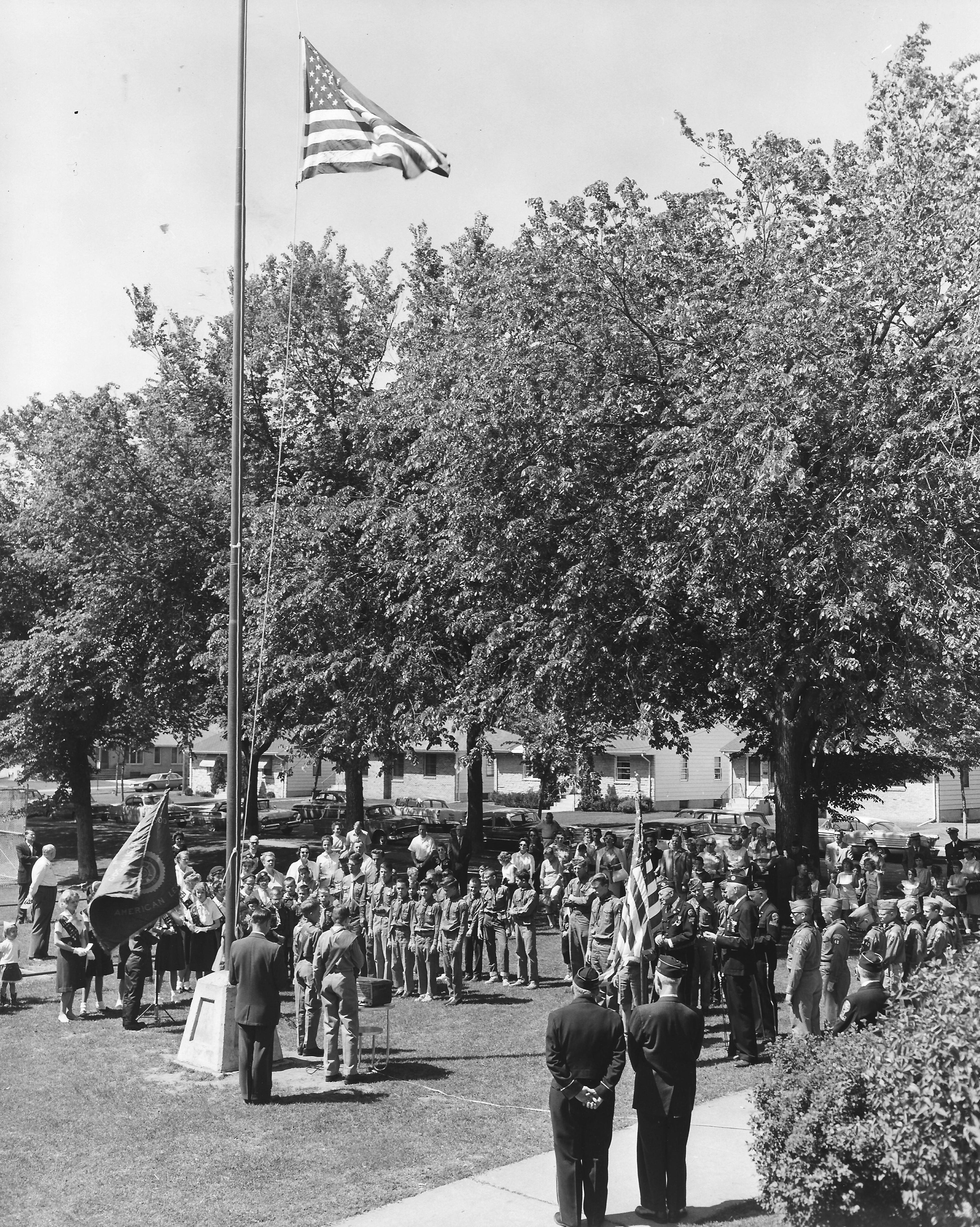
Memorial Day 1961, Pershing Park (Clair Peterson, Minneapolis Park and Recreation Board)
David C. Smith
Minneapolis Park Memory: Lake Harriet Hijinx
Filed under: Minneapolis Park Memory, Minneapolis Parks: General | Tags: Lake Harriet
Leave a comment My favorite story of the Minneapolis parks was one autumn weekend night in 1968, when I was in 11th grade. The standard place for “couples” to go and “make out” was around Lake Harriet on the east shore. There was a lane for parking and the cars would line up as soon as it was dark. I was with a couple of buddies and we had a few M-80’s. We drove around the east shore until we saw a couple having at it in their car. Then the M-80 was lit and rolled strategically under their car and we waited for the explosion. The ensuing few seconds in the car of the “parkers” was always indescribably hilarious. Well, after surprising a couple in their car we peeled out and headed to our favorite spot “Porky’s Drive-In” on 58th and Lyndale Ave. So.
About two hours later there was a noticeable “buzz” at Porky’s. We asked what was up and we heard the story. Apparently someone had lit an M-80 around the east shore of Lake Harriet and part of the explosion flew across the street and started a fairly large brush fire on the slope that surrounds the lake on that shore. It was about three blocks long by about 40 yards wide. There had been “numerous” fire trucks called to put out the fire. OOPS.
Name withheld by request, Washburn High School, Class of 1970
Editors note: Our parkways have served many useful purposes!
The Minneapolis city council banned fireworks in the city, without a permit, in 1873. At the same time the council passed an ordinance banning the firing of guns, pistols and cannons within the city. Prior to the Fourth of July in 1890 the police chief noted that it was impossible to “rigidly” enforce the anti-fireworks ordinance, but urged his forces to prohibit the shooting of fireworks in “alleys, backyards or other restricted spaces.” At a time when most structures were made of wood, and so were sidewalks, that was probably prudent.
The first newspaper reference I can find to fireworks at Lake Harriet was in the Minneapolis Tribune, August 10, 1887. An article on the Knights of Labor picnic the day before, which was attended by an estimated crowd of 15,000 to 20,000 despite light rain, noted a “brilliant display of fireworks” from 9 to 9:30 p.m. This was the second annual picnic by the largest labor organization of its time, but the first at Lake Harriet. The inaugural K of L picnic had been held at Lake Calhoun — but had also featured fireworks.
Even in the late 1800s, fireworks were associated primarily with the Fourth of July. The first newspaper reference I found to Fourth of July fireworks at Lake Harriet was in a July 5, 1890 Minneapolis Tribune article on festivities around the city, which concluded with a tragic note. A. L. Wellington of 629 Sixth Street South died of injuries he suffered while superintending the fireworks display at Lake Harriet the night before. Fireworks had exploded prematurely on the raft from which Wellington worked about 500 feet from shore.
Do you have a fireworks story from a Minneapolis park? Were you in the car the M-80 was rolled under? Any other story of Minneapolis parks? Help us write the popular history of our parks. Tell us your story (see post from September 30.)
David C. Smith
Charles M. Loring, Father of Minneapolis Parks
Filed under: Minneapolis Park Hero, Minneapolis Parks: General | Tags: Charles M. Loring, Minneapolis parks
Comments (2) “We must all work and work together, and it will be but a short time before we shall see what a united effort and good example can do toward forming a public sentiment so strong that the city government will give us the trees and parks we so much need for breathing spaces for the poor who cannot ride to the country for air.”
— Charles M. Loring, April 14, 1882
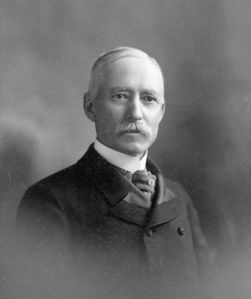
Charles M. Loring, Father of Minneapolis Parks, about 1900 (Brush, Minnesota Historical Society)
If you’ve read City of Parks or the history of Loring Park at minneapolisparks.org you already know how much I admire Charles Loring, the first president of the Minneapolis Board of Park Commissioners (BPC). He was one of the most effective advocates for parks before the park board was created and during a couple stints on the park board. He was a man of national reputation and influence on park matters. In addition, he donated the recreation shelter at Loring Park in 1906, paid for an artificial water fall to be built beside Glenwood (Wirth) Lake in 1917, and paid for the original trees for Victory Memorial Drive and created a $50,000 fund for the perpetual care of those trees. He was one of the most remarkable men in Minneapolis history. So once in a while I will tell a story here about Charles Loring that I haven’t had space to tell anywhere else. I will likely do the same for William W. Folwell, but that comes later.
On April 14, 1882, nearly a year before the creation of the BPC by the Minnesota legislature, Loring was asked to address the first annual meeting of the Oak Lake Addition Improvement Association. The neighborhood, which once stood where the Farmer’s Market now stands beside I-94, was the first in the city to create a homeowners association to care for the streets and grounds and sanitary requirements of a neighborhood. For their annual meeting, which was held at Hennepin Avenue Methodist Church, they asked Loring to speak about the care and culture of trees in the city.
According to newspaper coverage, Loring’s remarks focused on the experiences of W. R. Smith, the superintendent of parks in Washington, D.C. and the president of the Botanical Garden there. The park commission in D. C. had the power to plant and remove trees at will and they consulted with no one. (Loring obtained that same much-envied power for the BPC from the Minnesota legislature in 1887.) Loring commented that he thought Congress had done a very wise thing when it put the important matter of trees in the hands of arboriculturists “who go about their work without fear or favor,” Loring said.
Loring told that night of an unnamed U. S. Senator who sent a messenger to W. R. Smith asking if the superintendent could not remove a tree that the Senator believed obstructed his view from a window in his home. Loring said Smith responded by asking the Senator if he could not move his house.
The tree stayed and Loring had a story that entertained an influential Minneapolis audience and perhaps helped nudge public sentiment toward acceptance of a park commission that would also plant trees without fear or favor and convert a city that was largely open prairie into one of the greenest cities in the United States.
David C. Smith
First African-American golfers in Minneapolis
Filed under: Minneapolis Golf Courses, Minneapolis Parks: General | Tags: Minneapolis golf, Minneapolis parks
Leave a comment I don’t have plans to write more about the first private golf courses in the Minneapolis area, as noted in my last post, but I do have interesting information on the creation of the first public golf courses in Minneapolis parks. Someday.
I’ll also write about efforts to integrate the private golf clubs that operated out of Minneapolis park golf courses in the early 1950s. At the center of that story were representatives of the Twin City Golf Association, an organization of black golfers — Frederic Jones, Bert Davison, John Williams, L. Howard Bennett and others — and one of the more colorful park commissioners ever, Ed Haislett. Haislett was a boxing champion, a professor, and the author of a book on boxing that was plagiarized by martial artist movie star Bruce Lee. How’s that for a resume?
Continue reading
Minneapolis Golf Clubs Go To War
Filed under: Minneapolis Golf Courses, Minneapolis Parks: General | Tags: Minneapolis golf, Theodore Wirth Park
Comments (2) One more bit of information about the oldest golf courses in Minneapolis, then I’ll move on.
I found this item in The American Golfer, June 1917:
“Four private golf clubs in Minneapolis are going to utilize a portion of their grounds for raising foodstuffs this summer. At the University Club more than 25 acres will be plowed up. The Minneapolis Club has set aside 4 acres for potatoes, and Interlachen and Minikahda will devote all available spaces to small garden truck. One hunderd caddies of the Town and Country Club have organized a military company.”
The actions were in response to the United States entry into the “Great War” in April 1917.
The golf course at the University of Minnesota and the first public golf course in Minneapolis—at Glenwood Park, now Theodore Wirth Park—had only opened in 1916. Both courses were nine holes at that time.
After the Minneapolis Board of Park Commissioners opened the Glenwood golf course in June, 1916, The American Golfer noted that only Oakland and Portland among “western” cities did not have municipal golf courses.
David C. Smith
The Mother of All Minneapolis Golf Courses: Bryn Mawr II
Filed under: Minneapolis Golf Courses, Minneapolis Parks: General | Tags: Bryn Mawr, Interlachen Club, Minikahda Club, Minneapolis golf, Minneapolis parks, Theodore Wirth Park
Comments (3) When the golf and social activities of the Bryn Mawr Club shifted to the newly opened Minikahda Club at Lake Calhoun in July 1899, the Bryn Mawr golf course and club house didn’t stand empty for long. Two weeks after the Minikahda Club opened—and promptly became the hub of Minneapolis social life—golfers were already at work to get back on the Bryn Mawr links.
The Minneapolis Tribune on August 9, 1899 attributed the interest in reviving a golf club at Bryn Mawr to “young businessmen who find the Minikahda links at too great a distance from the city.” The paper speculated that the organizers of the new club also expected that the links could be used “at comparatively little expense.” A meeting of those interested in organizing the new club was announced at the West Hotel.
Tell us your story about Minneapolis parks
Do you have a favorite Minneapolis park? Why? How has your favorite park changed over time? Do you have a picture? Send your thoughts as a “comment” below. Perhaps you’re in this picture. Or maybe you just remember the scene on Nokomis beach.
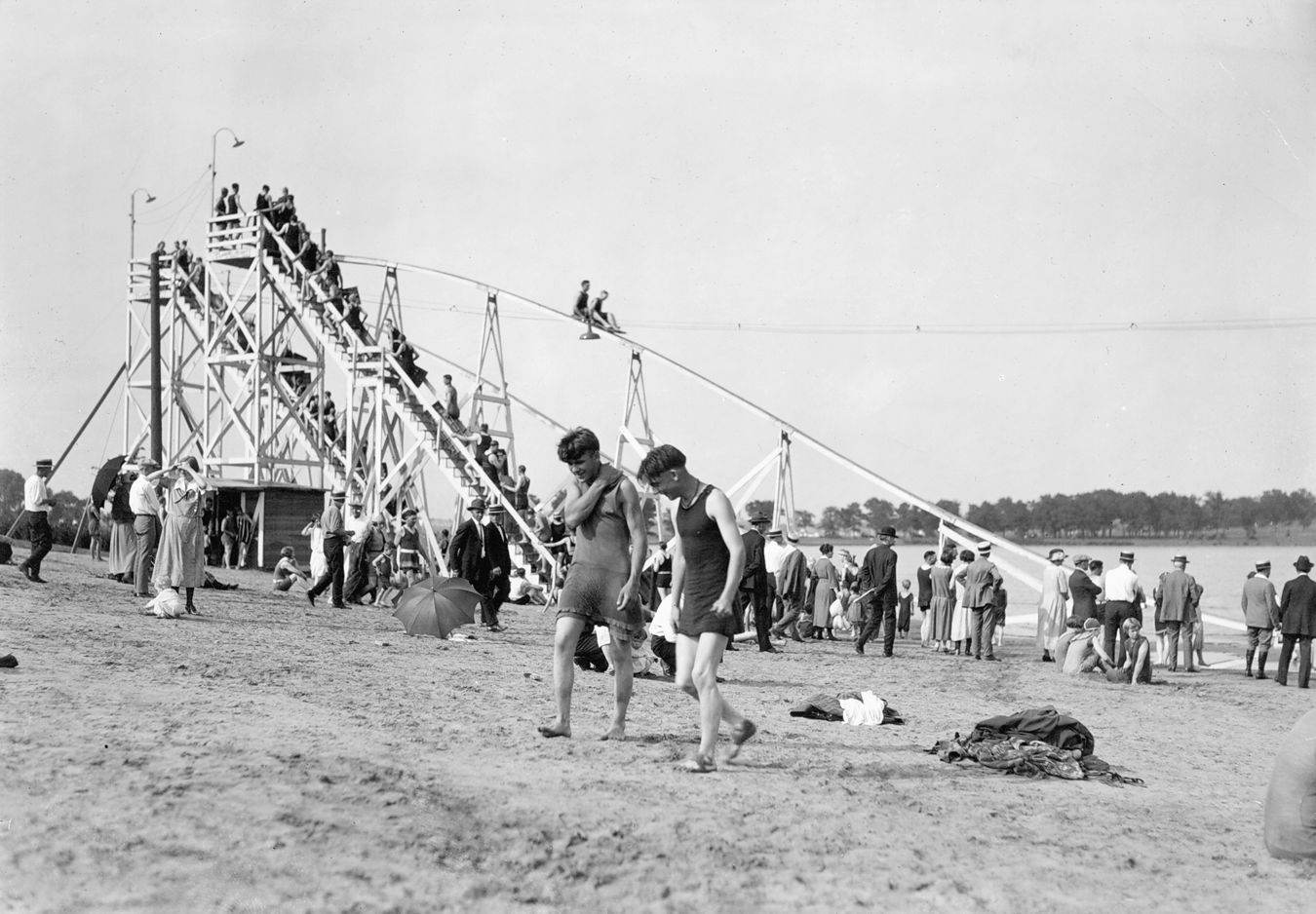
A slide at Nokomis Beach, built in 1924. (From City of Parks, courtesy Minnesota Historical Society.)
Do you remember when Waite Park was built? Did you ever attend a community sing at Folwell Park? Did you meet your wife at the old Lake Harriet bandstand or between high school football games at Parade Stadium?
The story of Minneapolis parks is really your story. Send us a chapter.
David C. Smith
 Minneapolis Park History