Archive for June, 2011|Monthly archive page
Prospect Park Garden Club wins Triangle Award; Orlin Triangle is smallest park.
Filed under: Bryn Mawr, Minneapolis parks, Prospect Park | Tags: Bryn Mawr, Elmwood Triangle, Laurel Triangle, Orlin Triangle, Prospect Park, Rollins Triangle
 Comments (1)
 An update on the smallest park triangles:
The beautiful triangles in Prospect Park are maintained by the Prospect Park Garden Club. I learned that in the delightful backyard of Mary Alice Kopf last Saturday during the Annual Garden Walk and Plant Sale sponsored by the Prospect Park Garden Club. Nobody I talked to in Prospect Park knew, however, why some triangles were taken over by the park board and others weren’t. So if you know…
I am certain now that Orlin Triangle is the smallest of the street triangles in the Minneapolis park system.

Orlin Triangle in Prospect Park is the smallest park in Minneapolis.
The second smallest is Elmwood Triangle at Luverne and Elmwood just north of Minnehaha Creek near Nicollet. Basic grass and tree — and two dead end signs. Seems a bit ominous.
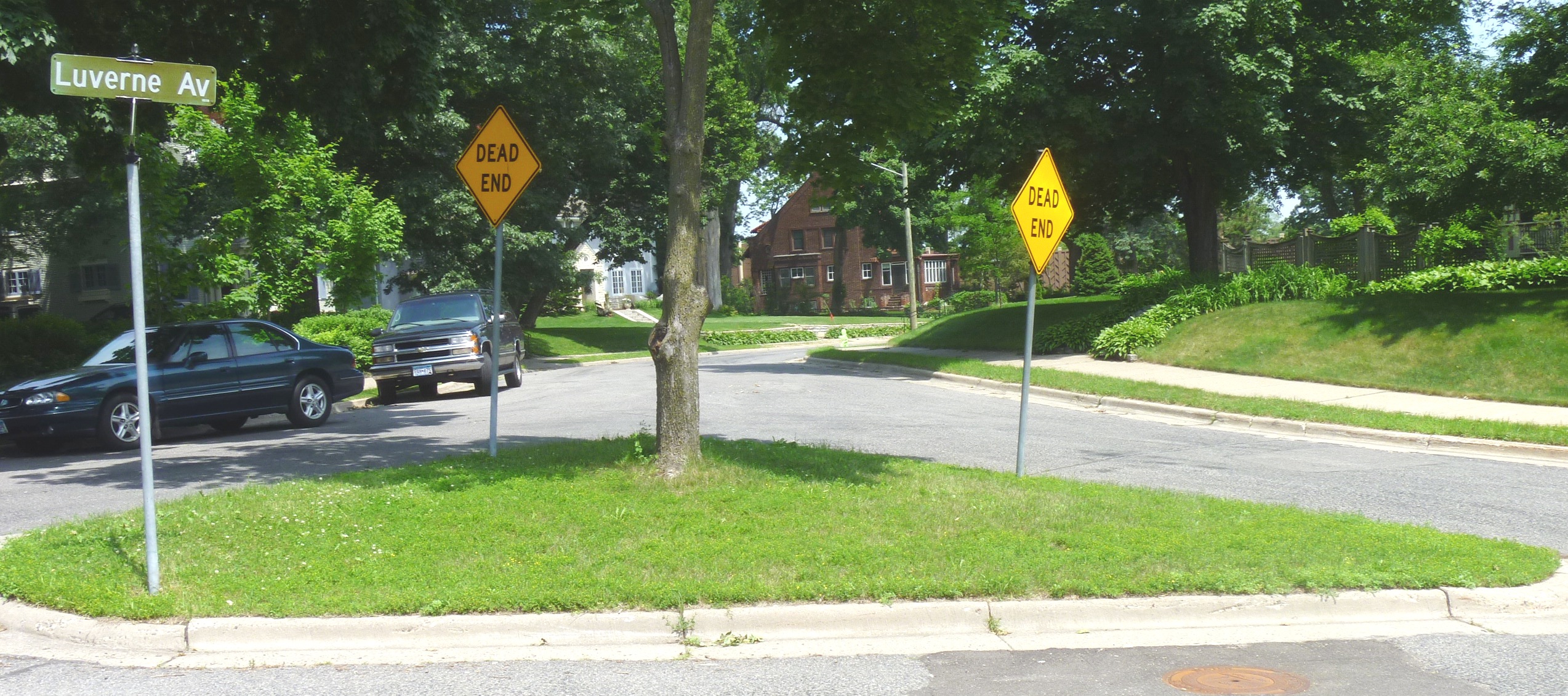
Elmwood Triangle, the second smallest park in Minneapolis, listed at 0.01 acre. Based on my rough measurements, bigger than Orlin Triangle.
The most attractive triangle park outside of Prospect Park is Laurel Triangle in Bryn Mawr. My next task is to find out who takes care of this park. Laurel Triangle was purchased by the park board for $700, most of which went to pay back taxes, in 1911, so it’s a little older park officially than the Prospect Park triangles.

Laurel Triangle, at Laurel and Cedar Lake Road, is beautiful too, in a wilder way than the Prospect Park triangles. So big it has two sidewalks and two stop signs. There’s a little stone bench next to the tree that I’d love to sit on with a cup of coffee.
Another of the smallest triangles is Rollins Triangle at Minnehaha and E. 33rd St. across from Peace Coffee. Quite a different environment on a busy thoroughfare and considerably larger than the smallest. Farther south, Adams Triangle on Minnehaha and 42nd, is one-third-acre, one of the larger triangles.

Rollins Triangle has a newspaper stand, a bus bench, vent pipes and a bit of a garden that’s overgrown. Definitely larger.
Most triangles are named for streets, but Rollins was named for the real estate development, Rollins Addition, in the neighborhood. It was taken over by the park board at the request of the city council in 1929 and officially named in 1931.
Someday soon I’ll visit the two remaining triangles listed at 0.01 acre in the park board’s inventory, Sibley and Oak Crest in northeast Minneapolis. But judging by their images on Google maps they are both larger than triangles shown here.
I purchased several plants for my yard at the Prospect Park Garden Sale at Pratt School. This whole business of planting triangles inspired me. And that was one objective of early park planners — to encourage us to replicate the pretty little public gardens on our own property.
David C. Smith
The Flying Merkel: Minneapolis Park Police Motorcycles
Filed under: Minneapolis Parks: General | Tags: Flying Merkel, Minneapolis Park Police
Comments (2) When the Minneapolis Board of Park Commissioners decided to purchase motorcycles they went with the best. On March 20, 1911 the park board approved the purchase of four “Flying Merkel” motorcycles. The specifications included “four horsepower with magneto and belt drive” at a cost of $238.50 each.

Almost like flying. This image is from theflyingmerkel.com, a web site loaded with info on one of the premier early motorcycles. Jos Ritzen, the administrator of the web site, reports that the image is from the company’s letterhead in 1912.
The Merkel Company was established in Milwaukee, Wisc. in 1902 by Joseph Merkel, a bicycle maker. His company was purchased by the Miami Cycle and Manufacturing Co. in 1911. An interesting history of the motorcycle is here, including the stories of Margaret Gast, early motorcycle racer and stunt driver, and Maldwyn Jones, a national champion racer who helped establish the Flying Merkel as a premiere speed machine. The Flying Merkel was apparently known for its bright orange color.

The 1911 Flying Merkel. The Minneapolis park board purchased four. (Photo auto.howstuffworks.com)
How did the park board use the Flying Merkels? We know the first recreation director, Clifford Booth, had used a motorcycle in previous years to speed from one playground to another, so he may have gotten one. Also in April 1910 the park board approved the purchase of a motorcycle or a horse — with a “recommendation” for the horse — for the park board’s forester. Perhaps the forester got the horse in 1910 and it was upgraded in 1911. But this photo from the 1912 annual report of the park board shows how at least two of the Flying Merkels were used.
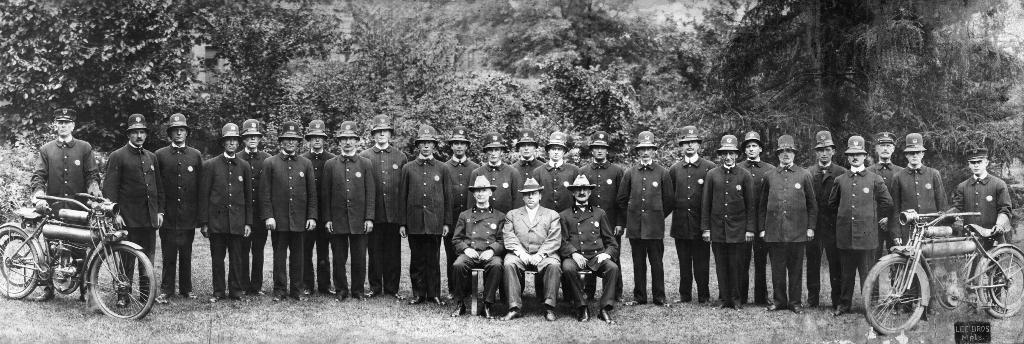
Minneapolis park police in the 1912 annual report of the Minneapolis Board of Park Commissioners. At least two “Flying Merkels” were used by the police. An independent park police force has often been cited as one reason for the great success of the Minneapolis park system. (Minneapolis Park and Recreation Board)
Park police chief Burton Kingsley, seated at the center of the photo, who later was elected as a park commissioner, asked to have the motorcycles replaced by horses. He argued that horses could be used in any weather, but motorcycles were useless in Minnesota for much of the year. He also claimed that police officers got more respect on horses. Perhaps orange wasn’t the best color for police work. But no horse could have had a cooler name.
Despite Kingsley’s preference for horses he reported that the police force logged 50,000 miles on their Flying Merkels in 1912. That’s a lot of oats.
David C. Smith
Did You Know? Tower Hill is not named for the “Witch’s Hat” tower.
Filed under: Minneapolis Parks: General | Tags: Prospect Park, Tower Hill Park, Witch's Hat
Comments (5) The park was named “Tower Hill” in 1909 four years before the water tower with the tall roof was built.
After purchasing the land for the park in 1906, the park board named the park “St. Anthony Heights.” Residents of the area petitioned the board to change the name to “Tower Hill,” which it did finally in 1909. The name was based on a long-gone observation tower built on the hill by an entrepreneur: for a dime anyone could climb the tower.
In the annual report for 1908 park superintendent Theodore Wirth presented his plan for improving the park, which included a suggestion to build an observation tower on what he called the “small plateau” at the center of the park. He continued: “This tower should be built of stone or steel and ought to be from 50 to 60 ft. high.” The park board never built that tower, but gave permission to the Minneapolis water department to build a water tower in the park in 1913 — the Witch’s Hat tower that still stands.
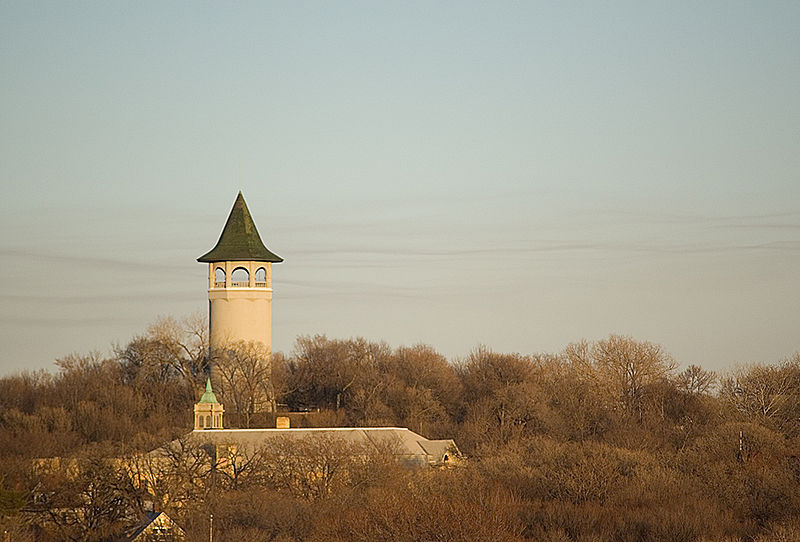
The Witch’s Hat photographed beautifully from Stadium Village by April M. King, aka Marumari. Pratt School is in the foreground.
The expansive viewing area at the top of the tower certainly fulfilled Wirth’s desire for an observation tower, although park board records do not indicate that it was a condition for granting permission to build the water tower in a park. In 1914 the city council asked the park board to provide a caretaker for the park, so people could climb the tower. The park board complied, providing a caretaker who opened the tower to the public five days a week.
As with so many park programs over the years it is easier to pinpoint when a service or program began than when it ended. There is no indication in park board records of when it stopped providing a caretaker to open the tower to the public.
David C. Smith
Lost Minneapolis Parks: A Fifth Prospect Park Triangle
Filed under: Lost Minneapolis Parks, Minneapolis parks | Tags: Midway Triangle, Prospect Park, Tower Hill Park, Witch's Hat
Comments (1) A fifth Prospect Park triangle was added to Minneapolis parks inventory in 1919 when the City Council turned over a 0.03-acre triangle at the intersection of Bedford Street and University Avenue S.E. The Minneapolis Board of Park Commissioners (BPC) instructed the superintendent to plant shrubbery on the triangle and to maintain it. It was named Midway Triangle. The City Council must have forgotten that it gave the land to the BPC—or ignored the fact—because in November 1944 the BPC adopted a resolution that “inasmuch as the intersection of University Avenue and Bedford Street, including what was formerly Midway Triangle, has been paved,” it was turning over the land to the City Council. There is still a remnant of the triangle at the intersection, just enough curbed space to hold a traffic signal, a light post and some signs.
The entire neighborhood might have looked quite different if the Minneapolis park board had acted on John Pillsbury’s proposal in 1887. Pillsbury was the former Governor of Minnesota and former Minneapolis park commissioner and still the president of the University of Minnesota’s Board of Regents at the time, who had just donated a $150,000 building to the University. He proposed that University Avenue be made a parkway from Central Ave. to the county line (the boundary with St Paul) and that from Oak Street east the parkway be 120 feet wide, or more than 50% wider than it is now.
That might have been spectacular, but it is also possible that a parkway on University Avenue would have suffered the same fate as early parkways on Hennepin Avenue from Loring Park to Lakewood Cemetery and Lyndale Avenue North from Loring Park to Farview Park. They were eventually abandoned by the BPC as parkways and returned to the control of the City of Minneapolis, because they carried too much traffic to be true parkways. I suspect the same would have happened to a parkway on University Avenue; it was a major thoroughfare. But it’s fun to speculate and try to picture a beautiful wide boulevard approaching the University of Minnesota from the east—in the shadow of Tower Hill.
David C. Smith
The Award for Prettiest Triangles Goes to….Prospect Park!
Filed under: Minneapolis Parks: General | Tags: Bryn Mawr, Prospect Park, Tower Hill Park, Witch's Hat
Comments (5) The prettiest little parks in Minneapolis are in Prospect Park.
I visited that neighborhood recently — it’s not a place you pass through conveniently on your way to anywhere else — to see what kind of damage the Emerald Ash Borer had done to Tower Hill Park.

The view from Tower Hill. One of three “overlook” views of the city from parks that you should check out. The others are Deming Heights Park and Theodore Wirth Park. (All photos: Talia Smith)
Last year nearly 80 diseased ash trees were removed from the park in which the green beetle had staked its first claim in Minneapolis. I anticipated seeing the Witch’s Hat on a bald head. Not so. Other species, especially the old oaks, make the absence of ashes barely noticeable. Several new trees had been planted, but the vegetation around the hill and tower is very dense. Given the weather of the last few months, the park, as well as the rest of the neighborhood, had the feel of a rain forest. The gentle mist at the time exaggerated the effect.
While in the neighborhood I wanted a closer look at the street triangles that are owned as parks by the MPRB. My recollection from visiting them a few years ago was that they were among the smallest “parks” in the city and the MPRB inventory lists Orlin Triangle (SE Orlin at SE Melbourne) as one of six triangles that measure 0.01 acres. The other one-hundredth-acre parks are Elmwood, Laurel, Oak Crest, Rollins and Sibley, all triangles; however, all but Elmwood appear to the naked eye to be considerably larger than Orlin.
Orlin Triangle measures roughly 30 feet per side. What’s remarkable about the triangle though is that it is a little garden. The unifying element of the little triangle gardens in Prospect Park is that each has one, two or three boulders.

Orlin Triangle, the littlest and one of the prettiest parks.
The first record I can find of requests to have the park board take over Prospect Park street triangles was in 1908. In response to a petition from the Prospect Park Improvement Association, the park board agreed on September 7, 1908 to plant flowers and shrubbery on the triangles and care for them if the neighborhood would curb them and fill them with “good black soil,” and “obtain the consent of the City Council to the establishment of such triangles.” The triangles were apparently at that time just wide and probably muddy spots in the roads.
The association reported in November of that year that the triangles were ready for planting. There is no indication in park records of how many triangles were involved or exactly where they were. Nor is there any record of whether the park board planted the flowers and shrubs as promised, or cared for them.
The next time I can find those properties mentioned in park board proceedings is 1915 when the City Council officially asked the Board of Park Commissioners to take control of four triangles in Prospect Park, which the park board agreed to do in October, 1915. In November the board named the four after the streets on which they were located: Barton, Bedford, Clarence and Orlin. Bedford was at some point paved over and no longer exists.

The mystery triangle at Clarence and Seymour. Love the maple tree. That’s Tower Hill Park in the background.
As for Clarence Triangle, its official address is listed in the middle of a block of houses and there is no traffic triangle at the corner of Bedford and Clarence where it is supposed to be. There is a triangle, however, at Clarence and Seymour, which is considerably smaller than the 0.02 acre that Clarence Triangle is listed at. If this were a park triangle it would easily be the smallest in the park system, measuring only 20 feet per side.
Somebody must mow the grass around the little maple tree. Did MPRB plant the maple tree or did someone else? Was it the same someone elses who maintain the other triangles in Prospect Park?
The other impressive non-park triangle in Prospect Park is at Orlin and Arthur. This is a three-boulder triangle blooming with gorgeous flowers. I’m sure the rest of the park system would be honored if this, too, were an official triangle park.
These little gems of gardens are what the park founders had in mind for the park system. They didn’t imagine giant sports complexes or ball fields in parks. They imagined parks to be little places of beauty — civilizing natural beauty — which is why they agreed to make parks of small odd lots at street intersections anyway. When you see the triangle parks of Prospect Park, you will understand better the intentions of the founders of Minneapolis parks.
Somebody deserves an award for maintaining those beautiful triangles, I just don’t know who to give it to. If you do, let me know.
The runner-up for prettiest triangle is Laurel Triangle at the intersection of Laurel Ave. and Cedar Lake Road in Bryn Mawr. Whoever planted and tends that garden deserves praise too.
David C. Smith
Minneapolis Park Memory: Coach Marv Nelson
Filed under: Minneapolis Park Memory, Minneapolis Parks: General | Tags: Folwell Park, Football, Marv Nelson
Comments (13) I was at a Patrick Henry Foundation ‘doings’ a couple of weeks ago and Marv Nelson’s name came up. Marv was a milk driver for Ewalds or Clover Leaf, but his passion was sports. He coached baseball, football, and hockey and the Cootie VFW was the sponsor, so his teams were the ‘Antsinpants’, but also called Marv’s Boys. It’s not like there was just one team. There were peewees, cubs, and midgets and Marv would have players on the midget teams coach the cubs and the peewees. Marv followed the Henry thing, so everything was red and gray. He always wore a sweat shirt, khakis (work pants, not dockers) and a red ball cap. He had glasses, a snarl and a cauliflower ear. He was ancient in 1965 and coached several more years. He was at Folwell, Bohanan, Shingle Creek. Any given spring there were at least 100 kids on Marv’s Boys teams. The northside never saw anyone like him.
The VFW also sponsored a “Cootie Bum Band” which would march in parades far and wide all through the 70s.
Jim Krave
Where is De Soto Harbor?
Filed under: Minneapolis parks, Mississippi River | Tags: De Soto Harbor, Ford Dam, Mississippi River, Stone Arch Bridge
Comments (5) With the completion of the High Dam, now the Ford Dam, on the Mississippi River just upstream from Minnehaha Creek in 1917, the Minneapolis park board was pressed to name the new reservoir that formed behind the dam. Without explanation, it settled on the odd name of “De Soto Harbor” on July 3, 1918. I have found no evidence that the name was ever changed, rescinded — or used.

The “High Dam” nearing completion in 1917. It became known as the Ford Dam in 1923. This was before the Ford Bridge was built later in the 1920s. (from City of Parks, Minnesota Historical Society)
The harbor was named for Hernando de Soto, the Spanish explorer who was believed then to have been the first European to see the Mississippi River about 1540. De Soto’s expedition never got anywhere near Minnesota, however, crossing the Mississippi near Memphis, Tennessee. De Soto’s story is one of some “firsts” in European exploration of North America, but also considerable brutality toward native people.
Other names the park board considered for the reservoir were Lafayette Lake, Liberty Lake, Lake Minneapolis and St. Anthony Harbor. (Minneapolis Tribune, June 27, 1918.)
The name chosen was unusual because the park board had not, for the most part, named park properties for people not connected with the history of the city or state. (Logan Park was a notable exception.) The decision to name parks only for people of local historical significance was adopted as an official policy of the park board in 1932. The policy was revised in 1968 to enable Nicollet Park to be renamed Dr. Martin Luther King Park.
Of course, some park features on the Minneapolis map—such as St. Anthony Falls, Lake Harriet, Lake Calhoun, Minnehaha Creek—predate by decades the creation of the park board in 1883.
The park board had been involved in issues surrounding dam construction for years by the time it named the reservoir, first with the Meeker Island Dam and later the “High Dam.” From as early as 1909 the park board had sent representatitives to meetings on high dam construction held by the US Army Corps of Engineers and in 1910 had requested that the park board receive half the electricity generated by the dam in exchange for “flowage rights” over land the park board owned. The government did not agree, even though the park board lost 27 acres of land for the reservoir in 1916. Included in that acreage were several islands in the river. The park board granted rights to cut down timber on one island in the river to a local charity before the trees were submerged. The board noted that neither the park board nor the Corps of Engineers wanted a stand of dead timber in the middle of the new reservoir.
Few photos I have seen give a good picture of water levels in the Mississippi before the dams were built. One of the most dramatic is this one of the Stone Arch Bridge in 1890.

Stone Arch Bridge 1890, before any dams downstream created reservoirs. (Minnesota Historical Society)
I don’t know what month the photo was taken, although foliage says summer. Perhaps the river was unusually low in late summer, but to see the Stone Arch Bridge nearly completely out of the water is unusual.
David C. Smith
You Think a Dog Park Was Controversial?
Filed under: Minneapolis parks | Tags: Dr. Martin Luther King Park, Dr. Strangelove, Nicollet Park, The Parade
Comments (1) After holding public hearings and receiving “various communications objecting to it,” on April 20, 1960, the Minneapolis park board rescinded an agreement with Minneapolis Civil Defense to build a “demonstration atomic bomb fallout protective shelter” in Nicollet Park. The board granted permission to build the demonstration fallout shelter at The Parade instead. Was it ever built? I don’t know.

This 1960 instructional booklet included plans for a fallout shelter, presumably similar to the one Minneapolis Civil Defense wanted to build at The Parade. This image is from authentichistory.com. The booklet is also available for sale on e-Bay at the time of this posting–if you’re still worried, or think it would do any good.
In 1968 Nicollet Park was renamed Dr. Martin Luther King Park. The park was the focus of bitter debate over the past year. The issue was whether converting a small portion of the park into an off-leash dog park would desecrate the memory of Dr. King. The dog park was not built.
During the 1960 meeting at which the board approved the fallout shelter, it also granted permission to the Twin City Walk for Peace Committee to hold an open air meeting at The Parade at the conclusion of a “peace walk.”
As a point of reference, Stanley Kubrick’s classic film of the atomic-bomb age, Dr. Strangelove, was released in 1964.

David C. Smith
 Minneapolis Park History