Archive for December, 2010|Monthly archive page
The Smack and Tang of Elemental Things
Filed under: Minneapolis Park Hero, Minneapolis Parks: General | Tags: Charles M. Loring, Edwin Markham, Florence Barton Loring, Henrietta Jewett Keith
 Comments (10)
 One of the coolest things I’ve ever purchased online was a book of poetry about trees published in 1923 or 1924. Not your ordinary, run-of-the-paper-mill tree poetry book. It was published by Florence Barton Loring as a remembrance from her husband, Charles M. Loring, “The Father of Minneapolis Parks.” (Do not accept imitation “creators” of the Minneapolis park system. More to come on that subject.) Only forty-eight pages with a hard cover. The little book was explained this way in a brief foreword by Mrs. Loring:
In explanation of this booklet’s publication, it may be stated that my beloved husband requested me, when circumstances favored, to compile a collection of verses from which we had derived much pleasure, on the subject of trees, for distribution as a parting souvenir of himself, among those who knew him well, and share his tastes and enthusiasm…It does not require this parting remembrance from Charles M. Loring to keep his memory alive in the hearts of his friends, but that may render it none the less acceptable to the recipients; while, to the compiler, it has been not only a means of redeeming a promise, but, also, has provided a labor of love.
Poets included range from Byron, Longfellow and William Cullen Bryant (Bryant Avenue) to Minnesota poets Henrietta Jewett Keith and May Stanley.
The poem excerpt that caught my attention though was a few lines from “Lincoln: The Man of the People,” by Edwin Markham. Loring cites only six lines of the poem including the closing four lines:
And when he fell in whirlwind, he went down
As when a lordly cedar, green with boughs,
Goes down with a great shout upon the hills
And leaves a lonesome place against the sky
That was perhaps Mrs. Loring’s tribute to Lincoln as well as her husband, who had been a stalwart of Lincoln’s party. But she left out Markham’s great description of Lincoln including the fabulous line used as a title here:
The color of the ground was in him, the red earth;
The smack and tang of elemental things;
A reading of Markham’s poem was part of the dedication of the Lincoln Memorial in Washington, D.C. in May, 1922. Markham, who had published the poem in 1901, read it himself. The dedication took place a little more than a month after Charles Loring died at the age of 88.
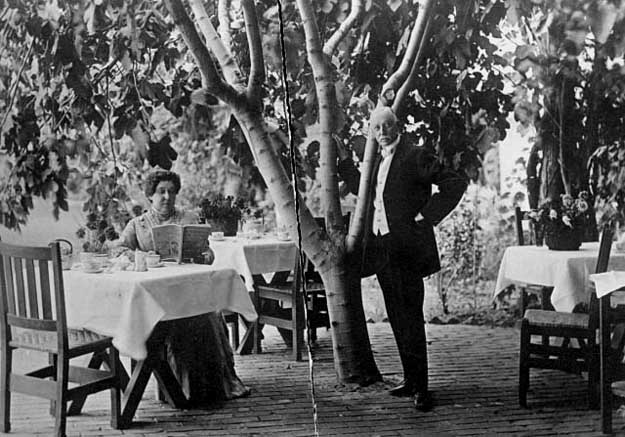
Florence Barton Loring and Charles Loring, about 1915, likely in Riverside, California where they often spent the winter. (Minnesota Historical Society, por 16225 r3)
I first saw the book at the Minnesota Historical Society Library in St. Paul (there is also a copy in Special Collections at the Hennepin Country Central Library downtown Minneapolis). Because relatively few copies were printed for gifts to Loring’s friends I was surprised to find one for sale online from a Los Angeles rare book dealer. It is one of only a few souvenirs I have collected from my research of Minneapolis parks.
More on Florence Barton Loring soon.
David C. Smith
© David C. Smith
Minneapolis Park Memory: Logan Ice
Filed under: Minneapolis Park Memory | Tags: Logan Park, Minneapolis parks
Comments (1) My park was Logan. In winter, there were hockey rinks, a beautiful skating area and a pavilion that featured many programs. In summer, many musical programs took place on an outdoor veranda. My favorite winter sport was ice skating, so I visited Logan Park almost daily.
Charlotte Brisley
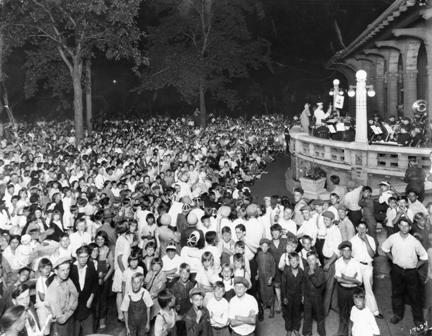
Community sing at the Logan Park Fieldhouse (City of Parks, Minneapolis Park and Recreaton Board).)
Minneapolis Park Memory: Treasure
Filed under: Minneapolis Golf Courses, Minneapolis Park Memory, Minneapolis Parks: General | Tags: Hiawatha Golf Course, Lake Harriet, Minnehaha Park, Powderhorn Park
Comments (1) How I have enjoyed the Minneapolis parks: watching fireworks at Powderhorn Park; concerts at Lake Harriet, with picnics on the hill; swimming and canoeing at Calhoun; walking in Minnehaha Park and eating crab cakes at Sea Salt; walking and biking at Nokomis; watching my children play hockey at various parks, and baseball at McRae and Diamond Lake; teaching the children to skate at Diamond Lake; my sons in their early teens taking the bus from our home at 48th and Clinton all the way to Theodore Wirth Park to play golf; my boys golfing at Hiawatha and telling us that they played with two really nice “old guys.” (These “old guys” happened to be friends of ours from church and were our age, in their 40s.)
My son Glen would leave the house in the summer early in the morning, bike to Lake Harriet with his fishing equipment, climb on a tree branch overhanging the lake and stay until suppertime. He enjoyed being outdoors even if he didn’t catch fish.
But here is my most treasured memory: In 1945, my future husband took me canoeing at Calhoun and then into Lake of the Isles, and gave me my engagement ring.
Alice Streed

The Romantic Route (from City of Parks, Minneapolis Park and Recreation Board)
Minneapolis Park Memory: A Hike Down Memory Lane
Filed under: Minneapolis Park Memory, Minneapolis Parks: General | Tags: Minneapolis parks, Minnehikers
Leave a comment The Minneapolis Municipal Hiking Club celebrated its 90th anniversary this year. On the first Saturday of January every year, we do an anniversary hike, starting at Rarig Center on the West Campus and continuing on West River Parkway all the way to Minnehaha Falls. The hiking club was started by Theodore Wirth in 1920, and they hiked from Minnehaha Falls to Riverside Park, where they cooked coffee over an open fire and enjoyed donuts. The club has done this hike every year, but in reverse. I have hiked this route many times, even in bitter cold weather, as cold as minus 16 degrees. We end up with dinner at one of the churches. I believe the hiking club has hiked in every park in Minneapolis over the years. The club has also donated over $21,000 for flowering crabapple trees and other tree varieties, also benches by the rose and peace gardens. I recently helped edit a history booklet highlighting some of the activities and trips taken by members.
Edith Johnson
Editor’s note: For more information on the history of the Minneapolis Municipal Hiking Club, or Minnehikers, visit the Special Collections department of the Central Library in Minneapolis. The collection includes hiking club yearbooks for almost every year 1924-1999. The Minnesota Historical Society Library has a more limited collection featuring the earlier years.
We would enjoy reading more memories of club hikes in these pages.
Minneapolis Park Memory: Best Days of My Life
Filed under: Minneapolis Park Memory | Tags: Brackett Park, Keewaydin Park, Longfellow Park, Minnehaha Falls
Comments (3) I grew up in South Minneapolis and enjoyed all the parks especially Minnehaha and the Falls. I have a picture of my Girl Scout Brownie Troop taken there (that would be along time ago). My family has had many wiener roasts at the “deer pen” and several family reunions attended by 80+ people from many different states. We just had one this past August at Wabun Park at the east end of Minnehaha Park. It has recently been remodeled and is a wonderful park.
My best memories have to do with our local neighborhood parks that aren’t necessarily on a tourist’s list, such as Keewaydin, Brackett, Longfellow, Hiawatha and many others. My favorite park was Longfellow, where my husband spent his childhood years skating and playing hockey, football and baseball. He was president of the Longfellow Activities Council for seven years and was a baseball coach. Those were the “good old days” when you could send your kids to the park without worrying about kidnapping and the like.
Activities at the park brought kids and parents together; we were one large family that would be known as a “village” today. Those were the best days of my life.
Shirley Adler
Minneapolis Park Memory: North to South
Filed under: Minneapolis Park Memory | Tags: Glenwood Park, Lake Hiawatha, Lake Nokomis, Minnehaha Falls, Victory Memorial Drive, Webber Pool
Comments (6) Minneapolis truly is a “City of Parks” for everyone — north, south, east , and west. As a ten-year-old tomboy in north Minneapolis, the neighbor kids and I would hike three miles to Glenwood Park, where we hunted for golf balls at the golf course, climbed the ski jump, and went wading in the creek until the golf workers would yell at us, “Hey, you little brats, get the heck out of that ‘crick’ NOW!” We would find a shady spot and dry off, giggling while eating our peanut butter and jelly sandwiches. Or we would hike along Victory Memorial Drive to the Camden Pool, where every kid in north Minneapolis came to swim or get a bath. It was jam-packed with grubby young bodies all day long! When I was twelve, we moved to south Minneapolis, the Nokomis Lake and Lake Hiawatha area, another neat area for having fun in the parks.
After marriage and four kids, it was my kids who kept up the “fun in the parks” tradition, especially at Minnehaha Park. They investigated every nook and cranny, often ending up at the Falls, where they would crawl down the steep banks to the bottom of the Falls and work their way behind the water falls so nobody could see them and then make scary sounds and howls when little kids came to look at the water falling. Down the path from the Falls to the river was a large tree on a high bank. My son found a sturdy branch to which he tied a long, 2″-wide rope. Then he crawled to the top of the bank, holding the rope firmly an gave a bloodcurdling “Tarzan” yell, swinging form the top of the bank to a small island in the river where he landed. All the kids had a good time with the “Tarzan tree.” There weren’t so many park police or restrictions to keep kids from getting into mischief in the 30s to 60s, but I don’t recall any accidents occurring.
Thanks to Theodore Wirth and the Minneapolis Park Board for their foresight and wonderful planning of our great park system. There is so much for our enjoyment, and it’s free.
Judy Knutson
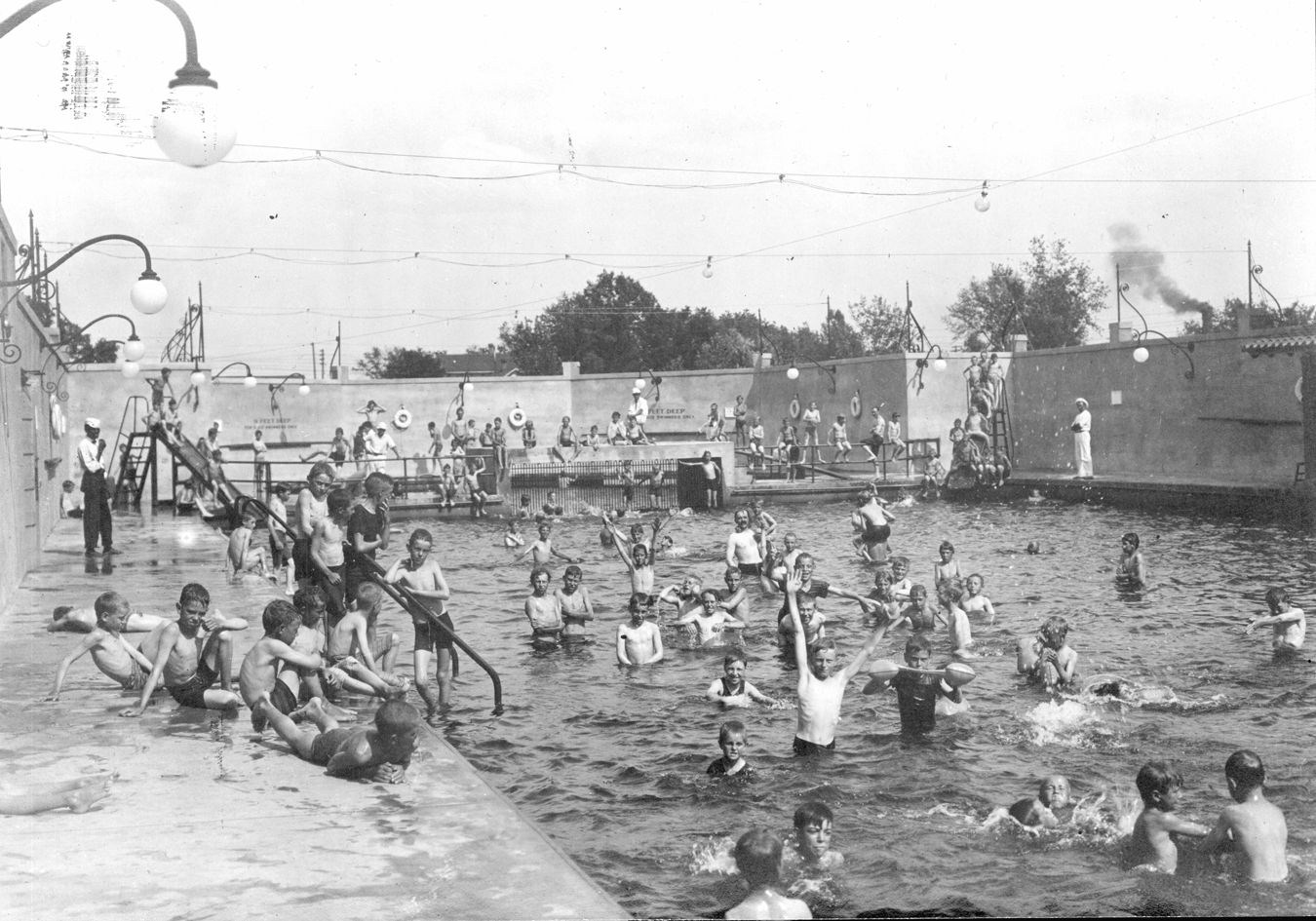
Webber Pool, year unknown. From the time it was built in 1910 until 1927, water was diverted form Shingle Creek to fill the pool. Beginning in 1927 the pool used filtered and chlorinated city water. In the early years, boys and girls used the pool at different times. One reason for the high wall around the pool was to prevent boys and girls from watching each other swim. In the 1930s, more than 1,500 children under the age of 14 used the pool every summer day. (City of Parks, Minneapolis Park and Recreation Board)
Minneapolis Park Memory: A Friend of Loring Park
Filed under: Minneapolis Park Memory | Tags: Loring Park, McRae Park, Minneapolis parks, Powderhorn Park, Theodore Wirth Park
Comments (1) After arriving in Minneapolis in September 1941, the first city park I became familiar with was Loring. I had come to enter nurse’s training at Eitel Hospital, and the park was right across the street. The park provided a beautiful view from patients’ rooms. It was also an oasis for student nurses, a place to relax in the summer or go skating on the lagoon in winter. Every nurse who has graduated from Eitel would have special memories of Loring Park.
The park looked different back in the forties. Old, tall trees grew along the edge of the lagoon. Now they are gone and tall grasses grow at the edge of the water. Bright red cannas blossomed in flower beds on the west side of the park. Now, “Friends of Loring” have created a large round garden on the northwest side called “Garden of the Seasons.” A variety of trees and flowers are in the center with benches and a brick path around it. Bricks can be donated in honor or memory of someone. A brick on the east side reads: “Eitel Hospital Nursing School — Class of 1944,” given in tribute to classmates, many of whom had served in the Army Nurse Corps in World War II.
In later years, my family and I enjoyed picnics at Minnehaha Park and viewing the beautiful Falls. Performances by the Aqua Follies at Theodore Wirth Park, and pop concerts at Lake Harriet on Sunday afternoons were great fun. My son as a teenager spent many winter evenings skating and playing hockey at McRae Park. On July 4th, we watched fireworks at Powderhorn Park. The park system provided something special for every season. My husband often said, “Minneapolis is the prettiest city I’ve ever seen.”
Ardelle Lande
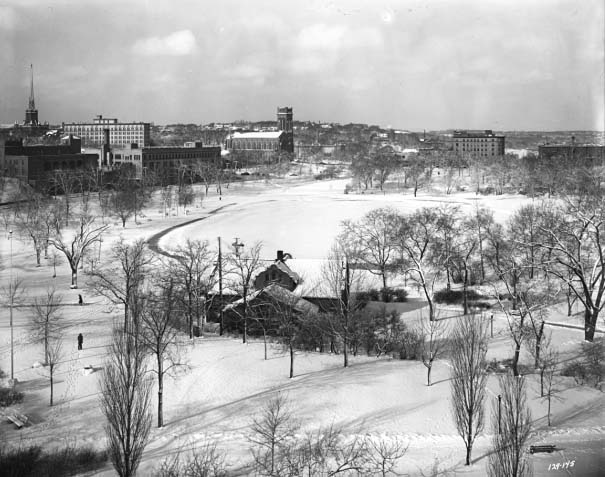
Looking west across Loring Park from Eitel Hospital, 1375 Willow Street, in 1939. (Norton and Peel, Minnesota Historical Society, NP129145)
Editor’s note: For more photos of Eitel Hospital visit the Photo Collection of the Minnesota Historical Society.
If you have a Minneapolis Park Memory, send it to minneapolisparkhistory[at]q.com. If you have a digital photo to accompany your memory, we’d love to see it.
Minneapolis Park Memory: Phelps Field Fun
Filed under: Minneapolis Park Memory | Tags: Minneapolis parks, Phelps Field
Leave a comment Living across the street from Phelps Field for fifty years, at 39th and Park Avenue, was sometimes both a joy and a curse. Cousins coming from out of town would always be eager to get to the park. If a baseball or basketball game was in progress, they would be eager to join in. The younger children loved the swings, slides, etc. But my paramount memory of Phelps Field was a basketball bouncing at one o’clock in the morning. I often wondered who the young man was. Did he not have a home to go to or would he rather be in the park than go home? I’ll never know. But to my way of thinking, he probably ended up playing in the NBA!
Jennie Aamodt
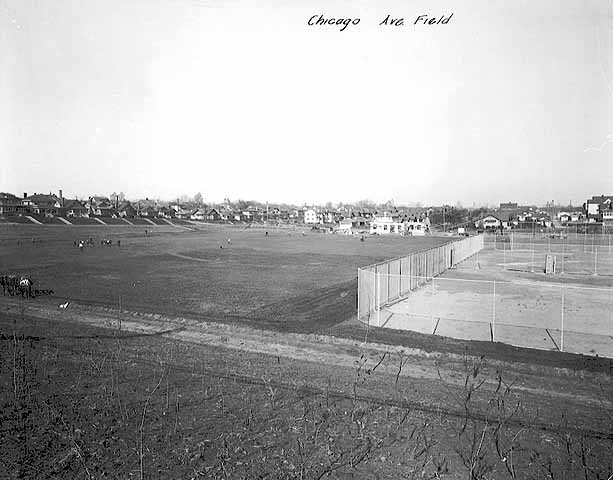
Phelps Field began life in 1917 as Chicago Avenue Field. The park was developed in 1924 (shown here). It was renamed Phelps Field in 1939. (Minnesota Historical Society, MH5.9 MP4.5 p8)
Minneapolis Park Memory: Spectacular Powderhorn
Filed under: Minneapolis Park Memory | Tags: Minneapolis parks, Powderhorn Park
Leave a comment Powderhorn Park in south Minneapolis is a unique park with a large island in the middle of the lake. I lived about eight blocks from there, just the right distance for a walk. In the winter, my friend, Muriel, and I would tie the laces of our skates, carry them around our necks, and head for Powderhorn. It was a great place to skate around and around the island; we spent many days skating.
On Monday nights in the summer, we walked to the park to listen to the band concert (more important to us was to walk around and meet the boys). It was on one of those nights that I met my husband, and the first date I had with him was made there. That date never materialized, because I stepped on a bee while mowing the lawn and had to stay home. I’m not quite sure he really believed me, but we did get married a year or so later. Since he was in the service then and only able to get home a few times, we got married after only eleven dates.
July 4th was a big night at Powderhorn. All the families brought blankets and sat on the hills to watch the big fireworks display. The fireworks were lit on the island. One year there was a mishap; every one of the rockets went up at once. It made for a short, but spectacular event.
Fern Eidsvoog
Inspiration, Ideas and Ideals (Courtesy of William Watts Folwell)
Filed under: Minneapolis Parks: General | Tags: Folwell Park, Minneapolis parks, William Watts Folwell
Comments (1) Park history provides more than pretty pictures. Thanks to people such as William Folwell, it also gives us inspiring words. Such inspiration has perhaps never been needed more than now when political discourse is dominated by petty self-interest and shallow swagger.
“We owe it to our children and to all future dwellers in Minneapolis to plan on a great and generous scale. If we fail to accomplish, let them know it was not for lack of ideas or ideals.”
— William W. Folwell, President, Minneapolis Board of Park Commissioners, Eighteenth Annual Report, 1900

William W. Folwell attended the dedication of facilities at Folwell Park, July 4, 1925. He was 92. (Minnesota Historical Society, por 12574 r18)
David C. Smith
Powderhorn Park and Augsburg Stories Converge
Filed under: Minneapolis Parks: General, Powderhorn Park | Tags: Murphy Square, Powderhorn Park, Speed Skating
Leave a comment A reader of recent posts on Murphy Square/Augsburg College and speed skating at Powderhorn Park put the two together and suggested a link to an article featuring U. S. Olympic speed skater Johnny Werket, who attended Augsburg. From the article we learn that a third Minneapolis park also played a role in the story: Longfellow Field was Werket’s home park.
Thanks for the tip.
David C. Smith
 Minneapolis Park History