Archive for July, 2011|Monthly archive page
Yes, there was a Clarence Triangle.
Filed under: Minneapolis Park Memory, Minneapolis parks | Tags: Clarence Triangle
 Leave a comment
 I just received this note from a reader who remembers Clarence Triangle in Prospect Park, which I wrote about recently. Thanks for the story.
Oh, there was a triangle there! I lived at 79 Bedford, across the street from the Triangle, at the foot of the hill that is Clarence. My parents bought the house in 1948, and sold it in 1975. Some time later, Dutch elm took most of the trees on Bedford, and they took out the curve at Bedford and Orlin (NOT an improvement in my opinion). I suspect when they modified the street, that is when they took out the triangle. I am guessing the late 1980’s?
It was a wonderful neighborhood to grow up in! As kids, we’d look out our living room window when it snowed, and watch the cars try to make it up the Clarence hill. They usually would, unless they met a car going downhill that would not move aside :) Cars were rear wheel drive then.
Lloyd Mann
Large Stone Fireplace in Minnehaha Dog Park?
Filed under: Minneapolis parks, Minnehaha Falls | Tags: Minnehaha Dog Park, Minnehaha Falls
Comments (7) Mary MacDonald recently wrote to ask for info on the large stone fireplace near the long path to the Mississippi River in the Minnehaha Dog Park off 54th and Hiawatha. She said she’s been unable to find any info on who built it and how old it is. Does anyone know? I don’t know anything about it. Leave a comment or e-mail me at the address below.
David C. Smith
Maybe it’s time for Puck to have a sniff.

Puck
Pioneering Minneapolis Landscape Architects: Wyman, Morell and Nichols, but not Wirth?
Filed under: Grand Rounds, Landscape Architects, Victory Memorial Drive | Tags: Anthony Morell, Arthur Nichols, Phelps Wyman, Theodore Wirth, Victory Memorial Drive, Warren Manning
Comments (4) I’ve been surprised at the interest generated by posts here about landscape architects who worked on Minneapolis parks, so I’ll add the latest info I have on a few landscape architects.
I once compiled a list of all the park designs and plans published in the annual reports of the Minneapolis Board of Park Commissioners for the first 60 years of its existence, 1883-1943. For the most part, that means the plans of Horace W. S. Cleveland, who designed the first Minneapolis parks, and Theodore Wirth, who was superintendent of parks 1906-1935.
From the time Cleveland stopped working, about 1893, until Wirth was hired in 1906, the Minneapolis park board did not have a landscape architect — nor the money to pay one following a severe economic downturn — except for hiring Warren H. Manning for various projects from 1899 to 1905. No Manning plans for Minneapolis parks have survived, although his in-depth written recommendations for Minneapolis parks were published in the 1899 Annual Report of the Minneapolis park board. More on Manning in a later post.
While Wirth was superintendent, he prepared nearly all park plans himself, although I believe he identified himself more as a gardener and engineer than a landscape architect. He listed himself as “Sup’t.” on most of his park plans until 1926 when he added “Eng’r.” He was an early and active member of the American Institute of Park Executives, but did not, to my knowledge, join the American Society of Landscape Architects. Wirth was not included in Pioneers of American Landscape Design, a compilation by Charles Birnbaum and Robin Karson of Americans who influenced the nation’s landscape. I think that is an oversight.
While Wirth gets too much credit from some in Minneapolis for creating the city’s park system, his omission from a list of more than 160 prominent landscape designers in the United States probably gives him too little credit for shaping one of the nation’s premier urban park systems.
Wirth’s omission from the “pioneers” list is more striking because three landscape architects who practiced in Minneapolis while Wirth was parks chief were profiled as pioneers: Anthony Urbanski Morell, Arthur Richardson Nichols and Phelps Wyman. I don’t believe it could be argued that any of the three had nearly as great an impact on the landscape of Minneapolis — and perhaps urban parks in general — as Wirth did, although they all worked in other locations as well.
I have already written about Wyman, but would like to add notes on Morell and Nichols’s involvement with Minneapolis parks and update info on Wyman.
Morell and Nichols
Morell and Nichols became partners in 1909 and relocated to Minneapolis to take advantage of connections they had made in Minnesota while working for a New York landscape architect on projects in Duluth — the Congdon Mansion and the Morgan Park neighborhood — according to Pioneers of American Landscape Design. Their names first appeared in Minneapolis park board documents in the park board’s annual report of 1910. They are cited as the creators of a design for Farwell Park in North Minneapolis for the David C. Bell Investment Company, one of the city’s most prominent real estate developers. The 1.2-acre park was platted in the Oak Park (not Oak Lake) Supplement in 1889, but it wasn’t until 1910 that the developer asked the park board to take control of the land and improve it as a park using a plan the developer provided. The plan itself was not unusual, but it was the first landscape plan to appear in an annual report that had not been commissioned by the park board. That Wirth chose to publish the plan in the annual report suggests his regard for Morell and Nichols. Wirth encouraged park commissioners to approve the plan, which they did. Wirth wrote in the 1910 annual report:
The proposed arrangement of lawns, plantings and walks, is very pleasing and appropriate to the surroundings and the present topography of the grounds, and the execution of the plan will not involve a very large expenditure.
Improvements to the park were begun in 1911 and completed in 1912. The Bell company originally paid for the work, but was reimbursed by the park board.
Regional Parks
The other references to Morell and Nichols in park board annual reports were in the 1930 and 1935 reports in connection with their work for Hennepin County, which includes Minneapolis, when they prepared a preliminary study for a county-wide park system in 1922 . Theodore Wirth referred to their plan in the 1930 annual report in his yearly words of encouragement for the Minneapolis park board to lead the effort to create a regional park authority. Wirth advocated including Minnehaha Creek, Bassett’s Creek and Shingle Creek, from their sources in Hennepin County lakes to the Mississippi River in Minneapolis, in a regional park system. In the 1930 report, Wirth included a map of the territory embracing the sources of Shingle Creek and Bassett’s Creek and highlighted park areas recommended by Morell and Nichols in their earlier report. Among the areas they had suggested for parks in northwest Hennepin County were portions of the shores of Medicine Lake, Bass Lake, Eagle Lake, Lime Lake, and all of Sweeney Lake adjacent to Glenwood Park. The map legend indicated that Robbinsdale planned to preserve the entire shorelines of Twin Lakes and Crystal Lake as parkland as well. Too bad that didn’t happen.
Five years later, in the 1935 annual report, Wirth’s last as park superintendent, he published his own “Tentative Study Plan” for a park district for the west metropolitan region. Wirth had been directed by the park board in February 1935 to undertake the study in hopes that the board could apply for federal work relief funds to begin to implement a metropolitan park plan. Although funds were not forthcoming for that project, the idea of a county park system eventually led to the creation of what is today the Three Rivers Park District.
Wirth submitted his report to the board in November 1935 and it was published in its entirety in that year’s annual report. Wirth noted that his plan had been created in collaboration with Arthur Nichols, who was then the consulting landscape architect to the Minnesota Highway Department. Wirth wrote that he and Nichols had spent one afternoon a week for two months touring possible park and parkway sites in suburban and rural Hennepin County and had completed their research with aerial reconnaissance of prospective parks.
These two events in which Morell and Nichols worked with Wirth on park design don’t tell us much about their practice, except that they seemed to have an effective working relationship with Wirth and were well-known to him and other decision makers, from developers to county commissioners. Phelps Wyman also knew Morell and Nichols. Morell was a consultant to the Minneapolis Planning Commission on which Wyman sat as the representative of the park board in the early 1920s. Wyman and Nichols had worked together for the US Housing Corporation in Washington, D.C. during the Great War. Moreover Nichols had been the first graduate in 1902 of MIT’s landscape architecture program, which Wyman completed a few years later. Having attended the same educational institution at a time when few academic programs in landscape architecture existed would have likely created some bond between them.
Phelps Wyman and Victory Memorial Drive
Of the three “pioneers” in landscape design, Wyman had by far the most input on park landscape architecture in Minneapolis due to his service as an elected park commissioner 1917-1924. In an earlier post I noted Wyman’s design of what is now Thomas Lowry Park, his proposed plan for Washburn Fair Oaks, and his suggestion of a traffic circle to relieve congestion at the Hennepin and Lyndale Avenue bottleneck. What I overlooked in that post was perhaps Wyman’s most creative park design, which Wirth included in the park board’s annual report of 1929 even though the plan had been created eight years earlier. (Phelps resigned from the park board and moved to Milwaukee in 1924, one reason I didn’t consider looking for Wyman’s influence on park designs in documents from the late 1920s.)
In the 1929 annual report Wirth included Wyman’s “Preliminary Sketch of Victory Memorial Drive” from 1921 to illustrate the need for grade separations between parkways and city streets in some locations. In Wyman’s sketch, Broadway Avenue West tunneled under a large plaza at the intersection of Victory Memorial Drive and Lowry Avenue North. Wirth provided no explanation of why Wyman created his “decorative scheme” for the parkway, but it is a fascinating design.

Phelps Wyman’s design for Victory Memorial Drive, 1921 (1929 Annual Report, Minneapolis Board of Park Commissioners)
Among Wyman’s more interesting ideas — in addition to putting Broadway underneath an extensive plaza:
- Three plazas would have anchored the drive: one at Camden (Webber) Park was labelled “America Mobilized,” the monument plaza and flag pole at the northwest corner of the drive was titled “Humanity,” and the Lowry Avenue Plaza was called “America at Peace.”
- Another plaza, “Freedom of Seas”, would have connected Victory Memorial Drive to Crystal Lake between 39th and 40th avenues north. The only connection I can imagine between a stretch of land along a Robbinsdale lake and a “Freedom of Seas” park is the sinking of the Lusitania, an important factor in the U.S. entry into WWI and the resulting dead young men and women who were honored along Victory Memorial Drive.
- The west side of Victory Memorial Drive from Lowry Avenue to 45th would have been reserved for “Public Institutions.”
David C. Smith
© David C. Smith
More Flying Merkel v. Horse: Depreciation
Filed under: Lake Harriet, Minneapolis Parks: General | Tags: Flying Merkel, Lake Harriet
Comments (1) Another element in the debate over whether a motorcycle or a horse is a more efficient means of conveyance for park police officers, which I introduced last week in a post about Flying Merkels, is the depreciation of each. I was forced to consider that by an entry in the Proceedings of the Minneapolis Board of Park Commissioners for February 5, 1919.
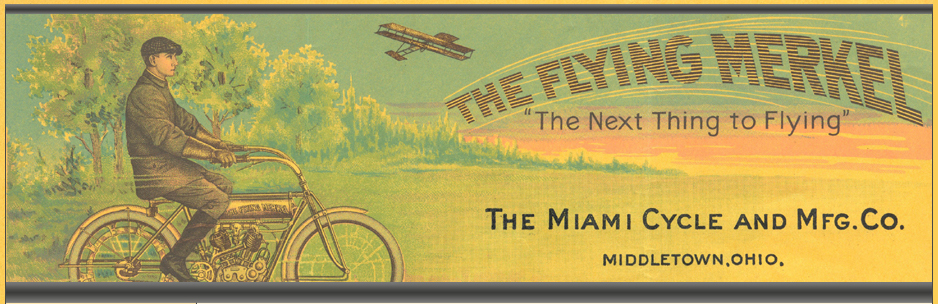 In January of that year a hired horse pulling an ice scraper over the ice skating rink on Lake Harriet had plunged through the ice and drowned. The owner of the horse submitted a bill for $125 to the park board to compensate him for the loss, which the park board paid. But knowing that in 1911 a Flying Merkel had cost the park board $238.50, I wondered if the horse was maybe old and worn out. $125 doesn’t seem like much for a horse; the price must have reflected considerable depreciation. What would a used Flying Merkel have been worth? And were there children skating on the lake the day the horse broke through the ice? Did the ice crack like a pistol shot or simply submerge with a gurgle. Did the horse make a sound or did it confront death with equine-imity? The Flying Merkel would have sunk quickly and quietly—but wouldn’t have been worth a damn pulling an ice scraper.
David C. Smith
Linking the Lakes: Making Minneapolis the Venice of North America
Filed under: Minneapolis parks | Tags: Lake Calhoun, Lake of the Isles
Leave a comment Happy Belated Centennial! Yesterday was the hundredth birthday of the channel that links Lake of the Isles with Lake Calhoun. It was the first of the navigable lake connections that later extended to Cedar Lake and Brownie Lake. Some background on those lake connections was featured in an earlier post on Lake Calhoun and Lake Harriet.
The “Linking of the Lakes” was turned into a civic celebration that lasted nearly a week. The event was conceived and planned by the Minneapolis Publicity Club. The idea for a civic celebration was apparently hatched in November 1910 at the Minneapolis Harvest Dinner, a more modest one-evening event. While the central event of the civic celebration was the linking of the lakes, it appears to have been pretense for a party.
“It is argued by the business men that in no better way can the city merchant get in more personal touch with his country customers than through the Civic celebration when, under the spirit of merrymaking and jollity, they come together.”
Minneapolis Morning Tribune, July 2, 1911
The park board knew exactly what the intent was when it passed a resolution on December 5, 1910 that “irrespective of the benefits which may accrue to the city through such a celebration, the occasion is of such peculiar interest and significance to this board, that every effort should be made to do its full part…”
The construction of a channel between Lake Calhoun and Lake of the Isles was not a particularly challenging or imaginative endeavor. As noted in the earlier post, the project had been considered for many years and treated as a done deal as early as 1899 by landscape architect Warren Manning in his recommendations for the Minneapolis park system. In engineering terms it was simpler than the dredging that had been going on for years at Lake of the Isles, both in the 1880s and 1900s. The only construction needed for the project were bridges over the excavated channel, which were not more challenging to plan and build than bridges elsewhere in the city — although the park board’s 1909 annual report included the admission that bridge construction estimates were 50 to 100 percent over budget.
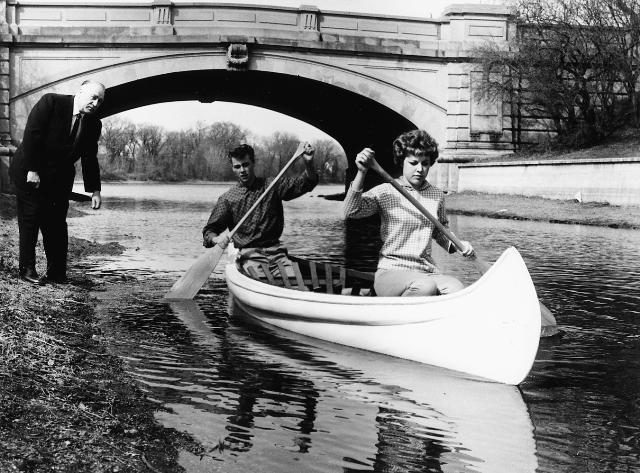
Park superintendent Howard Moore helps launch a canoe in 1960 to celebrate navigable water once again after a few years of a dry channel between Lake of the Isles and Lake Calhoun. (Minneapolis Park and Recreation Board)
Even the design competition for bridges, with a top prize of $800, had been disappointing. Park Superintendent Theodore Wirth wrote in the 1909 annual report, “With a few exceptions the designs submitted were not of the high-class character which it was thought the competition would bring forth.” The third prize was not even awarded. To make matters worse, the bridge over the channel from Lake of the Isles to Cedar Lake had to be partially torn down and rebuilt because it began to settle as soon as it was built, which delayed the connection of Isles and Cedar.
The connection of Lake of the Isles to Cedar Lake was finally completed in 1913, and Cedar Lake was linked to Brownie Lake in 1917. That final connection made possible a new feat of municipal athletic endurance: the swimming of the Chain of Lakes. The Minneapolis Morning Tribune, August 8, 1918 reported the setting of a new record when Dan Bessessen, the new captain of the University of Minnesota swim team and a life guard at Lake Calhoun, swam from the north end of Brownie Lake (off Superior Avenue then) to Thomas Avenue on the southern shore of Lake Calhoun in one hour and thirty-eight minutes. The swim was supervised by Frank Berry, the park board’s recreation director, who accompanied Bessessen in a boat that also carried four time keepers.
Despite the $125,000 price tag to link Isles and Calhoun, the park board appeared not to be profligate with funds. When Wirth submitted plans and an estimate for a park board float for the water parade during the celebration, it was defeated by a vote of 10-1 even though the City of Minneapolis was spending $500 for a float. Another request from Wirth to spend $200 to buy evergreen trees to temporarily cover the “unsightly” railroad embankment adjacent to the lagoon during the celebration was defeated by a vote of 11-0.
I think it’s debatable if the “Linking of the Lakes” was even the park board’s biggest role in municipal or state history in the spring and summer of 1911. I’d give top billing to another event that the park board didn’t initiate, but went along with: the donation to the park board by Clinton Morrison of the land for an art museum. The result of that transaction was the eventual construction of the Minneapolis Institute of Arts in Dorilus Morrison Park.
I love the channels that connect the lakes, which Jesse Northrop said would make Minneapolis the “Venice of North America,” but I think the construction of what has become an excellent art museum, while it might not make Minneapolis the “Florence of North America,” is still of greater importance to our city today. Even without the channels between lakes Minneapolis was still blessed with exceptional natural attributes. The art museum filled an otherwise unmet need at the time, despite Thomas Barlow Walker’s incredible art collection.
David C. Smith
 Minneapolis Park History