Archive for January, 2017|Monthly archive page
100 Years Ago: Altered Electoral Map and Shorelines
Filed under: Grand Rounds, Minneapolis Golf Courses, Minneapolis Park Board, Minneapolis Parks: General, Mississippi River | Tags: Dr. Martin Luther King Park, Folwell Park, Lake Calhoun, Lake Nokomis, Phelps Park, St. Anthony Boulevard, Theodore Wirth
 Comments (10)
 What has changed in 100 years? A few times on this site, I have looked back 100 years at park history. I’ll expand my scope this year because of extraordinary political developments. Politics first, then parks.
The national electoral map flipped. The electoral map of the 1916 Presidential contest is astonishing. Woodrow Wilson, a Democrat, won a close re-election against Republican candidate Charles Hughes, a Supreme Court Justice. Compare red and blue states below to today. Nearly inverted. The Northeast, Upper Midwest and Far West — well, Oregon — voted alike. Republican. And lost.

The 1916 electoral map was nearly opposite of the 2016 electoral map in terms of party preference. Unlike 2016, President Wilson won both the popular vote and the electoral vote, but his electoral-vote margin was smaller than Donald Trump’s. If the total of votes cast in 1916, fewer than 19 million, seems impossibly low even for the population at that time, keep in mind that only men could vote. (Source: Wikipedia)
While Minnesota’s electoral votes were cast for the Republican — although Hughes received only 392 more votes than Wilson out of nearly 400,000 cast — Minneapolis elected Thomas Van Lear as its mayor, the only Socialist to hold that office in city history. One hundred years later, Minneapolis politics are again dominated by left-of-center politicians.
The population of Minneapolis in 1916 and 2016 was about the same: now a little over 400,000, then a little under. Minneapolis population peaked in mid-500,000s in mid-1950s and dropped into mid-300,000s in late 20th Century. One hundred years ago, however, Minneapolis suburbs were very sparsely populated.
The world 100 years ago was a violent and unstable place. World War I was in its bloody, muddy depths, although the U.S. had not yet entered the war, and Russia was on the verge of revolution. Now people are killed indiscriminately by trucks, guns, and bombs. People worldwide debated then how to address the excesses of capitalists, oligarchs and despots unencumbered by morality. We still do.
One notable change? Many Americans campaigned in 1916 to put women in voting booths, in 2016 to put a woman in the Oval Office.
Continuing Park Growth: North and South
How about progress in parks? The Minneapolis park board added significantly to its playground holdings in 1916 and 1917 as public demand for facilities and fields for active recreation increased. In North Minneapolis, Glenwood (Theodore Wirth) Park was expanded and land for Folwell Park was acquired. In South Minneapolis, Nicollet (Rev. Dr. Martin Luther King, Jr.) Park and Chicago Avenue (Phelps) Park were purchased and land for Cedar Avenue Park was donated. In 1917, the first Longfellow Field was sold to Minneapolis Steel and steps were initiated to replace it at its present location.
One particular recreational activity was in park headlines in 1916 for the very first time. A nine-hole course was opened that year at Glenwood (Theodore Wirth) Park, the first public golf course in Minneapolis. Golf was free and greens weren’t green, they were made of sand. In less than ten years, the park board operated four 18-hole courses (Glenwood [Wirth], Columbia, Armour [Gross], and Meadowbrook) and was preparing to add a fifth at Lake Hiawatha.
The Grand Rounds were nearly completed conceptually, when first plans for St. Anthony Boulevard from Camden Bridge on the Mississippi River to the Ramsey County line on East Hennepin Avenue were presented in 1916. Park Superintendent Theodore Wirth also suggested that the banks of the Mississippi River above St. Anthony Falls might be made more attractive with shore parks and plantings, even if the railroads maintained ownership of the land. One hundred years later we’re still working on that, but have made some progress including the continuing purchase by the Park Board of riverfront lots as they have become available.These have been the only notable additions to park acreage in many years.
One important result of the increasing demand for playground space in Minneapolis one hundred years ago was the passage by the Minnesota legislature in 1917 of a bill that enabled the park board to increase property tax collections by 50%. In 2016, the Park Board and the City Council reached an important agreement on funding to maintain and improve neighborhood parks.
Altered Shorelines
In a city blessed with water and public waterfronts, however, some of the most significant issues facing the Minneapolis park board in 1917 involved shorelines — beyond beautifying polluted river banks.
The most contentious issue was an extension of Lake Calhoun, a South Bay, south on Xerxes Avenue to 43rd Street. Residents of southwest Minneapolis wanted that marshy area either filled or dredged — dry land or lake. There was no parkway at that time around the west and south shore of Lake Calhoun from Lake Street and Dean Parkway to William Berry Parkway. As a part of plans to construct a parkway along that shoreline, the park board in 1916 approved extending Lake Calhoun and putting a drive around a new South Bay as well.
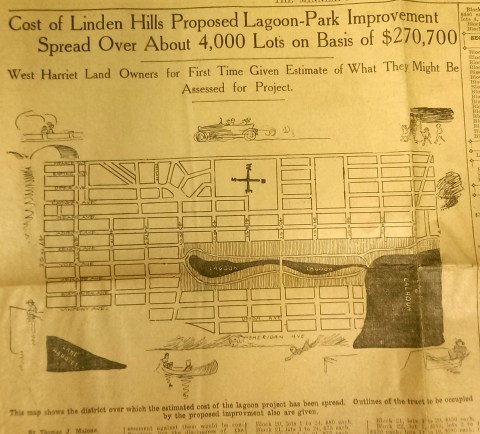
This drawing from a 1915 newspaper article shows the initial concept of a South Bay and outlines how it would be paid for. (Source: Minneapolis Sunday Tribune, June 20, 1915)
The challenge, of course was how to pay for it. The park board’s plan to assess property owners in the area for the expensive improvements was met with furiuos opposition and lawsuits. Many property owners thought that assessments they were already paying for acquisitions and improvements over the years at Lake Calhoun, Lake Harriet and William Berry Park were too heavy. The courts eventually decided in favor of the park board’s right to assess for those improvements, but by then estimated costs for the project had increased and become prohibitive and the South Bay scheme was abandoned.
Instead land for Linden Hills Park was acquired in 1919 and the surrounding wet land was drained into Lake Calhoun in the early 1920s. Dredged material from the lake was used to create a better-defined shoreline on the southwestern and northwestern shores of the lake in 1923 in preparation for the construction of the parkway.
Flowage Rights on the Mississippi River and a Canal to Brownie Lake
Minneapolis parks also lost land to water in 1916. The federal government claimed 27.6 acres of land in the Mississippi River gorge for flowage rights for the reservoir that would be created by a new dam to be built near Minnehaha Creek. Those acres, on the banks of the river and several islands in the river, would be submerged behind what became Lock and Dam No. 1 or the Ford Dam. In exchange for the land to be flooded, the park board did acquire some additional land on the bluffs overlooking the dam.
The other alteration in water courses was the dredging of a navigable channel between Cedar Lake and Brownie Lake, which completed the “linking of the lakes” that was begun with the connection of Lake of the Isles and Lake Calhoun in 1911. The land lost to the channel was negligible and probably balanced by a slight drop in water level in Brownie Lake. (A five-foot drop in Cedar Lake was caused by the opening of the Kenilworth Lagoon to Lake of the Isles in 1913.)
Another potential loss of water from Minneapolis parks may have occurred in 1917. William Washburn’s Fair Oaks estate at one time had a pond. I don’t know when that pond was filled. The estate became park board property upon the death of Mrs. Washburn in 1915. Perhaps in 1917 when the stables and greenhouses on the southwest corner of the property were demolished, the south end of the estate was graded and the pond was filled. Theodore Wirth’s suggestion for the park, presented in 1917, included an amphitheater in part of the park where the pond had once been.
The Dredge Report
The year 1917 marked the end of the most ambitious dredging project in Minneapolis parks — in fact the biggest single project ever undertaken by the park board until then, according to Theodore Wirth. The four-year project moved more than 2.5 million cubic yards of earth and reduced the lake from 300 shallow acres to 200 acres with a uniform depth of 15 feet.
That wasn’t the end of work at Lake Nokomis, however. The park surrounding the lake, especially the playing fields northwest of the lake couldn’t be graded for another five years, after the dredge fill had settled.
Dredging may again be an issue in 2017 if the Park Board succeeds in raising funds for a new park on the river in northeast Minneapolis. Dredges would carve a new island out of land where an old man-made island once existed next to the Plymouth Avenue Bridge. But that may be a long time off — and could go the way of South Bay.
Park Buzz
One other development in 1917 had more to do with standing water than was probably understood at the time. The Park Board joined with the Real Estate Board in a war on mosquitoes. However, after spending $100 on the project and realizing they would have to spend considerably more to achieve results, park commissioners terminated the project. It was not the first or last battle won by mosquitoes in Minneapolis.
As we look again at new calendars, it’s always worth taking a glance backward to see how we got here. For me, it is much easier to follow the course of events in Minneapolis park history than in American political history.
David C. Smith
Comments: I am not interested in comments of a partisan political nature here, so save those for your favorite political sites.
Where’s Waldo? Minnesota, Lair of Giants!
Filed under: Minneapolis Parks: General | Tags: H.W.S. Cleveland, Henry David Thoreau, Horace Cleveland, Lake Calhoun, Minneapolis, Ralph Waldo Emerson
Comments (4) I was researching other things last spring when I found two letters written by Ralph Waldo Emerson to his daughter Ellen from Minnesota in 1867—150 years ago this month.

Emerson’s signature on his letter to his daughter Ellen in Concord, Massachusetts, January 31, 1867. (Emerson Family Correspondence, ca. 1725-1900 (MS Am 1280.226) Houghton Library, Harvard University.)
Emerson was on one of his annual lecture tours to the West, but it was his first venture across the Mississippi River into Minnesota.
He seemed to like the place—even commenting in his letter that Minneapolis was “said to be of admirable climate.” Perhaps he was not willing to trust his own judgment on the matter as he was visiting in January and in an account of his visit published in Minnesota History, June 1930, Hubert H. Hoeltje wrote that Emerson travelled from LaCrosse to Winona in an open carriage on a day that the temperature tumbled to 20 below zero. Emerson was kind enough not to frighten his daughter with accounts in his letters of such extreme hardship.
Emerson likely knew something of Minnesota from his old friend Henry David Thoreau who had visited Minneapolis, residing for a time on the shore of Lake Calhoun, in 1861. We also learn from the letters that he had cousins here. And Hoeltje observes in his article that Emerson had purchased property in Wisconsin in 1856.
Despite these connections and a history of lecturing in other not-quite-so-exotic locales since 1852 when he first lectured in St. Louis, Emerson reassured his daughter in his January 31 letter from Faribault that he was “in good new country with plenty of robust people who take kind care of me.” Still he felt it “a little pathetic” that people “born to be delicate and petted” had “removed into this rough yeomanly lair of the giants.”
Writing from St. Paul the next day he recounted for Ellen his meeting with his cousin Hannah Ladd Meyer and her children who lived in Northfield. Hannah, he wrote, “was as good & almost as handsome as in her youth.”
Emerson also recounted that his host in Faribault, grandson of the founder of the eponymous city, had taken him to visit eight “Sioux tepis (conical tents)” near town. He noted that the small village included only older men, women and children as the warriors had been “removed to Nebraska.” With Faribault, who “spoke Indian”, Emerson had visited the tents and in one had listened to two girls sing “quite prettily.” He also wrote that young Faribault, who was three-quarters Indian himself, had gone to school in Montreal and “was as handsome & as accurately dressed and did the honors as gracefully…as any youth from New York could be or do.” Emerson was disappointed that light in the tepis was provided not by burning pine-knots or birchbark, but by kerosene lamps. “I inquired,” he concluded, “whether I could see such another Indian picture between that spot and Boston and I was assured I could not.”
From Faribault, Emerson travelled to St. Paul, which he called a “proud, new, thriving town” of 12-15,000 people with handsome buildings and fine banks. Escorted by Governor William Marshall, he visited the State Capitol, but seemed most struck by the fact that Gov. Marshall was Swedenborgian by religion, a subject on which they conversed.
I do not wish to sow seeds of strife in these troubled times, but I am only here as a chronicler, and am compelled to cite Emerson’s comparison of my present home with my boyhood home.
“Thence to Minneapolis,” Emerson wrote two days later from there, “a town of greatest promise in all the northwest…If Edward [his son, recently graduated from Harvard] were to come west, let him come here. It is the house, St. Paul being only the front door.”
Emerson was not left alone much on his visit. His travelling companion from Faribault to St. Paul was Wisconsin Congressman and future governor, and famous miller, C.C. Washburn, and he ate Sunday dinner in Minneapolis with C.C.’s younger brother and future Minnesota Senator, William Drew Washburn. That day he also visited another cousin, Phebe Chamberlain, whom he had not seen in 30 years.
While in Minneapolis, Emerson lectured twice, once for the Athenaeum Library Association at Harrison Hall and again at the Universalist Church at 4th Ave. South and 5th St. Hubert Hoeltje noted that the only local newspaper coverage of the first Minneapolis lecture cited the time and place and a “large and attentive audience,” but concluded, “lack of space forbids comment.” A newspaper account of Emerson’s second lecture ended with the observation, “So great was the rush of people that scores were unable to obtain admission—among whom was the writer.” That struck me as one of the funniest things I’ve ever read in a newspaper.
As popular as Emerson was, he was not the biggest draw for the lecture series that year. Hoeltje reports, for instance, that Frederick Douglass drew an audience to St. Paul twice as large as Emerson’s. Perhaps Emerson’s star had faded somewhat by then. He had been lecturing for many years and was 63 years old, nearing the end of his lecturing career.
Emerson had nothing to do with Minneapolis parks apart from any influence his philosophy may have had on H. W. S. Cleveland’s view of nature and preservation of natural features of the landscape, especially in cities. Cleveland and his partner at the time, Robert Morris Copeland, had designed Sleepy Hollow Cemetery in Emerson’s hometown of Concord, Mass. in 1855. Emerson was on the committee that commissioned their work and gave the address at the dedication of the cemetery. He was also buried there—along with Thoreau, Nathaniel Hawthorne, and Louisa Mae Alcott. Cleveland and Emerson certainly knew each other. Cleveland scholar Daniel Nadenicek considers Emerson an important influence on Cleveland’s aesthetic. While there are similarities between the two men’s views, the more I have learned of Cleveland’s life, the less weight I have come to place on Emerson’s influence on Cleveland. But that’s probably subject matter for a book one of these days.
For now suffice to say that the frontier city of the northwest that held significant appeal for Emerson in 1867, was also the city in which Cleveland chose to live years later—and beautify with his vision, however it was shaped.
David C. Smith
© 2017 David C. Smith
Thanks Barbara MacLeish for correcting the date Thoreau lived at Lake Calhoun: 1861, not 1860. Corrections are always appreciated.
 Minneapolis Park History