Archive for the ‘Powderhorn Park’ Category
Happy 99th, Don Johnson
Filed under: Minneapolis parks, Powderhorn Park, Winter Sports | Tags: Don Johnson, Powderhorn Park, Speedskating
 Comments (3)
 Don Johnson, a great, but little-known Minnesota athlete, just celebrated his 99th birthday. I hope you will join me in wishing him many more.
Don was a champion speed skater at the leading edge of a generation of speed skaters that dominated American speed skating from the 1930s into the 1950s. That was a time when speed skating races at Powderhorn Park and Como Lake in St. Paul drew tens of thousands of spectators and speed skating was an official sport in Minneapolis high schools. The sport thrived in part due to support from the Minneapolis Park Board and the excellent skating track it maintained at Powderhorn Park, but also due to sponsorship and hard work by several American Legion posts. Speed skating had similar support in St. Paul.

Don Johnson winning the 440-yard national championship in 1947, narrowly defeating his long-time rivals Ken Bartholomew on the right and another Minneapolitan, Bob Fitzgerald, on the left who tied for the silver medal at 500 meters in the 1948 Winter Olympics. At that time in the U.S. speed skaters raced in a pack, instead of racing against the clock as was done in the rest of the world. Pack-style racing was considered more entertaining for fans and resulted in much more strategic races. (Photo courtesy of Don Johnson.)
For another view of Don winning a race, check out this newsreel Clip of him winning the 880 in the 1948 national championships. (His is the second race in the newsreel.)
The first Minnesota skaters to break onto the national scene in that era and win national titles were James Webster of St. Paul, then Marvin Swanson of Minneapolis in the mid-1930s. They were followed by Johnson and Dick Beard, high school teammates at Minneapolis Central, then in rapid succession by Charles Leighton, future Olympic medalists Ken Bartholomew and Bob Fitzgerald, John Werket, Art Seaman, Pat McNamara, Gene Sandvig, Floyd Bedbury, and Tom Gray. All were national or world champions or Olympians. Women enjoyed a run of success nearly as impressive, led by Dorothy Franey, Mary Dolan, and Louise Herou of Minneapolis and Geraldine Scott, Janet Christopherson, Gwendolyn DuBois and Diane White of St. Paul, all of whom won national championships. (Women’s speed skating was an exhibition event at the 1932 Olympics in Lake Placid and Dorothy Franey of Minneapolis was on the team. Women didn’t compete in speed skating again in the Olympics until 1960. Mary Lawler of Minneapolis made the 1964 team.) Many more Minneapolis skaters excelled — won national championships or set age group records — at junior and intermediate levels. Of course there have been many world-class speed skaters from Minnesota since the early 1960s as well, but by then the Twin Cities, especially Powderhorn Park, was no longer the center of the American speed skating world.
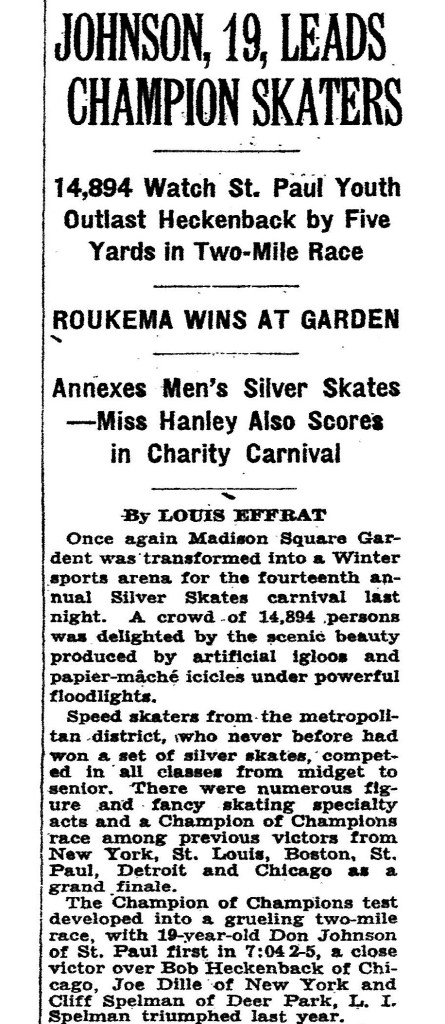
This article from the New York Times, February 8, 1938 tells the story of Johnson’s victory. The rest of the article covers the other races held that night.
One of Don Johnson’s greatest triumphs was as a 19-year-old at Madison Square Garden where he won the Champion of Champions two-mile race at the Silver Skates tournament before a crowd of nearly 15,000 in 1938.
Johnson recalled that the celebrity starter for the race was former heavyweight boxing champ Jack Dempsey.
What makes Johnson’s victory particularly impressive was that he enjoyed some of his greatest successes at shorter distances such as the 440 and 880 highlighted above — and on longer outdoor tracks. If you’re a sports fan you know that Madison Square Garden is the most famous basketball arena in the world, meaning hardly large enough for a speed skating rink. The track was about the size of the hockey rink when the New York Rangers played in the famous arena. The track hardly had a straightaway. At 16 laps to the mile it was all corners. If there was a precursor to today’s short-track speed skating, MSG was it.
Two Weeks Pay
Johnson almost didn’t make it to New York for that meet. Right out of high school, he had gone to work for General Electric in Minneapolis. He couldn’t afford to miss two weeks of work to make the trip to first Michigan for the national championships and then to New York for the Silver Skates meet. The St. Paul newspaper that sponsored the race locally — he qualified by winning the race in St. Paul — agreed to pick up his pay for the two weeks he would be gone. (The outdoor nationals in Petoskey, Mich. were cancelled due to warm weather and rain showers.)
Johnson returned to MSG the next year, 1939, to defend his title along with his local rival Ken Bartholomew. As the New York Times reported on February 7, 1939 the two were among ten of the leading speed skaters in the country that took part in the event. The race had another capacity crowd in the Garden on their feet at the finish. The grueling race ended in what the Times called a “blanket finish” by the top four skaters. The judges deliberated for five minutes while the crowd awaited an announcement of the winner. The Times reported that spectators thought the delay was due to debate over whether Johnson or Vincent Bozich of Detroit had won or whether it was a dead heat. Ken Bartholomew had finished a hair behind them. The judges’ decision shocked everyone: Johnson, Bozich and Bartholomew were disqualified for “pushing on the turn.” The victory went to the fourth place finisher who represented New York in the race. Such was life in the rough-and-tumble world of pack-style racing — where “pushing” was part of racing.
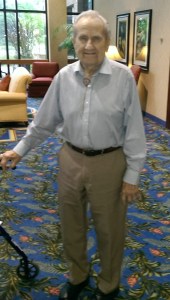
Don Johnson when he was only 96.
Despite Johnson’s successes, he was not selected for the 1940 Olympic team. Neither was Bartholomew. The only Minnesota skater to make that team was Charles Leighton. Of course he never got to race in the Olympics due to WWII. By the time the Olympics resumed in 1948, although still highly competitive with the country’s best — as witnessed by the photo and clip above — Johnson did not compete in the St. Moritz Olympics, but attended the Games as an alternate.
Two of Don’s long-time competitors from Minneapolis, Ken Bartholomew, who married Don’s sister, and Bob Fitzgerald, who was an altar boy at Don’s wedding, tied for the silver medal in St. Moritz in the 500 meter race, the only Americans to win speed skating medals in those games. They proved that Americans could win medals even when they skated the less exciting European Olympic style. No pushing.
Happy Birthday, Don. We hope we’ve helped revive happy memories of good friendships with tough competitors.
David C. Smith
Sisters of Chuckie: Powderhorn Park 1926
Filed under: Minneapolis Parks: General, Powderhorn Park | Tags: Doll Parades, Powderhorn Park
Comments (3) How did the cherished toys of one generation become scary to their great-grandchildren?
This photo raises the question. Doll buggy parades were big events at parks decades ago, especially in the 1930s. I’ve seen several photos of such events, some as recent as the 1970s. Yet, I’ve seen girls of today react very negatively to pictures of old dolls like these. They find them creepy. But aren’t these dolls more realistic and less creepy than many of the “fashion” dolls that girls play with now?

Dolls on parade at Powderhorn Park, 1926 (Minneapolis Park and Recreation Board)
Cool buggies, too. But with no children in sight? Yeah, they really are kinda creepy. The dolls look better with kids in the picture.

This Minneapolis Tribune photo from 1934, which includes girls from an unidentified park, is more appealing. (Minneapolis Photo Collection, Hennepin County Library)
Do you remember these events? Do you still have the dolls?
David C. Smith
Mystery Starters at Powderhorn Speed Skating Track
Filed under: Minneapolis Parks: General, Powderhorn Park | Tags: Gen. John Pershing, Pershing Park, Powderhorn Park, Speed Skating
Comments (18) This photo is labelled “Olympic Speed Skating Team.” The only date on it is February 16, 1947. That seems too early to have already selected skaters for the 1948 Olympic team. Can anyone identify the skaters? Local skaters Johnny Werket and Ken Bartholomew represented the U.S. at the 1948 Olympics in St. Moritz and Bartholomew won a silver medal. Gene Sandvig and Pat McNamara represented Minneapolis and the U.S. at the 1952 and 1956 Winter Games. (I posted more about those skaters here.) They might all be in this photo.
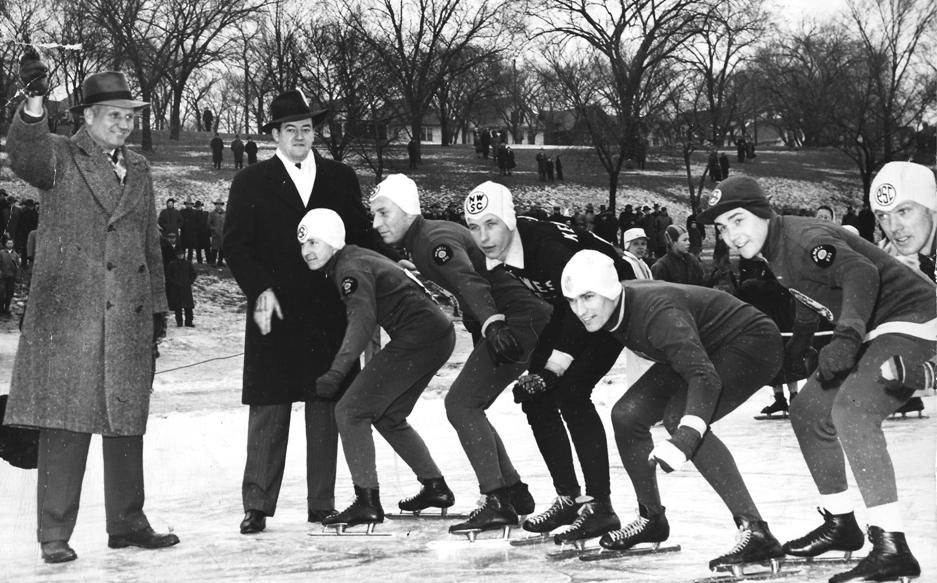
Can you identify any of these people — skaters and others — at the speed skating track at Powderhorn Park? (MPRB) (Note 9/18: Reader Tom McGrath has identified the starter and the skaters in a comment below. Thanks, Tom and Brian.)
I don’t know the skaters, but I do recognize the fellow in the dark overcoat next to the starter. Anybody know who that is — and what his job was at the time?
I don’t know the guy with the starter’s pistol, but he looks entirely too jolly to be a regular race official. Seems more like a politician holding a noisemaker, but I can’t name him.
Name them all and you get a free lifetime subscription to minneapolisparkhistory.com. (That’s the lifetime of the website, not you.) Be the first to name the man in the dark coat and I’ll email you a free, low-quality photocopy of Gen. John “Blackjack” Pershing’s letter to the Minneapolis park board in 1923 expressing his appreciation for having a park named for him. (More on that story later.)
David C. Smith
© David C. Smith
This is why we love our parks: Powderhorn Art Sled Rally
Filed under: Powderhorn Park, Winter Sports | Tags: Powderhorn Park
Leave a comment Creative use of space. It is the true gift of parks. If anyone ever needed convincing of the incredible benefits of public spaces, they should have been at Powderhorn Park yesterday for the 4th Annual Art Sled Rally. Thrills, chills and plenty of spills. Marvelous creativity. Wacky fun. It’s what a creative community can do when it has a place to do it.
Cheers to South Sixteenth Hijinks for the idea and energy. Be sure to click the link above to learn more about the event and organizers. Especially check out the sponsors and please support them.
I didn’t see all the sleds, but among my favorites were the bear from Puppet Farm, (picture a bear sliding on its stomach, and, yes, there was a child seated on top of the bear sled, too) and a wild dinner table on a sled, which I believe was called “Dinner at the Carlisle’s.” Other favorites were a couple of dragons, a dragon fly, a bunch of eyeballs and a London Bridge, which did indeed fall down. Some pictures are already posted on artsledrally.com from Dan Stedman. I hope others will soon follow.
The greatest tribute to the event and the people who made it happen: as we walked away my daughter asked, “Can we make a sled next year?”
David C. Smith
Powderhorn Park and Augsburg Stories Converge
Filed under: Minneapolis Parks: General, Powderhorn Park | Tags: Murphy Square, Powderhorn Park, Speed Skating
Leave a comment A reader of recent posts on Murphy Square/Augsburg College and speed skating at Powderhorn Park put the two together and suggested a link to an article featuring U. S. Olympic speed skater Johnny Werket, who attended Augsburg. From the article we learn that a third Minneapolis park also played a role in the story: Longfellow Field was Werket’s home park.
Thanks for the tip.
David C. Smith
A premier speed skating track in a Minneapolis park
Filed under: Powderhorn Park, Winter Sports | Tags: Gene Sandvig, John Werket, Ken Bartholomew, Minneapolis parks, Powderhorn Park, Speed Skating
Comments (15) A scrapbook of newspaper clippings about speed skating from 1953 to 1956 was recently given to Dave Garmany the recreation coordinator at Powderhorn Park in Minneapolis. The scrapbook features articles on the speed skating scene in Minneapolis, the U.S. and the world in those years and includes several articles from Norwegian newspapers.
In addition to the newspaper clips were several programs from international speed skating events at the Powderhorn Park speed skating track, such as this one in 1953.

A cropped version of the cover photo, showing a massive crowd at a 1930s event at Powderhorn Park—likely the national championships in 1934, which were reportedly attended by 50,000 in two days—is in the collection of the Minnesota Historical Society.
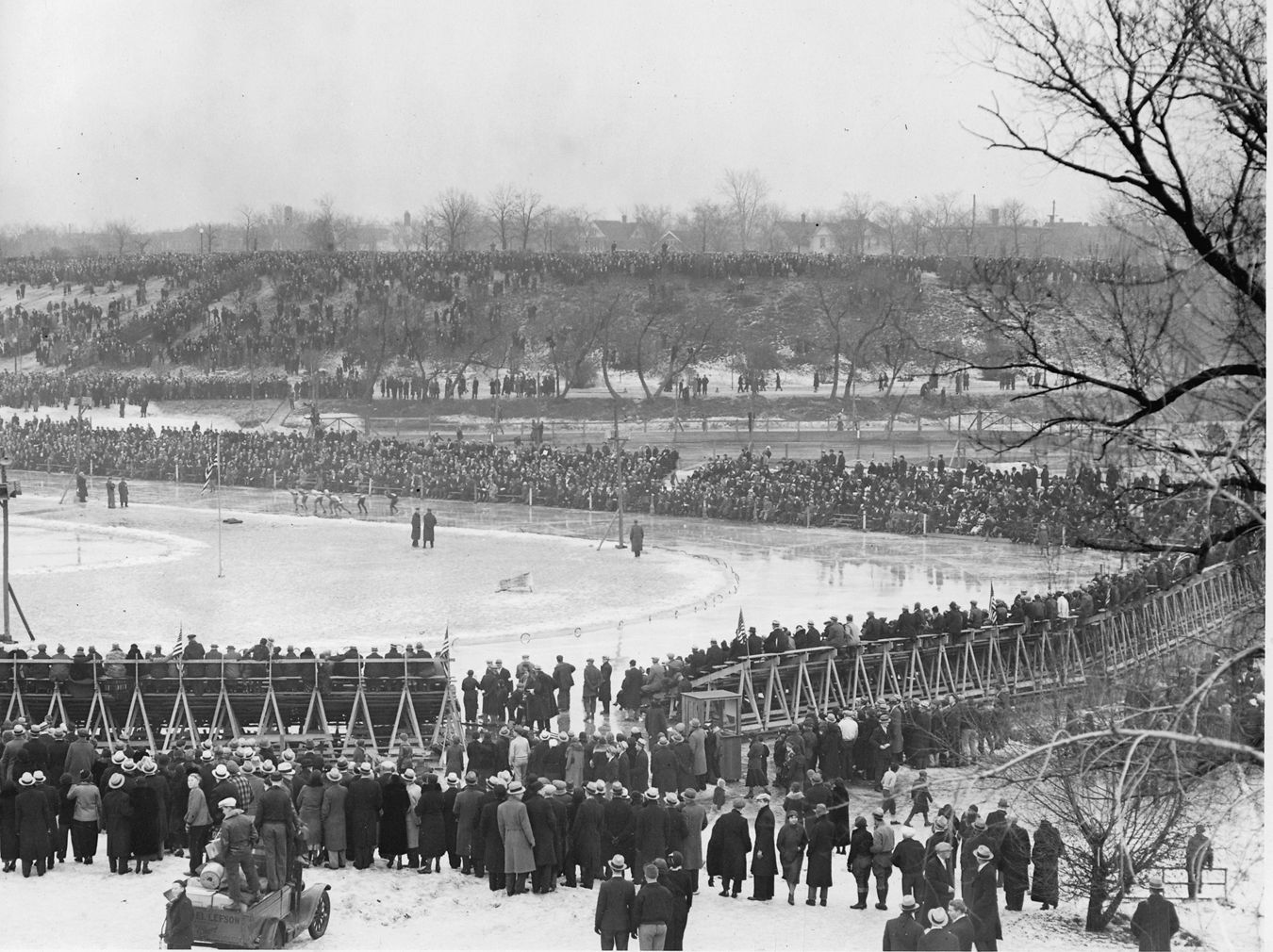
Huge crowds attended the National Speed Skating Championships held at Powderhorn Park in the 1930s and 1940s. (Minnesota Historical Society)
Most of the clips in the scrapbook were about the rivalry between Minneapolis skaters Ken Bartholomew and Gene Sandvig. Bartholomew won 14 National Outdoor Championships from 1939-1960. Sandvig was often runner-up in the 1950s after he had gotten out of the Army and enrolled at Gustavus Adolphus College. Bartholomew was a silver medalist for the U.S. in the Winter Olympics at St. Moritz in 1948. Sandvig skated for the U. S. in the 1952 Winter Games in Oslo and the 1956 Games at Cortina d’Ampezzo.

Planert skates were advertised in the 1953 speed skating program pictured above. The skates were not cheap. The list price for a pair of Planert’s “Olympic Model” skates in a 1955 ad was $60.
The skater featured in Planert’s ad, Leo Friesinger, was the bronze medalist for the U.S. in the 500 meters at the 1936 Olympics in Garmisch-Partenkirchen, Germany. Friesinger was from Chicago, which was also home to Planert.
Among other bits of info that caught my eye in news clips from Minneapolis Star and Minneapolis Tribune.
- Minneapolis high school athletic director Giffy O’Dell hopes to bring back speed skating as a regular sport in the Minneapolis high school sports program. January, 1954. (I never knew it ever had been part of that program.)
- Top Minneapolis skaters Ken Bartholomew and Gene Sandvig will not be challenged locally by two other elite Minneapolis skaters. Pat McNamara will return to Norway or will train in Japan. Johnny Werket is considering spending the winter in Japan. January, 1954.
- Werket and McNamara have created a new practice track early in the season on Augusta Lake in Mendota. They do not train at Powderhorn Lake. They prefer the European style of speed skating used in the Olympics. The European track is 400 meters compared to the standard American track (including the Powderhorn track) of 293 yards, four laps to a mile instead of six. Also in European skating all competitors race against the clock instead of against other skaters in a pack. (American-style speed skating at the time was in between the long-track and short-track skating in today’s Olympics. The Winter Olympics tried the North American pack-style of speed skating at the 1932 games in Lake Placid, New York. Canada and the U.S. won 10 of 12 medals skating that way. The 1936 games in Germany reverted to European-style racing against the clock — and Norway and Finland won 10 of the 12 medals. Pack speed skating returned to the Olympics as a separate demonstration sport, short track skating, in 1988 at Calgary and became a regular Olympic event in 1992 at Albertville.)
- Ken Bartholomew was a 14-time U.S. champion, but he skated for the U.S. Olympic team only once, winning a silver medal in 1948 at St. Moritz. He did not make the Olympic team again despite dominating the National Outdoor Championships for years. Werket was on the U. S. Olympic team in 1948, 1952 and 1956. McNamara skated in the Olympics for the U.S. in 1952 and 1956. Their greater success in making Olympic teams may have been partially due to training in the Olympic style of racing—although Gene Sandvig also made the Olympic team in 1952 and 1956. All three were also much younger than Bartholomew. A commentary in the Minneapolis Tribune after the Winter Games in Cortina d’Ampezzo in 1956 had this to say about the different styles: “The U.S. should adopt the Olympic system of competition—that is, a competition against time. True, it’s pretty dull for young Americans, as well as the few spectators who turn out. They (presumably young Americans and spectators) love the free-for-all scramble with all of its pushing, tugging, elbowing and the like such as popped up in the Nationals at Como over the weekend.” (The reference was to the races at Lake Como in St. Paul won by Bartholomew, in which Bartholomew and another skater got into a fight after the other accused Bartholomew of knocking him down. Bartholomew was obviously a racer, a strategist, not a time-trial expert that the Olympic style required. In other words, he was more Apolo Anton Ohno than Shani Davis, Eric Heiden or Dan Jansen.)
- One reason the Tribune advocated changing American racing to the Olympic style: the Russians had started to dominate international speed skating. It had begun with a surprise victory by the Russians at the world championships in Sapporo, Japan in 1954. The U.S. had failed to send a team. The U.S. State Department had declined to pay the travel costs of John Werket, Pat McNamara and a third skater from Chicago, Ken Henry, who was an Olympic gold medalist in 1952. The State Department determined that the request for funds was “not meritorious.” (Tribune, January 31, 1954) The Russian victory elicited this comment on the sports page: “The time is at hand when the athletic leaders of the free world had better take Russia’s bid for international supremacy seriously. The Commies proved in the last Olympic Games they have made greater strides in track and field than any other nation in the world. Over the week-end Russia did the unexpected by winning the world’s speed skating championships rather decisively, beating the best Norway and some other Scandinavian countries have to offer.” Russian dominance had grown at the 1956 Winter Games.
- The 1955 world championships were held in Moscow and Johnny Werket was one of three skaters to represent the U.S. after friends raised $700 to pay his expenses. Those three skaters were the first American athletes to compete in Russia after World War II, according to a February, 1955 Tribune article. Werket had high praise for the Russians. “Russians were tops,” said Werket, “as athletes, as hosts and as fans. It would be hard to find a fairer audience anywhere in the world.”
- Nearly all Minneapolis speed skating teams in the 1950s were sponsored by American Legion posts. Wenell, Laidlaw, Bearcat and Falldin posts all sponsored teams.

The 1955-1956 program for the Minnesota Speed Skating Association
Finally this item from the annual program of the Minnesota Speed Skating Association, 1955-1956:
Missing Skater News
- Tom Miller and Colleen Burke (Falldin American Legion Post team) married last June, Tom in U. S. Army, stationed in California
- Gene Sandvig (Bearcat) on Olympic Team
- Tom Hadley (Wenell) concentrating on studies, U of M on Evans Scholarship (Based on scholarship and golf proficiency)
- Janet Koch (Laidlaw) is now Mrs. Vasatka
- David Kahn (Wenell) out with knee injury suffered in football at Roosevelt Hi
- Dennis Boike (Laidlaw) at Nazareth Hall Prep Seminary studying for priesthood
- Tom Romfo (Wenell) recuperating from a bout with polio
For some reason, perhaps the mention of polio, the list seemed so 1950s. Poignant, too.
David C. Smith
© David C. Smith
Powderhorn Park Football
Filed under: Powderhorn Park | Tags: Football, Minneapolis parks, Powderhorn Park, The Parade
Comments (2) A recent visit to Powderhorn Park and a chat with recreation coordinator Dave Garmany turned up an excellent photo of the Powderhorn football team from 1925. Unusual for its time, it was labeled with the names and positions of the players.
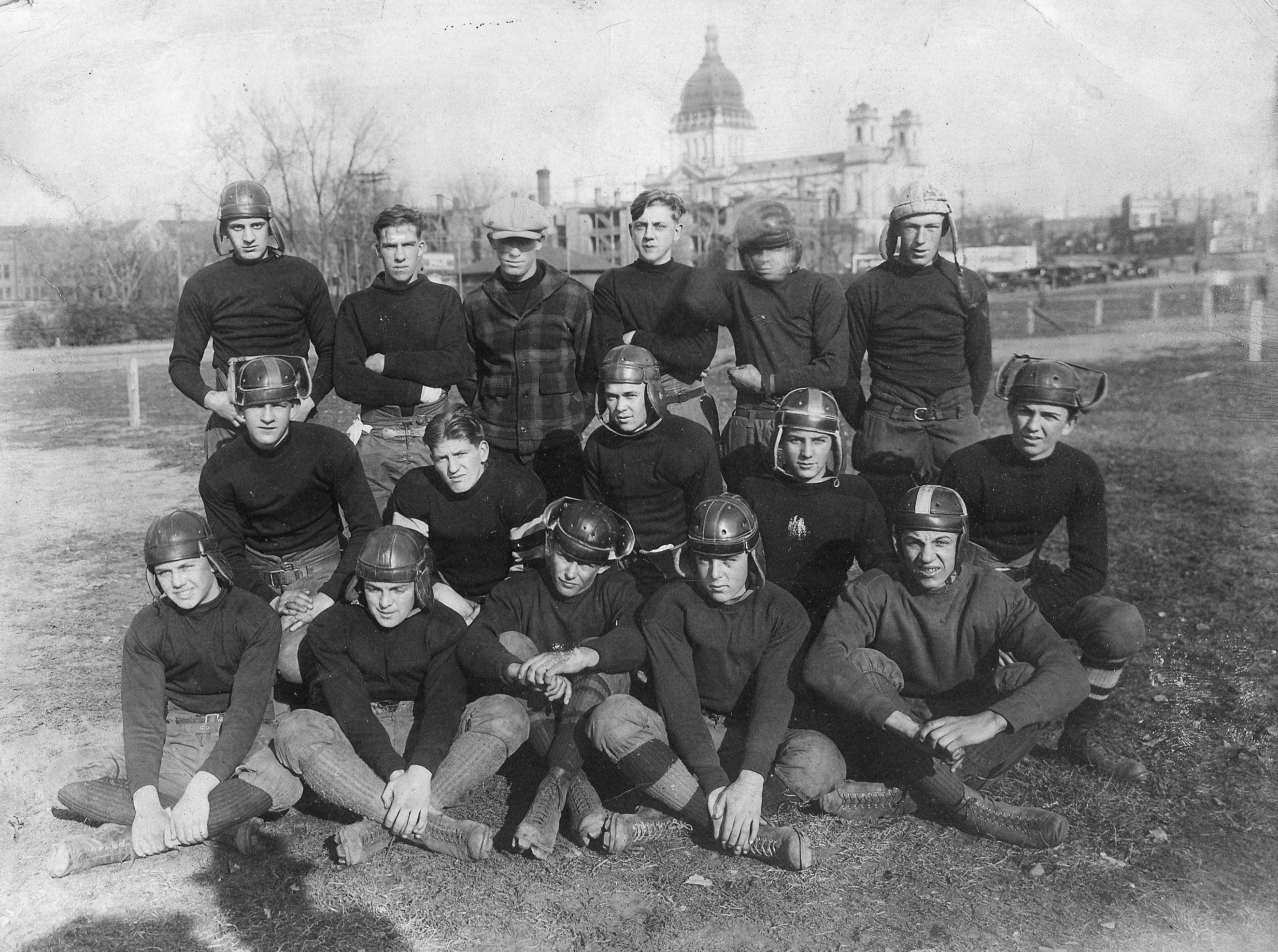
1925 Powderhorn Football Team at The Parade (Basilica in background). First Row L-R: Helmar Larson OB, Claude Casey FB, Manley Peterson LT, Kenneth Johnson RH, George Carlson RG. Second Row, L-R: Lee Blood RT, Joe Listered LE, John Larson RE, John Martin LE, Ed Mandeck LE. Third Row L-R: Frank Shogren LG, Hersel Johnson RE, Howard Shenessy Capt., Leonard Herlen RG, Walt Nordstrom LH, Al Dunning RH. (Minneapolis Park and Recreation Board)
The best part of the photo — for those not related to the players — is the location at The Parade, which is obvious because of the Basilica looming in the background. The year the photo was taken, 1925, was the year that the north end of Powderhorn Lake was filled in to create more athletic fields. I’ve spoken with one woman who remembered skating on the lake before the north end was filled. Do you remember that or know anyone who does?
The only other photo I’ve seen of early Powderhorn football players is this one from the collection of the Minnesota Historical Society.

Powderhorn football team, 1908 (Minnesota Historical Society)
Have you seen others? Let us know.
David C. Smith
 Minneapolis Park History