Archive for the ‘Winter Sports’ Category
Elusive Minneapolis Ski Jumps: Keegan’s Lake, Mount Pilgrim and Glenwood (Theodore Wirth) Park
Filed under: Minneapolis parks, Winter Sports | Tags: Bryn Mawr, Glenwood Park, Ski Jumps, Skiing, Theodore Wirth Park
 Comments (35)
 The Norwegians of Minneapolis had greater success getting their music recognized in a Minneapolis park than they did their sport. A statue of violinist and composer Ole Bull was erected in Loring Park in 1897.
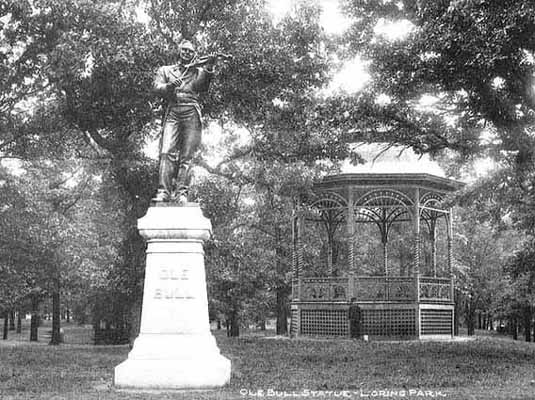
This statue of Norwegian violinist and composer Ole Bull was placed in Loring Park in 1897, shown here about 1900 (Minnesota Historical Society)
A ski jump was located in a Minneapolis park only when the park board expanded Glenwood (Theodore Wirth) Park in 1909 by buying the land on which a ski jump had already been built by a private skiing club. The photo and caption below are as they appear in the annual report of the Minneapolis Board of Park Commissioners for 1911.* While the park board included these photos in its annual report, they are a bit misleading. Park board records indicate that it didn’t really begin to support skiing in parks until 1920 — 35 years after the first ski clubs were created in the city.

Minneapolis, the American city with the largest population of Scandinavians, was not a leader in adopting or promoting the ski running and ski jumping that originated in that part of the world. Skiing had been around for millenia, but it had been transformed into sport only in the mid-1800s, around the time Minneapolis was founded. Ski competitions then included only cross-country skiing, often called ski running, and ski jumping — the Nordic combined of today’s Winter Olympics. Alpine or downhill skiing didn’t become a sport until the 1900s. Even the first Winter Olympics at Chamonix, France in 1924 included only Nordic events and — duh! — Norway won 11 of 12 gold medals.
The first mention of skiing in Minneapolis I can find is a brief article in the Minneapolis Tribune of February 4, 1886 about a Minneapolis Ski Club, which, the paper claimed, had been organized by “Christian Ilstrup two years ago.” That article said the club “is still flourishing.” Eight days later the Tribune noted that the Scandinavian Turn and Ski Club was holding its final meeting of the year. The two clubs may have been the same.
Ilstrup was one of the organizers two years later of one of the first skiing competitions recorded in Minneapolis, which was described by the Tribune, January 29, 1888, in glowing and self-congratulatory terms.
Tomorrow will witness the greatest ski contest that ever took place in this country. For several years our Norwegian cultivators of the noble ski-sport have worked assiduously to introduce their favorite sport in this country, but their efforts although crowned with success, did not experience a real boom until the Tribune interested itself in the matter and gave the boys a lift.
The Tribune mentioned the participation in the competition of the Norwegian Turn and Ski Club, “Vikings club” and “Der Norske Twin Forening.” The Tribune estimated that 3,000 spectators watched the competition held on the back of Kenwood Hill facing the St. Louis Railroad yard. Every tree had a dozen or so men and boys clinging to the branches, while others found that perches on freight cars in the rail yard provided the best vantage point.

The caption for this photo from the Minnesota Historical Society Visual Resource Database claims the photo is from the winter of 1887, but was almost certainly taken at the ski tournament held on Kenwood Hill late that winter in February, 1888.
The competition consisted of skiers taking turns speeding downhill and soaring off a jump or “bump” made of snow on the hill. Points were awarded for distance and for style points from judges.
The winners of the competition were reported as M. Himmelsvedt, St. Croix Falls, whose best jump was 72 feet, and 14-year-old crowd favorite Oscar Arntson, Red Wing, who didn’t jump nearly as far, but jumped three times without falling. Red Wing was a hot bed of ski-jumping, along with Duluth and towns on the Iron Range. (The winner was perhaps Mikkjel Hemmestveit, who along with his brother, Torger, came from Norway to manufacture skis using highly desirable U.S. hickory. The Hemmestveit brothers are usually associated with Red Wing skiing, however, not St. Croix Falls.)
A Rocky Start
Despite the enthusiasm of the Tribune and the crowds, skiing then disappeared from the pages of the Tribune until 1891, when on March 2, the paper reported on a gathering of thirty members of the Minneapolis Ski Club at Prospect (Farview) Park. “This form of amusement is as distinctively Scandinavian as lutefisk, groet, kringles and shingle bread,” the Tribune reported. “With skis on his feet a man can skim swiftly over the soft snow in level places, and when a slope is convenient the sport resembles coasting in a wildly exhilarating and exciting form,” the report continued. The article also described the practice of building snow jumps on the hill, noting that “one or two of the contestants were skilful enough to retain their equilibrium on reaching terra firma again, and slid on to the end of the course, arousing the wildest enthusiasm.”
The enthusiasm didn’t last once again. The Tribune’s next coverage of skiing appeared nearly eight years later — but it came with an explanation:
During recent winters snow has been a rather scarce article. A few flakes, now and then, have made strenuous efforts to organize a storm, but generally the effort has proven a failure. The heavy snow of yesterday was so unusual that it is hardly to be wondered at that there arose in the breasts of local descendants of the Viking race a longing for the old national pastime, skiing…The sport of skiing was fostered to a considerable extent in the Northwest, and particularly in this city, a few years ago, but the snow famine of late winters put a damper on it.
— Minneapolis Tribune, November 11, 1898
The paper further reported that the “storm of yesterday had a revivifying effect upon the number of enthusiasts” and that the persistent Christian Ilstrup of the Minneapolis Ski Club was arranging a skiing outing on the hills near the “Washburn home” (presumably the orphanage at 50th and Nicollet). The paper also reported that while promoters of the club were Norwegian-Americans, “they do not propose to be clannish in the matter.”
Within a week of that first friendly ski, Continue reading
Glenwood Toboggan Slide II: 1887
Filed under: Minneapolis Parks: General, Winter Sports | Tags: Glenwood Park, Theodore Wirth Park, toboggan slide
Comments (3) Since posting a newspaper photo of a toboggan slide on “Glenwood Hill” in 1887, I found this photo in the Minnesota Historical Society Visual Resources Database. This photo is purportedly of the same toboggan chute on the same hill in the same year, but they are obviously different places. The photo clipped from a newspaper had trees right up to the sides of the track.
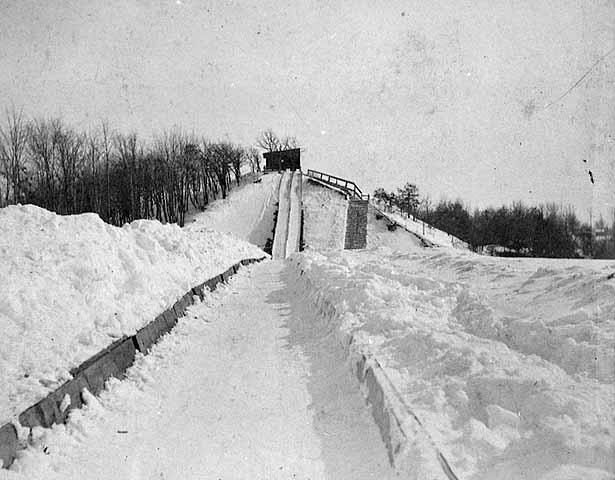
The North Star toboggan chute on Glenwood Hill, 1887. (Minnesota Historical Society)
Looking up the hill instead of down, gives a completely different prespective on the possible location of the slide. I doubt that the slide in this photo is in the same location as the ski jumps that were built after the park board acquired land in the vicinity. Any guesses as to the location of this toboggan slide? Or the other one? Which one is the real “North Star” chute?
In the same wonderful photo collection, I found this picture of the St. Paul toboggan slide in front of the State Capitol, which I referred to in my earlier post.

A 1957 photo of the toboggan slide I rode as a kid, a few years later, in front of the State Capitol. (Minnesota Historical Society)
David C. Smith
This is why we love our parks: Powderhorn Art Sled Rally
Filed under: Powderhorn Park, Winter Sports | Tags: Powderhorn Park
Leave a comment Creative use of space. It is the true gift of parks. If anyone ever needed convincing of the incredible benefits of public spaces, they should have been at Powderhorn Park yesterday for the 4th Annual Art Sled Rally. Thrills, chills and plenty of spills. Marvelous creativity. Wacky fun. It’s what a creative community can do when it has a place to do it.
Cheers to South Sixteenth Hijinks for the idea and energy. Be sure to click the link above to learn more about the event and organizers. Especially check out the sponsors and please support them.
I didn’t see all the sleds, but among my favorites were the bear from Puppet Farm, (picture a bear sliding on its stomach, and, yes, there was a child seated on top of the bear sled, too) and a wild dinner table on a sled, which I believe was called “Dinner at the Carlisle’s.” Other favorites were a couple of dragons, a dragon fly, a bunch of eyeballs and a London Bridge, which did indeed fall down. Some pictures are already posted on artsledrally.com from Dan Stedman. I hope others will soon follow.
The greatest tribute to the event and the people who made it happen: as we walked away my daughter asked, “Can we make a sled next year?”
David C. Smith
Glenwood Toboggan Slide: 1887
Filed under: Minneapolis Parks: General, Winter Sports | Tags: Glenwood Park, Theodore Wirth Park, toboggan slide
Comments (4) It’s an old, wrinkled photo clipped from an unidentified newspaper, but it’s also the oldest photo I’ve seen of a toboggan slide in Minneapolis.

A privately run toboggan slide on “Glenwood” hill in 1887, years before the park board acquired land in the area.
The newspaper caption calls it the “North Star” chute and puts the date at 1887. That was two years before the first land (64 acres) was acquired for what was then Saratoga Park. The park was renamed Glenwood Park in 1890 and was renamed for Theodore Wirth in 1938. The majority of the land for the park we know today was acquired in 1909. I suspect that this hill was a part of that acquisition. Although I’m not certain, I think this slide was located near where the ski jumps were later built.
At different times the park board operated toboggan slides at Lake Harriet, Lake Calhoun, Glenwood (Wirth) Park, Columbia Park and Minnehaha Park. I don’t believe any of them were operated after the 1940s, but as always its difficult to discern from park board records when such services or programs were stopped.
The only toboggan slide I remember from growing up in the Twin Cities was the long slide erected on the approach to the State Capitol in St. Paul. I remember it being operated as a part of the St. Paul Winter Carnival. It was one of the highlights of winter life as a boy in St. Paul.
David C. Smith
Powderhorn Park Speed Skating Track: Best Ice in the United States
Filed under: Minneapolis parks, Winter Sports | Tags: Powderhorn Park, Speed Skating
Comments (3) Many years before Frank Zamboni invented his ice resurfacer (in California!?), Minneapolis park board personnel had to prepare the speed skating track at Powderhorn Park mostly by hand for international competition and Olympic trials. They were very good at it.
Olympic medalist speed skater Leo Friesinger from Chicago (whom you already met in these pages here) had this to say after he won the Governor Stassen trophy as the 10,000 Lakes senior men’s champion in the early 1940s:
“It is a pleasure for me to return to Minneapolis and skate on the best ice in the United States.”
That was high praise for Elmer Anderson and Gotfred Lundgren, the park board employees who maintained the track at Powderhorn using this sweeper, a tractor-drawn ice planer and a bucket of warm water.

The ice sweeper that cleaned the Powderhorn speed skating track in the 1940s. Elmer Anderson (left) and Gotfred Lundgren kept the track in top shape.
They began to prepare the track 3-4 days before a meet by sprinkling it with water a few times. Then they’d pull out a tractor and a plane—a 36-inch blade—to smooth out any bumps from uneven freezing. The biggest problem was cracks in the ice. So the day before the race, Elmer and Gotfred would spend 8-10 hours filling small cracks by pouring warm water into them.
At times their crack-filling work continued right through the races. When large crowds showed up, and for some races attendance surpassed 20,000, the ice tended to crack more often. If Elmer or Gotfred spotted a crack during a race they’d hustle out with a bucket of water after skaters passed and try to patch it. The sweeper was used to remove light snow from the track.
Elmer and Gotfred, who began working for the park board on the same day 18 years before this picture was taken, agreed that the most speed skating records were set when the air temperature was about 30 degrees, which raised a “sweat” on the ice and produced maxiumum speed.
(Source: an undated newspaper clip in a scrapbook kept by Victor Gallant, the park keeper for many years at Kenwood Park, Kenwood Parkway and Bryn Mawr Meadows.)
It’s no wonder that speed skating (as well as hockey) eventually moved indoors to temperature-controlled arenas. But wouldn’t it be fun to see a big race at Powderhorn again?
David C. Smith
© David C. Smith
A premier speed skating track in a Minneapolis park
Filed under: Powderhorn Park, Winter Sports | Tags: Gene Sandvig, John Werket, Ken Bartholomew, Minneapolis parks, Powderhorn Park, Speed Skating
Comments (15) A scrapbook of newspaper clippings about speed skating from 1953 to 1956 was recently given to Dave Garmany the recreation coordinator at Powderhorn Park in Minneapolis. The scrapbook features articles on the speed skating scene in Minneapolis, the U.S. and the world in those years and includes several articles from Norwegian newspapers.
In addition to the newspaper clips were several programs from international speed skating events at the Powderhorn Park speed skating track, such as this one in 1953.

A cropped version of the cover photo, showing a massive crowd at a 1930s event at Powderhorn Park—likely the national championships in 1934, which were reportedly attended by 50,000 in two days—is in the collection of the Minnesota Historical Society.
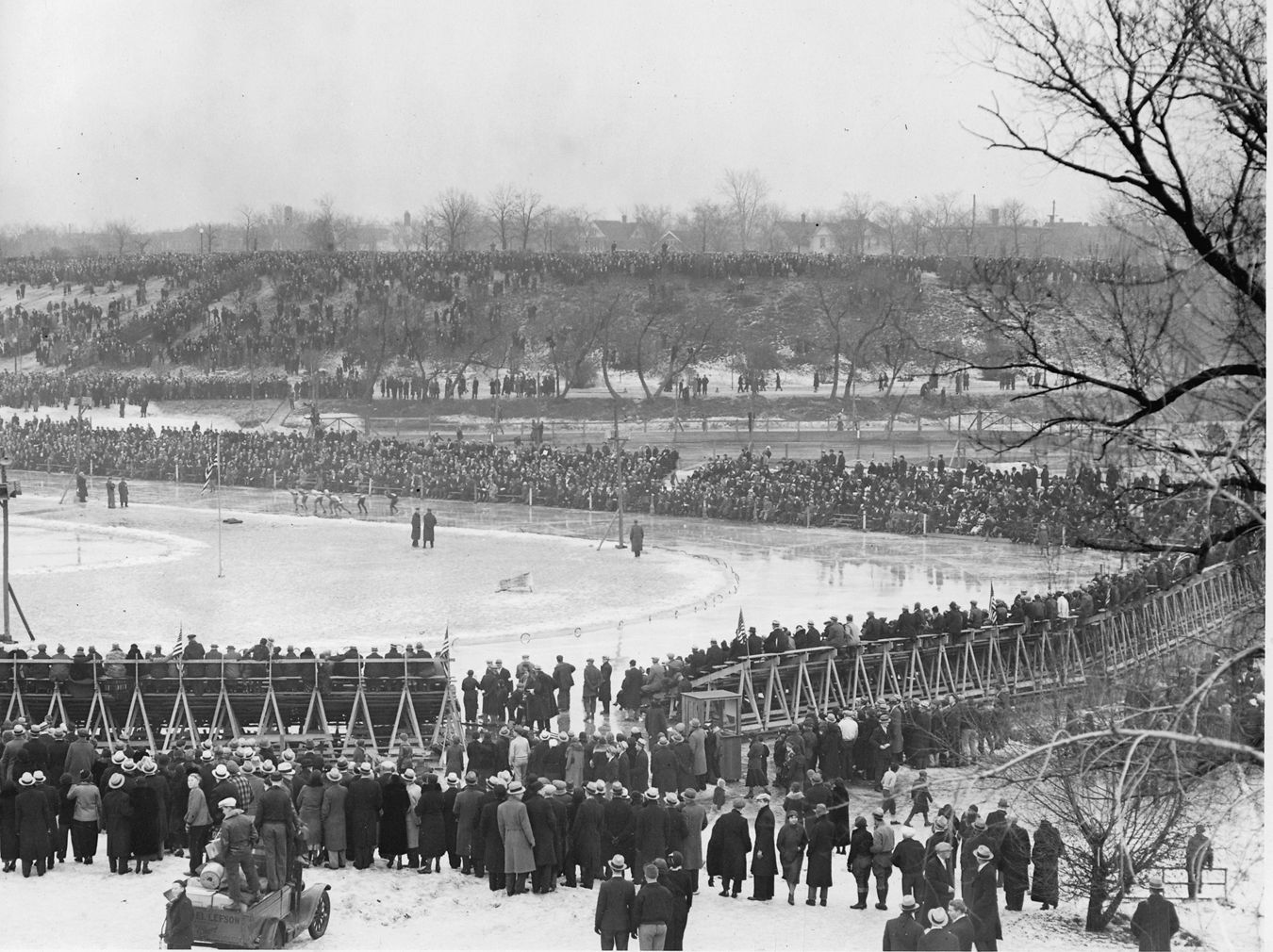
Huge crowds attended the National Speed Skating Championships held at Powderhorn Park in the 1930s and 1940s. (Minnesota Historical Society)
Most of the clips in the scrapbook were about the rivalry between Minneapolis skaters Ken Bartholomew and Gene Sandvig. Bartholomew won 14 National Outdoor Championships from 1939-1960. Sandvig was often runner-up in the 1950s after he had gotten out of the Army and enrolled at Gustavus Adolphus College. Bartholomew was a silver medalist for the U.S. in the Winter Olympics at St. Moritz in 1948. Sandvig skated for the U. S. in the 1952 Winter Games in Oslo and the 1956 Games at Cortina d’Ampezzo.

Planert skates were advertised in the 1953 speed skating program pictured above. The skates were not cheap. The list price for a pair of Planert’s “Olympic Model” skates in a 1955 ad was $60.
The skater featured in Planert’s ad, Leo Friesinger, was the bronze medalist for the U.S. in the 500 meters at the 1936 Olympics in Garmisch-Partenkirchen, Germany. Friesinger was from Chicago, which was also home to Planert.
Among other bits of info that caught my eye in news clips from Minneapolis Star and Minneapolis Tribune.
- Minneapolis high school athletic director Giffy O’Dell hopes to bring back speed skating as a regular sport in the Minneapolis high school sports program. January, 1954. (I never knew it ever had been part of that program.)
- Top Minneapolis skaters Ken Bartholomew and Gene Sandvig will not be challenged locally by two other elite Minneapolis skaters. Pat McNamara will return to Norway or will train in Japan. Johnny Werket is considering spending the winter in Japan. January, 1954.
- Werket and McNamara have created a new practice track early in the season on Augusta Lake in Mendota. They do not train at Powderhorn Lake. They prefer the European style of speed skating used in the Olympics. The European track is 400 meters compared to the standard American track (including the Powderhorn track) of 293 yards, four laps to a mile instead of six. Also in European skating all competitors race against the clock instead of against other skaters in a pack. (American-style speed skating at the time was in between the long-track and short-track skating in today’s Olympics. The Winter Olympics tried the North American pack-style of speed skating at the 1932 games in Lake Placid, New York. Canada and the U.S. won 10 of 12 medals skating that way. The 1936 games in Germany reverted to European-style racing against the clock — and Norway and Finland won 10 of the 12 medals. Pack speed skating returned to the Olympics as a separate demonstration sport, short track skating, in 1988 at Calgary and became a regular Olympic event in 1992 at Albertville.)
- Ken Bartholomew was a 14-time U.S. champion, but he skated for the U.S. Olympic team only once, winning a silver medal in 1948 at St. Moritz. He did not make the Olympic team again despite dominating the National Outdoor Championships for years. Werket was on the U. S. Olympic team in 1948, 1952 and 1956. McNamara skated in the Olympics for the U.S. in 1952 and 1956. Their greater success in making Olympic teams may have been partially due to training in the Olympic style of racing—although Gene Sandvig also made the Olympic team in 1952 and 1956. All three were also much younger than Bartholomew. A commentary in the Minneapolis Tribune after the Winter Games in Cortina d’Ampezzo in 1956 had this to say about the different styles: “The U.S. should adopt the Olympic system of competition—that is, a competition against time. True, it’s pretty dull for young Americans, as well as the few spectators who turn out. They (presumably young Americans and spectators) love the free-for-all scramble with all of its pushing, tugging, elbowing and the like such as popped up in the Nationals at Como over the weekend.” (The reference was to the races at Lake Como in St. Paul won by Bartholomew, in which Bartholomew and another skater got into a fight after the other accused Bartholomew of knocking him down. Bartholomew was obviously a racer, a strategist, not a time-trial expert that the Olympic style required. In other words, he was more Apolo Anton Ohno than Shani Davis, Eric Heiden or Dan Jansen.)
- One reason the Tribune advocated changing American racing to the Olympic style: the Russians had started to dominate international speed skating. It had begun with a surprise victory by the Russians at the world championships in Sapporo, Japan in 1954. The U.S. had failed to send a team. The U.S. State Department had declined to pay the travel costs of John Werket, Pat McNamara and a third skater from Chicago, Ken Henry, who was an Olympic gold medalist in 1952. The State Department determined that the request for funds was “not meritorious.” (Tribune, January 31, 1954) The Russian victory elicited this comment on the sports page: “The time is at hand when the athletic leaders of the free world had better take Russia’s bid for international supremacy seriously. The Commies proved in the last Olympic Games they have made greater strides in track and field than any other nation in the world. Over the week-end Russia did the unexpected by winning the world’s speed skating championships rather decisively, beating the best Norway and some other Scandinavian countries have to offer.” Russian dominance had grown at the 1956 Winter Games.
- The 1955 world championships were held in Moscow and Johnny Werket was one of three skaters to represent the U.S. after friends raised $700 to pay his expenses. Those three skaters were the first American athletes to compete in Russia after World War II, according to a February, 1955 Tribune article. Werket had high praise for the Russians. “Russians were tops,” said Werket, “as athletes, as hosts and as fans. It would be hard to find a fairer audience anywhere in the world.”
- Nearly all Minneapolis speed skating teams in the 1950s were sponsored by American Legion posts. Wenell, Laidlaw, Bearcat and Falldin posts all sponsored teams.

The 1955-1956 program for the Minnesota Speed Skating Association
Finally this item from the annual program of the Minnesota Speed Skating Association, 1955-1956:
Missing Skater News
- Tom Miller and Colleen Burke (Falldin American Legion Post team) married last June, Tom in U. S. Army, stationed in California
- Gene Sandvig (Bearcat) on Olympic Team
- Tom Hadley (Wenell) concentrating on studies, U of M on Evans Scholarship (Based on scholarship and golf proficiency)
- Janet Koch (Laidlaw) is now Mrs. Vasatka
- David Kahn (Wenell) out with knee injury suffered in football at Roosevelt Hi
- Dennis Boike (Laidlaw) at Nazareth Hall Prep Seminary studying for priesthood
- Tom Romfo (Wenell) recuperating from a bout with polio
For some reason, perhaps the mention of polio, the list seemed so 1950s. Poignant, too.
David C. Smith
© David C. Smith

 Minneapolis Park History