Archive for the ‘Horace Cleveland’ Tag
Public-private collaborations that work: Sea Salt, Tin Fish and…Bread and Pickle?
Filed under: Lake Calhoun, Lake Harriet, Minneapolis Parks: General, Minnehaha Falls | Tags: Horace Cleveland, Lake Calhoun, Lake Harriet, Minnehaha Falls, Theodore Wirth
 Comments (1)
 The mention of Sea Salt restaurant in Alice Streed’s Minneapolis Park Memory: Treasure (below) is noteworthy. A relatively new development in our parks is mentioned in the same sentences as long-celebrated spaces and activities. The popular restaurant in the Minnehaha Park refectory — run as a private, for-profit business — is a marvelous example of the best of public-private collaboration. It proves that private enterprise can do some things, such as serving delicious sea food, better than a public agency. I believe it also demonstrates the silliness of claims that the sky is falling whenever an agency like the park board considers change.
Lest private enterprise advocates get carried away here, however, let me state quite emphatically that there would be no park system in which to place these wonderful little restaurants if we would have relied on private interests to create parks. Our parks prove that public agencies can do some things, such as creating a park system, that private enterprise will not do.
The debate over allowing businesses to operate in Minneapolis parks is old — and sometimes entertaining. The park board began granting concessions for boat rentals, then food sales, to private businesses at Lake Calhoun and Lake Harriet very early in the history of Minneapolis parks. The park board assumed control of the boat rentals at Lake Harriet in the late 1880s when Charles Loring noted that the business could be easily managed by the park board. On other issues, however, the presence of private enterprise on park property was vigorously opposed.
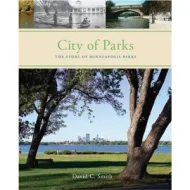
Permit me to quote myself — and Horace Cleveland — from City of Parks:
(Cleveland) had also written (to William Folwell) of his disgust that the park board was considering permitting a structure next to Minnehaha Falls where people could have their photos taken beside the cataract. “If erected,” Cleveland complained, “it will be simply pandering to the tastes of the army of boobies who think to boost themselves into notoriety by connecting their own stupid features with the representation of one of the most beautiful of God’s works.”
You didn’t mess with Cleveland’s favorite natural landscapes — one of the things that made him one of the first great landscape architects. Fortunately, William Folwell, who was president of the park board at the time, agreed with his friend.
Another early private business on park property was a service to pump up deflated bicycle tires on the new bicycle paths created by the park board during the bicycle craze of the 1880s-1890s. The park board did exercise some control over the business, however, by stipulating that the business could not charge more than a penny for filling a tire.
The park board began to take over food service in park buildings after Theodore Wirth became park superintendent in 1906. Wirth, like many park executives of the day, believed that no private concessions should be operated in parks — although he seemed to make an exception for pony rides and probably would have for the polo fields and barns he proposed for Bryn Mawr Meadows. (And, of course, the sheep he brought in to graze at Glenwood Park in 1921 were not owned by the park board. Wirth wrote that he thought sheep grazing in a park was a cool visual effect and that the sheep would earn their keep by cutting grass, keeping weeds down, which reduced fire risk, and fertilizing. Unfortunately they didn’t mow evenly and ate other plants too, so the borrowed sheep were evicted in 1922. ) One of the few other historical examples of a private venture operating on park property was the Minneapolis Tennis Club, which operated first at The Parade and then moved to Nicollet (Martin Luther King) Park in the early 1950s when Parade Stadium was built.
Do you remember concession stands in parks? What about treats at the Calhoun, Nokomis or Wirth beach houses? As good as fish tacos?
I have high hopes for Bread & Pickle, the new food service contracted for Lake Harriet next summer. I hope the Citizens Advisory Council that worked so hard on the recommendations wasn’t too conservative in forcing a new service into old space.
David C. Smith
Was landscape architect Warren Manning the first to propose a public golf course in a Minneapolis park?
Filed under: Landscape Architects, Minneapolis Golf Courses, Minneapolis Parks: General | Tags: Horace Cleveland, Minneapolis golf, Minneapolis parks, Sculpture Garden, The Parade, Thomas Lowry, Warren Manning
Comments (2) Under the headline “Fine Park Is Assured”, the Minneapolis Tribune ran a story on November 15, 1903 that contained details I had never seen on plans for a golf course and baseball field in a Minneapolis park. The basic facts of the article are well-known: Thomas Lowry, along with William Dunwoody and Seurity Bank, offered to donate land at the foot of Lowry Hill for what eventually became The Parade.
What was new (to me) in the story was that when Lowry submitted his proposal to donate land down the hill from his mansion he also submitted designs for the park. The plans were prepared by well-known landscape architect Warren Manning at Lowry’s request. Lowry also offered to foot the cost of implementing Manning’s plan. Lowry eventually did donate thousands of dollars to help the park board convert the land to a park, but Manning’s plans were never mentioned in park board records.
Frederick Law Olmsted and Minneapolis Parks
Filed under: Landscape Architects, Minneapolis parks | Tags: Frederick Law Olmsted, H.W.S. Cleveland, Horace Cleveland, Minneapolis parks, Washburn Fair Oaks, William D. Washburn
Comments (3) How many Minneapolis parks did Frederick Law Olmsted design? How about his sons, Junior and JC? I believe the grand total is zero.
Some people have a mistaken notion that Olmsted, the godfather of American parks, played a role in the creation of Minneapolis parks. The impression was created in part by a letter Olmsted wrote to the Minneapolis park board in 1886 and by claims that Olmsted designed the grounds around William Washburn’s mansion Fair Oaks, which later became Washburn Fair Oaks Park.
A city claiming that Olmsted designed a park is akin to an inn in the East declaring “George Washington slept here.” A quick way to impress. The difference is that exhaustive records and correspondence document what Olmsted actually did, while there is little proof of where George laid his wooden teeth on any given night.
 Minneapolis Park History