Archive for the ‘Theodore Wirth’ Tag
Lake Calhoun Bath House and Calhoun Beach Club: From “Disfigurement” to National Register
Filed under: Minneapolis parks | Tags: Charles M. Loring, Lake Calhoun, Theodore Wirth
 Comments (2)
 Charles Loring was the first to sound the alarm about businesses across Lake Street from the Lake Calhoun Bath House, but no one put the criticism so bluntly as Theodore Wirth.

The Calhoun Beach Club loomed over the beach and lake in 1940. The old three-level diving platform was a bit less timid than today’s rafts. (Minneapolis Tribune, Minnesota Historical Society)
Four days after the official dedication of the new bath house—with changing rooms, lockers and showers, not to mention $10,000 worth of sand on the new beach—Loring appeared in person at the August 5, 1912 meeting of the Board of Park Commissioners, a board he had once presided over, to plead for the park board to acquire the land across Lake Street from the beach before it became filled with “refreshment stands.” He wasn’t proposing a massive acquisition: the park board already owned Dean Parkway to the west and much of the land between Calhoun and Lake of the Isles to the east. Loring only wanted the board to buy the strip between Lake Street and the railroad tracks sandwiched between existing park lands.
It didn’t. Which gave rise to one of the most novel criticisms ever of a Minneapolis landscape. From one of the most unusual locations.
Writing from a ship sailing from Capetown, South Africa to the Canary Islands in 1936, Theodore Wirth wrote this about Durban, a South African city on the Indian Ocean (see Letters from Theodore post):
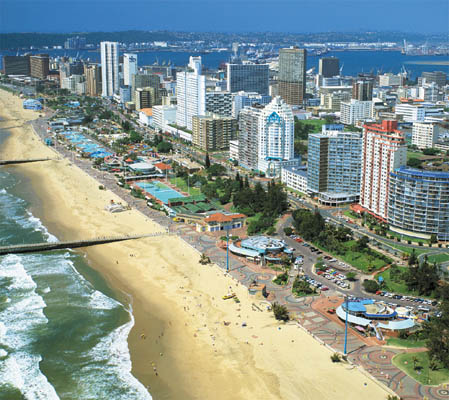
Modern Durban. The buildings might still be “monster rent barracks,” to use Wirth’s phrase, but the atmosphere at Durban’s beach has changed much more since 1936 than at Lake Calhoun. This photo looks nothing like what I remember from a visit in 1980.
Along the city side of the Durban Bay is the Marine Parade or Ocean Beach, flanked by a number of imposing modern buildings serving apartment and hotel purposes. The latter are called “flats” here and some of them are deserving of no better name, for they are anything but attractive. I am inclined to classify them as “monster rent barracks” — a still worse disfigurement of an otherwise attractive landscape than our Calhoun Beach Hotel at Dean Boulevard.
Theodore Wirth’s first opinion on the land across from the bath house was expressed in the 1912 annual report when he seconded the words of Loring and then board president Wilbur Decker encouraging the board to acquire the land to preserve it from commercial development.
Their fears may have been prompted by unpleasantness around Minnehaha Park in the early 1900s. Saloons and other commercial establishments near the falls had contributed to an objectionable environment in the park. In the 1905 annual report of the park board, president Fred Smith wrote that a new pavilion, changes in policing and support from the city administration had “done much to redeem Minnehaha from its unsavory reputation and make it a place where women and children can visit and enjoy their picnics without fear of molestation or insult.”
I can imagine that specter haunting Loring in particular, a man who had run for mayor of Minneapolis in 1882 on a strong anti-saloon platform. Loring also deserved most of the credit for the park board acquiring Minnehaha Falls, Lake Calhoun and Lake Harriet, the three jewels in the park crown at the time, and I’m sure he took a proprietary interest in their well-being, which would not have included “refreshment stands” nearby.
Despite their fears, the land across Lake Street from the immensely popular bath house — it was called the best beach between the oceans — was not filled with houses of debauchery. At least that’s the inference we can draw from another round of encouragement for the park board to acquire the land in 1917. Still it didn’t happen.
Another ten years passed before grand plans for the property took shape. It would become a residential building fitted with its own entertainment and recreation facilities. Curiously, the last mention of the development in park board proceedings is Wirth’s recommendation on April 20, 1927 that the board consent to a building permit for the facility as long as the building did not come within 15 feet of park property along Dean Parkway. The board agreed. Perhaps plans for the property were too far along for Wirth and the park board to fight, or they had no real alternative after taking no action themselves for 15 years
But perhaps Wirth’s objection in 1936 was not that the building was there, but that it was unfinished. Although construction began in 1927 the building remained unfinished and empty until 1946. In a bit of irony, the property Wirth worried would fall into private hands and the building which he said “disfigured” the lake was the site of a tribute dinner to him in 1946 before he moved from Minneapolis to San Diego for health reasons.
The Calhoun Beach Club was added to the National Register of Historic Places in 2003 for its architecture and engineering. The building now adjacent to the commercial and residential “club” was the focus of a fight in 1988 to limit the height of buildings around Minneapolis lakes. That battle resulted in a city ordinance that limits the height of such buildings. When the Calhoun Beach Club was first designed in 1927, at ten stories, it was the tallest building in the city outside of downtown.
David C. Smith
Pioneering Minneapolis Landscape Architects: Wyman, Morell and Nichols, but not Wirth?
Filed under: Grand Rounds, Landscape Architects, Victory Memorial Drive | Tags: Anthony Morell, Arthur Nichols, Phelps Wyman, Theodore Wirth, Victory Memorial Drive, Warren Manning
Comments (4) I’ve been surprised at the interest generated by posts here about landscape architects who worked on Minneapolis parks, so I’ll add the latest info I have on a few landscape architects.
I once compiled a list of all the park designs and plans published in the annual reports of the Minneapolis Board of Park Commissioners for the first 60 years of its existence, 1883-1943. For the most part, that means the plans of Horace W. S. Cleveland, who designed the first Minneapolis parks, and Theodore Wirth, who was superintendent of parks 1906-1935.
From the time Cleveland stopped working, about 1893, until Wirth was hired in 1906, the Minneapolis park board did not have a landscape architect — nor the money to pay one following a severe economic downturn — except for hiring Warren H. Manning for various projects from 1899 to 1905. No Manning plans for Minneapolis parks have survived, although his in-depth written recommendations for Minneapolis parks were published in the 1899 Annual Report of the Minneapolis park board. More on Manning in a later post.
While Wirth was superintendent, he prepared nearly all park plans himself, although I believe he identified himself more as a gardener and engineer than a landscape architect. He listed himself as “Sup’t.” on most of his park plans until 1926 when he added “Eng’r.” He was an early and active member of the American Institute of Park Executives, but did not, to my knowledge, join the American Society of Landscape Architects. Wirth was not included in Pioneers of American Landscape Design, a compilation by Charles Birnbaum and Robin Karson of Americans who influenced the nation’s landscape. I think that is an oversight.
While Wirth gets too much credit from some in Minneapolis for creating the city’s park system, his omission from a list of more than 160 prominent landscape designers in the United States probably gives him too little credit for shaping one of the nation’s premier urban park systems.
Wirth’s omission from the “pioneers” list is more striking because three landscape architects who practiced in Minneapolis while Wirth was parks chief were profiled as pioneers: Anthony Urbanski Morell, Arthur Richardson Nichols and Phelps Wyman. I don’t believe it could be argued that any of the three had nearly as great an impact on the landscape of Minneapolis — and perhaps urban parks in general — as Wirth did, although they all worked in other locations as well.
I have already written about Wyman, but would like to add notes on Morell and Nichols’s involvement with Minneapolis parks and update info on Wyman.
Morell and Nichols
Morell and Nichols became partners in 1909 and relocated to Minneapolis to take advantage of connections they had made in Minnesota while working for a New York landscape architect on projects in Duluth — the Congdon Mansion and the Morgan Park neighborhood — according to Pioneers of American Landscape Design. Their names first appeared in Minneapolis park board documents in the park board’s annual report of 1910. They are cited as the creators of a design for Farwell Park in North Minneapolis for the David C. Bell Investment Company, one of the city’s most prominent real estate developers. The 1.2-acre park was platted in the Oak Park (not Oak Lake) Supplement in 1889, but it wasn’t until 1910 that the developer asked the park board to take control of the land and improve it as a park using a plan the developer provided. The plan itself was not unusual, but it was the first landscape plan to appear in an annual report that had not been commissioned by the park board. That Wirth chose to publish the plan in the annual report suggests his regard for Morell and Nichols. Wirth encouraged park commissioners to approve the plan, which they did. Wirth wrote in the 1910 annual report:
The proposed arrangement of lawns, plantings and walks, is very pleasing and appropriate to the surroundings and the present topography of the grounds, and the execution of the plan will not involve a very large expenditure.
Improvements to the park were begun in 1911 and completed in 1912. The Bell company originally paid for the work, but was reimbursed by the park board.
Regional Parks
The other references to Morell and Nichols in park board annual reports were in the 1930 and 1935 reports in connection with their work for Hennepin County, which includes Minneapolis, when they prepared a preliminary study for a county-wide park system in 1922 . Theodore Wirth referred to their plan in the 1930 annual report in his yearly words of encouragement for the Minneapolis park board to lead the effort to create a regional park authority. Wirth advocated including Minnehaha Creek, Bassett’s Creek and Shingle Creek, from their sources in Hennepin County lakes to the Mississippi River in Minneapolis, in a regional park system. In the 1930 report, Wirth included a map of the territory embracing the sources of Shingle Creek and Bassett’s Creek and highlighted park areas recommended by Morell and Nichols in their earlier report. Among the areas they had suggested for parks in northwest Hennepin County were portions of the shores of Medicine Lake, Bass Lake, Eagle Lake, Lime Lake, and all of Sweeney Lake adjacent to Glenwood Park. The map legend indicated that Robbinsdale planned to preserve the entire shorelines of Twin Lakes and Crystal Lake as parkland as well. Too bad that didn’t happen.
Five years later, in the 1935 annual report, Wirth’s last as park superintendent, he published his own “Tentative Study Plan” for a park district for the west metropolitan region. Wirth had been directed by the park board in February 1935 to undertake the study in hopes that the board could apply for federal work relief funds to begin to implement a metropolitan park plan. Although funds were not forthcoming for that project, the idea of a county park system eventually led to the creation of what is today the Three Rivers Park District.
Wirth submitted his report to the board in November 1935 and it was published in its entirety in that year’s annual report. Wirth noted that his plan had been created in collaboration with Arthur Nichols, who was then the consulting landscape architect to the Minnesota Highway Department. Wirth wrote that he and Nichols had spent one afternoon a week for two months touring possible park and parkway sites in suburban and rural Hennepin County and had completed their research with aerial reconnaissance of prospective parks.
These two events in which Morell and Nichols worked with Wirth on park design don’t tell us much about their practice, except that they seemed to have an effective working relationship with Wirth and were well-known to him and other decision makers, from developers to county commissioners. Phelps Wyman also knew Morell and Nichols. Morell was a consultant to the Minneapolis Planning Commission on which Wyman sat as the representative of the park board in the early 1920s. Wyman and Nichols had worked together for the US Housing Corporation in Washington, D.C. during the Great War. Moreover Nichols had been the first graduate in 1902 of MIT’s landscape architecture program, which Wyman completed a few years later. Having attended the same educational institution at a time when few academic programs in landscape architecture existed would have likely created some bond between them.
Phelps Wyman and Victory Memorial Drive
Of the three “pioneers” in landscape design, Wyman had by far the most input on park landscape architecture in Minneapolis due to his service as an elected park commissioner 1917-1924. In an earlier post I noted Wyman’s design of what is now Thomas Lowry Park, his proposed plan for Washburn Fair Oaks, and his suggestion of a traffic circle to relieve congestion at the Hennepin and Lyndale Avenue bottleneck. What I overlooked in that post was perhaps Wyman’s most creative park design, which Wirth included in the park board’s annual report of 1929 even though the plan had been created eight years earlier. (Phelps resigned from the park board and moved to Milwaukee in 1924, one reason I didn’t consider looking for Wyman’s influence on park designs in documents from the late 1920s.)
In the 1929 annual report Wirth included Wyman’s “Preliminary Sketch of Victory Memorial Drive” from 1921 to illustrate the need for grade separations between parkways and city streets in some locations. In Wyman’s sketch, Broadway Avenue West tunneled under a large plaza at the intersection of Victory Memorial Drive and Lowry Avenue North. Wirth provided no explanation of why Wyman created his “decorative scheme” for the parkway, but it is a fascinating design.

Phelps Wyman’s design for Victory Memorial Drive, 1921 (1929 Annual Report, Minneapolis Board of Park Commissioners)
Among Wyman’s more interesting ideas — in addition to putting Broadway underneath an extensive plaza:
- Three plazas would have anchored the drive: one at Camden (Webber) Park was labelled “America Mobilized,” the monument plaza and flag pole at the northwest corner of the drive was titled “Humanity,” and the Lowry Avenue Plaza was called “America at Peace.”
- Another plaza, “Freedom of Seas”, would have connected Victory Memorial Drive to Crystal Lake between 39th and 40th avenues north. The only connection I can imagine between a stretch of land along a Robbinsdale lake and a “Freedom of Seas” park is the sinking of the Lusitania, an important factor in the U.S. entry into WWI and the resulting dead young men and women who were honored along Victory Memorial Drive.
- The west side of Victory Memorial Drive from Lowry Avenue to 45th would have been reserved for “Public Institutions.”
David C. Smith
© David C. Smith
Minneapolis Parks 100 Years Ago
Filed under: Minneapolis Parks: General | Tags: Theodore Wirth, Wilbur Decker
Comments (1) The Minneapolis park board and other park activists in town have a full plate this year: a new park superintendent, reorganization and significant staff turnover, Minneapolis Riverfront Design Competition and Initiative, development of Boom Island and B. F. Nelson parks, proposed green finger of parks running into downtown from the river through Gateway Park past the library, potential power plant—Crown Hydro—on park property, and a budget inadequate to do much else. Those are only a handful of the bigger challenges.
But, hah!, Wilbur Decker and Theodore Wirth, park board president and superintendent respectively in 1911, would smirk at this puny agenda. It’s nothing compared to what the park board did 100 years ago. Here’s a summary of what the park board accomplished in 1911. Continue reading
Has the Park Board Neglected Northeast Minneapolis?
Filed under: Grand Rounds, Minneapolis parks, Mississippi River | Tags: Columbia Park, Horace Cleveland, Logan Park, Mississippi River, Northeast Minneapolis, Sandy Lake, Theodore Wirth
Comments (2) The argument is sometimes made, particularly by “Nordeasters,” that northeast Minneapolis is park poor and that the Minneapolis park board has neglected that part of the city. “Underserved” seems to be the popular word. The idea even flowed as an undercurrent through the recent Minneapolis Riverfront Design Competition. The thinking goes that ever since Minneapolis and St. Anthony merged in 1872, and took the name Minneapolis, power, money and prestige—not to mention amenities such as parks—have accumulated west and south of the river. (Read Lucille M. Kane, The Waterfall That Built a City, for a fascinating examination of why that might have happened.)
While writing recently about Alice Dietz and the marvelous programs she ran at the Logan Park field house I thought again about the perceived neglect of Northeast and whether it might be true. I concluded that it is not; northeast Minneapolis has been a victim of industry, topography and opportunity, but not discrimination or even indifference. What’s more, all those elements have now realigned, putting northeast Minneapolis in the position to get a far bigger slice of the park pie in the foreseeable future than any other section of the city.
Minneapolis Park Memory: Meetings with Grandpa
Filed under: Minneapolis Park Memory | Tags: Francis A. Gross, Minnehaha Park, Theodore Wirth, William Lohff
Leave a comment I feel so fortunate having our parks in Minneapolis. My late husband, Bob, used to tell how his mother saved her coins until she could buy a toboggan for the family to use in Minnehaha Park. I have used the tennis courts at Nokomis.
My family has a personal interest in the park system, as my grandfather, William Lohff, was on the park board with Francis Gross and others. I remember Theodore Wirth and Gross meeting with Grandpa at his home in south Minneapolis. They had a hard time convincing people that the parks and lakes should be for all the people and not allow park land to be sold. We have all benefitted from those decisions.
Mary Thompson
Public-private collaborations that work: Sea Salt, Tin Fish and…Bread and Pickle?
Filed under: Lake Calhoun, Lake Harriet, Minneapolis Parks: General, Minnehaha Falls | Tags: Horace Cleveland, Lake Calhoun, Lake Harriet, Minnehaha Falls, Theodore Wirth
Comments (1) The mention of Sea Salt restaurant in Alice Streed’s Minneapolis Park Memory: Treasure (below) is noteworthy. A relatively new development in our parks is mentioned in the same sentences as long-celebrated spaces and activities. The popular restaurant in the Minnehaha Park refectory — run as a private, for-profit business — is a marvelous example of the best of public-private collaboration. It proves that private enterprise can do some things, such as serving delicious sea food, better than a public agency. I believe it also demonstrates the silliness of claims that the sky is falling whenever an agency like the park board considers change.
Lest private enterprise advocates get carried away here, however, let me state quite emphatically that there would be no park system in which to place these wonderful little restaurants if we would have relied on private interests to create parks. Our parks prove that public agencies can do some things, such as creating a park system, that private enterprise will not do.
The debate over allowing businesses to operate in Minneapolis parks is old — and sometimes entertaining. The park board began granting concessions for boat rentals, then food sales, to private businesses at Lake Calhoun and Lake Harriet very early in the history of Minneapolis parks. The park board assumed control of the boat rentals at Lake Harriet in the late 1880s when Charles Loring noted that the business could be easily managed by the park board. On other issues, however, the presence of private enterprise on park property was vigorously opposed.
Permit me to quote myself — and Horace Cleveland — from City of Parks:
(Cleveland) had also written (to William Folwell) of his disgust that the park board was considering permitting a structure next to Minnehaha Falls where people could have their photos taken beside the cataract. “If erected,” Cleveland complained, “it will be simply pandering to the tastes of the army of boobies who think to boost themselves into notoriety by connecting their own stupid features with the representation of one of the most beautiful of God’s works.”
You didn’t mess with Cleveland’s favorite natural landscapes — one of the things that made him one of the first great landscape architects. Fortunately, William Folwell, who was president of the park board at the time, agreed with his friend.
Another early private business on park property was a service to pump up deflated bicycle tires on the new bicycle paths created by the park board during the bicycle craze of the 1880s-1890s. The park board did exercise some control over the business, however, by stipulating that the business could not charge more than a penny for filling a tire.
The park board began to take over food service in park buildings after Theodore Wirth became park superintendent in 1906. Wirth, like many park executives of the day, believed that no private concessions should be operated in parks — although he seemed to make an exception for pony rides and probably would have for the polo fields and barns he proposed for Bryn Mawr Meadows. (And, of course, the sheep he brought in to graze at Glenwood Park in 1921 were not owned by the park board. Wirth wrote that he thought sheep grazing in a park was a cool visual effect and that the sheep would earn their keep by cutting grass, keeping weeds down, which reduced fire risk, and fertilizing. Unfortunately they didn’t mow evenly and ate other plants too, so the borrowed sheep were evicted in 1922. ) One of the few other historical examples of a private venture operating on park property was the Minneapolis Tennis Club, which operated first at The Parade and then moved to Nicollet (Martin Luther King) Park in the early 1950s when Parade Stadium was built.
Do you remember concession stands in parks? What about treats at the Calhoun, Nokomis or Wirth beach houses? As good as fish tacos?
I have high hopes for Bread & Pickle, the new food service contracted for Lake Harriet next summer. I hope the Citizens Advisory Council that worked so hard on the recommendations wasn’t too conservative in forcing a new service into old space.
David C. Smith
Minneapolis Park Memory: A Memorable Silence
Filed under: Minneapolis Park Memory, Minneapolis Parks: General | Tags: Bossen Field, Edward Foote Waite, Minneapolis parks, Minnehikers, Theodore Wirth, Waite Park
Comments (1) I was the editor of the Minneapolis Municipal Hiking Club’s monthly newsletter for many years, up through the last month of the club’s existence in October 2010.
One hike I particularly remember took place on Wednesday, September 12, 2001. The Club had an evening hike scheduled for the neighborhood around Bossen Field in south central Minneapolis. Many planes fly over this area approaching the airport, but this was the day after 9/11 and all U.S. civilian planes were grounded by federal decree. It was quite a sensation walking in this area, expecting to hear planes fly over, but hearing none.
George Bridgman

Minnehikers was a popular club. Annual banquet, 1938. (Norton and Peel, Minnesota Historical Society, GV1.22 p87)
Editor’s note: The Minnehikers, as the club was known, was originally organized by the park board’s recreation staff in 1920. According to Theodore Wirth (Minneapolis Park System 1883-1944), the first hike took place on January 10, 1920. Minneapolis Mayor J. E. Meyers, Judge Edward Foote Waite and Wirth led 83 hikers 3 1/2 miles from Minnehaha Falls to Riverside Park.
Twenty-nine years later, the park board named a park for the juvenile court judge who participated that day: Waite Park in northeast Minneapolis.

Waite Park and Waite Park School, the first joint school/park development in Minneapolis in 1949, were named for Judge Edward F. Waite, pictured here with students and teachers at the school in about 1955, when he was 95. (Newburg Studio, Minnesota Historical Society, por 5807 p8)
The mayor’s name is on a park too, the J.E. Meyers Memorial Park in Mound on Lake Minnetonka. Internet sites list it as both a boy’s camp and a cemetery. A mystery to be solved. Of course, we know that Wirth has a park named for him, too.
I would tell more about the Minnehikers, but I hope former members of the group will do that themselves with first person accounts. The club sponsored its last hike in October. Changing times.
David C. Smith
Theodore Wirth Gets a New Home…and Office
Filed under: Minneapolis Parks: General | Tags: Lyndale Farmstead, Minneapolis parks, Superintendent's House, Theodore Wirth, Theodore Wirth House
Comments (6) I think I’ve finally got it: the last chapter in the saga of building a house for celebrated Minneapolis parks superintendent Theodore Wirth at Lyndale Farmstead. The ending is much more intriguing than I had previously known. I discovered it just a little more than 100 years after the construction of the house! The story told in the Lyndale Farmstead pages at minneapolisparks.org is true—as far as it goes.
The comptroller of Minneapolis, Dan Brown, did refuse to countersign the contract between the Minneapolis Board of Park Commissioners and C. P. Johnson and Son to build a house for Theodore Wirth at Lyndale Farmstead, a Minneapolis park. I had previously assumed that because the house was built in 1910 anyway, that the park board had found a way around getting Mr. Brown’s John Hancock on a contract. That was my mistake. The park board finally did get Dan Brown to countersign the contract, but it took a bit of legal work—and a divided opinion by the Minnesota Supreme Court. Continue reading
 Minneapolis Park History