Archive for November, 2011|Monthly archive page
More Bassett’s Creek
Filed under: Minneapolis parks, Minnehaha Creek | Tags: Bassett's Creek, Minnehaha Creek, Neiman Sports Complex
 Leave a comment
 Interesting thoughts from readers on city and park board treatment of Bassett’s Creek:
Is it possible that Minneapolis spent as much or more tunneling Bassett’s Creek in an attempt to improve north Minneapolis than it spent building a parkway along Minnehaha Creek? Someone would have to go through financial reports to determine the city/Bassett’s Creek figures. Building two tunnels, the second one 80 feet beneath downtown Minneapolis, must have had a fairly hefty price tag. What if you threw in the federal and park board dollars from the time of Civilian Conservation Corps and Works Progress Administration projects in the 1930s until now on Bassett’s Creek above ground from Bryn Mawr into Theodore Wirth Park?
Perhaps the park board’s biggest missed opportunity in dealing with Bassett’s Creek was the decision to build a competition-quality youth sports complex—the one named for Leonard Neiman—at Fort Snelling instead of in Bryn Mawr/Harrison. I don’t recall what Bryn Mawr or Harrison residents thought of the idea when it was considered in the late 1990s. Does anyone remember that discussion? It would certainly be a better location for youth sports than the distant fields of Fort Snelling (for people living almost anywhere in Minneapolis—south, north, northeast, or southeast). Whether building that complex in the central city would have spurred other development or at least raised awareness of Bassett’s Creek is hard to say, but it could’ve been positive for the neighborhoods beside and above the creek.
David C. Smith
The Myth of Bassett’s Creek
Filed under: Minneapolis parks, Mississippi River | Tags: Bassett's Creek, H.W.S. Cleveland, Horace Cleveland, Minnehaha Creek, Mississippi River
Comments (24) I heard again recently the old complaint that north Minneapolis would be a different place if Bassett’s Creek had gotten the same treatment as Minnehaha Creek. Another story of neglect. Another myth.
You can find extensive information on the history of Bassett’s Creek online: a thorough account of the archeology of the area surrounding Bassett’s Creek near the Mississippi River by Scott Anfinson at From Site to Story — must reading for anyone who has even a passing interest in Mississippi River history; a more recent account of the region in a very good article by Meleah Maynard in City Pages in 2000; and, the creek’s greatest advocate, Dave Stack, provides info on the creek at the Friends of Bassett Creek , as well as updates on a Yahoo group site. Follow the links from the “Friends” site for more detailed information from the city and other sources.
What none of those provided to my satisfaction, however, was perspective on Bassett’s Creek itself after European settlement. A search of Minneapolis Tribune articles and Minneapolis City Council Proceedings, added to other sources, provides a clearer picture of the degree of degradation of Bassett’s Creek — mostly in the context of discussions of the city’s water supply. This was several years before the creation of the Minneapolis Board of Park Commissioners in 1883 — a time when Minnehaha Creek was still two miles outside of Minneapolis city limits. The region around the mouth of Bassett’s Creek was an economic powerhouse and an environmental disaster at a very early date — a mix that has never worked well for park acquisition and development.

Idyllic Minnehaha Creek, still in rural surroundings around 1900, quite a different setting than Bassett’s Creek, which had already been partly covered over by then. (Minnesota Historical Society)
“A Lady Precipitated from Bassett’s Creek Bridge”
Anfinson provides many details of the industrial development of the area around the mouth of Bassett’s Creek from shortly after Joel Bean Bassett built his first farm at the junction of the river and the creek in 1852. By the time the Minneapolis Tribune came into existence in 1867, industry was already well established near the banks of the creek. A June 1867 article relates how the three-story North Star Shingle Mill had been erected earlier that year near the creek. The next March an article related the decision to build a new steam-powered linseed oil plant near the creek on Washington Avenue.
Even more informative is a June 27, 1868 story about an elderly woman who fell from a wagon off the First Street bridge over the creek. “A Lady Precipitated from Bassett’s Creek Bridge, a Distance of Thirty Feet,” was the actual headline. (I’m a little embarrassed that I laughed at the odd headline, which evoked an image of old ladies raining down on the city; sadly, her injuries were feared to be fatal.) But a bridge height of thirty feet? That’s no piddling creek — even if a headline writer may have exaggerated a bit. The article was written from the perspective that the bridge was worn out and dangerous and should have been replaced when the city council had considered the matter a year earlier. Continue reading
Horace Cleveland’s Friends: Five of Clubs
Filed under: Landscape Architects, Longfellow Field Park, Minneapolis Parks: General | Tags: Cornelius C. Felton, Five of Clubs, George Stillman Hillard, H.W.S. Cleveland, Henry Russell Cleveland, Henry Wadsworth Longfellow, Horace Cleveland, Longfellow Park, Sumner Field
Comments (1) Trivia to delight and amaze.
Can you name two Minneapolis parks named for members of the “Five of Clubs,” an informal sort of book club?
The “Five of Clubs” met informally at the suburban Boston home of Horace W. S. Cleveland’s brother, Henry, in the early 1840s. Horace lived with his older brother for a time and sat in on those “club” gatherings.
Answer: Sumner Field and Longfellow Field.
Sumner Field was named for Sumner Place, the street in north Minneapolis on which the park was built in 1911. Sumner Place was named for U. S. Senator Charles Sumner, famous for his opposition to slavery and for ensuring the rights of freed slaves during Reconstruction. Before he was elected to the Senate from Massachusetts, he was an attorney in Boston — and a member of the “Five of Clubs.”

Longfellow statue in a field near Longfellow Garden upstream from Minnehaha Falls, 2011. (Ursula Murray Husted, flickr.com)
Longfellow Field was named for Henry Wadsworth Longfellow, the poet and professor of modern languages at Harvard in the 1840s and also a member of the “Five of Clubs.” In 1855, Longfellow published his epic poem “Song of Hiawatha,” which made Minnehaha Falls famous around the world. Longfellow never visited Minnehaha Falls and the book was written 17 years before Horace Cleveland first saw the Falls.
Imagine Horace Cleveland’s astonishment if he would have been told that 110 years after his death he would be more respected in his field than Longfellow is in his.
The other members of the “Five of Clubs” were Cornelius C. Felton, professor and future president of Harvard University, and George Stillman Hillard, Sumner’s law partner and author and publisher.
A reminder: Minneapolis should have a park along the Mississippi River gorge named for Horace Cleveland.
For much, much more on Horace Cleveland, click on his name in the tag cloud at right. For the whole story of Horace Cleveland and Minneapolis parks read City of Parks.
Just curious. Any future Sumners or Longfellows or Clevelands in your book club?
David C. Smith
Talmud Torahs vs. Swastikas
Filed under: Minneapolis parks | Tags: Football, Sumner Field, Talmud Torah
Leave a comment The combination of words was eye-catching. And image-generating: holocaust, horrors. But on the sports pages of the Minneapolis Tribune? In 1921?
There they were, two teams competing in the 125-pound division of the Minneapolis Amateur Football Association: the Swastikas and the Talmud Torahs. But this was before the Nazis stigmatized the swastika, which had Sanskrit origins and had been used around the globe for millenia as a symbol of good luck or success. It was a good word, a positive symbol. It was only a year earlier that the German National Socialist Party had adopted the swastika as its symbol and it would be nine years more until Adolph Hitler created the famous red, white and black swastika flag.
I haven’t been able to find any information on who sponsored the Swastika team or what part of the city they came from. I know more about the Talmud Torah teams. The Talmud Torah was a Hebrew free school, established in 1893, that instructed Jewish children in Hebrew language and literature and the history and traditions of the Jewish people. Students attended the Talmud Torah after their regular day of study at public schools.

Talmud Torah, 725 Fremont Avenue North, ca. 1950, sponsored sports teams in park recreation leagues beginning in 1919. (Minneapolis Star Journal Tribune, Minnesota Historical Society)
In 1915 a new Talmud Torah opened on Fremont and Eighth Avenue North. The original Talmud Torah had been supported by the Keneseth Israel congregation, but the school in the new building had a wider base of support than a single congregation. According to an article in the Minneapolis Tribune, January 10, 1915, the school “will make Minneapolis famous as the only city in which practically all the people of the Jewish race have united in providing an institute … for Jews of any language and social condition.”
The first sports score I can find for the Talmud Torahs was a basketball victory at their gym in December 20, 1919, when they defeated the Eagle A. C. 56-4. Nice debut. (Minneapolis Tribune, December 21, 1919.) But the Talmud Torahs — that’s what newspapers called them, just as they referred to the “Bottineaus” or “Powderhorns” for teams representing those parks — showed up in the sports pages of the Tribune especially during the football season. That was presaged perhaps by an article in the Minneapolis Tribune, November 28, 1915, which announced that the Newsboys Club of some 300 boys “accustomed to the life of the streets” had been taken under the wing of the social settlement house also established at Talmud Torah and that they would be instructed by University students that were “expert in football.” Those newsboys may have been the foundation for later Talmud Torah teams. Perhaps the most famous newsboy of that neighborhood is Sid Hartman of the StarTribune sports page, although he isn’t quite old enough to have been in the club at that date.
The home football field of the Talmud Torah teams was Sumner Field, just two blocks east of the school on Eighth. The school sponsored one to three teams each year in the early 1920s.
The weight divisions in those days were determined quite differently from today, when most restrictions on youth football are based on a weight limit. Only players under a certain weight are allowed to play in that league. It was different in the late 1910s and 1920s. Then each team registered with 16 players on its roster. The players were weighed and the average weight of those players determined the league they played in. Leagues ranged from 95 or 100 pounds to 140 pounds. increasing in 5 or 10 pound increments, with a “senior” division in which weight did not matter. Also interesting is that the weight classes applied without apparent regard to age. For example, an article in the Tribune about a 135-pound league game in 1921 noted that the match-up featured several former All-City high school stars.
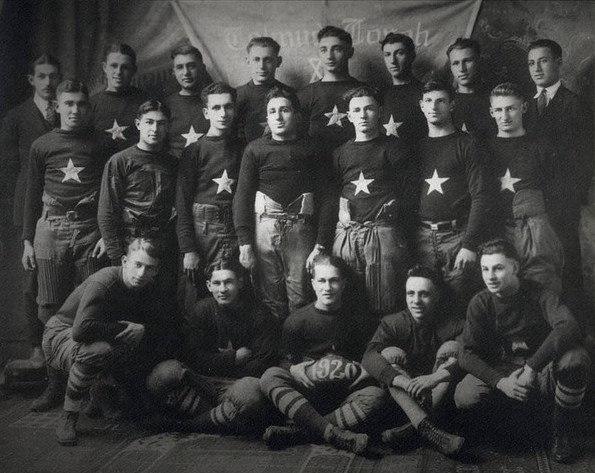
The first Talmud Torah football team, 1920 (Jewish Historical Society of the Upper Midwest, jhsum.com)
In 1920 the Talmud Torah team played in the 140-pound league and deep into the season was undefeated and unscored upon. In 1921 Talmud Torah had two teams, one played in the 125-pound league with the Swastikas — and won their division, a playoff with the winner of the other 125-pound division was snowed out — and the Talmud Torah Cubs played in the 100-pound league. The next year Talmud Torah sponsored three teams, one each in the 130-, 100- and 90-pound divisions.

In 1922, the Talmud Torahs were joined in park football by another Jewish team from the Judea A.C. Later Judea football teams were sponsored by the Emmanuel Cohen Center, a social service center established in 1924. The first Judeas team played in the 90-pound division — along with a Talmud Torah team — which is not likely the weight classification in which these fellows played.
The Rise of Activities Councils
If you happen by a soccer field in the fall or a park gym in winter now you’ll see nearly every team in uniforms with a name that ends in AC. Whether the uniform says WESAC, MFAC, SWAC, SIBAC, or something else, the AC stands for “activities council.” Activities councils — call them boosters or volunteers — associated with parks are a phenomenon that began with the creation of the Minnehaha Falls Activities Council (MFAC) serving Keewaydin Park in 1936. In the booklet, “Recommended Procedures for Park Area Recreation Councils” published by the park board in 1971, Robert Ruhe, park superintendent at the time, wrote that the councils were to his knowledge “unique among park and recreation departments in the United States.” The councils were and are independent of the park board recreation staff but work closely together to finance teams, buy equipment and provide coaches. The 1971 document lists the creation dates of 27 activities councils, many of which still exist.
While MFAC was the first booster club that promoted activities park wide, the idea of booster clubs was given a boost itself in 1951 and 1952 when new playgrounds were opened at Waite Park and Armatage respectively. Both school/park combinations were joint projects of the park board and the school board from the ground up. New parks were fertile ground for booster clubs and one was created at both parks. They were soon followed by the Southwest Activites Council (SWAC) in 1953 that covered two parks: Pershing and Linden Hills. SWAC was one of the most successful booster groups, providing a model for other parks. Two early activists in SWAC later became park commissioners, Inez Crimmins and Leonard Neiman, for whom the sports complex at Fort Snelling is named.
The booster clubs organized by park gradually replaced the more loosely managed efforts of players or businesses to put togther teams and secure equipment and create schedules. The job of organizing teams was more complicated then also because park recreation centers, other than the Logan Park Fieldhouse, were open and staffed only in the summer. There was no such thing as a year-round playground staff or recreation supervisors
For more photos and information about 1920s park football see this story about the football team from Bottineau.

This Camden team won the 1922 senior or open division of the Minneapolis Amateur Football Association managed by the park board recreation department.
David C. Smith
© David C. Smith
Northeast River Parks
Filed under: Minneapolis parks, Mississippi River | Tags: Edgewater Park, Gluek Park, Horace Cleveland, Mississippi River
Comments (4) I enjoyed a walk yesterday along the riverfront parks in northeast Minneapolis sponsored by the Minneapolis Riverfront Partnership. I told a few historical stories and park commissioner Liz Wielinski, Above the Falls committee member Mary Jamin Maguire, and Cordelia Pierson, executive director of the partnership, provided insights into park developments, past and future, along the river. We were also delighted to hear stories of the neighborhood from a few longtime residents of the area.
We visited Marshall Terrace, Edgewater Park, and Gluek Park and along the way we passed the newest, still unnamed, Minneapolis park at 2220 Marshall Street—a single lot from Marshall to the river purchased by the park board in 2010.
These are a few of the notes I made for my input into the program.
Marshall Terrace
Marshall Terrace was purchased in 1914. The first land chosen for a First Ward Park was a few blocks farther upriver, but neighborhood objections resulted in the park board asking for suggestions from residents and politicians for a better site. This eight-acre parcel further downriver was the result. (The park board also acquired the upriver acreage, but as a segment of a planned parkway across northeast Minneapolis, now St. Anthony Parkway, instead of a playground park.)
Park superintendent Theodore Wirth prepared these two plans for the new park, which were included in the 1915 Annual Report. (The same report included plans for nearby Bottineau Park.) Continue reading
City Ordinance Restricts Building Height Around Minneapolis Lakes
Filed under: Minneapolis Parks: General | Tags: Gates Mansion, Lake Calhoun, Lake of the Isles, Loring Park, Washburn Fair Oaks
Comments (1) If you’re a long-time follower of Minneapolis politics, you might think this headline came from the 1988 fight to prevent a high-rise building from being constructed next to the Calhoun Beach Club facing Lake Calhoun. But you have to go back much farther in history to get to the first city ordinance to restrict construction on parkways encircling Minneapolis lakes.
I wrote a few weeks ago about Theodore Wirth’s description of the Calhoun Beach Club as a “disfigurement.” In that post I noted that Charles Loring was the first to warn the park board of the likelihood of commercial encroachment on the lake following the highly successful opening of the Lake Calhoun Bath House in July, 1912. Loring urged the park board to acquire the property across Lake Street from the bath house to prevent commercial development there. The fear, I’m sure, was the opening of saloons or dance halls. (Just two years earlier, in June 1910, the park board expanded Riverside Park when a dance hall was planned for land facing the park. The board preempted the dance hall plans by acquiring the land through condemnation.)
Since I wrote that post I’ve learned that by the time Loring made his suggestion in August 1912, the city had already passed an ordinance limiting construction on parkways around the lakes. And it had nothing to do with the Lake Calhoun Bath House. The purpose of the ordinance was essentially to facilitate the construction of this castle. Continue reading

 Minneapolis Park History