Stone Quarry Update: Limestone Quarry in Minnehaha Park at Work
I was technically correct when I wrote in October that the park board only operated a limestone quarry and stone crushing plant in Minnehaha Park for one year: 1907. But I’ve now learned that the Minnehaha Park quarry was operated for nearly five years by someone else—the Works Progress Administration (WPA).
From early 1938 until 1942 the WPA, a federal program that provided jobs during the Depression, operated the quarry after “tests revealed a large layer of limestone of hard blue quality near the surface” in the park near the Fort Snelling property line at about 54th, according to the park board’s 1937 Annual Report. The WPA technically operated the plant, but it was clearly for the benefit of the Minneapolis park system.
“Although this plant is operated by the WPA, our Board supplied the bed of limestone, the city water, lighting, gasoline and oil, and also some small equipment, since it was set up primarily for our River Road West project, which included the paving of the boulevard from Lake Street to Godfrey Road, and also to supply sand and gravel to the River Road West Extension project (north from Franklin Avenue) where there was a large amount of concrete retaining wall construction.”
— 1938 Annual Report, Minneapolis Board of Park Commissioners
In 1938 the park board estimated that 85% of the product of the stone crushing plant was used on park projects, the remainder on other WPA projects in the city.
The quarry was established in an area that “was not used by the public and when the operations are completed, the area can be converted into picnic grounds and other suitable recreational facilities,” the park board reported. (I bet no one thought then that a “suitable” facility would include a place where people could allow their dogs to run off leash!)
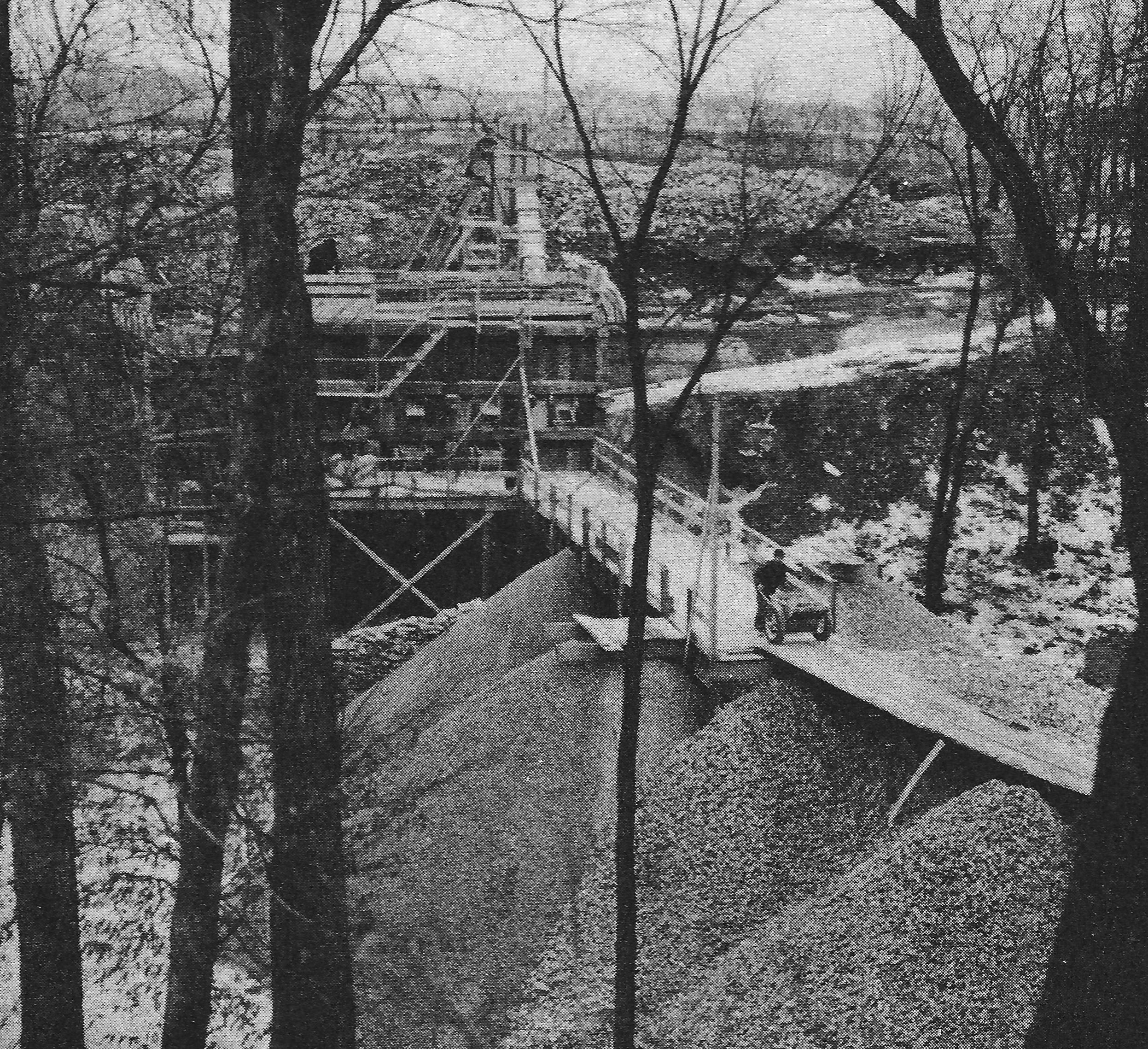
“The Stone-crushing Plant at Minnehaha Park” (1938 Annual Report, Minneapolis Board of Park Commissioners) Doesn’t look much like one of our favorite wild places, does it?
The plant consisted of “two large jaw crushers” and a conveyor that lifted the crushed rock to shaker screens over four large bins. It was operated by gasoline engines and was lit by electric lights so it could operate day and night. (The fellow with the wheelbarrow in the photo might have liked more conveyor.)
The crushed stone was used in paving River Road West and East, Godfrey Road and many roads, walks and tennis courts throughout the park system. The rock was also used as a paving base at the nearby “Municipal Airport,” also known as Wold-Chamberlain Field, which the park board owned and developed until it ceded authority over the airport to the newly created Metropolitan Airports Commission in 1944. According to the 1942 Annual Report of the park board, in four-and-a-half years the quarry produced 76,000 cubic yards of crushed limestone, 50,000 cubic yards of sand and gravel and 36,000 cubic feet of cut limestone.
The cut limestone was used to face bridges over Minnehaha Creek, shore retaining walls at Lake Harriet, Lake Nokomis and Lake Calhoun and other walls throughout the park system.
The plant was used to crush gravel only in 1938. The gravel was taken from the banks of the Mississippi River, “it having been excavated by the United States Government to deepen the channel of the Mississippi River just below the dam and locks.” After that, the WPA acquired the sand and gravel it needed from a more convenient source in St. Paul.
The project was terminated in 1942 near the end of the WPA. In his 1942 report, park superintendent Christian Bossen wrote in subdued tones that, “For a number of years, practically the only improvement work carried on was through WPA projects. In 1942, WPA confined its work almost exclusively to war projects: and under these conditions considerable work was done at the airport and a very little work was done on park projects.” The WPA was terminated the following year.
The next time you take your dog for a run at the off-leash recreation area at Minnehaha, have a look to see if there are any signs of the quarry and let us know what you find.
David C. Smith

 Minneapolis Park History
I wonder if limestone from Spirit Island below Owamniyomni (St Anthony Falls) was used by the Park Board and WPA to do this work along the park sytem? I am particularly interested to know if it was used to build the stone walls around Lake Hiawatha Bde Psin?
There is a part of the largely submerged stone wall that is engraved with a date and the letters WPA. It is important that we remember and acknowledge that this sacred Dakota site was desecrated. Parsing out where this stone went and how it was used seems important.
I appreciate the interest, Sean. The limestone on Spirit Island was gone by 1900 according to several photos at the Minnesota Historical Society. I had once published several of those images on this blog, but removed them to do a more complete story, which I have yet to get around to. I’ll try to repost the earlier stories and provide links to the photos. I don’t know the source of the stone used extensively by the WPA in the park system–lakes and Minnehaha Falls especially–in the 1930s.
One reason H. W.S. Cleveland was so passionate about acquiring the Mississippi River gorge as park land was to prevent the quarrying of limestone from the river banks. Several islands in the river further downstream were owned by the park board but were submerged by the reservoir created by construction of the Ford Dam. However, the park board did not own the river banks as far upstream as Spirit Island.
I took a photo of what’s left of metal tracks in the national park boarding the off leash dog park. The tracks lead up to the MRT Guessing these are tracks from the quarry for loading limestone on a train. Has anyone anyone shared a photo of the tracks? Happy to share if not.
Thanks, Rene, I’d love to see the photo. Send me you email as a comment and I won’t post it but will give you my address back. Spam precautions!
From the map showing the planned quarry extension, it looks like the quarry was north of the dog park. It looks like it was just uphill from Minnehaha Creek.
I remember about 1947 playing exploring as a 8 yr old in the area – also the old water reservoir used by the Fort . I still have a nice perfect snail fossil I found there.
Today a friend talks about the WPA as ; ” We Poke Along ” !
It was so much fun growing up in the area going to Minnehaha School and to now look back.