Archive for January, 2013|Monthly archive page
Fear in the Hearts of Children: More from the Autobiography of Francis A. Gross
Filed under: Minneapolis parks, Mississippi River | Tags: 1862 US-Dakota War, Francis A. Gross, North Minneapolis
 Leave a comment
 Last weekend I read Mni Sota Makoce: The Land of the Dakota and Our Way or the Highway: Inside the Minnehaha Free State. That followed a recent rereading of Folwell’s History of Minnesota, Volume I, and I also had read Spirit Car recently. They were part of my continuing research into the history of Minnehaha Falls. (More on that project soon.)
With the sad story of the disintegration of relations long ago between American Indians and whites fresh in mind, I recalled a passage in the unpublished autobiography of former park commissioner Francis Gross. (Background on Gross and his autobiography.) Gross was born in Minnesota in 1870 and lived near the intersection of Plymouth (13th) Avenue and Washington Avenue North in north Minneapolis from 1875 into his teen years. Among his memories of childhood on the north side was this:
“Until shortly after 1880, the shore lands of the Mississippi river were grandly beautiful. Other than a small sawmill at the bridge on Plymouth Avenue, there stood virgin timber of many varieties. For a few years after our coming to the northside, each spring many Indians, their squaws and papooses, would travel from the north on the river in canoes and locate their camp at about 14th Avenue North on the river flat there. The many Indians, young and old, their tepees, boiling pots, the furs and beaded leather goods and trinkets they had brought to trade or sell was an interesting sight. Each evening they would entertain their white visitors with war dances. Made their drums taut by the heat of the campfire, painted their faces in most hideous designs and wore their best and most beautifully patterned and beaded dress. As this time was not long after the most serious of the wars with Indians in this territory, fear of the Indian was in the heart of every child. It can therefore be easily guessed that the sight of these hideously painted, tomahawk-swinging savages, performing at night in the sinister-appearing light given by a few torches, was a scene as exciting as any small boy could wish for.” (Emphasis added.)
I wonder if that fear may have been heightened for Gross as a child because he grew up in a community of predominantly German immigrants. In another section of his hand-written autobiography he recalled:
“On the north side until after 1885, it was common to hear German spoken whenever people congregated. The early settlers of the north side were mostly of German birth…When German immigrants came to Minneapolis, very few spoke English, hence it was necessary that they were met on their arrival by an American. Often, my father would meet those immigrant German families with his grocery delivery wagon.”
The connection between the fear and the immigrants is that many of the settlers in the Minnesota River Valley—the violent epicenter of the 1862 U.S.-Dakota War—were also German immigrants. I suspect the violence of that war was painfully felt by many in the German community in Minneapolis, too. While that war was 13 years in the past by the time Gross’s family moved to north Minneapolis, local newspapers carried many stories in the later 1870s of continuing battles between American Indians and U.S. forces not far to the west, including lurid accounts of battles featuring such famous names as Custer, Sheridan, Sitting Bull and Crazy Horse.
I hadn’t planned to write here about this passage in Gross’s autobiography when I first read it, because it did not relate to parks or early land use in Minneapolis, nor do I believe it reflects on Gross whom I have always admired as a fair, just, and humane man. But I was drawn back to it in the convergence of my research. Gross’s description had power and it had nothing to do with some anachronistic terms. Rather, the power comes from the poignant phrase: “fear of the Indian was in the heart of every child.”
It is not the object of the fear that impressed me—I can imagine as well fear of the White Man in the hearts of Indian children—but the sad realization that fear in the hearts of children can take lifetimes to conquer.
The greatest injustices, the greatest atrocities grow from fear of some monolithic, broadly-defined “Other” instilled young—a conviction reinforced last night as my daughter described watching the film Hotel Rwanda in her geography class.
The dangers of implanting fear in the hearts of children are as great today as ever. Let’s keep that seed from being planted and nourished in our children’s hearts.
David C. Smith
If you know of accounts or pictures of American Indian encampments along the Mississippi River in North Minneapolis in the 1870s-1880s, such as Gross described, I’d like to learn more.
© David C. Smith
Park Progress: 100 Years of Engines, Wheels, Automobiles and Metropolitan Parks
Filed under: Grand Rounds, Minneapolis parks | Tags: bicycle paths, Edmund J. Phelps, Grand Rounds, Minneapolis parkways
Comments (1) Writing one hundred years ago this week, then Minneapolis park board president Edmund Phelps, made several observations in the park board’s annual report for 1912 that attracted my attention.
“I notice in the Board’s report, especially between 1894 and 1900, frequent references to our bicycle paths and the very general use of the bicycle itself. It will be remembered that at one time there was great agitation for fine bicycle paths upon all main thoroughfares. During the last few years there has been nothing said in the reports and there has been no attention paid to keeping up bicycle paths for the reason that the use of the wheel, unfortunately, was very largely diminished.”

This is one of my favorite park photos. It first appeared in the Minneapolis park board’s 1896 annual report. It shows bicycle paths around Lake Harriet created that year. The layout of walking path, bicycle path and carriage way, there were no cars yet, is almost identical to today. (Minneapolis Park and Recreation Board)
The “wheel,” as Phelps called the bicycle, has made quite a comeback. Bicycle riders were generally called “wheel men” then although as this picture demonstrates riding bicycles was not strictly a male pursuit. Perhaps most remarkable however, despite the fact that today you could spend more on a bicycle than the park board paid for Lake Calhoun, the basic concept of the bicycle has not changed at all: two wheels on a connecting frame, pedals, seat, handlebars—and a dog out for exercise.
Another thematically related passage from Phelps’s 1912 report is worth noting.
“We ought not to mow forty acres of lawn at Lake of the Isles by handpower, but the best power lawn mowers, such as are used by parks and country clubs, should be provided, as they facilitate the work and reduce greatly the expense per acre.”
I have no idea if Phelps was a stockholder in The Toro Company.
Greater Grand Rounds
Finally, Phelps recommended an idea that was not new, but was placed in an automotive context I haven’t seen before. Writing thirty years after the creation of the park board, Phelps looked thirty years into the future and foresaw,
“Two or three trunk lines of excellent highway will connect the eastern and western extremities of our great country. Good roads of high class construction will prevail throughout every state of the Union. While these state roads should and will radiate from the large cities of the commonwealths, yet all will connect in a nearly direct line with the nearest transcontinental highway.”
Combining the development of good roads for automobiles with his prediction that there would be more than a million people in the Twin Cities in thirty years (1943), Phelps wrote,
“Long before that time the boulevard system of the two cities should be extended so as to make one ‘Greater Grand Rounds’ of one hundred miles or more.”
Phelps then described a parkway system that followed Minnehaha Creek to Lake Minnetonka, around that lake, then south from Excelsior to Shakopee, down the Minnesota River valley and its “enchanting scenery” to Fort Snelling, through St. Paul to and around White Bear Lake, then to Anoka and the Mississippi River, passing many beautiful lakes on the way,” then back to Minneapolis along the river. Phelps concluded,
“I am sure that a boulevard similar to the one suggested eventually will be built. An enabling act should be prepared and presented to the Legislature at the present session, and passed, so that the work may be prosecuted later.”
The parkway Phelps recommended was never authorized or built, but parks have been acquired along much of the route he suggested.
The First Automobile Ordinance
Phelps vision of automobiles, transcontinental highways and “Greater Grand Rounds” is not surprising given his early adoption of the automobile himself.
Phelps first appearance before the park board, more than a year before he was elected to be a park commissioner, was on behalf of the Automobile Club of Minneapolis. On May 7, 1903 Phelps requested permission for the club to have an automobile hill-climbing contest on the steep hill on Kenwood Parkway near Spring Lake. Hill-climbing contests were an early form of car racing, seeing whose car could climb a steep hill in the shortest time. As an inducement for approval of the club’s request perhaps, Phelps invited park commissioners and friends to attend the contest and afterwards be given a ride by automobile around the parkways.

1903 Model A Ford. It also came in a two-seat version. It was manufactured only in red. It had a top speed of 28 mph. (americanfords.com)
Phelps’s request for use of the parkway was approved, but he may have gotten more than he bargained for. Immediately following approval of his request, the board directed the Privileges and Entertainments Committee to meet with the City Council Committee on Ordinances to develop an ordinance governing the use of automobiles in parks.
The park board subsequently passed an automobile ordinance on June 20, 1903. The ordinance restricted automobile speeds to 15 miles per hour, required that each car powered by gasoline have a muffler, that each car have a bell or horn, and a have at least one lighted lamp if operated after dark. In addition,
“Every person operating an automobile shall stop upon request or signal from any person in charge of a horse or horses, and shall also stop whenever a horse or horses show signs of fright at the automobile.”
Anyone convicted of violating the ordinance was subject to a fine of $2-$100 and, if in default of payment of a fine, imprisonment in the City Work House for a period of up to 90 days.
To give you some idea of how new cars were at the time, the Ford Motor Company was incorporated only four days before the park board’s automobile ordinance was passed in June 1903 and Ford’s first three Model A’s were manufactured the next month. The success of those vehicles is still evident in Minneapolis where we refer to the Ford Dam and Ford Bridge, named for their proximity to and relationship with the Ford assembly plant in St Paul. The construction of the Ford Bridge made Minnehaha Park easily accessible to St. Paulites.
David C. Smith
© David C. Smith
Cleveland’s Van Cleve: A Playground or a Pond
Filed under: Landscape Architects, Minneapolis parks | Tags: H.W.S. Cleveland, Horace Cleveland, Jackson Square, Theodore Wirth, Van Cleve Park
Comments (6) A tantalizing paragraph.
“Professor Cleveland submitted a plan of the improvement of the 2nd Ward Park, whereupon Commissioner Folwell moved that that part of the park designated as a play ground be changed to a pond and that so changed the plan be approved.”
“2nd Ward Park” was later named Van Cleve Park. It was the first park in southeast Minneapolis, not far from the University of Minnesota. I find it odd that the park board would create a pond in a city full of lakes, streams and rivers, but more significant, and unexpected, is what the pond replaced in the plan. A playground. Huh! Horace William Shaler Cleveland, often referred to in Minneapolis by the honorific “Professor,” never seemed a playground sort of guy.
The paragraph appeared in the proceedings of the Minneapolis Board of Park Commissioners from its meeting of May 19, 1890. That date is important because at that time few playgrounds existed. Anywhere.
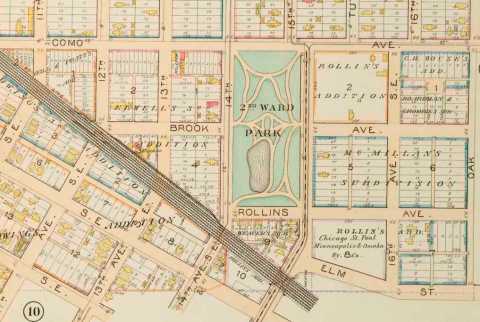
Before Van Cleve Park was named, it was referred to as 2nd Ward Park as seen here in the 1892 Plat Book for Minneapolis. The man-made pond took the place of what would have been the first “playground” in a Minneapolis park. (C.M. Foote & Co., John R. Borchert Map Library, University of Minnesota)
Unfortunately Cleveland’s drawings for Van Cleve Park didn’t survive. Six of his other park designs—large-scale drawings—are owned by Hennepin History Museum, but the Van Cleve plan is not among them. Neither was it ever published in an annual report, as several other of his plans were. No documents explaining Cleveland’s intent with his plan have been found either, so we really don’t know what type of playground he imagined for the center of the new park. We can only guess.
The Infancy of Playgrounds
The idea of public space devoted to play was still quite new at the time—to Cleveland and to everyone else. In his most famous book, Landscape Architecture as Applied to the Wants of the West, published in 1873, Cleveland mentioned “play ground” only as something that might be desired in the back yard of a home. In his famous 1883 blueprint for Minneapolis’s park system, Suggestions for a System of Parks and Parkways for the City of Minneapolis, he doesn’t mention play or playgrounds at all. Even in the notes that accompanied his first six individual park designs in Minneapolis (unpublished) in 1883 and 1885, he never mentioned play spaces. Yet, in 1890, when he was 76 years old, Cleveland proposed to put a playground in a new park.
The idea was just being explored elsewhere then. In 1886 Boston had placed sand piles for kids play in some parks. The next year San Francisco created a formal children’s play area in Golden Gate Park. In New York, reform mayor Abram Hewitt supported a movement in 1887 to create small, city-sponsored combination parks and playgrounds, but that effort bore little fruit until a decade later. In 1889, Boston created a playstead at Franklin Park and an outdoor gymnasium on the bank of the Charles River, a collaboration of a Harvard professor and Cleveland’s friend Frederick Law Olmsted. Historian Steven A. Riess calls it the “first American effort to provide active play space for slum residents.” (See Riess’s City Games for a fascinating account of the growth of sports in American cities.)
The social reform movement, which later helped create playgrounds in many cities, was gaining steam with the publication in 1890 of Jacob Riis’s, How the Other Half Lives, a glimpse of grinding poverty in the slums of New York. That movement would have an enormous impact on cities in the early 1900s, especially Chicago, which became the playground capital of the United States, led in part by Jane Addams of Hull House settlement fame.
Even though Cleveland addressed many of his efforts in civic improvement to providing fresh air, green spaces and access to nature’s beauty for the urban poor, especially children, he seems an unlikely proponent of playgrounds in parks. Based on the bitter complaint in a letter to William Folwell, July 29, 1884, I had taken Cleveland to be opposed to any manufactured entertainments at the cost of natural beauty. He wrote from Chicago,
“There’s no controlling the objects of men’s worship or the means by which they attain them. A beautiful oak grove was sacrificed just before I left Minneapolis to make room for a baseball club.” (Folwell Papers, Minnesota Historical Society)
Yet, we have proof that Cleveland had a much more positive view of play areas for children in parks than he had of ball fields. A playground at Van Cleve Park, would have been a first in Minneapolis parks.
The Pond Instead
With the revised plan of the park approved, construction of the pond began immediately in the summer of 1890. A pond of 1.5 acres was created in the southern half of the park. The earth removed to create the pond was used to grade the rest of the park. That winter the park board had the pond cleared of snow so it could serve as a skating rink, too.

The artificial pond at Van Cleve was a popular skating rink. (Minneapolis Park and Recreation Board)
There must have been problems keeping water in the pond, because the next summer it was drained and the pond basin was lined with puddled clay. An artist’s rendering of the park in the 1891 annual report shows a fountain spraying a geyser of water in the middle of the pond. I’ve never seen a photo of such a fountain at Van Cleve, or read an account of it, but a similar fountain was built into the pond at Elliot Park, the only other pond created in a Minneapolis park, so it is possible a fountain existed. The park board erected a temporary warming house and toilet rooms for skaters on the pond beginning in the winter of 1905.
When Theodore Wirth arrived in Minneapolis as park superintendent in 1906, he placed a priority on improving Van Cleve Park as “half playground, half show park.” He recommended creating a sand bottom for the pond so it could be used as a wading pool and building a small shelter beside it that could double as a warming house for skaters.
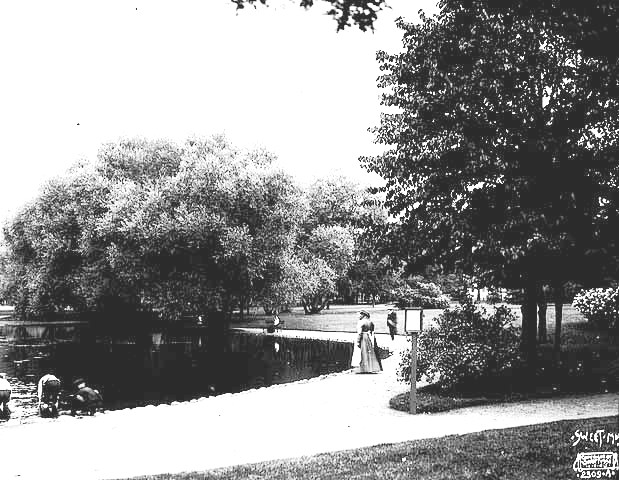
Van Cleve pond, 1905. (Sweet, Minnesota Historical Society)
The first playground equipment was installed in Van Cleve Park in 1907, following the huge popularity of the first playground equipment installed at Riverside and Logan parks in 1906.
The shelter was finally built in 1910, along with shelters at North Commons and Jackson Square. The Van Cleve shelter was designed by Minneapolis architect Cecil Bayless Chapman and was built at a total cost of just over $6,000. It included a boiler room, toilets and a large central room. The Van Cleve shelter was considerably more modest than the shelters at Jackson Square and North Commons, which cost approximately $12,000 and $16,000 respectively. On the other hand, neither of those parks had a pond. (Jackson Square actually had been a pond at one time, however, called Long John Pond. The cost of the Jackson Square shelter rose due to the need to drive pilings down 26 feet to get through the peat on which the park was built.)

The original recreation shelter at Van Cleve Park was built in 1910 facing the man-made pond. (Minneapolis Park and Recreation Board)
Wirth published a new plan for Van Cleve Park in the 1911 annual report. Although he claimed that Van Cleve demonstrated that a playground and show park could exist without “interfering” with each other, the playground occupied only a narrow strip of land between the pond and 14th Ave. SE. There were still no playing fields of any kind in the park then.
In 1917, Wirth recommended pouring a concrete bottom for the pond, really converting it into a shallow pool. Two years later the park board did pave the pond basin, but with tar macadam.

The Van Cleve shelter well after 1940 renovations, date unknown. (Minneapolis Park and Recreation Board)
Very few improvements were made at Van Cleve, or any other park in the city, for many years from the late-1920s to the late- 1940s. In 1935, in his last year as park superintendent, Wirth recommended that a swimming pool be built at Van Cleve in place of the pond, but the park board didn’t have the money for such a project during the Great Depression.
The park did get its share of WPA attention in 1940 when the federal work relief agency completed several renovations on the Van Cleve shelter to improve its capacity to host indoor recreation activities. Also included in those repairs were such basics as a concrete floor in the shelter’s boiler room. Comparing the two photos above, it’s obvious that the veranda was enclosed and the ground around the shelter was paved as well.
The man-made pond was finally filled in 1948. A modern, much smaller concrete wading pool was built to replace it the next year. The little rec shelter stood until a new community center was built at Van Cleve in 1970. By then Van Cleve, like most other neighborhood parks in the city, had been given over almost completely to active playgrounds and athletic fields.
Despite Cleveland’s aborted provision for a playground of some kind in his plan for Van Cleve Park in 1890, I imagine him astonished and a bit saddened to see neighborhood parks change so completely from the pastoral reserves and quiet gardens he had once preserved or coaxed from the urban landscapes of his time.
David C. Smith
© David C. Smith
Ski Jump Update
Filed under: Minneapolis parks, Winter Sports | Tags: Minneapolis Ski Club, Ski Jumping, Skiing, Theodore Wirth Park
Comments (2) So many people have commented on my article posted nearly two years ago about the history of ski jumping in Minneapolis that I thought I should provide an update. I was prompted by an exchange of emails this week with Greg Fangel who is the owner of woodenskis.com, where he buys and sells wooden cross-country skis and provides a great deal of ski information and links to other skiing sites. I’ve edited together some of Greg’s emailed comments below, with thanks.
I’ve been an avid cross-country skier since 1974 and currently live in White Bear Lake. I’ve been researching ski history for the past 5 years or so, mostly from a Mpls/St. Paul/Minnesota point of view. In my research, ski jumping comes into play, since it’s Nordic and one of the early forms of competition. I personally know Norm Oakvik, who is mentioned in your blog. He organized many events and coached USSA teams in Minneapolis. Norm is a legend in the cross-country ski community in the Minneapolis/St. Paul area. I interviewed Norm in November of 1995 for a story in the Løype, a newsletter of the North Star Ski Touring Club.
Norm’s parents were from Norway and Norm started skiing in Minneapolis in the 1930-40s. He competed with the Minneapolis Ski Club in 1940-70s, specializing in Nordic combined in the early years. Nordic combined is ski jumping and cross-country skiing combined into one event. He was a driving force behind the National Nordic ski competition, which was held in Bloomington in 1976. Bill Koch came to ski that event.
In May of 2005 a few of the ‘movers and shakers’ in the Minneapolis ski community wanted to name a trail or system after Norm Oakvik at Theodore Wirth Park. We held a special meeting at Wirth with supporters and Norm present. Norm was so humble, that he didn’t want his name on the trails, even though he spent countless hours trail clearing, grooming, and coaching at Wirth. I don’t know how Norm is doing now, but he was recently in the hospital.
I’ve interviewed ski jumper Adrian Watt from Duluth who participated in the 1968 Winter Olympics and competed at the Glenwood jump in Minneapolis. He has some fascinating stories.
Minneapolis has a rich ski history and that should not be overlooked. We need to preserve that history for generations to come.
Greg Fangel
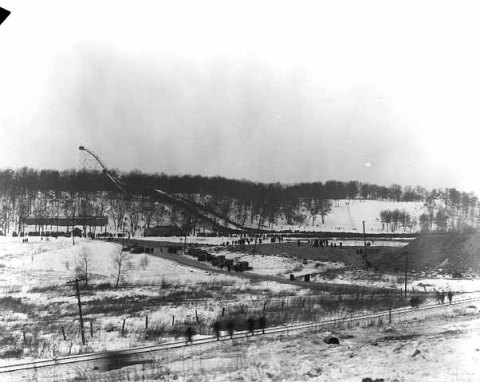
The ski jump at Glenwood (Wirth) Park in 1923. (Charles J. Hibbard, Minnesota Historical Society)
Greg mentioned that he’s interested in putting together an exhibit on local skiing history for a possible new project at Wirth Park.
Over the past couple years, several veterans of the Minneapolis skiing scene have commented on my original post on Minneapolis ski history. If you haven’t looked at those comments in a while, check them out. Add your own stories either here or on the original post. Thanks!
If you haven’t kept track of what’s going on with cross-country skiing in Minneapolis parks you might be surprised to find out about current trails, especially at Wirth Park. Get more skiing info at minneapolisparks.org.
David C. Smith
 Minneapolis Park History