Archive for March, 2013|Monthly archive page
Theodore Wirth, Francis Gross and Me: A Friday Photo and a Re-assessment
Filed under: Minneapolis Park Hero, Minneapolis parks | Tags: Francis A. Gross, Hubert H. Humphrey, Lyndale Park, Theodore Wirth
 Comments (2)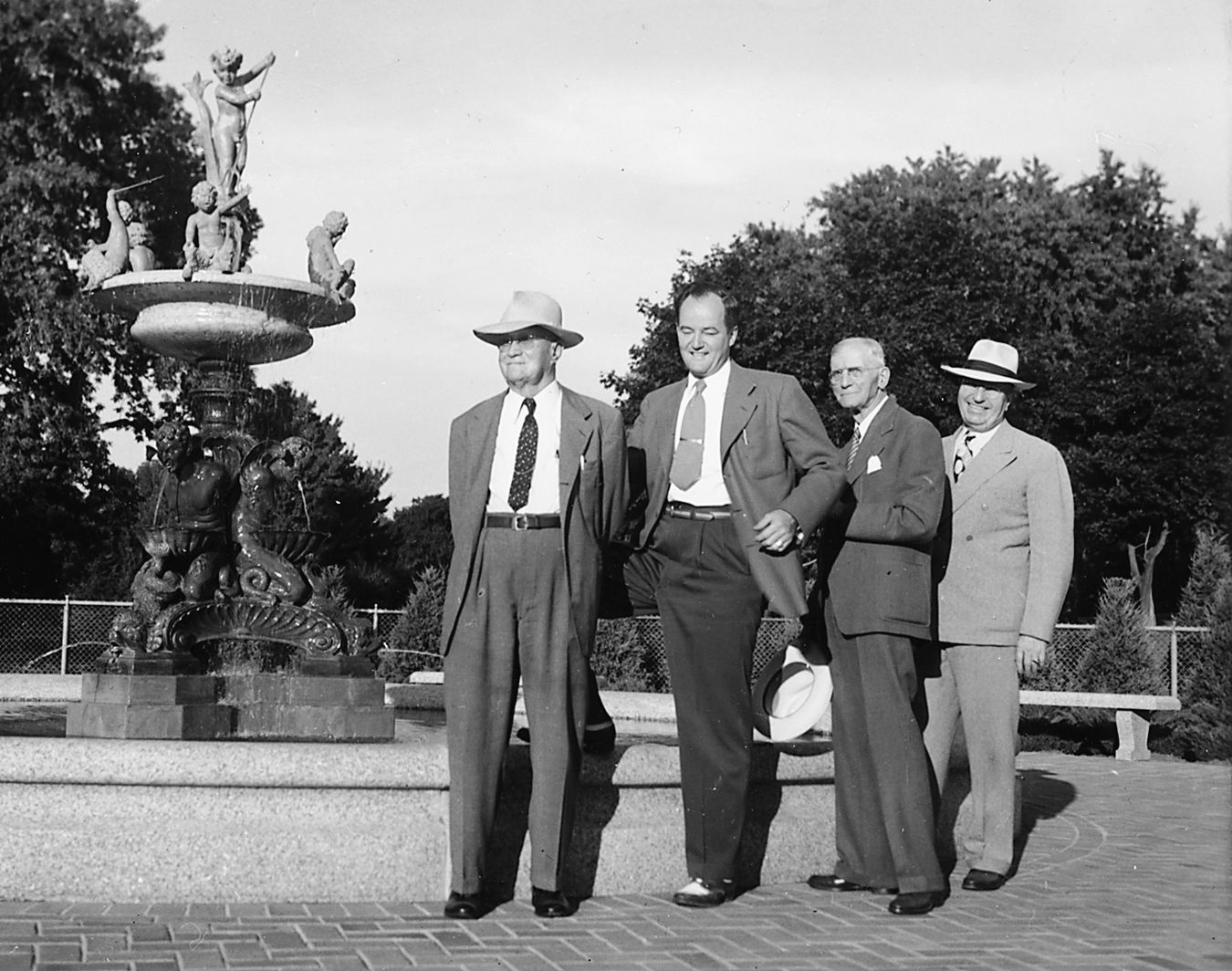
The dedication of Heffelfinger Fountain in Lyndale Park, 1947. This is the only photo I’ve seen of Theodore Wirth and Francis Gross together. They are joined by an even better-known Minneapolitan. From left: Park Superintendent Emeritus Theodore Wirth, Minneapolis Mayor Hubert H. Humphrey, Park Board President Francis A. Gross, Park Superintendent Charles E. Doell. Wirth was then 84 and Gross 77. The fountain had been discovered and purchased in Italy by Frank Heffelfinger, shipped to Minneapolis, and given to the park board. (Minneapolis Park and Recreation Board)
As I began my initial, intensive assault on Minneapolis park history in 2007 to write City of Parks, I was inclined to attribute the great success of our park system to Theodore Wirth — as so many people do. I had heard his name—attached as it was to a park, lake and parkway — for many years, and I promptly read his book on the park system—part history, part memoir.
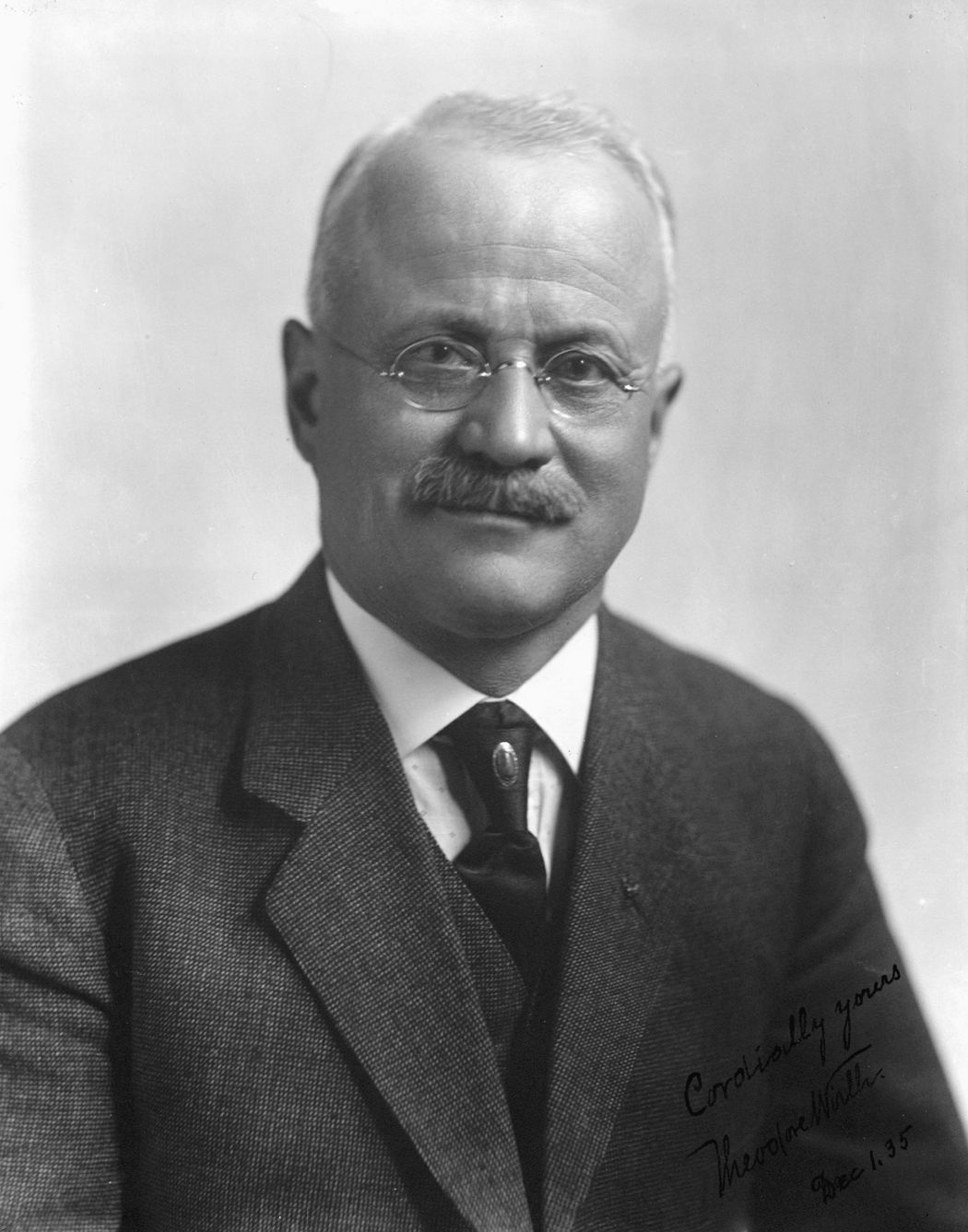
Theodore Wirth was superintendent of Minneapolis parks for 30 years, 1906-1935. (Minneapolis Park and Recreation Board)
It was the beginning of an up-and-down ride for me with Mr. Wirth and his legacy, one that I am reexamining in light of comments by Francis Gross in the autobiography he wrote in 1938.
I knew little about Wirth in 2007, but I did recall vividly being introduced to a Swedish gentleman at a party in Stockholm, Sweden in 1986 who, when he learned where I was from, gushed about what a great park planner Theodore Wirth had been. He knew much more about Wirth than I did and …Read more about how Francis Gross convinced me that Theodore Wirth was a good guy
Highlights, Lowlights and Unsolved Mysteries: 130 Years of Parks in Minneapolis
Celebrate the 130th birthday of the Minneapolis park system with me and the Linden Hills History Study Group, April 4, 7 p.m. at St. John’s Episcopal Church, 4201 Sheridan Avenue South. A $3 donation is suggested for those who aren’t members of the study group.
I’ll talk about the greatest accomplishments and most puzzling failures in Minneapolis parks since the Minneapolis Board of Park Commissioners was created by the Minnesota legislature and approved by Minneapolis voters on April 3, 1883. I’ll touch on many of the people, places and policies that have contributed to the fabulous park system we enjoy today — and I’ll also mention a few parks that might have been.
I hope you’ll join us.
David C. Smith
Friday Photo: How A Stone Arch Was Made
Filed under: Minneapolis parks, Mississippi River | Tags: Father Hennepin Bluffs, Mill Ruins Park, Stone Arch Bridge
Comments (5) The Stone Arch Bridge over the Mississippi River in downtown Minneapolis is becoming one of the iconic images of the city. Have you ever wondered how those arches were made? I have. So I found this photo of the bridge under construction. The deck of the bridge is maintained by the Minneapolis Park and Recreation Board, so let’s call it a park. Day and night the bridge provides the best views of the city. A hike over the bridge between Mill Ruins and Father Hennepin Bluffs, in either direction, is a must for visitors and residents.
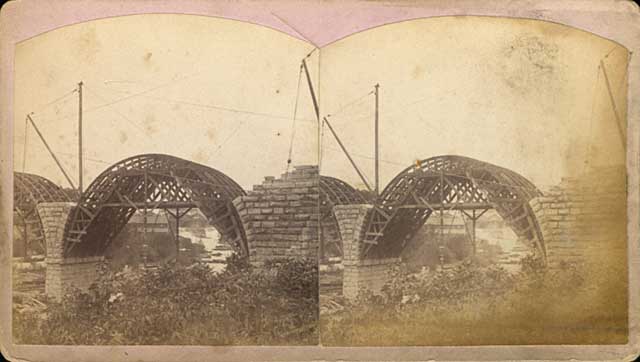
This stereoscope image shows the stone arches being built over forms in 1883. (Henry Farr, Minnesota Historical Society)
The two-track railroad bridge was being built at the time the park board was created in 1883.

The Stone Arch Bridge being completed in 1883. (Burlington Northern, Minnesota Historical Society)
This is another favorite shot of the bridge as it neared completion
David C. Smith
A Racetrack Before It Became a Park — and an Airport
Filed under: Minneapolis Airport, Minneapolis parks | Tags: Eddie Rickenbacker, Metropolitan Airport Commission, Snelling Speedway, Twin City Motor Speedway, Wold Chamberlain Field
Comments (8) Not many people would recognize this Minneapolis park property, which lies outside city limits and was acquired in 1928, twelve years after this photo was taken. There is some uncertainty about how much of this property is still technically owned by the Minneapolis Park and Recreation Board, but the property is administered by another agency.

Four-wide racing at the Snelling Speedway, 1916. (Minneapolis Park and Recreation Board.)
This is the famous Twin City Motor Speedway, or Snelling Speedway, in 1916, the second year of its three-year life. The speedway was named informally for its location adjacent to Fort Snelling. The infield of the two-mile concrete track was later used as a landing field for airplanes — and eventually became Minneapolis-St. Paul International Airport. The Minneapolis Board of Park Commissioners acquired the land in 1928 to develop it as an airport for the city. The task fell to the park board because it was the only agency of Minneapolis city government that could own land outside of city limits. (The law that permitted the park board to own land outside city limits was passed by the Minnesota legislature in 1885 to permit the park board to purchase land in Golden Valley for part of what eventually became Glenwood (Wirth) Park .) The park board built and ran the airport from 1928 until the Metropolitan Airports Commission was created in 1943, at which time the park board turned over administration of the airport. The park board had spent a significant percentage of its meager resources in those years developing the airport.
The enormous grandstands pictured left and center were built in 1915 to hold 100,000 people. The problem was that far, far fewer attended the few races held there. The first major race in 1915, a 500-mile race patterned after the Indianapolis 500, was widely promoted by the newspapers for weeks. The weekend of the race — the first weekend in September, just before the State Fair opened — the Minneapolis Tribune wrote that hotel rooms were impossible to find in the Twin Cities; hoteliers were referring unaccommodated visitors to private homes for a place to sleep. It was said to be the busiest weekend in the history of Minneapolis hotels with guests arriving from around the country. The Twin City Rapid Transit Company built a special spur track to the speedway to transport the crowds.
Unfortunately for the promoters, drivers, and the legions of workers who constructed the track and were not paid, attendance was much smaller than hoped. Society columns in the Tribune covered the rich and famous who attended the races and trumpeted this “innovation in divertisement” for the social elite, but the paper reported race attendance at only 28,000.
The 1915 race was a disappointment in every respect. The banked concrete track, heralded as the fastest and safest track in the world, was in fact extremely rough. The cars vibrated to pieces and the drivers didn’t fare much better. The champion Italian driver, Dario Resta, was reported to have denounced the roughness of the track “vociferously” after his first test drive during race week. If you know any Italian curse words, you could probably translate the “vociferously”. He was prescient, because his car didn’t survive much more than 100 miles on race day. But potential race fans didn’t know that ahead of time.
Neither could they have imagined the snoozefest that the race became. It only takes a glance at the race results to understand how tedious the day must have been for spectators. With only twenty cars starting the race and most of them falling apart or dropping out for mechanical reasons early on — having a “mechanician” riding along, the second person visible in the cars, didn’t prevent mechanical failures — there wasn’t much action despite the nail-biting finish of the race, which was won by 1/5 of a second. The Tribune, which had promoted the race so breathlessly, could hardly contain its excitement proclaiming in its headline Sept. 5, 1914, “Cooper Wins Closest Finish in History.”

Here’s part of the problem! 1915 500-mile race results. (Minneapolis Tribune, September 5, 1915)
An exciting finish didn’t make up for the rest of the race. The slow pace of the race, only 86 mph, dragged it out for nearly six hours, and the third place car was more than a half-hour behind the leaders. The Tribune blamed the pace on the fact that the cars of so many of the “most daring” drivers — “speed demons” — were incapacitated. Those drivers included the famous Italians Resta and Ralph De Palma and the American “Wild” Bob Burman. Picture only eight cars spread over a two-mile track, none of them travelling much faster, and some not as fast as, ordinary traffic on 35W and think of what you’d be doing to amuse yourself as a spectator. As stirring as the finish must have been with Cooper and Anderson pushing their matching Stutzes to the finish (the Stutz company dropped racing the next year anyway), most of the barely awake spectators headed for the exits before O’Donnell’s Duesenberg, manufactured in Minneapolis, came anywhere near the finish lap in third place.
Chandler and the great Barney Oldfield were still on the track — with no one in the stands and the sun about to set — plodding along more than an hour from finishing when they were mercifully flagged off the track in the dusk. The most notable thing about the Oldfield performance was that his relief driver — the drivers took breaks during the race — was the later World War I flying ace, Eddie Rickenbacker.
It’s no wonder that the Tribune concluded the next day, in a heroic effort at understatement:
“The crowd could not be called enthusiastic, the length of the grind and the heat probably preventing continuous hilarity.”
Prospective ticket buyers probably didn’t imagine the downside of what was then endurance racing. The greater problem was the cost of the tickets. Ticket prices were widely acknowledged as being much too high — the lowest ticket price was $2 and that didn’t include a seat, which cost another $2.50, the equivalent of what the park board paid workers for an 8-hour workday then.
(For more detail on the 1915 race, go here. Noel Allard reconstructs the race, and the era in racing.)
Lower Prices, More Hilarity
The speedway’s promoters realized that they had to reduce prices as well as the tedium of a 500-mile race the next year. For the 1916 Fourth of July race, admission to the bleachers was cut to $1.00 and prices for seats in the grandstand began at $2.00. In hopes of more hilarity, even if not continuous, the race was shortened to 150 miles. A full day of racing was also to feature races of 50, 20 and 10 miles.
The roster of drivers was much the same as 1915: Resta chose to race in Omaha and Burman had crashed and died two months earlier in a California race. Oldfield returned, but only in capacity of referee, while his former relief driver, “Rick” Rickenbacker, had his own car to drive. (I’m no expert on race cars of the era, but it’s possible that Rickenbacker’s white Maxwell is on the far left in the photo above.) St. Paul’s own Tommy Milton, known then for his success at state fair races, but who would win two Indy 500s in the 1920s, entered in a Duesenberg. The Tribune predicted the largest race crowd in Minnesota history.
It was not to be. While I haven’t found an attendance figure for the race, there couldn’t have been many fans buying tickets because the total gate was only $8,000. We know that because at the time the flag was supposed to drop on the first race, the promoters had not yet posted the $20,000 in prize money for the races and the drivers, obviously noting the sparse crowd, refused to race until the prize money was in trustworthy hands. After a two-hour delay that caused the 50-, 20-, and 10-mile races to be scrubbed, the promoter turned over the entire gate receipts of about $8,000 and wrote a $12,000 personal check to cover the rest of the prize money for the 150-mile race. And off they went down the stilll-rough concrete track, bouncing like the promoter’s check.
Ralph De Palma won the race by a 12-minute margin in a time of just under an hour and a half, or an average speed of a bit over 91 mph. He was one of only seven finishers, with Tom Milton finishing fourth.

By 1930 the Minneapolis park board had begun the transformation of the old speedway into an airport, but a segment of the old 2-mile oval still remained. The Mendota Bridge is upper right. Note the NWA hangar among the airport buildings. The landing strip was not on the old concrete race track, which was too rough. Airplanes landed on the grass in the infield of the old race track. (J. E. Quigley, Minneapolis Park and Recreation Board)
That was essentially the end of the Twin City Motor Speedway. Within two days the speedway had declared bankruptcy and never recovered. The speedway that cost more than $800,000 to build went into foreclosure in August of 1916. The owner of the Indianapolis Speedway, who was also a stockholder in the Twin City Motor Speedway, declined to purchase the track. By the spring of 1917 the track property was already being mentioned as a possible site for an airfield or training ground for the navy aviation corps. Both Dunwoody Institute and the University of Minnesota had proposed to begin training military aviators and a site was needed.
A group of race car drivers led by Louis Chevrolet — yes, that Chevrolet — organized a final race at the track in 1917, which the Tribune called a “revival” race. The patient was too far gone to be resuscitated, despite a victory by Ira Vail in the 100-mile race at the much-improved average speed of more than 96 mph. Less than three months later the Tribune reported that the receiver for the bankrupt speedway had rented a portion of the grounds to a hog farmer who was fattening 500 pigs by feeding them Fort Snelling garbage. The speedway was finished, but the land was about to be given over to the service of a whole different kind of speed — and eventually the Minneapolis park board.
David C. Smith
© 2013 David C . Smith
The Worst Idea Ever #8: Power Boat Canal from Minnetonka to Harriet
Filed under: Minneapolis Lakes, Minneapolis Parks: General | Tags: 1911 Minneapolis Civic Celebration, Lake Harriet, Lake Hiawatha, Lake Minnetonka, Lake Nokomis, Minnehaha Creek, Minnehaha Falls
Comments (1) Ok, it wasn’t really a Minneapolis park project, but it still deserves a laugh: Minnehaha Creek converted into a 30-foot-wide power boat canal from Lake Minnetonka to Lake Harriet!

Lake Harriet could have been more like Lake Minnetonka.
Minneapolis was obsessed in the spring of 1911 with the upcoming Civic Celebration during which the channel between Lake Calhoun and Lake of the Isles would be opened. That was a very good thing. Huzzah, huzzah. But the attention it was drawing to the city also focused a lot of eyes on a very bad thing: Minnehaha Creek was nearly dry — in the spring! — which meant almost no water over Minnehaha Falls. Minneapolis could hardly celebrate the opening of the lake connection at the same time it suffered the ignominy of a dry Minnehaha Falls. The many out-of-town visitors anticipated for the celebration would surely want to see both. And let’s face it, a fifty-foot waterfall written about by a Harvard poet, which attracted visitors from around the world was a bit more impressive to most people than a short canal under a busy road and railroad tracks. The Minneapolis PR machine could call the city the “Venice of North America” all it wanted with its new canal, but visitors’ imaginations were still probably fueled more by the images of the famous poet’s noble heathen, beautiful maiden, and “laughing waters.”
The generally accepted solution to the lack of water over Minnehaha Falls was to divert Minnehaha Creek into Lake Amelia (Nokomis), drain Rice Lake (Hiawatha), dam the outlet of the creek from Amelia to create a reservoir, and release the impounded water as needed — perhaps 8 hours a day — to keep a pleasing flow over the falls. Unfortunately, with all the last-minute dredging and bridge-building for the Isles-Calhoun channel, that couldn’t be done in 1911 between April and July 4, when the Civic Celebration would launch.
Into this superheated environment of waterways and self-promotion stepped Albert Graber, according to the Saturday Evening Tribune, May 28, 1911. With the backing of “members of the board of county commissioners, capitalists, attorneys and real estate dealers”, Graber proposed to dredge Minnehaha Creek into a canal 30-feet wide from Lake Minnetonka to Lake Harriet. This would provide not only a water superhighway from Minnetonka to Minneapolis, and boost real estate prices along the creek, but it would also create a much larger water flow in Minnehaha Creek, solving the embarrassment of no laughing water.
“The plan, say the promoters, would enable residents of summer houses on the big lake to have their launches waiting at the town lake.”
Saturday Evening Tribune, May 28, 1911
Sure, there were problems. Not every plan could be perfect. The plan would require dismantling the dam at Gray’s Bay at the head of Minnehaha Creek, which might lower the level of Lake Minnetonka. But Graber and his backers had thought of that. The Minnesota River watershed in the area of St. Bonifacius and Waconia would be diverted into Lake Minnetonka — no problem! — which also solved another bother: it would reduce flooding on the Minnesota River.
The dam at Gray’s Bay had been operated by Hennepin Country since 1897. Many people then and now consider the dam the cause of low water flow in Minnehaha Creek, but the earliest reference I can find to low water in the creek was in 1820, when the soldiers of Fort Snelling wanted to open a mill on Minnehaha Creek, but were forced to move to St. Anthony Falls due to low water. That was even before two intrepid teenagers from the fort discovered that the creek flowed out of a pretty big lake to the west.
Graber estimated that dredging Minnehaha Creek would cost about $4,000 a mile for the nine miles between the two lakes. He and his backers, which included an officer of the Savings Bank of Minneapolis (who presumably had a summer house on the big lake and could put a launch on the town lake), provided assurances that the money to finance the project could be “readily found.”
The Evening Tribune article concluded with an announcement that meetings of those interested in the project would be held in the near future with an eye to beginning work before the end of the summer. Graber noted that his inspection of the project had been, no surprise, “superficial”, but that he would make a thorough report soon to his backers. I can find no evidence that the idea progressed any further.
The Board of Park Commissioners would have had no role in the plan, except, perhaps, allowing power boats to enter and be anchored on Lake Harriet. (I think they would have said no.) Park board ownership of Minnehaha Creek west of Lake Harriet to Edina wasn’t proposed until 1919 and the deal wasn’t done until 1930.
David C. Smith
© 2013 David C. Smith
Friday Photo: Lake Calhoun North Shore
Filed under: Lake Calhoun, Minneapolis Parks: General | Tags: Lake Calhoun, Lake Calhoun Bath House
Leave a comment One of my favorite photos of Lake Calhoun. The photo is undated, but I would estimate that it was taken in the late 1910s. The view indicates it was taken near the Minikahda Club on the west side of the lake looking northeast toward downtown. The photo was taken after the Lake Calhoun Bath House (center) was completed in 1912, but before a parkway was built on the west side of the lake, which occurred in the early 1920s.
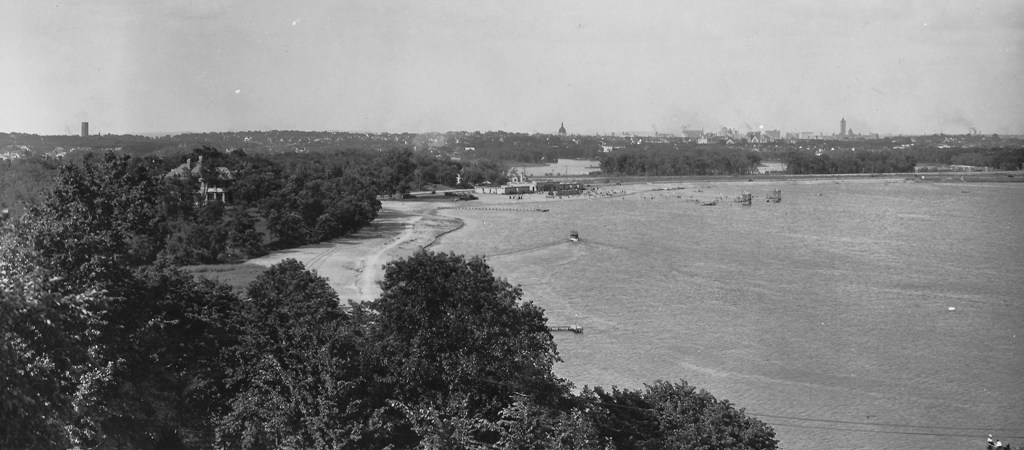
Lake Calhoun’s northwest shore and Bath House in late 1910s. Photo taken from Minikahda Club. Click to enlarge. (Minneapolis Park and Recreation Board)
Note how far into the lake the diving platforms were built.
One of things I like from this photo is a sense of the connection between Lake of the Isles and Lake Calhoun. There is some open land between them. This was taken a few years before construction began on the Calhoun Beach Club across Lake Street from the bath house.
Another remarkable feature of this photo is the prominence of the Basilica on the skyline west of downtown. The Basilica was dedicated in 1914.
This is the view that Theodore Wirth hoped could one day be incorporated into the park system if the Minikahda Club ever relocated. Wirth wrote in the 1906 Annual Report of the Board of Park Commissioners, his first, that this view was of “such scenic beauty that it is almost a crime to pass it unnoticed.”
David C. Smith
© David C. Smith
Glenwood Spring: A Premier Park — and Water Supply?
Filed under: Minneapolis Parks: General | Tags: Bassett's Creek, Bassett's Creek Valley Park, H.W.S. Cleveland, Horace Cleveland
Comments (1) H.W.S. Cleveland, the landscape architect who created the blueprint for Minneapolis’s park system in 1883, made his first visit to Glenwood Spring near Bassett’s Creek in north Minneapolis in the spring of 1888. In a letter to the Minneapolis Tribune, published April 22, 1888. Cleveland described that visit.
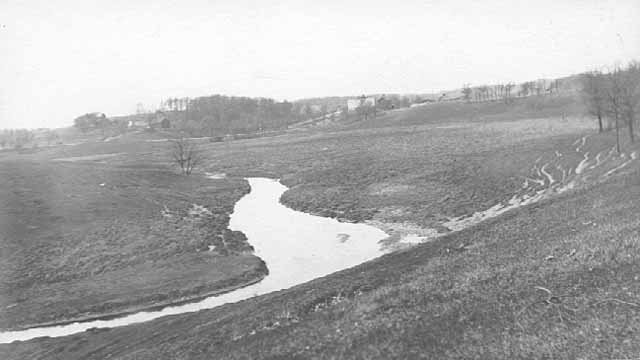
Bassett’s Creek in the vicinity of Glenwood Spring, about 1910 according to the Minnesota Historical Society. I’m not familiar enough with the lay of the land in the area to guess the exact location of this scene, but I was struck by how open the landscape was, especially given Horace Cleveland’s description of “large bodies of very fine native trees” in the vicinity of the spring. Perhaps those groves were behind the photographer. (Minnesota Historical Society)
Cleveland’s letter addressed the subject of the city’s water supply, noting that when he and his family moved to Minneapolis from Chicago in 1886 they experienced deleterious health effects — “winter cholera,” as he put it — that they thought might be associated with Minneapolis tap water. He reported that after they began using Glenwood spring water his family had no further health issues and they also found the spring water more “palatable” than the city water, which was taken from the Mississippi. Cleveland wrote that he had used the spring water for more than a year before he visited the neighborhood of the springs. When he finally did visit,
“I was not alone surprised and delighted by the beauty of the springs themselves, and their topographical surroundings, but amazed and grieved that my attention had not been called to the locality when I first came by invitation of the park commissioners, five years previous, to study the possibilities of park improvements.”
Cleveland claimed that because he was put in charge of an engineer, Frank Nutter, who, he was told, was familiar with all the sites desirable for park purposes, he didn’t feel it necessary to look at areas he was not shown. Cleveland didn’t believe he was deceived or misled, but…
“An hour’s inspection of the area in the neighborhood of these springs satisfied me that no place in the neighborhood of the city, except the vicinity of Minnehaha falls, was so well adapted by nature for the construction of a park, comprising rarely attractive topographical features — while the distance from the center of business was less than half that to Minnehaha, and the apparently unlimited capacity of the springs, which gushed from the hillsides at various points over a widely extended area, seemed to offer every possible opportunity for the ornamental use of water.”
The prospect of bubbling springs of clear water and “hills and valleys of graceful form” that wouldn’t have needed “heavy expense in grading” to be transformed into parkland appealed to Cleveland’s aesthetic sense. He also asked “whether it is worth our while to ascertain the character and capacity of the springs” to supply the entire city with water. Cleveland suggested that if the springs were capable of meeting the city’s water needs, “the city should secure them, and enough land around them to preserve them from contamination, and then enclose the area as an ornamental reservoir as had been done in Philadelphia, New York and Boston.

This photo of the ice house at Inglewood spring was taken in the mid-1890s. (Minnesota Historical Society)
What Cleveland didn’t know at the time was that the Glenwood and Inglewood springs may not have been well-known in 1883, when Nutter hosted Cleveland’s park exploration visit. Most accounts I can find of Glenwood Spring’s history claim it was discovered by William Fruen in 1884, a year after Cleveland wrote his “Suggestions for a System of Parks for the City of Minneapolis.” One account suggests Fruen found the springs in 1882. Some accounts have him discovering Glenwood Spring when building a mill on Bassett’s Creek, others when he was digging a fish pond. The latter tale, probably a tall one, was disseminated on the cached web site of the Glenwood Inglewood Water Company.
Fruen’s history with the spring includes filing the first vending machine patent in U. S. history. He invented a coin-operated machine in 1884 to dispense his spring water by the glass. Fruen also attempted to distribute his water by pipeline as Cleveland thought might be desirable. John West, owner of the posh West Hotel in Minneapolis, Thomas Lowry and Fruen wanted to build a two-mile pipeline from the spring to the West Hotel, and also sought permission to pipe the water into homes and restaurants along the way. That plan was vetoed in 1885 by Mayor George Pillsbury.

The Glenwood-Inglewood Company, 1910. The Glenwood and Inglewood springs were on adjacent property and run as separate water companies until about 1896. Until then, they were competitors. See below. (Minnesota Historical Society)
In the spring of 1885, Fruen published ads in the Tribune touting the purity of water from Glenwood Spring. He published a chemical analysis of the water conducted by Professor James Dodge of the University of Minnesota, who attested, “This water is extremely pure, being almost entirely free from organic matter.”
The ad invited readers to, “Drive out and see as fine a spring as you ever looked upon.” Another admonition in the copy is particularly interesting given the long association in later years of the Glenwood and Inglewood springs:
“Do not confound this spring with the Inglewood. Ours is the Glenwood.”
William Fruen’s son, Arthur, donated 13 acres of land along Bassett’s Creek to the park board in 1930, which was the beginning of Bassett’s Creek Valley Park. Arthur Fruen was a city council member at the time and an ex-officio member of the park board. I don’t know if that 13 acres included the site of the original spring—in other words, if Cleveland’s vision of a park that included the spring was partially realized nearly 50 years after he first saw it.
David C. Smith
© David C. Smith

 Minneapolis Park History