Archive for November, 2015|Monthly archive page
Arts and Parks: Part II
Filed under: Minneapolis parks | Tags: Minneapolis Institute of Arts, Washburn Fair Oaks, William D. Washburn
 Comments (9)
 Another of my favorite recent photo finds is a good intro to my next speaking engagement on Minneapolis park history this Saturday.
I recently found this photo of the Washburn Fair Oaks mansion built by William Washburn in 1883.

Washburn Fair Oaks mansion, probably in the 1880s. Looking west across Third Avenue South in foreground. (W.S. Zinn)
Compare it to this photo taken two Sundays ago from about the same vantage point across Third Avenue South.

Washburn Fair Oaks Park looking west across Third Avenue South.
Now turn about 90 degrees left and you get this image of the Minneapolis Institute of Arts.

Minneapolis Institute of Arts looking southwest across Third Avenue South.
I’ll be talking about both parks and arts, and how many of the same people created Minneapolis’s parks and its art institutions at the Washburn Library on Lyndale Avenue, Saturday, November 21 at 10 a.m. My presentation is being hosted by the Minnesota Independent Scholars’ Forum, but the event is free and open to the public.
For more information visit here. Hope to see you Saturday.
If you want to know more about the landscaping of the Washburn Fair Oaks grounds, you can begin here. Of course, the story features H.W.S. Cleveland.
David C. Smith
The Demise of the 10th Avenue Bridge
In response to the previous post on Charles Tenney’s photos of Highland Avenue and the 10th Avenue Bridge, MaryLynn Pulscher sent her favorite photo of the 10th Avenue Bridge. It’s a fascinating bit of history itself. We don’t know the origin of the photo but believe it’s from a newspaper. If anyone knows who took it or where it was published, please let us know so we can give proper attribution.
David C. Smith
Lost Minneapolis Parks: Highland Oval
Filed under: Lost Minneapolis Parks, Minneapolis parks | Tags: Charles A. Tenney, H.W.S. Cleveland, Highland Oval, Horace Cleveland, Oak Lake, Samuel Gale, Stone Arch Bridge
Comments (1) The elegant neighborhood on the hills surrounding Oak Lake—now the site of the Farmer’s Market off Lyndale Avenue—has been gone for decades. Oak Lake itself was filled in 100 years ago. You can read the whole story here. The latest news: I finally found a picture of one of the five small parks in the Oak Lake Addition. I give you Highland Oval.

The title on the photo is “Highland Avenue, Oak Lake Division”, but the open space in the middle of the photo can only be Highland Oval. The view is looking northwest. Tiny, isn’t it? But the effort to preserve any open green space in rapidly expanding cities was a novel concept. (Photo by Charles A. Tenney)
The photo was probably taken in the mid-1880s, before the park board assumed responsibility for the land as a park. The land was designated as park in the 1873 plat of the addition by brothers Samuel and Harlow Gale. Although I have no proof, I believe it likely that H.W.S. Cleveland laid out the Oak Lake Addition, owing largely to the known relationship between Cleveland and Samuel Gale. The curving streets that followed topography and the triangles and ovals at street intersections were hallmarks of Cleveland’s unique work about that same time for William Marshall’s St. Anthony Park in St. Paul and later for William Washburn’s Tangletown section of Minneapolis near Minnehaha Creek. It was also characteristic of Cleveland’s work in other cities.
Photographer Charles A. Tenney published a few series of stereoviews of St. Paul and Minneapolis 1883-1885. He was based in Winona and most of his photos are of the area around that city and across southern Minnesota.
Highland Oval was located in what is now the northeastern corner of the market.
As happy as I was to find the Highland Oval photo, my favorite photo by Tenney tells a different story.

10th Avenue Bridge. (Photo by Charles A. Tenney)
At first glance, this image from Tenney’s Minneapolis Series 1883 was simply the 10th Avenue Bridge below St. Anthony Falls, looking east. The bridge no longer exists, although a pier is still visible in the river. What makes the photo remarkable for me are the forms in the upper left background being built for the construction of the Stone Arch Bridge. (See a closeup of the construction method here.) The Stone Arch Bridge was completed in 1883 — the same year the Minneapolis Board of Park Commissioners was created.
Nearly 100 years after the bridge was built, trains quit using it and several years later the park board, Hennepin County and Minnesota reached an agreement for the park board to maintain the bridge deck for pedestrians and bicyclists, thus helping to transform Minneapolis’s riverfront—a process that continues today.
Note also the low level of the river around the bridge piers. This was long before dams were built to raise the river level to make it navigable.
David C. Smith
© 2015 David C. Smith
Hiawatha and Minnehaha Do Chicago
Filed under: Minneapolis parks, Minnehaha Falls | Tags: Daniel Chester French, Hiawatha and Minnehaha Statue, Jakob Fjelde, Minnehaha Falls, Ole Bull Statue, William Watts Folwell
Leave a comment The World’s Columbian Exposition in Chicago hosted the debut of Minneapolis’s most famous sculptural couple, Hiawatha and Minnehaha, in 1893.
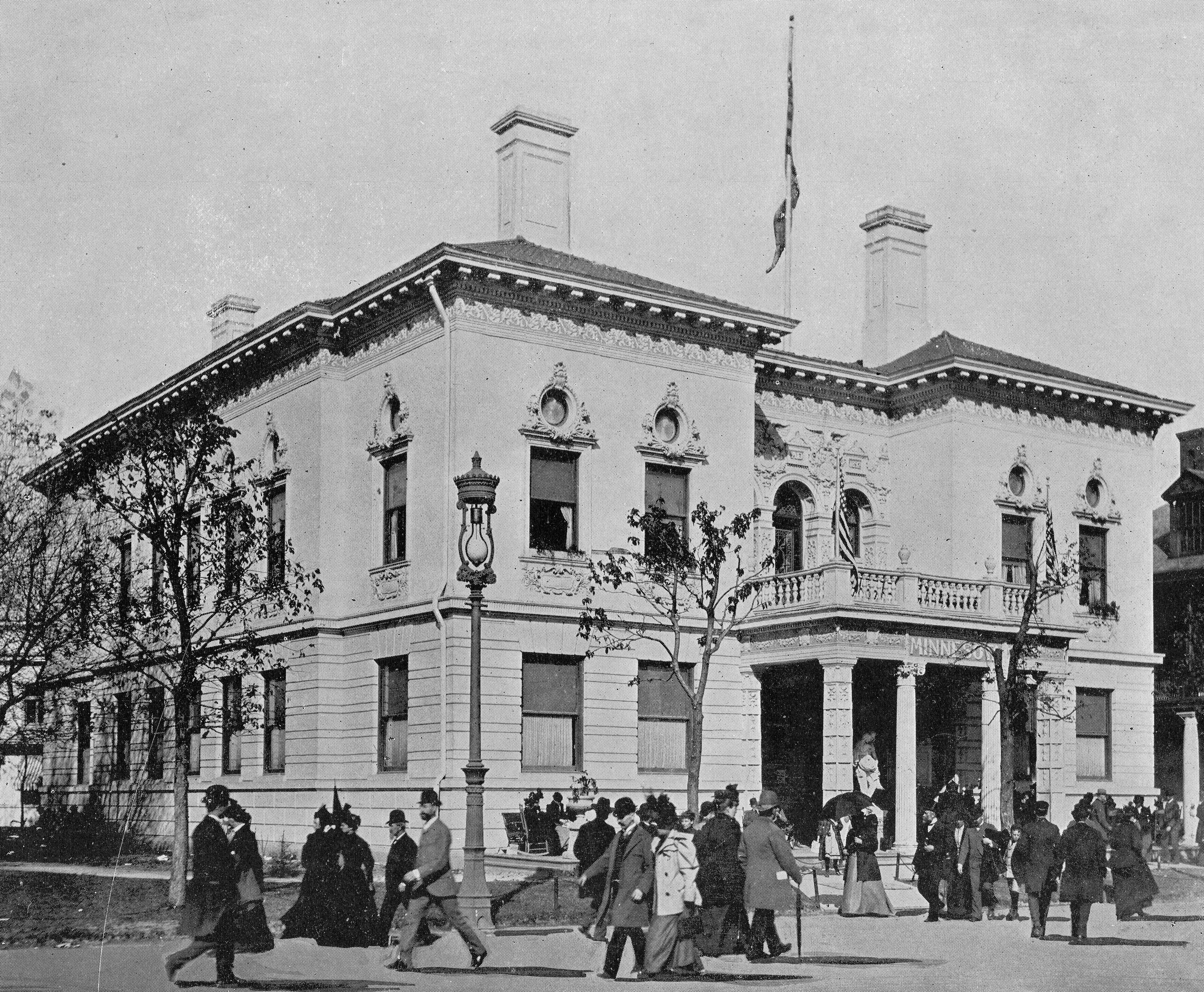
The Minnesota building at the World’s Columbian Exposition in 1893 featured Jakob Fjelde’s sculpture of Hiawatha and Minnehaha in the vestibule.
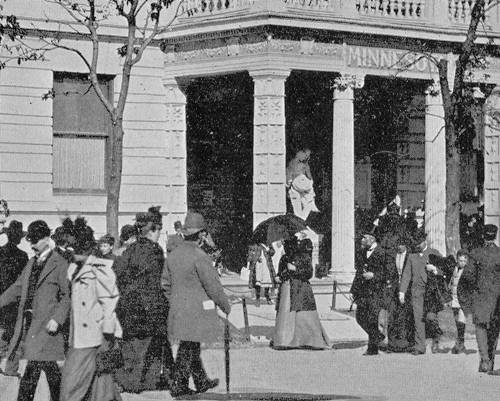
Zoooom.
Hiawatha and Minnehaha greeted visitors to the state’s pavilion in their modest plaster costumes nearly two decades before sculptor Jakob Fjelde’s pair took their much-photographed places on the small island above Minnehaha Falls in their bronze finery in 1912.

Hiawatha and Minnehaha in their customary place above Minnehaha Falls. This photo, from a postcard, was probably taken in the 1910s. I chose this picture not only because Hiawatha appears to be climbing a mountain of rocks to cross the stream, unlike today, but also because it is a Lee Bros. photo, the same photographers who shot the photo of Fjelde below.

Jakob Fjelde, Lee Bros., year unknown. I like the cigar. (Photo courtesy of cabinetcardgallery.wordpress.com)
Jakob Fjelde was largely responsible for two other sculptures in Minneapolis parks. He created the statue of Ole Bull, the Norwegian violinist, in Loring Park in 1895. He also created the drawing that Johannes Gelert used after Fjelde’s death to sculpt the figure of pioneer John Stevens, which now stands in Minnehaha Park. Fjelde also created the bust of Henrik Ibsen, Norway’s most famous writer, that adorns Como Park in St. Paul. Fjelde’s best-known work other than Longfellow’s lovers, however, is the charging foot soldier of the 1st Minnesota rushing to his likely death on the battlefield of Gettysburg.

Fjelde’s simple commemoration of the sacrifice of Minnesota men at a pivotal moment in the Civil War. The sculpture was installed in 1893 and dedicated in 1897. (Photo: Wikipedia)
These thoughts and images of sculpture in Minneapolis parks were prompted in part by my recent post on Daniel Chester French, but also by another letter found in the papers of William Watts Folwell at the Minnesota Historical Society. Just two years after Fjelde’s successes with his sculptures for Gettysburg and Chicago, he wrote a poignant letter to Folwell in July 1895 seeking his support for an “extravagant” offer. Fjelde proposes to the Court House Commission, which was developing plans for a new City Hall and Court House, that he create a seven-foot tall statue of the Chief Justice of the U.S. Supreme Court, John Marshall, and a bronze bust of District Court Judge William Lochren, both for the sum of $1,400. Fjelde calls the price of $1,000 for the Marshall statue “1/3 of its real value.” He explains his offer to Folwell:
“Anyone who knows a little about sculpture work will know that the sums above stated are no price for such a statue but as I for the last six months have been unable to get any work to do at all and have wife and four children to take care of and in spite of utmost economy, unable to make both ends meet, I am obliged to do something extravagant, if only I can get the work to do.”
Fjelde adds that $400 for a bronze bust of Lochren would only pay for the bronze work, meaning that he would be creating the bust free. He writes that he is willing to do so because by getting Lochren’s bust into the Court House, “it might go easier in the future to get the busts of other judges who could afford to give theirs, so I would hope that would give me some work later on.”
He concludes his plea by noting that with his proposition, “The Court House would thereby get a grand courtroom hardly equalled in the U.S.”
Although I have not searched the records diligently, I have not come across anything to suggest that the Court House Commission accepted Fjelde’s offer. That may be because barely two weeks after writing his letter, the Norwegian Singing Society, led by Fjelde’s friend, John Arctander, began to raise money for a statue of Ole Bull. Fjelde began work on that statue in 1895. When all but the finishing touches were completed on the image of the Norwegian maestro the next spring, Fjelde died. He was 37.
I can’t leave another sculpture story without returning a moment to Daniel Chester French. In a longer piece on French a couple of weeks ago, I noted that when his Longfellow Memorial at Minnehaha Falls didn’t materialize, he moved on to create an enormous sculpture for the Chicago World’s Fair. Here it is in its massive splendor. It stood 60 feet tall,

Daniel Chester French’s Republic looms over the Columbian Exposition.
French’s Chicago sculpture was much larger than Fjelde’s, but Fjelde’s sculpture eventually found a home at Minnehaha Falls, where French’s proposed sculpture of Longfellow did not.
David C. Smith
© 2015 David C. Smith
Prospect Park Memories
Filed under: Minneapolis Park Memory | Tags: Luxton Park, Prospect Park, Tower Hill Park
Leave a comment Joan Pudvan’s comment on the previous post reminded me to share a wonderful image of Tower Hill that she sent to me.

Tower Hill, by Opal Raines, in about 1944. This is the cover illustration of Memories of Prospect Park, edited by Joan Pudvan. (Image courtesy of Joan Pudvan)
For more memories of a neighborhood, Prospect Park in southeast Minneapolis, and two parks, Tower Hill and Luxton, I’d encourage you to have a look at the book Joan put together, Memories of Prospect Park, in 2001. The book is a compilation of memories from many people covering the years 1910-1950. The book is available at the Minneapolis Central branch of the Hennepin County Library and the Minnesota Historical Society Library in St. Paul.
David C. Smith
BPC: Board of Park Commissioners or Buttered Pop Corn?
Filed under: Minneapolis Park Memory | Tags: North Commons, Webber Park
Comments (9) I recently received a note from Marge Siers who wrote about her memories of growing up in Minneapolis parks. Her dad, Earl Baker, was a park board employee from 1952 into the 1980s. She wrote of her father:
He took care of Marshall Field and Bottineau Field in northeast Minneapolis and later was in charge of Webber Park in north Minneapolis. My dad loved his job and took great pride in caring for his parks. He remembers when the guys would get on a wagon going from park to park to cut the grass and rake leaves when all that work was done by hand and there were about 5000 acres of lawn. When we were kids, many Sunday drives were spent checking out the parks and how they were being kept. Dad could tell by looking at the grass if mower blades needed sharpening or if they were cutting unevenly or cutting too short. And, yes, Monday morning those problems were taken care of (he still does this today).

The dam on Shingle Creek next to the old pool and library at Webber Park, where Earl Baker worked. The wall at right surrounded the pool. The pool was built originally to be filled with water from the creek, but as the creek became polluted, city water was used. Marge Siers didn’t know when this photo was taken or who took it, but remarked that in her childhood “photo taking cost money so they were reserved for special occasions.”
Marge wrote that she and her siblings remember going to work with their dad and playing all day in the park or ice skating all day during winter vacations.
Two of her dad’s vivid memories were of an older colleague who told about maintaining the Minneapolis airport in its early days — yes it was owned and operated by the Minneapolis park board. His colleague told of planes buzzing the maintenance building to get someone to turn on the runway lights. Earl also recollected a frantic, but successful, effort to keep an oil spill out of Shingle Creek when vandals damaged tanks in the pump house at the Webber Pool.
Marge also recalled the times when she and her siblings would help set up folding chairs for events at North Commons. Stencilled on the back of each chair was “BPC”, which they pretended stood for “Buttered Pop Corn.” In fact, it was the mark of the “Board of Park Commissioners”, the official name of the park board from 1883 until it was changed in 1969 to the Minneapolis Park and Recreation Board or MPRB. When the BPC was created, active recreation — things like running, jumping, climbing, swinging or playing ball games — was not considered appropriate behavior in parks. Parks were for quiet rest and relaxation in beautiful surroundings.
The memories of Marge and Earl put in context the park board’s current efforts to secure needed funds for maintaining and operating neighborhood parks throughout the city. TImes change, needs change and we constantly ask for more and better services at facilities that play central roles in so many of our lives. Now we have incredible public spaces for many types of recreation from the most active to the most tranquil — even if the park board no longer owns an airport.* Those spaces, which were created to meet needs, often demands, expressed by us, can’t be maintained without funding.
Thanks for the memories Marge and Earl.
David C. Smith
© 2015 David C. Smith
* The latest calculation from Renay Leone, park board real estate attorney, is that the park board still owns about 35 acres of land under the runways at Minneapolis-St. Paul International Airport.
 Minneapolis Park History