The Printing Plant and The Parks
Amid the debate about what should be done with the Minnesota StarTribune’s former printing plant in the North Loop and complaints about the tardiness of printed newspapers that now arrive in trucks from Des Moines, we’ve lost sight of the transformative effect of that printing plant on the city. When that plant was built forty years ago there was scarcely a North Loop and the Mississippi River was closed to downtown. The deal that was made to build the printing plant changed Minneapolis. For the better.
Since the mid-1970s the city, the park board and the housing authority had been working together through the Riverfront Development Coordinating Board (RDCB) to create a plan to make the central riverfront an asset to the city. Below St. Anthony Falls, both St. Paul and Minneapolis had done a laudable job of protecting the riverbanks through the unique gorge and preserving them in their natural state for posterity — except for the river becoming a reservoir behind the Ford Dam, but that’s another story. But ever since the creation of Minneapolis more than a century earlier, the downtown or central riverfront above the falls was dominated by mills — lumber, then flour — and the railroads that serviced them. The city owed its existence to the river and its waterfall.
By the mid-1900s, however, that had changed. Mills no longer relied exclusively on the power of falling water, they could be built almost anywhere, and railroad travel and shipping was in transition as cars, trucks and airplanes changed the way we consumed and travelled. The two Minneapolis railroad passenger depots, the Milwaukee Road and the Great Northern, closed in 1971 and 1978 respectively. With the closure of the Great Northern Depot on Hennepin Avenue, the Stone Arch Bridge closed, too.
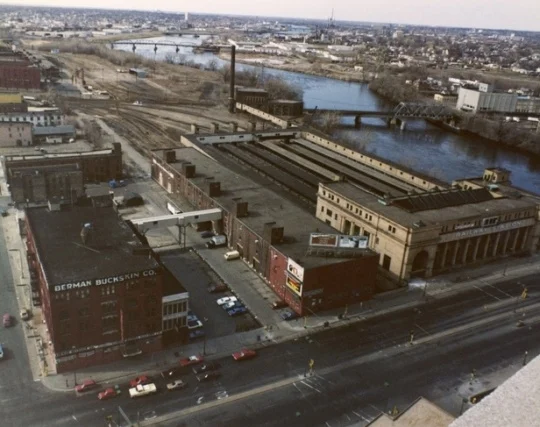
With the closure of the depot, the real estate subsidiary of the Burlington Northern Railroad wanted to develop their land from Hennepin up to the Plymouth Avenue bridge near the top of the photo. And they had a customer. The Minneapolis Star and Tribune wanted to build a new printing plant on the railroad’s land. But to do that they needed some changes in zoning from the city. To encourage that and enhance the value of remaining land for residential development the company offered to donate to the city 22 acres of riverfront. The donation valued at $11 million was accepted by the city in 1985.
One condition attached to the donation was that the park board had to build a parkway along the river — from Plymouth Avenue to Portland Avenue — in two years. So what is now James Rice Parkway was created and dedicated in the fall of 1987 as the Minnesota Twins took on the St. Louis Cardinals in the World Series. As the parkway and riverfront park were being developed, the Minneapolis Star and Tribune’s new printing plant was built, too.
The new parkway was named for James Rice, a state legislator from northeast Minneapolis who played a key role at the Minnesota legislature in securing funding for the construction of the parkway. With the new parkway from the Falls to Plymouth Avenue in place, the park board had a target and incentive to then connect Rice Parkway with West River Parkway which was accomplished with some complicated land deals in the 1990s. As various parcels were acquired for that connection the park board also developed Mill Ruins Park and First Bridge Park and converted the Stone Arch Bridge to an incredible pedestrian amenity. And it made possible a continuous park connection from North Minneapolis to Minnehaha Falls.
That connection was critical to furthering the vision of parks along the whole length of the riverfront in Minneapolis, a vision that is being realized more each year with acquisition and development of parks further and further upriver.
The deal that was made to enable construction of the newspaper printing plant was a turning point in the development of the central riverfront. It opened the riverfront to extensive residential, commercial and entertainment development on former railroad property and beyond. The opening of the river to the city would have likely happened anyway eventually, but it was certainly accelerated by the land donation for a parkway. Let’s hope that the next phase in the history of that parcel of land has as positive an effect on the city.
David Carpentier Smith


Leave a Reply