Archive for the ‘Minneapolis Parks: General’ Category
Minneapolis Park Memory: Coach Marv Nelson
Filed under: Minneapolis Park Memory, Minneapolis Parks: General | Tags: Folwell Park, Football, Marv Nelson
 Comments (13)
 I was at a Patrick Henry Foundation ‘doings’ a couple of weeks ago and Marv Nelson’s name came up. Marv was a milk driver for Ewalds or Clover Leaf, but his passion was sports. He coached baseball, football, and hockey and the Cootie VFW was the sponsor, so his teams were the ‘Antsinpants’, but also called Marv’s Boys. It’s not like there was just one team. There were peewees, cubs, and midgets and Marv would have players on the midget teams coach the cubs and the peewees. Marv followed the Henry thing, so everything was red and gray. He always wore a sweat shirt, khakis (work pants, not dockers) and a red ball cap. He had glasses, a snarl and a cauliflower ear. He was ancient in 1965 and coached several more years. He was at Folwell, Bohanan, Shingle Creek. Any given spring there were at least 100 kids on Marv’s Boys teams. The northside never saw anyone like him.
The VFW also sponsored a “Cootie Bum Band” which would march in parades far and wide all through the 70s.
Jim Krave
More Horace W. S. Cleveland: A Bit of Oak Lake and More of Kenwood Parkway
Filed under: Landscape Architects, Minneapolis Parks: General | Tags: H.W.S. Cleveland, Horace Cleveland, Kenwood Parkway, Oak Lake
Comments (1) Since I wrote about Oak Lake and speculated whether Samuel Gale might have hired Horace Cleveland to lay out his Oak Lake Addition to Minneapolis — it had the look of Cleveland’s work — I have been digging through notes to see if I could find a connection between the two men. I couldn’t find anything that put the two of them together in 1873 when Gale was platting Oak Lake, but I did find two interesting pieces of paper linking Cleveland with Oak Lake and with Gale in 1886.
One connection between Cleveland and Gale in 1886 comes from the Frederick Law Olmsted Papers at the Library of Congress. Continue reading
Minneapolis Parks 100 Years Ago
Filed under: Minneapolis Parks: General | Tags: Theodore Wirth, Wilbur Decker
Comments (1) The Minneapolis park board and other park activists in town have a full plate this year: a new park superintendent, reorganization and significant staff turnover, Minneapolis Riverfront Design Competition and Initiative, development of Boom Island and B. F. Nelson parks, proposed green finger of parks running into downtown from the river through Gateway Park past the library, potential power plant—Crown Hydro—on park property, and a budget inadequate to do much else. Those are only a handful of the bigger challenges.
But, hah!, Wilbur Decker and Theodore Wirth, park board president and superintendent respectively in 1911, would smirk at this puny agenda. It’s nothing compared to what the park board did 100 years ago. Here’s a summary of what the park board accomplished in 1911. Continue reading
Where do you think Andy Warhol got the idea?
Filed under: Minneapolis Parks: General | Tags: Clinton Field Park, Dorilus Morrison Park, Leo Harris, Minneapolis Institute of Arts
Comments (3) This has nothing to do with parks.
From the Minneapolis Morning Tribune, October 30, 1915.
Artistic tomato cans and beer bottles? No, not now, but maybe in the future. Joseph Breck, director of the Minneapolis Institute of Arts, intimated the possibility in an address before the art division of the Minnesota Educational Association today. “When some future historian,” he said, “comes to write the story of nineteenth century art, will he praise our tomato cans, our beer bottles, as the art historians of our day praise the vases of ancient Greece? I fear not. But our industrial arts are improving so rapidly and we have made such tremendous advances on the hideousness of the Victorian era that the time is not far off when the future historian will find much to occupy him in the decorative arts of the coming day. If my statement is borne out it will be largely because we have trained the children to know and to want what is beautiful.”

Beauty in a Can. Andy Warhol
Nothing to do with parks—except I came across the article while researching park issues, precisely the park board service of Leo Harris. Minneapolis developer Ray Harris once commented to me that there were many big battles on the park board in the days his father Leo served as a park commissioner (1915-1918). “It was not all sweetness and light,” Ray said. I was searching the Minneapolis Tribune for reference to some of those battles, when I found the tomato can quote.
One of Harris’s biggest fights was with park superintendent Theodore Wirth over what Harris considered faulty and inferior paving methods on parkways.
But there was some sweetness and light too. In 1916 Harris donated a 12-inch silver trophy that was awarded to the city’s Sunday League baseball champion each year. I don’t know what became of the trophy or how long it was awarded.
The best Leo Harris story I could find was from the Minneapolis Tribune October 27, 1914, subtitled “One Reason Why He Became a Candidate for the Park Board.” Harris said he was walking near his home in the eleventh ward the previous spring when he encountered an army of young children playing in the street. He tried to count them, but the crowd was too large and fluid, so he offered to buy them all ice cream cones. When it came time to settle, he paid for 49 cones. Harris said he became a candidate for the park board a few days later. Harris was quoted as saying, “I love the Park Lakes, the River Drive, the beautiful Minnehaha, but I also believe in giving the children in congested districts a place to play and play right. It is a shame for a city to give these kids only the streets to play in.”
Leo Harris resigned from the park board in 1918 to enlist in the U.S. Army during World War I.
I wrote in a post earlier today that the Minnesota Historical Society photo collection has a picture of almost everything. Here’s more proof: I searched for Leo Harris and while I didn’t find a portrait, I did find his business!
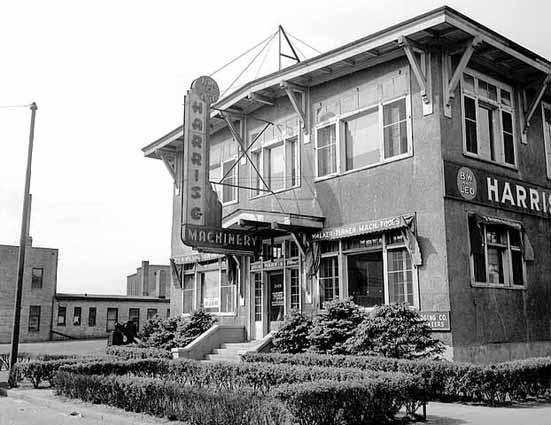
B.W. & Leo Harris Company, 2429 University Avenue Southeast, 1948 (Minneapolis Star Journal, Minnesota Historical Society)
Harris announced the creation of the business in an ad in the Minneapolis Tribune April 23, 1922.
I should also add that the Minneapolis Institute of Arts, of which Mr. Breck was the director when he gave Warhol his inspiration, is located in a Minneapolis park, Dorilus Morrison Park. I knew there would be a picture of that in the MHS collection.

Dorilus Morrison’s home ca. 1900 (Minnesota Historical Society)
This was Dorilus Morrison’s home in about 1900, which his son, Clinton, donated to the park board in 1911 order to build this…
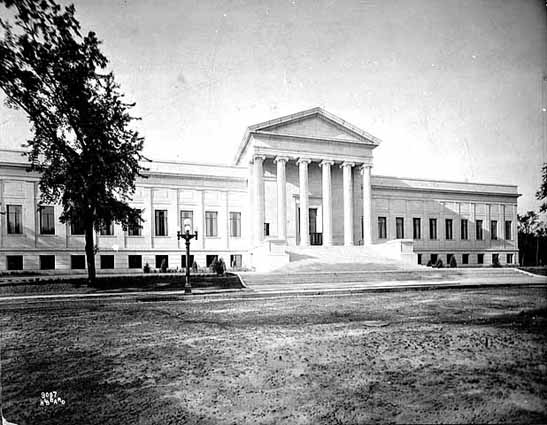
The Minneapolis Institute of Arts, photographed in about 1920, was built in Dorilus Morrison Park. (Charles J. Hibbard, Minnesota Historical Society)
The new Institute opened in January, 1915 and was the site of Breck’s speech later that year. On the day the new building opened, January 7, 1915, a Minneapolis Tribune editorial called it “A New and Powerful Force for Good.”
Dorilus Morrison was instrumental in creating the park board and was a commissioner on the first park board in 1883. Even his son Clinton has a park named for him in a way. Clinton Park was named for its location on Clinton Avenue, but Clinton Avenue was named because it was the street on which Clinton Morrison resided, a block east of his father’s house.
David C. Smith
© 2011 David C. Smith
Housecleaning, Maude Armatage, Emma Smith and Earth Day
Filed under: Minneapolis Parks: General | Tags: Alice Dietz, Maude Armatage
Comments (1) Tomorrow will commemorate the 99th anniversary of an event some people in Minneapolis may overlook. On April 9, 1912 a Minneapolis cop, Patrolman Hollison, made what the Minneapolis Tribune called the “first arrest ever” in Minneapolis for scattering refuse — littering. As Patrolman Hollison stood at the corner of Lake and Nicollet he saw someone throw a newspaper out the window of a street car. Hollison boarded the street car and arrested August Davidson of 4724 Clinton Avenue, who pleaded guilty and was fined $1. The fine was suspended — but it was a start. I bet Mr.Davidson never again flung his newspaper out a street car window, even if he didn’t like the editorials. The story was reported under the headline “Newspaper Tosser Nabbed.” Minneapolis Tribune, April 10, 1912.)
Of course one arrest and a one-eyebrow-raised headline didn’t alter behavior citywide. That took time, as illustrated by a series of events more than nine years later. At the meeting of the Minneapolis Board of Park Commissioners on July 15, 1921, in the last item of business before adjournment, commissioners voted to create “a workable plan to ensure that picnic parties clean up the picnic grounds which they have used before leaving the parks.” The motion seemed almost a throw-away before everyone went home for the night, but it provided an opening for the board’s newest member to make herself heard.
When the board met again three days later, commissioner Maude Armatage asked if the Board would like to have the cooperation of the women’s organizations in an educational campaign for municipal housecleaning. The board immediately moved that Armatage “be allowed to obtain the assistance of the women in such work.”
Ten days later, July 28, 1921, Armatage inaugurated a campaign to reduce litter in Minneapolis parks. She pointed out that the city spent nearly $8,000 a year cleaning up park litter, mostly on Mondays after huge park attendance on Sundays, although at popular Loring Park the cleanup often extended into Tuesday. This event also dealt with litter, but much more with the perception of capabilities, roles and rights. It was another first, another start. It was the first action by a woman as a park commissioner. Continue reading
What Happened to Minneapolis-made Cigars?
In light of the tobacco use policy of the Minneapolis park board, which essentially prohibits the use of tobacco in most park areas, I had to chuckle at the entry in the proceedings of the Board of Park Commissioners for April 19, 1916—almost 95 years ago.
Mr. A. B. Weigel appeared that day before the park board as secretary of the Cigar Makers’ Union—Local No. 77 of the Cigar Makers’ International Union of America, according to the Minneapolis Tribune April 20, 1916—to ask that the park board, as far as possible, sell only Minneapolis union-made cigars at park refectories. On the spot the park board adopted a resolution instructing the manager of refectories to, as much as possible, purchase and enhance the sale of products manufactured in Minneapolis.
What surprised me about that news is not that Minneapolis park refectories sold cigars, but that cigars were made in Minneapolis — enough of them that local cigar-makers were unionized.
Current limits on tobacco use in Minneapolis parks went into effect July 1, 2010.
Of course whenever I’m curious about anything from our city’s or state’s past I go to the photo collection of the Minnesota Historical Society to see if there are pictures. Naturally, when I entered the search term “cigar” I found a number of interesting photos. Here are two.
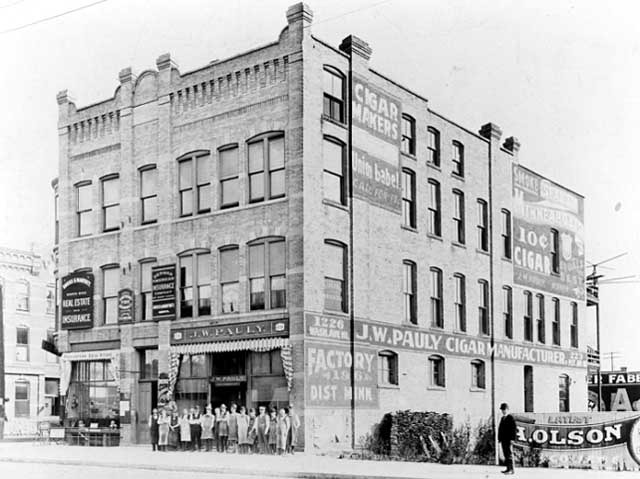
J. W. Pauly Cigar Company, 1226 Washington Avenue North, ca. 1895 (Minnesota Historical Society)
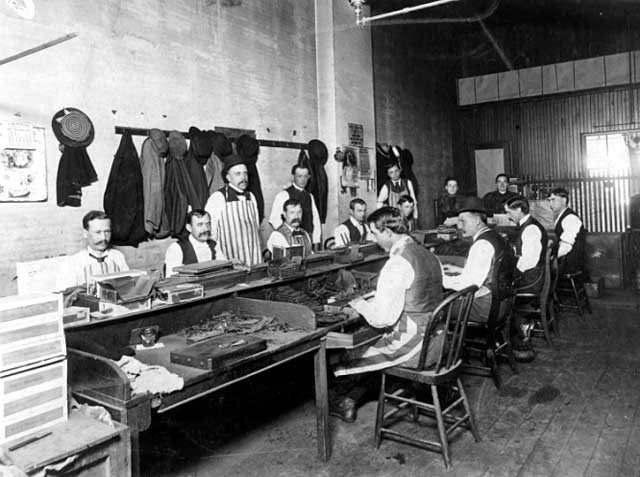
J. W. Pauly Cigar Company cigar makers, perhaps members of Local 77 Cigar Makers’ International Union of America, ca. 1895 (Minnesota Historical Society)
David C. Smith
Minneapolis Park History Resources: Hathitrust
Filed under: Minneapolis Park History Resources, Minneapolis Parks: General | Tags: Hathitrust.org, Warren Manning, William Watts Folwell
Comments (2) If you’re researching early Minneapolis history, particularly parks, you absolutely must know about this resource: hathitrust.org.
HathiTrust is a digital library that has millions of books from university and public libraries. Most of the books are no longer copyrighted so they are in the public domain. (This includes most books published before 1923.)
What is most useful is that the volumes are searchable. Fortunately the annual reports and the proceedings of the Minneapolis Board of Park Commissioners were widely sought after nationally and widely distributed. In old park board files, there are many cards and letters from individuals and institutions around the country requesting copies of the annual reports. Hathitrust has scanned most years of the park board’s annual reports and some proceedings up to 1923 either from the collections of the New York Public Library or the University of Michigan. The University of Minnesota also participates in Hathitrust.
“No other city gets out such artistic and complete records of its park work as does Minneapolis.”
Warren Manning’s magazine, Billerica (“The Fugitive Literature of the Landscape Art,” Vol. IV, March 1916, No. 10, Part 2), singled out the annual reports of the Minneapolis Board of Park Commissioners for praise. The article particularly recommended the Fourteenth (1896) and Eighteenth (1900) annual reports, which were “notable for their illustrations.”
Both reports were produced while William Watts Folwell was president of the park board. As a historian Folwell understood well the value of documenting the efforts of an organization such as the park board.
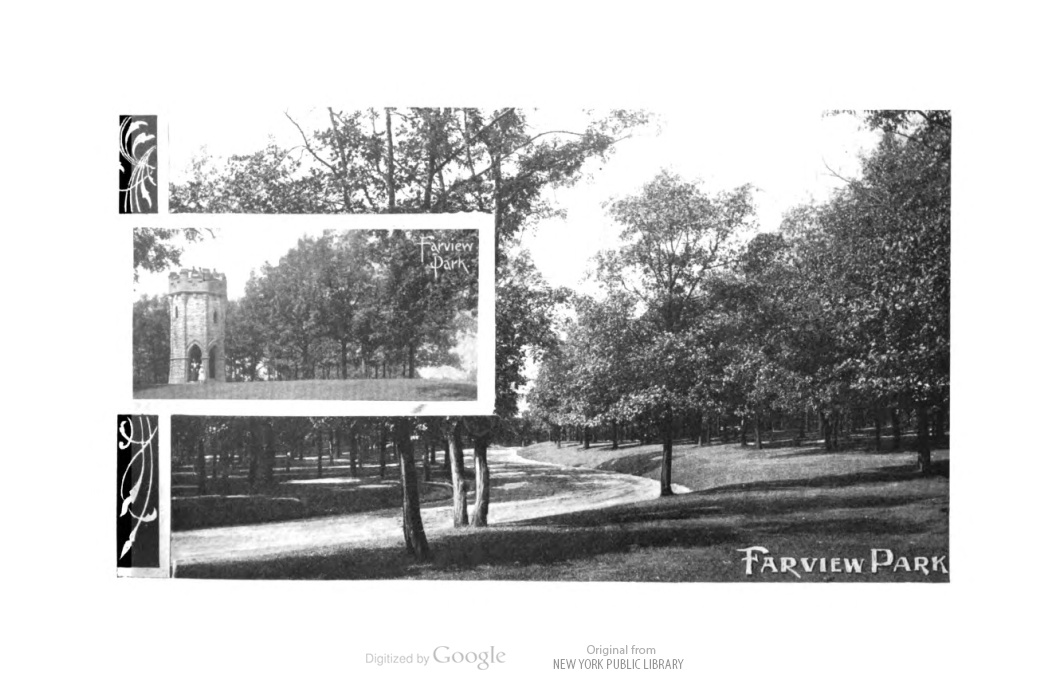
An illustration from the 1896 annual report praised by Manning
HathiTrust also allows you to create an account and establish your own “collections” from its vast catalog. It’s easy to set up a guest account. Here’s what I did: I put all available issues of the park board’s annual reports and proceedings, as well as most of the early books about Minneapolis history, such as Isaac Atwater’s and Horace Hudson’s histories, into a single “collection.” I can then search the collection for any terms I want. That means I can search for Lake Harriet or Powderhorn Park and find every reference to those park properties in park board documents—and other books—over many years. Such a capability saves hours of research because the park board annual reports and proceedings in the early years did not have indexes.
Annual reports are not available for some years in the Minneapolis park board’s first decade, but all annual reports 1895-1922 are available. HathiTrust also has many issues of the Minneapolis City Council proceedings, which provides for another layer of research. HathiTrust has also scanned many park board annual reports from 1923-1960. Due to copyright restrictions the full text of those reports is not available online, but a search will reveal if and how often terms do appear in those volumes. Not as helpful as full-view text searches, but still a big time-saver. You can then go straight to the pages you want in a library.
Give hathitrust.org a try. You’ll be amazed at what you’ll be able to find. The digitization for HathiTrust was done by Google, but the collection is far more extensive than what is available at Google Books.
David C. Smith
Lost Minneapolis Parks: Rauen Triangle
Filed under: Lost Minneapolis Parks, Minneapolis Parks: General | Tags: Horace Cleveland, Rauen Triangle
Comments (5) Minneapolis lost one of its only parks named for someone with a German surname in 1939. Given that more Minneapolitans define their ancestry as German than any other nationality — nearly one in four — it seems a bit odd that a city with more than 180 parks would have so few named after people of German descent. As I was looking over a list I compiled of Minneapolis park properties that no longer exist, I was struck by the description of Rauen Triangle; a 1930s park inventory claimed that the triangle was named after “German settler” Peter Rauen. When that triangle was paved over in 1939, the only park property that remained with a German name was Humboldt Triangle in north Minneapolis. Alexander von Humboldt was a German naturalist and explorer who died in 1859. Even Humboldt’s name adorned a park property by default rather than by choice; the triangle took its name from its location on Humboldt Avenue.
Rauen Triangle was a small piece of land (0.03 acre) at the oddly configured intersection of 11th Avenue North, North Fifth Street and North Sixth Street. The park board purchased the land at the request of residents of the neighborhood in 1890 for $3,462 — a price that seems exorbitant for such a small, otherwise useless tract. The entire cost was assessed on property in the neighborhood. It was given the unimaginative name of Fifth Street Triangle.
If the Nomenclature Committee had had its way in May 1893 the triangle would have been renamed Iota Triangle. The committee of Harry Wild Jones, William Folwell and Patrick Ryan had suggested naming most of the small street triangles after letters of the Greek alphabet. The park board approved many other names recommended by the committee that day — Kings Highway, The Beard Plaisance, Logan Park, Windom Park, and Van Cleve Park — but returned the Greek alphabet names to the committee for further consideration. Good choice.
The only suggested park name recommended by the committee that was shot down completely by the board was the name Hiyata Park for Spring Lake Park, the small pond at the foot of Kenwood Hill behind the Parade Ice Arena. The board voted to keep the name Spring Lake. Hiyata, the committee claimed, was an “Indian name meaning Back-By-The-Hill.”
After further deliberation, instead of Iota Triangle the committee returned with a recommendation of Rauen Triangle in honor of Peter Rauen, a German who had arrived at St. Anthony in 1856. The name made sense because Peter Rauen’s home at 1101 North Sixth Street faced the triangle.

Peter Rauen’s house at 1101 North Sixth Street, about 1875. This photo was taken from approximately the site of the future Rauen Triangle. I like the board sidewalk. (Michael Nowack, Minnesota Historical Society)
Rauen operated a successful grocery and general merchandise store at the corner of Plymouth and Washington. He was an alderman on the first city council after the merger of St Anthony and Minneapolis in 1872 and he was mentioned in Horace Hudson’s early history of Minneapolis as a prominent president of the Harmonia Society, one of the more successful musical organizations in the early days of Minneapolis.
The park board gave up Rauen Triangle in 1939 to the city of Minneapolis. On the same lot that Rauen’s home had once stood, the city built Fire Station 4, which still stands on the site. It seems that the triangle got in the way of the long hook and ladder fire engines maneuvering into the station. The triangle was paved over to create a quite wide intersection.
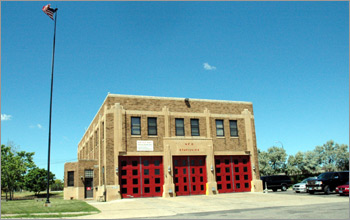
Fire Station 4, 1101 North Sixth Street (City of Minneapolis website)
In Rauen’s time the neighborhood was all residential, but it is now completely industrial and hemmed in by freeways.
Since the demise of Rauen Triangle, two other Minneapolis parks have been named for people with German surnames: Mueller Park (1973) and Gluek Park (1995).
I don’t mention the nationality or ethnicity of park names as something that needs to be addressed; it is simply an observation. The only name missing from a Minneapolis park that really must be added is Horace Cleveland’s.
David C. Smith
© David C. Smith
Minneapolis Park Hero: Alice Dietz
Filed under: Minneapolis Park Hero, Minneapolis Parks: General | Tags: Alice Dietz, Logan Park, Minneapolis parks
Comments (5) Early in my research of Minneapolis park history for City of Parks, Alice Dietz caught my attention. She had a forty-year career in Minneapolis parks, 1916-1957. She rose to prominence in the park system quickly from her start as a recreation director. In January 1918, the park board received a letter from an appreciative mother asking that Dietz be reappointed as recreation director at Maple Hill (Beltrami) Park. She was not reappointed at Maple Hill; in the park board’s annual report for 1918 Dietz was singled out for praise for her work at bigger, busier Bryant Square Park. The next year Dietz moved again, this time to the most visible and important recreation job in the city as the director of the Logan Park field house, the only year-round facility the park board operated.
Dietz needed very little time to establish her reputation at Logan Park. In an article on the opening of the 1920 summer playground season, the Minneapolis Tribune (June 20) commented that Dietz had already “taught the Logan Park neighborhood what a field house was really meant to be.” Apparently in the seven years between its construction in 1912 and Dietz’s arrival the field house had been less successful.
By the end of that summer the Tribune (October 17) provided an unusual glimpse of park life “in a community where there are a dozen nationalities struggling with the intricacies of life in a new country.” In that environment, the paper reported, Mrs. Dietz was trusted by “children and mothers alike.” As a result, Dietz was able to “buoy the self-confidence of the women who are awed by the greater facility of their children in the new tongue and to make the children realize what they owe to their parents.”
Among her responsibilities were teaching drama, dance and arts and craft classes, directing all athletic activities for girls, and putting on plays and pageants. The previous year she had also managed boys athletic activities developing “proficiency in boxing and football that surprised even herself” the Tribune reported. The paper continued that “almost to her regret,” a man had then been brought in to look after the boys and young men. In between all this she “listens to all the troubles that everybody tells her…and never turns a hair through it all.” The Tribune also praised the “Logan Park spirit” she had instilled noting that “the children have come to feel that the place belongs to them and they look over a newcomer with stern eyes. He has to measure up to what they think is proper Logan Park behavior.”
Dietz’s work with pageants and performances at Logan Park led to her being handed responsibility for the citywide playground pageants staged at Lyndale Park at the end of each summer.

The first playground pageant on the hill above the Rose Garden at Lyndale Park attracted a crowd estimated at 10,000. (1918 Annual Report, Minneapolis Board of Park Commissioners)
The first two pageants, “Mother Goose” in 1918 and “The Pied Piper” in 1919, were directed by Julia Beckman, a teacher at North High School, but from 1920 Dietz wrote and directed the playground pageants as they became one of the highlights of the summer playground program. Children from every Minneapolis park were involved in creating costumes and props for the program. Up to 1,500 children appeared in the pageants each year which were staged on the hill overlooking the Rose Garden in Lyndale Park. The two-night performances were attended by up to 40,000 people. The popularity of the pageants caused the park board to consider more than once (first in 1930) the construction of an amphitheater on the site. Except for a brief hiatus during the Depression, the pageants continued through 1941. The pageant was incorporated into the Aquatennial in 1940, the first year of that celebration. With the ascendancy of the Aquatennial, and with the nation at war, the pageant was discontinued a year later.
The pageants were original scripts written by Dietz. While she created small roles in her pageants for park commissioners, she never allowed commissioners to have speaking parts. After her second pageant in 1921, “Weaver of Dreams,” Dietz asked the park board to allow her to retain copyright of the pageant scripts. The park board agreed that she could retain those copyrights as her personal property. (I have seen no indication that Dietz ever licensed those or subsequent scripts for performances by others.)
I recently found in a scrapbook kept by Victor Gallant evidence that Dietz had a background in theater as a performer before she worked for the park board. I had found an item in park board proceedings that Dietz requested a leave of absence for a week in the 1920s to attend a dance workshop in New York at her own expense, which was granted by the board. From that reference I knew Dietz had an interest in dance beyond the classes she taught at Logan Park and the dances she had incorporated into her pageant scripts. But the undated newspaper clip that appeared at the time of her 40th anniversary of employment with the park board (her last year), mentions her own theater performances as a girl.

Alice Dietz in 1957 near the time of her retirement and as a child actor, from an undated newspaper clip.
As the Director of Community Centers in Minneapolis parks, Dietz played a central role in the redefinition of recreation in the park context. The range of activities and classes offered at Logan Park was unprecedented in Minneapolis. In addition to expanding the range of activities provided for both children and adults, Dietz oversaw the conversion in 1922 of the large social room at Logan Park into a gymnasium for sports. The other recreation centers in Minneapolis at that time were little more than warming houses for skaters. They were later criticized by a national park expert as too big for warming houses and too small for anything else. (Weir Report, 1944.) Despite the phenomenal popularity of Logan Park under Dietz’s direction, the park board did not build another similar facility until the 1960s. Perhaps park commissioners feared that while they could replicate the field house they could not replicate Dietz.
Dietz’s role in the development of park programming in the 1920s at Logan Park was significant, but her greatest achievement may have been in training the army of recreation supervisors who worked in parks across the city in the 1930s. With the onset of the Depression in 1930 and the slashing of recreation budgets, Dietz lost her three assistants at Logan. Summer recreation positions in parks across the city were slashed from seventy-five to zero in 1933. When the American Legion tried to fill the void in eleven parks by providing volunteer supervisors, they were sent to Dietz for training.
That was just a glimmer of what would follow. For the 1934 playground season the Works Progress Administration inaugurated a recreation program that at its peak would place more than 240 recreation supervisors in Minneapolis parks and playgrounds. The WPA recreation program continued until 1943. During those ten years, thanks to federal and state work-relief programs, Minneapolis parks offered the most comprehensive, year-round recreation programming in the city’s history. The entire program, including the training of hundreds of new personnel, was coordinated by Alice Dietz from her office at Logan Park.
That experience served her and the city well after WWII when the park board was able to expand recreation programming and offer year-round activities at a handful of parks. Dietz was once again responsible for training the first generation of full-time, year-round recreation supervisors employed by the park board.
These are the outlines of Alice Dietz’s remarkable career in the recreation department of Minneapolis parks. I know little about Alice Dietz beyond what I have related here other than the fact that she was president of the Minnesota Recreation and Park Association in 1947. If you can tell us more about Dietz — or you have another person to nominate as a Minneapolis Park Hero — please comment here or contact me at the e-mail address below.
David C. Smith
© David C. Smith
Lost Minneapolis Parks: Virginia Triangle
Filed under: Lost Minneapolis Parks, Minneapolis Parks: General | Tags: Loring Park, Minneapolis parks, Smith Triangle, The Parade, Thomas Lowry, Virginia Triangle
Comments (3) Can you tell where this photo was taken? The land in the foreground is a lost Minneapolis park: Virginia Triangle.
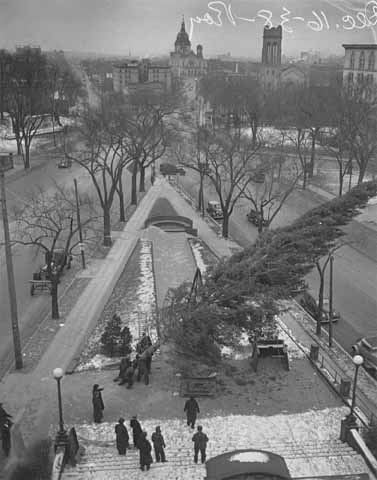
Virginia Triangle 1938 (Minnesota Historical Society)
Virginia Triangle was at the intersection of Hennepin and Lyndale avenues; the cross street is Groveland Avenue. Hennepin crosses left to right and Lyndale right to left. The photographer was facing north. That’s the Basilica straight ahead, St. Mark’s to the right, with the trees in Loring Park between them. To your immediate right (out of the picture) is Hennepin Avenue Methodist Church. On your left, just past the cross street, is Walker Art Center. Beyond that is The Parade, athletic fields when this picture was taken, but now the home of the Sculpture Garden.
Isn’t this view lovely compared to the freeway interchanges, tunnels, etc. of today? The park board put up and decorated a huge Christmas tree in the triangle each year. I don’t know when that practice began or ended, but I’ll try to find out. If you know, send me a note.
An important memorial was installed at Virginia Triangle in 1915. The park board did not pay for the memorial but agreed that it could be placed in the park triangle. Whose memorial was it? This photo was taken at the dedication. ( That’s Hennepin Methodist church across Lyndale Avenue in the background, Hennepin Avenue in foreground.)
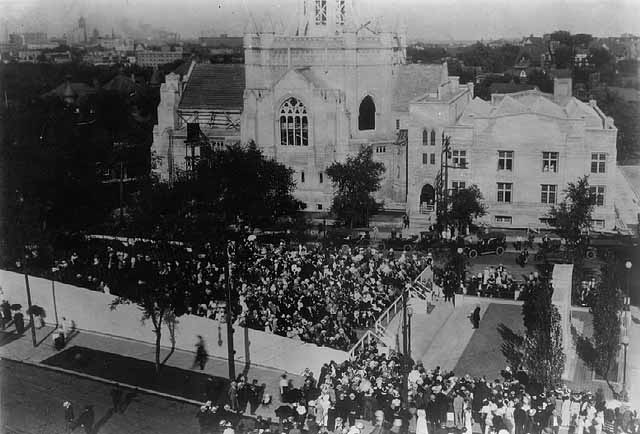
Virginia Triangle in 1915
He had something to do with urban transit and his mansion was immediately to the left of the photographer when this picture was taken. An avenue in north Minneapolis is named for him. He donated part of the land for The Parade and paid to have it developed into a park.
Here is his statue as part of the memorial that was put on the triangle.
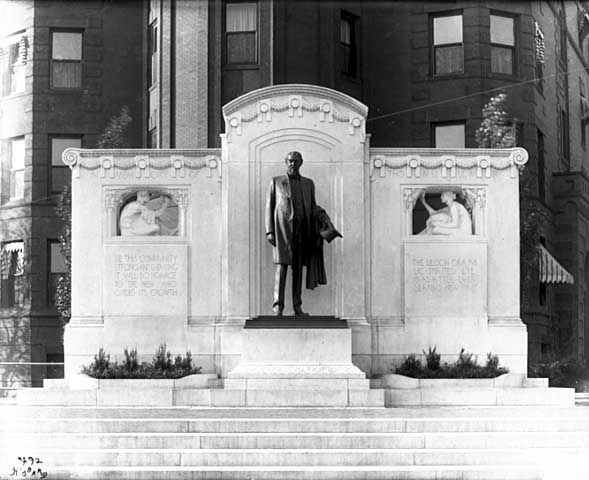
Virginia Triangle Memorial (Charles Hibbard, Minnesota Historical Society)
This is what Rev. Dr. Marion Shutter said when he spoke to the crowd gathered at the dedication above:
How grandly has the sculptor done his work! This heroic figure needs no emblazoned name to identify the original. It seems almost as if Karl Bitter (the sculptor) had stood by the door of that little Greek temple at Lakewood (cemetery), and had said: ‘Thomas Lowry, come forth.’
Virginia Triangle was acquired by the Minneapolis park board on the first day of the last century. A.W. French and his wife donated the property to the park board in a swap. The Frenches had originally donated a piece of land for Hennepin Avenue Parkway, but apparently wanted that piece back and offered what became Virginia Triangle instead. The park board accepted on January 1, 1900. The best guess is that the name of the triangle comes from “Virginia Flats,” the apartment building behind the memorial in the photo above according to a 1903 plat map.
Thomas Lowry was joined on the triangle by another statue for a time during the summer of 1931. The Knights Templar held their conclave in Minneapolis that year and requested permission to erect life-sized statues of knights on horses throughout the city. The request was approved by the park board on the condition that all park properties be returned to their original condition without cost to the park board at the conclusion of the conclave.

Knights Templar statue at The Gateway, 1931 (Minnesota Historical Society)
The statue at Virginia Triangle was probably similar to this one placed at The Gateway during the conclave. Other statues were placed at The Parade and Lyndale Park.
Virginia Triangle was eventually lost to freeway construction when I-94 was built through the city. With freeway entrances and exits needed for Hennepin and Lyndale, the triangle had to be removed even though the freeway itself was put underground below Lowry Hill and Virginia Triangle.
The state highway department paid the park board $24,300 for the triangle in 1966, plus the actual cost of relocating the Lowry Memorial. The park board chose another triangle about a half-mile south on Hennepin Avenue at 24th Street as the new site for Thomas Lowry. The low bid for moving the memorial to the new site at Smith Triangle in 1967 was $38,880.
The inscription on Lowry’s memorial reads:
Be this community strong and enduring — it will do homage to the men who guided its youth.
David C. Smith
© David C. Smith
Glenwood Toboggan Slide II: 1887
Filed under: Minneapolis Parks: General, Winter Sports | Tags: Glenwood Park, Theodore Wirth Park, toboggan slide
Comments (3) Since posting a newspaper photo of a toboggan slide on “Glenwood Hill” in 1887, I found this photo in the Minnesota Historical Society Visual Resources Database. This photo is purportedly of the same toboggan chute on the same hill in the same year, but they are obviously different places. The photo clipped from a newspaper had trees right up to the sides of the track.
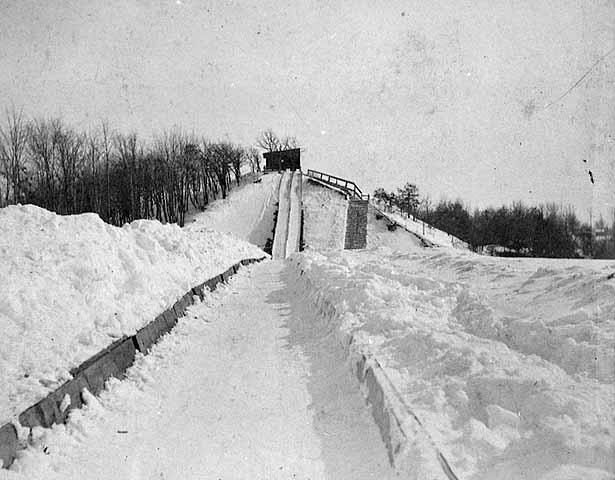
The North Star toboggan chute on Glenwood Hill, 1887. (Minnesota Historical Society)
Looking up the hill instead of down, gives a completely different prespective on the possible location of the slide. I doubt that the slide in this photo is in the same location as the ski jumps that were built after the park board acquired land in the vicinity. Any guesses as to the location of this toboggan slide? Or the other one? Which one is the real “North Star” chute?
In the same wonderful photo collection, I found this picture of the St. Paul toboggan slide in front of the State Capitol, which I referred to in my earlier post.

A 1957 photo of the toboggan slide I rode as a kid, a few years later, in front of the State Capitol. (Minnesota Historical Society)
David C. Smith
New Rodents at the U: Beavers, not Gophers
Filed under: Minneapolis Parks: General, Mississippi River | Tags: James Ford Bell Museum of Natural History
Comments (2) Beavers invade Minneapolis park near University of Minnesota!
That’s the gist of my favorite, undated newspaper clip from Victor Gallant’s scrapbook: Minneapolis Parks, 1923-1949. The article had to be from the late 1940s, I’ll tell you why in a moment.
Here’s the story. Three beavers have moved into the east river flats below the U. Need proof? They’ve been felling cottonwood trees along the river bank. Two dozen of them! (Cottonwoods are nobody’s favorite tree, in fact the park board once considered banning the planting of them in the city, but they do spring up on river banks and provide greenery and shade that is flood tolerant.)
The newspaper reports that the beavers are living under a sunken houseboat along the river bank. Park superintendent Charles Doell asks the game warden to remove the beavers so they don’t cut down more trees. (Seems to me it would have been smarter to remove the sunken houseboat to eliminate the avant garde urban beaver habitat.) But Dr. W. J. Breckenridge of the University’s Museum of Natural History points out the advantages of having a living natural history exhibit virtually on campus. Doell relents and instead of evicting Goldy’s cousins, he has a couple loads of poplar trees delivered to the riverbank so the beavers have something to eat other than living cottonwoods. It is believed that the beavers immigrated from known colonies on the Mississippi River at Dayton and Anoka. (Did they come over the falls or through the mill races?)
Big Yellow Taxi
That’s the first and last I’ve heard of beavers in Minneapolis. I suspect they didn’t stay long. I’m pretty sure that the article appeared between 1945 and 1949. It had to be after Doell became Superintendent in 1945 and before Gallant quit keeping the scrapbook in 1949. But I didn’t need to know that was the end of Gallant’s newspaper clipping to figure out that date, because it was in 1949 that the University and park board signed a ten-year agreement for the U to use the river flats as a parking lot. I’m guessing that the beavers wouldn’t have settled next to a busy parking lot. And if they had, everyone would have been happy to evict them if their gnawing was endangering cars instead of just trees. Nobody wants a cottonwood in their back seat, even if its young.
The U’s lease of the parking lot kept being extended beyond the original ten-year term. The park board didn’t take back the land for a park until 1976! Some cottonwood trees only live about as long as that lease lasted.

“They paved paradise and put up a parking lot.”
Do you know the official name of the park where the rodents lived for a while? It rhymes with beavers.
In 1894 the park board named the east river flats “Cheever’s Landing,” after the man who operated a ferry across the river there. I don’t believe the name ever has been changed officially.
And speaking of wildlife and the James Ford Bell Musuem of Natural History at the University of Minnesota, the coolest sculpture in the city is the wolf pack attacking a moose near the entrance to that museum. Worth a visit. Don’t jump when you see them.
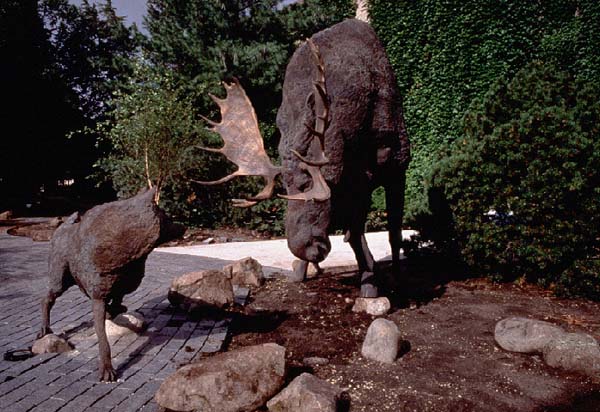
A partial view of the sculpture by Ian Dudley outside the James Ford Bell Museum of Natural History at the University of Minnesota (Photo: Tara C. Patty)
David C. Smith
© David C. Smith

 Minneapolis Park History