Archive for the ‘Minneapolis parks’ Category
The Stadium the Pillsburys Built: Northrop Field at the U of M Where Ticket Scalping Became Illegal
Filed under: Minneapolis parks | Tags: Alfred F. Pillsbury, Golden Gophers, John S. Pillsbury, Northrop Field, University of MInnesota football
 Leave a comment
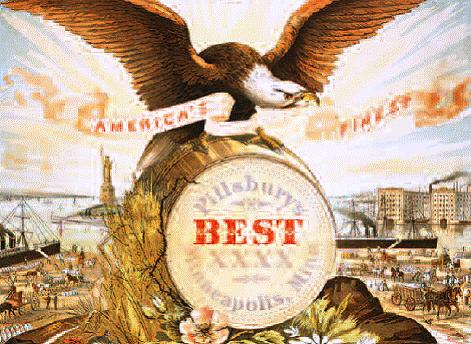
 Alfred Fisk Pillsbury is probably best known for three things in Minnesota other than his “Best XXXX” flour-making name.
 One, he was a major contributor to the Minneapolis Institute of Art. The renown of MIA’s Chinese collection is due in large part to Pillsbury bequeathing his personal collection of bronzes and jades to the museum. He had a good eye in addition to deep pockets.
Two, he played for eight University of Minnesota Gophers football teams 1886-1893. That’s right, eight! As long as a student was working toward a degree in those days, he was eligible to compete on a university’s athletic teams. Earned your degree? No problem! Pursue another, stay eligible. So young Pillsbury—”Pilly” to fans and sportswriters—twice captain of the team and, literally, the owner of the team’s only football his freshman year, went from undergraduate courses to law school. Eight years, six as the team’s QB!
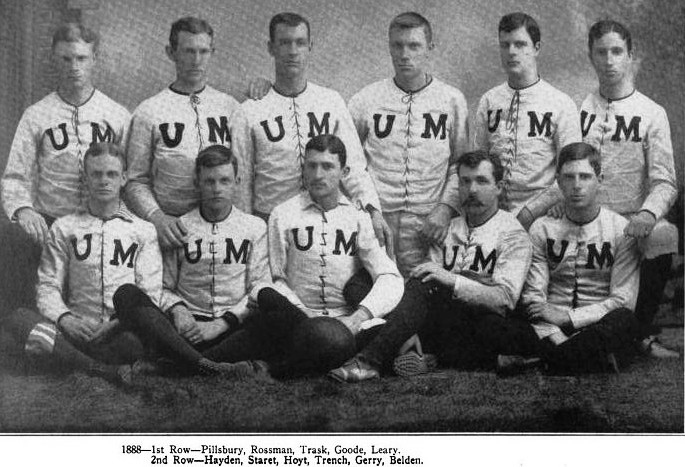
Alfred F. Pillsbury (first row, far left) with the 1888 Gophers. This was the third year of his eight year career at the University of Minnesota. He was captain of the 1887 and 1889 teams. He began his playing days in 1886 as a lineman, but at only 142 pounds he was soon shifted to quarterback. He was not as small as it would seem by today’s standards; players who weighed 200 pounds were considered gigantic then. Don’t you love those lace-up shirts? They were made of canvas to provide some protection and elusiveness. It was hard to get hold of the snug-fitting canvas.
His eighth year on the team is a bit mysterious. Most sources, including the History of Minnesota Football, published in 1928 by the General Alumni Association of the University of Minnesota, claim Pilly’s football playing days ended in 1892. John Hayden writes in a chapter titled “The Early Days”: “For long and creditable performance no one has surpassed Alf. Pillsbury. He played good football on the first team, in 1886, and on successive teams until 1892, when he completed his law course.”
But it seems as if Pilly had one game left in him. The Minneapolis Tribune’s account of the Gophers’ 40-0 thrashing of the Wisconsin Badgers—the biggest game of the year—on November 11, 1893 describes several Pillsbury plays as a halfback that day. He scored two touchdowns. A drawing that illustrates the story shows “Pilly” carrying the ball. It was apparently his only appearance during the 1893 season. Though he wasn’t on the team’s roster for the year, he does appear in the 1893 team photo (too grainy to reproduce here). He was still in law school—he didn’t actually graduate until 1894—so perhaps the team felt they needed their former star to defeat the highly regarded team from Madison and complete a second consecutive undefeated season.

The Marx Brothers in Horsefeathers (mobypicture.com)
The Badgers’ star halfback that day, Lyman, had faced the Gophers before as a student at Grinnell College in Iowa. He reportedly vowed he would stay in college until he beat Minnesota—which evokes images of Professor Wagstaff, Pinky and Baravelli in “Horsefeathers” a few decades later.
The Wisconsin game in 1893 was not the last time Pillsbury took the field in a Minnesota football game. He twice played against the Gophers—and lost—in 1895 representing the Minnesota Boat Club and the Ex-Collegiates.
Perhaps the greatest tribute to Pilly as a player was offered by the famous University of Chicago coach Amos Alonzo Stagg. Writing in the University of Minnesota Alumni Weekly football special in 1914, Stagg recalled the first contact he ever had with a Minnesota team when he refereed a Gophers game in 1891. Pillsbury was one of four players he remembered from that game more than 20 years earlier, noting that Pilly was a “stalwart” at his position and “made a great reputation.”
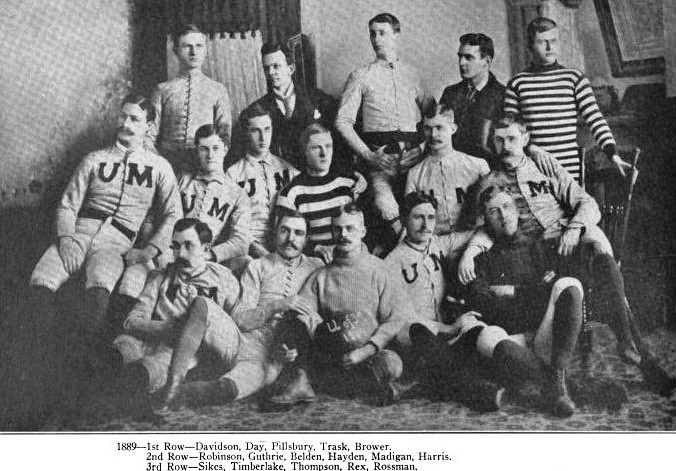
The 1889 Gophers were a more relaxed outfit. Pillsbury, the captain, is front center.
Digression: Golden Gophers. When did the University of Minnesota officially add “Golden” to Gophers? How silly. “Back when I was a kid they were just Gophers and that was plenty good for us.” (Spits tobacco, misses spittoon.) Golden? That’s trying way too hard. “Gopher” too wimpy for you? Well, “Golden” makes it seem like we’re begging for a wedgie. Every time a national sports announcer says “Golden Gophers”, I can hear the eye-roll. There was a time when the “Gophers” were winners. Since the “Golden” was added? Losers. Posers. Hosers. It’s a curse. In the name of Jerry Kill and Richard Pitino, drop the Golden! Especially since the teams have gone to an ugly yellow—Grotesqueyellow Gophers!—instead of gold for a uniform color anyway. If “Buckeye”—the least fearsome nickname/mascot ever— doesn’t need enhancement, why should “Gopher”? Ohio St. still does okay.
Alfred Pillsbury’s third most visible personal accomplishment was serving as a Minneapolis park commissioner for 19 years between 1925 and 1946. He was president of the board for three years in the 1930s. My favorite quote from the annual reports that Pillsbury wrote was from the park board’s report for 1933.
While pleading the case for greater spending on park recreation programs, even in the depth of the Depression, Pillsbury wrote that providing recreation was, “just as vital as any function of government, not excluding that of the apprehension and conviction of criminals and the education of our youth.” I doubt that anyone has ever put the case more strongly for the value of recreation in our society.
That’s how the world seems to remember Alf, as Lori Sturdevant calls him in her family biography, The Pillsburys of Minnesota. But in these days of stadium subsidies and related land development d-d-d-deals—Gestribheit!—it is worth noting something else Pilly/Alf did.
The Stadium that Outlawed Ticket Scalping
Alfred Pillsbury is credited with playing a pivotal role in creating a new stadium for the Gopher football teams. Until 1896 — Pilly’s entire playing career — the Gophers usually played football on the baseball field behind the West Hotel in downtown Minneapolis. The biggest drawback was that the baseball field wasn’t quite long enough for a regulation football field, which lead Northwestern University to protest their loss on the shortened field in 1892. In 1896 the team moved to a new field, a sandy burr patch next to the Armory on the University campus. For three years spectators were accommodated by chairs placed around the field. In 1899, the athletic department borrowed $1,500 from the Board of Regents to construct a 3,000-seat grandstand. A board fence around the field was built by students, although the student newspaper reported with shock that some students climbed over the fence to attend games. The new field was named after University President Cyrus Northrop.

Alfred F. Pillsbury (Minneapolis Park and Recreation Board)
Northrop Field, however, was never considered adequate. Dissatisfaction with the field led to a discussion in 1900 between the Dean at the time, Fred Jones, and former Minnesota Governor, President of the Board of Regents, and Pilly’s dad, John S. Pillsbury. The elder Pillsbury had also been one of the original twelve commissioners when the Minneapolis Board of Park Commissioners was created in 1883. John and Alfred Pillsbury were the first father-son duo to achieve park commissionerhood. The most recent was Leonard and Scott Neiman. The Neiman family could add a generation this year, given the candidacy of Scott Neiman’s son, Josh, for the park commissioner seat from the same southwest Minneapolis district that elected his father and grandfather.
Subsequent to his chat with Fred Jones, John Pillsbury privately purchased six lots adjacent to the Armory football field and convinced the city to vacate Arlington and Union Streets through the campus at that point. His intention apparently was to give the lots he had purchased to the university to expand the football stadium, but this plans were not completed before he died in 1901. His son and heir, Pilly, completed the plan, however, deeding the land to the University. The University then augmented the gift with the purchase of additional land and paid for the construction of a new grandstand that would seat 10,000 and provide standing room for nearly 10,000 more spectators. Pilly then stepped up again with the money to construct a brick wall around the entire athletic complex, which also included a running track and a baseball field.
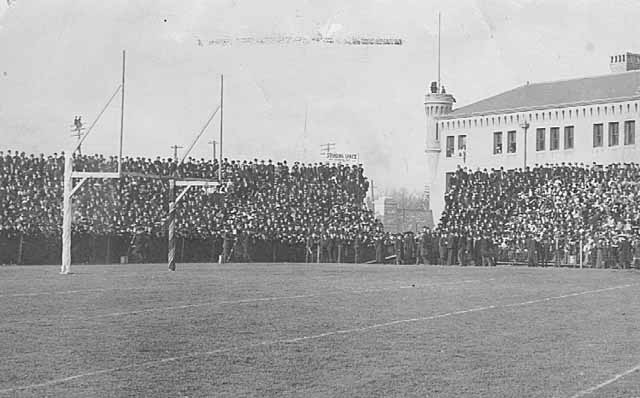
The west end zone and standing room sections of Greater Northrop Field with the a portion of the Armory at right. My favorite part of the photo is the fans on the pole outside the stadium. Alfred Pillsbury’s brick wall wasn’t going to keep them from watching the game. (Minnesota Historical Society)
The new stadium, Greater Northrop Field, which opened in 1903, was considered exceptional for its time, but pressure for a bigger and better stadium would grow in only a decade.
Coaches Never Change. After praising the Gophers’ stadium as one of the “very best football playing fields in the country” a coach expounded, “Fine as this is, however, it does not meet the present football requirements of the University…Michigan, Northwestern, Wisconsin, Chicago, and Illinois have all far outstripped Minnesota in extent of grounds and equipment. A new field with concrete stands and ample acreage is a not unreasonable hope for the near future. Commodious, clean dressing quarters, baths and locker rooms in place of the present inadequate cramped, dirty, unsanitary, and unhygienic quarters should accompany the new field. While bearing but indirectly on football and yet affecting all athletic enterprises at the University, it might be well to mention that Minnesota has one of the poorest college gymnasiums in the country, in no wise in keeping with its needs or its athletic accomplishments.”
— U of M football coach Dr. Henry L. Williams writing in the Alumni Weekly, November 9, 1914. Norwood Teague could use that speech today with minor revisions.
The demand for tickets to see the Gophers play in those days is demonstrated by a law passed by the Minnesota Legislature in 1913, Chapter 521 of the General Laws of Minnesota.
“Be it enacted by the Legislature of the State of Minnesota:
Section 1. Prohibiting theater ticket scalping.–No person, firm, or corporation shall sell or offer or expose for sale any ticket of admission to any theater, opera, concert, athletic contest, or other public entertainment at a greater price than the same are being sold or offered for sale by the management of the same.”
Although the law is couched in general entertainment terms, the Minneapolis Tribune reported April 27, 1913 that the bill was passed expressly to prohibit the scalping of Gopher football tickets, which had been prevalent when the Wisconsin Badgers came to Northrop Field to play the Gophers the previous November. At that time — the Tribune headline was “Football Fever Grips City” — tickets that normally cost $1.50 were selling for as much as $10, putting them out of reach of most fans. (The first Minnesota legislation I can find that applies to excess charges on tickets of any kind is a 1893 law that prevented ticket brokers from raising prices for steamship and railroad tickets.)
The new law got its first great test when Coach Stagg’s University of Chicago eleven came to Minneapolis for a mid-November game in 1913. The 10,000 seats in the grandstand sold out the same morning tickets went on sale even though a limit of six tickets per person was implemented to curtail the anticipated aftermarket in tickets despite the new law. While the penalty for scalping tickets was a $10-$100 fine or 10-90 days in the county jail, the University also imposed punishment for students who sold their student tickets, which cost $5 for the season. The penalty was harsh: expulsion from school. Minneapolis police assigned three plain clothes detectives to patrol “hotel lobbies, cigar stores and saloons” to catch anyone trying to sell tickets over face value. (It wasn’t until 1949 that the legislature expanded the law to prohibit selling tickets below face value, too.)
The big game, played on a field that had been protected from frost all week by a covering of 18 tons of hay, lived up to advance billing resulting in a dramatic 13-7 win by Chicago. Despite the home team’s loss, the Tribune reported an “orgy of celebration” after the game that had never been equalled in Minneapolis history. The paper credited the Chicago win to Coach Stagg’s “shifty plays.” Chicago went on to beat Wisconsin the next week — the entire Wisconsin team was rumored to be at the Minnesota game scouting the Chicago squad — and won the Big Nine conference championship. It was the Big Nine, instead of the Big Ten, at the time because Michigan had temporarily withdrawn from the conference. Chicago was a member then, not replaced by Michigan State until 1949 after Chicago dropped out of major college athletics. What became of all that hay remains a mystery.
At conference meetings the week after the 1913 season ended, faculty representatives of Big Nine schools agreed to try out using numbers on players uniforms the next year. They also appointed Chicago’s coach, Amos Alonzo Stagg, to lead an effort to “devise a signal code by which officials in football games can inform announcers of the causes of penalties”.(Minneapolis Tribune November 29, 1913)
Digression: Squirrels, ferrets and flats. Lest you think that the 1913 legislature was being frivolous in passing laws against ticket scalping, it also passed laws against killing any kind of squirrel in public parks and repealed the law that had made it illegal to use ferrets to hunt rabbits in Hennepin, Ramsey and St. Louis counties. Apparently after passage of the law banning ferrets, the rabbit population had exploded and was destroying fruit trees in those counties. I don’t know if or when either law was ever amended or repealed. So if you plan to use your ferret to hunt rabbits in Minneapolis this summer, you might want to check first. The legislature also granted city councils the authority to determine where flat or apartment buildings could or could not be built, one of the first steps toward zoning restrictions and modern city planning.
After several years of intense public pressure, Northrop Field was replaced after only 21 years by Memorial Stadium, which opened in 1924. Alfred Pillsbury was reported to have donated $50,000 toward the construction of that stadium.
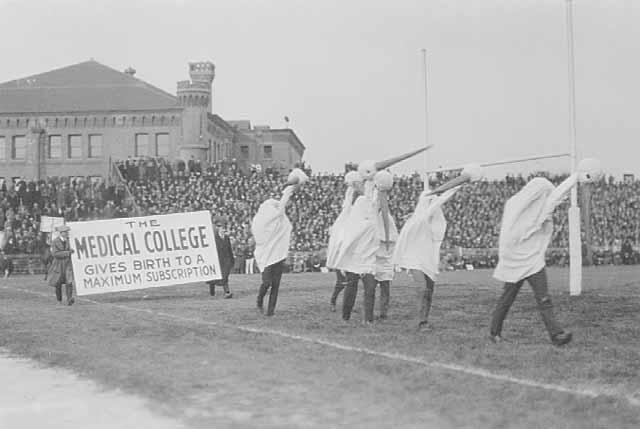
Medical school students demonstrating support for a new stadium about 1920. (Minnesota Historical Society)
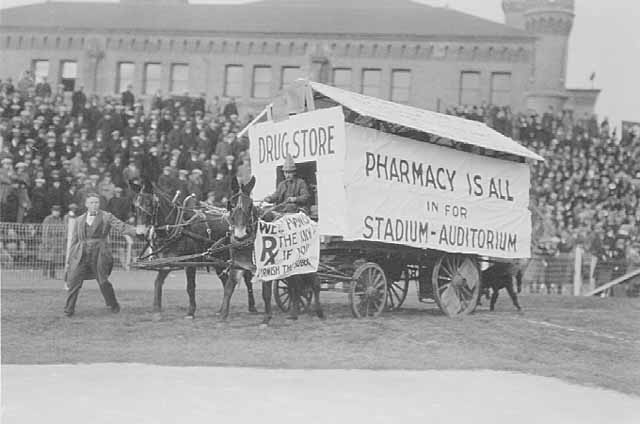
Pharmacy students demonstrating for a new stadium around 1920. (Minnesota Historical Society)
The reference to the “auditorium” in the photo above was to what became “Northrop Auditorium.” The fundraising campaign for Memorial Stadium also included raising money to build Northrop Auditorium.
Although I don’t know if you can still use ferrets to hunt rabbits in Minneapolis, the laws prohibiting selling tickets to sporting events and other entertainment for more or less than face value was repealed in 2007.
While no evidence remains of the Pillsbury family’s contributions to athletic facilities at the University of Minnesota long ago—I don’t know if Pillsbury descendants contributed toward construction of The Bank or other newer facilities at the U—a statue of John S. Pillsbury remains prominent on campus for his role in creating the entire University. History also remembers both John and Alfred, father and son, for their contributions to Minneapolis through the park board; in that sense our city parks are also part of their legacy. And you can still go to the Minneapolis Institute of Art and find items donated from the collection of Alfred F. Pillsbury. I think I can write with confidence that he is the premier art collector in history who also played on his college football team for eight years.
David C. Smith
© 2013 David C. Smith
Friday Photo: Forgotten Field on Nicollet Island
Filed under: Minneapolis parks, Mississippi River | Tags: DeLaSalle High School, Nicollet Island
Comments (2) Funny that in all the debate a few years ago about the football “stadium” for DeLaSalle High School on Nicollet Island, I don’t recall seeing the photo below of the island in 1947. I discovered this photo in Borchert Library’s Minnesota Historical Aerial Photos Online that I wrote about last week.
Nicollet Island clearly had a baseball field adjacent to the high school long before the park board acquired much of the island.

Detail of Nicollet Island, 1947, with a baseball field in the middle. For the full image go here, then click on the green push-pin north of Nicollet Island. (John R. Borchert Map Library, University of Minnesota)
I do recall great distress caused by the possibility of closing “historic” Grove Street across the center of the island in order to install the football field. But no one mentioned then that the eastern half of Grove Street that was to be closed had been historically (among other things) the left field fence of a baseball field. I had no idea. The things you learn from photos.
The photo demonstrates that some claims from both sides of the football field argument were wrong. Those who opposed the field in part for fear of losing a historic street were more than 60 years late to that argument. On the other hand, those who claimed that DeLaSalle, in its 100-year history, had never had a home athletic field were wrong, too. Maybe they didn’t have a football field to call home, although it looks as though one might have been squeezed in there in the ’40s, but they obviously did have a home baseball field at one time.
For the earliest plans for a park on Nicollet Island see previous posts on Horace Bushnell, the first person to suggest it, and the first ideas for parks upriver from St. Anthony Falls.
I don’t know who actually owned or maintained the field in the 1940s. Something to investigate. Some old “D” yearbooks must have more photos.
David C. Smith
© 2013 David C. Smith
Lofty Words, Lofty Ground: Portius C. Deming
Filed under: Minneapolis Park Hero, Minneapolis parks | Tags: Deming Heights, Deming Lake, Itasca State Park, Mary Gibbs, Portius C. Deming, St.Anthony Parkway
Comments (1) One of the lesser-known park heroes in Minneapolis history left us with inspiring advice —for both citizens and park commissioners. His most memorable words come from his writing in park board annual reports when he was the president of the Minneapolis Board of Park Commissioners 1915-1917. His most enduring actions to create parks and preserve nature’s beauty, however, had nothing to do with Minneapolis. We would honor his service to the state and city if we maintained more thoughtfully the park named for him.
Julius Caesar enriched the common people of Rome by bequeathing to them all his parks and gardens. The people of Minneapolis do not need await the death of an Emperor to enjoy such treasures. They possess them in their own rights. Every man or woman that walks beneath the refreshing shade, or treads the green grass of our parks, or rides upon their sparkling waters, or listens to strains of enchanting music in an environment of nature’s beauty — every boy and girl that gains health of body and mind within our playgrounds — every one of these can proudly say, “These parks are mine; I am joint owner of all these splendors.”
— Portius C. Deming, President, Minneapolis Board of Park Commissioners, 1915 Annual Report
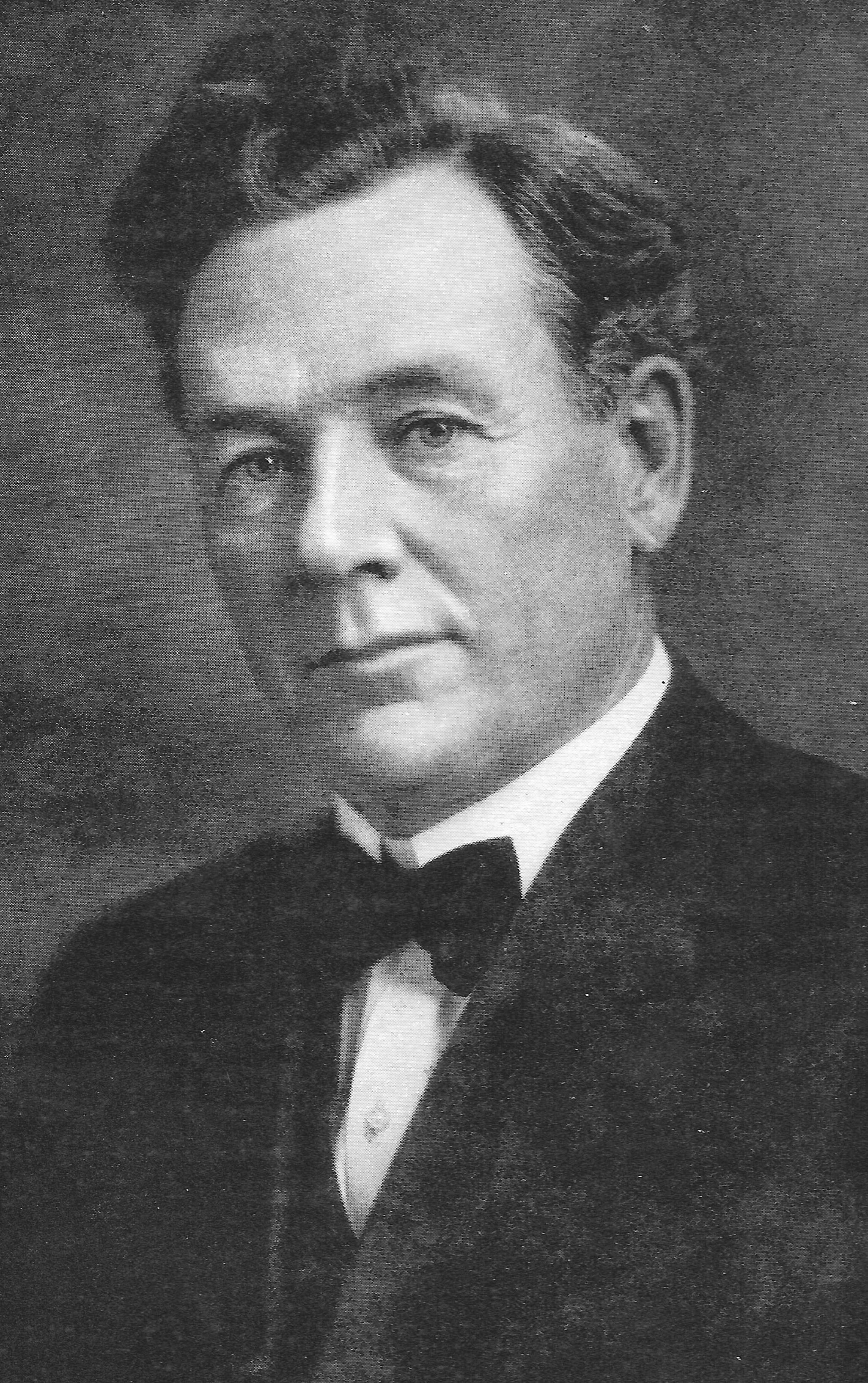
Portius C. Deming, 1916. Lofty hair, too. (MPRB)
Portius C. Deming was a realtor and insurance agent — the two professions went hand-in-hand in the years Minneapolis grew the fastest in the late 1800s. Deming lived on the corner of 23rd Ave. NE and Central Avenue and had his office a block away on the other side of the street. He was one of the men who helped put together the proposal for the park board to acquire what became Columbia Park in northeast Minneapolis in 1892. He was 38 at the time.
The creation of a large park, which included part of Sandy Lake, was certainly in Deming’s long-term business interest, although he was not a large landowner in the vicinity of the park and residential development had not reached within several blocks of the new park at the time. Most of the land near the park had not yet been platted into residential lots — and the Shoreham railroad yard was already quite extensive to the south of the new park. While sprawling railroad yards have never been converted into attractive scenery, the yard did provide the jobs that would support the construction of new houses, new businesses, and a flourishing community north of what was commonly called “New Boston” in northeast Minneapolis.
Still, as a business leader and realtor, Deming certainly would have appreciated the benefit to the city of a large park beside the only significant body of water in that part of the city. And William Folwell had argued convincingly for such a park only a year earlier when he applied the term “Grand Rounds” to the linked system of parks he supported.
Deming was elected to the park board in the fall of 1894 after he won the Republican Party nomination for the seat over the incumbent president of the park board, J. A. Ridgway. Ridgway would later become the secretary to the Board, a full-time position, a job he held for more than 20 years. (Deming’s wife was the niece of Adin Austin, one of the original 12 park commissioners when the Minneapolis park board was created in 1883.) Deming did not complete his six-year term as park commissioner, because he was elected to the Minnesota House of Representatives in November 1898. He had to relinquish his park board position when he took his seat in the House in January 1899.
It took very little time for Deming to make an impact in the House and leave a profound mark on the state.
Deming Lake
Driving north on Highway 71 about twenty miles beyond Park Rapids, you reach the southern entrance to Itasca State Park. You’ve already passed so many lakes since Park Rapids—Fishhook, Portage, Little Mantrap, Eagle, Island—not to mention “Christmas World”, and you are so eager to get to Lake Itasca and the slippery stones that create a path across the lake’s outlet stream, the modest beginning of the Mighty Mississippi, that you probably don’t notice the third lake on your left after you enter the park: Josephine, Arco, Deming. Yep, Deming as in Portius C. The lake once named “Danger”, was renamed to honor the legislator from Minneapolis who adroitly managed the passage of a law in 1899 that appropriated the first money for the state to buy private land within the 35 square miles that had been designated Itasca State Park in 1891.
The legislatures of Minnesota and the United States had already contributed the land they owned within the park boundary, and the railroads cut generous deals to convey their lands to the park, but about 8,000 acres still remained in private hands in a patchwork within the park boundaries, including several tracts bordering Lake Itasca itself. Deming and others believed that the additional land had to be acquired by the state before it was clear-cut of its majestic white pines. A “Stumpage State Park” had little appeal, particularly as a setting for the source of the continent’s mightiest river.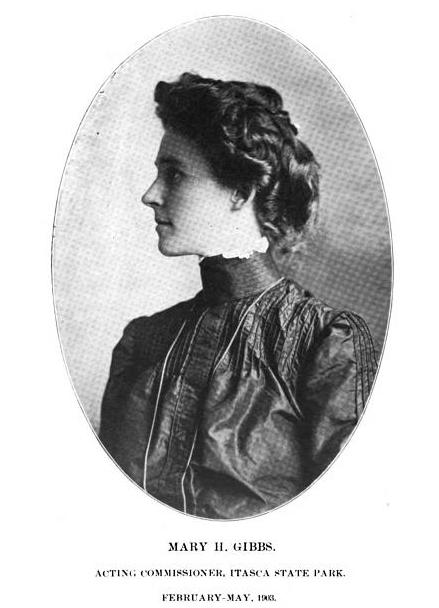
The “Deming Law”, which appropriated $20,000 for land purchases, didn’t end battles between park proponents and the lumber companies over rights to cut pine, create lumber roads across public park land, and dam Lake Itasca to float the lumber down the Mississippi River to Minneapolis saw mills. But it did establish a precedent and legal justification for action.
One of the great stories in Minnesota park history is how Mary Gibbs, in 1903, confronted the lumbermen and opened the dam they had built on the Mississippi River that was flooding the shores of Lake Itasca. Gibbs was the acting commissioner of Itasca State Park at age 24 after the previous commissioner, her father, died. She was quickly stopped from upholding state law by a local judge and promptly replaced by Governor Van Sant with someone more malleable to lumbering interests. Still, the young woman who had the integrity and courage to take on powerful interests is an inspiration. The visitors center in the park at the headwaters of the Mississippi is named for her.

Lake Itasca as log reservoir, 1903. (Illustrated History of Itasca State Park)
Despite the efforts of Deming, Gibbs and others like them, lumber companies opposed preservation efforts in the park effectively for many years. But Deming and Gibbs made a critical contribution to protecting natural resources, a forward-thinking effort that continues to provide benefits today.
For the in-depth story of efforts to protect the park, and Deming’s role, read the Illustrated History of Itasca State park by Jacob V. Brower here. Note whose picture is on the cover of this edition of the Collections of the Minnesota Historical Society. You can’t mistake the high hair of Portius C. Deming. That book is also the source of his signature.
From Park to Parole
Deming’s influence as a legislator was also significant as an advocate for the University of Minnesota, but the other piece of legislation with which his name is linked is the bill passed in 1901 providing for the possibility of parole for convicts with life sentences. The “Deming Bill” is also referred to as the “Youngers’ Bill”, because its practical effect was to provide for the parole of two infamous residents of Stillwater Prison who had been model prisoners for 25 years: Cole and Jim Younger.
The Younger brothers had been captured after the notorious robbery of the Northfield Bank by the James-Younger Gang in 1876. Cole and Jim Younger entered a plea of “guilty” in 1876 to the bank robbery and murder of a bank clerk to avoid the death penalty. If they had pleaded “not guilty” and been convicted, they could have been executed — and I don’t believe anyone, including them, ever claimed they hadn’t committed the robbery, although accounts of the robbery suggest they did not shoot the clerk. Another brother, Bob, also plead guilty to the charges, but died in Stillwater prison of tuberculosis in 1889. Following the passage of Deming’s Parole Bill, written solely for humanitarian purposes, the Youngers were paroled. (The only other prisoner who met the strict conditions of the bill was an old man who refused parole because he had been in prison so long he no longer knew anyone outside of prison and had no means to support himself. Prison was his home.) Jim Younger committed suicide a year after his release. Cole Younger returned to his Missouri home and lived until 1916.
The results of a quick search revealed only one other especially interesting piece of legislation sponsored by Deming. In 1903, he sought a legislative appropriation of $5,000 for victims of a famine in Sweden, Norway and Finland — an unusual venture into international relations. The bill did not pass.

As president of the park board, Deming presided over the dedication of The Gateway in 1915. He also commanded the podium at the dedication of two other memorials that year, one to Thomas Lowry at Virginia Triangle; the other to Gunnar Wennerburg at Minnehaha Park. (MPRB)
President of the Park Board
After three sessions in the legislature, Deming stepped away from politics for a few years until he was tapped by the Minneapolis park board in November 1909 to complete the unexpired term of park commissioner Milton Nelson, who had resigned. The other candidate nominated to fill Nelson’s post was a young banker from north Minneapolis, Francis A. Gross. While Deming prevailed in that selection process, Gross was elected by park commissioners to fill another unexpired term a few months later in May 1910. With a few interruptions, Gross served on the park board into the 1940s.
Following the expiration of the partial term that he was selected to fill, Deming stood for popular election for another term and during that term was elected President of the park board by his fellow commissioners for 1915 and 1916.
Deming’s focus as a park commissioner is not associated with any particular park developments, although the decade of his second stint on the board was an extremely productive time in Minneapolis park history: the lakes were linked with canals, land for the northern half of the Grand Rounds was acquired and the parkways partially completed, the Lake Calhoun bathhouse was constructed, Glenwood (Wirth) Park was developed, the land around Lake Nokomis was acquired and development began, the John Deere Webber Baths at Camden (Webber) Park were built, and playgrounds and neighborhood parks became an important focus. During this period, parks also became accepted as the appropriate venue for active, athletic recreation and the park board began to provide extensive athletic facilities for the first time, including the Logan Park field house.

The plaque set in a boulder in Deming Heights Park.
Portius Deming’s service to his city as a park commissioner ended in 1919 when he was 65. His place in park history was commemorated shortly after his death in 1930 when a ten-acre park commanding one of the highest points in Minneapolis, Grandview Park astride St. Anthony Parkway in northeast Minneapolis, was renamed Deming Heights.
Beyond a lake, a park and a plaque, we have Deming’s words to remember him by. I find especially appealing the excerpt quoted to open this article and the last paragraph he wrote for the 1915 Annual Report:
The story of the Board’s work for these past thirty-three years is impressed upon our City as upon on open book. Representing the whole people, this Body has conscientiously striven to do equal justice to all, to develop the park system in an equitable relation to the whole city, ever remembering the diverse uses for which parks are demanded and created. It has aimed to carry the opportunity for outdoor rest and recreation to every locality; it has acknowledged the supreme duty of acquiring and reserving for all the people the God-given lakes and streams, which are the City’s grandest heritage. This open book now presents to us an unwritten page. May it be as worthily filled as those which have preceded it.
— Portius C. Deming, 1915 Annual Report
Deming Heights
Deming Heights is—or could be—one of the most charming places in the Minneapolis park system. From the top of the hill—surpassed in elevation in all of Minneapolis only by a point a few blocks northeast near Waite Park—one can see a great distance in three directions. The only problem with the park is that it’s not nearly as spectacular as it should be.

The view from Deming Heights — without leaves. The downtown Minneapolis skyline is out there — somewhere.
If ever there were a place where some discretion should be used in cutting trees it is here. Why put parks on the highest ground with the most splendid views if we allow trees and brush to obscure the views we purchased? Especially when most of the trees obscuring that view are not the most desirable tree species and some are simply invaders. Can we not cut a tree of any kind? Much of the brush growing on the side of the hill should be cleared as well.

The stairway and path up Norwegian Hill.
I don’t even mind the dilapidated railing along the best staircase in the city. It has its own charm. But clear the brush and trim a few trees. Part of the park was purchased specifically to remove buildings that blocked the view from the crest of the hill. Now we allow scraggly trees to do what we would not let houses do.
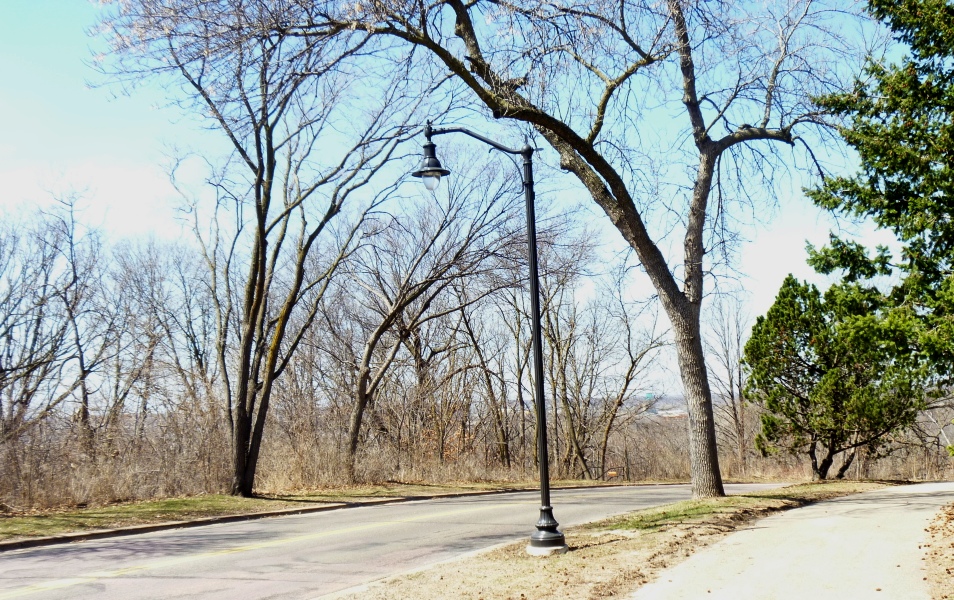
Fill in some leaves and there’s no view at all. Might as well be Deming Flats.
The park board has wonderful gardeners and foresters. They could make this view spectacular. Let’s let them. Something worthy of Portius C. Deming. If they need a hand clearing brush, I’ll help. My tribute to Mr. Deming.
David C. Smith
© David C. Smith 2013
Theodore Wirth, Francis Gross and Me: A Friday Photo and a Re-assessment
Filed under: Minneapolis Park Hero, Minneapolis parks | Tags: Francis A. Gross, Hubert H. Humphrey, Lyndale Park, Theodore Wirth
Comments (2) 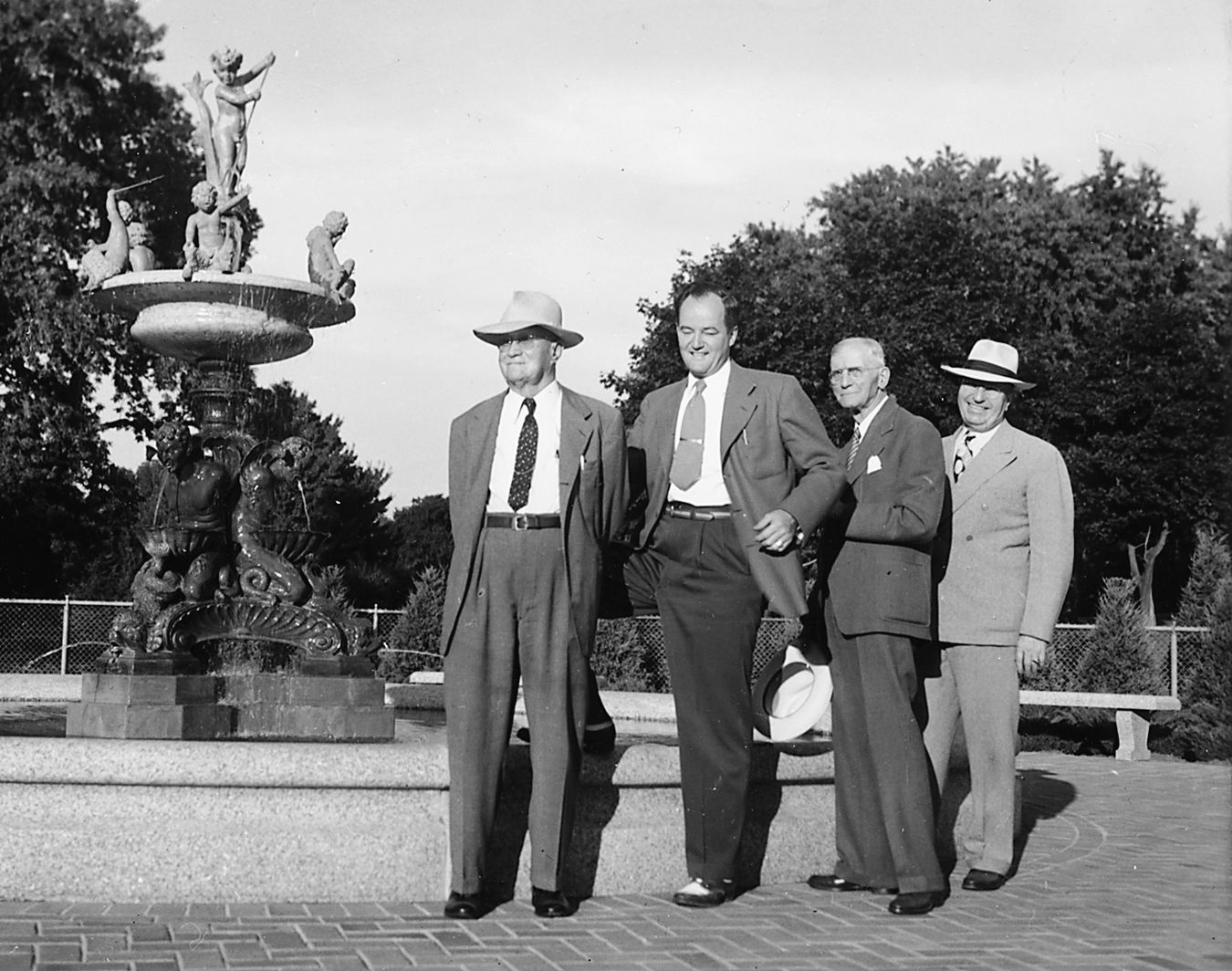
The dedication of Heffelfinger Fountain in Lyndale Park, 1947. This is the only photo I’ve seen of Theodore Wirth and Francis Gross together. They are joined by an even better-known Minneapolitan. From left: Park Superintendent Emeritus Theodore Wirth, Minneapolis Mayor Hubert H. Humphrey, Park Board President Francis A. Gross, Park Superintendent Charles E. Doell. Wirth was then 84 and Gross 77. The fountain had been discovered and purchased in Italy by Frank Heffelfinger, shipped to Minneapolis, and given to the park board. (Minneapolis Park and Recreation Board)
As I began my initial, intensive assault on Minneapolis park history in 2007 to write City of Parks, I was inclined to attribute the great success of our park system to Theodore Wirth — as so many people do. I had heard his name—attached as it was to a park, lake and parkway — for many years, and I promptly read his book on the park system—part history, part memoir.
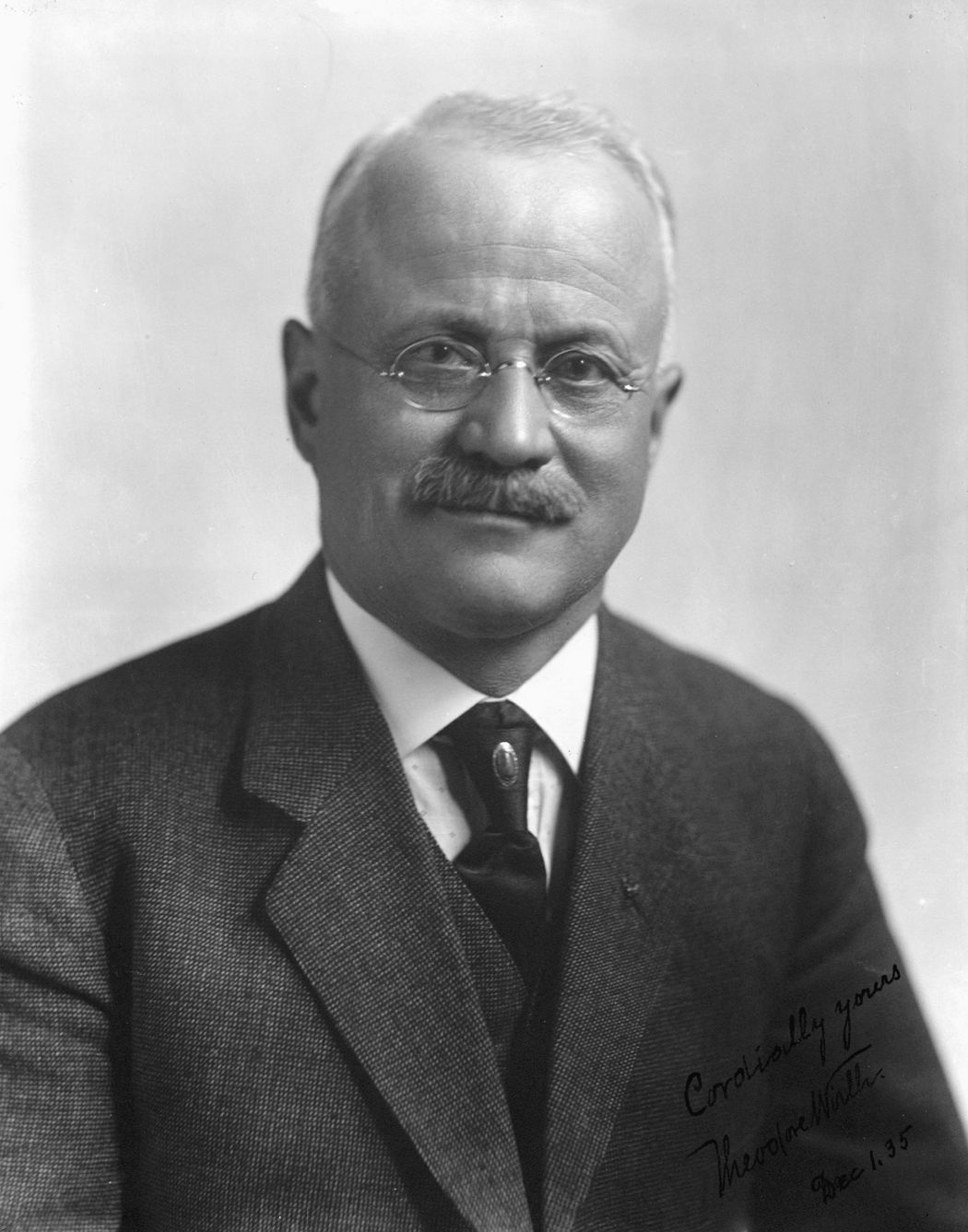
Theodore Wirth was superintendent of Minneapolis parks for 30 years, 1906-1935. (Minneapolis Park and Recreation Board)
It was the beginning of an up-and-down ride for me with Mr. Wirth and his legacy, one that I am reexamining in light of comments by Francis Gross in the autobiography he wrote in 1938.
I knew little about Wirth in 2007, but I did recall vividly being introduced to a Swedish gentleman at a party in Stockholm, Sweden in 1986 who, when he learned where I was from, gushed about what a great park planner Theodore Wirth had been. He knew much more about Wirth than I did and …Read more about how Francis Gross convinced me that Theodore Wirth was a good guy
Highlights, Lowlights and Unsolved Mysteries: 130 Years of Parks in Minneapolis
Celebrate the 130th birthday of the Minneapolis park system with me and the Linden Hills History Study Group, April 4, 7 p.m. at St. John’s Episcopal Church, 4201 Sheridan Avenue South. A $3 donation is suggested for those who aren’t members of the study group.
I’ll talk about the greatest accomplishments and most puzzling failures in Minneapolis parks since the Minneapolis Board of Park Commissioners was created by the Minnesota legislature and approved by Minneapolis voters on April 3, 1883. I’ll touch on many of the people, places and policies that have contributed to the fabulous park system we enjoy today — and I’ll also mention a few parks that might have been.
I hope you’ll join us.
David C. Smith
Friday Photo: How A Stone Arch Was Made
Filed under: Minneapolis parks, Mississippi River | Tags: Father Hennepin Bluffs, Mill Ruins Park, Stone Arch Bridge
Comments (5) The Stone Arch Bridge over the Mississippi River in downtown Minneapolis is becoming one of the iconic images of the city. Have you ever wondered how those arches were made? I have. So I found this photo of the bridge under construction. The deck of the bridge is maintained by the Minneapolis Park and Recreation Board, so let’s call it a park. Day and night the bridge provides the best views of the city. A hike over the bridge between Mill Ruins and Father Hennepin Bluffs, in either direction, is a must for visitors and residents.
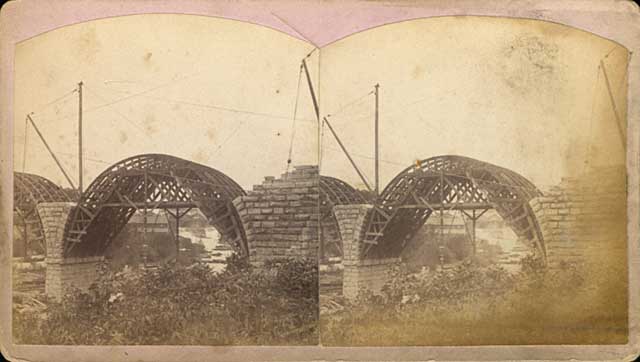
This stereoscope image shows the stone arches being built over forms in 1883. (Henry Farr, Minnesota Historical Society)
The two-track railroad bridge was being built at the time the park board was created in 1883.

The Stone Arch Bridge being completed in 1883. (Burlington Northern, Minnesota Historical Society)
This is another favorite shot of the bridge as it neared completion
David C. Smith
A Racetrack Before It Became a Park — and an Airport
Filed under: Minneapolis Airport, Minneapolis parks | Tags: Eddie Rickenbacker, Metropolitan Airport Commission, Snelling Speedway, Twin City Motor Speedway, Wold Chamberlain Field
Comments (8) Not many people would recognize this Minneapolis park property, which lies outside city limits and was acquired in 1928, twelve years after this photo was taken. There is some uncertainty about how much of this property is still technically owned by the Minneapolis Park and Recreation Board, but the property is administered by another agency.

Four-wide racing at the Snelling Speedway, 1916. (Minneapolis Park and Recreation Board.)
This is the famous Twin City Motor Speedway, or Snelling Speedway, in 1916, the second year of its three-year life. The speedway was named informally for its location adjacent to Fort Snelling. The infield of the two-mile concrete track was later used as a landing field for airplanes — and eventually became Minneapolis-St. Paul International Airport. The Minneapolis Board of Park Commissioners acquired the land in 1928 to develop it as an airport for the city. The task fell to the park board because it was the only agency of Minneapolis city government that could own land outside of city limits. (The law that permitted the park board to own land outside city limits was passed by the Minnesota legislature in 1885 to permit the park board to purchase land in Golden Valley for part of what eventually became Glenwood (Wirth) Park .) The park board built and ran the airport from 1928 until the Metropolitan Airports Commission was created in 1943, at which time the park board turned over administration of the airport. The park board had spent a significant percentage of its meager resources in those years developing the airport.
The enormous grandstands pictured left and center were built in 1915 to hold 100,000 people. The problem was that far, far fewer attended the few races held there. The first major race in 1915, a 500-mile race patterned after the Indianapolis 500, was widely promoted by the newspapers for weeks. The weekend of the race — the first weekend in September, just before the State Fair opened — the Minneapolis Tribune wrote that hotel rooms were impossible to find in the Twin Cities; hoteliers were referring unaccommodated visitors to private homes for a place to sleep. It was said to be the busiest weekend in the history of Minneapolis hotels with guests arriving from around the country. The Twin City Rapid Transit Company built a special spur track to the speedway to transport the crowds.
Unfortunately for the promoters, drivers, and the legions of workers who constructed the track and were not paid, attendance was much smaller than hoped. Society columns in the Tribune covered the rich and famous who attended the races and trumpeted this “innovation in divertisement” for the social elite, but the paper reported race attendance at only 28,000.
The 1915 race was a disappointment in every respect. The banked concrete track, heralded as the fastest and safest track in the world, was in fact extremely rough. The cars vibrated to pieces and the drivers didn’t fare much better. The champion Italian driver, Dario Resta, was reported to have denounced the roughness of the track “vociferously” after his first test drive during race week. If you know any Italian curse words, you could probably translate the “vociferously”. He was prescient, because his car didn’t survive much more than 100 miles on race day. But potential race fans didn’t know that ahead of time.
Neither could they have imagined the snoozefest that the race became. It only takes a glance at the race results to understand how tedious the day must have been for spectators. With only twenty cars starting the race and most of them falling apart or dropping out for mechanical reasons early on — having a “mechanician” riding along, the second person visible in the cars, didn’t prevent mechanical failures — there wasn’t much action despite the nail-biting finish of the race, which was won by 1/5 of a second. The Tribune, which had promoted the race so breathlessly, could hardly contain its excitement proclaiming in its headline Sept. 5, 1914, “Cooper Wins Closest Finish in History.”

Here’s part of the problem! 1915 500-mile race results. (Minneapolis Tribune, September 5, 1915)
An exciting finish didn’t make up for the rest of the race. The slow pace of the race, only 86 mph, dragged it out for nearly six hours, and the third place car was more than a half-hour behind the leaders. The Tribune blamed the pace on the fact that the cars of so many of the “most daring” drivers — “speed demons” — were incapacitated. Those drivers included the famous Italians Resta and Ralph De Palma and the American “Wild” Bob Burman. Picture only eight cars spread over a two-mile track, none of them travelling much faster, and some not as fast as, ordinary traffic on 35W and think of what you’d be doing to amuse yourself as a spectator. As stirring as the finish must have been with Cooper and Anderson pushing their matching Stutzes to the finish (the Stutz company dropped racing the next year anyway), most of the barely awake spectators headed for the exits before O’Donnell’s Duesenberg, manufactured in Minneapolis, came anywhere near the finish lap in third place.
Chandler and the great Barney Oldfield were still on the track — with no one in the stands and the sun about to set — plodding along more than an hour from finishing when they were mercifully flagged off the track in the dusk. The most notable thing about the Oldfield performance was that his relief driver — the drivers took breaks during the race — was the later World War I flying ace, Eddie Rickenbacker.
It’s no wonder that the Tribune concluded the next day, in a heroic effort at understatement:
“The crowd could not be called enthusiastic, the length of the grind and the heat probably preventing continuous hilarity.”
Prospective ticket buyers probably didn’t imagine the downside of what was then endurance racing. The greater problem was the cost of the tickets. Ticket prices were widely acknowledged as being much too high — the lowest ticket price was $2 and that didn’t include a seat, which cost another $2.50, the equivalent of what the park board paid workers for an 8-hour workday then.
(For more detail on the 1915 race, go here. Noel Allard reconstructs the race, and the era in racing.)
Lower Prices, More Hilarity
The speedway’s promoters realized that they had to reduce prices as well as the tedium of a 500-mile race the next year. For the 1916 Fourth of July race, admission to the bleachers was cut to $1.00 and prices for seats in the grandstand began at $2.00. In hopes of more hilarity, even if not continuous, the race was shortened to 150 miles. A full day of racing was also to feature races of 50, 20 and 10 miles.
The roster of drivers was much the same as 1915: Resta chose to race in Omaha and Burman had crashed and died two months earlier in a California race. Oldfield returned, but only in capacity of referee, while his former relief driver, “Rick” Rickenbacker, had his own car to drive. (I’m no expert on race cars of the era, but it’s possible that Rickenbacker’s white Maxwell is on the far left in the photo above.) St. Paul’s own Tommy Milton, known then for his success at state fair races, but who would win two Indy 500s in the 1920s, entered in a Duesenberg. The Tribune predicted the largest race crowd in Minnesota history.
It was not to be. While I haven’t found an attendance figure for the race, there couldn’t have been many fans buying tickets because the total gate was only $8,000. We know that because at the time the flag was supposed to drop on the first race, the promoters had not yet posted the $20,000 in prize money for the races and the drivers, obviously noting the sparse crowd, refused to race until the prize money was in trustworthy hands. After a two-hour delay that caused the 50-, 20-, and 10-mile races to be scrubbed, the promoter turned over the entire gate receipts of about $8,000 and wrote a $12,000 personal check to cover the rest of the prize money for the 150-mile race. And off they went down the stilll-rough concrete track, bouncing like the promoter’s check.
Ralph De Palma won the race by a 12-minute margin in a time of just under an hour and a half, or an average speed of a bit over 91 mph. He was one of only seven finishers, with Tom Milton finishing fourth.

By 1930 the Minneapolis park board had begun the transformation of the old speedway into an airport, but a segment of the old 2-mile oval still remained. The Mendota Bridge is upper right. Note the NWA hangar among the airport buildings. The landing strip was not on the old concrete race track, which was too rough. Airplanes landed on the grass in the infield of the old race track. (J. E. Quigley, Minneapolis Park and Recreation Board)
That was essentially the end of the Twin City Motor Speedway. Within two days the speedway had declared bankruptcy and never recovered. The speedway that cost more than $800,000 to build went into foreclosure in August of 1916. The owner of the Indianapolis Speedway, who was also a stockholder in the Twin City Motor Speedway, declined to purchase the track. By the spring of 1917 the track property was already being mentioned as a possible site for an airfield or training ground for the navy aviation corps. Both Dunwoody Institute and the University of Minnesota had proposed to begin training military aviators and a site was needed.
A group of race car drivers led by Louis Chevrolet — yes, that Chevrolet — organized a final race at the track in 1917, which the Tribune called a “revival” race. The patient was too far gone to be resuscitated, despite a victory by Ira Vail in the 100-mile race at the much-improved average speed of more than 96 mph. Less than three months later the Tribune reported that the receiver for the bankrupt speedway had rented a portion of the grounds to a hog farmer who was fattening 500 pigs by feeding them Fort Snelling garbage. The speedway was finished, but the land was about to be given over to the service of a whole different kind of speed — and eventually the Minneapolis park board.
David C. Smith
© 2013 David C . Smith
The Beginnings of a Garden
Filed under: Minneapolis parks | Tags: Armory Garden, Kenwood Garden, Louis Boeglin, Minneapolis Sculpture Garden, The Parade, Theodore Wirth
Comments (1) One hundred years ago next week, Theodore Wirth made a request of the Minneapolis park board that made possible one of Minneapolis’s most cherry-ished landmarks—and parks. The park superintendent who was known for his passion for gardens—and also for hiring a talented full-time park florist, Louis Boeglin—asked the park board to approve preparing a square of ground next to the Minnesota National Guard Armory for a garden. At least for a summer.
The Society of American Florists and Ornamental Horticulturists (SAFOH) were holding their national convention at the Armory in August 1913. The Armory had been built in 1906 between Kenwood Parkway and Vineland Place adjacent to a park known as The Parade. To the east of the Armory, bordering on Lyndale Avenue, was an empty plot of ground that Thomas Lowry had donated to the park board in 1906. It was that square that Wirth asked for. The park board approved Wirth’s request the day he made it — March 4, 1913 — for the “free use” of the space by SAFOH for “an extensive display of outdoor plants consisting of the best adapted hardy and tender plants that can be used for the decoration of public and private grounds and of plant novelties that are not yet known to many florists.”

The green space to the right of the Armory was the site of the SAFOH Garden. Lyndale Avenue is at right. Kenwood Parkway, which no longer goes through, is at top. Thomas Lowry’s residence is where the Walker Art Center is now. (Atlas of Minneapolis 1914, reflections.mndigital.org)
To prepare for this test garden, the board authorized Wirth to provide the property with “the necessary dressing of good loam,” which the board would pay for from funds allocated for The Parade.
As recently as 1911 Wirth had proposed to use the space for tennis courts, in keeping with the active recreation focus of the park, but those courts were not built. (See plan in 1911 Annual Report.)
The Minneapolis Tribune enthused that the garden would be one of the “most beautiful and extraordinary displays that the city has ever enjoyed.” The Tribune estimated (April 20) that some bulbs to be planted, which began arriving from florists around the country in April, were valued at up to $100 each and, therefore, a guard would be posted at the garden site.
As the dates of the convention approached much was written in local newspapers about the floral display that would inform and entertain 1,500 guests from around the country who would make Minneapolis the “floral capital of the country” for a week (Tribune, August 10, 1913). Private railroad cars were to bring florists from the major eastern cities and so many florists were coming from, or through, Chicago that both the Milwaukee Road and Great Northern had dedicated trains from there solely for convention goers. 
The Tribune observed that membership in the Society was “coveted” because there was an “exchange of courtesies” among members, such as the “invaluable service” of a “telegraph order system between cities.” Many of us have used the FTD—originally Florists’ Telegraph Delivery—system, which was created in 1910, only a few years before the Minneapolis convention. The image of Mercury, at left, was first used in 1914.
The garden was such a huge hit—with florists and Minneapolis citizens—that one park commissioner recommended keeping the garden and naming it the Wirth Botanical Garden. Wirth, who was vice president of the national society before the convention, was unanimously elected president of the national organization while it was in session in Minneapolis.

The 1913 garden adjacent to the Armory, looking southwest from the intersection of Lyndale Avenue, coming in from left, and Kenwood Parkway, at right. The photo was taken from the Plaza Hotel between The Parade and Loring Park. The garden is now part of the Minneapolis Sculpture Garden. (MPRB)
The park board did support the continuation of the garden the following year and it became a popular attraction for decades, in part because of the labels that identified the plants. But the garden was never named for Wirth. It was referred to as the “Armory Garden” until the Armory was demolished in 1934. At that time the land where the Armory stood was donated to the park board. After that the garden became known as “Kenwood Garden.” Those floral gardens, introduced as a concept 100 years ago next week, unquestionably facilitated the current use of the grounds as quite a different type of garden.
For the rest of the garden’s story, look for a documentary being produced by tpt and the Walker Art Center this spring in celebration of the 25th birthday of the Minneapolis Sculpture Garden. It is scheduled to premier in late May.
David C. Smith
NOTE May 30,2013: The tpt documentary can now be viewed here.
© David C. Smith 2013
H.W.S. Cleveland and Lake Harriet
Filed under: Lake Harriet, Landscape Architects, Minneapolis parks | Tags: H.W.S. Cleveland, Horace Cleveland, Lake Harriet
Leave a comment While looking for other things I keep encountering bits of information that deepen my understanding of and appreciation for Horace W. S. Cleveland’s profound contribution to Minneapolis parks.
More than a year before the creation of the Minneapolis park board and Cleveland’s “Suggestions for a System of Parks for the City of Minneapolis” a Minneapolis Tribune editorial, published January 22, 1882, announced “A Prospective Park.” The editorial noted that Philo Remington and Col. Innes, who ran the Minneapolis Lyndale Motor Line, were planning to lay out a park on the shores of Lake Harriet and “may eventually” donate it to the city. The newspaper had high praise for the property.
“It is a natural forest, with hill and dale, and comprises without exception one of the most beautiful bits of woodland scenery that can be found anywhere.”
But it was the following sentence that caught my attention and provided more insight into Cleveland’s influence in the city before the park board.
“Col. Innes has made arrangements with Mr. Cleveland, the celebrated landscape gardener, who laid out Union Park, Chicago, whereby that gentleman will take immediate charge of the work of superintending the laying out of a park that will not only be a credit to the city but an inestimable benefit to our citizens.”
I have found no evidence in Cleveland’s correspondence that he was actually hired for any work at Lake Harriet; he never mentions it. And who knows, Remington and Innes may have been blowing smoke. They had other grand plans that didn’t materialize. But whether they were serious or not about a park at Lake Harriet, the editorial indicates the high regard in which Cleveland was held in the city and the likelihood that, at the very least, he was already being consulted on park matters, especially around the lakes, before the park board existed.
A bit prematurely the Tribune enthused, “Minneapolitans may now congratulate themselves on the fact that a public park, the need of which has so long been felt, will soon be completed for their pleasure and benefit.”
Only a year later, at the next session of the legislature, a bill was passed that created the Minneapolis Board of Park Commissioners. Although Cleveland was never credited with designing any of the parks at Lake Harriet, he likely had considerable influence on how the lake shore was perceived and, later, developed.
Just another small piece of evidence of Cleveland’s immense influence on the Minneapolis park system. And yet his name does not appear on a Minneapolis park property.
David C. Smith
For more on Col. Innes’s plans for Lake Calhoun and Lake Harriet see this entry.
For more on why Cleveland’s name should be connected to the vast park that is the Mississippi River Gorge see this entry and this one, too.
For more on Cleveland in general, search above for his name or click on his name in the tag cloud at right. I’ve written quite a bit about him. Take a closer look at the map from his “Suggestions…” at right, too.
Minnehaha Falls Photos
Filed under: Minneapolis parks, Minnehaha Falls | Tags: Minnehaha Falls, Minnehaha Park
Comments (2) Karen Cooper tells me she has photos of more 19th- and early 20th-Century bridges over Minnehaha Creek at Minnehaha Falls than the ones I’ve already posted. You can see those photos and more next Sunday, Feb. 10, at 2 pm at Hennepin History Museum. (Get more info here.)
I’m told that Karen has the most amazing Minnehaha Falls collection. I’m looking forward to seeing part of it myself for the first time. Hope to see you there.

The 1910 stone arch bridge was actually made of reinforced concrete and given a facade of boulders found in the vicinity. (Minnesota Historical Society)
David C. Smith
Fear in the Hearts of Children: More from the Autobiography of Francis A. Gross
Filed under: Minneapolis parks, Mississippi River | Tags: 1862 US-Dakota War, Francis A. Gross, North Minneapolis
Leave a comment Last weekend I read Mni Sota Makoce: The Land of the Dakota and Our Way or the Highway: Inside the Minnehaha Free State. That followed a recent rereading of Folwell’s History of Minnesota, Volume I, and I also had read Spirit Car recently. They were part of my continuing research into the history of Minnehaha Falls. (More on that project soon.)
With the sad story of the disintegration of relations long ago between American Indians and whites fresh in mind, I recalled a passage in the unpublished autobiography of former park commissioner Francis Gross. (Background on Gross and his autobiography.) Gross was born in Minnesota in 1870 and lived near the intersection of Plymouth (13th) Avenue and Washington Avenue North in north Minneapolis from 1875 into his teen years. Among his memories of childhood on the north side was this:
“Until shortly after 1880, the shore lands of the Mississippi river were grandly beautiful. Other than a small sawmill at the bridge on Plymouth Avenue, there stood virgin timber of many varieties. For a few years after our coming to the northside, each spring many Indians, their squaws and papooses, would travel from the north on the river in canoes and locate their camp at about 14th Avenue North on the river flat there. The many Indians, young and old, their tepees, boiling pots, the furs and beaded leather goods and trinkets they had brought to trade or sell was an interesting sight. Each evening they would entertain their white visitors with war dances. Made their drums taut by the heat of the campfire, painted their faces in most hideous designs and wore their best and most beautifully patterned and beaded dress. As this time was not long after the most serious of the wars with Indians in this territory, fear of the Indian was in the heart of every child. It can therefore be easily guessed that the sight of these hideously painted, tomahawk-swinging savages, performing at night in the sinister-appearing light given by a few torches, was a scene as exciting as any small boy could wish for.” (Emphasis added.)
I wonder if that fear may have been heightened for Gross as a child because he grew up in a community of predominantly German immigrants. In another section of his hand-written autobiography he recalled:
“On the north side until after 1885, it was common to hear German spoken whenever people congregated. The early settlers of the north side were mostly of German birth…When German immigrants came to Minneapolis, very few spoke English, hence it was necessary that they were met on their arrival by an American. Often, my father would meet those immigrant German families with his grocery delivery wagon.”
The connection between the fear and the immigrants is that many of the settlers in the Minnesota River Valley—the violent epicenter of the 1862 U.S.-Dakota War—were also German immigrants. I suspect the violence of that war was painfully felt by many in the German community in Minneapolis, too. While that war was 13 years in the past by the time Gross’s family moved to north Minneapolis, local newspapers carried many stories in the later 1870s of continuing battles between American Indians and U.S. forces not far to the west, including lurid accounts of battles featuring such famous names as Custer, Sheridan, Sitting Bull and Crazy Horse.
I hadn’t planned to write here about this passage in Gross’s autobiography when I first read it, because it did not relate to parks or early land use in Minneapolis, nor do I believe it reflects on Gross whom I have always admired as a fair, just, and humane man. But I was drawn back to it in the convergence of my research. Gross’s description had power and it had nothing to do with some anachronistic terms. Rather, the power comes from the poignant phrase: “fear of the Indian was in the heart of every child.”
It is not the object of the fear that impressed me—I can imagine as well fear of the White Man in the hearts of Indian children—but the sad realization that fear in the hearts of children can take lifetimes to conquer.
The greatest injustices, the greatest atrocities grow from fear of some monolithic, broadly-defined “Other” instilled young—a conviction reinforced last night as my daughter described watching the film Hotel Rwanda in her geography class.
The dangers of implanting fear in the hearts of children are as great today as ever. Let’s keep that seed from being planted and nourished in our children’s hearts.
David C. Smith
If you know of accounts or pictures of American Indian encampments along the Mississippi River in North Minneapolis in the 1870s-1880s, such as Gross described, I’d like to learn more.
© David C. Smith
Park Progress: 100 Years of Engines, Wheels, Automobiles and Metropolitan Parks
Filed under: Grand Rounds, Minneapolis parks | Tags: bicycle paths, Edmund J. Phelps, Grand Rounds, Minneapolis parkways
Comments (1) Writing one hundred years ago this week, then Minneapolis park board president Edmund Phelps, made several observations in the park board’s annual report for 1912 that attracted my attention.
“I notice in the Board’s report, especially between 1894 and 1900, frequent references to our bicycle paths and the very general use of the bicycle itself. It will be remembered that at one time there was great agitation for fine bicycle paths upon all main thoroughfares. During the last few years there has been nothing said in the reports and there has been no attention paid to keeping up bicycle paths for the reason that the use of the wheel, unfortunately, was very largely diminished.”

This is one of my favorite park photos. It first appeared in the Minneapolis park board’s 1896 annual report. It shows bicycle paths around Lake Harriet created that year. The layout of walking path, bicycle path and carriage way, there were no cars yet, is almost identical to today. (Minneapolis Park and Recreation Board)
The “wheel,” as Phelps called the bicycle, has made quite a comeback. Bicycle riders were generally called “wheel men” then although as this picture demonstrates riding bicycles was not strictly a male pursuit. Perhaps most remarkable however, despite the fact that today you could spend more on a bicycle than the park board paid for Lake Calhoun, the basic concept of the bicycle has not changed at all: two wheels on a connecting frame, pedals, seat, handlebars—and a dog out for exercise.
Another thematically related passage from Phelps’s 1912 report is worth noting.
“We ought not to mow forty acres of lawn at Lake of the Isles by handpower, but the best power lawn mowers, such as are used by parks and country clubs, should be provided, as they facilitate the work and reduce greatly the expense per acre.”
I have no idea if Phelps was a stockholder in The Toro Company.
Greater Grand Rounds
Finally, Phelps recommended an idea that was not new, but was placed in an automotive context I haven’t seen before. Writing thirty years after the creation of the park board, Phelps looked thirty years into the future and foresaw,
“Two or three trunk lines of excellent highway will connect the eastern and western extremities of our great country. Good roads of high class construction will prevail throughout every state of the Union. While these state roads should and will radiate from the large cities of the commonwealths, yet all will connect in a nearly direct line with the nearest transcontinental highway.”
Combining the development of good roads for automobiles with his prediction that there would be more than a million people in the Twin Cities in thirty years (1943), Phelps wrote,
“Long before that time the boulevard system of the two cities should be extended so as to make one ‘Greater Grand Rounds’ of one hundred miles or more.”
Phelps then described a parkway system that followed Minnehaha Creek to Lake Minnetonka, around that lake, then south from Excelsior to Shakopee, down the Minnesota River valley and its “enchanting scenery” to Fort Snelling, through St. Paul to and around White Bear Lake, then to Anoka and the Mississippi River, passing many beautiful lakes on the way,” then back to Minneapolis along the river. Phelps concluded,
“I am sure that a boulevard similar to the one suggested eventually will be built. An enabling act should be prepared and presented to the Legislature at the present session, and passed, so that the work may be prosecuted later.”
The parkway Phelps recommended was never authorized or built, but parks have been acquired along much of the route he suggested.
The First Automobile Ordinance
Phelps vision of automobiles, transcontinental highways and “Greater Grand Rounds” is not surprising given his early adoption of the automobile himself.
Phelps first appearance before the park board, more than a year before he was elected to be a park commissioner, was on behalf of the Automobile Club of Minneapolis. On May 7, 1903 Phelps requested permission for the club to have an automobile hill-climbing contest on the steep hill on Kenwood Parkway near Spring Lake. Hill-climbing contests were an early form of car racing, seeing whose car could climb a steep hill in the shortest time. As an inducement for approval of the club’s request perhaps, Phelps invited park commissioners and friends to attend the contest and afterwards be given a ride by automobile around the parkways.

1903 Model A Ford. It also came in a two-seat version. It was manufactured only in red. It had a top speed of 28 mph. (americanfords.com)
Phelps’s request for use of the parkway was approved, but he may have gotten more than he bargained for. Immediately following approval of his request, the board directed the Privileges and Entertainments Committee to meet with the City Council Committee on Ordinances to develop an ordinance governing the use of automobiles in parks.
The park board subsequently passed an automobile ordinance on June 20, 1903. The ordinance restricted automobile speeds to 15 miles per hour, required that each car powered by gasoline have a muffler, that each car have a bell or horn, and a have at least one lighted lamp if operated after dark. In addition,
“Every person operating an automobile shall stop upon request or signal from any person in charge of a horse or horses, and shall also stop whenever a horse or horses show signs of fright at the automobile.”
Anyone convicted of violating the ordinance was subject to a fine of $2-$100 and, if in default of payment of a fine, imprisonment in the City Work House for a period of up to 90 days.
To give you some idea of how new cars were at the time, the Ford Motor Company was incorporated only four days before the park board’s automobile ordinance was passed in June 1903 and Ford’s first three Model A’s were manufactured the next month. The success of those vehicles is still evident in Minneapolis where we refer to the Ford Dam and Ford Bridge, named for their proximity to and relationship with the Ford assembly plant in St Paul. The construction of the Ford Bridge made Minnehaha Park easily accessible to St. Paulites.
David C. Smith
© David C. Smith
 Minneapolis Park History