Minnehaha Park Fireplace Mystery Solved
Filed under: Minneapolis parks, Minnehaha Falls | Tags: Folwell Park, Keewaydin Park, Marv Nelson, McRae Park, Minneapolis Veterans Hospital, Minnehaha Dog Park, Minnehaha Park
 Comments (3)
 The mystery of the fireplace in the dog park at Minnehaha Park has been solved thanks to reader “Tom.” Many people have followed this issue or expressed an interest in it and I know that many readers don’t check back to see comments on posts, so I wanted to bring this comment to your attention.

The fireplace surrounded by picnic tables in 1935. (Minnesota Historical Society)
This is the photo of the fireplace that Tom found in the collection of the Minnesota Historical Society, which includes more than 230,000 photographs. As I’ve noted many times, that collection is invaluable and immensely enjoyable. The picnic ground belonged to the Minneapolis Veterans Hospital according to the photo description. Tom further notes that the park board acquired this land in 1959. Thanks for your comment, Tom. Does anyone want to tell us when the fireplace and picnic ground were built?
Excellent Comments
I would suggest that you check back on your favorite park subjects occasionally to see recent comments, or subscribe to comments on any post. Especially interesting in recent months have been
Chuck Solomon’s comment in which he named all of the coaches and nearly every player from a McRae Park football photo
Another tribute to Marv Nelson, a youth football coach at Folwell Park in the 1960s and 1970s
Memories of Keewaydin Park, especially kids’ games and hockey.
These are just a few of the comments in recent months. Thanks to everyone who has commented on the articles here or has contacted me personally with more stories. I appreciate them all. Stories: that’s what this web site is all about.
David C. Smith
© 2014 David C. Smith
Logan Park Field House Centennial: Public Input, Public Outrage
Filed under: Minneapolis parks | Tags: Lebert Weir, Logan Park, Logan Park Field House
Comments (2) With dazzling talk of new parks along the river in northeast and downtown Minneapolis in 2013, an important anniversary slipped my attention. You probably missed it too: the Centennial of the first Logan Park Field House. The Logan Park Field House was arguably the most important building the Minneapolis park board has ever constructed. It opened in February 1913 amid a national movement to open “social centers” for burgeoning urban populations.
The population of Minneapolis in 2013 was about the same as it was in 1920: 380,000.
In 1940, the population exceeded 492,000; it peaked at about 550,000 in the mid-1950s.
The remarkable story of the Logan Park Field House includes the first extensive citizen input on the design of a park building—the first Citizen’s Advisory Committee (CAC), if you will—and the first park building targeted by neighborhood groups protesting “immoral” behavior. The objects of this indignation were the turkey trot, bear hug, and other dances that involved “hugging” or “wiggling.” The protestors might have collapsed dead on the spot if they had seen “grinding” or “twerking”, the cause of high school dance controversy these days.

Kids bursting out of the Logan Park Field House for the annual Easter egg hunt. (Minnesota Historical Society)
The importance of the Logan Park Field House is obviously my opinion. (I’d like to hear yours!) You could make a case for the club houses at Wirth and Columbia golf courses, which were not really recreation buildings, but were used year round for community gatherings. I consider the pavilion/bandstand at Lake Harriet and the bath houses at Webber Pool, Lake Calhoun or Lake Nokomis in a different category because they were seasonal structures, with open walls or roofs. The Webber community center did include a branch library, but it was not designed to be a multipurpose recreation facility.
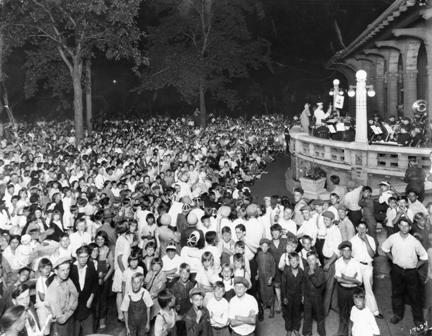
A community sing at Logan Park. The band performed from the partially covered veranda of the field house. (City of Parks, Minneapolis Park and Recreation Board.)
The field house at Logan Park was the first multi-purpose, all-season recreation center in a Minneapolis park. There had been other recreation buildings in parks — and more would soon follow — but most were little more than glorified warming houses for ice skaters until the 1960s and 1970s. A good example is the one built at North Commons in 1910, which consisted of a furnace room, toilets, an office and one large room. One of the only exceptions to this standard was the shelter in Loring Park, Charles Loring’s gift to the city when he retired from the park board (for the last time) in 1906, which featured two “kindergarten” rooms on a second floor.
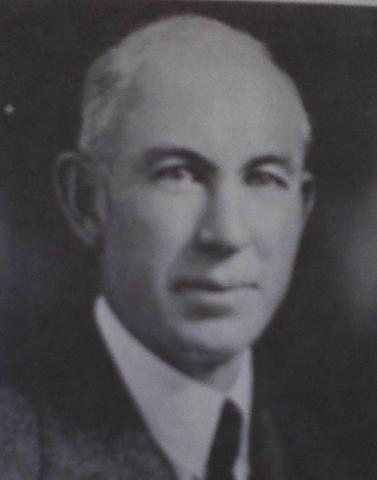
Lebert H. Weir knew Minneapolis parks well. He first conducted a survey of Minneapolis parks beginning in 1914 and repeated the process in greater depth in 1944, when he was the National Field Secretary of the National Playground Association. He also served in 1917 as the recreation director for officer training at Fort Snelling during mobilization prior to U. S. entry into World War I.
Lebert Weir, a leading figure in the national playground movement, wrote in 1944 that the recreation buildings in Minneapolis parks (other than the one at Logan) were “too large for merely shelter houses and too small for use as a general recreation building. When the central room is used as a warming room for skaters, no other, or little, use can be made of the building for recreational activities.” (Recreation Survey, 1944.) In another study of recreational needs in Minneapolis, conducted by F. S. Staley in 1915 for the Civic and Commerce Association, Staley reported that the recreation shelters in parks, other than Logan and Webber, were little more than “comfort stations”, the polite term in the day for toilets. Although Weir did not lump the Logan Park Field House with other recreation shelters in his 1944 report, he had no praise for it either, recommending that it needed to be razed or remodeled. It wasn’t replaced for another 27 years, in 1971, at a time when nearly every recreation center in the city was replaced. Weir also recommended a new center for Loring Park in 1944, supporting suggestions to preserve the original shelter, too, and make it into a clubhouse for “older men.”
Social Center Movement
The importance of the Logan Park Field House rested in the explicit recognition by the park board that it had a role in addressing social issues beyond recreation, whether passive or active. The national social center movement saw facilities such as field houses in parks as essential to weaving the fabric of community. They had much in common with settlement houses. They provided gathering places, places for self-improvement, even places where hygiene could be taught or improved. They became places for assimilation and Americanization, especially in the crowded urban cores. The social centers were truly the melting pots. They were also seen as providing an alternative social venue to saloons in a society that had been struggling for decades with what many believed was excessive liquor consumption.
The new social centers were ultimately places where an Alice Dietz could emerge as Director of Community Centers for Minneapolis parks and be seen as a friend not only to neighborhood children, but to their mothers. Dietz’s office in the 1920s, of course, was at the Logan Park Field House. In Minneapolis, as elsewhere, the construction of recreation centers was the beginning of neighborhoods being identified with—and often named for—the neighborhood park.
Park superintendent Theodore Wirth credited Chicago’s South Park District as the model for his first plans for a building at Logan Park. In his 1908 annual report he wrote:
I have been so much impressed with the immense amount of benefit derived by the entire population of good-sized districts in Chicago through some of their play parks that I could not deny myself the pleasure of working out on paper and in thought, what could be done along similar lines with our Logan Park.
Wirth’s choice of Logan Park for a new center is not surprising. It was one of the first four parks acquired by the Minneapolis park board when it was created in 1883 and it was still one of the few parks in the city that offered no distinguishing landscape features, neither lakes, streams, nor hills. That was likely the reason that the Minneapolis park board’s first landscape architect, H.W.S. Cleveland, proposed the fountain that stood at the middle of the park.
Logan had also been one of the first two Minneapolis parks to have playground equipment installed in 1906, when the park board took its first timid steps into the park and recreation era. (Riverside Park was the other.)
In his 1908 report,Wirth provided two photos of the field house at Sherman Park in Chicago to accompany his “Suggestive Plan for the Transformation of Logan Park into a General Recreation Ground”. The most prominent feature of his plan for Logan Park was a “General Recreation Building” along 13th Avenue NE. He proposed a building far, far grander than was eventually built. His proposal included an indoor swimming pool, gymnasium and lunch counter, as well as an assembly room, office and multiple club rooms. He even provided a sample of a budget for improvements at Armour Park in Chicago, which was similar in size, he said, to Logan Park. There the building, improvements and equipment had cost $170,000. As was often the case in Wirth’s proposals for Minneapolis parks, he significantly overshot what the park board would spend or neighborhoods would agree to pay in property assessments. The eventual cost of the Logan Park Field House was $40,000, with $8,000 of that chipped in by the Library Board in exchange for space to operate a branch library in the building.
While it would take another four years before the Logan Park field house was built on a reduced scale, the park board in 1908 had begun to appreciate and anticipate the larger social role it would play throughout the city. At the same time, the park board recognized its increasing role in city life, it also demonstrated that it valued the increasing role that citizens would play in the board’s decision-making.
Incidentally, it’s not likely that Wirth was among those who saw the new park field house as a weapon in the war against alcohol. When Wirth helped design a house for himself at Lyndale Farmstead later that year he would build in a hidden liquor cabinet and he would be censured later by the park board for serving alcohol to visiting dignitaries at the Lake Harriet Pavilion, where liquor was forbidden.

The new field house shortly after it opened in 1913. (Charles J. Hibbard, Minnesota Historical Society)
Citizens Advisory
The Logan Park Field House provided another first in Minneapolis park history; the park board solicited the views of the neighborhood on the architectural plans for the field house. A jury examined designs from twelve architects who submitted plans for the field house and selected those of Minneapolis architect Cecil Bayless Chapman. Designs by Downs and Eads and A. R. Van Dyke placed second and third. Based on input from a committee of the Logan Park Improvement Association on the style of building, materials, and interior arrangements, the park board’s improvement committee modified Chapman’s plan “considerably”, according to the Morning Tribune.
“This is the first time we have invited the people of any neighborhood to help us choose plans for a park building,” said President [Wilbur] Decker, “but this is the first time the park board has ever contemplated erecting a building in a park to serve neighborhood recreation purposes.” (Minneapolis Morning Tribune, Dec. 28, 1911)
The Tribune’s coverage of park board deliberations on the issue concluded with the claim that the building would have “a large assembly room that can be used for neighborhood gatherings, including dances or similar entertainments.” That would prove to be somewhat sticky.
Dance Fever
Logan Park’s field house was the focus of great controversy shortly after it officially opened February 1, 1913.
The Minneapolis Tribune wrote the next morning, “The formal exercises marked an era in Minneapolis, the beginning of the movement to open social centers in all parts of the city.” The objective, the paper wrote, was “social development and civic betterment furnished by recreational environment.”
It took barely three months for some neighborhood residents to challenge the “development” and “betterment” because of one aspect of the environment. A rumor rippled through neighborhood churches that on Saturday night, May 3, a “dance” had been held at the field house. It mattered little to the pastors of the eight churches within a block of the park that the dance had been part of a private wedding anniversary celebration. The ministers claimed that they had opposed construction of the field house the previous year until they had been assured that the facility would not be used for dances.
Park superintendent Wirth contested that such an assurance had ever been made and added that he had been assured that the only dancing at the event would be a few “old folks” dances.
At the time, dancing was a hot-button issue. In a poll of 10,000 families the week before the field house opened, the Tribune found a close correlation between those who opposed social centers and those who opposed dancing. About 21% of those polled opposed dancing and about 24% opposed social centers.
Efforts to outlaw dances, even school dances and charity balls, had passed the city council the previous year, but was vetoed by Mayor Haynes. At the time of the controversy, a bill was being introduced in the Minnesota legislature that would dramatically curtail public dance halls through licensing and prohibition of serving alcohol in them. The bill also banned “immodest” dancing and required bright lighting in rooms where dances were held. The bill eventually passed the House, but not the Senate.
The debate over dancing, like that over alcohol, was not restricted to Minnesota. In the spring of 1913, Chicago was considering an ordinance that would have mandated that dancers maintain a distance between them of no less than six inches.
The protest to the park board over dances at Logan Park didn’t get far. When a committee hearing was held on the issue, all but one park commissioner expressed himself, in the words of the Tribune, “heartily in favor of public dances, properly supervised, in the parks.” Commissioner David Jones, chair of the committee, was particularly outspoken in his defense of dancing at the parks, claiming that park dances offered a positive alternative to young people frequenting public dance halls where mixed crowds gathered without supervision. When a trustee of Emanuel Swedish Lutheran Church accused the park board of building the field house at Logan Park to “set up a worship of dancing,” Commissioner Jones demanded and received a retraction. Jones reportedly said that dancing was not a religious or even an ethical issue, but one only of “decent comportment” and he refused to allow those who opposed dancing to impose their standards on the rest of the city. The park board did concede, however, that “rag” dancing shouldn’t be permitted at dances on park property.
That was not the end of the issue. A year later, representatives of five churches returned to the park board with a new resolution to restrict dancing, and this time they had the support of the park commissioner who represented that part of the city, Portius Deming. Dancing had become too popular. The opponents claimed that the field house was booked six to eight weeks in advance for dances. They asked that dances be limited to three a week and only from October 1 to April 1. Deming’s support for the measure and his former legislative skill was evident in the wording of the resolution: it applied only to park field houses that also housed a branch library. As Logan Park had the only facility to fit that description, the restrictions wouldn’t apply in any other city park.
The neighborhood was not, however, unanimous in its opposition to dances. E. J. Comstock presented a petition from those who lived in houses that faced the park. Thirty-one of thirty-seven park neighbors favored the use of the field house for dancing.
Ultimately, the park board agreed to prohibit dances at Logan Park for the summer of 1914 while a new ordinance was written that would set stricter conditions for dances at all parks. In exchange for that compromise, Deming withdrew his resolution that applied only to Logan Park. After a summer of study, the park board passed a new dance ordinance in October that restricted dances to Tuesday and Saturday nights from 9 to 11:45 pm. Girls younger than 18 could not to be admitted and only residents of the neighborhood could attend. The question of smoking at dances was to be “tactfully handled” by park employees, whatever that meant. Curiously, while the Minneapolis Tribune reported the new policy on dancing at Logan Park on October 7, 1914, those restrictions were never part of the officially published “Proceedings” of the park board.
I can find no indication that dancing in parks was an issue of policy debate after 1914, although I wouldn’t be surprised if the issue came up at individual parks. One reason it may not have been an issue after 1914 was that despite the enormous success of the Logan Park Field House, the park board never built another like it anywhere in the city for the next fifty years. I did find an article in the Tribune about a winter carnival at Logan Park in 1920 that mentioned there was dancing both indoors and outdoors for the ten thousand people who attended. They must not have objected to dancing. Along the way, however, in 1917 the Minnesota Senate did pass a law that prohibited dancing to the Star Spangled Banner. That’s a bit surprising because the song isn’t exactly a toe-tapper — not to mention the fact that the song didn’t officially become the national anthem until a Congressional resolution passed in 1931.
The most significant lesson of the Logan Park Field House story is that, as always, the people of Minneapolis determined how parks would be used. At Logan Park, neighborhood residents first had input into how a building was designed and constructed and then, through considerable, often noisy, public debate, how it was used. One hundred years later, we still do things much the same way.
That’s worth celebrating a centennial. Here’s to the original Logan Park Field House.
David C. Smith
© 2014 David C. Smith
Another Elite Powderhorn Park Speedskater
Filed under: Minneapolis parks, Winter Sports | Tags: Powderhorn Park, Roger Mosiman, Speed Skating
Comments (2) I’ve written before about the world-class speedskaters who skated at Powderhorn Park in the 1940s and 1950s and the high-level competitions held there. Now reader Gayle Mosiman Meadows has shared more information about speedskating at Powderhorn in the 1930s, especially involving her late father, Roger Mosiman.
She sent this image of a program from a meet in 1938 that featured her father who was then 14.
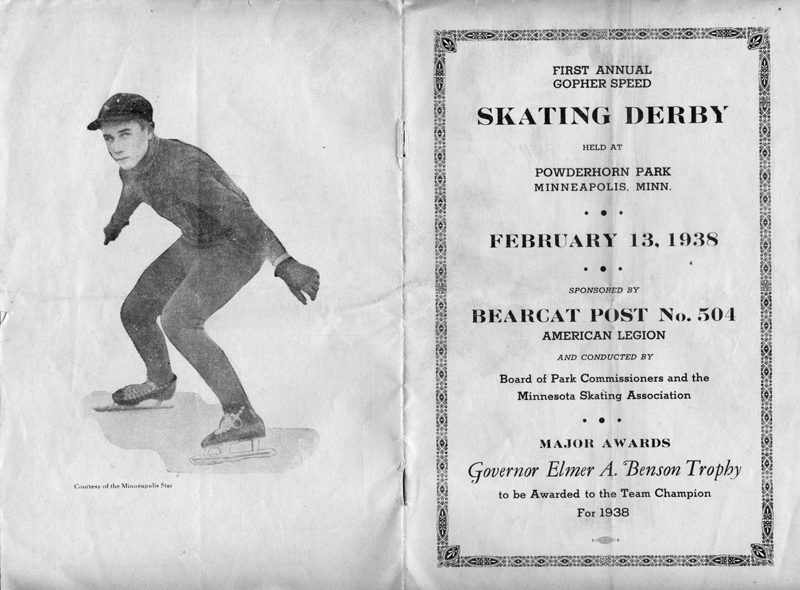
Program from 1938 speedskating event at Powderhorn Park, featuring photo of Roger Mosiman. (Gayle Meadows Mosiman)
Mosiman was likely featured on the program because at the time he held the juvenile boys national record for the fastest time in the 220 yard sprint. The national record for intermediate boys at the same distance was held at that time by Roger’s older brother, Earl Mosiman. The Bearcat American Legion Post was one of four posts that featured prominently as sponsors of speedskating teams.
Gayle also sent a copy of photo of Roger boarding a train for a skating competition in New York, likely the 1940 North American Speedskating Championship in Schenectady, NY. He is being seen off by his mother, Lillie, and his younger sister, Bernice.

Roger Mosiman boarding a train for the 1940 North American Speedskating Championship in Schenectady, NY. (Photo courtesy of Gayle Mosiman Meadows)
Roger, who attended Marshall High School in Minneapolis, finished the multi-event competition for the junior boys championship tied with Art Bulrice of Saranac Lake, NY. In a one-sixth mile race to determine the title, Roger fell and had to settle for second place. Winning the men’s title that day was future Olympian Leo Freisinger of Chicago.
After Marshall High School, Roger attended the University of Minnesota and became a navy pilot in WWII. In the 1960s, he moved to Gig Harbor, Washington. Roger died there in December 2011 at age 87.
Many thanks to Gayle for the program, the photo and the memories.
David C. Smith
© 2014 David C. Smith
The Streetcar through Linden Hills: 100 Years on Xerxes Avenue
Filed under: Lake Harriet, Minneapolis parks | Tags: Fulton School, Linden Hills, Linden Hills Park, Pershing Park, Xerxes Avenue
Comments (2) Another centennial in our young city. On October 1, 1913 streetcars began running south through Linden Hills on Xerxes Avenue into the Fulton neighborhood. The extension of the Oak and Harriet line ran south on Xerxes from the streetcar right-of-way near 44th out to 50th Street. The hope at the time was that as population in the region grew, the line would be extended east on 50th from Xerxes to Penn and south from there. (The Xerxes line was extended east on 50th to Penn the following year, but the line ended there. The line that eventually ran south on Penn was the Bryant Avenue line.)
Articles in the Minneapolis Tribune (see October 2 and October 6, 1913 issues) gave much of the credit for the line extension on Xerxes to the Robert Fulton School District Improvement Association. The Harriet Heights Improvement Association had supported a six-year campaign for the line extension, but the Fulton association, created in the fall of 1912, “had for its avowed purpose the securing of the car line extension.”

Xerxes Avenue South looking south in the 4500 block. A streetcar line opened here October 1, 1913, carrying passengers as far as 50th Street. Some rails still lie beneath the pavement. (David C. Smith)
The original idea had been to run the line out from Linden Hills on Upton Avenue or build a new east-west streetcar line along 50th to serve the area south of Lake Harriet. Both plans were “negatived” by the street railway company, the Upton Avenue route due to “mechanical” difficulties and the crosstown route because the company didn’t project enough traffic to make it profitable. (In a 1914 atlas of the neighborhood there were only 11 houses on Xerxes between 47th and 50th, but only a handful of empty lots from 44th to 47th.)
The problem with the Xerxes route was that the streetcar company wouldn’t lay track until the street was graded. The city council was willing to spend only $600 for the grading project, so the neighborhood had to come up with an additional $1,600 to do the job. The Fulton association raised more than three-quarters of that sum.
One of the contributors to the grading fund was Tingdale Bros. Inc., which was developing Harriet Manor, a subdivision that included those blocks of empty lots along Xerxes. A small park in Edina, where the Tingdales were later also active residential developers, is named Tingdale Park,
The economic success of the campaign to extend the streetcar line — and the Tingdale brothers contribution to the road grading fund that made the extension possible — is highlighted by the fact that a quite large, new Robert Fulton School was built at 49th and Washburn only two years later to meet the needs of the burgeoning neighborhood.
The land for Linden Hills Park at Xerxes and 42nd, mostly bog, was not acquired by the park board until 1921 and construction of the park wasn’t begun until 1924. The land for Pershing Field, further south, was acquired in 1922, but construction didn’t begin until 1931. Southwest High School near Pershing Field was built in 1940.
David C. Smith
© David C. Smith
Perkins Hill Park Was Not Named for Frances Perkins
A few days ago Wendy Hajicek commented on an earlier post, mentioning her memories of Perkins Hill. Wendy asked if Perkins Hill was named for Frances Perkins the Secretary of Labor in the Cabinet of Franklin Delano Roosevelt. I had written in a historical profile of Perkins Hill for the Minneapolis park board’s website that the park was named for the Perkins Hill Addition, a property development. Park board proceedings from that era do not indicate that the name was ever formally approved. It is one of those “so-called” properties.
I had never heard before the possibility that the park had been named for Frances Perkins, so I quickly looked up the time frame of the acquisition to see if it would have been possible. The park was acquired in 1948 and Frances Perkins had served in Roosevelt’s cabinet from 1933 to 1945. The time period fit perfectly.
So then I went back to the plat maps from 1914, 1903 and 1892 that I consult so often from the Minnesota Digital Library and the Borchert Map Library at the U of M. I wanted to see how the property was named at those times. The name Perkins Hill Addition is on the 1903 plat map and the 1892 plat map notes that four adjoining parcels of land are owned by people with the Perkins surname. So it appears that the name is based in Minneapolis, not Washington, D.C.

Frances Perkins, Secretary of Labor, 1933-1945.
I haven’t looked up the Perkins family that owned, then subdivided, the north Minneapolis property in the late 19th century. Perhaps they were leading citizens of the community and I wouldn’t want to diminish their part in the early history of Minneapolis, but part of me was hoping that the park could have been named for Frances Perkins, the first woman to serve on a presidential cabinet and, therefore, the first to take a place in the line of succession for the presidency. A brief online exploration of her life suggests that she was influential in formulating Roosevelt’s labor policies, Depression-era work relief programs, and the creation of social security.
I’ll look for info on the Perkins family of north Minneapolis as well. If you know any of their story, let me know.
And as I mentioned in my reply to Wendy’s comment, I hope more people stop by Perkins Hill Park for a picnic or a visit. The view of the city is splendid. Does anyone have a photo to share?
David C. Smith
© 2013 David C. Smith
Frederick Law Olmsted and Minneapolis Parks: Part 3, The Smoking Gun?
Filed under: Landscape Architects, Minneapolis parks | Tags: Frederick Law Olmsted, H.W.S. Cleveland, Washburn Fair Oaks, William D. Washburn
Comments (2) I have more circumstantial evidence that Frederick Law Olmsted didn’t design the grounds around Fair Oaks, the mansion of William D. Washburn in Minneapolis — and that H. W. S. Cleveland did.
I found it among my own files of stuff, but it took a long chain of events to help me find it. You can catch up to those events by reading my post and post script from yesterday.
Where we left the issue was that Kerck Kelsey in researching his book, Prairie Lightning, on the life of William Drew Washburn, had found a reference in a 1884 magazine to “Cleveland” having been the landscape architect at Fair Oaks. I had expressed surprise at that claim in an earlier post, because I had never seen it before.
But I can now offer evidence that supports the claim. For the first time in a few years, I returned to the detailed notes I took from the letters of Horace Cleveland to William Watts Folwell, which I read at the Minnesota Historical Society when I was researching, City of Parks, the history of the Minneapolis park system. In those notes I found a passage that connected Washburn and Cleveland. Why wasn’t that detail more “sticky” for me? Why didn’t I remember it before now?
Cleveland’s letter from Chicago to Minneapolis was dated March 18, 1883. and two very important events had occurred just prior to that date that occupied my attention. Only a couple weeks before Cleveland wrote, the Minnesota Legislature had passed legislation creating an independent Board of Park Commissioners for the city of Minneapolis. (The exact date of the legislation was February 27 — which is coincidentally the birthday of Henry Wadsworth Longfellow and me.) The often-dashed hopes of park advocates in Minneapolis were on the verge of coming true; only a public referendum in Minneapolis remained as an obstacle.
I thought that subject would be addressed by Cleveland in his letter, but it wasn’t. Minneapolis voters did approve the creation of the park board on April 3, 1883 and on April 24 the new board hired Cleveland to make his now-famous “suggestions” for the type of parks Minneapolis should develop. In other words, I was looking for big, important stuff. Something earthshaking: Cleveland writing with trembling hand about soon meeting his destiny.
But life ain’t like that — because another recent event had more immediate consequences: Cleveland had just learned that his friend, William Watts Folwell, the first and only president of the University of Minnesota, had resigned his post as the leader of a university he had practically created. Cleveland knew well the battles Folwell had fought, and had tired of, at the University, and he expressed his happiness upon hearing the news of Folwell’s action. In Minneapolis park history terms this was huge news, too, because Folwell’s return to the classroom and the library enabled him to devote considerable energy to parks as a future Minneapolis park commissioner and extremely influential president of the park board throughout the 1890s.
Park board creation, resignation from a prestigious job: no wonder I overlooked two sentences that had nothing to do with Minneapolis parks at the time.
“I am beginning to hear whispers,” Cleveland wrote, “of coming work in various quarters and am glad that Minneapolis is one of them, though I confess that I shrink from the thought of renewed journeys and protracted absences from home. Gen. Washburn writes me that he will be in Minneapolis about the middle of April and will want to see me there soon after.” (Emphasis added)
What could General William Drew Washburn (not yet a U. S. Senator) have wanted to see Cleveland about if not for designing the grounds of his new mansion, for which ground was probably about to be broken?
One tiny bit of historical evidence that Sam Waterston would scoff at. And I needed help from Dr. Gregory Kaliss, Kerck Kelsey, Andrew Caddock and Dave Stevens to find it. But for a few minutes this morning, I was the only person in the world who knew it. The thrill of discovery and the satisfaction of sharing it: Big reasons we keep reading old letters — and writing new ones.
David C. Smith
© 2013 David C. Smith
Frederick Law Olmsted and Minneapolis Parks: Part 2
Filed under: Landscape Architects, Minneapolis parks | Tags: E. Townsend Mix, Frederick Law Olmsted, H.W.S. Cleveland, Horace Cleveland, Washburn Fair Oaks, William D. Washburn
Comments (7) One question is answered, but more are raised.
One of my first posts on this blog nearly three years ago examined the likelihood that Frederick Law Olmsted, the most prominent landscape architect in U.S. history, had designed any part of the Minneapolis park system. I wrote then that I didn’t think he had, not even the grounds of William D. Washburn’s Fair Oaks estate/mansion/castle, which later became Washburn Fair Oaks Park.

Frederick Law Olmsted (www.olmsted.org)
Many writers have attributed the landscape of Fair Oaks to Olmsted, but I have never found evidence to support that claim. As noted in my earlier post, an authoritative online resource guide to Olmsted’s projects, correspondence and plans listed an 1881 letter from the New York architectural firm McKim, Mead & White to Olmsted about the estate of W. D. Washburn. ORGO also listed a reply from Olmsted to that letter. I asked then if anyone knew the content of those letters.
To the rescue comes Dr. Gregory Kaliss, co-editor of Vol. 9 of Frederick Law Olmsted’s letters, which is scheduled for publication in 2015. After an exchange of emails with Greg about correspondence between Olmsted and H. W. S. Cleveland, I mentioned my curiosity about the contents of Olmsted’s communication with McKim et al. This week, Greg graciously sent scans of those letters, which are part of the Frederick Law Olmsted Papers at the Library of Congress. Thanks, Greg.
What I learned doesn’t exactly answer the question of Olmsted’s involvement with the landscape at Washburn Fair Oaks, but it does suggest a story about the design of Fair Oaks itself. There is a good mystery here for someone to solve.
Why did William Washburn part company with McKim, Mead & White and hire E. Townsend Mix?
The letter from McKim to Olmsted, dated June 2, 1881 — signed only “McKim, Mead & White”, so I’ll refer to it as the McKim letter — gives the impression that the job of designing Washburn’s mansion is a done deal.
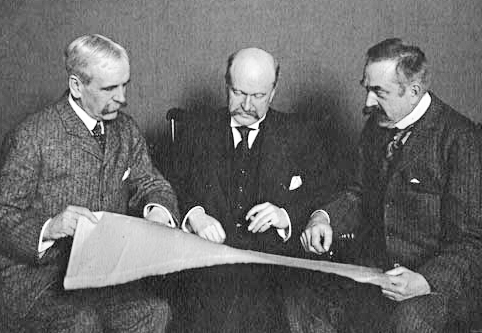
Charles Follen McKim, William Rutherford Mead, Stanford White
“We have made plans for a large house for Hon. W. D. Washburn of Minneapolis,” the letter begins, “and he has asked us to advise him as to the laying out of the grounds, and we have suggested he consult with you.” The letter offers Olmsted the option of submitting a proposal through McKim or corresponding directly with Washburn.
The letter continues, “Our house is a large one and the grounds comprise, we believe, 10 acres in the heart of the city. The house will be rather severe in character — 15th Century Renaissance — and we should think a more or less formal treatment of the grounds immediately around it would be in character.” Enclosed with the letter were notes from Washburn, the nature of which was not divulged.
Olmsted responded two days later. He wrote that because he had just moved to his Brookline, Massachusetts home for the summer, he didn’t want to travel “so far away as Minneapolis,” but added, “I can do so later if required.”
Olmsted continued,
“As the house is large and in the midst of town and of the architectural character you state, it is probable that the design of the grounds would be ruled by considerations of convenience and of suitability and support of the motives of the house rather by those of local topography and distant prospects. In this case, if Mr. Washburn will provide, as he suggests, a good topographical map of the property and a map of the city from which its neighborhood relations can be understood, I could probably agree, in consultation with you, upon what should be arrived at and advise as to site, aspects, entrances and approaches. For such consultation and advice my charge would be $100.”
He added, “I cannot well estimate the charges which I should incur for further planning without knowing more of the circumstances,” including the “degree of detail” that would be required of him.
Olmsted concludes his letter with comments that reveal his close relationship with the principals of the firm. “I need not say,” he writes, “that it would give me great pleasure to cooperate with you.” Olmsted then “warmly” congratulates “Mr. White” (Stanford White) on the “extraordinary success” of the monument he designed to honor Admiral David Farragut, which had been unveiled to critical acclaim the week before in New York’s Madison Square. (That project was the first collaboration between White and the sculptor Augustus Saint-Gaudens, who created the sculpture of Farragut for the monument.) Olmsted called White’s monument a “distinct advance of our public monumental standards.”
Olmsted had a personal interest in the success of the young architects. Charles McKim’s father, James Miller McKim, had been, along with Olmsted, one of the principals in founding the magazine, The Nation. Olmsted was also a friend of White’s father, Richard Grant White, who had written for The Nation. (One common thread is that they were all staunch abolitionists; they were joined by Saint-Gaudens father as well.) Mossette Broderick writes in The Triumvirate: McKim, Mead and White that Olmsted provided counsel to Richard White on a professional path for Stanford and introduced the sixteen-year-old to his friend, famous architect Henry Hobson Richardson, who gave Stanford his first job, setting him on a path to fame and fortune as an architect who never finished high school.
Finally, in his response to the McKim letter, Olmsted added that he was returning Mr. Washburn’s notes. The paper trail linking Olmsted to Washburn ends as abruptly as it began.

William Drew Washburn. Everyone had impressive whiskers!
There appears to be no evidence in Olmsted’s voluminous papers that he carried on any further correspondence on the project with McKim, Washburn — or with another architect, E. Townsend Mix. Mix matters, because he is the architect credited with the design of Fair Oaks in 1883. Mix was a highly regarded architect in Milwaukee who had done little or no work in Minneapolis before that year. How did Washburn meet Mix? And why did he have Mix design his grandiose residence instead of using plans already prepared by McKim, Mead and White who were on their way to becoming the most prestigious architects in the nation? Perhaps there is further evidence in the papers of Charles Follen McKim in the Library of Congress. Another item on the list of things to look up the next time I’m in Washington, D. C. I may have to move there!
Could Washburn have been dissatisfied with the “large…severe…15th Century Renaissance” house that McKim and company had designed for him? Instead he got from Mix a house that Larry Millet, in Once There Were Castles, describes as a “melange of Queen Ann, Tudor, Romanesque, and Gothic elements.”
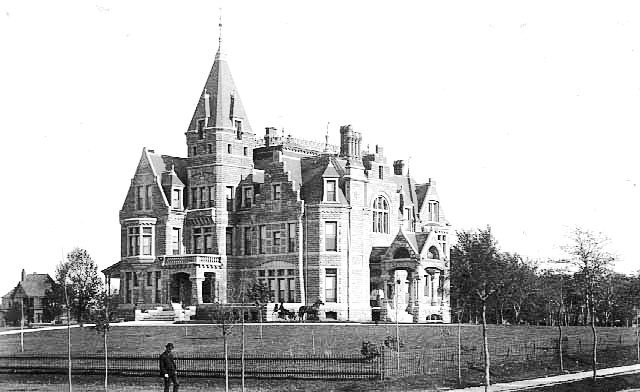
Fair Oaks, looking southeast from E. 22nd Street and Stevens Avenue, about 1886. (Minnesota Historical Society)
In the past, some writers have presumed — mistakenly — from a letter Olmsted wrote to the Minneapolis park board in 1886 — after he had passed through town on his way to California — that he was somehow responsible for Minneapolis’s system of parks. So it’s possible that others could have made the leap from the exchange of letters with McKim to the conclusion that Olmsted does proceed to design the grounds of Fair Oaks. But does he? Dr. Gregory Kaliss : “Whether he actually does or not, I have no idea.”
It is hard to prove a negative — that he did not — but consider these factors.
From all I can learn about Olmsted’s visit to Minneapolis in 1886 on his way to California, he had not been to the city before, another argument against his active participation in the detailed layout of the Fair Oaks estate.
H. W. S. Cleveland never gives a hint in his letters to Olmsted (or others) that Olmsted had ever visited Minneapolis other than the brief stop in 1886. And Cleveland was upset with park board president Charles Loring on that occasion for taking Olmsted only to see Minneapolis’s lakes and not the Mississippi River gorge, which Cleveland considered to be the “jewel” of the city. If Olmsted had spent any time in Minneapolis to work at Fair Oaks he almost certainly would have seen both the lakes and the river gorge before 1886. And if he had designed Fair Oaks landscape from afar, you’d think he would have wanted to see his work, but the newspaper account of his visit (Minneapolis Tribune, August 24, 1886) gives no indication that he visited Fair Oaks.
I don’t know how often Olmsted designed landscapes — to any “degree of detail” — without visiting them first, but his reply to the McKim letter suggests that he was not offering to design a 10-acre landscape anyway. He seems to be offering his advice on the location and situation of the house on the property — “site, aspects, entrances, approaches” — rather than the design of the whole 10 acres. Moreover, I can’t imagine Olmsted doing much more than a cursory mansion site plan for a hundred bucks. That was considerably below the going rate at the time for planning a 10-acre estate.
For a landscape architect to design a pond, stream, bridge, extensive plantings, greenhouse, stables and the rest of 10 acres without visiting the site would have required extensive correspondence with someone and that correspondence doesn’t seem to exist. And there is ample evidence (reel after reel of microfilm at the Library of Congress) that Olmsted saved just about every scrap of paper that crossed his desk.
Olmsted also makes clear by his reference to arriving at a plan “in consultation” with McKim that he would prefer to “cooperate” with McKim rather than work directly with Washburn. His return of Washburn’s notes with his letter confirms that intent.
The pond, stream and bridge that later became well-known appear in an 1890-ish photo of Fair Oaks taken from 3rd Avenue. This is the section of the park that people want to attribute to Olmsted — even though the pond ceased to exist nearly 100 years ago.

Washburn Fair Oaks from 3rd Avenue, facing west, about 1890 (Hennepin County Library, Minneapolis Collection)
A much lusher version of a pond and fountain on the estate were featured on a postcard in about 1910.
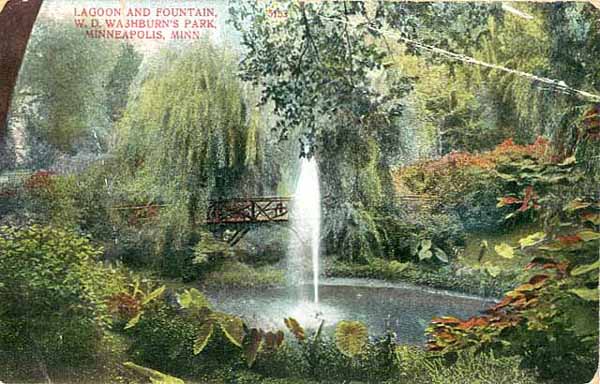
“W. D. Washburn’s Park”, meaning the grounds at Fair Oaks, looking like a tropical garden — and with a different bridge — about 1910 (Minnesota Historical Society)
Now that I’ve had a chance to see the correspondence between McKim and Olmsted, I’m more convinced that Olmsted did not design the landscape of Fair Oaks.
I’d still appreciate hearing from anyone who can make a case for Olmsted on these 10 acres. I’d also like to know more about why Washburn switched architects after McKim, Mead and White had already drawn up a plan for the house. If you know anything, we’d love to hear it.
Thanks again to Dr. Gregory Kaliss for sending copies of the letters cited here. I look forward to seeing his project in print.
David C. Smith
Postscript 6/14/2013: Thanks to an email from Andrew Caddock who was directed to a source by Kerck Kelsey, author of Prairie Lightning, a biography of William D. Washburn, we find this passage in The Northwestern Miller, (1884-1885 Holiday Number, “A Miller’s Palatial Home,” p. 82.) about Washburn’s estate: “The grounds are splendid specimens of landscape gardening from plans by Cleveland who stands at the head of the list of American specialists in this line of work. Broad winding drives and walks lead up to the front and side entrances and end at a large and handsome stable in the rear at the southwest corner of the block.” The reference is almost certainly to H. W. S. Cleveland. This is the only reference I’ve seen to Cleveland designing a private estate in Minneapolis. Thanks, Andrew.
© 2013 David C. Smith
Approaching Lake Calhoun — A Couple Years Later
Filed under: Minneapolis Parks: General | Tags: Dean Parkway, Lake Calhoun
Comments (5) Julieann Swanson, Assistant Curator of Digital Collections and Archives at the University of Minnesota’s College of Design just sent a fabulous photo of the Lake Street, Dean Parkway, and West Calhoun Parkway intersection from about 1956 in response to my post earlier today. See Julieann’s comments on that post for more information on this photo and the Digital Content Library.
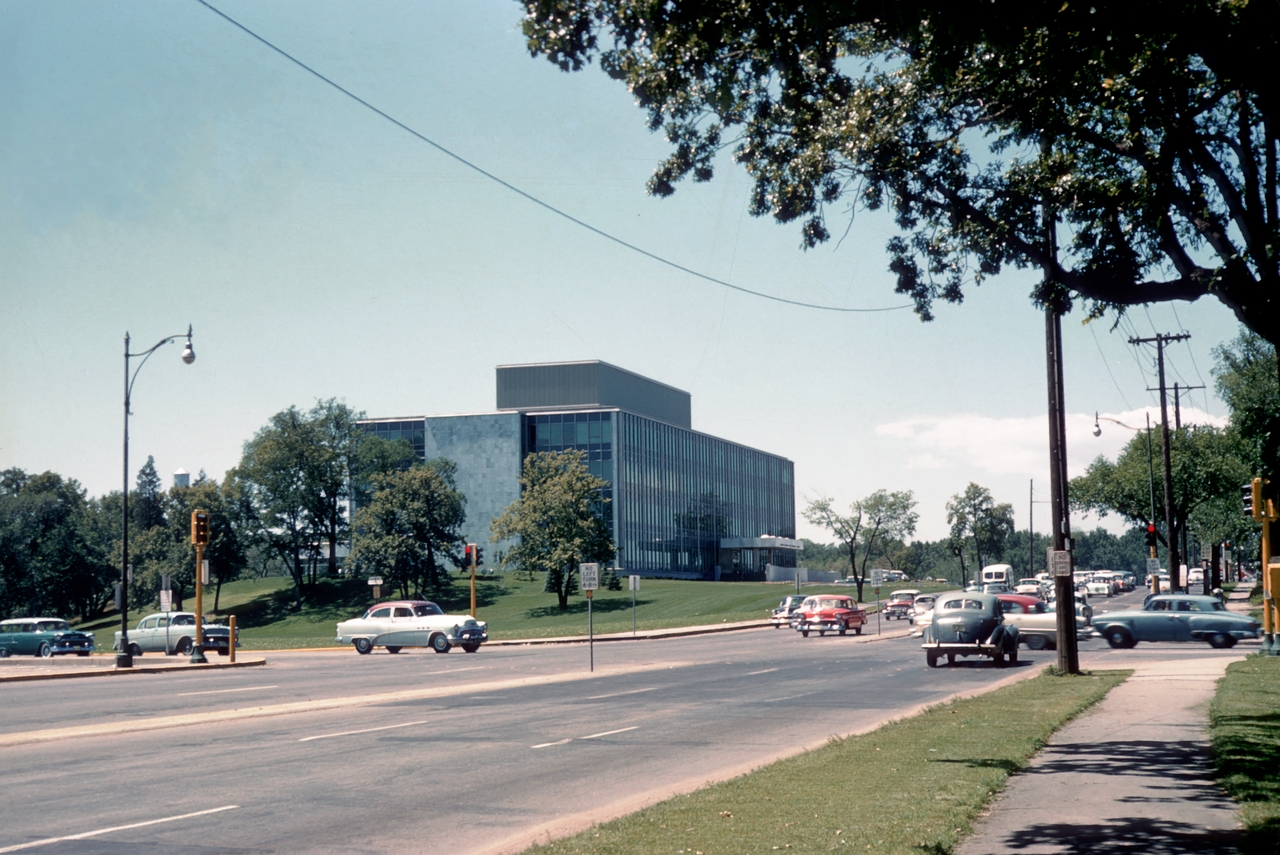
Looking west on Lake Street toward the intersection with Dean Parkway and West Calhoun Parkway. (Photo: University of Minnesota, Digital Content Library)
Julieann suggested that the photo is circa 1955, but I’ve advanced it a year to 1956, because I believe that is a red 1956 Chevy sitting at the east-bound stop light. And, yes, the traffic lights are quite visible in this photo! Would that car have been called, “Cherry”? I’m a little too young to remember ’50s slang.
Thanks, Julieann.
David C. Smith
© 2013 David C. Smith
Approaching Lake Calhoun
Filed under: Minneapolis Parks: General | Tags: Dean Parkway, Lake Calhoun, William Berry Parkway
Comments (7) Two photos from the 1950s, and two that are much older, show how people got to Lake Calhoun once upon a time. Both photos are from the Minnesota Historical Society’s online collection. I haven’t written about that collection in some time, but I continue to use it extensively for research on Minneapolis parks and other historical subjects. You should take a look if you haven’t before. It’s a treasure.
The first photo shows the intersection of Lake Street, Dean Parkway and West Calhoun Parkway, looking west.
Many Minneapolis parkways were once called “boulevards”, but that changed in 1968 when the Minneapolis park board renamed nearly all of them “parkways.” The park board wanted to create uniformity in treatment, but also believed that by calling them parkways, people would better understand that they were owned by the park board and were part of the park system. I still refer to them as boulevards at times, out of habit, as do many others. Curiously, Google maps hedges, labelling the road around the west side of Lake Calhoun “W Calhoun Pkwy” and “Calhoun Blvd”.
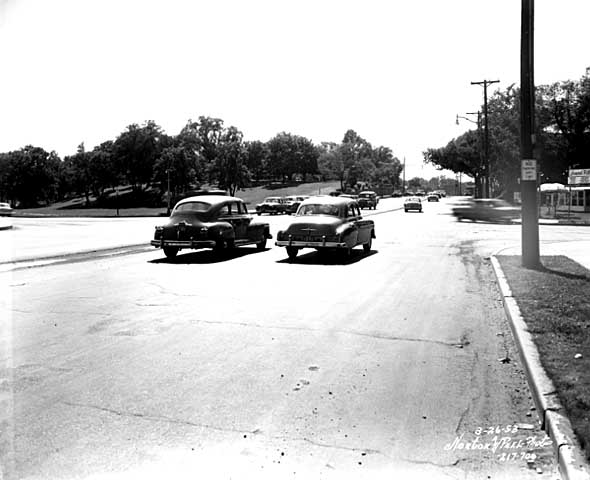
Travelling west on Lake St. at Dean Parkway. West Calhoun parkway begins at far left. (Norton and Peel, Minnesota Historical Society)
Note that the lot on the southwest corner of the intersection (upper left) is still undeveloped in 1953.
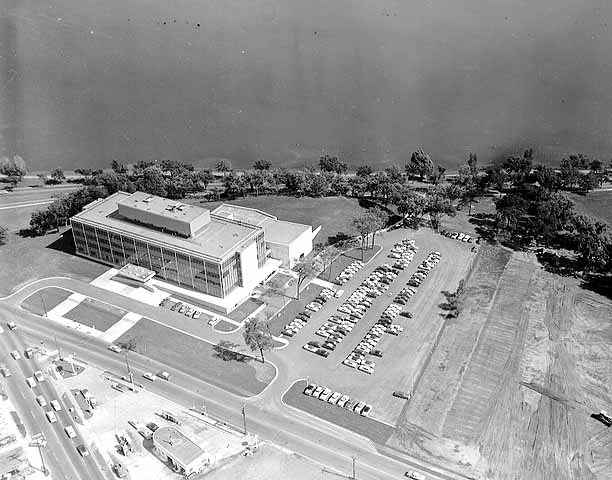
Aerial view, 1956. Excelsior Blvd. is in the foreground. Minnesota Historical Society)
The earliest photos I’ve found of the American Hardware Mutual Insurance Company building on the site are dated 1956, such as this aerial photo from the Minneapolis Star Journal Tribune.
The park board never owned that piece of land, although it would have been a good addition to the lake park. The park board reported in 1916 that the purchase of 93 acres on that corner was pending, but the deal never was completed. The land behind the building to the southwest was once a small bay of the lake, which the park board filled with material dredged from the lake bottom.
Perhaps it’s simply an issue of the resolution of this photo, but I don’t see traffic lights even though it appears that east- and west-bound traffic is stopped. The lights must have been installed about this time, because the city engineer had developed an initial plan for lights at this increasingly busy intersection in 1951.
The photo below was taken at the opposite, or southeastern, corner of Lake Calhoun at about the same time.

36th Street approaching the southeastern corner of Lake Calhoun, 1955. Lakewood Cemetery is on the left. (Norton and Peel, Minnesota Historical Society)
The photo is notable especially because the foundation of the street railway bridge over 36th Street still stands. This was the location of the rails that went to Lake Harriet and beyond to Excelsior and Lake Minnetonka. Of course, there were no traffic lights at the intersection of 36th and East Calhoun Parkway either.

East Calhoun Parkway in about 1890. Looking north from Lakewood Cemetery.(Minnesota Historical Society)
The trestle had been there since before the park board built the parkway. (See more on the Lyndale Railway Company at Lake Calhoun and Lake Harriet.) In the photo at right you can see the bridge foundation (far right), in front of the carriage turning east onto 36th Street. The fountain in the boulevard for watering horses was an interesting touch. So was the scalloped hedge between the parkway and the lake. Does anyone know when the street railway bridge supports were torn down?
Most of the earliest parkways around lakes ran right along the water’s edge. That feature of early parkways is more prominent in the photo below of the end of Calhoun Parkway in about 1905. At that time the parkway ended where it turned south to connect to Lake Harriet. The land behind the photographer in this photo was private land all the way around the west shore of the lake back to Lake Street and the top photo.

The end of Calhoun Parkway at the south end of Lake Calhoun in 1905. The road turned to the right, the future William Berry Parkway, connecting to Lake Harriet. (Minnesota Historical Society)
The photo below shows the approach to the north end of Lake Calhoun from about the same time period as the photo above.

The north shore of Lake Calhoun from Lake Street, facing west in about 1902. (Minnesota Historical Society)
This photo shows Lake Street facing west at the northeast corner of Lake Calhoun. This was before the park board acquired the north shore of the lake. The only park land around the lake at this time was Calhoun Parkway beginning at the left of this photo and continuing to the previous photo.
David C. Smith
A Missed Opportunity: The Witch’s Hat Is Closed for Another Year!
Filed under: Minneapolis Parks: General, Tower Hill Park | Tags: Frederick W. Cappelen, Tower Hill Park, Witch's Hat
Comments (6) 
The view from Tower Hill — at the base of the Witch’s Hat. Imagine the view from the observation deck above. (Talia Smith)
For years my “To Do in Minneapolis” list has included a climb that I have never made. And it’s not something I can do just any old day. We get one evening a year and that’s it. And once again I missed my chance. I wasn’t paying close enough attention that the Prospect Park/Pratt School Ice Cream Social was May 31. The night of that neighborhood party is the one time a year that the Witch’s Hat Tower on Tower Hill Park is open for climbing.
The climb would have been especially gratifying this year because it was the tower’s 100th birthday. The City of Minneapolis built the water tower on the hill, with the park board’s permission, in 1913. As explained before, the park was already named Tower Hill, at the request of neighborhood residents, when the Witch’s Hat water tower was built.
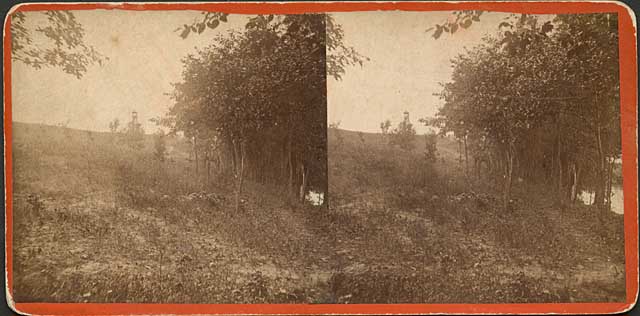
Since my earlier post on the Witch’s Hat, I found this stereopticon image of “Cheever’s Tower” dated 1858. (Minnesota Historical Society)
The Witch’s Hat tower was designed by Frederick Cappelen, as noted on a plaque that was put on the tower in 1999. I have a complaint about that plaque.
Cappelen is described on the plaque only as a “Norwegian architect.” Concise, but really misleading. Yes, he was Norwegian by birth, but he had immigrated to the United States at the age of 23 in 1880. He went to work for the City of Minneapolis in 1886 as a bridge engineer and in 1893 was elected Minneapolis’s City Engineer. He left that office in 1899, but was elected City Engineer again in 1913 and held that title until he died of complications from appendicitis in 1921. So, although Norway-born, he lived nearly his entire adult life in Minneapolis and during much of that time was a city employee.
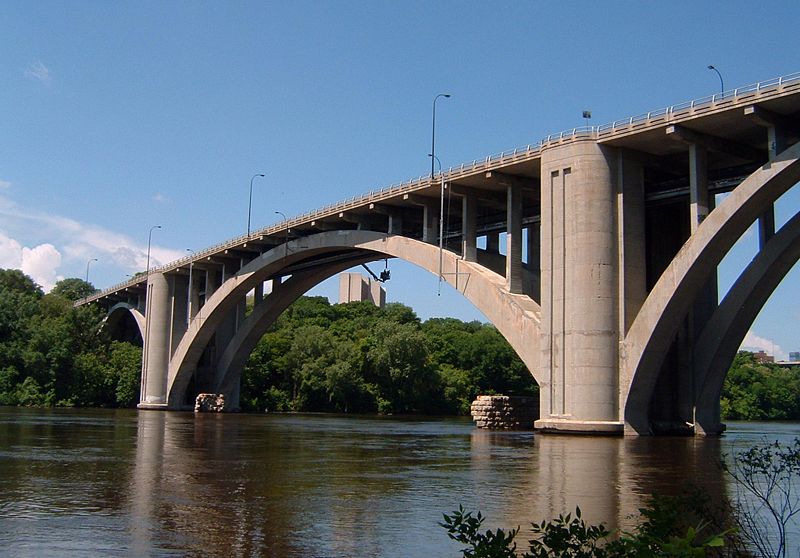
The graceful arch of the bridge was the world’s longest concrete span at the time it was completed in 1923. (Mulad)
Cappelen’s greatest achievements in Minneapolis had nothing to do with the Witch’s Hat. He was the designer of the Franklin Avenue Bridge over the Mississippi, which was completed after his death. At that time, the bridge was the longest concrete-span bridge in the world, with a central span of 400 feet. The bridge’s official name is F. W. Cappelen Memorial Bridge.
Cappelen was also a key figure in designing the city’s water distribution system from the 1890s into the 1900s. He was so well-known as a bridge designer and a water works designer that his obituary was included in both the Proceedings of the Society of American Civil Engineers and the Journal of the American Water Works Association.
Cappelen was a Public Servant
Here’s my complaint about the plaque. I have no problem with identifying him as a “Norwegian architect” despite the fact that he was as American as everyone else in the city. My problem is with not identifying him as a public employee, as the City Engineer, a description that has far more to do with our memory of him than that he was Norwegian by birth.
The omission of his status as a public employee is part of my larger complaint that too many people praise everything in the private sector and disparage everything and everyone in the public sector. Too many people have such blind reverence for business methods and profit motives that they cannot distinguish between public and private good and the sometimes vastly different challenges involved in each. Some public problems cannot be solved by methods designed to maximize private profits.
I have also witnessed first-hand brilliance, stupidity and sloth in both government and corporate worlds. I have known very successful business people whom I would not trust to walk my dog around the block for fear that they’d screw it up somehow — or sell my dog before they made it back. I have known public employees with whom I would trust my life.
I have no tolerance for people who assume that someone who gets his or her paycheck from a government entity is incompetent and that everyone who works for a profit-making enterprise is more industrious and resourceful.
I have as much tolerance — none — for those who assume the only reason we have parks at all was a conspiracy of capitalists to enrich themselves. This myopic view, in my recent experience, seems particularly prevalent among people writing doctoral dissertations and some of those advising them.
To emerge from our present political quagmire, we have to be better than those extremes.
If there is a valuable lesson in Minneapolis park history it is that a great variety of people, with disparate philosophies and political views, have worked together on issues of the common good and achieved marvelous results. They included “capitalists” who looked beyond self-interest and profit, and they certainly included talented and dedicated public servants — like Frederick William Cappelen, City Engineer.
I’m sorry I missed again a chance to climb the tower he imagined 100 years ago. I’ll have to settle for a walk over his bridge.
David C. Smith
NOTE (6/6/2013): abockheim raises an excellent point in a comment on the post I linked to above about the identity of the tower that led to the naming of Tower Hill. Can anyone shed light?

An illustration of the view from Cheever’s Tower in 1857 by Edwin Whitefield. The lithographer was W. Endicott & Co. (Digital gallery of the New York Public Library.)
Here’s the link to the above illustration. I can’t picture this view from the campus or Tower Hill.
© David C. Smith 2013
Minneapolis Sculpture Garden is 25
Filed under: Minneapolis Parks: General | Tags: Armory Garden, Minneapolis Sculpture Garden, The Parade
Leave a Comment Happy 25th Birthday Minneapolis Sculpture Garden!
Sorry, I forgot to inform you of the original air date of tpt’s history of the Minneapolis Sculpture Garden. It premiered last Sunday evening on tpt/MN. The half-hour documentary was made to celebrate the 25th birthday of an extraordinary public space.
The program will air again at various times throughout the summer. Check tpt schedules or watch it here.
Producer Mark Fischer and executive producer Tom Trow did an excellent job telling the story; they even let me be in it!
The Sculpture Garden was a collaboration between the Minneapolis Park and Recreation Board, which owns and maintains the land, and the Walker Art Center, which designed the garden and selected the sculptures. It’s a Minnesota treasure.
The following photos show the transformation of part of the Sculpture Garden when the Armory Garden was created in 1913.

The southern half of the Sculpture Garden site before it was designated to become a garden in 1913, looking southwest, Armory in background, Walker Art Center site at left, Lyndale Avenue in lower left, Kenwood Parkway, now closed at right. (Minneapolis Park and Recreation Board)

The same site as above ready for planting for the 1913 convention of the Society of American Florists and Ornamental Horticulturists. (Minneapolis Collection, Hennepin Country Library)

The 1913 Armory Garden. The photo was taken from the Palace Hotel between The Parade and Loring Park. (Minneapolis Park and Recreation Board)
Whether you love the Sculpture Garden, or don’t really care, it is a remarkable use of parkland — one of many examples in the Minneapolis park system. As I said in the video, I think the transformation of one corner of a recreation park into an art park is a remarkable example of how the use of public land can — and should — change over time. It’s another tribute to the wisdom of those who envisioned the park system and the need to set aside land for public enjoyment. Because we own the land, we can adapt its use to meet our needs, however they may be defined and redefined. Brilliant!
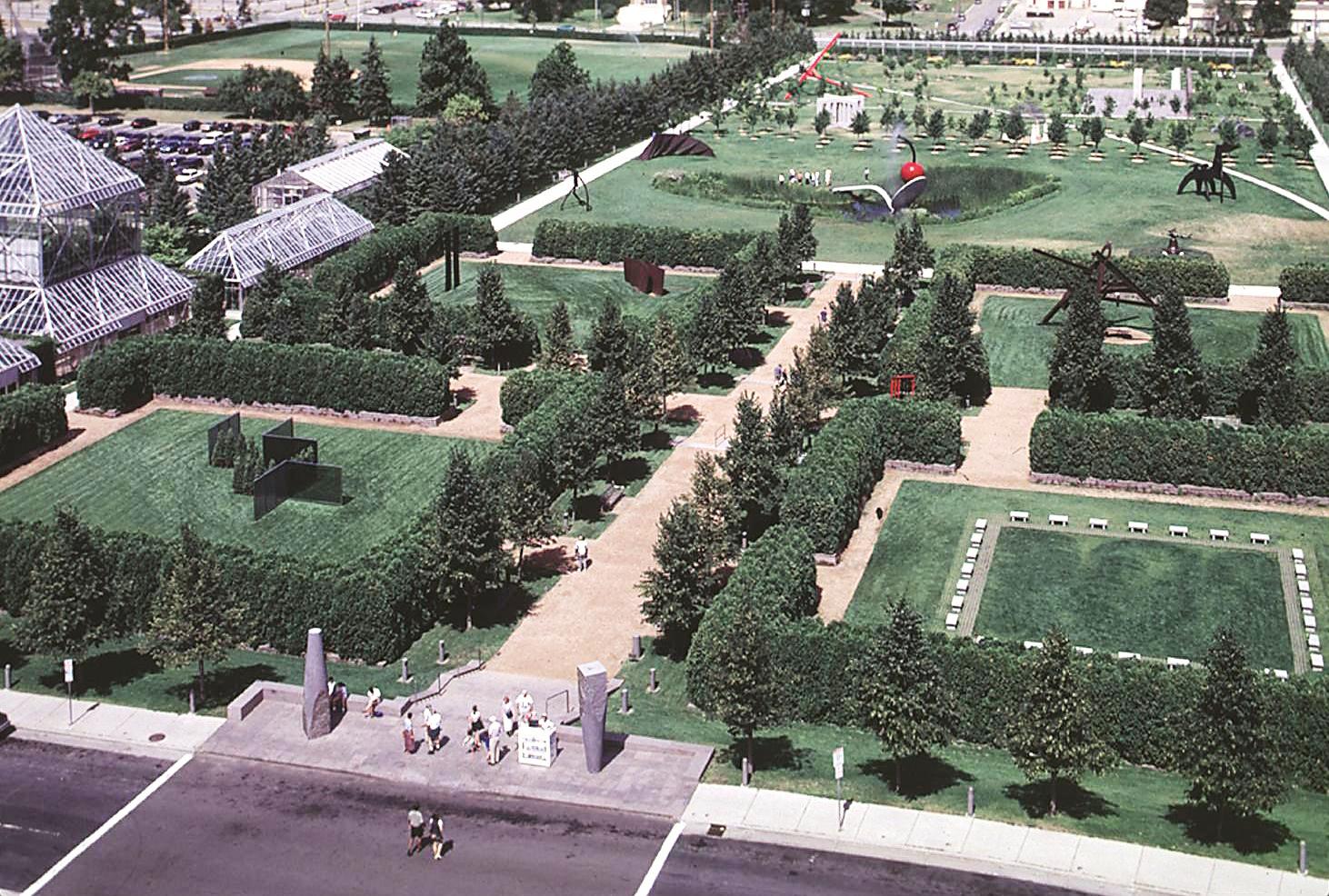
The same land in the photos above, but seen from the south. (Minneapolis Park and Recreation Board)
When’s the last time you visited the Sculpture Garden? Maybe it’s time to take another look.
David C. Smith
© 2013 David C. Smith
The Stadium the Pillsburys Built: Northrop Field at the U of M Where Ticket Scalping Became Illegal
Filed under: Minneapolis parks | Tags: Alfred F. Pillsbury, Golden Gophers, John S. Pillsbury, Northrop Field, University of MInnesota football
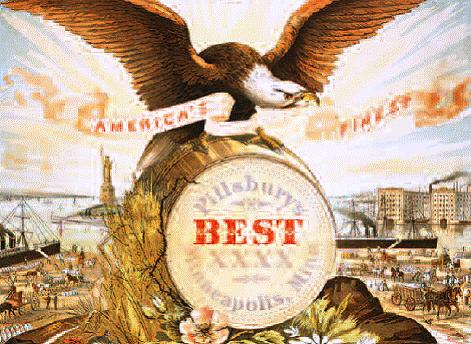
Leave a Comment Alfred Fisk Pillsbury is probably best known for three things in Minnesota other than his “Best XXXX” flour-making name.
 One, he was a major contributor to the Minneapolis Institute of Art. The renown of MIA’s Chinese collection is due in large part to Pillsbury bequeathing his personal collection of bronzes and jades to the museum. He had a good eye in addition to deep pockets.
Two, he played for eight University of Minnesota Gophers football teams 1886-1893. That’s right, eight! As long as a student was working toward a degree in those days, he was eligible to compete on a university’s athletic teams. Earned your degree? No problem! Pursue another, stay eligible. So young Pillsbury—”Pilly” to fans and sportswriters—twice captain of the team and, literally, the owner of the team’s only football his freshman year, went from undergraduate courses to law school. Eight years, six as the team’s QB!
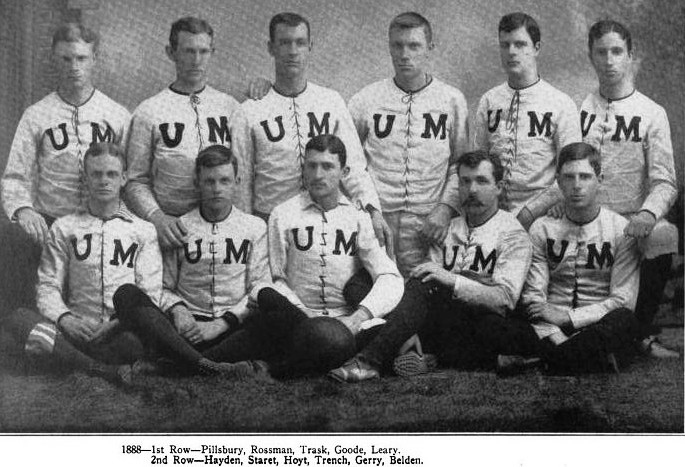
Alfred F. Pillsbury (first row, far left) with the 1888 Gophers. This was the third year of his eight year career at the University of Minnesota. He was captain of the 1887 and 1889 teams. He began his playing days in 1886 as a lineman, but at only 142 pounds he was soon shifted to quarterback. He was not as small as it would seem by today’s standards; players who weighed 200 pounds were considered gigantic then. Don’t you love those lace-up shirts? They were made of canvas to provide some protection and elusiveness. It was hard to get hold of the snug-fitting canvas.
His eighth year on the team is a bit mysterious. Most sources, including the History of Minnesota Football, published in 1928 by the General Alumni Association of the University of Minnesota, claim Pilly’s football playing days ended in 1892. John Hayden writes in a chapter titled “The Early Days”: “For long and creditable performance no one has surpassed Alf. Pillsbury. He played good football on the first team, in 1886, and on successive teams until 1892, when he completed his law course.”
But it seems as if Pilly had one game left in him. The Minneapolis Tribune’s account of the Gophers’ 40-0 thrashing of the Wisconsin Badgers—the biggest game of the year—on November 11, 1893 describes several Pillsbury plays as a halfback that day. He scored two touchdowns. A drawing that illustrates the story shows “Pilly” carrying the ball. It was apparently his only appearance during the 1893 season. Though he wasn’t on the team’s roster for the year, he does appear in the 1893 team photo (too grainy to reproduce here). He was still in law school—he didn’t actually graduate until 1894—so perhaps the team felt they needed their former star to defeat the highly regarded team from Madison and complete a second consecutive undefeated season.

The Marx Brothers in Horsefeathers (mobypicture.com)
The Badgers’ star halfback that day, Lyman, had faced the Gophers before as a student at Grinnell College in Iowa. He reportedly vowed he would stay in college until he beat Minnesota—which evokes images of Professor Wagstaff, Pinky and Baravelli in “Horsefeathers” a few decades later.
The Wisconsin game in 1893 was not the last time Pillsbury took the field in a Minnesota football game. He twice played against the Gophers—and lost—in 1895 representing the Minnesota Boat Club and the Ex-Collegiates.
Perhaps the greatest tribute to Pilly as a player was offered by the famous University of Chicago coach Amos Alonzo Stagg. Writing in the University of Minnesota Alumni Weekly football special in 1914, Stagg recalled the first contact he ever had with a Minnesota team when he refereed a Gophers game in 1891. Pillsbury was one of four players he remembered from that game more than 20 years earlier, noting that Pilly was a “stalwart” at his position and “made a great reputation.”
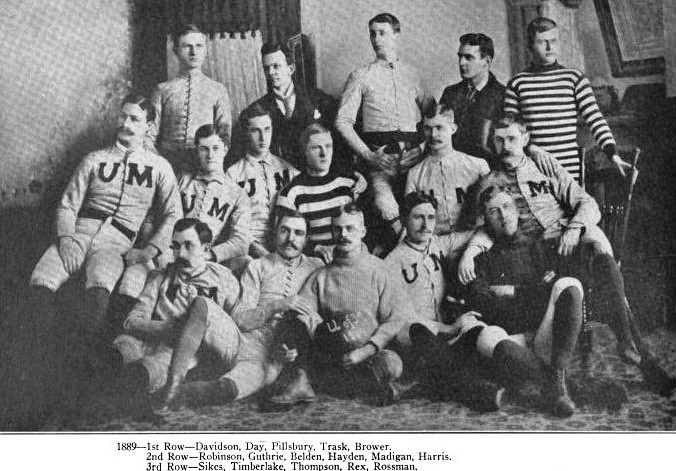
The 1889 Gophers were a more relaxed outfit. Pillsbury, the captain, is front center.
Digression: Golden Gophers. When did the University of Minnesota officially add “Golden” to Gophers? How silly. “Back when I was a kid they were just Gophers and that was plenty good for us.” (Spits tobacco, misses spittoon.) Golden? That’s trying way too hard. “Gopher” too wimpy for you? Well, “Golden” makes it seem like we’re begging for a wedgie. Every time a national sports announcer says “Golden Gophers”, I can hear the eye-roll. There was a time when the “Gophers” were winners. Since the “Golden” was added? Losers. Posers. Hosers. It’s a curse. In the name of Jerry Kill and Richard Pitino, drop the Golden! Especially since the teams have gone to an ugly yellow—Grotesqueyellow Gophers!—instead of gold for a uniform color anyway. If “Buckeye”—the least fearsome nickname/mascot ever— doesn’t need enhancement, why should “Gopher”? Ohio St. still does okay.
Alfred Pillsbury’s third most visible personal accomplishment was serving as a Minneapolis park commissioner for 19 years between 1925 and 1946. He was president of the board for three years in the 1930s. My favorite quote from the annual reports that Pillsbury wrote was from the park board’s report for 1933.
While pleading the case for greater spending on park recreation programs, even in the depth of the Depression, Pillsbury wrote that providing recreation was, “just as vital as any function of government, not excluding that of the apprehension and conviction of criminals and the education of our youth.” I doubt that anyone has ever put the case more strongly for the value of recreation in our society.
That’s how the world seems to remember Alf, as Lori Sturdevant calls him in her family biography, The Pillsburys of Minnesota. But in these days of stadium subsidies and related land development d-d-d-deals—Gestribheit!—it is worth noting something else Pilly/Alf did.
The Stadium that Outlawed Ticket Scalping
Alfred Pillsbury is credited with playing a pivotal role in creating a new stadium for the Gopher football teams. Until 1896 — Pilly’s entire playing career — the Gophers usually played football on the baseball field behind the West Hotel in downtown Minneapolis. The biggest drawback was that the baseball field wasn’t quite long enough for a regulation football field, which lead Northwestern University to protest their loss on the shortened field in 1892. In 1896 the team moved to a new field, a sandy burr patch next to the Armory on the University campus. For three years spectators were accommodated by chairs placed around the field. In 1899, the athletic department borrowed $1,500 from the Board of Regents to construct a 3,000-seat grandstand. A board fence around the field was built by students, although the student newspaper reported with shock that some students climbed over the fence to attend games. The new field was named after University President Cyrus Northrop.

Alfred F. Pillsbury (Minneapolis Park and Recreation Board)
Northrop Field, however, was never considered adequate. Dissatisfaction with the field led to a discussion in 1900 between the Dean at the time, Fred Jones, and former Minnesota Governor, President of the Board of Regents, and Pilly’s dad, John S. Pillsbury. The elder Pillsbury had also been one of the original twelve commissioners when the Minneapolis Board of Park Commissioners was created in 1883. John and Alfred Pillsbury were the first father-son duo to achieve park commissionerhood. The most recent was Leonard and Scott Neiman. The Neiman family could add a generation this year, given the candidacy of Scott Neiman’s son, Josh, for the park commissioner seat from the same southwest Minneapolis district that elected his father and grandfather.
Subsequent to his chat with Fred Jones, John Pillsbury privately purchased six lots adjacent to the Armory football field and convinced the city to vacate Arlington and Union Streets through the campus at that point. His intention apparently was to give the lots he had purchased to the university to expand the football stadium, but this plans were not completed before he died in 1901. His son and heir, Pilly, completed the plan, however, deeding the land to the University. The University then augmented the gift with the purchase of additional land and paid for the construction of a new grandstand that would seat 10,000 and provide standing room for nearly 10,000 more spectators. Pilly then stepped up again with the money to construct a brick wall around the entire athletic complex, which also included a running track and a baseball field.
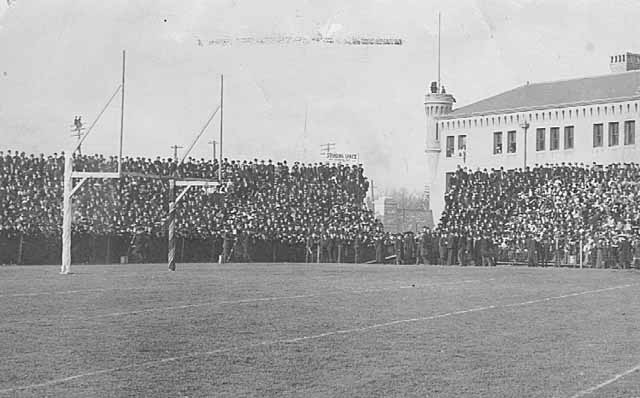
The west end zone and standing room sections of Greater Northrop Field with the a portion of the Armory at right. My favorite part of the photo is the fans on the pole outside the stadium. Alfred Pillsbury’s brick wall wasn’t going to keep them from watching the game. (Minnesota Historical Society)
The new stadium, Greater Northrop Field, which opened in 1903, was considered exceptional for its time, but pressure for a bigger and better stadium would grow in only a decade.
Coaches Never Change. After praising the Gophers’ stadium as one of the “very best football playing fields in the country” a coach expounded, “Fine as this is, however, it does not meet the present football requirements of the University…Michigan, Northwestern, Wisconsin, Chicago, and Illinois have all far outstripped Minnesota in extent of grounds and equipment. A new field with concrete stands and ample acreage is a not unreasonable hope for the near future. Commodious, clean dressing quarters, baths and locker rooms in place of the present inadequate cramped, dirty, unsanitary, and unhygienic quarters should accompany the new field. While bearing but indirectly on football and yet affecting all athletic enterprises at the University, it might be well to mention that Minnesota has one of the poorest college gymnasiums in the country, in no wise in keeping with its needs or its athletic accomplishments.”
— U of M football coach Dr. Henry L. Williams writing in the Alumni Weekly, November 9, 1914. Norwood Teague could use that speech today with minor revisions.
The demand for tickets to see the Gophers play in those days is demonstrated by a law passed by the Minnesota Legislature in 1913, Chapter 521 of the General Laws of Minnesota.
“Be it enacted by the Legislature of the State of Minnesota:
Section 1. Prohibiting theater ticket scalping.–No person, firm, or corporation shall sell or offer or expose for sale any ticket of admission to any theater, opera, concert, athletic contest, or other public entertainment at a greater price than the same are being sold or offered for sale by the management of the same.”
Although the law is couched in general entertainment terms, the Minneapolis Tribune reported April 27, 1913 that the bill was passed expressly to prohibit the scalping of Gopher football tickets, which had been prevalent when the Wisconsin Badgers came to Northrop Field to play the Gophers the previous November. At that time — the Tribune headline was “Football Fever Grips City” — tickets that normally cost $1.50 were selling for as much as $10, putting them out of reach of most fans. (The first Minnesota legislation I can find that applies to excess charges on tickets of any kind is a 1893 law that prevented ticket brokers from raising prices for steamship and railroad tickets.)
The new law got its first great test when Coach Stagg’s University of Chicago eleven came to Minneapolis for a mid-November game in 1913. The 10,000 seats in the grandstand sold out the same morning tickets went on sale even though a limit of six tickets per person was implemented to curtail the anticipated aftermarket in tickets despite the new law. While the penalty for scalping tickets was a $10-$100 fine or 10-90 days in the county jail, the University also imposed punishment for students who sold their student tickets, which cost $5 for the season. The penalty was harsh: expulsion from school. Minneapolis police assigned three plain clothes detectives to patrol “hotel lobbies, cigar stores and saloons” to catch anyone trying to sell tickets over face value. (It wasn’t until 1949 that the legislature expanded the law to prohibit selling tickets below face value, too.)
The big game, played on a field that had been protected from frost all week by a covering of 18 tons of hay, lived up to advance billing resulting in a dramatic 13-7 win by Chicago. Despite the home team’s loss, the Tribune reported an “orgy of celebration” after the game that had never been equalled in Minneapolis history. The paper credited the Chicago win to Coach Stagg’s “shifty plays.” Chicago went on to beat Wisconsin the next week — the entire Wisconsin team was rumored to be at the Minnesota game scouting the Chicago squad — and won the Big Nine conference championship. It was the Big Nine, instead of the Big Ten, at the time because Michigan had temporarily withdrawn from the conference. Chicago was a member then, not replaced by Michigan State until 1949 after Chicago dropped out of major college athletics. What became of all that hay remains a mystery.
At conference meetings the week after the 1913 season ended, faculty representatives of Big Nine schools agreed to try out using numbers on players uniforms the next year. They also appointed Chicago’s coach, Amos Alonzo Stagg, to lead an effort to “devise a signal code by which officials in football games can inform announcers of the causes of penalties”.(Minneapolis Tribune November 29, 1913)
Digression: Squirrels, ferrets and flats. Lest you think that the 1913 legislature was being frivolous in passing laws against ticket scalping, it also passed laws against killing any kind of squirrel in public parks and repealed the law that had made it illegal to use ferrets to hunt rabbits in Hennepin, Ramsey and St. Louis counties. Apparently after passage of the law banning ferrets, the rabbit population had exploded and was destroying fruit trees in those counties. I don’t know if or when either law was ever amended or repealed. So if you plan to use your ferret to hunt rabbits in Minneapolis this summer, you might want to check first. The legislature also granted city councils the authority to determine where flat or apartment buildings could or could not be built, one of the first steps toward zoning restrictions and modern city planning.
After several years of intense public pressure, Northrop Field was replaced after only 21 years by Memorial Stadium, which opened in 1924. Alfred Pillsbury was reported to have donated $50,000 toward the construction of that stadium.
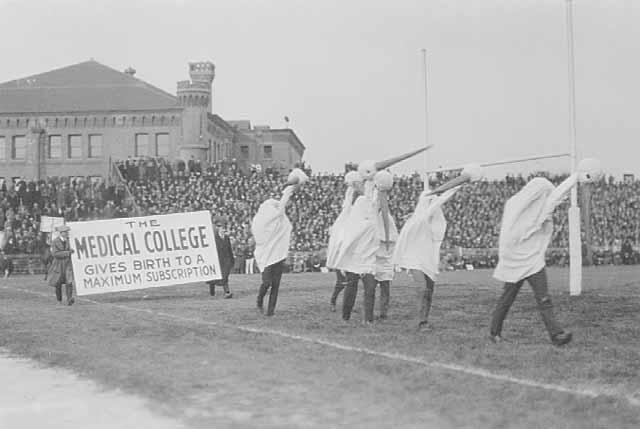
Medical school students demonstrating support for a new stadium about 1920. (Minnesota Historical Society)
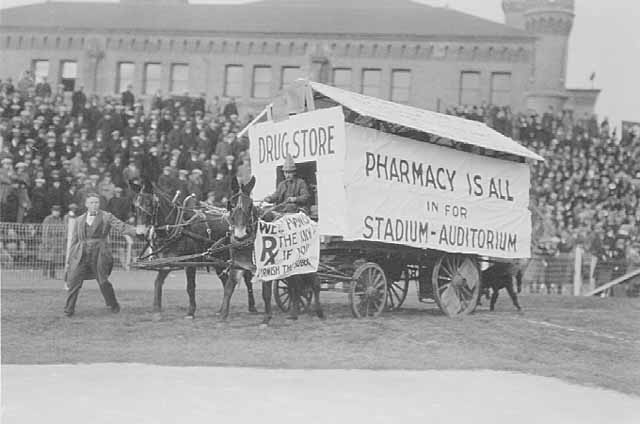
Pharmacy students demonstrating for a new stadium around 1920. (Minnesota Historical Society)
The reference to the “auditorium” in the photo above was to what became “Northrop Auditorium.” The fundraising campaign for Memorial Stadium also included raising money to build Northrop Auditorium.
Although I don’t know if you can still use ferrets to hunt rabbits in Minneapolis, the laws prohibiting selling tickets to sporting events and other entertainment for more or less than face value was repealed in 2007.
While no evidence remains of the Pillsbury family’s contributions to athletic facilities at the University of Minnesota long ago—I don’t know if Pillsbury descendants contributed toward construction of The Bank or other newer facilities at the U—a statue of John S. Pillsbury remains prominent on campus for his role in creating the entire University. History also remembers both John and Alfred, father and son, for their contributions to Minneapolis through the park board; in that sense our city parks are also part of their legacy. And you can still go to the Minneapolis Institute of Art and find items donated from the collection of Alfred F. Pillsbury. I think I can write with confidence that he is the premier art collector in history who also played on his college football team for eight years.
David C. Smith
© 2013 David C. Smith

 Minneapolis Park History