Phelps Wyman: Pioneer Landscape Architect and Minneapolis Park Commissioner
Filed under: Landscape Architects, Minneapolis parks | Tags: Minnehaha Creek, Mt. Curve Triangle, Phelps Wyman, Thomas Lowry Park, Virginia Triangle, Washburn Fair Oaks
 Comments (6)
 Several pioneer landscape architects were associated with Minneapolis parks, from H. W. S. Cleveland, in a very big way, to Warren H. Manning, more modestly, to Frederick Law Olmsted, who once wrote a letter to Minneapolis park commissioners at Cleveland’s request. But only one pioneer landscape architect was also elected to the Minneapolis Board of Park Commissioners: Phelps Wyman. (He never used his first name, Alanson, so I won’t either.) Wyman’s pioneer status in landscape architecture was determined by Charles A. Birnbaum and Robin Karson in Pioneers of American Landscape Design, which profiles about 150 American landscape architects.
Wyman is also one of a very few landscape architects not employed by the Minneapolis park board to have had designs for Minneapolis parks published in annual reports of the park board. The 1922 annual report presented Wyman’s plan for Douglas Triangle, now Thomas Lowry Park, which I wrote about here. This plan was executed in 1923. Curiously, I can find no record that Wyman was paid for the work.

Wyman’s plan for pools and pergola in 1922 annual report of the Minneapolis Board of Park Commissioners
The next year he had another interesting plan published in the park board’s annual report, but it was never implemented. Wyman’s plan for Washburn Fair Oaks Park across from the Minneapolis Institute of Arts (MIA) Read more »
More Horace W. S. Cleveland: A Bit of Oak Lake and More of Kenwood Parkway
Filed under: Landscape Architects, Minneapolis Parks: General | Tags: H.W.S. Cleveland, Horace Cleveland, Kenwood Parkway, Oak Lake
Comments (1) Since I wrote about Oak Lake and speculated whether Samuel Gale might have hired Horace Cleveland to lay out his Oak Lake Addition to Minneapolis — it had the look of Cleveland’s work — I have been digging through notes to see if I could find a connection between the two men. I couldn’t find anything that put the two of them together in 1873 when Gale was platting Oak Lake, but I did find two interesting pieces of paper linking Cleveland with Oak Lake and with Gale in 1886.
One connection between Cleveland and Gale in 1886 comes from the Frederick Law Olmsted Papers at the Library of Congress. Read more »
Minneapolis Parks 100 Years Ago
Filed under: Minneapolis Parks: General | Tags: Theodore Wirth, Wilbur Decker
Comments (1) The Minneapolis park board and other park activists in town have a full plate this year: a new park superintendent, reorganization and significant staff turnover, Minneapolis Riverfront Design Competition and Initiative, development of Boom Island and B. F. Nelson parks, proposed green finger of parks running into downtown from the river through Gateway Park past the library, potential power plant—Crown Hydro—on park property, and a budget inadequate to do much else. Those are only a handful of the bigger challenges.
But, hah!, Wilbur Decker and Theodore Wirth, park board president and superintendent respectively in 1911, would smirk at this puny agenda. It’s nothing compared to what the park board did 100 years ago. Here’s a summary of what the park board accomplished in 1911. Read more »
Horace Cleveland Hated Rectangles
Filed under: Landscape Architects, Minneapolis parks | Tags: Forest Heights, Glen Gale, H.W.S. Cleveland, Horace Cleveland, Oak Lake, Samuel Gale
Comments (2) Oak Lake Addition was a rare real estate development in Minneapolis because the streets followed the contour of the land instead of a grid pattern. While I’ve found no evidence of who was responsible for the layout of the addition in 1873, it is reminiscent of Horace Cleveland’s work in St. Anthony Park for William Marshall at about the same time and later in Washburn Park or Tangletown near Minnehaha Creek. Although I find no reference to the project in Cleveland’s correspondence, it is plausible that he was involved in the layout of Oak Lake Addition.

Oak Lake Addition, platted in 1873. 1892 plat map (John R. Borchert Map Library, University of Minnesota)
Samuel Gale, the man who platted the Oak Lake Addition, had his hands in nearly everything in the young city: School Board, Athenaeum and Library Board, Academy of Natural Sciences, Society of Fine Arts, Board of Trade, City Council, the public lecture series, he even sang in the city’s most celebrated quartet along with his brother, Harlow, and it was later claimed that although nearly everyone speculated in real estate in those days, he was the dean of realtors in the city. Given his wide interests and involvement in civic affairs, it would be incredible if Gale hadn’t been one of those who welcomed Horace Cleveland to the city during his first visits in 1872.
In July, 1873 Gale was the chair of the Board of Trade’s committee on parks, which reported that several “public-spirited citizens” planned to devote considerable time to the issue of parks with “Mr. Cleveland, well-known landscape gardener” before the next Board of Trade meeting. (Minneapolis Tribune, July 18, 1873.) I think it is safe to assume that Gale himself was one of those who planned to meet with Cleveland. So it appears almost certain that Gale and Cleveland knew each other and had likely discussed park issues before Gale produced his plat for the Oak Lake Addition.
Absent information on who designed Oak Lake Addition, it’s fun to speculate that Cleveland may have had a hand in it, or at least influenced it through the book he published in early 1873, Landscape Architecture as Applied to the Wants of the West. In his classic of landscape architecture, Cleveland expressed his distaste for the grid pattern of streets in so many cities, because it ignored “sanitary, economic and esthetic sense.”
“Every Western traveller is familiar with the monotonous character of towns resulting from the endless repetition of the dreary uniformity of rectangles,” he wrote.
While he singled out western cities — it was his book’s theme — it takes only a glimpse of a map of Manhattan to know that rectangularism was not a sin peculiar to the frontier. For New York, however, it was already too late to do anything about that “dreary uniformity”; the West still had a chance to get it right. Cleveland added that “even when the site is level” the rectangular fashion of laying out cities “is on many accounts objectionable.”
He suggested that if blocks had to be rectangular at least they should be Read more »
Lost Minneapolis Parks: Oak Lake, Two Ovals and Two Triangles
Filed under: Lost Minneapolis Parks, Minneapolis parks | Tags: H.W.S. Cleveland, Horace Cleveland, Loring Park, Oak Lake, Samuel Gale
Comments (14) Another convergence: the season of farmers’ markets is upon us and so is a decision on whether the Minnesota Vikings get a new tax-supported stadium. The site favored for a stadium by some Hennepin County commissioners is the Minneapolis Farmers’ Market on Lyndale Avenue just west of downtown and Target Field.
You’d never know by looking at it today, but the site is rich in history. The current market sits in the middle of what was once Oak Lake, one of the attractions of a semi-exclusive and progressive residential neighborhood late in the 19th Century. It was Minneapolis’s second-oldest park. A bandstand near the lake was built in 1881 to host some of the earliest outdoor concerts in the city. The gracefully curved streets of the neighborhood filled with the carriages of wealthier concert goers, while residents of the neighborhood and music lovers without carriages sat on the sloping hillside in what was called a natural amphitheater near the lake.
Oak Lake Addition, platted in 1873. 1892 plat map (John R. Borchert Map Library, University of Minnesota)
Some people say the Oak Lake Addition experienced gentile flight, then white flight, as the neighborhood went from mostly white Protestant to Jewish to black before it finally gave way to industrial and market uses. And it happened fast. But the trendy little neighborhood was probably doomed by something much more benign than ethnic, religious or racial bigotry; the creation of the Minneapolis Board of Park Commissioners helped kill the Oak Lake Addition.
Where do you think Andy Warhol got the idea?
Filed under: Minneapolis Parks: General | Tags: Clinton Field Park, Dorilus Morrison Park, Leo Harris, Minneapolis Institute of Arts
Comments (3) This has nothing to do with parks.
From the Minneapolis Morning Tribune, October 30, 1915.
Artistic tomato cans and beer bottles? No, not now, but maybe in the future. Joseph Breck, director of the Minneapolis Institute of Arts, intimated the possibility in an address before the art division of the Minnesota Educational Association today. “When some future historian,” he said, “comes to write the story of nineteenth century art, will he praise our tomato cans, our beer bottles, as the art historians of our day praise the vases of ancient Greece? I fear not. But our industrial arts are improving so rapidly and we have made such tremendous advances on the hideousness of the Victorian era that the time is not far off when the future historian will find much to occupy him in the decorative arts of the coming day. If my statement is borne out it will be largely because we have trained the children to know and to want what is beautiful.”

Beauty in a Can. Andy Warhol
Nothing to do with parks—except I came across the article while researching park issues, precisely the park board service of Leo Harris. Minneapolis developer Ray Harris once commented to me that there were many big battles on the park board in the days his father Leo served as a park commissioner (1915-1918). “It was not all sweetness and light,” Ray said. I was searching the Minneapolis Tribune for reference to some of those battles, when I found the tomato can quote.
One of Harris’s biggest fights was with park superintendent Theodore Wirth over what Harris considered faulty and inferior paving methods on parkways.
But there was some sweetness and light too. In 1916 Harris donated a 12-inch silver trophy that was awarded to the city’s Sunday League baseball champion each year. I don’t know what became of the trophy or how long it was awarded.
The best Leo Harris story I could find was from the Minneapolis Tribune October 27, 1914, subtitled “One Reason Why He Became a Candidate for the Park Board.” Harris said he was walking near his home in the eleventh ward the previous spring when he encountered an army of young children playing in the street. He tried to count them, but the crowd was too large and fluid, so he offered to buy them all ice cream cones. When it came time to settle, he paid for 49 cones. Harris said he became a candidate for the park board a few days later. Harris was quoted as saying, “I love the Park Lakes, the River Drive, the beautiful Minnehaha, but I also believe in giving the children in congested districts a place to play and play right. It is a shame for a city to give these kids only the streets to play in.”
Leo Harris resigned from the park board in 1918 to enlist in the U.S. Army during World War I.
I wrote in a post earlier today that the Minnesota Historical Society photo collection has a picture of almost everything. Here’s more proof: I searched for Leo Harris and while I didn’t find a portrait, I did find his business!
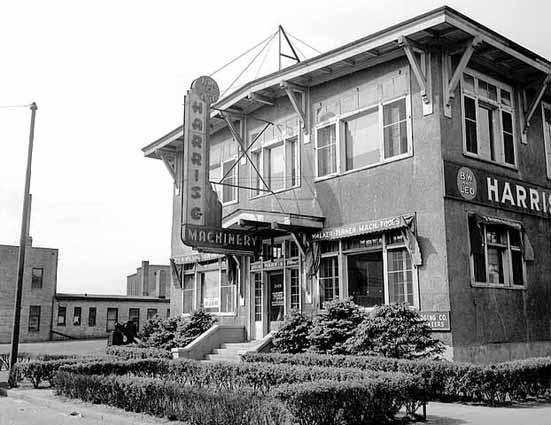
B.W. & Leo Harris Company, 2429 University Avenue Southeast, 1948 (Minneapolis Star Journal, Minnesota Historical Society)
Harris announced the creation of the business in an ad in the Minneapolis Tribune April 23, 1922.
I should also add that the Minneapolis Institute of Arts, of which Mr. Breck was the director when he gave Warhol his inspiration, is located in a Minneapolis park, Dorilus Morrison Park. I knew there would be a picture of that in the MHS collection.

Dorilus Morrison’s home ca. 1900 (Minnesota Historical Society)
This was Dorilus Morrison’s home in about 1900, which his son, Clinton, donated to the park board in 1911 order to build this…
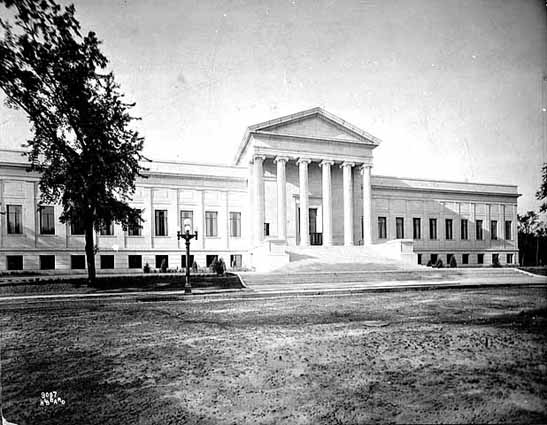
The Minneapolis Institute of Arts, photographed in about 1920, was built in Dorilus Morrison Park. (Charles J. Hibbard, Minnesota Historical Society)
The new Institute opened in January, 1915 and was the site of Breck’s speech later that year. On the day the new building opened, January 7, 1915, a Minneapolis Tribune editorial called it “A New and Powerful Force for Good.”
Dorilus Morrison was instrumental in creating the park board and was a commissioner on the first park board in 1883. Even his son Clinton has a park named for him in a way. Clinton Park was named for its location on Clinton Avenue, but Clinton Avenue was named because it was the street on which Clinton Morrison resided, a block east of his father’s house.
David C. Smith
© 2011 David C. Smith
More on Murphy Square and Augsburg College — and more praise for the Minnesota Historical Society.
Filed under: Minneapolis parks | Tags: Augsburg College, Carl Chrislock, Murphy Square
Leave a Comment In response to my request for info on Murphy Square before the freeway, Juventino Meza, a student at Augsburg College, reports that two books provide stories and photos of the Augsburg campus and the neighborhood before the 1960s. He writes that From Fjord to Freeway: 100 Years of Augsburg College, by Carl H. Chrislock, is available at the Augsburg library. He also recommends From Immigrant Parish to Inner-city Ministry: Trinity Lutheran Congregation 1868-1998, by James S. Hamre. The Trinity Lutheran Church building, once located south of Murphy Square and the Augsburg campus, was taken out by the freeway. The latter book is available from Trinity Lutheran Congregation, which still exists and has an office at 2001 Riverside Avenue and a website here.
I have written often of the amazing resource this state maintains in the Minnesota Historical Society. More than once I have noted that regardless of subject, I always check to see if the Visual Resources Database at MHS has a photo. While looking for photos of Augsburg College and Murphy Square I was astonished to find a photo of Augsburg history professor Carl H. Chrislock, author of the Augsburg history Mr. Meza recommended. Here’s proof.
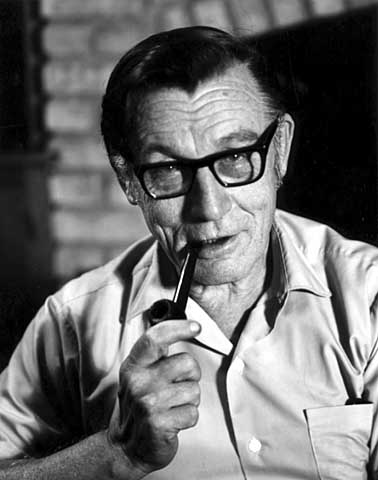
Carl H. Chrislock, professor emeritus, Augsburg College, 1970 (Alan Ominsky, Minnesota Historical Society)
Thanks to Mr. Meza——and to Minnesota legislators for the Minnesota Historical Society. It’s probably a good idea to remind your legislators that the Minnesota Historical Society needs their support.
David C. Smith
Has the Park Board Neglected Northeast Minneapolis?
Filed under: Grand Rounds, Minneapolis parks, Mississippi River | Tags: Columbia Park, Horace Cleveland, Logan Park, Mississippi River, Northeast Minneapolis, Sandy Lake, Theodore Wirth
Comments (2) The argument is sometimes made, particularly by “Nordeasters,” that northeast Minneapolis is park poor and that the Minneapolis park board has neglected that part of the city. “Underserved” seems to be the popular word. The idea even flowed as an undercurrent through the recent Minneapolis Riverfront Design Competition. The thinking goes that ever since Minneapolis and St. Anthony merged in 1872, and took the name Minneapolis, power, money and prestige—not to mention amenities such as parks—have accumulated west and south of the river. (Read Lucille M. Kane, The Waterfall That Built a City, for a fascinating examination of why that might have happened.)
While writing recently about Alice Dietz and the marvelous programs she ran at the Logan Park field house I thought again about the perceived neglect of Northeast and whether it might be true. I concluded that it is not; northeast Minneapolis has been a victim of industry, topography and opportunity, but not discrimination or even indifference. What’s more, all those elements have now realigned, putting northeast Minneapolis in the position to get a far bigger slice of the park pie in the foreseeable future than any other section of the city.
Housecleaning, Maude Armatage, Emma Smith and Earth Day
Filed under: Minneapolis Parks: General | Tags: Alice Dietz, Maude Armatage
Comments (1) Tomorrow will commemorate the 99th anniversary of an event some people in Minneapolis may overlook. On April 9, 1912 a Minneapolis cop, Patrolman Hollison, made what the Minneapolis Tribune called the “first arrest ever” in Minneapolis for scattering refuse — littering. As Patrolman Hollison stood at the corner of Lake and Nicollet he saw someone throw a newspaper out the window of a street car. Hollison boarded the street car and arrested August Davidson of 4724 Clinton Avenue, who pleaded guilty and was fined $1. The fine was suspended — but it was a start. I bet Mr.Davidson never again flung his newspaper out a street car window, even if he didn’t like the editorials. The story was reported under the headline “Newspaper Tosser Nabbed.” Minneapolis Tribune, April 10, 1912.)
Of course one arrest and a one-eyebrow-raised headline didn’t alter behavior citywide. That took time, as illustrated by a series of events more than nine years later. At the meeting of the Minneapolis Board of Park Commissioners on July 15, 1921, in the last item of business before adjournment, commissioners voted to create “a workable plan to ensure that picnic parties clean up the picnic grounds which they have used before leaving the parks.” The motion seemed almost a throw-away before everyone went home for the night, but it provided an opening for the board’s newest member to make herself heard.
When the board met again three days later, commissioner Maude Armatage asked if the Board would like to have the cooperation of the women’s organizations in an educational campaign for municipal housecleaning. The board immediately moved that Armatage “be allowed to obtain the assistance of the women in such work.”
Ten days later, July 28, 1921, Armatage inaugurated a campaign to reduce litter in Minneapolis parks. She pointed out that the city spent nearly $8,000 a year cleaning up park litter, mostly on Mondays after huge park attendance on Sundays, although at popular Loring Park the cleanup often extended into Tuesday. This event also dealt with litter, but much more with the perception of capabilities, roles and rights. It was another first, another start. It was the first action by a woman as a park commissioner. Read more »
What Happened to Minneapolis-made Cigars?
In light of the tobacco use policy of the Minneapolis park board, which essentially prohibits the use of tobacco in most park areas, I had to chuckle at the entry in the proceedings of the Board of Park Commissioners for April 19, 1916—almost 95 years ago.
Mr. A. B. Weigel appeared that day before the park board as secretary of the Cigar Makers’ Union—Local No. 77 of the Cigar Makers’ International Union of America, according to the Minneapolis Tribune April 20, 1916—to ask that the park board, as far as possible, sell only Minneapolis union-made cigars at park refectories. On the spot the park board adopted a resolution instructing the manager of refectories to, as much as possible, purchase and enhance the sale of products manufactured in Minneapolis.
What surprised me about that news is not that Minneapolis park refectories sold cigars, but that cigars were made in Minneapolis — enough of them that local cigar-makers were unionized.
Current limits on tobacco use in Minneapolis parks went into effect July 1, 2010.
Of course whenever I’m curious about anything from our city’s or state’s past I go to the photo collection of the Minnesota Historical Society to see if there are pictures. Naturally, when I entered the search term “cigar” I found a number of interesting photos. Here are two.
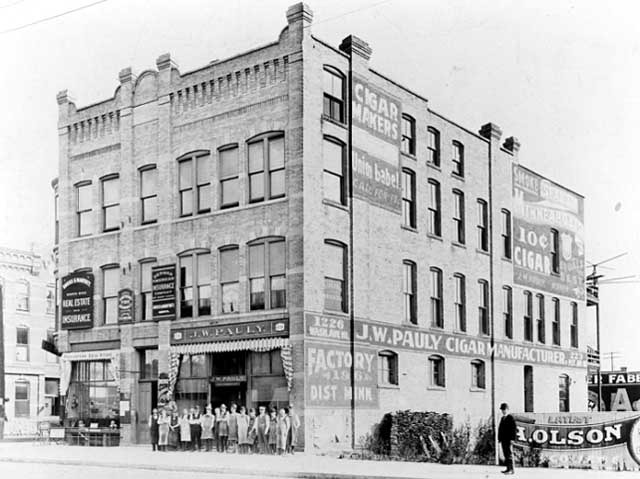
J. W. Pauly Cigar Company, 1226 Washington Avenue North, ca. 1895 (Minnesota Historical Society)
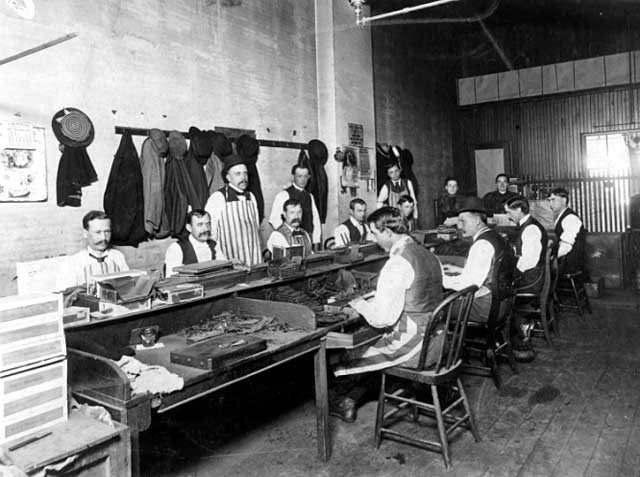
J. W. Pauly Cigar Company cigar makers, perhaps members of Local 77 Cigar Makers’ International Union of America, ca. 1895 (Minnesota Historical Society)
David C. Smith
Minneapolis Park Hero: Maude Armatage
Filed under: Minneapolis Park Hero, Minneapolis parks | Tags: Armatage Park, Maude Armatage
Leave a Comment Dan Greenwood recently produced a report on KFAI radio about Maude Armatage, the first woman on the Minneapolis Board of Park Commissioners. Armatage, for whom a park and school in south Minneapolis are named, served on the park board from 1921 until 1951, the longest continuous service on the board in its history. (Francis Gross, nicknamed “Mr. Park Board,” served more years, but his service was divided into several terms.) I appreciated the opportunity to tell Dan and his listeners some of what I know about this extraordinary public servant. She is also the namesake of Cafe Maude, a popular cafe near the park and school on Penn Avenue South.
I hope to write more about Armatage and her role on the park board in the near future. Until then, read this very informative article by Caitlin Pine, which originally appeared in the Southwest Journal in 2003, I believe, and has since been reprinted.
David C. Smith
Minneapolis Park History Resources: Hathitrust
Filed under: Minneapolis Park History Resources, Minneapolis Parks: General | Tags: Hathitrust.org, Warren Manning, William Watts Folwell
Comments (2) If you’re researching early Minneapolis history, particularly parks, you absolutely must know about this resource: hathitrust.org.
HathiTrust is a digital library that has millions of books from university and public libraries. Most of the books are no longer copyrighted so they are in the public domain. (This includes most books published before 1923.)
What is most useful is that the volumes are searchable. Fortunately the annual reports and the proceedings of the Minneapolis Board of Park Commissioners were widely sought after nationally and widely distributed. In old park board files, there are many cards and letters from individuals and institutions around the country requesting copies of the annual reports. Hathitrust has scanned most years of the park board’s annual reports and some proceedings up to 1923 either from the collections of the New York Public Library or the University of Michigan. The University of Minnesota also participates in Hathitrust.
“No other city gets out such artistic and complete records of its park work as does Minneapolis.”
Warren Manning’s magazine, Billerica (“The Fugitive Literature of the Landscape Art,” Vol. IV, March 1916, No. 10, Part 2), singled out the annual reports of the Minneapolis Board of Park Commissioners for praise. The article particularly recommended the Fourteenth (1896) and Eighteenth (1900) annual reports, which were “notable for their illustrations.”
Both reports were produced while William Watts Folwell was president of the park board. As a historian Folwell understood well the value of documenting the efforts of an organization such as the park board.
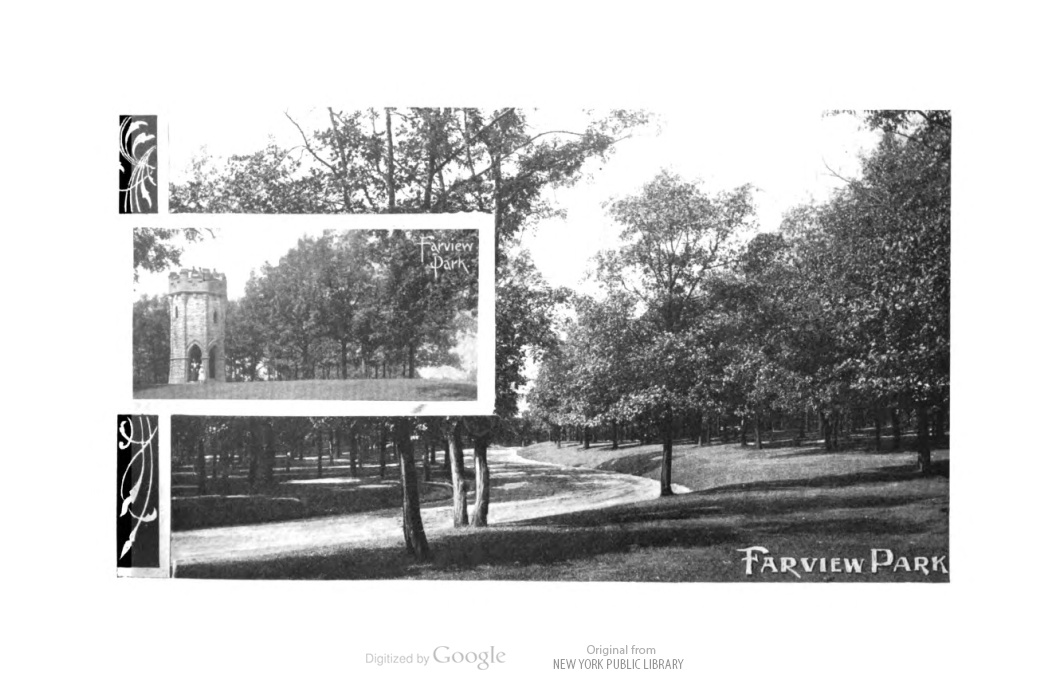
An illustration from the 1896 annual report praised by Manning
HathiTrust also allows you to create an account and establish your own “collections” from its vast catalog. It’s easy to set up a guest account. Here’s what I did: I put all available issues of the park board’s annual reports and proceedings, as well as most of the early books about Minneapolis history, such as Isaac Atwater’s and Horace Hudson’s histories, into a single “collection.” I can then search the collection for any terms I want. That means I can search for Lake Harriet or Powderhorn Park and find every reference to those park properties in park board documents—and other books—over many years. Such a capability saves hours of research because the park board annual reports and proceedings in the early years did not have indexes.
Annual reports are not available for some years in the Minneapolis park board’s first decade, but all annual reports 1895-1922 are available. HathiTrust also has many issues of the Minneapolis City Council proceedings, which provides for another layer of research. HathiTrust has also scanned many park board annual reports from 1923-1960. Due to copyright restrictions the full text of those reports is not available online, but a search will reveal if and how often terms do appear in those volumes. Not as helpful as full-view text searches, but still a big time-saver. You can then go straight to the pages you want in a library.
Give hathitrust.org a try. You’ll be amazed at what you’ll be able to find. The digitization for HathiTrust was done by Google, but the collection is far more extensive than what is available at Google Books.
David C. Smith
 Minneapolis Park History