Go Botts: Bottineau Athletic Club dominated Minneapolis park board sports for a decade
Filed under: Minneapolis parks | Tags: Bottineau Field, Marshall Terrace
 Comments (2)
 The young men on the east side of the Mississippi River in northern Minneapolis didn’t need much incentive to become a powerhouse in Minneapolis sports. They just needed a field, and the name it gave them.
Bottineau Field in Northeast Minneapolis was purchased by the park board in 1915 to be a recreation park. Fields and a temporary shelter were laid out the next year. Although a more substantial recreation center or field house was recommended for the neighborhood, it wouldn’t get more than the wood frame warming house for 40 years. But that didn’t matter to a talented group of young athletes and their persistent manager, Charlie Cells. From the time the park was open for business in 1917 through 1926 a core group of athletes grew up together—and won a few trophies along the way. The Bottineau Athletic Club, popularly called the “Botts,” won eight park board football championships and ten more citywide titles in baseball, basketball, volleyball and diamondball. The same group of kids, then young men, played everything.
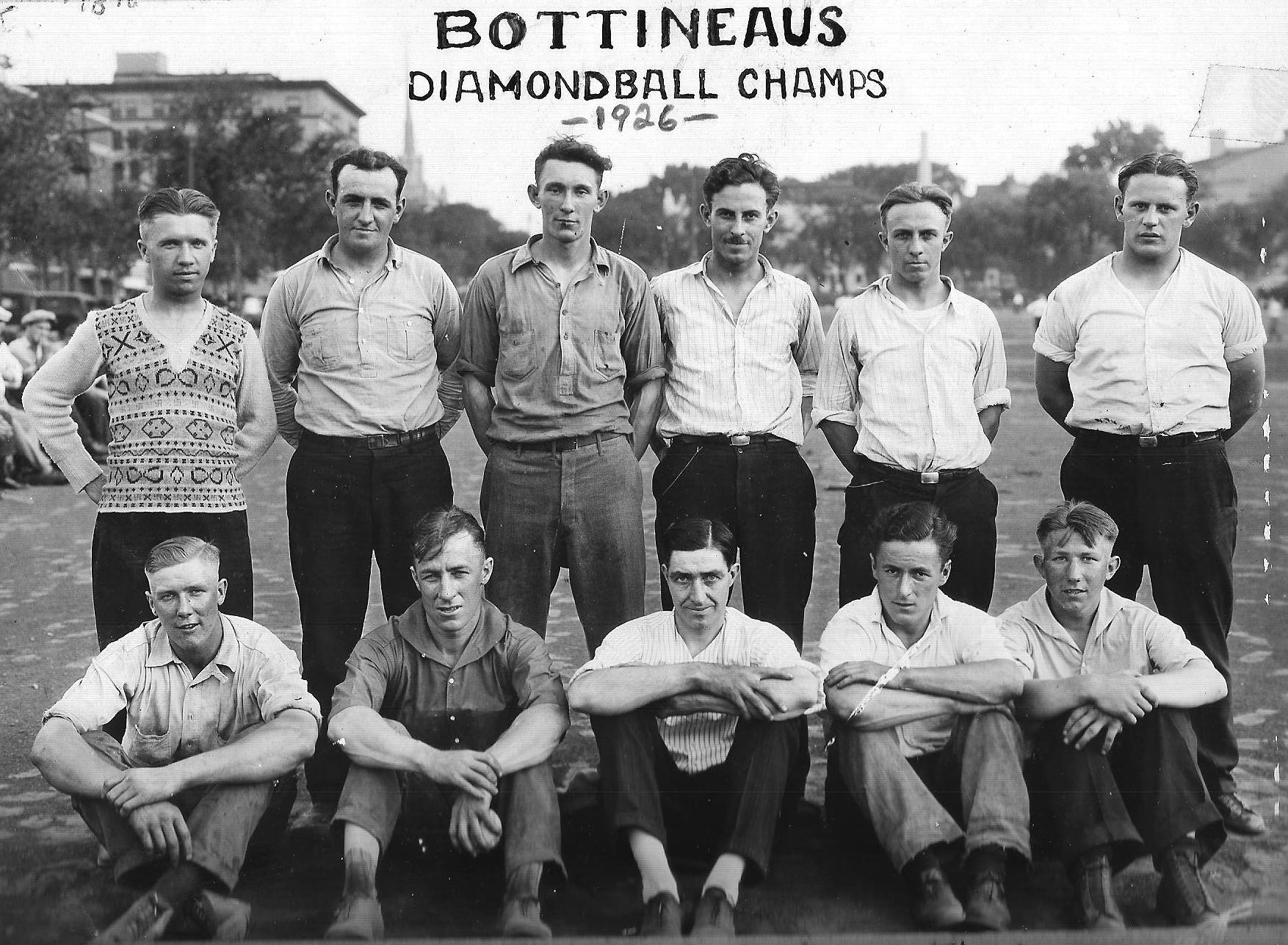
Bottineaus, Minneapolis diamondball champs, 1926, one of their last championships together. Front row (l-r): Carl Pearson, Tubby Burns, Haloran, George Besnah, Zig Bishop. Back row: Charlie Cells, Mgr., Pat Long, Boney Selinsky, Bloom Brothers, Swede Wilson. Manager Charlie Cells kept the scrapbook from which all of the “Bottineaus” pictures were copied. (Minneapolis Park and Recreation Board)
In addition to their Minneapolis championships, the Botts travelled the state to play the best basketball teams they could find and made it as far as the semi-finals of the Minnesota amateur baseball tournament in 1925.
This information is preserved in a scrapbook, “Bottineau ‘Cuts’ in Sports, Chas. A. Cells,” which comprises mostly newspaper clippings from 1925 and 1926. Most of the clippings are undated and appear to come from the Minneapolis Daily Star and Minneapolis Journal, although it is clear that some coverage of games played outside of Minneapolis, such as in Dawson and Ortonville, Minn., came from papers in those localities.
The highlight of the scrapbook and clippings is newspaper coverage of the battle for football supremacy in Minneapolis between the Botts and their nemesis from 1924-1926. Their rivals were also their neighbors, the Marshall Terrace team just up river. The Bottineaus and the Terraces, as newspapers called them, battled for the city title in all three of those years. The photo in City of Parks of a football game at Bottineau Field was of the city championship game between Bottineau and Marshall Terrace in 1926. The Minneapolis Journal estimated the crowd at 5,000.
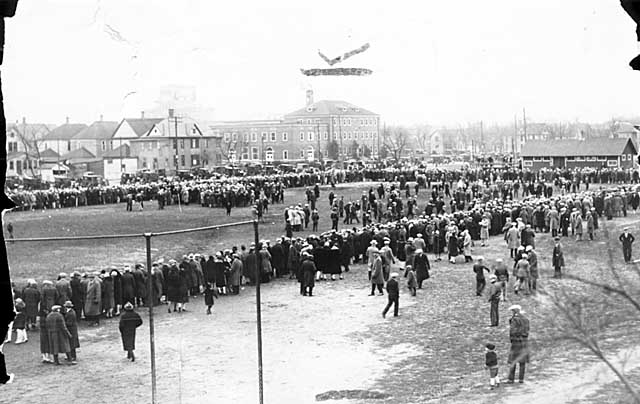
In the biggest game of the 1926 park league season perennial powerhouses Bottineau and Marshall Terrace played at Bottineau Field in front of a crowd estimated by the Minneapolis Journal at 5,000. The Botts defeated the Terraces on a 55-yard punt return by Charles Samek. (City of Parks, Minneapolis Journal, Minnesota Historical Society)
A similar crowd had witnessed the championship at The Parade a year earlier when special bleachers had to be erected for the big crowd.
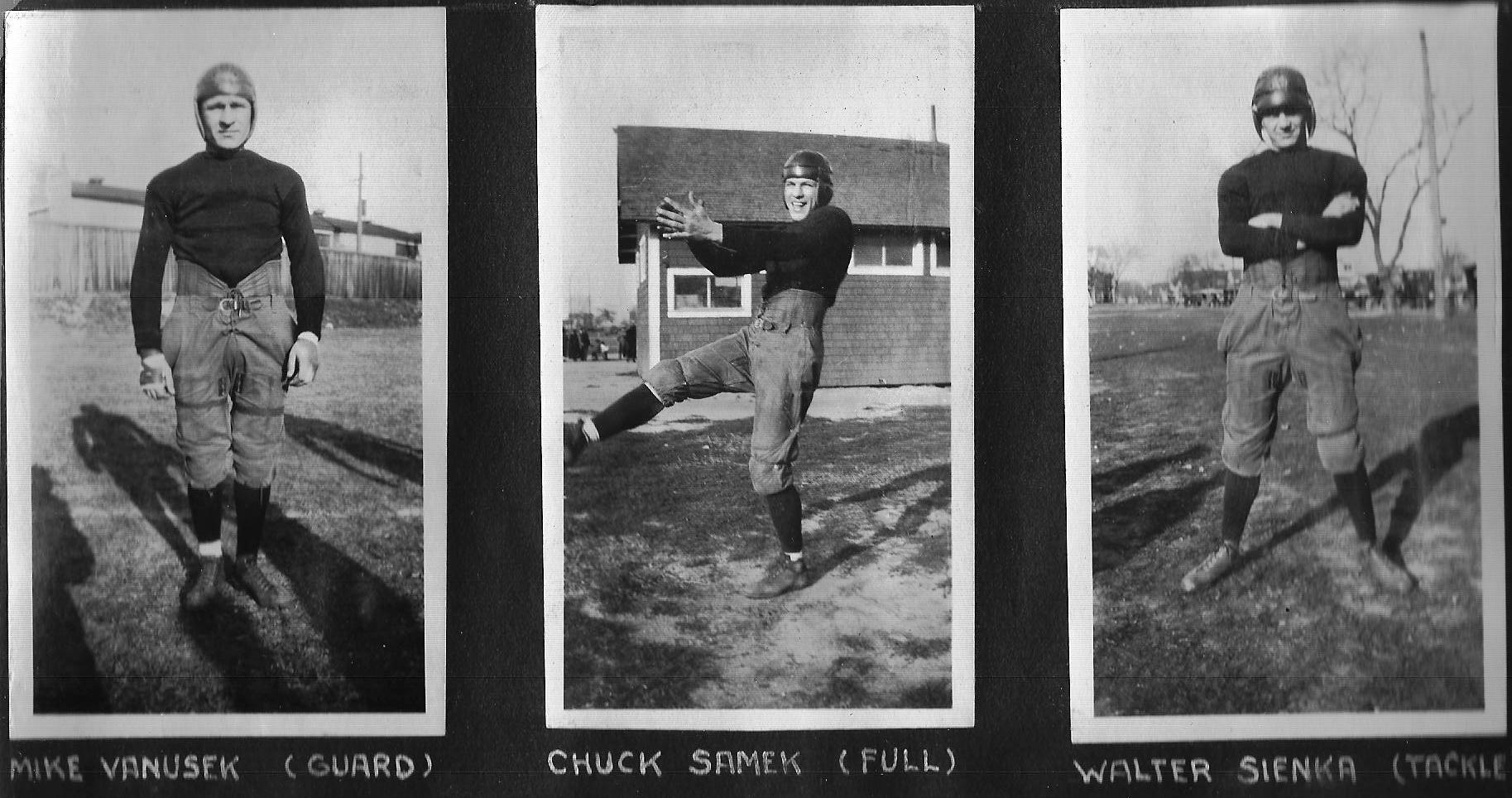
Bottineau football players, 1925. Mike Vanusek (guard), Chuck Samek (full), the hero of the 1926 game, and Walter Sienka (tackle). The building behind Samek is the Bottineau Field shelter that served the park 1916-1956. The original shelter did not have bathrooms. The park board moved two toilets from Loring Park to Bottineau in 1918. There is no record that indoor plumbing was added to this shelter before it was replaced in 1956. Does anyone remember toilets at the old Bottineau Field shelter? (Minneapolis Park and Recreation Board)
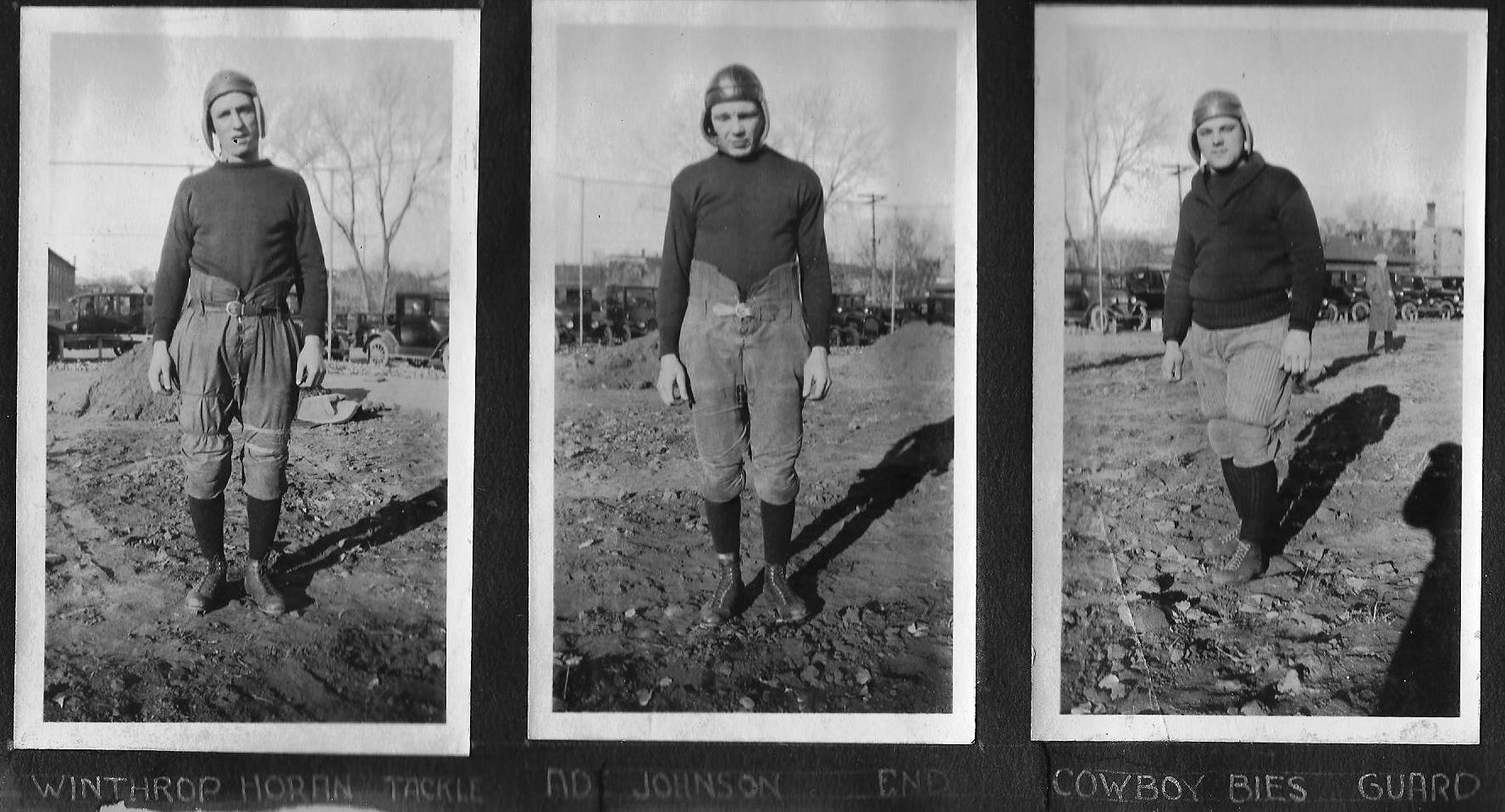
Bottineau football players, 1925. Winthrop Horan (tackle), Ade Johnson (end), Cowboy Bies (guard). I like the cars in the background. (Minneapolis Park and Recreation Board)
The Botts began in the junior division, but the players grew into the senior division winning consistently along the way. During the mid-1920s the Botts played a series of games against Gustavus Adolphus college from St. Peter. In 1924 the Botts prevailed 6-0 thanks to a blocked punt recovered for a touchdown. The scrap book contains one imposing image of a “giant” that played for Gustavus: Henry Goecken from South Dakota stood an amazing 6′ 4″ and weighed 198 pounds.
One reason for the Botts success over the years appears to be that they had at least one elite athlete: George Besnah.
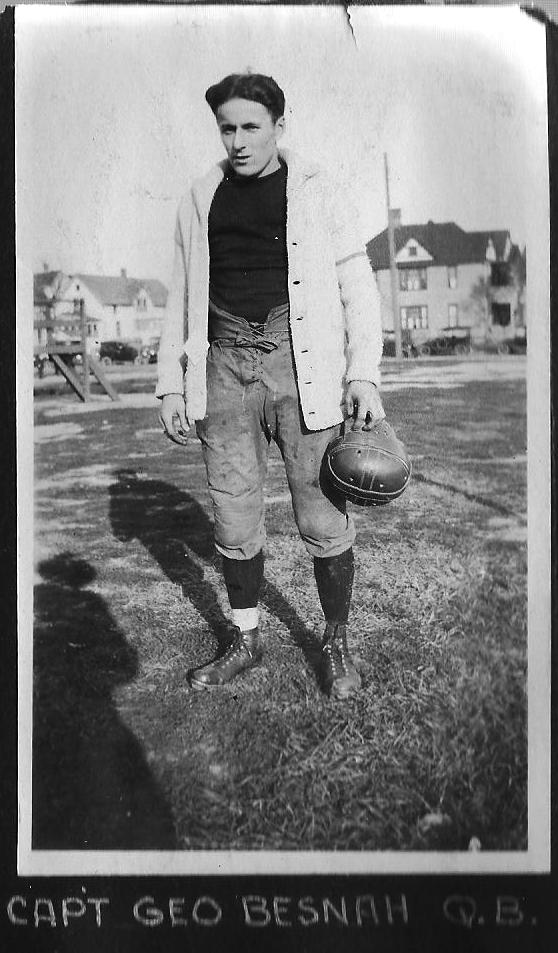
George Besnah was apparently the superstar of the Botts. He was the captain of the football team and a superb basketball player who played for a Chicago team in an early professional league. (Minneapolis Park and Recreation Board)
Newspaper clippings tell of Botts’ games in Mora, Sauk Center, Howard Lake, Dawson, Ortonville, Madison and Benson, and include requests for teams from Duluth, Redwood Falls and other towns to call Charles Cells to schedule games. One of those road games, presumably in Ortonville, prompted a reporter to write that the Botts had put on a “great exhibition of the court game.” The reporter went on to write:
But there was one player—George Besnah—who was the “cream of the lot” and his playing of the floor and his ability to dribble was well worth the price of admission. His play was a revelation, even more because he was not “out there” trying to make all the points himself, but to the contrary made fine use of his ability to pass to a teammate when such a play put his mate at better advantage.
Toward the back of Charlie Cells scrapbook, were a couple undated clips about George Besnah. The first one reported that Besnah, who had been playing for the Hopkins Independents, was in Chicago for a tryout with the Chicago Bruins in the American Professional League. The report continued that Besnah would be replaced on the Hopkins team by Joe Hutton and Fat Nordly, former Carleton College stars. (If you know Minnesota basketball, you know where this is going.)
Another clip delivered the news that Besnah had signed a contract to play with the Chicago Maroons of the National professional league. He was reported to have signed for $50 a game, a handsome sum, and would get into a Maroon uniform immediately. (There were two teams named the Chicago Maroons that I can find: one, was the University of Chicago, of Jay Berwanger and Amos Alonzo Stagg fame in football and the university team didn’t likely pay players (at least not that much!) ; and two, a team named the Chicago Maroons did play professionally, but it was a team of black players from Chicago. So I’m not sure exactly who Besnah signed with.)
Back to Besnah’s replacements on the Hopkins Independents. Joe Hutton went on to become the most successful basketball coach in Minnesota history in 35 years coaching at Hamline University. He won three national championships in the smaller college division, but Hamline played a high-level national schedule including games against NCAA champion City College of New York in Madison Square Garden and George Mikan’s DePaul team at Chicago Stadium. At one time seven of Hutton’s Hamline players were in the NBA, including Vern Mikkelsen, an NBA Hall of Fame player. Hutton was offered the job of coaching the Minneapolis Lakers, but chose to remain at Hamline.
(As a sophomore at Hamline I was looking for part-time work and was sent by the financial aid office to a house across Snelling Avenue from the university that needed painting. I was surprised to find that it was the home of Joe Hutton, who had retired as Hamline’s coach six years earlier. He wanted to hire a student to do his painting. While I painted, he told me basketball stories. He had recognized me from my freshman season playing basketball for Hamline; he still attended all the home games. I wish I had written down those stories.)
The other former Carleton star who was reported to replace Besnah on the Hopkins team was Carl Nordly who later became a professor and basketball coach at the University of Minnesota.
When the Botts finally decided to disband after the 1926 football season, Cells put a clip in the scrapbook that must have given him great pleasure. “Charles Cells, manager of the Bottineau Athletic Club,” the newspaper reported, “has been with the aggregation for many years and much of the credit for the splendid record of this group can be laid to Mr. Cells active interest and unselfish effort in bringing the organization to the highest point of perfection.”
Cells’ management of the club must have included fundraising, because in a clip about an appreciation dinner after one championship season, Cells thanked the businessmen of the East side for their support. Among the businesses he acknowledged were R. F. Bertch Furniture, Kozlak Bros. furniture dealers, Northeast Bakery, Bottineau Billiard Parlor, Hygienic Artificial Ice Co., Joe Schmidt Meat Co., Super Bros. drugs, Mergen’s Department store, East Side Bakery and Webster McDonald of McDonald Bros. (Another clip mentioned that one of the Botts trophies was on display at Mergen’s.)
Cells’ contribution to the Botts has now extended well beyond managing their varied teams: he left behind a scrapbook which gives us a glimpse of the exceptional group of athletes that grew up together on the east side of the river and dominated Minneapolis amateur sports for a decade.
David C. Smith
© David C. Smith
Minneapolis Park Memory: My Park
When I was a child, my family lived at 42nd Street and 33rd Avenue. My parents and brother often walked to Minnehaha Park on a sunny Sunday afternoon. We usually made one stop, at 46th Street, so my brother and I could ride the ponies. They had three pairs of ponies that went around and around and around. Mother packed a small lunch; we never took liquids because there were several water fountains in the park. The lower part of the park was fenced in for deer; it was called the “deer pen.” I have a picture of me standing on thh bridge in front of the falls dressed in my Sunday best. Mother had curled my hair to look my best for a trip to the park.
In teen years we ice skated on the lagoon above the falls. We had a warming house, as well as an iced toboggan run. A park employee monitored the run. In the summertime, my family would walk the trails on either side of the creek all the way down to the river, where we would wave to the people across the water. Every year we had our fall church picnic at the park. We used the wonderful pavilion with its restrooms, stoves and lots of picnic tables. This is most of my life. What would I have done without my park?
Gladys Wangstad
Minneapolis Park Memory: A Wonderful Gift
Filed under: Minneapolis Park Memory | Tags: Columbia Park, Lake Calhoun, Lake Harriet, Lake Nokomis, Minneapolis parks, Minnehaha Creek, Powderhorn Park
Leave a Comment About two years ago, when our son-in-law was in the North St. Paul Library, he saw David Smith’s book about Minneapolis parks. He bought one and gave it to me for Christmas. We have enjoyed reading it and looking at the pictures.
Jim became acquainted with Minnehaha Park and Parkway when he came to freshman orientation at Hamline in 1948. He particularly remembers the beauty of the lilac trees. When we lived in Rosemount, we came to Nokomis Park to picnic, swim and sail with friends. When we moved to Columbia Heights, Jim started to bike daily, and a few times each summer, he biked the Grand Rounds. We biked it with a church group a time or two. We continued to do that when we lived in Champlin and in north Minneapolis.
The house we owned since 1985 was near Lake Harriet and we biked around that lake and also Lake Calhoun and Lake of the Isles. We slid in the snow and watched our grandson’s rugby games at Columbia Park. We enjoyed many picnics near each of those lakes and the Rose Garden, Hiawatha, Nokomis, Farwell, Powderhorn and Wirth. Sometimes there were only two of us; other times it was a family gathering. We celebrated many birthdays and events by having picnics at a park. Following Thanksgiving dinner at our house, most of the guests enjoyed a walk around all or part of Lake Harriet. A recent memory is walking with our five-year-old granddaughter to a bridge over Minnehaha Creek and dropping sticks into the water and watching them float away. We are glad that our new home is near the Parkway, Minnehaha Park and Lake Nokomis, so we can continue to enjoy our wonderful gift of parks.
Phyllis Minehart
Public-private collaborations that work: Sea Salt, Tin Fish and…Bread and Pickle?
Filed under: Lake Calhoun, Lake Harriet, Minneapolis Parks: General, Minnehaha Falls | Tags: Horace Cleveland, Lake Calhoun, Lake Harriet, Minnehaha Falls, Theodore Wirth
Comments (1) The mention of Sea Salt restaurant in Alice Streed’s Minneapolis Park Memory: Treasure (below) is noteworthy. A relatively new development in our parks is mentioned in the same sentences as long-celebrated spaces and activities. The popular restaurant in the Minnehaha Park refectory — run as a private, for-profit business — is a marvelous example of the best of public-private collaboration. It proves that private enterprise can do some things, such as serving delicious sea food, better than a public agency. I believe it also demonstrates the silliness of claims that the sky is falling whenever an agency like the park board considers change.
Lest private enterprise advocates get carried away here, however, let me state quite emphatically that there would be no park system in which to place these wonderful little restaurants if we would have relied on private interests to create parks. Our parks prove that public agencies can do some things, such as creating a park system, that private enterprise will not do.
The debate over allowing businesses to operate in Minneapolis parks is old — and sometimes entertaining. The park board began granting concessions for boat rentals, then food sales, to private businesses at Lake Calhoun and Lake Harriet very early in the history of Minneapolis parks. The park board assumed control of the boat rentals at Lake Harriet in the late 1880s when Charles Loring noted that the business could be easily managed by the park board. On other issues, however, the presence of private enterprise on park property was vigorously opposed.
Permit me to quote myself — and Horace Cleveland — from City of Parks:
(Cleveland) had also written (to William Folwell) of his disgust that the park board was considering permitting a structure next to Minnehaha Falls where people could have their photos taken beside the cataract. “If erected,” Cleveland complained, “it will be simply pandering to the tastes of the army of boobies who think to boost themselves into notoriety by connecting their own stupid features with the representation of one of the most beautiful of God’s works.”
You didn’t mess with Cleveland’s favorite natural landscapes — one of the things that made him one of the first great landscape architects. Fortunately, William Folwell, who was president of the park board at the time, agreed with his friend.
Another early private business on park property was a service to pump up deflated bicycle tires on the new bicycle paths created by the park board during the bicycle craze of the 1880s-1890s. The park board did exercise some control over the business, however, by stipulating that the business could not charge more than a penny for filling a tire.
The park board began to take over food service in park buildings after Theodore Wirth became park superintendent in 1906. Wirth, like many park executives of the day, believed that no private concessions should be operated in parks — although he seemed to make an exception for pony rides and probably would have for the polo fields and barns he proposed for Bryn Mawr Meadows. (And, of course, the sheep he brought in to graze at Glenwood Park in 1921 were not owned by the park board. Wirth wrote that he thought sheep grazing in a park was a cool visual effect and that the sheep would earn their keep by cutting grass, keeping weeds down, which reduced fire risk, and fertilizing. Unfortunately they didn’t mow evenly and ate other plants too, so the borrowed sheep were evicted in 1922. ) One of the few other historical examples of a private venture operating on park property was the Minneapolis Tennis Club, which operated first at The Parade and then moved to Nicollet (Martin Luther King) Park in the early 1950s when Parade Stadium was built.
Do you remember concession stands in parks? What about treats at the Calhoun, Nokomis or Wirth beach houses? As good as fish tacos?
I have high hopes for Bread & Pickle, the new food service contracted for Lake Harriet next summer. I hope the Citizens Advisory Council that worked so hard on the recommendations wasn’t too conservative in forcing a new service into old space.
David C. Smith
The “Brownie” in Brownie Lake
Filed under: Minneapolis parks | Tags: Agnes "Brownie" McNair Hull, Brownie Lake, Cedar Lake Parkway, Charles M. Loring, Minneapolis parks, William McNair, Wilson Park
Comments (2) In the historical profile I wrote about Brownie Lake for the Minneapolis Park and Recreation Board, I reported that I had found a handwritten note on an old park board document that attributed the lake’s name to the nickname of William McNair’s daughter. Now, I’ve also found a newspaper reference to that.
The Minneapolis Tribune of November 13, 1910 reported on the origin of the names of Minneapolis lakes. The article said Brownie Lake was taken from the nickname of Mrs. Louis K. Hull. Louis Hull, a prominent young attorney in Minneapolis, married Agnes McNair, one of two daughters of William McNair, on December 12, 1892.
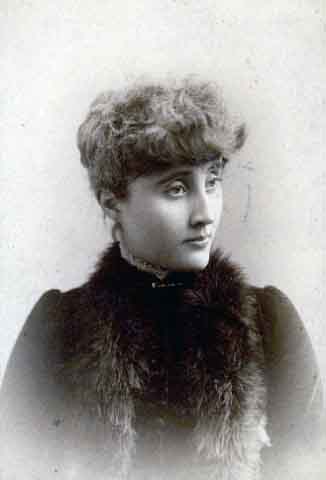
Agnes “Brownie” McNair Hull, namesake of Brownie Lake, about 1890 (Jordan, Minnesota Historical Society)
William McNair was an influential attorney and businessman in Minneapolis who had died in 1885. Among his many real estate holdings in the city was a 1,000-acre farm that stretched across much of near north Minneapolis to include Brownie Lake. At the time of his death he was said to be in negotiation with the park board to donate a 100-foot-wide strip of land for a parkway that would have extended from Lake of the Isles, around Cedar Lake, to Farview Park in north Minneapolis. It was said he already owned nearly all the land that would be required for that four-mile parkway. His obituary (September 16, 1885, Minneapolis Tribune) claimed that he was building a mansion at 13th and Linden (facing Hawthorne Park) that would rival W. D. Washburn’s “Fair Oaks” in south Minneapolis. Louise McNair, his widow, apparently finished it, judging by this photo. Whatever happened to it? Did it outlive Fair Oaks?

McNair home, about 1890, Hawthorne Park, Minneapolis. “Brownie” McNair was married here. (Minnesota Historical Society)
A curiosity about Brownie Lake: about half of the lake was platted into streets and “blocks.” The map of Cedar Lake and environs in the 1909 annual report of the park board shows Drew, Chowen and Beard avenues platted through Brownie Lake. Much of the land for Cedar Lake Parkway, and park board control of Cedar Lake, came from donations by McNair’s widow, Louise. She was the sister of McNair’s first law partner, Eugene Wilson, who was an important park commissioner and the attorney for the first park board. Hawthorne Park, where the McNair’s were building their mansion, was later renamed Wilson Park after Eugene Wilson. Wilson Park was condemned in the 1960s to become part of the I-94 interchange.

Wilson Park, once known as Hawthorne Park, in about 1942, looking southwest with Basilica in background (Jack Delano, Minnesota Historical Society)
The park and playground west of Cedar Lake, which has always been known as Reserve Block 40, but never formally named, is in a neighborhood known as McNair Park. As residents of the Bryn Mawr neighborhood consider renaming Reserve Block 40, they could do worse than to keep the McNair Park name.
A final bit of Brownie Lake-related trivia: One of the pall bearers at William McNair’s funeral was Charles M. Loring. What makes that noteworthy in these days of political and philosophical rancor is that Loring and McNair were local leaders among Republicans and Democrats respectively. Clearly they were able to see past their political differences.
David C. Smith
© David C. Smith
The Good Old Days
The men and women of today who recall with lively joy the days when they played unwatched through the long summer days in meadow or woods or the old swimmin’ hole are likely to pity the youngsters of the present whose recreation is supervised and scheduled by grownups. For young dreamers with vigorous personalities there was something not to be duplicated in the lazy happiness of those days. But “other times, other customs.” City life of today is immeasurably more complicated: it has manifold possibilities for evil, numerous forces which make the child sophisticated before his time and which make a carefully planned constructive work necessary.
Overheard that discussion lately? Had it yourself?
The quote was taken verbatim from an article about park playgrounds in the Minneapolis Tribune, June 20 — 1920.
Do you have a story about playgrounds in the summer when you were a kid? Send it to me.
David C. Smith
The Smack and Tang of Elemental Things
Filed under: Minneapolis Park Hero, Minneapolis Parks: General | Tags: Charles M. Loring, Edwin Markham, Florence Barton Loring, Henrietta Jewett Keith
Comments (10) One of the coolest things I’ve ever purchased online was a book of poetry about trees published in 1923 or 1924. Not your ordinary, run-of-the-paper-mill tree poetry book. It was published by Florence Barton Loring as a remembrance from her husband, Charles M. Loring, “The Father of Minneapolis Parks.” (Do not accept imitation “creators” of the Minneapolis park system. More to come on that subject.) Only forty-eight pages with a hard cover. The little book was explained this way in a brief foreword by Mrs. Loring:
In explanation of this booklet’s publication, it may be stated that my beloved husband requested me, when circumstances favored, to compile a collection of verses from which we had derived much pleasure, on the subject of trees, for distribution as a parting souvenir of himself, among those who knew him well, and share his tastes and enthusiasm…It does not require this parting remembrance from Charles M. Loring to keep his memory alive in the hearts of his friends, but that may render it none the less acceptable to the recipients; while, to the compiler, it has been not only a means of redeeming a promise, but, also, has provided a labor of love.
Poets included range from Byron, Longfellow and William Cullen Bryant (Bryant Avenue) to Minnesota poets Henrietta Jewett Keith and May Stanley.
The poem excerpt that caught my attention though was a few lines from “Lincoln: The Man of the People,” by Edwin Markham. Loring cites only six lines of the poem including the closing four lines:
And when he fell in whirlwind, he went down
As when a lordly cedar, green with boughs,
Goes down with a great shout upon the hills
And leaves a lonesome place against the sky
That was perhaps Mrs. Loring’s tribute to Lincoln as well as her husband, who had been a stalwart of Lincoln’s party. But she left out Markham’s great description of Lincoln including the fabulous line used as a title here:
The color of the ground was in him, the red earth;
The smack and tang of elemental things;
A reading of Markham’s poem was part of the dedication of the Lincoln Memorial in Washington, D.C. in May, 1922. Markham, who had published the poem in 1901, read it himself. The dedication took place a little more than a month after Charles Loring died at the age of 88.
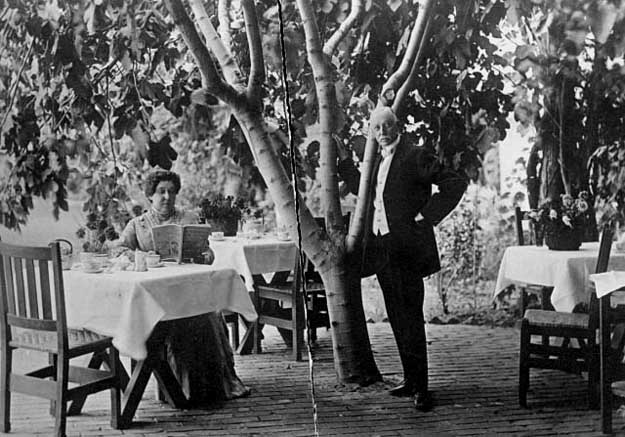
Florence Barton Loring and Charles Loring, about 1915, likely in Riverside, California where they often spent the winter. (Minnesota Historical Society, por 16225 r3)
I first saw the book at the Minnesota Historical Society Library in St. Paul (there is also a copy in Special Collections at the Hennepin Country Central Library downtown Minneapolis). Because relatively few copies were printed for gifts to Loring’s friends I was surprised to find one for sale online from a Los Angeles rare book dealer. It is one of only a few souvenirs I have collected from my research of Minneapolis parks.
More on Florence Barton Loring soon.
David C. Smith
© David C. Smith
Minneapolis Park Memory: Logan Ice
Filed under: Minneapolis Park Memory | Tags: Logan Park, Minneapolis parks
Comments (1) My park was Logan. In winter, there were hockey rinks, a beautiful skating area and a pavilion that featured many programs. In summer, many musical programs took place on an outdoor veranda. My favorite winter sport was ice skating, so I visited Logan Park almost daily.
Charlotte Brisley
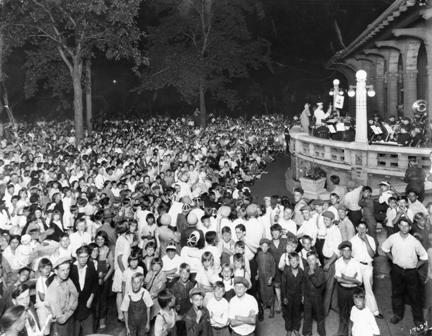
Community sing at the Logan Park Fieldhouse (City of Parks, Minneapolis Park and Recreaton Board).)
Minneapolis Park Memory: Treasure
Filed under: Minneapolis Golf Courses, Minneapolis Park Memory, Minneapolis Parks: General | Tags: Hiawatha Golf Course, Lake Harriet, Minnehaha Park, Powderhorn Park
Comments (1) How I have enjoyed the Minneapolis parks: watching fireworks at Powderhorn Park; concerts at Lake Harriet, with picnics on the hill; swimming and canoeing at Calhoun; walking in Minnehaha Park and eating crab cakes at Sea Salt; walking and biking at Nokomis; watching my children play hockey at various parks, and baseball at McRae and Diamond Lake; teaching the children to skate at Diamond Lake; my sons in their early teens taking the bus from our home at 48th and Clinton all the way to Theodore Wirth Park to play golf; my boys golfing at Hiawatha and telling us that they played with two really nice “old guys.” (These “old guys” happened to be friends of ours from church and were our age, in their 40s.)
My son Glen would leave the house in the summer early in the morning, bike to Lake Harriet with his fishing equipment, climb on a tree branch overhanging the lake and stay until suppertime. He enjoyed being outdoors even if he didn’t catch fish.
But here is my most treasured memory: In 1945, my future husband took me canoeing at Calhoun and then into Lake of the Isles, and gave me my engagement ring.
Alice Streed

The Romantic Route (from City of Parks, Minneapolis Park and Recreation Board)
Minneapolis Park Memory: A Hike Down Memory Lane
Filed under: Minneapolis Park Memory, Minneapolis Parks: General | Tags: Minneapolis parks, Minnehikers
Leave a Comment The Minneapolis Municipal Hiking Club celebrated its 90th anniversary this year. On the first Saturday of January every year, we do an anniversary hike, starting at Rarig Center on the West Campus and continuing on West River Parkway all the way to Minnehaha Falls. The hiking club was started by Theodore Wirth in 1920, and they hiked from Minnehaha Falls to Riverside Park, where they cooked coffee over an open fire and enjoyed donuts. The club has done this hike every year, but in reverse. I have hiked this route many times, even in bitter cold weather, as cold as minus 16 degrees. We end up with dinner at one of the churches. I believe the hiking club has hiked in every park in Minneapolis over the years. The club has also donated over $21,000 for flowering crabapple trees and other tree varieties, also benches by the rose and peace gardens. I recently helped edit a history booklet highlighting some of the activities and trips taken by members.
Edith Johnson
Editor’s note: For more information on the history of the Minneapolis Municipal Hiking Club, or Minnehikers, visit the Special Collections department of the Central Library in Minneapolis. The collection includes hiking club yearbooks for almost every year 1924-1999. The Minnesota Historical Society Library has a more limited collection featuring the earlier years.
We would enjoy reading more memories of club hikes in these pages.
Minneapolis Park Memory: Best Days of My Life
Filed under: Minneapolis Park Memory | Tags: Brackett Park, Keewaydin Park, Longfellow Park, Minnehaha Falls
Comments (3) I grew up in South Minneapolis and enjoyed all the parks especially Minnehaha and the Falls. I have a picture of my Girl Scout Brownie Troop taken there (that would be along time ago). My family has had many wiener roasts at the “deer pen” and several family reunions attended by 80+ people from many different states. We just had one this past August at Wabun Park at the east end of Minnehaha Park. It has recently been remodeled and is a wonderful park.
My best memories have to do with our local neighborhood parks that aren’t necessarily on a tourist’s list, such as Keewaydin, Brackett, Longfellow, Hiawatha and many others. My favorite park was Longfellow, where my husband spent his childhood years skating and playing hockey, football and baseball. He was president of the Longfellow Activities Council for seven years and was a baseball coach. Those were the “good old days” when you could send your kids to the park without worrying about kidnapping and the like.
Activities at the park brought kids and parents together; we were one large family that would be known as a “village” today. Those were the best days of my life.
Shirley Adler
Minneapolis Park Memory: North to South
Filed under: Minneapolis Park Memory | Tags: Glenwood Park, Lake Hiawatha, Lake Nokomis, Minnehaha Falls, Victory Memorial Drive, Webber Pool
Comments (6) Minneapolis truly is a “City of Parks” for everyone — north, south, east , and west. As a ten-year-old tomboy in north Minneapolis, the neighbor kids and I would hike three miles to Glenwood Park, where we hunted for golf balls at the golf course, climbed the ski jump, and went wading in the creek until the golf workers would yell at us, “Hey, you little brats, get the heck out of that ‘crick’ NOW!” We would find a shady spot and dry off, giggling while eating our peanut butter and jelly sandwiches. Or we would hike along Victory Memorial Drive to the Camden Pool, where every kid in north Minneapolis came to swim or get a bath. It was jam-packed with grubby young bodies all day long! When I was twelve, we moved to south Minneapolis, the Nokomis Lake and Lake Hiawatha area, another neat area for having fun in the parks.
After marriage and four kids, it was my kids who kept up the “fun in the parks” tradition, especially at Minnehaha Park. They investigated every nook and cranny, often ending up at the Falls, where they would crawl down the steep banks to the bottom of the Falls and work their way behind the water falls so nobody could see them and then make scary sounds and howls when little kids came to look at the water falling. Down the path from the Falls to the river was a large tree on a high bank. My son found a sturdy branch to which he tied a long, 2″-wide rope. Then he crawled to the top of the bank, holding the rope firmly an gave a bloodcurdling “Tarzan” yell, swinging form the top of the bank to a small island in the river where he landed. All the kids had a good time with the “Tarzan tree.” There weren’t so many park police or restrictions to keep kids from getting into mischief in the 30s to 60s, but I don’t recall any accidents occurring.
Thanks to Theodore Wirth and the Minneapolis Park Board for their foresight and wonderful planning of our great park system. There is so much for our enjoyment, and it’s free.
Judy Knutson
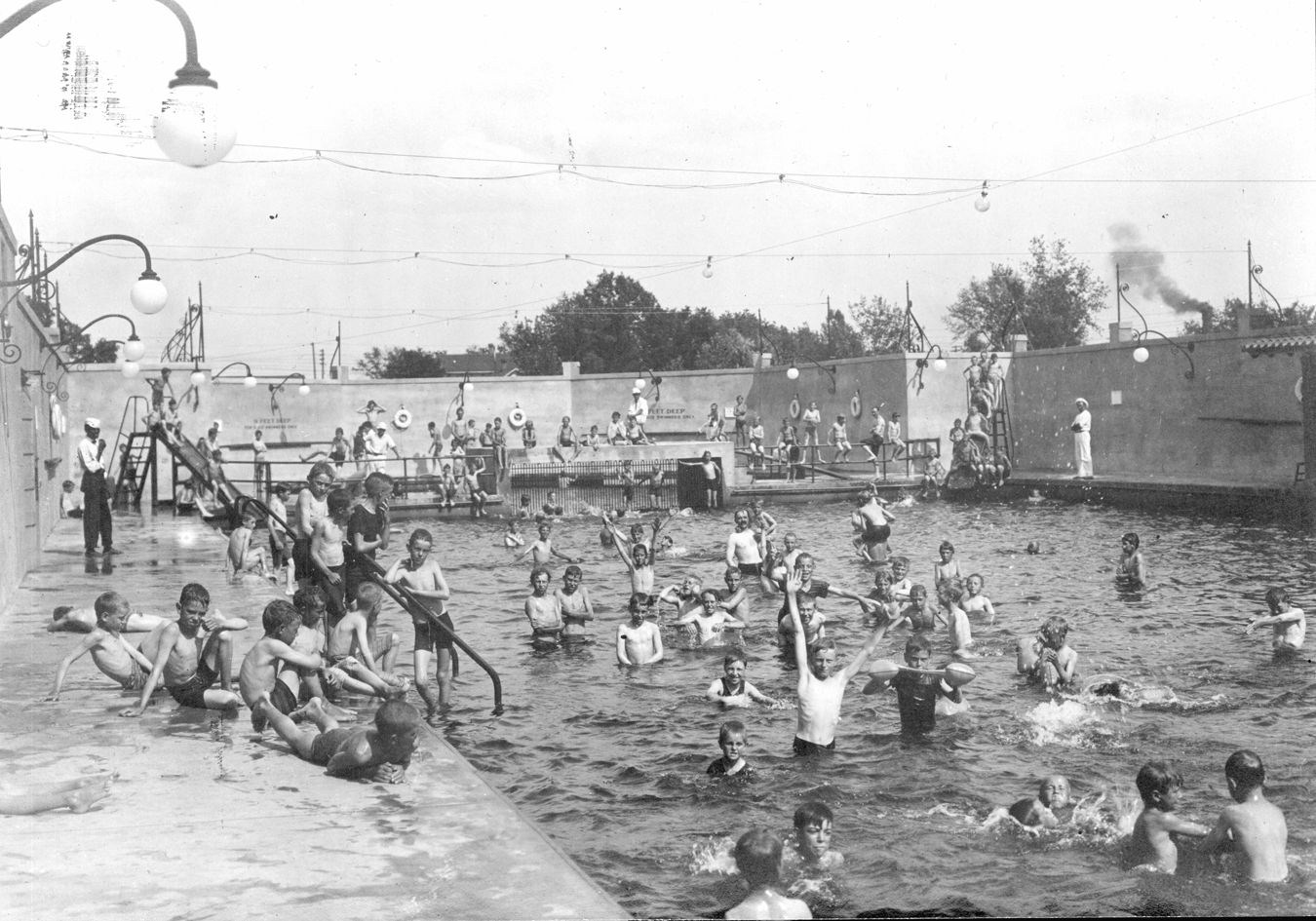
Webber Pool, year unknown. From the time it was built in 1910 until 1927, water was diverted form Shingle Creek to fill the pool. Beginning in 1927 the pool used filtered and chlorinated city water. In the early years, boys and girls used the pool at different times. One reason for the high wall around the pool was to prevent boys and girls from watching each other swim. In the 1930s, more than 1,500 children under the age of 14 used the pool every summer day. (City of Parks, Minneapolis Park and Recreation Board)

 Minneapolis Park History