Charles M. Loring, Father of Minneapolis Parks
Filed under: Minneapolis Park Hero, Minneapolis Parks: General | Tags: Charles M. Loring, Minneapolis parks
 Comments (2)
 “We must all work and work together, and it will be but a short time before we shall see what a united effort and good example can do toward forming a public sentiment so strong that the city government will give us the trees and parks we so much need for breathing spaces for the poor who cannot ride to the country for air.”
— Charles M. Loring, April 14, 1882
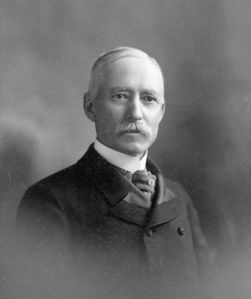
Charles M. Loring, Father of Minneapolis Parks, about 1900 (Brush, Minnesota Historical Society)
If you’ve read City of Parks or the history of Loring Park at minneapolisparks.org you already know how much I admire Charles Loring, the first president of the Minneapolis Board of Park Commissioners (BPC). He was one of the most effective advocates for parks before the park board was created and during a couple stints on the park board. He was a man of national reputation and influence on park matters. In addition, he donated the recreation shelter at Loring Park in 1906, paid for an artificial water fall to be built beside Glenwood (Wirth) Lake in 1917, and paid for the original trees for Victory Memorial Drive and created a $50,000 fund for the perpetual care of those trees. He was one of the most remarkable men in Minneapolis history. So once in a while I will tell a story here about Charles Loring that I haven’t had space to tell anywhere else. I will likely do the same for William W. Folwell, but that comes later.
On April 14, 1882, nearly a year before the creation of the BPC by the Minnesota legislature, Loring was asked to address the first annual meeting of the Oak Lake Addition Improvement Association. The neighborhood, which once stood where the Farmer’s Market now stands beside I-94, was the first in the city to create a homeowners association to care for the streets and grounds and sanitary requirements of a neighborhood. For their annual meeting, which was held at Hennepin Avenue Methodist Church, they asked Loring to speak about the care and culture of trees in the city.
According to newspaper coverage, Loring’s remarks focused on the experiences of W. R. Smith, the superintendent of parks in Washington, D.C. and the president of the Botanical Garden there. The park commission in D. C. had the power to plant and remove trees at will and they consulted with no one. (Loring obtained that same much-envied power for the BPC from the Minnesota legislature in 1887.) Loring commented that he thought Congress had done a very wise thing when it put the important matter of trees in the hands of arboriculturists “who go about their work without fear or favor,” Loring said.
Loring told that night of an unnamed U. S. Senator who sent a messenger to W. R. Smith asking if the superintendent could not remove a tree that the Senator believed obstructed his view from a window in his home. Loring said Smith responded by asking the Senator if he could not move his house.
The tree stayed and Loring had a story that entertained an influential Minneapolis audience and perhaps helped nudge public sentiment toward acceptance of a park commission that would also plant trees without fear or favor and convert a city that was largely open prairie into one of the greenest cities in the United States.
David C. Smith
First African-American golfers in Minneapolis
Filed under: Minneapolis Golf Courses, Minneapolis Parks: General | Tags: Minneapolis golf, Minneapolis parks
Leave a Comment I don’t have plans to write more about the first private golf courses in the Minneapolis area, as noted in my last post, but I do have interesting information on the creation of the first public golf courses in Minneapolis parks. Someday.
I’ll also write about efforts to integrate the private golf clubs that operated out of Minneapolis park golf courses in the early 1950s. At the center of that story were representatives of the Twin City Golf Association, an organization of black golfers — Frederic Jones, Bert Davison, John Williams, L. Howard Bennett and others — and one of the more colorful park commissioners ever, Ed Haislett. Haislett was a boxing champion, a professor, and the author of a book on boxing that was plagiarized by martial artist movie star Bruce Lee. How’s that for a resume?
Read more »
Minneapolis Golf Clubs Go To War
Filed under: Minneapolis Golf Courses, Minneapolis Parks: General | Tags: Minneapolis golf, Theodore Wirth Park
Comments (2) One more bit of information about the oldest golf courses in Minneapolis, then I’ll move on.
I found this item in The American Golfer, June 1917:
“Four private golf clubs in Minneapolis are going to utilize a portion of their grounds for raising foodstuffs this summer. At the University Club more than 25 acres will be plowed up. The Minneapolis Club has set aside 4 acres for potatoes, and Interlachen and Minikahda will devote all available spaces to small garden truck. One hunderd caddies of the Town and Country Club have organized a military company.”
The actions were in response to the United States entry into the “Great War” in April 1917.
The golf course at the University of Minnesota and the first public golf course in Minneapolis—at Glenwood Park, now Theodore Wirth Park—had only opened in 1916. Both courses were nine holes at that time.
After the Minneapolis Board of Park Commissioners opened the Glenwood golf course in June, 1916, The American Golfer noted that only Oakland and Portland among “western” cities did not have municipal golf courses.
David C. Smith
The Mother of All Minneapolis Golf Courses: Bryn Mawr II
Filed under: Minneapolis Golf Courses, Minneapolis Parks: General | Tags: Bryn Mawr, Interlachen Club, Minikahda Club, Minneapolis golf, Minneapolis parks, Theodore Wirth Park
Comments (3) When the golf and social activities of the Bryn Mawr Club shifted to the newly opened Minikahda Club at Lake Calhoun in July 1899, the Bryn Mawr golf course and club house didn’t stand empty for long. Two weeks after the Minikahda Club opened—and promptly became the hub of Minneapolis social life—golfers were already at work to get back on the Bryn Mawr links.
The Minneapolis Tribune on August 9, 1899 attributed the interest in reviving a golf club at Bryn Mawr to “young businessmen who find the Minikahda links at too great a distance from the city.” The paper speculated that the organizers of the new club also expected that the links could be used “at comparatively little expense.” A meeting of those interested in organizing the new club was announced at the West Hotel.
The Mother of All Minneapolis Golf Courses: Bryn Mawr I
Filed under: Bryn Mawr, Lake Calhoun, Minneapolis Golf Courses, Webber Park | Tags: Bryn Mawr, Lake Calhoun, Minikahda Club, Minneapolis golf, Minneapolis parks
Comments (2) The first golf course in Minneapolis was not Minikahda. A year before Minikahda opened, many of its members, Minneapolis’s highest society, played at a course much closer to the central city. The first Minneapolis golf course and club were in Bryn Mawr. The course didn’t last long, a little more than 10 years, but it did spawn two of the more famous golf courses in Minnesota: Minikahda and Interlachen.
When I discovered Warren Manning’s proposal for a public golf course at The Parade in 1903, I became curious about the first golf played in Minneapolis. I wanted to know what led up to the park board creating the first public golf course at Glenwood (Wirth) Park in 1916. I was surprised to learn about courses, or plans for them, at four locations in the city by 1900. The only one that still exists is Minikahda, which overlooks Lake Calhoun.
The first mention I can find of a golf course in Minneapolis — St. Paul already had Town and Country just across the Mississippi River at Lake Street — was in a Minneapolis Tribune article from April 23, 1898, which noted that twenty men who were interested in golf and wanted links closer than Town and Country had met at the West Hotel on Hennepin Avenue for the purpose of forming a Minneapolis golf club. The paper reported, “The grounds proposed are in Bryn Mawr and the high land west, ideal in location and well adapted to links, with sufficient hazards to make the game interesting.” The article also mentioned that the course was advantageously placed near the streetcar line, which ran out Laurel Avenue.
Less than two weeks later, the Tribune reported that the Minneapolis Golf Club had been formally organized, the links were almost ready for play, and a greenskeeper—Scottish, of course—had been hired away from the Chicago Golf Club in Wheaton, Illinois. He called the new course the “best inland links he had seen,” according to a Tribune article a few days later.

Golfing at Bryn Mawr in 1898. (Photo from Visual Resources Database at Minnesota Historical Society, mnhs.org.)

Golf duds at the turn of the century.
The Bryn Mawr clubhouse was formally opened on June 18. The Tribune reported the next day that several hundred people attended. “An orchestra greeted the visitors with music,” wrote the Tribune, “and there was a stream of handsome turnouts over the Laurel avenue bridge, bringing the women in their lovely summer frocks to smile on the men in their gay golfing suits.”
The nine-hole course measured a bit over 2300 yards with only two holes longer than 300 yards. The first tee was west of the clubhouse and the first green was on the east side of Cedar Lake Road. The second green was across that highway and a small pond.
Par for the course, at that time referred to as “bogey,” was set at 45 strokes. That must have seemed an impossible achievement for club members, based on early scores. At the first handicap tourney on the day the clubhouse opened, Martin Hanley beat a field of 40 golfers for the prize of a box of gutta percha balls. His net score was 101. Adding his handicap of 30, he had actually played the course in 131 strokes! That’s not three over par, it’s nearly three times par. The game was young. Hanley remained one of the club’s top golfers after the club moved to Minikahda.
It’s worth noting that the most thorough description of the new course and club appeared on May 15, 1898 in the Tribune’s society column, not its sports pages. The list of the first 200-plus members reads like a who’s who of early Minneapolis society: Pillsbury, Peavey, Heffelfinger, Jaffray, Rand, Lowry, Bell, Dunwoody, Christian, Morrison, Koon, Loring. The original plan was to admit 150 men and 100 women as members, but the initial number of female applicants was a bit lower than expected at only 62.
The new club had not only a course and greenskeeper, but a club house. The Woodburn residence had been “secured” for that purpose. The clubhouse featured “capacious rooms” and “broad verandas” and was being renovated to provide locker rooms and a restaurant. The location of the clubhouse is indicated by a report in the Saint Paul Globe of July 27, 1898 of a fire at the “quarters of the Bryn Mawr Golf club at the rear of 95 Elm Street.” Elm Street was later renamed Morgan Avenue North. So what was then 95 Elm Street would now likely be in Bryn Mawr Meadows—but that was more than ten years before Bryn Mawr Meadows was a park. The Globe reported that the total loss from the fire was not expected to exceed $200, so it was not likely a factor in the decision of the club to build a new clubhouse in a new—and now famous—location the next year.
Over the winter the members of the Bryn Mawr golf club must have become dissatisfied with the course or clubhouse or both, because the membership built a new golf course and a much grander clubhouse near the western shore of Lake Calhoun, the Minikahda Club.
On June 25, 1899 the Minneapolis Tribune reported, “Although somewhat late in starting its tournament season, the golf club which is now using the Bryn Mawr links until the Minikahda links are completed, had its tournament yesterday afternoon.” Some of the golfers at the club must have been quick learners, because early in the club’s second season scores had dropped dramatically. C. T. Jaffray won the opening tournament with a score of 85. The Tribune noted that the club was looking forward to the opening of the Minikahda clubhouse in “about three weeks.”
Roughly on schedule, the Tribune announced on July 14, “the activities that have centered around the Bryn Mawr links since the first of the season will be transferred tomorrow afternoon to the Minikahda links…The new club house on the west shore of Lake Calhoun is practically finished.”

The Minikahda clubhouse overlooking Lake Calhoun. The club’s boathouse was removed several years later when the club and other land owners along Lake Calhoun donated land for a parkway along the shore.
That was not the end of the Bryn Mawr golf links, but before it was resurrected another Minneapolis golf course emerged. “The Camden Park golf club has been organized among the young men in the employ of the C. A. Smith Lumber company,” the Minneapolis Tribune reported on July 21, 1899. The new club had a membership of 25 and growing. “It plays over a beautiful course of nine holes laid out in the Camden park region and crosses the creek three times,” wrote the Tribune. The reference must have been to Shingle Creek.
As with the Bryn Mawr course, it is not clear that the club owned the land on which it had laid out its holes. Although the Tribune noted that the new club was “particularly fortunate in its course” and that the club “anticipates becoming a large and influential organization some day,” this article is the only mention I can find in Minneapolis newspapers of a golf course in north Minneapolis. A description of the course was included in Harper’s Official Golf Guide published in 1901, with distances and “bogey” for nine holes and the clubs officers. Based on newspaper descriptions of a course that crossed a creek, the course was perhaps laid out on land that became part of Camden (Webber) Park when the park board acquired land for that park in 1908.
Next: The Mother of All Minneapolis Golf Courses: Bryn Mawr II. A new Bryn Mawr Golf Club leads to yet another famous club.
David C. Smith
Minneapolis park scenes from more than 100 years ago
I found these postcards in a lot box at an auction. They intrigued me because I work for the park board. What I liked about them was that we always think that the world changes so much, but here was proof that we are still enjoying the exact same activity (having fun at Minnehaha Falls) that people did over a hundred years ago. Kind of reassuring in a crazy world.
Iris Pahlberg Peterson
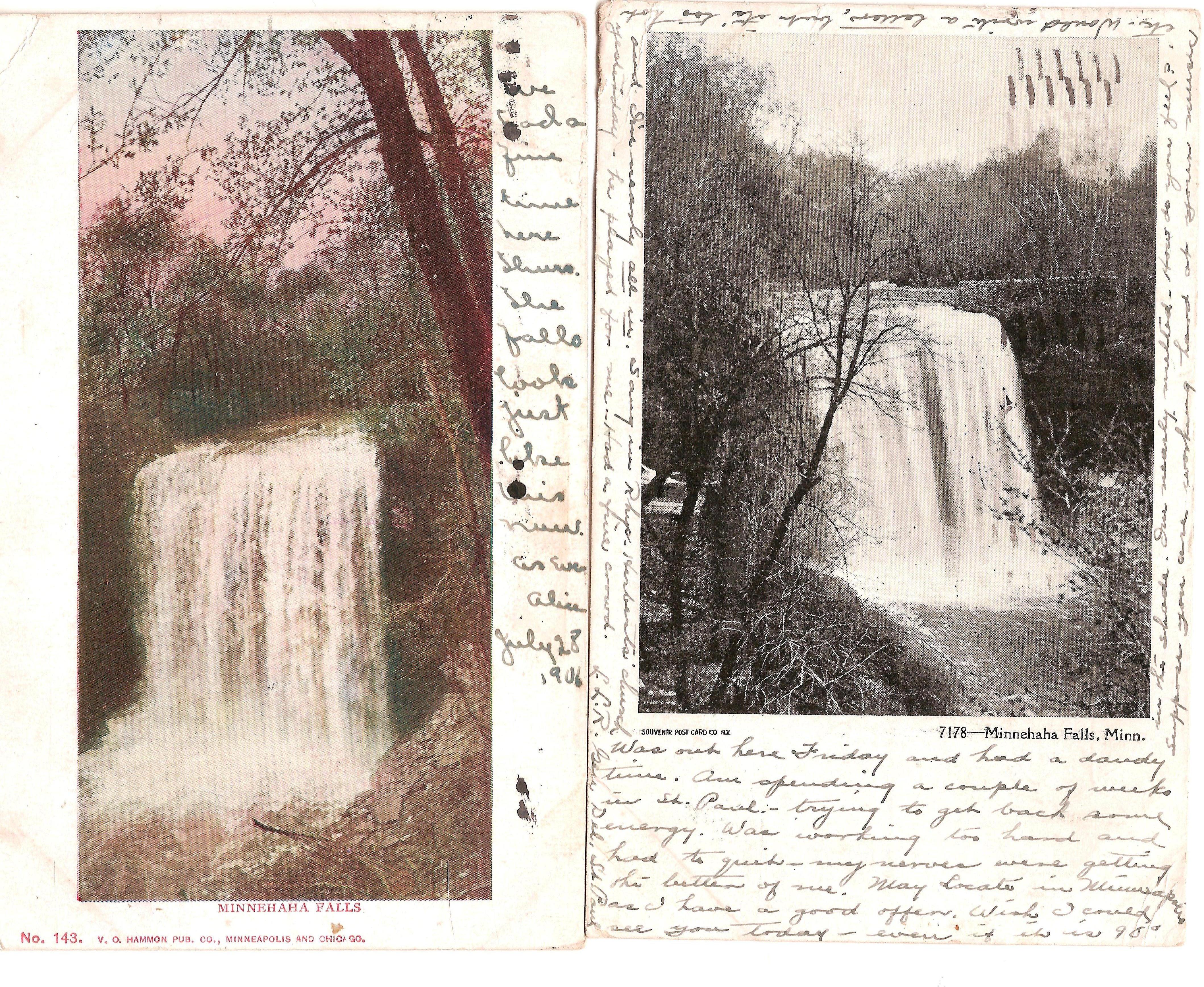
Minnehaha Falls on postcards postmarked in 1906 and 1908
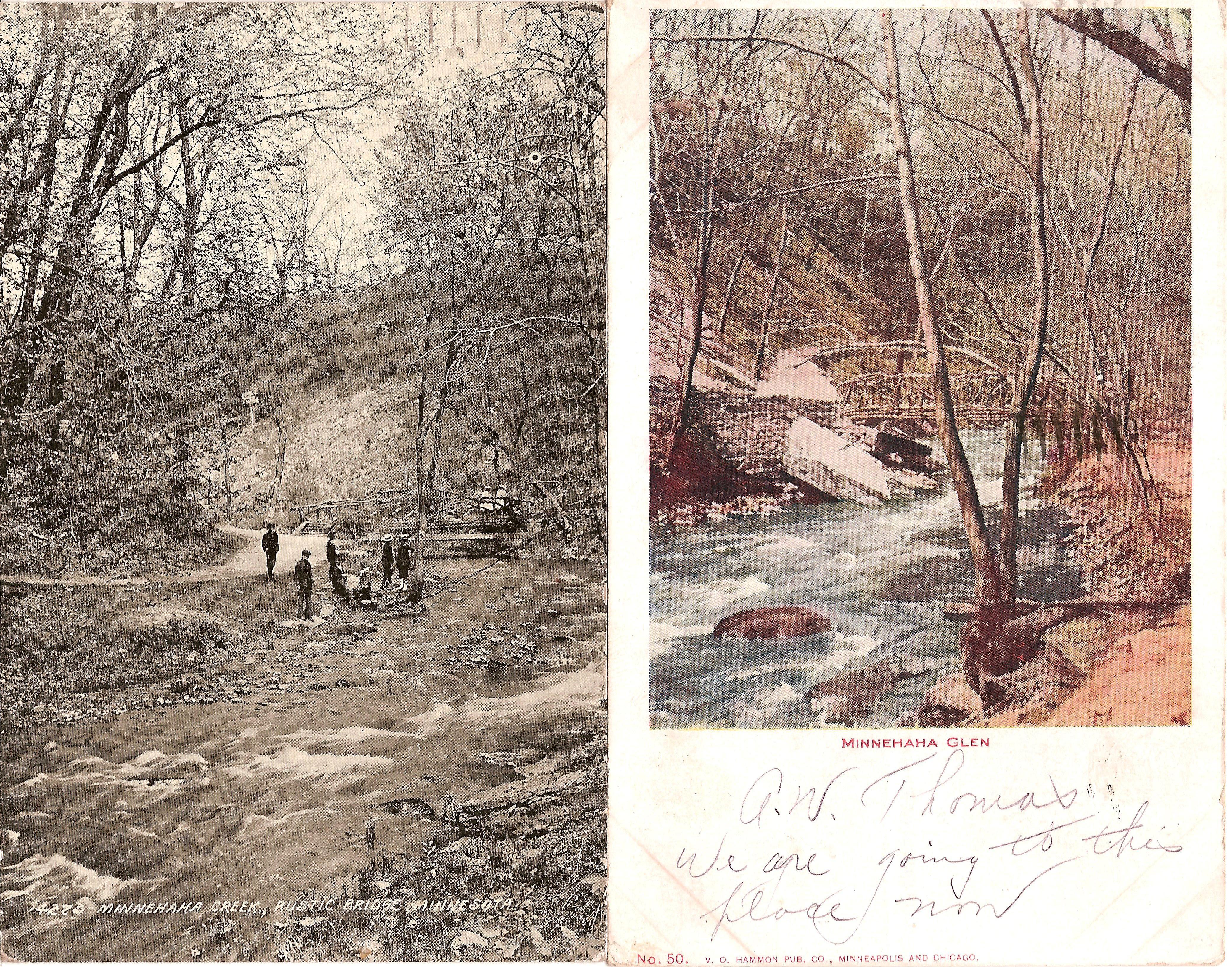
Minnehaha Glen below the falls, in postcards mailed in 1907 and 1911
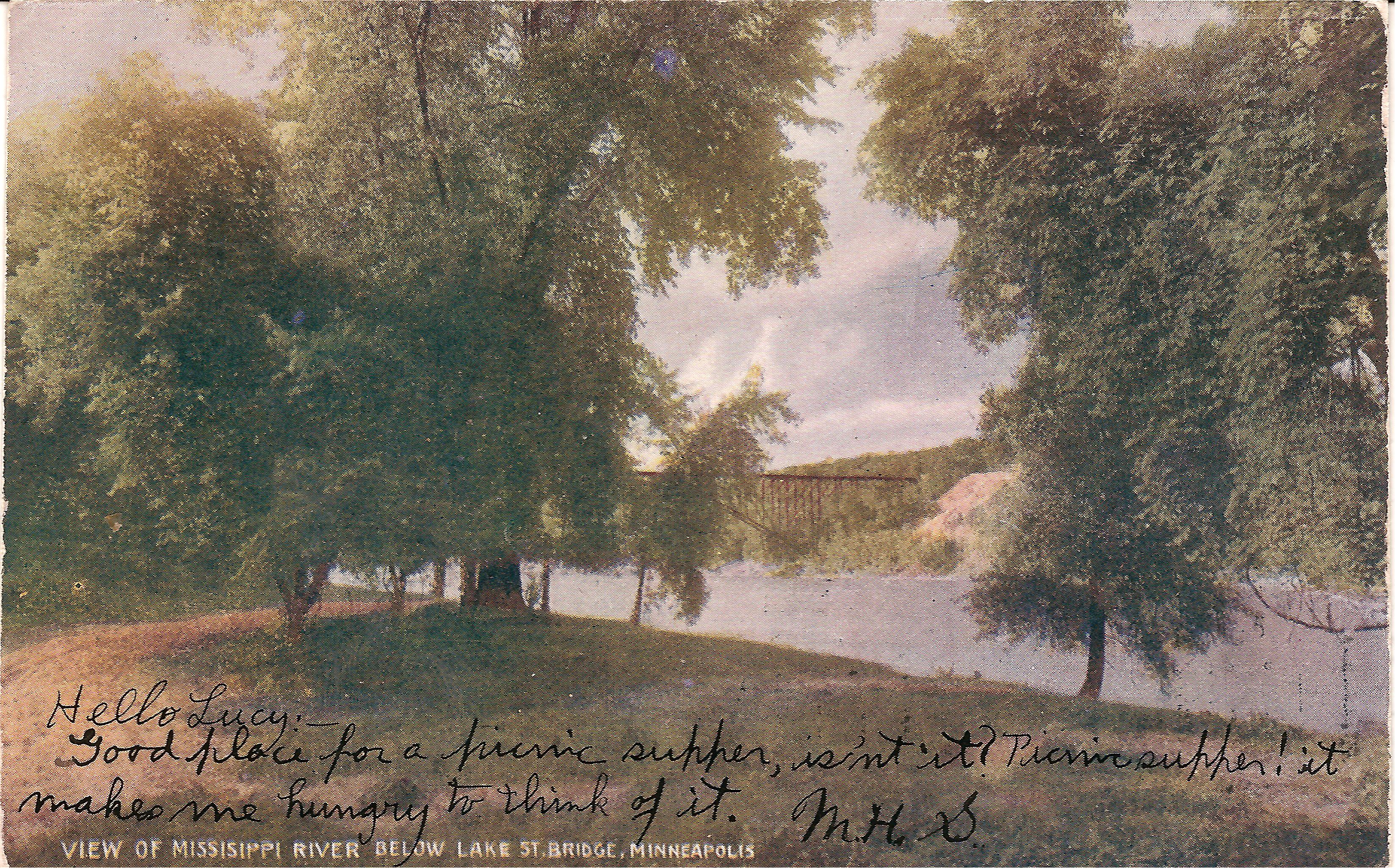
West bank of Mississippi River with view of Lake Street bridge in 1908 postcard. This was the river bank before the Ford Dam created a reservoir of the river.
Tell us your story about Minneapolis parks
Do you have a favorite Minneapolis park? Why? How has your favorite park changed over time? Do you have a picture? Send your thoughts as a “comment” below. Perhaps you’re in this picture. Or maybe you just remember the scene on Nokomis beach.
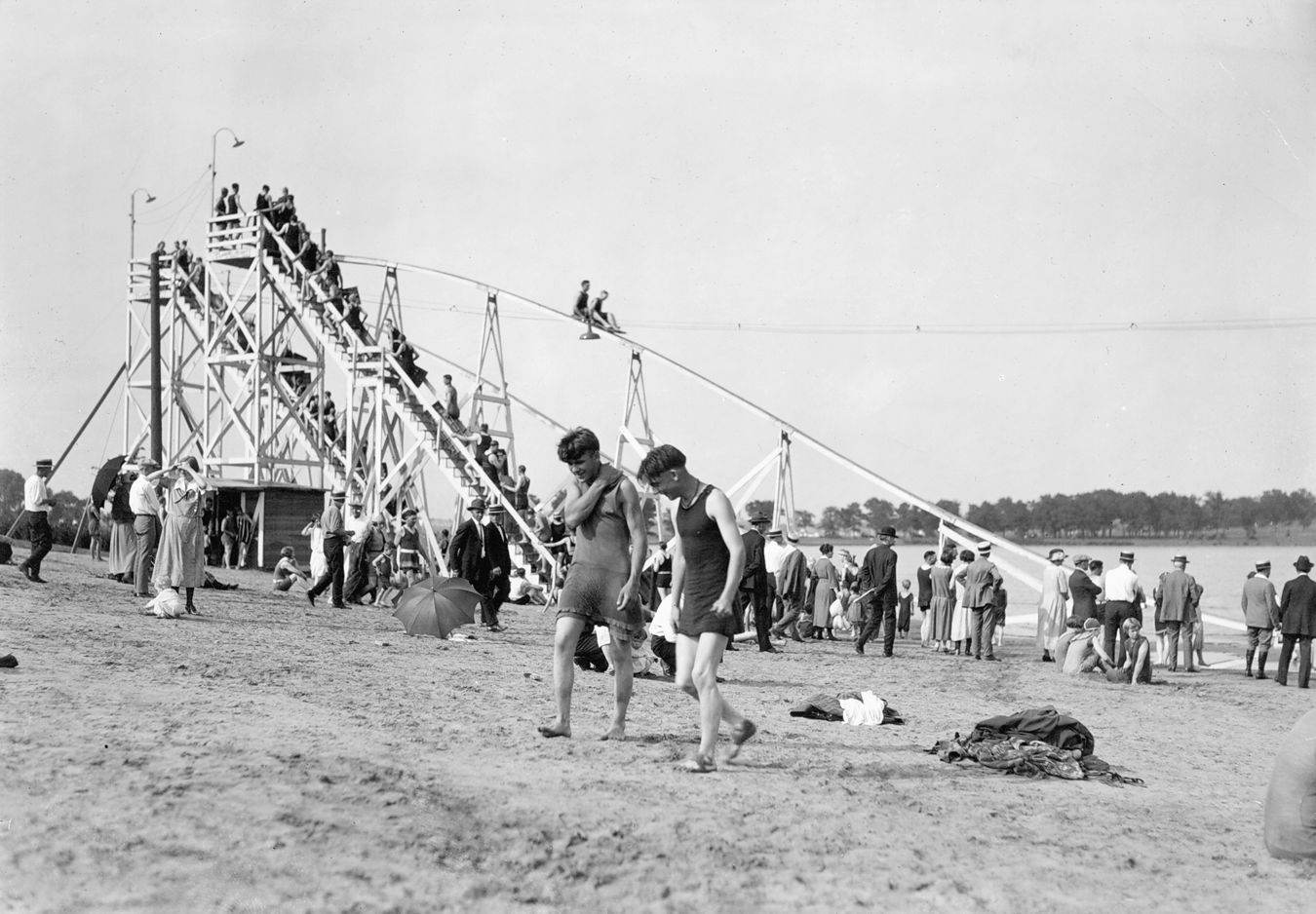
A slide at Nokomis Beach, built in 1924. (From City of Parks, courtesy Minnesota Historical Society.)
Do you remember when Waite Park was built? Did you ever attend a community sing at Folwell Park? Did you meet your wife at the old Lake Harriet bandstand or between high school football games at Parade Stadium?
The story of Minneapolis parks is really your story. Send us a chapter.
David C. Smith
Theodore Wirth Gets a New Home…and Office
Filed under: Minneapolis Parks: General | Tags: Lyndale Farmstead, Minneapolis parks, Superintendent's House, Theodore Wirth, Theodore Wirth House
Comments (6) I think I’ve finally got it: the last chapter in the saga of building a house for celebrated Minneapolis parks superintendent Theodore Wirth at Lyndale Farmstead. The ending is much more intriguing than I had previously known. I discovered it just a little more than 100 years after the construction of the house! The story told in the Lyndale Farmstead pages at minneapolisparks.org is true—as far as it goes.
The comptroller of Minneapolis, Dan Brown, did refuse to countersign the contract between the Minneapolis Board of Park Commissioners and C. P. Johnson and Son to build a house for Theodore Wirth at Lyndale Farmstead, a Minneapolis park. I had previously assumed that because the house was built in 1910 anyway, that the park board had found a way around getting Mr. Brown’s John Hancock on a contract. That was my mistake. The park board finally did get Dan Brown to countersign the contract, but it took a bit of legal work—and a divided opinion by the Minnesota Supreme Court. Read more »
Documentaries on Minneapolis Parks
A TPT documentary on Twin Cities parks, “Parks for the People,” has been nominated for a regional Emmy award. The awards program is Saturday night in Minneapolis. Good luck to producers Diane Steinbach and Dan Bergin and their crew. The program premiered on TPT last October.
While on the subject, congratulations to Joey Keiski, a seventh grader last year at Lake Harriet Community School, who took second place at Minnesota History Day last spring in the Junior Individual Documentary category for “Minneapolis Parks.”
David C. Smith
Was landscape architect Warren Manning the first to propose a public golf course in a Minneapolis park?
Filed under: Landscape Architects, Minneapolis Golf Courses, Minneapolis Parks: General | Tags: Horace Cleveland, Minneapolis golf, Minneapolis parks, Sculpture Garden, The Parade, Thomas Lowry, Warren Manning
Comments (2) Under the headline “Fine Park Is Assured”, the Minneapolis Tribune ran a story on November 15, 1903 that contained details I had never seen on plans for a golf course and baseball field in a Minneapolis park. The basic facts of the article are well-known: Thomas Lowry, along with William Dunwoody and Seurity Bank, offered to donate land at the foot of Lowry Hill for what eventually became The Parade.
What was new (to me) in the story was that when Lowry submitted his proposal to donate land down the hill from his mansion he also submitted designs for the park. The plans were prepared by well-known landscape architect Warren Manning at Lowry’s request. Lowry also offered to foot the cost of implementing Manning’s plan. Lowry eventually did donate thousands of dollars to help the park board convert the land to a park, but Manning’s plans were never mentioned in park board records.
Frederick Law Olmsted and Minneapolis Parks
Filed under: Landscape Architects, Minneapolis parks | Tags: Frederick Law Olmsted, H.W.S. Cleveland, Horace Cleveland, Minneapolis parks, Washburn Fair Oaks, William D. Washburn
Comments (3) How many Minneapolis parks did Frederick Law Olmsted design? How about his sons, Junior and JC? I believe the grand total is zero.
Some people have a mistaken notion that Olmsted, the godfather of American parks, played a role in the creation of Minneapolis parks. The impression was created in part by a letter Olmsted wrote to the Minneapolis park board in 1886 and by claims that Olmsted designed the grounds around William Washburn’s mansion Fair Oaks, which later became Washburn Fair Oaks Park.
A city claiming that Olmsted designed a park is akin to an inn in the East declaring “George Washington slept here.” A quick way to impress. The difference is that exhaustive records and correspondence document what Olmsted actually did, while there is little proof of where George laid his wooden teeth on any given night.
Connecting Lake Harriet and Lake Calhoun
Filed under: Lake Calhoun, Lake Harriet | Tags: Lake Calhoun, Lake Harriet, Lyndale Railway Company, Minneapolis parks
Comments (6) Imagine a canal between Lake Harriet and Lake Calhoun. It nearly happened long before Minneapolis had a park board. If that canal had been built when it was first authorized, in 1879, Lake Harriet and Lake Calhoun may never have become parks. All we would know of those lakes today might be from a public access landing for boats. Imagine Lake Harriet and Lake Calhoun like Lake Minnetonka with mansions, Mc and real, within a spit of the water, a private lake instead of a public one. But let’s back up.
 Minneapolis Park History