A premier speed skating track in a Minneapolis park
Filed under: Powderhorn Park, Winter Sports | Tags: Gene Sandvig, John Werket, Ken Bartholomew, Minneapolis parks, Powderhorn Park, Speed Skating
 Comments (15)
 A scrapbook of newspaper clippings about speed skating from 1953 to 1956 was recently given to Dave Garmany the recreation coordinator at Powderhorn Park in Minneapolis. The scrapbook features articles on the speed skating scene in Minneapolis, the U.S. and the world in those years and includes several articles from Norwegian newspapers.
In addition to the newspaper clips were several programs from international speed skating events at the Powderhorn Park speed skating track, such as this one in 1953.

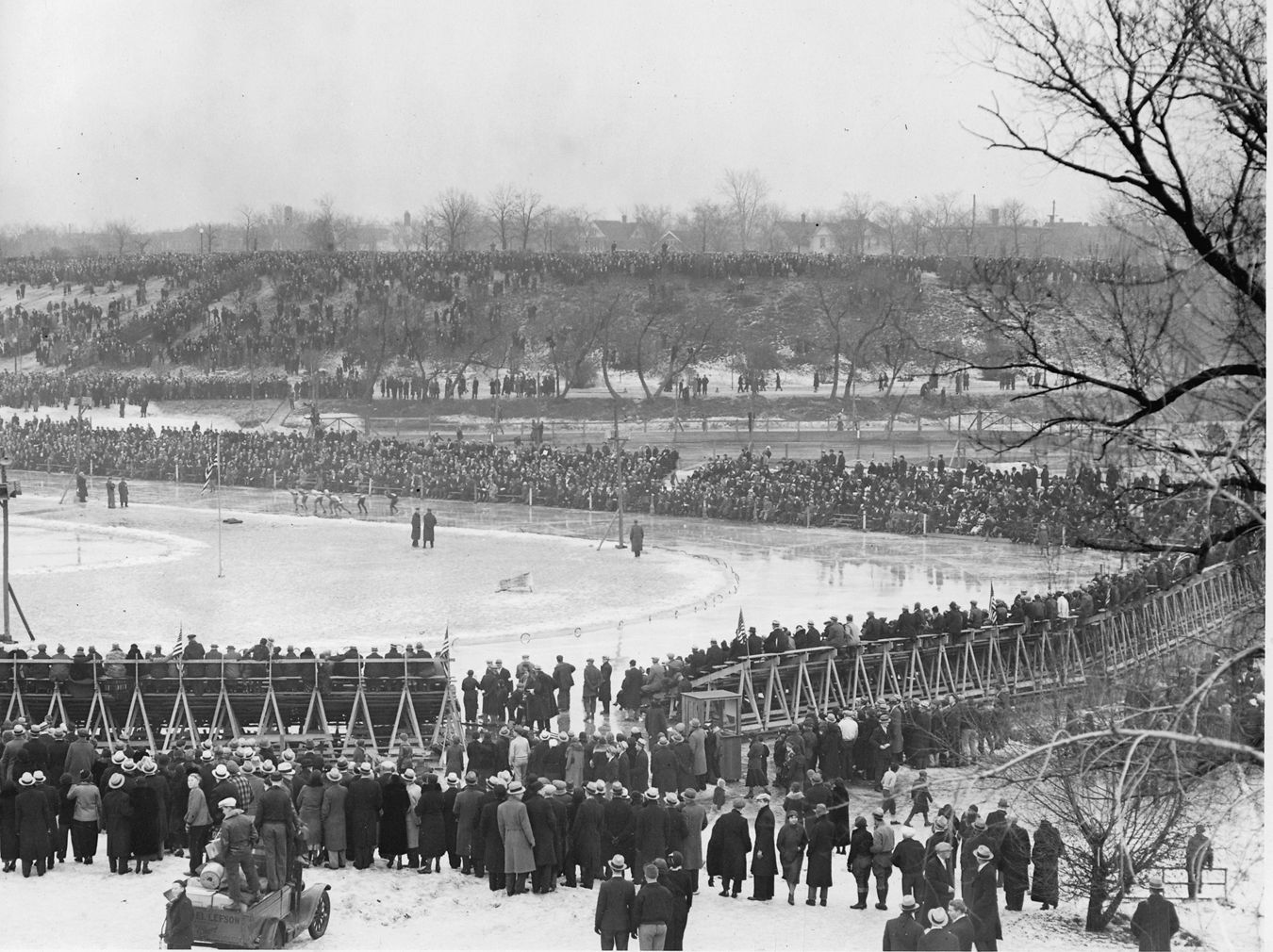
A cropped version of the cover photo, showing a massive crowd at a 1930s event at Powderhorn Park—likely the national championships in 1934, which were reportedly attended by 50,000 in two days—is in the collection of the Minnesota Historical Society.
Most of the clips in the scrapbook were about the rivalry between Minneapolis skaters Ken Bartholomew and Gene Sandvig. Bartholomew won 14 National Outdoor Championships from 1939-1960. Sandvig was often runner-up in the 1950s after he had gotten out of the Army and enrolled at Gustavus Adolphus College. Bartholomew was a silver medalist for the U.S. in the Winter Olympics at St. Moritz in 1948. Sandvig skated for the U. S. in the 1952 Winter Games in Oslo and the 1956 Games at Cortina d’Ampezzo.

The skater featured in Planert’s ad, Leo Friesinger, was the bronze medalist for the U.S. in the 500 meters at the 1936 Olympics in Garmisch-Partenkirchen, Germany. Friesinger was from Chicago, which was also home to Planert.
Among other bits of info that caught my eye in news clips from Minneapolis Star and Minneapolis Tribune.
- Minneapolis high school athletic director Giffy O’Dell hopes to bring back speed skating as a regular sport in the Minneapolis high school sports program. January, 1954. (I never knew it ever had been part of that program.)
- Top Minneapolis skaters Ken Bartholomew and Gene Sandvig will not be challenged locally by two other elite Minneapolis skaters. Pat McNamara will return to Norway or will train in Japan. Johnny Werket is considering spending the winter in Japan. January, 1954.
- Werket and McNamara have created a new practice track early in the season on Augusta Lake in Mendota. They do not train at Powderhorn Lake. They prefer the European style of speed skating used in the Olympics. The European track is 400 meters compared to the standard American track (including the Powderhorn track) of 293 yards, four laps to a mile instead of six. Also in European skating all competitors race against the clock instead of against other skaters in a pack. (American-style speed skating at the time was in between the long-track and short-track skating in today’s Olympics. The Winter Olympics tried the North American pack-style of speed skating at the 1932 games in Lake Placid, New York. Canada and the U.S. won 10 of 12 medals skating that way. The 1936 games in Germany reverted to European-style racing against the clock — and Norway and Finland won 10 of the 12 medals. Pack speed skating returned to the Olympics as a separate demonstration sport, short track skating, in 1988 at Calgary and became a regular Olympic event in 1992 at Albertville.)
- Ken Bartholomew was a 14-time U.S. champion, but he skated for the U.S. Olympic team only once, winning a silver medal in 1948 at St. Moritz. He did not make the Olympic team again despite dominating the National Outdoor Championships for years. Werket was on the U. S. Olympic team in 1948, 1952 and 1956. McNamara skated in the Olympics for the U.S. in 1952 and 1956. Their greater success in making Olympic teams may have been partially due to training in the Olympic style of racing—although Gene Sandvig also made the Olympic team in 1952 and 1956. All three were also much younger than Bartholomew. A commentary in the Minneapolis Tribune after the Winter Games in Cortina d’Ampezzo in 1956 had this to say about the different styles: “The U.S. should adopt the Olympic system of competition—that is, a competition against time. True, it’s pretty dull for young Americans, as well as the few spectators who turn out. They (presumably young Americans and spectators) love the free-for-all scramble with all of its pushing, tugging, elbowing and the like such as popped up in the Nationals at Como over the weekend.” (The reference was to the races at Lake Como in St. Paul won by Bartholomew, in which Bartholomew and another skater got into a fight after the other accused Bartholomew of knocking him down. Bartholomew was obviously a racer, a strategist, not a time-trial expert that the Olympic style required. In other words, he was more Apolo Anton Ohno than Shani Davis, Eric Heiden or Dan Jansen.)
- One reason the Tribune advocated changing American racing to the Olympic style: the Russians had started to dominate international speed skating. It had begun with a surprise victory by the Russians at the world championships in Sapporo, Japan in 1954. The U.S. had failed to send a team. The U.S. State Department had declined to pay the travel costs of John Werket, Pat McNamara and a third skater from Chicago, Ken Henry, who was an Olympic gold medalist in 1952. The State Department determined that the request for funds was “not meritorious.” (Tribune, January 31, 1954) The Russian victory elicited this comment on the sports page: “The time is at hand when the athletic leaders of the free world had better take Russia’s bid for international supremacy seriously. The Commies proved in the last Olympic Games they have made greater strides in track and field than any other nation in the world. Over the week-end Russia did the unexpected by winning the world’s speed skating championships rather decisively, beating the best Norway and some other Scandinavian countries have to offer.” Russian dominance had grown at the 1956 Winter Games.
- The 1955 world championships were held in Moscow and Johnny Werket was one of three skaters to represent the U.S. after friends raised $700 to pay his expenses. Those three skaters were the first American athletes to compete in Russia after World War II, according to a February, 1955 Tribune article. Werket had high praise for the Russians. “Russians were tops,” said Werket, “as athletes, as hosts and as fans. It would be hard to find a fairer audience anywhere in the world.”
- Nearly all Minneapolis speed skating teams in the 1950s were sponsored by American Legion posts. Wenell, Laidlaw, Bearcat and Falldin posts all sponsored teams.

Finally this item from the annual program of the Minnesota Speed Skating Association, 1955-1956:
Missing Skater News
- Tom Miller and Colleen Burke (Falldin American Legion Post team) married last June, Tom in U. S. Army, stationed in California
- Gene Sandvig (Bearcat) on Olympic Team
- Tom Hadley (Wenell) concentrating on studies, U of M on Evans Scholarship (Based on scholarship and golf proficiency)
- Janet Koch (Laidlaw) is now Mrs. Vasatka
- David Kahn (Wenell) out with knee injury suffered in football at Roosevelt Hi
- Dennis Boike (Laidlaw) at Nazareth Hall Prep Seminary studying for priesthood
- Tom Romfo (Wenell) recuperating from a bout with polio
For some reason, perhaps the mention of polio, the list seemed so 1950s. Poignant, too.
David C. Smith
© David C. Smith
Powderhorn Park Football
Filed under: Powderhorn Park | Tags: Football, Minneapolis parks, Powderhorn Park, The Parade
Comments (2) A recent visit to Powderhorn Park and a chat with recreation coordinator Dave Garmany turned up an excellent photo of the Powderhorn football team from 1925. Unusual for its time, it was labeled with the names and positions of the players.
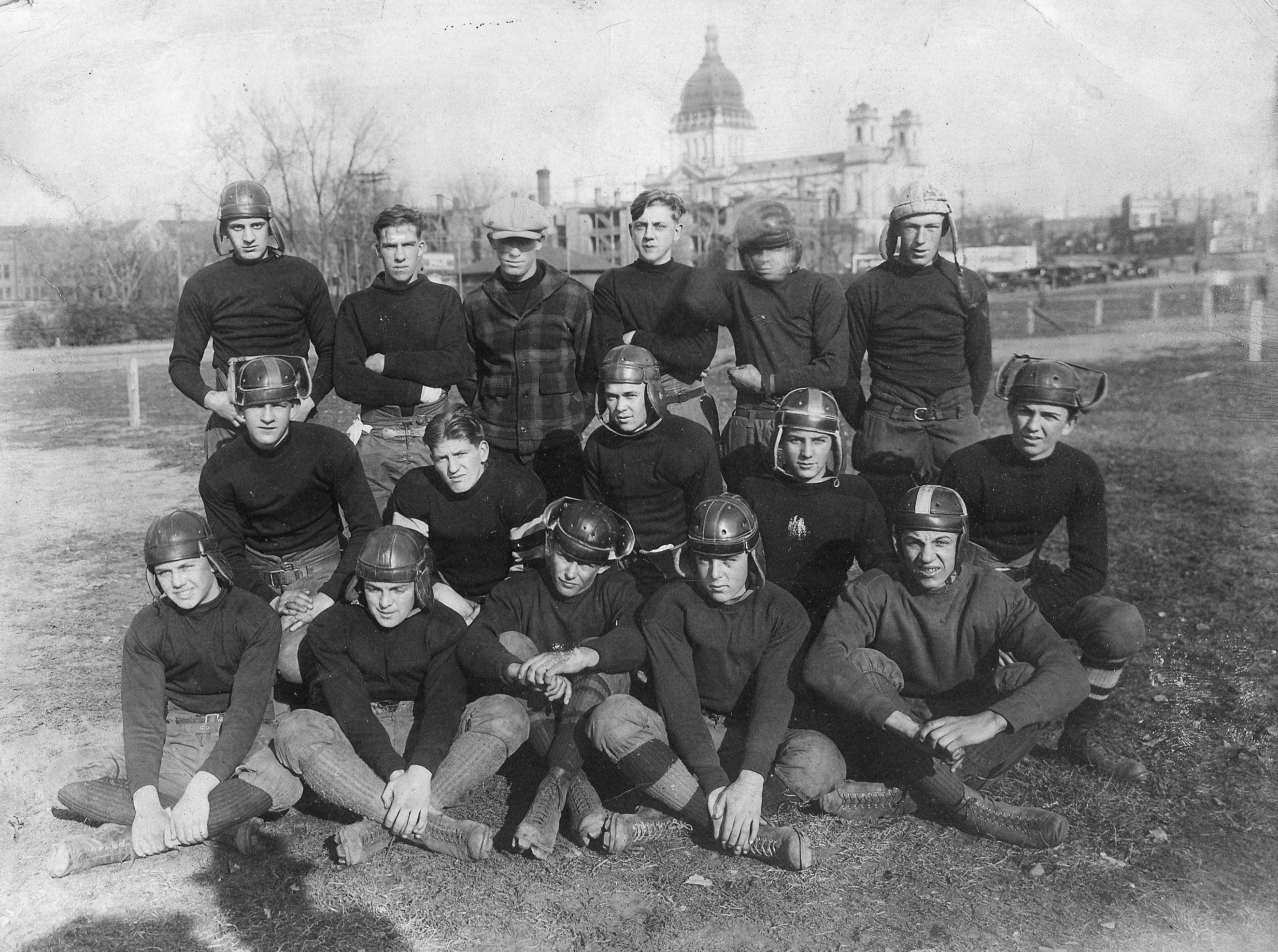
1925 Powderhorn Football Team at The Parade (Basilica in background). First Row L-R: Helmar Larson OB, Claude Casey FB, Manley Peterson LT, Kenneth Johnson RH, George Carlson RG. Second Row, L-R: Lee Blood RT, Joe Listered LE, John Larson RE, John Martin LE, Ed Mandeck LE. Third Row L-R: Frank Shogren LG, Hersel Johnson RE, Howard Shenessy Capt., Leonard Herlen RG, Walt Nordstrom LH, Al Dunning RH. (Minneapolis Park and Recreation Board)
The best part of the photo — for those not related to the players — is the location at The Parade, which is obvious because of the Basilica looming in the background. The year the photo was taken, 1925, was the year that the north end of Powderhorn Lake was filled in to create more athletic fields. I’ve spoken with one woman who remembered skating on the lake before the north end was filled. Do you remember that or know anyone who does?
The only other photo I’ve seen of early Powderhorn football players is this one from the collection of the Minnesota Historical Society.

Powderhorn football team, 1908 (Minnesota Historical Society)
Have you seen others? Let us know.
David C. Smith
The Myth of Murphy Square
Filed under: Minneapolis Parks: General | Tags: Minneapolis parks, Murphy Square
Comments (9) In Nimocks’ pamphlet, he tells the story of Edward Murphy who donated the first park to Minneapolis in July 1857—what is now Murphy Square near Riverside Avenue.
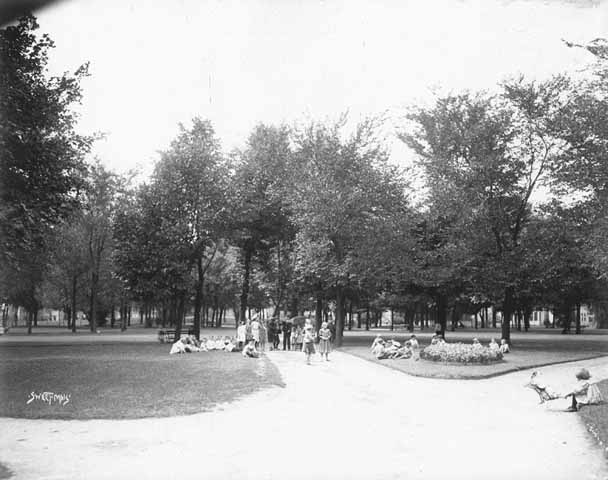
“For years,” Nimocks wrote, “the land was used as a cow pasture, but on April 16th, 1873, Mr. Murphy secured an appropriation of $500 by the City Council for the purpose of fencing and setting out a row of trees around the park. Mr. Murphy expended this amount and a warrant was drawn on the City Treasurer to pay the same, which Mayor Ames refused to sign and the warrant was never paid.”
While searching early issues of the Minneapolis Tribune recently (thank you, thank you Hennepin County Library) I came across this four-sentence article in the July 3, 1874 edition.
The Murphy Bill
The Council voted on Wednesday to instruct the City Clerk to deliver to Mr. Edward Murphy his order which has been in chancery for the last year or two. Mr. Murphy called and received the order yesterday, and City Treasurer Laraway at once paid him the money thereon, principal and interest. The interest amounted to almost one hundred dollars. Mr. Murphy declares that as the Council has finally done tardy justice to him, he now proposes to improve and care for the park at his own expense.
The article makes little sense without the knowledge that Mr. Murphy had not been paid for his work at Murphy Park a year earlier. And even then, it’s not until the last sentence that we can infer what he may have been paid for: the improvement and care of a park. As Murphy’s park was the only one in the city at the time, the article offers evidence that Murphy was reimbursed for some work he did there.
Perhaps because the article appeared in the Tribune, not his Journal, Nimocks chose to overlook it. Next chance I get at the library I will see if the Journal made a similar report. On the other hand, Nimocks wrote his pamphlet nearly forty years after the event. He may have “misremembered”—at least the resolution of the problem.
There is little doubt however that someone planted trees in the park, because newspaper stories that mention the park in subsequent years refer to it as Murphy’s grove, as in “Swedish Lutheran Sabbath School will have a picnic in Murphy’s grove,” from the Tribune, July 3, 1880.
Still it’s nice to know that Edward Murphy, a civic-minded man with foresight, was not cheated by the city that benefited from his generosity. One other note: Edward Murphy was a member of the City Council that finally did him “tardy justice.” He was not without some influence.
Bravo Augsburg College and Park Board!
For anyone who missed the news in October—I did—Murphy Square will be maintained for the next five years by Augsburg College. The college will provide routine maintenance, such as mowing the grass and shoveling the sidewalks.
The college, which established a campus next to the undeveloped park in 1872, nearly surrounded the park by the 1930s. But what really made the park appear to be a part of the campus was the construction of I-94 in the 1960s. The freeway and its imposing sound wall formed a barrier at the south end of the park and the freeway prevented access from the residential neighborhoods to the south.

Does anyone from the Franklin Avenue neighborhood south of Augsburg College — or Augsburg College students before the 1960s — remember the park before the freeway was built? Tell us your story.
David C. Smith
Pershing Field Scrapbooks
Filed under: Minneapolis Parks: General | Tags: Pershing Park, Southwest Activities Council (SWAC)
Leave a Comment Pershing Park recreation supervisor Marc Holtey recently pulled out some old scrapbooks at the park. One scrapbook was a collection of “guest books” from the Southwest Activities Council’s (SWAC) Annual Meetings, Open Houses and Winter Carnivals in the 1950s and 1960s. Among those who signed the books were many former park commissioners and park board employees. I noticed that Felix Dhainin and his wife signed the guest book for a few events. Dhainin was the park board’s landscape architect for many years beginning in the 1940s. Many guests added their addresses after their signatures, from which I learned that the Dhainins lived barely a block from the park. Another park board employee, Alice Dietz, one of the leaders of the recreation department since the early 1920s, also attended several 1950s events. If anyone can tell me more about Dhainin or Dietz, please do. They are two of hundreds of park board employees who were instrumental in building our park system.
Another signature that caught my attention in the Guest Book for the 11th Annual SWAC Winter Carnival, January 25 & 26, 1964: Mrs. Ray Rybak and children. We can surmise that the present-day Mayor of Minneapolis was in attendance at about the age of eight.
A second scrap book contained clips about SWAC from 1957-1959 from the Lake Harriet Courier. Some highlights:
- Attendance at 1958 Halloween parties sponsored by SWAC. Linden Hills: 250 children at an afternoon party; 225 teens for a dance that night after the Southwest-Roosevelt football game. Pershing: 350 children.
- Attendance at Pershing Field for a Friday night dance in January 1958: 130 junior teens and 200 senior teens. Live music was provided by the Jazz Knights.
- Attendance at the SWAC football banquet at Mount Olivet Lutheran Church: 320
I suspect that parks across the city had similar, staggering attendance at big events. Those may have been the glory days of park-sponsored activities for children. If you attended events like these in any park in Minneapolis, tell us about it.
Dick Yates was for many years a recreation supervisor at Longfellow, then Lynnhurst Park, before he became the head of special services for the park board in the 1970s. I interviewed Dick when I was researching City of Parks in 2007. When the book came out I asked Dick what he thought of it. He had one complaint: he didn’t think I captured the robustness of the dynamic playground programs of the 1950s and 1960s. I had to agree with him. The number of kids who participated in playground programs in those years was truly incredible by today’s standards. So help me correct that shortcoming of City of Parks. Let’s capture here some of the vitality of playground events in years past. Tell us the story.
A third scrapbook at Pershing was a book of photos. Most of them were of unidentified children and didn’t provide much information of historical interest. The two that I found most interesting were these.

Goalies weren’t protected then as they are now. Photo from 1958 Annual Report of the Southwest Activities Council (SWAC) (Photo courtesy of Minneapolis Park and Recreation Board)
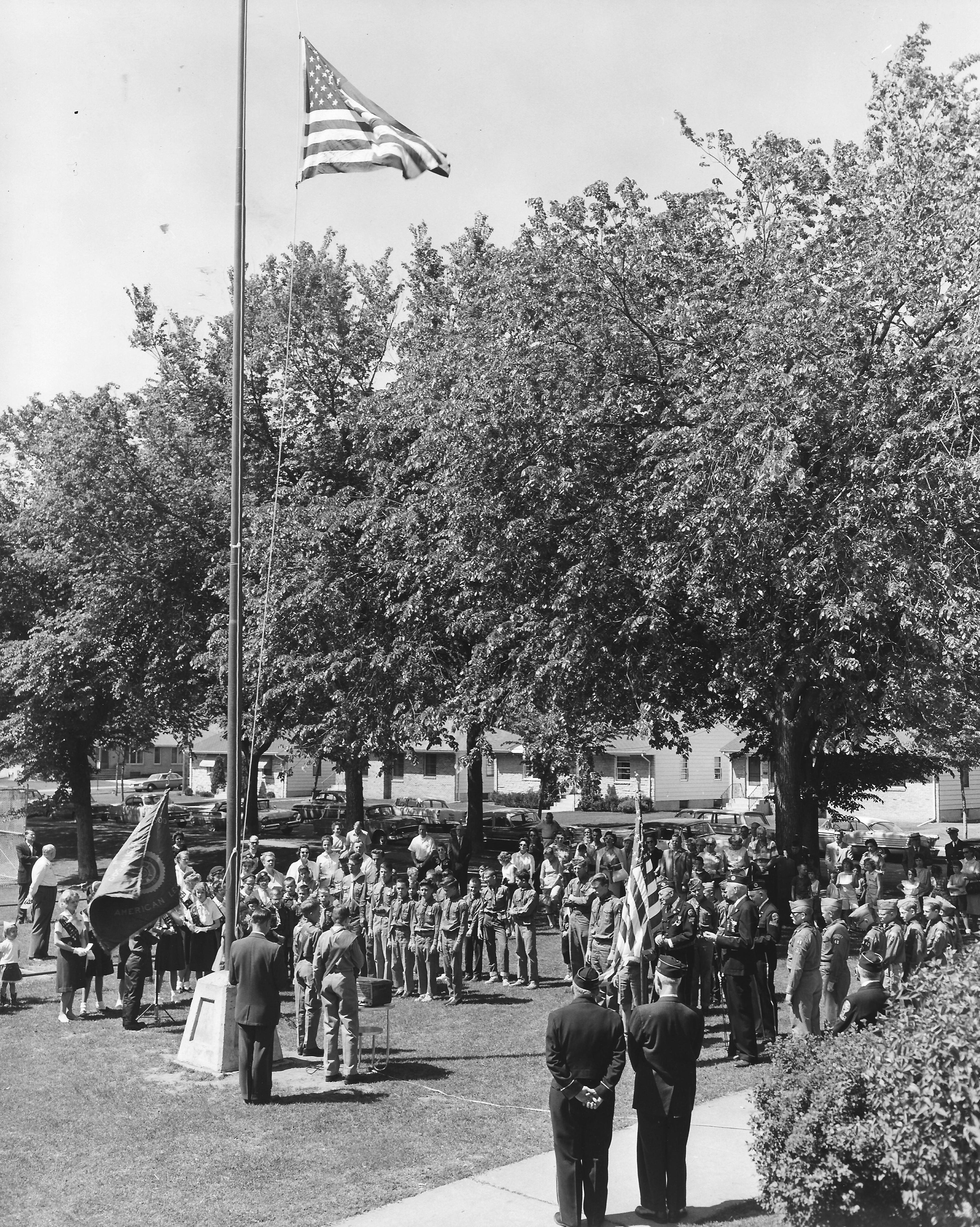
Memorial Day 1961, Pershing Park (Clair Peterson, Minneapolis Park and Recreation Board)
David C. Smith
Minneapolis Park Memory: Lake Harriet Hijinx
Filed under: Minneapolis Park Memory, Minneapolis Parks: General | Tags: Lake Harriet
Leave a Comment My favorite story of the Minneapolis parks was one autumn weekend night in 1968, when I was in 11th grade. The standard place for “couples” to go and “make out” was around Lake Harriet on the east shore. There was a lane for parking and the cars would line up as soon as it was dark. I was with a couple of buddies and we had a few M-80’s. We drove around the east shore until we saw a couple having at it in their car. Then the M-80 was lit and rolled strategically under their car and we waited for the explosion. The ensuing few seconds in the car of the “parkers” was always indescribably hilarious. Well, after surprising a couple in their car we peeled out and headed to our favorite spot “Porky’s Drive-In” on 58th and Lyndale Ave. So.
About two hours later there was a noticeable “buzz” at Porky’s. We asked what was up and we heard the story. Apparently someone had lit an M-80 around the east shore of Lake Harriet and part of the explosion flew across the street and started a fairly large brush fire on the slope that surrounds the lake on that shore. It was about three blocks long by about 40 yards wide. There had been “numerous” fire trucks called to put out the fire. OOPS.
Name withheld by request, Washburn High School, Class of 1970
Editors note: Our parkways have served many useful purposes!
The Minneapolis city council banned fireworks in the city, without a permit, in 1873. At the same time the council passed an ordinance banning the firing of guns, pistols and cannons within the city. Prior to the Fourth of July in 1890 the police chief noted that it was impossible to “rigidly” enforce the anti-fireworks ordinance, but urged his forces to prohibit the shooting of fireworks in “alleys, backyards or other restricted spaces.” At a time when most structures were made of wood, and so were sidewalks, that was probably prudent.
The first newspaper reference I can find to fireworks at Lake Harriet was in the Minneapolis Tribune, August 10, 1887. An article on the Knights of Labor picnic the day before, which was attended by an estimated crowd of 15,000 to 20,000 despite light rain, noted a “brilliant display of fireworks” from 9 to 9:30 p.m. This was the second annual picnic by the largest labor organization of its time, but the first at Lake Harriet. The inaugural K of L picnic had been held at Lake Calhoun — but had also featured fireworks.
Even in the late 1800s, fireworks were associated primarily with the Fourth of July. The first newspaper reference I found to Fourth of July fireworks at Lake Harriet was in a July 5, 1890 Minneapolis Tribune article on festivities around the city, which concluded with a tragic note. A. L. Wellington of 629 Sixth Street South died of injuries he suffered while superintending the fireworks display at Lake Harriet the night before. Fireworks had exploded prematurely on the raft from which Wellington worked about 500 feet from shore.
Do you have a fireworks story from a Minneapolis park? Were you in the car the M-80 was rolled under? Any other story of Minneapolis parks? Help us write the popular history of our parks. Tell us your story (see post from September 30.)
David C. Smith
Charles M. Loring, Father of Minneapolis Parks
Filed under: Minneapolis Park Hero, Minneapolis Parks: General | Tags: Charles M. Loring, Minneapolis parks
Comments (2) “We must all work and work together, and it will be but a short time before we shall see what a united effort and good example can do toward forming a public sentiment so strong that the city government will give us the trees and parks we so much need for breathing spaces for the poor who cannot ride to the country for air.” — Charles M. Loring, April 14, 1882
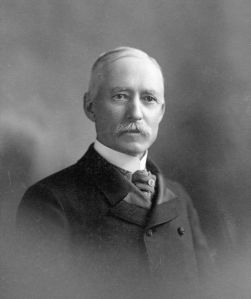
If you’ve read City of Parks or the history of Loring Park at minneapolisparks.org you already know how much I admire Charles Loring, the first president of the Minneapolis Board of Park Commissioners (BPC). He was one of the most effective advocates for parks before the park board was created and during a couple stints on the park board. He was a man of national reputation and influence on park matters. In addition, he donated the recreation shelter at Loring Park in 1906, paid for an artificial water fall to be built beside Glenwood (Wirth) Lake in 1917, and paid for the original trees for Victory Memorial Drive and created a $50,000 fund for the perpetual care of those trees. He was one of the most remarkable men in Minneapolis history. So once in a while I will tell a story here about Charles Loring that I haven’t had space to tell anywhere else. I will likely do the same for William W. Folwell, but that comes later.
On April 14, 1882, nearly a year before the creation of the BPC by the Minnesota legislature, Loring was asked to address the first annual meeting of the Oak Lake Addition Improvement Association. The neighborhood, which once stood where the Farmer’s Market now stands beside I-94, was the first in the city to create a homeowners association to care for the streets and grounds and sanitary requirements of a neighborhood. For their annual meeting, which was held at Hennepin Avenue Methodist Church, they asked Loring to speak about the care and culture of trees in the city.
According to newspaper coverage, Loring’s remarks focused on the experiences of W. R. Smith, the superintendent of parks in Washington, D.C. and the president of the Botanical Garden there. The park commission in D. C. had the power to plant and remove trees at will and they consulted with no one. (Loring obtained that same much-envied power for the BPC from the Minnesota legislature in 1887.) Loring commented that he thought Congress had done a very wise thing when it put the important matter of trees in the hands of arboriculturists “who go about their work without fear or favor,” Loring said.
Loring told that night of an unnamed U. S. Senator who sent a messenger to W. R. Smith asking if the superintendent could not remove a tree that the Senator believed obstructed his view from a window in his home. Loring said Smith responded by asking the Senator if he could not move his house.
The tree stayed and Loring had a story that entertained an influential Minneapolis audience and perhaps helped nudge public sentiment toward acceptance of a park commission that would also plant trees without fear or favor and convert a city that was largely open prairie into one of the greenest cities in the United States.
David C. Smith
First African-American golfers in Minneapolis
Filed under: Minneapolis Golf Courses, Minneapolis Parks: General | Tags: Minneapolis golf, Minneapolis parks
Leave a Comment I don’t have plans to write more about the first private golf courses in the Minneapolis area, as noted in my last post, but I do have interesting information on the creation of the first public golf courses in Minneapolis parks. Someday.
I’ll also write about efforts to integrate the private golf clubs that operated out of Minneapolis park golf courses in the early 1950s. At the center of that story were representatives of the Twin City Golf Association, an organization of black golfers — Frederic Jones, Bert Davison, John Williams, L. Howard Bennett and others — and one of the more colorful park commissioners ever, Ed Haislett. Haislett was a boxing champion, a professor, and the author of a book on boxing that was plagiarized by martial artist movie star Bruce Lee. How’s that for a resume?
Minneapolis Golf Clubs Go To War
Filed under: Minneapolis Golf Courses, Minneapolis Parks: General | Tags: Minneapolis golf, Theodore Wirth Park
Comments (2) One more bit of information about the oldest golf courses in Minneapolis, then I’ll move on.
I found this item in The American Golfer, June 1917:
“Four private golf clubs in Minneapolis are going to utilize a portion of their grounds for raising foodstuffs this summer. At the University Club more than 25 acres will be plowed up. The Minneapolis Club has set aside 4 acres for potatoes, and Interlachen and Minikahda will devote all available spaces to small garden truck. One hunderd caddies of the Town and Country Club have organized a military company.”
The actions were in response to the United States entry into the “Great War” in April 1917.
The golf course at the University of Minnesota and the first public golf course in Minneapolis—at Glenwood Park, now Theodore Wirth Park—had only opened in 1916. Both courses were nine holes at that time.
After the Minneapolis Board of Park Commissioners opened the Glenwood golf course in June, 1916, The American Golfer noted that only Oakland and Portland among “western” cities did not have municipal golf courses.
David C. Smith
The Mother of All Minneapolis Golf Courses: Bryn Mawr II
Filed under: Minneapolis Golf Courses, Minneapolis Parks: General | Tags: Bryn Mawr, Interlachen Club, Minikahda Club, Minneapolis golf, Minneapolis parks, Theodore Wirth Park
Comments (3) When the golf and social activities of the Bryn Mawr Club shifted to the newly opened Minikahda Club at Lake Calhoun in July 1899, the Bryn Mawr golf course and club house didn’t stand empty for long. Two weeks after the Minikahda Club opened—and promptly became the hub of Minneapolis social life—golfers were already at work to get back on the Bryn Mawr links.
The Minneapolis Tribune on August 9, 1899 attributed the interest in reviving a golf club at Bryn Mawr to “young businessmen who find the Minikahda links at too great a distance from the city.” The paper speculated that the organizers of the new club also expected that the links could be used “at comparatively little expense.” A meeting of those interested in organizing the new club was announced at the West Hotel.
In a little more than a week, the new Bryn Mawr Golf club had been officially created with a membership limit of 200 (compared to Minikahda’s 700) and initiation fees of $10 for men and $5 for women. Curiously, the club was organized as a corporation that was to be limited to ten years. Why that provision, reported in the Tribune of August 18, was made in the club’s organization eludes me, unless it could have been based on a lease for the land. That provision may have been a factor in the creation of another well-known club when those ten years were up.
Initial reports were that the new club would also use the old club house, but that didn’t last long. By the time the new club held its annual meeting on March 19, 1900 prior to its first full season in operation, it already had architectural plans drawn for a new two-story club house that would cost about $2,000. It had “all the necessary adjuncts of a modern club on a small scale,” according to the Tribune.
One reason for the new club house and perhaps a reason the old club house’s previous occupants abandoned it for new digs at Lake Calhoun was revealed when the Minneapolis Tribune reported that the new Bryn Mawr club house would be “erected near the green, so as to avoid the lengthy walk occasioned by the location of the old club house.”
The exact location of the new club house wasn’t cited, but was evidently nearer the present intersection of Laurel and Cedar Lake Road than the earlier Elm Street address. The new club also lengthened two holes at Bryn Mawr making the course a few hundred yards longer. Despite the increased length, the “bogey” for the course (par) was reported in the Tribune as 38, or seven strokes lower than the bogey score when the course was established two years earlier. The Tribune also reported that club member F. A. Stuart had already posted a course record of 42. Players were clearly getting better.
The new club hired a part-time instructor, Martin Watson, who split his time between the Bryn Mawr course and the brand new Lafayette Club course on Lake Minnetonka. Martin was the brother of Minikahda pro William Watson.
The other big golfing news of 1900 in Minneapolis was foreshadowed by an article in the Minneapolis Tribune, June 17, 1900, which reported that Minneapolis Mayor James Gray had tried his hand at golf for the first time at a new St. Paul course at Merriam Park. (The course was bounded by Selby, Summit, Snelling and Prior.) The humorous piece detailed Gray’s adventures on the new course. The afternoon of golf must have made a big impression on His Honor because Harper’s Official Golf Guide, published in 1901, listed a Lake Harriet Golf Club in Minneapolis organized in September, 1900. The listing for the club included Mayor Gray as a “Principal Member.” The listing for the club and its “nine-hole course” in the guide provides no information on the location of the course.
(I can find no other mention of a proposed or actual course anywhere near Lake Harriet. If any readers have more info, I’d love to know.)
The Bryn Mawr course was often referred to in the press as the “businessman’s course.” Newspaper accounts of local golf competitions among clubs noted also that some golfers were members of both Minikahda and Bryn Mawr. Although Bryn Mawr never promoted the social aspects of club life as Minikahda did, the club did expand its offering in 1900 with the addition of two tennis courts and a handball court.
The end of the Bryn Mawr Golf club was announced in the September 4, 1909 issue of the Minneapolis Morning Tribune. “When the Bryn Mawr Golf club closes its present season it will move from its grounds…and next year will find the home of this socio-athletic organization farther out in the country,” the paper reported. The paper speculated that grounds would be found beside Lake Minnetonka. It claimed that the old Bryn Mawr clubhouse site would be taken over by a newly organized tennis club.
In late November, however, the Morning Tribune reported quite a different location for the new club. “Options have been secured by the Bryn Mawr Golf club on 150 acres of land bordering Mirror Lake, three miles beyond the Harriet loop and bonds are being sold to enable the promoters to consummate the deal,” the newspaper reported on November 28. The Bryn Mawr Golf club was about to transform into Interlachen Country Club.
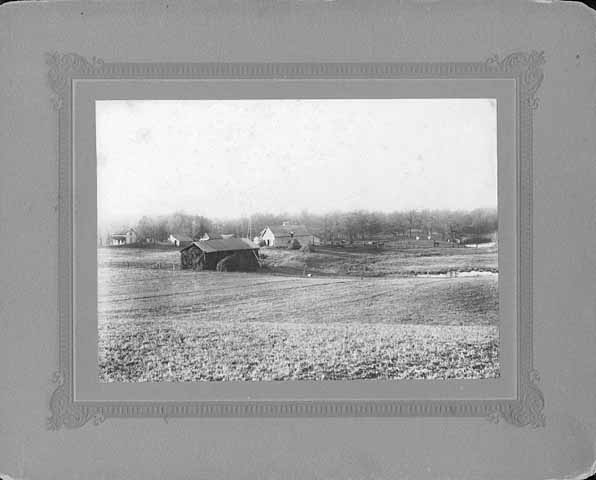
The little $2,000 club house at Bryn Mawr was scheduled to be replaced by a $25,000 club house (soon increased to $30,000) at what would become Interlachen. By January 9, 1910 the newly organized Interlachen club announced that it had acquired 146 acres of land between the Brookside and Mendelsohn stations on the Minnetonka streetcar line for the new country club at a cost of about $55,000. Golf play continued at Bryn Mawr for the 1910 season while the new course and club house were being constructed.
The demise of the Bryn Mawr Golf club was best described by a golf columnist of the Minneapolis Morning Tribune, May 14, 1911. “The cozy little club with its congenial membership was crowded out by the growth of the city,” he wrote, “and thus passed into history an organization which was within the reach of the small salaried man and yet claimed as members some of the most prominent businessmen of the city.” The Tribune’s golf writer, George Rhame, who was a member of Bryn Mawr and Interlachen wrote in 1913 that Bryn Mawr had “passed into history when the sporty little nine hole course was cut up into building lots.”
With the formal opening of Interlachen Country Club in late July 1911 it became the second child of the nine-hole course and club at Bryn Mawr. Two of the oldest and most prominent private clubs in the Minneapolis area were both given life by Bryn Mawr, the modest little club that could be reached by streetcar.
It’s interesting to note that the location of Interlachen, one of the most prestigious country clubs in the area, was chosen partly because it was accessible by streetcar. “The Bryn Mawr club was one of the most representative clubs in the city, likewise it was democratic,” wrote the Minneapolis Morning Tribune on May 8, 1910. “The necessity arose for more grounds and while the desire was for a country club, it was also requisite that a site should be selected within reach of the members who depend on the street cars for transportation.”
I don’t suppose Interlachen has many members these days who take the bus to play a round of golf.
At about the time that the Bryn Mawr golf course went out of business, the Minneapolis park board was acquiring land nearly surrounding the old course. In 1908 the park board purchased more than 500 acres to add to Glenwood (Wirth) Park west of Bryn Mawr. In 1911 it purchased most of the land for what is now Bryn Mawr Meadow Park. The remaining land along Bassett’s Creek between Bryn Mawr and Glenwood was acquired by purchase and donation in the 1930s.
In the mid-1920s the Minneapolis Board of Park Commissioners added what was then it’s fourth golf course, Meadowbrook, next door to Interlachen.
David C. Smith
The Mother of All Minneapolis Golf Courses: Bryn Mawr I
Filed under: Bryn Mawr, Lake Calhoun, Minneapolis Golf Courses, Webber Park | Tags: Bryn Mawr, Lake Calhoun, Minikahda Club, Minneapolis golf, Minneapolis parks
Comments (2) The first golf course in Minneapolis was not Minikahda. A year before Minikahda opened, many of its members, Minneapolis’s highest society, played at a course much closer to the central city. The first Minneapolis golf course and club were in Bryn Mawr. The course didn’t last long, a little more than 10 years, but it did spawn two of the more famous golf courses in Minnesota: Minikahda and Interlachen.
When I discovered Warren Manning’s proposal for a public golf course at The Parade in 1903, I became curious about the first golf played in Minneapolis. I wanted to know what led up to the park board creating the first public golf course at Glenwood (Wirth) Park in 1916. I was surprised to learn about courses, or plans for them, at four locations in the city by 1900. The only one that still exists is Minikahda, which overlooks Lake Calhoun.
The first mention I can find of a golf course in Minneapolis — St. Paul already had Town and Country just across the Mississippi River at Lake Street — was in a Minneapolis Tribune article from April 23, 1898, which noted that twenty men who were interested in golf and wanted links closer than Town and Country had met at the West Hotel on Hennepin Avenue for the purpose of forming a Minneapolis golf club. The paper reported, “The grounds proposed are in Bryn Mawr and the high land west, ideal in location and well adapted to links, with sufficient hazards to make the game interesting.” The article also mentioned that the course was advantageously placed near the streetcar line, which ran out Laurel Avenue.
Less than two weeks later, the Tribune reported that the Minneapolis Golf Club had been formally organized, the links were almost ready for play, and a greenskeeper—Scottish, of course—had been hired away from the Chicago Golf Club in Wheaton, Illinois. He called the new course the “best inland links he had seen,” according to a Tribune article a few days later.

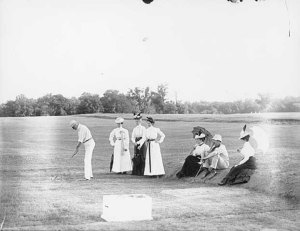
The Bryn Mawr clubhouse was formally opened on June 18. The Tribune reported the next day that several hundred people attended. “An orchestra greeted the visitors with music,” wrote the Tribune, “and there was a stream of handsome turnouts over the Laurel avenue bridge, bringing the women in their lovely summer frocks to smile on the men in their gay golfing suits.”
The nine-hole course measured a bit over 2300 yards with only two holes longer than 300 yards. The first tee was west of the clubhouse and the first green was on the east side of Cedar Lake Road. The second green was across that highway and a small pond.
Par for the course, at that time referred to as “bogey,” was set at 45 strokes. That must have seemed an impossible achievement for club members, based on early scores. At the first handicap tourney on the day the clubhouse opened, Martin Hanley beat a field of 40 golfers for the prize of a box of gutta percha balls. His net score was 101. Adding his handicap of 30, he had actually played the course in 131 strokes! That’s not three over par, it’s nearly three times par. The game was young. Hanley remained one of the club’s top golfers after the club moved to Minikahda.
It’s worth noting that the most thorough description of the new course and club appeared on May 15, 1898 in the Tribune’s society column, not its sports pages. The list of the first 200-plus members reads like a who’s who of early Minneapolis society: Pillsbury, Peavey, Heffelfinger, Jaffray, Rand, Lowry, Bell, Dunwoody, Christian, Morrison, Koon, Loring. The original plan was to admit 150 men and 100 women as members, but the initial number of female applicants was a bit lower than expected at only 62.
The new club had not only a course and greenskeeper, but a club house. The Woodburn residence had been “secured” for that purpose. The clubhouse featured “capacious rooms” and “broad verandas” and was being renovated to provide locker rooms and a restaurant. The location of the clubhouse is indicated by a report in the Saint Paul Globe of July 27, 1898 of a fire at the “quarters of the Bryn Mawr Golf club at the rear of 95 Elm Street.” Elm Street was later renamed Morgan Avenue North. So what was then 95 Elm Street would now likely be in Bryn Mawr Meadows—but that was more than ten years before Bryn Mawr Meadows was a park. The Globe reported that the total loss from the fire was not expected to exceed $200, so it was not likely a factor in the decision of the club to build a new clubhouse in a new—and now famous—location the next year.
Over the winter the members of the Bryn Mawr golf club must have become dissatisfied with the course or clubhouse or both, because the membership built a new golf course and a much grander clubhouse near the western shore of Lake Calhoun, the Minikahda Club.
On June 25, 1899 the Minneapolis Tribune reported, “Although somewhat late in starting its tournament season, the golf club which is now using the Bryn Mawr links until the Minikahda links are completed, had its tournament yesterday afternoon.” Some of the golfers at the club must have been quick learners, because early in the club’s second season scores had dropped dramatically. C. T. Jaffray won the opening tournament with a score of 85. The Tribune noted that the club was looking forward to the opening of the Minikahda clubhouse in “about three weeks.”
Roughly on schedule, the Tribune announced on July 14, “the activities that have centered around the Bryn Mawr links since the first of the season will be transferred tomorrow afternoon to the Minikahda links…The new club house on the west shore of Lake Calhoun is practically finished.”

That was not the end of the Bryn Mawr golf links, but before it was resurrected another Minneapolis golf course emerged. “The Camden Park golf club has been organized among the young men in the employ of the C. A. Smith Lumber company,” the Minneapolis Tribune reported on July 21, 1899. The new club had a membership of 25 and growing. “It plays over a beautiful course of nine holes laid out in the Camden park region and crosses the creek three times,” wrote the Tribune. The reference must have been to Shingle Creek.
As with the Bryn Mawr course, it is not clear that the club owned the land on which it had laid out its holes. Although the Tribune noted that the new club was “particularly fortunate in its course” and that the club “anticipates becoming a large and influential organization some day,” this article is the only mention I can find in Minneapolis newspapers of a golf course in north Minneapolis. A description of the course was included in Harper’s Official Golf Guide published in 1901, with distances and “bogey” for nine holes and the clubs officers. Based on newspaper descriptions of a course that crossed a creek, the course was perhaps laid out on land that became part of Camden (Webber) Park when the park board acquired land for that park in 1908.
Next: The Mother of All Minneapolis Golf Courses: Bryn Mawr II. A new Bryn Mawr Golf Club leads to yet another famous club.
David C. Smith
Minneapolis park scenes from more than 100 years ago
I found these postcards in a lot box at an auction. They intrigued me because I work for the park board. What I liked about them was that we always think that the world changes so much, but here was proof that we are still enjoying the exact same activity (having fun at Minnehaha Falls) that people did over a hundred years ago. Kind of reassuring in a crazy world.
Iris Pahlberg Peterson
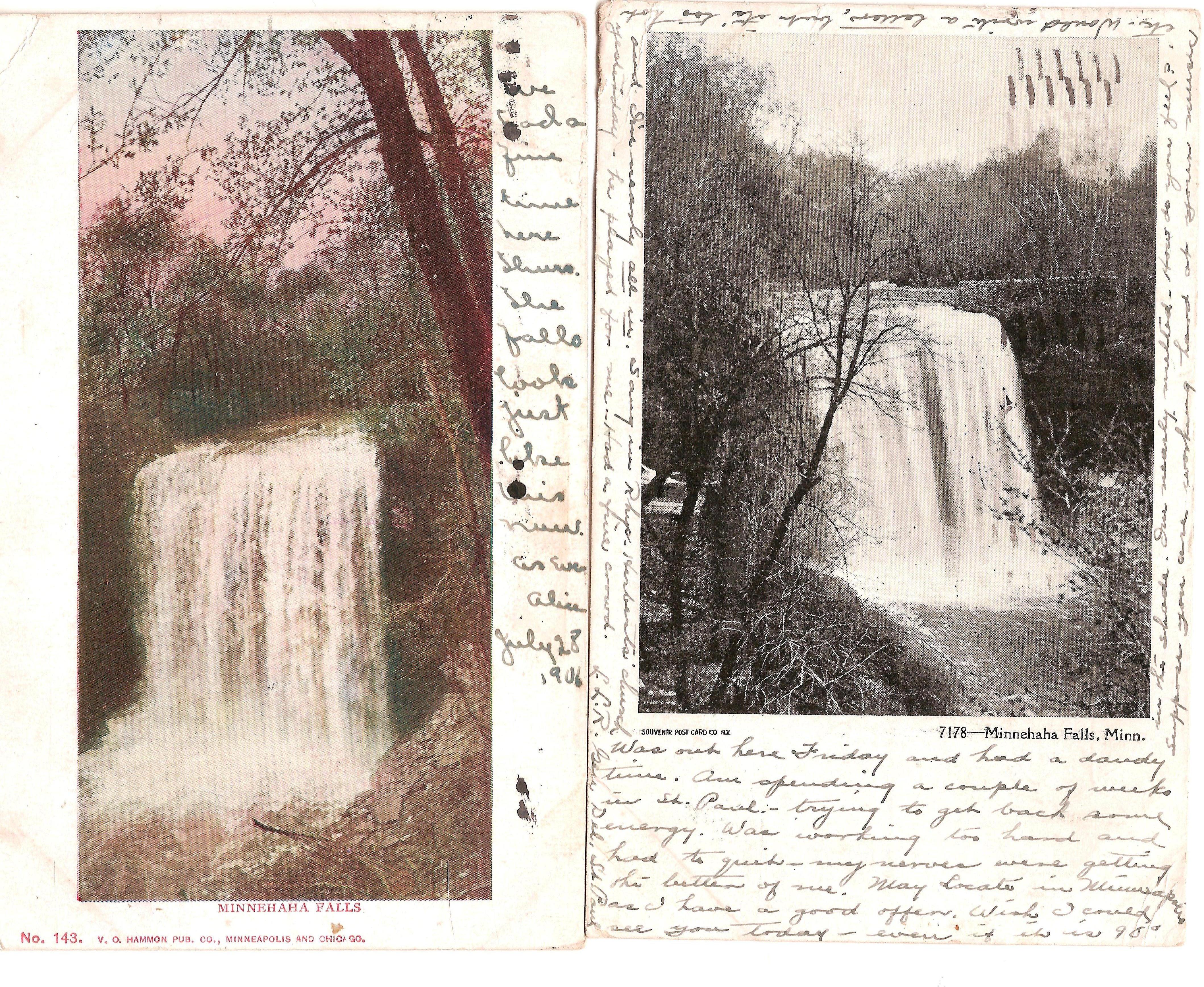
Minnehaha Falls on postcards postmarked in 1906 and 1908
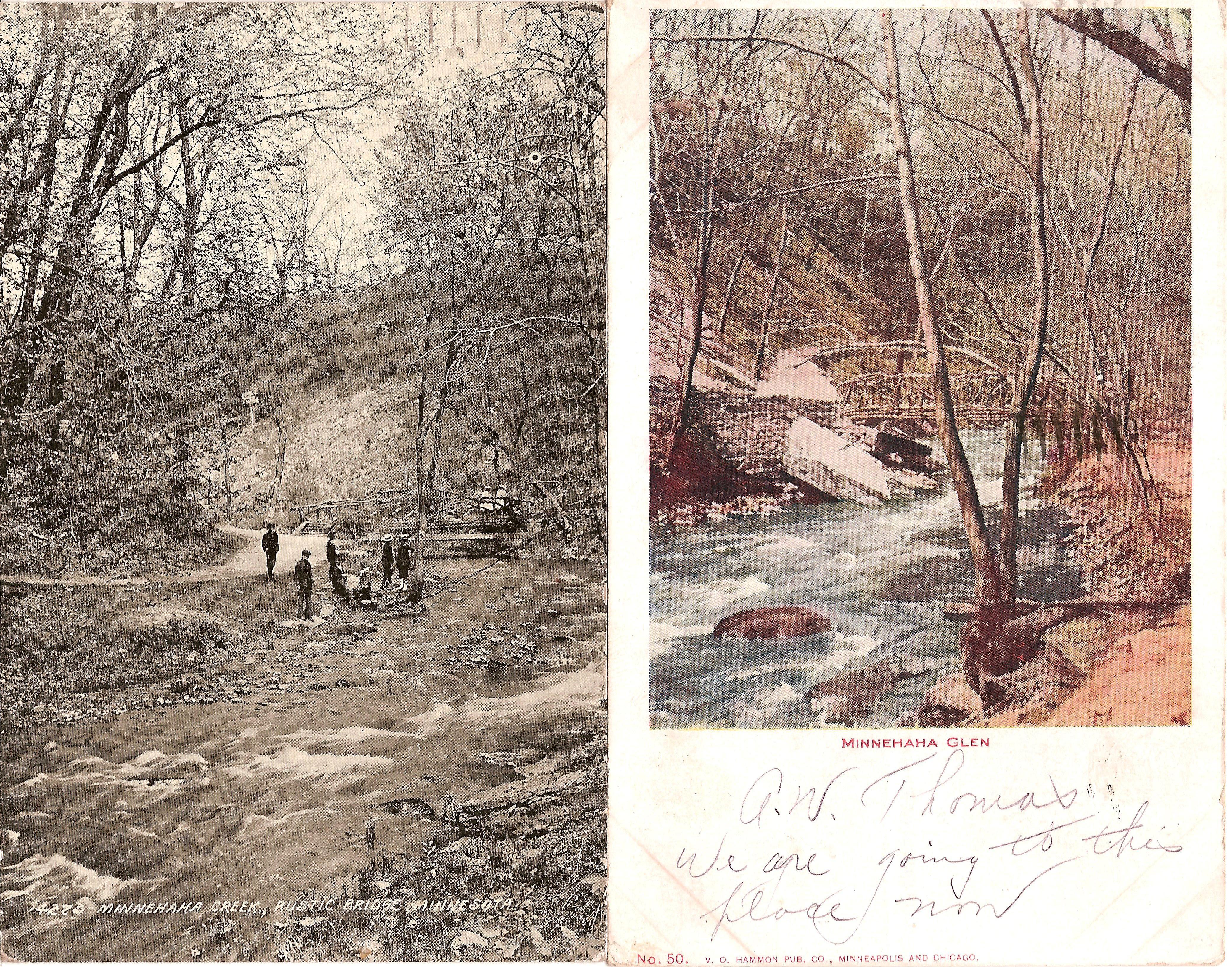
Minnehaha Glen below the falls, in postcards mailed in 1907 and 1911
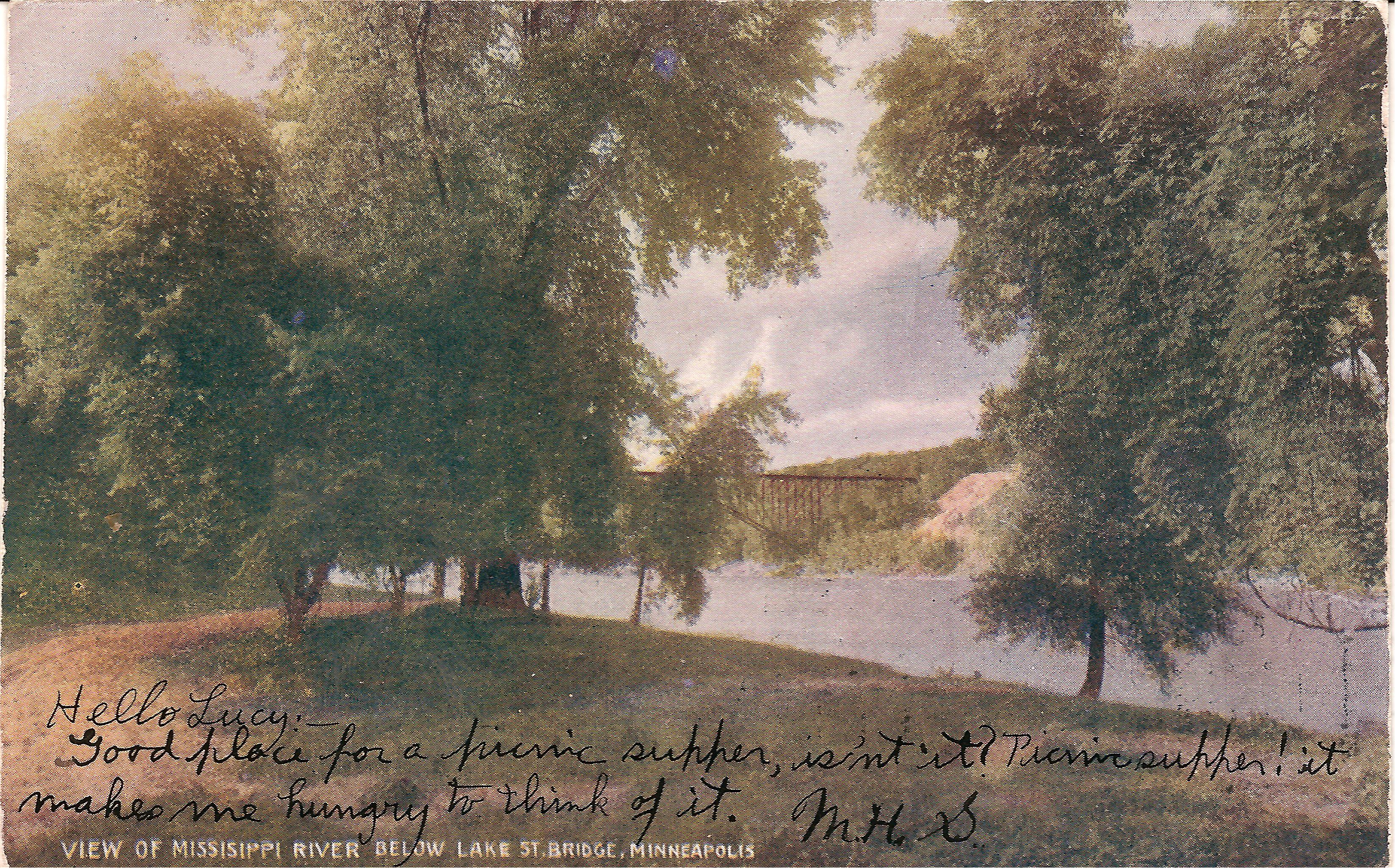
West bank of Mississippi River with view of Lake Street bridge in 1908 postcard. This was the river bank before the Ford Dam created a reservoir of the river.
Tell us your story about Minneapolis parks
Do you have a favorite Minneapolis park? Why? How has your favorite park changed over time? Do you have a picture? Send your thoughts as a “comment” below. Perhaps you’re in this picture. Or maybe you just remember the scene on Nokomis beach.
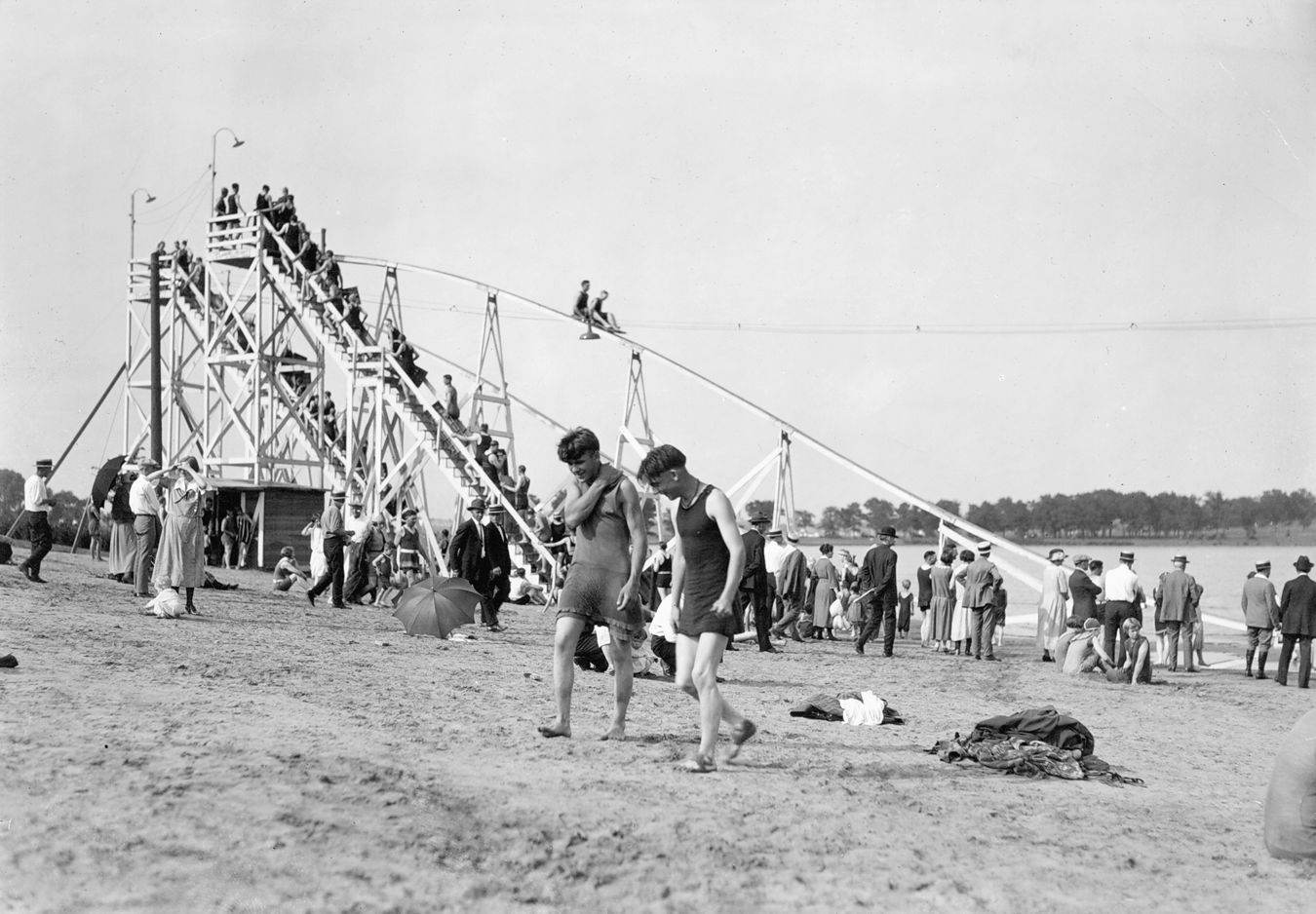
A slide at Nokomis Beach, built in 1924. (From City of Parks, courtesy Minnesota Historical Society.)
Do you remember when Waite Park was built? Did you ever attend a community sing at Folwell Park? Did you meet your wife at the old Lake Harriet bandstand or between high school football games at Parade Stadium?
The story of Minneapolis parks is really your story. Send us a chapter.
David C. Smith