Archive for the ‘H.W.S. Cleveland’ Tag
Recommended Reading from Horace W. S. Cleveland
Filed under: Landscape Architects, Minneapolis parks, Mississippi River | Tags: H.W.S. Cleveland, Horace Cleveland, Landscape Gardening
 Comments (1)
 We haven’t had much of a winter yet in Minnesota, but it’s inevitable. When it comes and you’re imprisoned in your cozy den, your thoughts may turn to spring and the gardens you’ll plant or visit. To get you thinking about warmer weather, I’m providing a reading list from the man who envisioned Minneapolis’s park system and designed the first parks acquired by the Minneapolis park board in the 1880s.
In 1886, the secretary to the Minneapolis park board, Rufus J. Baldwin, apparently asked landscape architect Horace W. S. Cleveland to recommend books on his profession. It’s not clear if Baldwin was interested in furthering his own education (he was a prominent Minneapolis attorney) or if he was acquiring books for the park board. Below is Cleveland’s reply dated 23 Sep. 1886.
(All of the books Cleveland cited are now available free online at Google Books. The links in the letter take you to the online volume of the work cited.)
In considering your request that I would furnish you a list of desirable works on landscape gardening I find the subject growing in my mind so rapidly and attaining such dimension that the chief difficulty lies in making a judicious selection. The literature of the last century was especially rich in the discussion of the principles on which the art is founded. “Repton’s Landscape Gardening” is perhaps the ablest and most elaborate of the works of that date, but I think I learned more of first principles from the “Essays on the Picturesque, By Sir Uvedale Price,” than from any book.
It is doubtful however whether either of these books can be purchased in this country unless by chance at a second-hand store. “Loudon’s Encyclopedia of Horticulture,” contains perhaps the most detailed, practical instructions of any English work and is still a standard of reference and can be had in England though it has not been republished here.
“Downing’s Landscape Gardening” is at the head of all works on the subject in this country and is in fact a compilation and adaptation to our wants of all the essential principles of the best foreign writers. Next to that and in fact supplying much in which Downing’s work is deficient is “Country Life By Robert Morris Copeland.” He was for many years my partner and was a man of rare taste and skill, and his book is an admirable one. “Scott’s Suburban Homes,” is also an excellent treatise and full of judicious advice in regard to the arrangement of grounds and tasteful use of trees and shrubbery. These books can be procured of any of the leading booksellers or at the seed stores of the principal cities. In ordering Downing’s book, be sure to get the edition which has the appendix by Winthrop Sargent, which contains a vast amount of very valuable information.
I do not think of any other work directly devoted to the subject that would add to the value of what is contained in the above.
“The Horticulturist” during the time it was edited by Downing was rich in essays on different branches of useful ornamental gardening, but it is doubtful if a complete set could be had, and indeed the three works above enumerated comprise I think all the essential principles so far as they can be given by print and illustration.
If I think of others that would be desirable I will let you know.
The letter is signed, “Very truly yrs, H.W.S. Cleveland.”
(The original letter is in the files of the Minneapolis Park and Recreation Board at Special Collections, Minneapolis Central Library, Hennepin County Library.)
Amazing, isn’t it, that works Cleveland cited as unavailable in the United States in 1886 — or available at “the seed stores of principal cities” — are now free to anyone with access to a computer. Some people have a problem with a company such as Google having so much control over information — I just read The Googlization of Everything (And Why We Should Worry) by Siva Vaidhyanathan — and while I agree with concerns over the concentration of information control, the widespread availability of so much information, even as old and arcane as these texts, is an invaluable resource.
Happy reading.
David C. Smith
P.S. Minneapolis still doesn’t have a park named for Horace W. S. Cleveland — and we should. I’m still in favor of naming the west side of the Mississippi River Gorge for him.
The Myth of Bassett’s Creek
Filed under: Minneapolis parks, Mississippi River | Tags: Bassett's Creek, H.W.S. Cleveland, Horace Cleveland, Minnehaha Creek, Mississippi River
Comments (24) I heard again recently the old complaint that north Minneapolis would be a different place if Bassett’s Creek had gotten the same treatment as Minnehaha Creek. Another story of neglect. Another myth.
You can find extensive information on the history of Bassett’s Creek online: a thorough account of the archeology of the area surrounding Bassett’s Creek near the Mississippi River by Scott Anfinson at From Site to Story — must reading for anyone who has even a passing interest in Mississippi River history; a more recent account of the region in a very good article by Meleah Maynard in City Pages in 2000; and, the creek’s greatest advocate, Dave Stack, provides info on the creek at the Friends of Bassett Creek , as well as updates on a Yahoo group site. Follow the links from the “Friends” site for more detailed information from the city and other sources.
What none of those provided to my satisfaction, however, was perspective on Bassett’s Creek itself after European settlement. A search of Minneapolis Tribune articles and Minneapolis City Council Proceedings, added to other sources, provides a clearer picture of the degree of degradation of Bassett’s Creek — mostly in the context of discussions of the city’s water supply. This was several years before the creation of the Minneapolis Board of Park Commissioners in 1883 — a time when Minnehaha Creek was still two miles outside of Minneapolis city limits. The region around the mouth of Bassett’s Creek was an economic powerhouse and an environmental disaster at a very early date — a mix that has never worked well for park acquisition and development.

Idyllic Minnehaha Creek, still in rural surroundings around 1900, quite a different setting than Bassett’s Creek, which had already been partly covered over by then. (Minnesota Historical Society)
“A Lady Precipitated from Bassett’s Creek Bridge”
Anfinson provides many details of the industrial development of the area around the mouth of Bassett’s Creek from shortly after Joel Bean Bassett built his first farm at the junction of the river and the creek in 1852. By the time the Minneapolis Tribune came into existence in 1867, industry was already well established near the banks of the creek. A June 1867 article relates how the three-story North Star Shingle Mill had been erected earlier that year near the creek. The next March an article related the decision to build a new steam-powered linseed oil plant near the creek on Washington Avenue.
Even more informative is a June 27, 1868 story about an elderly woman who fell from a wagon off the First Street bridge over the creek. “A Lady Precipitated from Bassett’s Creek Bridge, a Distance of Thirty Feet,” was the actual headline. (I’m a little embarrassed that I laughed at the odd headline, which evoked an image of old ladies raining down on the city; sadly, her injuries were feared to be fatal.) But a bridge height of thirty feet? That’s no piddling creek — even if a headline writer may have exaggerated a bit. The article was written from the perspective that the bridge was worn out and dangerous and should have been replaced when the city council had considered the matter a year earlier. Continue reading
Horace Cleveland’s Friends: Five of Clubs
Filed under: Landscape Architects, Longfellow Field Park, Minneapolis Parks: General | Tags: Cornelius C. Felton, Five of Clubs, George Stillman Hillard, H.W.S. Cleveland, Henry Russell Cleveland, Henry Wadsworth Longfellow, Horace Cleveland, Longfellow Park, Sumner Field
Comments (1) Trivia to delight and amaze.
Can you name two Minneapolis parks named for members of the “Five of Clubs,” an informal sort of book club?
The “Five of Clubs” met informally at the suburban Boston home of Horace W. S. Cleveland’s brother, Henry, in the early 1840s. Horace lived with his older brother for a time and sat in on those “club” gatherings.
Answer: Sumner Field and Longfellow Field.
Sumner Field was named for Sumner Place, the street in north Minneapolis on which the park was built in 1911. Sumner Place was named for U. S. Senator Charles Sumner, famous for his opposition to slavery and for ensuring the rights of freed slaves during Reconstruction. Before he was elected to the Senate from Massachusetts, he was an attorney in Boston — and a member of the “Five of Clubs.”

Longfellow statue in a field near Longfellow Garden upstream from Minnehaha Falls, 2011. (Ursula Murray Husted, flickr.com)
Longfellow Field was named for Henry Wadsworth Longfellow, the poet and professor of modern languages at Harvard in the 1840s and also a member of the “Five of Clubs.” In 1855, Longfellow published his epic poem “Song of Hiawatha,” which made Minnehaha Falls famous around the world. Longfellow never visited Minnehaha Falls and the book was written 17 years before Horace Cleveland first saw the Falls.
Imagine Horace Cleveland’s astonishment if he would have been told that 110 years after his death he would be more respected in his field than Longfellow is in his.
The other members of the “Five of Clubs” were Cornelius C. Felton, professor and future president of Harvard University, and George Stillman Hillard, Sumner’s law partner and author and publisher.
A reminder: Minneapolis should have a park along the Mississippi River gorge named for Horace Cleveland.
For much, much more on Horace Cleveland, click on his name in the tag cloud at right. For the whole story of Horace Cleveland and Minneapolis parks read City of Parks.
Just curious. Any future Sumners or Longfellows or Clevelands in your book club?
David C. Smith
Horace W. S. Cleveland’s Real Estate: Pleasant Avenue and West 44th Street
Filed under: Landscape Architects, Minneapolis parks | Tags: Frederick Law Olmsted, H.W.S. Cleveland, Horace Cleveland
Comments (3) In a fascinating and sad letter to Frederick Law Olmsted, dated February 23, 1892, Horace W. S. Cleveland proposed that the two collaborate as writers on “professional themes.” (Frederick Law Olmsted Papers, Library of Congress.) Cleveland mentions that Olmsted had written in “complimentary terms” of Cleveland’s writing style and that Olmsted had also noted his own desire to write more, which was frustrated by many demands on his time and energy. (At the time, Olmsted was overseeing preparation for the grounds at Chicago’s Columbian Exposition and was about to take a six-month trip to Europe, in part, to regain his health.)
“Often the thought has come to me,” Cleveland explained, “that if I could join forces with you, we might together produce something that would be essentially serviceable to the public and your name would suffice to summon an audience who would not listen to me.”
Cleveland explained that his motive was primarily to make money.
“I have been able to do but little more than keep even with my expenses, but thank God I have done that and am entirely clear of debt, and own some real estate which I hope to dispose of whenever a new demand arises, and may be worth two or three thousand dollars. You perceive that in this situation it is impossible for me to fold my hands and wait the course of events. I am constantly trying to devise means to stave off the necessity of becoming dependent on others.”
There is no record of Olmsted’s response to Cleveland’s proposal, nor any evidence that the men ever did attempt to write anything together. The health of both men deteriorated rapidly over the next couple years. Witold Rybczynski in his biography of Olmsted, A Clearing in the Distance, notes that Olmsted was managing to save about $1,000 a year at the time.
The real estate Cleveland referred to was likely the two half-blocks of land northwest of the intersection of West 44th Street and Pleasant Avenue in south Minneapolis.

H. W. S. Cleveland is listed as the owner of 4.7 acres on West 44th Street between Pleasant and Harriet in the upper left corner of this section of an 1892 plat map of Minneapolis. (John R. Borchert Map Library, University of Minnesota. Go to http://map.lib.umn.edu/collections/digitizedplatbooks/minn1892index.htm for the complete map.)
If you know anyone who lives in the southern halves of the 4300 blocks of Pleasant, Grand and Harriet, they live on land once owned by one of the most important people in the history of Minneapolis.
The Washburn Park neighborhood at the bottom of the map above, often called “Tangletown,” was laid out by Cleveland.
David C. Smith
More Horace W. S. Cleveland: A Bit of Oak Lake and More of Kenwood Parkway
Filed under: Landscape Architects, Minneapolis Parks: General | Tags: H.W.S. Cleveland, Horace Cleveland, Kenwood Parkway, Oak Lake
Comments (1) Since I wrote about Oak Lake and speculated whether Samuel Gale might have hired Horace Cleveland to lay out his Oak Lake Addition to Minneapolis — it had the look of Cleveland’s work — I have been digging through notes to see if I could find a connection between the two men. I couldn’t find anything that put the two of them together in 1873 when Gale was platting Oak Lake, but I did find two interesting pieces of paper linking Cleveland with Oak Lake and with Gale in 1886.
One connection between Cleveland and Gale in 1886 comes from the Frederick Law Olmsted Papers at the Library of Congress. Continue reading
Horace Cleveland Hated Rectangles
Filed under: Landscape Architects, Minneapolis parks | Tags: Forest Heights, Glen Gale, H.W.S. Cleveland, Horace Cleveland, Oak Lake, Samuel Gale
Comments (2) Oak Lake Addition was a rare real estate development in Minneapolis because the streets followed the contour of the land instead of a grid pattern. While I’ve found no evidence of who was responsible for the layout of the addition in 1873, it is reminiscent of Horace Cleveland’s work in St. Anthony Park for William Marshall at about the same time and later in Washburn Park or Tangletown near Minnehaha Creek. Although I find no reference to the project in Cleveland’s correspondence, it is plausible that he was involved in the layout of Oak Lake Addition.

Oak Lake Addition, platted in 1873. 1892 plat map (John R. Borchert Map Library, University of Minnesota)
Samuel Gale, the man who platted the Oak Lake Addition, had his hands in nearly everything in the young city: School Board, Athenaeum and Library Board, Academy of Natural Sciences, Society of Fine Arts, Board of Trade, City Council, the public lecture series, he even sang in the city’s most celebrated quartet along with his brother, Harlow, and it was later claimed that although nearly everyone speculated in real estate in those days, he was the dean of realtors in the city. Given his wide interests and involvement in civic affairs, it would be incredible if Gale hadn’t been one of those who welcomed Horace Cleveland to the city during his first visits in 1872.
In July, 1873 Gale was the chair of the Board of Trade’s committee on parks, which reported that several “public-spirited citizens” planned to devote considerable time to the issue of parks with “Mr. Cleveland, well-known landscape gardener” before the next Board of Trade meeting. (Minneapolis Tribune, July 18, 1873.) I think it is safe to assume that Gale himself was one of those who planned to meet with Cleveland. So it appears almost certain that Gale and Cleveland knew each other and had likely discussed park issues before Gale produced his plat for the Oak Lake Addition.
Absent information on who designed Oak Lake Addition, it’s fun to speculate that Cleveland may have had a hand in it, or at least influenced it through the book he published in early 1873, Landscape Architecture as Applied to the Wants of the West. In his classic of landscape architecture, Cleveland expressed his distaste for the grid pattern of streets in so many cities, because it ignored “sanitary, economic and esthetic sense.”
“Every Western traveller is familiar with the monotonous character of towns resulting from the endless repetition of the dreary uniformity of rectangles,” he wrote.
While he singled out western cities — it was his book’s theme — it takes only a glimpse of a map of Manhattan to know that rectangularism was not a sin peculiar to the frontier. For New York, however, it was already too late to do anything about that “dreary uniformity”; the West still had a chance to get it right. Cleveland added that “even when the site is level” the rectangular fashion of laying out cities “is on many accounts objectionable.”
He suggested that if blocks had to be rectangular at least they should be Continue reading
Lost Minneapolis Parks: Oak Lake, Two Ovals and Two Triangles
Filed under: Lost Minneapolis Parks, Minneapolis parks | Tags: H.W.S. Cleveland, Horace Cleveland, Loring Park, Oak Lake, Samuel Gale
Comments (14) Another convergence: the season of farmers’ markets is upon us and so is a decision on whether the Minnesota Vikings get a new tax-supported stadium. The site favored for a stadium by some Hennepin County commissioners is the Minneapolis Farmers’ Market on Lyndale Avenue just west of downtown and Target Field.
You’d never know by looking at it today, but the site is rich in history. The current market sits in the middle of what was once Oak Lake, one of the attractions of a semi-exclusive and progressive residential neighborhood late in the 19th Century. It was Minneapolis’s second-oldest park. A bandstand near the lake was built in 1881 to host some of the earliest outdoor concerts in the city. The gracefully curved streets of the neighborhood filled with the carriages of wealthier concert goers, while residents of the neighborhood and music lovers without carriages sat on the sloping hillside in what was called a natural amphitheater near the lake.
Oak Lake Addition, platted in 1873. 1892 plat map (John R. Borchert Map Library, University of Minnesota)
Some people say the Oak Lake Addition experienced gentile flight, then white flight, as the neighborhood went from mostly white Protestant to Jewish to black before it finally gave way to industrial and market uses. And it happened fast. But the trendy little neighborhood was probably doomed by something much more benign than ethnic, religious or racial bigotry; the creation of the Minneapolis Board of Park Commissioners helped kill the Oak Lake Addition.
And the answer is….French
Filed under: Landscape Architects, Minneapolis parks | Tags: Daniel Chester French, H.W.S. Cleveland, Horace Cleveland, William Merchant Richardson French, William Watts Folwell
Comments (3) In a post on December 29, 2010 I asked how these two pictures were related to the creation of Minneapolis parks.
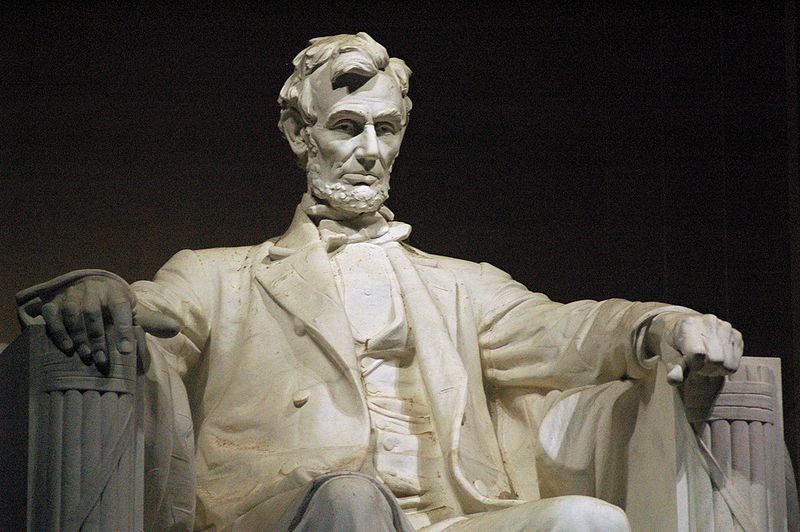
Abraham Lincoln, Lincoln Memorial, Washington, D. C. (Jeff Kubina)
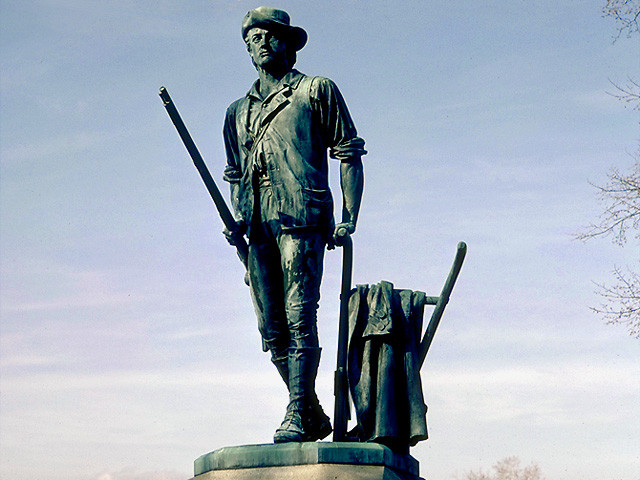
Minute Man, Minute Man National Historical Park, Concord, Massachusetts
Nobody has come up with the right obscure answer! So I’ll tell you.
The photos are of the most famous works of American sculptor Daniel Chester French. (The best example of French’s work in Minneapolis is the statue of John Pillsbury at the University of Minnesota.)
Here is the connection — and the key word is “related”:
Daniel Chester French’s older brother was William Merchant Richardson French. That’s this guy:
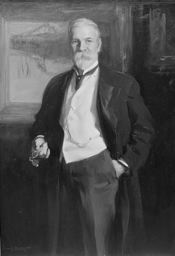
William Merchant Richardson French (Louis Betts, Art Institute of Chicago)
(Their father was Henry Flagg French who was the number two man in the U. S. Treasury Department. For eight months in 1881 he worked under Secretary of the Treasury William Windom, a U. S. Senator from Minnesota who resigned his Senate seat to become Treasury Secretary for President James Garfield. After those eight months, Windom resigned at Treasury and was elected to fill his own open seat in the Senate. He served as Secretary of the Treasury again from 1888 until his death in 1891.)
The important connection of William French to Minneapolis parks is that after graduating from Harvard in 1864 and a year at MIT studying engineering he moved to Chicago and met a man in the new and unusual profession of landscape gardening. It’s not clear how it came about, but in 1870 William French became the partner of a man thirty years older than he was. That pioneering landscape architect was Horace Cleveland.
Of course, young William, who was eager I’m sure to earn his keep with his much more experienced partner, went through his list of connections to identify potential clients. He likely recognized that one name on his list might provide useful contacts in a young city west of Chicago, Minneapolis. That contact was his cousin, George Leonard Chase, who was rector at the episcopal church in the small town of St. Anthony, which was springing up beside the falls of that name. Now it just happened that Chase had married one of the Heywood girls, Mary. And that was a funny thing because Chase’s best friend married Sarah Heywood, Mary’s sister. He and his best friend had lived together while they were students at Hobart College in New York. In fact, Chase had apparently had some influence with the regents of the University of Minnesota when they were hiring the university’s first president in 1869. Chase’s friend and brother-in-law by marriage was hired for that job. His name was William Watts Folwell.
Minneapolis Park Music: Loring Park, Horace Cleveland, by Gregory Reese
Filed under: Loring Park | Tags: H.W.S. Cleveland, Horace Cleveland, Loring Park
Leave a comment This is the only music I know of based on a Minneapolis park and the landscape architect who designed it. Gregory Reese composed “Loring Park, Horace Cleveland” for McNally Smith College of Music Art-inspired Music Project. Very cool. Have a listen while you stroll through the park. Or find a favorite bench.
Know of other music based on Minneapolis parks? A playground or two must have shown up in some rock or rap lyrics, no? I recall a reference to Holmes playground in a song, but can’t remember the group.
David C. Smith
Horace Cleveland River Gorge Park: We need the man’s name on our map
Filed under: Landscape Architects, Minneapolis Park Names, Minneapolis Parks: General | Tags: H.W.S. Cleveland, Horace Cleveland
Comments (4) Folwell Junior High School is no longer, but we still have Folwell Park in north Minneapolis and Folwell Hall at the University of Minnesota. The building at the university won’t last forever, but the park should, so people will have reason to remember William Watts Folwell even if they never see scribblings such as this or City of Parks. Many other heroes of our park development are remembered in park names, too: Loring, Berry, Morrison, King, Beard, Wirth, Gross, Bossen, Armatage.
Not so for Horace William Shaler Cleveland who played such an important role in the creation of the Minneapolis park system. His name is nowhere in this city. While I’m quoting Folwell today, there’s this from the close of his President’s Address in the 1895 annual report of the Minneapois Board of Park Commissioners:
“Although still in the land of the living, no further service can be expected of Mr. H. W. S. Cleveland, disabled as he is by the infirmities incident to his advanced age. Our city may count itself fortunate to have had his assistance in the original development of plark plans, and in the later execution of them in part. In some proper way his name should be perpetuated in connection with our park system.”
That is as true today as it was 115 years ago. We need Horace Cleveland’s name on Minneapolis maps.
My recommendation: everything between West River Parkway and the Mississippi River, from the mouth of Minnehaha Creek to Riverside Park, should become “Horace Cleveland River Gorge Park.” He loved most of all the river gorge and never stopped fighting for its acquisition as parkland, something that wasn’t accomplished until after his death. The west river bank is really known only as that; it doesn’t have a real name anyway. So why not put Cleveland’s name on it? No one has to call it that, I don’t care, just print it on the map so people don’t forget. It seems a little thing to do for a man who did so much for you and me.
I’m looking at you, park commissioners.

Horace Cleveland proposed this system of parks and parkways in 1883. I think it merits his name on a bit of the park system he suggested. (Minneapolis Park and Recreation Board)
David C. Smith
Frederick Law Olmsted and Minneapolis Parks
Filed under: Landscape Architects, Minneapolis parks | Tags: Frederick Law Olmsted, H.W.S. Cleveland, Horace Cleveland, Minneapolis parks, Washburn Fair Oaks, William D. Washburn
Comments (3) How many Minneapolis parks did Frederick Law Olmsted design? How about his sons, Junior and JC? I believe the grand total is zero.
Some people have a mistaken notion that Olmsted, the godfather of American parks, played a role in the creation of Minneapolis parks. The impression was created in part by a letter Olmsted wrote to the Minneapolis park board in 1886 and by claims that Olmsted designed the grounds around William Washburn’s mansion Fair Oaks, which later became Washburn Fair Oaks Park.
A city claiming that Olmsted designed a park is akin to an inn in the East declaring “George Washington slept here.” A quick way to impress. The difference is that exhaustive records and correspondence document what Olmsted actually did, while there is little proof of where George laid his wooden teeth on any given night.
 Minneapolis Park History