Archive for the ‘Horace Cleveland’ Tag
Horace Cleveland’s Friends: Five of Clubs
Filed under: Landscape Architects, Longfellow Field Park, Minneapolis Parks: General | Tags: Cornelius C. Felton, Five of Clubs, George Stillman Hillard, H.W.S. Cleveland, Henry Russell Cleveland, Henry Wadsworth Longfellow, Horace Cleveland, Longfellow Park, Sumner Field
 Comments (1)
 Trivia to delight and amaze.
Can you name two Minneapolis parks named for members of the “Five of Clubs,” an informal sort of book club?
The “Five of Clubs” met informally at the suburban Boston home of Horace W. S. Cleveland’s brother, Henry, in the early 1840s. Horace lived with his older brother for a time and sat in on those “club” gatherings.
Answer: Sumner Field and Longfellow Field.
Sumner Field was named for Sumner Place, the street in north Minneapolis on which the park was built in 1911. Sumner Place was named for U. S. Senator Charles Sumner, famous for his opposition to slavery and for ensuring the rights of freed slaves during Reconstruction. Before he was elected to the Senate from Massachusetts, he was an attorney in Boston — and a member of the “Five of Clubs.”

Longfellow statue in a field near Longfellow Garden upstream from Minnehaha Falls, 2011. (Ursula Murray Husted, flickr.com)
Longfellow Field was named for Henry Wadsworth Longfellow, the poet and professor of modern languages at Harvard in the 1840s and also a member of the “Five of Clubs.” In 1855, Longfellow published his epic poem “Song of Hiawatha,” which made Minnehaha Falls famous around the world. Longfellow never visited Minnehaha Falls and the book was written 17 years before Horace Cleveland first saw the Falls.
Imagine Horace Cleveland’s astonishment if he would have been told that 110 years after his death he would be more respected in his field than Longfellow is in his.
The other members of the “Five of Clubs” were Cornelius C. Felton, professor and future president of Harvard University, and George Stillman Hillard, Sumner’s law partner and author and publisher.
A reminder: Minneapolis should have a park along the Mississippi River gorge named for Horace Cleveland.
For much, much more on Horace Cleveland, click on his name in the tag cloud at right. For the whole story of Horace Cleveland and Minneapolis parks read City of Parks.
Just curious. Any future Sumners or Longfellows or Clevelands in your book club?
David C. Smith
Northeast River Parks
Filed under: Minneapolis parks, Mississippi River | Tags: Edgewater Park, Gluek Park, Horace Cleveland, Mississippi River
Comments (4) I enjoyed a walk yesterday along the riverfront parks in northeast Minneapolis sponsored by the Minneapolis Riverfront Partnership. I told a few historical stories and park commissioner Liz Wielinski, Above the Falls committee member Mary Jamin Maguire, and Cordelia Pierson, executive director of the partnership, provided insights into park developments, past and future, along the river. We were also delighted to hear stories of the neighborhood from a few longtime residents of the area.
We visited Marshall Terrace, Edgewater Park, and Gluek Park and along the way we passed the newest, still unnamed, Minneapolis park at 2220 Marshall Street—a single lot from Marshall to the river purchased by the park board in 2010.
These are a few of the notes I made for my input into the program.
Marshall Terrace
Marshall Terrace was purchased in 1914. The first land chosen for a First Ward Park was a few blocks farther upriver, but neighborhood objections resulted in the park board asking for suggestions from residents and politicians for a better site. This eight-acre parcel further downriver was the result. (The park board also acquired the upriver acreage, but as a segment of a planned parkway across northeast Minneapolis, now St. Anthony Parkway, instead of a playground park.)
Park superintendent Theodore Wirth prepared these two plans for the new park, which were included in the 1915 Annual Report. (The same report included plans for nearby Bottineau Park.) Continue reading
Horace W. S. Cleveland’s Real Estate: Pleasant Avenue and West 44th Street
Filed under: Landscape Architects, Minneapolis parks | Tags: Frederick Law Olmsted, H.W.S. Cleveland, Horace Cleveland
Comments (3) In a fascinating and sad letter to Frederick Law Olmsted, dated February 23, 1892, Horace W. S. Cleveland proposed that the two collaborate as writers on “professional themes.” (Frederick Law Olmsted Papers, Library of Congress.) Cleveland mentions that Olmsted had written in “complimentary terms” of Cleveland’s writing style and that Olmsted had also noted his own desire to write more, which was frustrated by many demands on his time and energy. (At the time, Olmsted was overseeing preparation for the grounds at Chicago’s Columbian Exposition and was about to take a six-month trip to Europe, in part, to regain his health.)
“Often the thought has come to me,” Cleveland explained, “that if I could join forces with you, we might together produce something that would be essentially serviceable to the public and your name would suffice to summon an audience who would not listen to me.”
Cleveland explained that his motive was primarily to make money.
“I have been able to do but little more than keep even with my expenses, but thank God I have done that and am entirely clear of debt, and own some real estate which I hope to dispose of whenever a new demand arises, and may be worth two or three thousand dollars. You perceive that in this situation it is impossible for me to fold my hands and wait the course of events. I am constantly trying to devise means to stave off the necessity of becoming dependent on others.”
There is no record of Olmsted’s response to Cleveland’s proposal, nor any evidence that the men ever did attempt to write anything together. The health of both men deteriorated rapidly over the next couple years. Witold Rybczynski in his biography of Olmsted, A Clearing in the Distance, notes that Olmsted was managing to save about $1,000 a year at the time.
The real estate Cleveland referred to was likely the two half-blocks of land northwest of the intersection of West 44th Street and Pleasant Avenue in south Minneapolis.

H. W. S. Cleveland is listed as the owner of 4.7 acres on West 44th Street between Pleasant and Harriet in the upper left corner of this section of an 1892 plat map of Minneapolis. (John R. Borchert Map Library, University of Minnesota. Go to http://map.lib.umn.edu/collections/digitizedplatbooks/minn1892index.htm for the complete map.)
If you know anyone who lives in the southern halves of the 4300 blocks of Pleasant, Grand and Harriet, they live on land once owned by one of the most important people in the history of Minneapolis.
The Washburn Park neighborhood at the bottom of the map above, often called “Tangletown,” was laid out by Cleveland.
David C. Smith
More Horace W. S. Cleveland: A Bit of Oak Lake and More of Kenwood Parkway
Filed under: Landscape Architects, Minneapolis Parks: General | Tags: H.W.S. Cleveland, Horace Cleveland, Kenwood Parkway, Oak Lake
Comments (1) Since I wrote about Oak Lake and speculated whether Samuel Gale might have hired Horace Cleveland to lay out his Oak Lake Addition to Minneapolis — it had the look of Cleveland’s work — I have been digging through notes to see if I could find a connection between the two men. I couldn’t find anything that put the two of them together in 1873 when Gale was platting Oak Lake, but I did find two interesting pieces of paper linking Cleveland with Oak Lake and with Gale in 1886.
One connection between Cleveland and Gale in 1886 comes from the Frederick Law Olmsted Papers at the Library of Congress. Continue reading
Horace Cleveland Hated Rectangles
Filed under: Landscape Architects, Minneapolis parks | Tags: Forest Heights, Glen Gale, H.W.S. Cleveland, Horace Cleveland, Oak Lake, Samuel Gale
Comments (2) Oak Lake Addition was a rare real estate development in Minneapolis because the streets followed the contour of the land instead of a grid pattern. While I’ve found no evidence of who was responsible for the layout of the addition in 1873, it is reminiscent of Horace Cleveland’s work in St. Anthony Park for William Marshall at about the same time and later in Washburn Park or Tangletown near Minnehaha Creek. Although I find no reference to the project in Cleveland’s correspondence, it is plausible that he was involved in the layout of Oak Lake Addition.

Oak Lake Addition, platted in 1873. 1892 plat map (John R. Borchert Map Library, University of Minnesota)
Samuel Gale, the man who platted the Oak Lake Addition, had his hands in nearly everything in the young city: School Board, Athenaeum and Library Board, Academy of Natural Sciences, Society of Fine Arts, Board of Trade, City Council, the public lecture series, he even sang in the city’s most celebrated quartet along with his brother, Harlow, and it was later claimed that although nearly everyone speculated in real estate in those days, he was the dean of realtors in the city. Given his wide interests and involvement in civic affairs, it would be incredible if Gale hadn’t been one of those who welcomed Horace Cleveland to the city during his first visits in 1872.
In July, 1873 Gale was the chair of the Board of Trade’s committee on parks, which reported that several “public-spirited citizens” planned to devote considerable time to the issue of parks with “Mr. Cleveland, well-known landscape gardener” before the next Board of Trade meeting. (Minneapolis Tribune, July 18, 1873.) I think it is safe to assume that Gale himself was one of those who planned to meet with Cleveland. So it appears almost certain that Gale and Cleveland knew each other and had likely discussed park issues before Gale produced his plat for the Oak Lake Addition.
Absent information on who designed Oak Lake Addition, it’s fun to speculate that Cleveland may have had a hand in it, or at least influenced it through the book he published in early 1873, Landscape Architecture as Applied to the Wants of the West. In his classic of landscape architecture, Cleveland expressed his distaste for the grid pattern of streets in so many cities, because it ignored “sanitary, economic and esthetic sense.”
“Every Western traveller is familiar with the monotonous character of towns resulting from the endless repetition of the dreary uniformity of rectangles,” he wrote.
While he singled out western cities — it was his book’s theme — it takes only a glimpse of a map of Manhattan to know that rectangularism was not a sin peculiar to the frontier. For New York, however, it was already too late to do anything about that “dreary uniformity”; the West still had a chance to get it right. Cleveland added that “even when the site is level” the rectangular fashion of laying out cities “is on many accounts objectionable.”
He suggested that if blocks had to be rectangular at least they should be Continue reading
Lost Minneapolis Parks: Oak Lake, Two Ovals and Two Triangles
Filed under: Lost Minneapolis Parks, Minneapolis parks | Tags: H.W.S. Cleveland, Horace Cleveland, Loring Park, Oak Lake, Samuel Gale
Comments (14) Another convergence: the season of farmers’ markets is upon us and so is a decision on whether the Minnesota Vikings get a new tax-supported stadium. The site favored for a stadium by some Hennepin County commissioners is the Minneapolis Farmers’ Market on Lyndale Avenue just west of downtown and Target Field.
You’d never know by looking at it today, but the site is rich in history. The current market sits in the middle of what was once Oak Lake, one of the attractions of a semi-exclusive and progressive residential neighborhood late in the 19th Century. It was Minneapolis’s second-oldest park. A bandstand near the lake was built in 1881 to host some of the earliest outdoor concerts in the city. The gracefully curved streets of the neighborhood filled with the carriages of wealthier concert goers, while residents of the neighborhood and music lovers without carriages sat on the sloping hillside in what was called a natural amphitheater near the lake.
Oak Lake Addition, platted in 1873. 1892 plat map (John R. Borchert Map Library, University of Minnesota)
Some people say the Oak Lake Addition experienced gentile flight, then white flight, as the neighborhood went from mostly white Protestant to Jewish to black before it finally gave way to industrial and market uses. And it happened fast. But the trendy little neighborhood was probably doomed by something much more benign than ethnic, religious or racial bigotry; the creation of the Minneapolis Board of Park Commissioners helped kill the Oak Lake Addition.
Has the Park Board Neglected Northeast Minneapolis?
Filed under: Grand Rounds, Minneapolis parks, Mississippi River | Tags: Columbia Park, Horace Cleveland, Logan Park, Mississippi River, Northeast Minneapolis, Sandy Lake, Theodore Wirth
Comments (2) The argument is sometimes made, particularly by “Nordeasters,” that northeast Minneapolis is park poor and that the Minneapolis park board has neglected that part of the city. “Underserved” seems to be the popular word. The idea even flowed as an undercurrent through the recent Minneapolis Riverfront Design Competition. The thinking goes that ever since Minneapolis and St. Anthony merged in 1872, and took the name Minneapolis, power, money and prestige—not to mention amenities such as parks—have accumulated west and south of the river. (Read Lucille M. Kane, The Waterfall That Built a City, for a fascinating examination of why that might have happened.)
While writing recently about Alice Dietz and the marvelous programs she ran at the Logan Park field house I thought again about the perceived neglect of Northeast and whether it might be true. I concluded that it is not; northeast Minneapolis has been a victim of industry, topography and opportunity, but not discrimination or even indifference. What’s more, all those elements have now realigned, putting northeast Minneapolis in the position to get a far bigger slice of the park pie in the foreseeable future than any other section of the city.
Lost Minneapolis Parks: Rauen Triangle
Filed under: Lost Minneapolis Parks, Minneapolis Parks: General | Tags: Horace Cleveland, Rauen Triangle
Comments (5) Minneapolis lost one of its only parks named for someone with a German surname in 1939. Given that more Minneapolitans define their ancestry as German than any other nationality — nearly one in four — it seems a bit odd that a city with more than 180 parks would have so few named after people of German descent. As I was looking over a list I compiled of Minneapolis park properties that no longer exist, I was struck by the description of Rauen Triangle; a 1930s park inventory claimed that the triangle was named after “German settler” Peter Rauen. When that triangle was paved over in 1939, the only park property that remained with a German name was Humboldt Triangle in north Minneapolis. Alexander von Humboldt was a German naturalist and explorer who died in 1859. Even Humboldt’s name adorned a park property by default rather than by choice; the triangle took its name from its location on Humboldt Avenue.
Rauen Triangle was a small piece of land (0.03 acre) at the oddly configured intersection of 11th Avenue North, North Fifth Street and North Sixth Street. The park board purchased the land at the request of residents of the neighborhood in 1890 for $3,462 — a price that seems exorbitant for such a small, otherwise useless tract. The entire cost was assessed on property in the neighborhood. It was given the unimaginative name of Fifth Street Triangle.
If the Nomenclature Committee had had its way in May 1893 the triangle would have been renamed Iota Triangle. The committee of Harry Wild Jones, William Folwell and Patrick Ryan had suggested naming most of the small street triangles after letters of the Greek alphabet. The park board approved many other names recommended by the committee that day — Kings Highway, The Beard Plaisance, Logan Park, Windom Park, and Van Cleve Park — but returned the Greek alphabet names to the committee for further consideration. Good choice.
The only suggested park name recommended by the committee that was shot down completely by the board was the name Hiyata Park for Spring Lake Park, the small pond at the foot of Kenwood Hill behind the Parade Ice Arena. The board voted to keep the name Spring Lake. Hiyata, the committee claimed, was an “Indian name meaning Back-By-The-Hill.”
After further deliberation, instead of Iota Triangle the committee returned with a recommendation of Rauen Triangle in honor of Peter Rauen, a German who had arrived at St. Anthony in 1856. The name made sense because Peter Rauen’s home at 1101 North Sixth Street faced the triangle.

Peter Rauen’s house at 1101 North Sixth Street, about 1875. This photo was taken from approximately the site of the future Rauen Triangle. I like the board sidewalk. (Michael Nowack, Minnesota Historical Society)
Rauen operated a successful grocery and general merchandise store at the corner of Plymouth and Washington. He was an alderman on the first city council after the merger of St Anthony and Minneapolis in 1872 and he was mentioned in Horace Hudson’s early history of Minneapolis as a prominent president of the Harmonia Society, one of the more successful musical organizations in the early days of Minneapolis.
The park board gave up Rauen Triangle in 1939 to the city of Minneapolis. On the same lot that Rauen’s home had once stood, the city built Fire Station 4, which still stands on the site. It seems that the triangle got in the way of the long hook and ladder fire engines maneuvering into the station. The triangle was paved over to create a quite wide intersection.
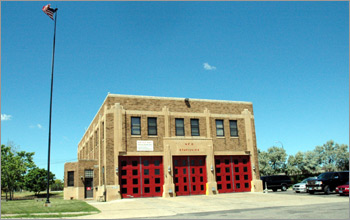
Fire Station 4, 1101 North Sixth Street (City of Minneapolis website)
In Rauen’s time the neighborhood was all residential, but it is now completely industrial and hemmed in by freeways.
Since the demise of Rauen Triangle, two other Minneapolis parks have been named for people with German surnames: Mueller Park (1973) and Gluek Park (1995).
I don’t mention the nationality or ethnicity of park names as something that needs to be addressed; it is simply an observation. The only name missing from a Minneapolis park that really must be added is Horace Cleveland’s.
David C. Smith
© David C. Smith
And the answer is….French
Filed under: Landscape Architects, Minneapolis parks | Tags: Daniel Chester French, H.W.S. Cleveland, Horace Cleveland, William Merchant Richardson French, William Watts Folwell
Comments (3) In a post on December 29, 2010 I asked how these two pictures were related to the creation of Minneapolis parks.
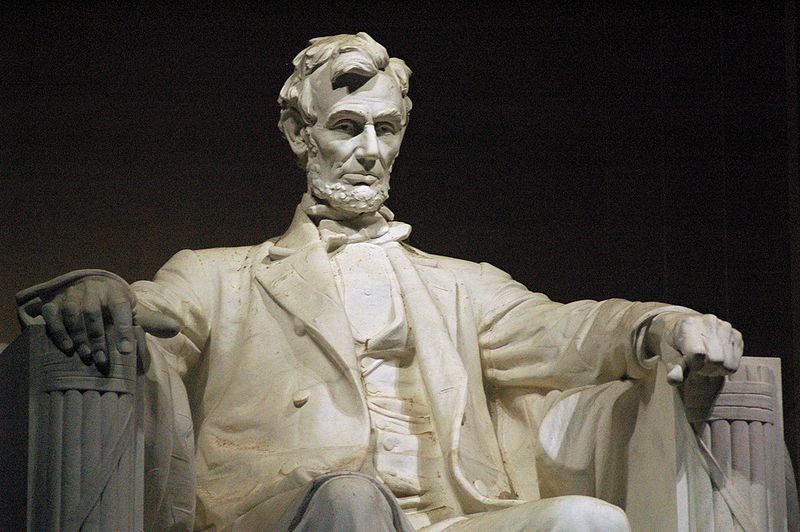
Abraham Lincoln, Lincoln Memorial, Washington, D. C. (Jeff Kubina)
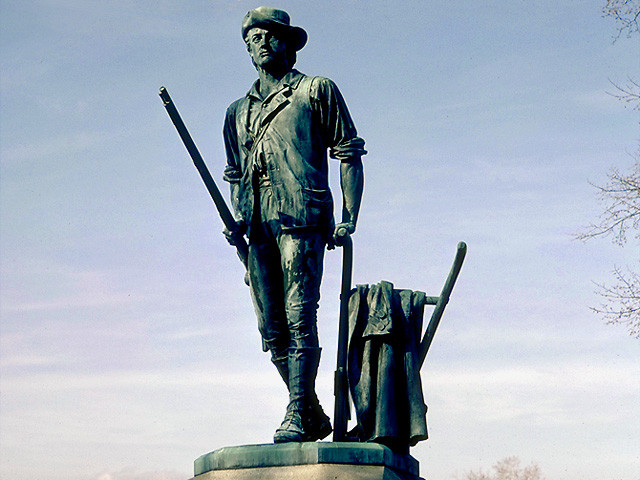
Minute Man, Minute Man National Historical Park, Concord, Massachusetts
Nobody has come up with the right obscure answer! So I’ll tell you.
The photos are of the most famous works of American sculptor Daniel Chester French. (The best example of French’s work in Minneapolis is the statue of John Pillsbury at the University of Minnesota.)
Here is the connection — and the key word is “related”:
Daniel Chester French’s older brother was William Merchant Richardson French. That’s this guy:
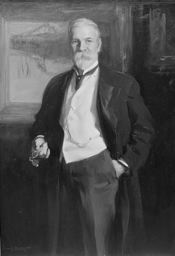
William Merchant Richardson French (Louis Betts, Art Institute of Chicago)
(Their father was Henry Flagg French who was the number two man in the U. S. Treasury Department. For eight months in 1881 he worked under Secretary of the Treasury William Windom, a U. S. Senator from Minnesota who resigned his Senate seat to become Treasury Secretary for President James Garfield. After those eight months, Windom resigned at Treasury and was elected to fill his own open seat in the Senate. He served as Secretary of the Treasury again from 1888 until his death in 1891.)
The important connection of William French to Minneapolis parks is that after graduating from Harvard in 1864 and a year at MIT studying engineering he moved to Chicago and met a man in the new and unusual profession of landscape gardening. It’s not clear how it came about, but in 1870 William French became the partner of a man thirty years older than he was. That pioneering landscape architect was Horace Cleveland.
Of course, young William, who was eager I’m sure to earn his keep with his much more experienced partner, went through his list of connections to identify potential clients. He likely recognized that one name on his list might provide useful contacts in a young city west of Chicago, Minneapolis. That contact was his cousin, George Leonard Chase, who was rector at the episcopal church in the small town of St. Anthony, which was springing up beside the falls of that name. Now it just happened that Chase had married one of the Heywood girls, Mary. And that was a funny thing because Chase’s best friend married Sarah Heywood, Mary’s sister. He and his best friend had lived together while they were students at Hobart College in New York. In fact, Chase had apparently had some influence with the regents of the University of Minnesota when they were hiring the university’s first president in 1869. Chase’s friend and brother-in-law by marriage was hired for that job. His name was William Watts Folwell.
Minneapolis Park Music: Loring Park, Horace Cleveland, by Gregory Reese
Filed under: Loring Park | Tags: H.W.S. Cleveland, Horace Cleveland, Loring Park
Leave a comment This is the only music I know of based on a Minneapolis park and the landscape architect who designed it. Gregory Reese composed “Loring Park, Horace Cleveland” for McNally Smith College of Music Art-inspired Music Project. Very cool. Have a listen while you stroll through the park. Or find a favorite bench.
Know of other music based on Minneapolis parks? A playground or two must have shown up in some rock or rap lyrics, no? I recall a reference to Holmes playground in a song, but can’t remember the group.
David C. Smith
The Case For Horace Cleveland’s Name on a River Gorge Park
Filed under: Landscape Architects, Minneapolis Park Names, Minneapolis Parks: General | Tags: H. W. S. Cleveland, Horace Cleveland, Minneapolis parks, Mississippi River
Comments (8) “A continuous park…of such picturesque character as no art could create and no other city can possess.”
That is how Horace Cleveland described the park he imagined along the boulevard he recommended for the west bank of the Mississippi River in Minneapolis. He went on to write in his Suggestions for a System of Parks and Parkways for the City of Minneapolis, which he presented to the first Minneapolis park board on June 2, 1883:
“The Mississippi River is not only the grand natural feature which gives character to your city and constitutes the main spring of prosperity, but it is the object of vital interest and center of attraction to intelligent visitors from every quarter of the globe, who associate such ideas of grandeur with its name as no human creation can excite. It is due therefore, to the sentiments of the civilized world, and equally in recognition of your own sense of the blessings it confers upon you, that it should be placed in a setting worthy of so priceless a jewel.”
Horace Cleveland had a special passion for the Mississippi River gorge. The banks of the river remain a beautiful and wild place thanks, in part, to his constant encouragement over nearly three decades for Minneapolis (St. Paul, too) to acquire the river banks downstream from St Anthony Falls to preserve them from ruin.
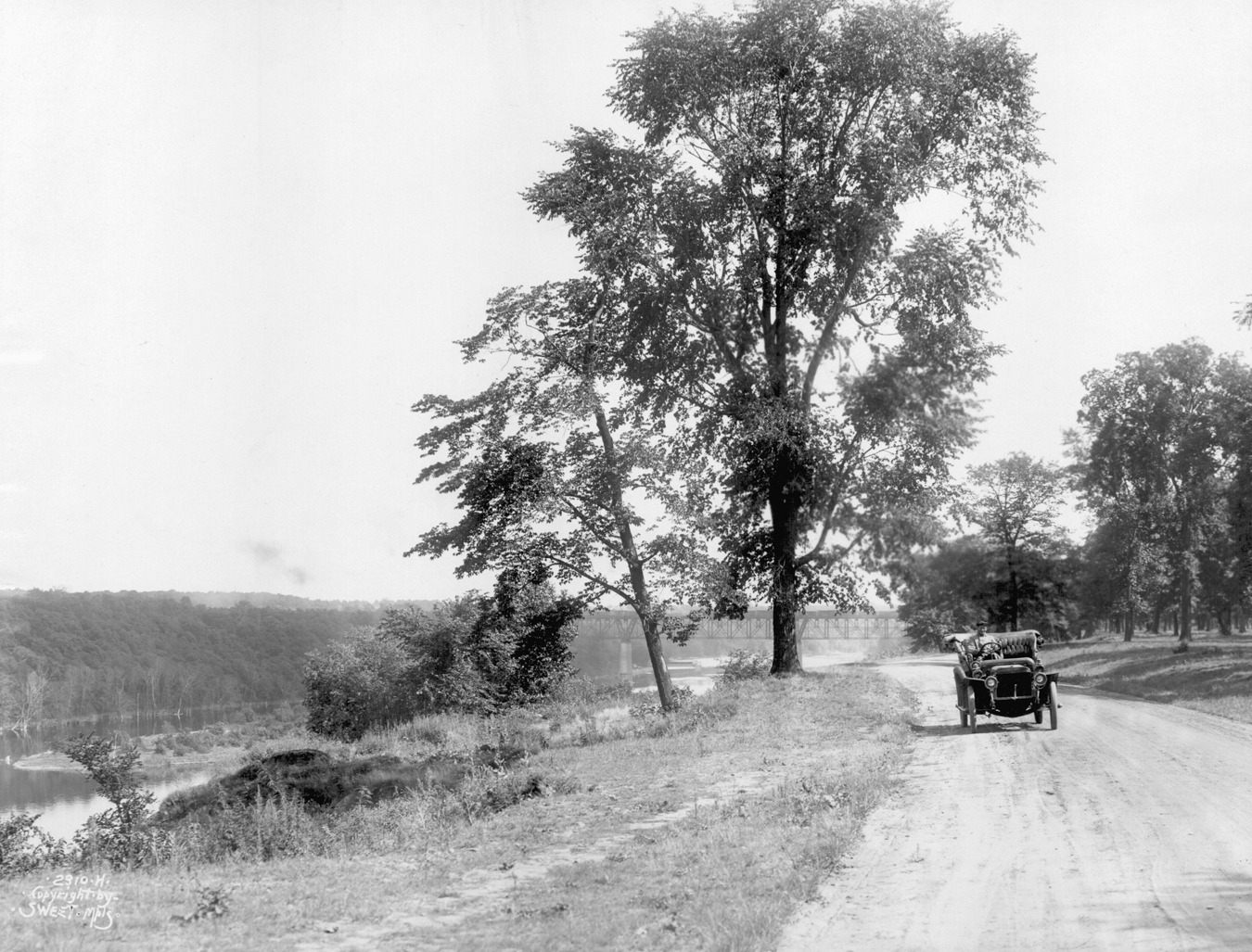
This photo of West River Parkway in about 1910 shows how wild the river banks were. The ruggged, wild banks of the river gorge, the only such place on the entire length of the Mississippi River, remain as beautiful today as during Horace Cleveland’s lifetime. (Hennepin County Public Library, Minneapolis Collection, M0129)
The park board finally acquired all the land along the west side of the gorge downriver from Riverside Park to Minnehaha Creek in 1902, more than a year after Cleveland’s death. Cleveland once said that he would feel that he “had not lived in vain” if the city would preserve the river bank in its natural state.
Cleveland wrote of the river banks:
“No artist who has any appreciation of natural beauty would presume to do more than touch with reverent hands the features whose charms suggest their own development. No plan for such work could be made.”
Cleveland not only appreciated the beauty of the river, but he foresaw that the cities of St. Paul and Minneapolis would one day grow together. In his mind that probability made it even more important that the cities preserve some wild, natural places along the river that ran between them.
We should name a river gorge park for Cleveland just as a tribute to his descriptive powers, even if he hadn’t suggested, recommended, planned, cajoled, informed and educated a generation or two of the city’s leaders on land preservation and city building.
I believe the only name ever given to the land along the river was Mississippi Park. A bit plain. Winchell Trail and West River Parkway run through it, and those names can remain. It would cause no one any discomfort to officially name the rest of the west gorge for Cleveland. It’s not like renaming a street, which causes people to have to change their addresses and the city to put up new road signs. It’s just putting a name on a space that essentially has none now.
A marker or two along Winchell Trail and the parkway would suffice to let people know Horace Cleveland’s name. That couldn’t cost much. I’ll put up the first hundred bucks.
Horace Cleveland River Gorge Park. He’s why we have it, so let’s put his name on it. I think we owe him that.
David C. Smith
© David C. Smith
Horace Cleveland River Gorge Park: We need the man’s name on our map
Filed under: Landscape Architects, Minneapolis Park Names, Minneapolis Parks: General | Tags: H.W.S. Cleveland, Horace Cleveland
Comments (4) Folwell Junior High School is no longer, but we still have Folwell Park in north Minneapolis and Folwell Hall at the University of Minnesota. The building at the university won’t last forever, but the park should, so people will have reason to remember William Watts Folwell even if they never see scribblings such as this or City of Parks. Many other heroes of our park development are remembered in park names, too: Loring, Berry, Morrison, King, Beard, Wirth, Gross, Bossen, Armatage.
Not so for Horace William Shaler Cleveland who played such an important role in the creation of the Minneapolis park system. His name is nowhere in this city. While I’m quoting Folwell today, there’s this from the close of his President’s Address in the 1895 annual report of the Minneapois Board of Park Commissioners:
“Although still in the land of the living, no further service can be expected of Mr. H. W. S. Cleveland, disabled as he is by the infirmities incident to his advanced age. Our city may count itself fortunate to have had his assistance in the original development of plark plans, and in the later execution of them in part. In some proper way his name should be perpetuated in connection with our park system.”
That is as true today as it was 115 years ago. We need Horace Cleveland’s name on Minneapolis maps.
My recommendation: everything between West River Parkway and the Mississippi River, from the mouth of Minnehaha Creek to Riverside Park, should become “Horace Cleveland River Gorge Park.” He loved most of all the river gorge and never stopped fighting for its acquisition as parkland, something that wasn’t accomplished until after his death. The west river bank is really known only as that; it doesn’t have a real name anyway. So why not put Cleveland’s name on it? No one has to call it that, I don’t care, just print it on the map so people don’t forget. It seems a little thing to do for a man who did so much for you and me.
I’m looking at you, park commissioners.

Horace Cleveland proposed this system of parks and parkways in 1883. I think it merits his name on a bit of the park system he suggested. (Minneapolis Park and Recreation Board)
David C. Smith
 Minneapolis Park History