Archive for the ‘Minnehaha Falls’ Tag
Minnehaha Falls Photos
Filed under: Minneapolis parks, Minnehaha Falls | Tags: Minnehaha Falls, Minnehaha Park
 Comments (2)
 Karen Cooper tells me she has photos of more 19th- and early 20th-Century bridges over Minnehaha Creek at Minnehaha Falls than the ones I’ve already posted. You can see those photos and more next Sunday, Feb. 10, at 2 pm at Hennepin History Museum. (Get more info here.)
I’m told that Karen has the most amazing Minnehaha Falls collection. I’m looking forward to seeing part of it myself for the first time. Hope to see you there.

The 1910 stone arch bridge was actually made of reinforced concrete and given a facade of boulders found in the vicinity. (Minnesota Historical Society)
David C. Smith
The Preservation Instincts of Charles M. Loring
Filed under: Minneapolis parks, Minnehaha Falls | Tags: Charles M. Loring, Horace Cleveland, Minnehaha Falls
Comments (2) Charles Loring’s view on preserving natural landscapes was so well-known that this anonymous poem appeared in the St. Paul Daily Globe on September 8, 1889 in a humor column, “All of Everything: A Symposium of Gossip About Minneapolis Men and Matters.”
A grasping feature butcher,
With adamantine gall,
Wants to build a gallery
At Minnehaha’s fall.He wants to catch the people
Who come to see the falls,
And sell them Injun moccasins
And beaded overalls.He wants to take their “phizes,”
A dozen at a crack,
With the foliage around them
And the water at the back.But the shade of Hiawatha
No such sacrilege would brook:
And he’d shake the stone foundations
Ere a “picter had been took.”C. M. Loring doesn’t like it,
For he says he’d like to see
The lovely falls, the creek, the woods,
Just as they used to be.
Loring had chaired a commission appointed by the governor to acquire Minnehaha Falls as a state park in 1885. The land was finally acquired, after a long court fight over valuations, in the winter of 1889. (The total paid for the 180-plus acres was about $95,000.) See City of Parks for the story of how George Brackett and Henry Brown took extraordinary action to ensure the falls would be preserved as a park.
The poem in the Daily Globe appeared because the park board was considering permitting construction of a small building beside the falls for the express purpose of taking people’s photos with “the water at the back.” And of course charging them for the privilege.
That proposal elicited a sharp response from landscape architect H. W. S. Cleveland who also opposed having any structure marring the natural beauty of the falls. Cleveland used language much harsher than the reserved Loring likely would have used. In a letter to his friend William W. Folwell, Cleveland wrote on September 5, 1889,
I cannot be silent in view of this proposed vandalism which I am sure you cannot sanction, and which I am equally sure will forever be a stigma upon Minneapolis, and elicit the anathema of every man of sense and taste who visits the place.
If erected it will simply be pandering to the tastes of the army of boobies who think to boost themselves into notoriety by connecting their own stupid features with the representation of one of the most beautiful of God’s works.
The preservation passion of Loring and Cleveland is evident today in the public lakeshores and river banks throughout Minneapolis. The next time you take a stroll around a lake or beside the river, or fight to acquire as parks the sections of the Mississippi River banks that remain in private hands, say a little “thank you” to people like Loring and Cleveland who saw the need to acquire lakes and rivers as parks more than 125 years ago—and nearly got them all.
And the photography shack was never built.
David C. Smith
Stone Quarry Update: Limestone Quarry in Minnehaha Park at Work
Filed under: Minneapolis parks, Minnehaha Falls, Mississippi River | Tags: Christian Bossen, Minnehaha Dog Park, Minnehaha Falls, Minnehaha Park, Mississippi River, WPA
Comments (6) I was technically correct when I wrote in October that the park board only operated a limestone quarry and stone crushing plant in Minnehaha Park for one year: 1907. But I’ve now learned that the Minnehaha Park quarry was operated for nearly five years by someone else—the Works Progress Administration (WPA).
From early 1938 until 1942 the WPA, a federal program that provided jobs during the Depression, operated the quarry after “tests revealed a large layer of limestone of hard blue quality near the surface” in the park near the Fort Snelling property line at about 54th, according to the park board’s 1937 Annual Report. The WPA technically operated the plant, but it was clearly for the benefit of the Minneapolis park system.
“Although this plant is operated by the WPA, our Board supplied the bed of limestone, the city water, lighting, gasoline and oil, and also some small equipment, since it was set up primarily for our River Road West project, which included the paving of the boulevard from Lake Street to Godfrey Road, and also to supply sand and gravel to the River Road West Extension project (north from Franklin Avenue) where there was a large amount of concrete retaining wall construction.”
— 1938 Annual Report, Minneapolis Board of Park Commissioners
In 1938 the park board estimated that 85% of the product of the stone crushing plant was used on park projects, the remainder on other WPA projects in the city.
The quarry was established in an area that “was not used by the public and when the operations are completed, the area can be converted into picnic grounds and other suitable recreational facilities,” the park board reported. (I bet no one thought then that a “suitable” facility would include a place where people could allow their dogs to run off leash!)
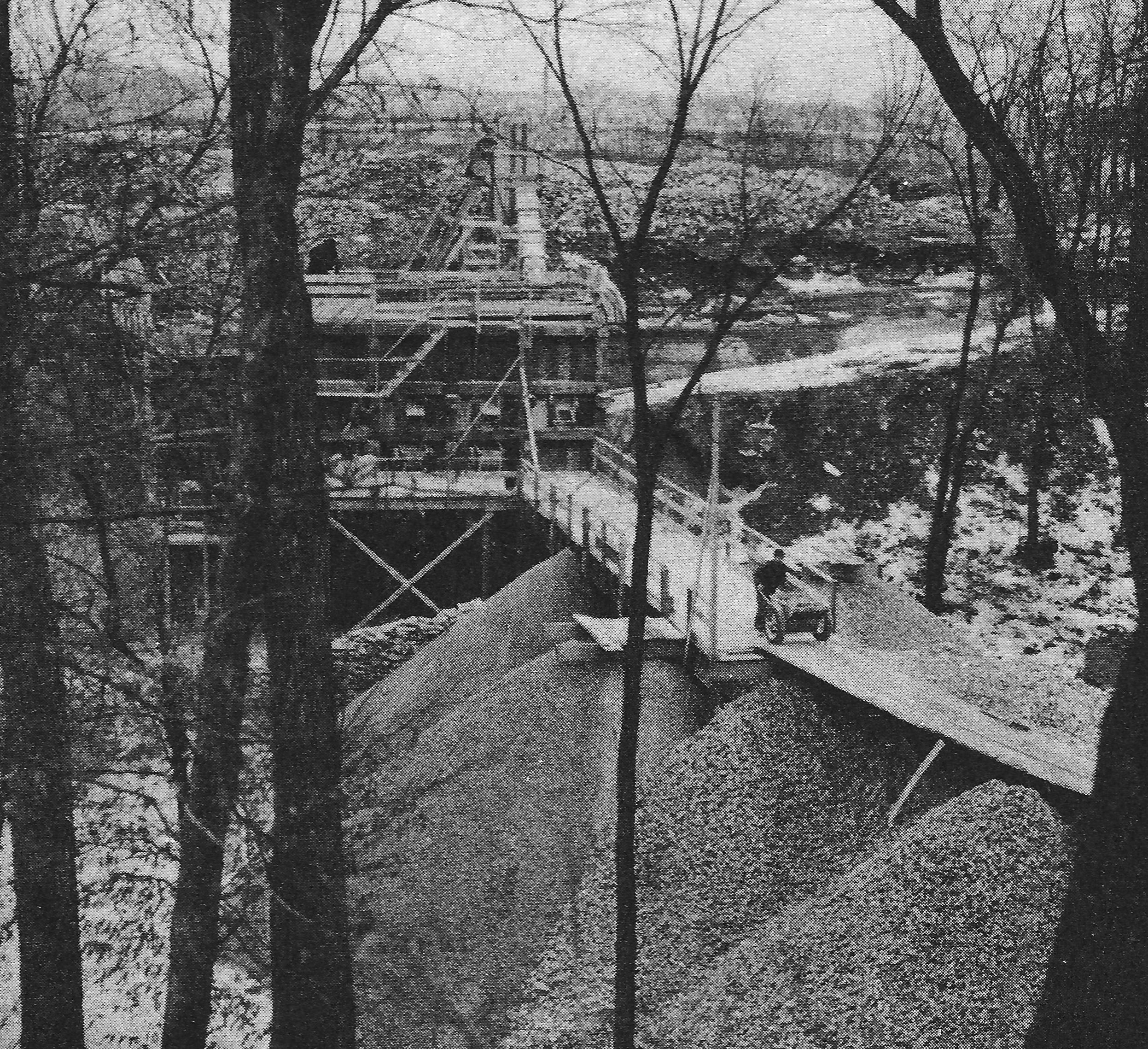
“The Stone-crushing Plant at Minnehaha Park” (1938 Annual Report, Minneapolis Board of Park Commissioners) Doesn’t look much like one of our favorite wild places, does it?
The plant consisted of “two large jaw crushers” and a conveyor that lifted the crushed rock to shaker screens over four large bins. It was operated by gasoline engines and was lit by electric lights so it could operate day and night. (The fellow with the wheelbarrow in the photo might have liked more conveyor.)
The crushed stone was used in paving River Road West and East, Godfrey Road and many roads, walks and tennis courts throughout the park system. The rock was also used as a paving base at the nearby “Municipal Airport,” also known as Wold-Chamberlain Field, which the park board owned and developed until it ceded authority over the airport to the newly created Metropolitan Airports Commission in 1944. According to the 1942 Annual Report of the park board, in four-and-a-half years the quarry produced 76,000 cubic yards of crushed limestone, 50,000 cubic yards of sand and gravel and 36,000 cubic feet of cut limestone.
The cut limestone was used to face bridges over Minnehaha Creek, shore retaining walls at Lake Harriet, Lake Nokomis and Lake Calhoun and other walls throughout the park system.
The plant was used to crush gravel only in 1938. The gravel was taken from the banks of the Mississippi River, “it having been excavated by the United States Government to deepen the channel of the Mississippi River just below the dam and locks.” After that, the WPA acquired the sand and gravel it needed from a more convenient source in St. Paul.
The project was terminated in 1942 near the end of the WPA. In his 1942 report, park superintendent Christian Bossen wrote in subdued tones that, “For a number of years, practically the only improvement work carried on was through WPA projects. In 1942, WPA confined its work almost exclusively to war projects: and under these conditions considerable work was done at the airport and a very little work was done on park projects.” The WPA was terminated the following year.
The next time you take your dog for a run at the off-leash recreation area at Minnehaha, have a look to see if there are any signs of the quarry and let us know what you find.
David C. Smith
Minnehaha Park: The Incinerator and the Fireplace
Filed under: Minneapolis parks, Minnehaha Falls, Mississippi River | Tags: Minnehaha Falls, Minnehaha Park
Comments (13) A few months ago Mary MacDonald and Doug Rosenquist asked about fireplaces near 54th and Hiawatha in Minnehaha Park. Mary asked about the stone fireplace a few hundred yards down the path into the dog park and Doug asked about the brick fireplace nearer the road and north of 54th Street.

View of the fireplace from the path in the dog park.
Unfortunately I haven’t found any information on the massive stone fireplace. Not even MaryLynn Pulscher of the park board knows why it’s there or who built it—and if MaryLynn doesn’t know it’s a decent bet that no one does. Still, I’ll keep asking around. I hope one of our readers knows somebody who remembers something and can pass it along to the rest of us.
I have better news about the two-story incinerator. It was built in 1939 by a WPA crew. This is how it was described in the park board’s 1939 annual report:
“Along this roadway a concrete, limestone-faced incinerator was constructed at the old stone quarry site. This incinerator, the first of its kind in our park system, will burn the waste accumulated from the various picnic grounds in this section of the city. A continuation of improvements similar to these is contemplated for next year.”
Two photos of the incinerator are included in the 1939 annual report, but those photos would be hard to reproduce due to the low quality printing of the annual report that year. The 1931-1939 annual reports were not typeset and production values were low.

A stairway goes down behind the incinerator to a lower level where the fire could be stoked and ashes removed..
Despite a reputation for producing elegant and well-illustrated annual reports dating back to the earliest days of the park board (see praise for the park board’s annual reports from noted landscape architect Warren Manning here), the park board’s finances during the Great Depression would not allow anything above the barest minimum of expenditures on annual reports. I am still grateful, however, that photos were included in the reports during those lean depression years.
Until you can get to a library to find a copy of the report and see the original photos, I will provide this quick shot I took last week.
In materials and construction — concrete faced with limestone — the incinerator is similar to the other WPA construction projects in Minnehaha Park in 1939 and 1940, including bridges across Minnehaha Creek in the lower glen and retaining walls built along the creek. (You still have two days to vote for Minnehaha Park and Mill Ruins Park in the Partners in Preservation contest on facebook.)
The Old Stone Quarry Site
The most interesting part of the incinerator description, for me, is its location at the “old stone quarry site.” I remember seeing the photo below in the 1907 annual report and assumed that the quarry was in operation for several years. It appears that it was not. Continue reading
Large Stone Fireplace in Minnehaha Dog Park?
Filed under: Minneapolis parks, Minnehaha Falls | Tags: Minnehaha Dog Park, Minnehaha Falls
Comments (7) Mary MacDonald recently wrote to ask for info on the large stone fireplace near the long path to the Mississippi River in the Minnehaha Dog Park off 54th and Hiawatha. She said she’s been unable to find any info on who built it and how old it is. Does anyone know? I don’t know anything about it. Leave a comment or e-mail me at the address below.
David C. Smith
Maybe it’s time for Puck to have a sniff.

Puck
Minneapolis Park Memory: Sparks, shetlands and a muskrat
Filed under: Minneapolis Park Memory | Tags: Minnehaha Falls, Powderhorn Park
Leave a comment I lived at 3040 Longfellow Avenue South until I was nine years old, and I have fond memories of Minneapolis parks and lakes. We were a walking, rail-riding family, often hurrying to Cedar Avenue to catch the streetcar. Do you remember the overhead sparks?
My dad and his younger brother Bobby, who often stayed with us, would pull me on the toboggan all the way to Powderhorn Park to slide down the “big” hill. Family legend has it that I didn’t trudge up the hill hand-in-hand like most kids: I had to be carried. My mom took me by streetcar for ice skating lessons at the Minneapolis Arena, and Dad and I would carry our skates to Powderhorn Park to practice on the lake. Do you remember when it was so cold you could hear the ice all the way across the lake?
Of course, Minnehaha Falls was a fascination for the young me. Remember the pony rides? I’m sure I thought I was Dale Evans as those Shetlands made endless circles. A family outing at the Falls always included a long walk down (and up) the stairs built by the federal work-relief crews. I have pictures of me and Dad posed at those beautiful stonework rest stops.
Other bits and pieces of my Minneapolis park and lake memories include the swans of Loring Park, the Aqua Follies at Theodore Wirth, and canoeing in a borrowed canoe on Lake of the Isles, with my fellow paddlers trying to hit a muskrat with their paddles.
Pam Schultz
Minneapolis Park Memory: My Park
When I was a child, my family lived at 42nd Street and 33rd Avenue. My parents and brother often walked to Minnehaha Park on a sunny Sunday afternoon. We usually made one stop, at 46th Street, so my brother and I could ride the ponies. They had three pairs of ponies that went around and around and around. Mother packed a small lunch; we never took liquids because there were several water fountains in the park. The lower part of the park was fenced in for deer; it was called the “deer pen.” I have a picture of me standing on thh bridge in front of the falls dressed in my Sunday best. Mother had curled my hair to look my best for a trip to the park.
In teen years we ice skated on the lagoon above the falls. We had a warming house, as well as an iced toboggan run. A park employee monitored the run. In the summertime, my family would walk the trails on either side of the creek all the way down to the river, where we would wave to the people across the water. Every year we had our fall church picnic at the park. We used the wonderful pavilion with its restrooms, stoves and lots of picnic tables. This is most of my life. What would I have done without my park?
Gladys Wangstad
Public-private collaborations that work: Sea Salt, Tin Fish and…Bread and Pickle?
Filed under: Lake Calhoun, Lake Harriet, Minneapolis Parks: General, Minnehaha Falls | Tags: Horace Cleveland, Lake Calhoun, Lake Harriet, Minnehaha Falls, Theodore Wirth
Comments (1) The mention of Sea Salt restaurant in Alice Streed’s Minneapolis Park Memory: Treasure (below) is noteworthy. A relatively new development in our parks is mentioned in the same sentences as long-celebrated spaces and activities. The popular restaurant in the Minnehaha Park refectory — run as a private, for-profit business — is a marvelous example of the best of public-private collaboration. It proves that private enterprise can do some things, such as serving delicious sea food, better than a public agency. I believe it also demonstrates the silliness of claims that the sky is falling whenever an agency like the park board considers change.
Lest private enterprise advocates get carried away here, however, let me state quite emphatically that there would be no park system in which to place these wonderful little restaurants if we would have relied on private interests to create parks. Our parks prove that public agencies can do some things, such as creating a park system, that private enterprise will not do.
The debate over allowing businesses to operate in Minneapolis parks is old — and sometimes entertaining. The park board began granting concessions for boat rentals, then food sales, to private businesses at Lake Calhoun and Lake Harriet very early in the history of Minneapolis parks. The park board assumed control of the boat rentals at Lake Harriet in the late 1880s when Charles Loring noted that the business could be easily managed by the park board. On other issues, however, the presence of private enterprise on park property was vigorously opposed.
Permit me to quote myself — and Horace Cleveland — from City of Parks:
(Cleveland) had also written (to William Folwell) of his disgust that the park board was considering permitting a structure next to Minnehaha Falls where people could have their photos taken beside the cataract. “If erected,” Cleveland complained, “it will be simply pandering to the tastes of the army of boobies who think to boost themselves into notoriety by connecting their own stupid features with the representation of one of the most beautiful of God’s works.”
You didn’t mess with Cleveland’s favorite natural landscapes — one of the things that made him one of the first great landscape architects. Fortunately, William Folwell, who was president of the park board at the time, agreed with his friend.
Another early private business on park property was a service to pump up deflated bicycle tires on the new bicycle paths created by the park board during the bicycle craze of the 1880s-1890s. The park board did exercise some control over the business, however, by stipulating that the business could not charge more than a penny for filling a tire.
The park board began to take over food service in park buildings after Theodore Wirth became park superintendent in 1906. Wirth, like many park executives of the day, believed that no private concessions should be operated in parks — although he seemed to make an exception for pony rides and probably would have for the polo fields and barns he proposed for Bryn Mawr Meadows. (And, of course, the sheep he brought in to graze at Glenwood Park in 1921 were not owned by the park board. Wirth wrote that he thought sheep grazing in a park was a cool visual effect and that the sheep would earn their keep by cutting grass, keeping weeds down, which reduced fire risk, and fertilizing. Unfortunately they didn’t mow evenly and ate other plants too, so the borrowed sheep were evicted in 1922. ) One of the few other historical examples of a private venture operating on park property was the Minneapolis Tennis Club, which operated first at The Parade and then moved to Nicollet (Martin Luther King) Park in the early 1950s when Parade Stadium was built.
Do you remember concession stands in parks? What about treats at the Calhoun, Nokomis or Wirth beach houses? As good as fish tacos?
I have high hopes for Bread & Pickle, the new food service contracted for Lake Harriet next summer. I hope the Citizens Advisory Council that worked so hard on the recommendations wasn’t too conservative in forcing a new service into old space.
David C. Smith
Minneapolis Park Memory: Best Days of My Life
Filed under: Minneapolis Park Memory | Tags: Brackett Park, Keewaydin Park, Longfellow Park, Minnehaha Falls
Comments (3) I grew up in South Minneapolis and enjoyed all the parks especially Minnehaha and the Falls. I have a picture of my Girl Scout Brownie Troop taken there (that would be along time ago). My family has had many wiener roasts at the “deer pen” and several family reunions attended by 80+ people from many different states. We just had one this past August at Wabun Park at the east end of Minnehaha Park. It has recently been remodeled and is a wonderful park.
My best memories have to do with our local neighborhood parks that aren’t necessarily on a tourist’s list, such as Keewaydin, Brackett, Longfellow, Hiawatha and many others. My favorite park was Longfellow, where my husband spent his childhood years skating and playing hockey, football and baseball. He was president of the Longfellow Activities Council for seven years and was a baseball coach. Those were the “good old days” when you could send your kids to the park without worrying about kidnapping and the like.
Activities at the park brought kids and parents together; we were one large family that would be known as a “village” today. Those were the best days of my life.
Shirley Adler
Minneapolis Park Memory: North to South
Filed under: Minneapolis Park Memory | Tags: Glenwood Park, Lake Hiawatha, Lake Nokomis, Minnehaha Falls, Victory Memorial Drive, Webber Pool
Comments (6) Minneapolis truly is a “City of Parks” for everyone — north, south, east , and west. As a ten-year-old tomboy in north Minneapolis, the neighbor kids and I would hike three miles to Glenwood Park, where we hunted for golf balls at the golf course, climbed the ski jump, and went wading in the creek until the golf workers would yell at us, “Hey, you little brats, get the heck out of that ‘crick’ NOW!” We would find a shady spot and dry off, giggling while eating our peanut butter and jelly sandwiches. Or we would hike along Victory Memorial Drive to the Camden Pool, where every kid in north Minneapolis came to swim or get a bath. It was jam-packed with grubby young bodies all day long! When I was twelve, we moved to south Minneapolis, the Nokomis Lake and Lake Hiawatha area, another neat area for having fun in the parks.
After marriage and four kids, it was my kids who kept up the “fun in the parks” tradition, especially at Minnehaha Park. They investigated every nook and cranny, often ending up at the Falls, where they would crawl down the steep banks to the bottom of the Falls and work their way behind the water falls so nobody could see them and then make scary sounds and howls when little kids came to look at the water falling. Down the path from the Falls to the river was a large tree on a high bank. My son found a sturdy branch to which he tied a long, 2″-wide rope. Then he crawled to the top of the bank, holding the rope firmly an gave a bloodcurdling “Tarzan” yell, swinging form the top of the bank to a small island in the river where he landed. All the kids had a good time with the “Tarzan tree.” There weren’t so many park police or restrictions to keep kids from getting into mischief in the 30s to 60s, but I don’t recall any accidents occurring.
Thanks to Theodore Wirth and the Minneapolis Park Board for their foresight and wonderful planning of our great park system. There is so much for our enjoyment, and it’s free.
Judy Knutson
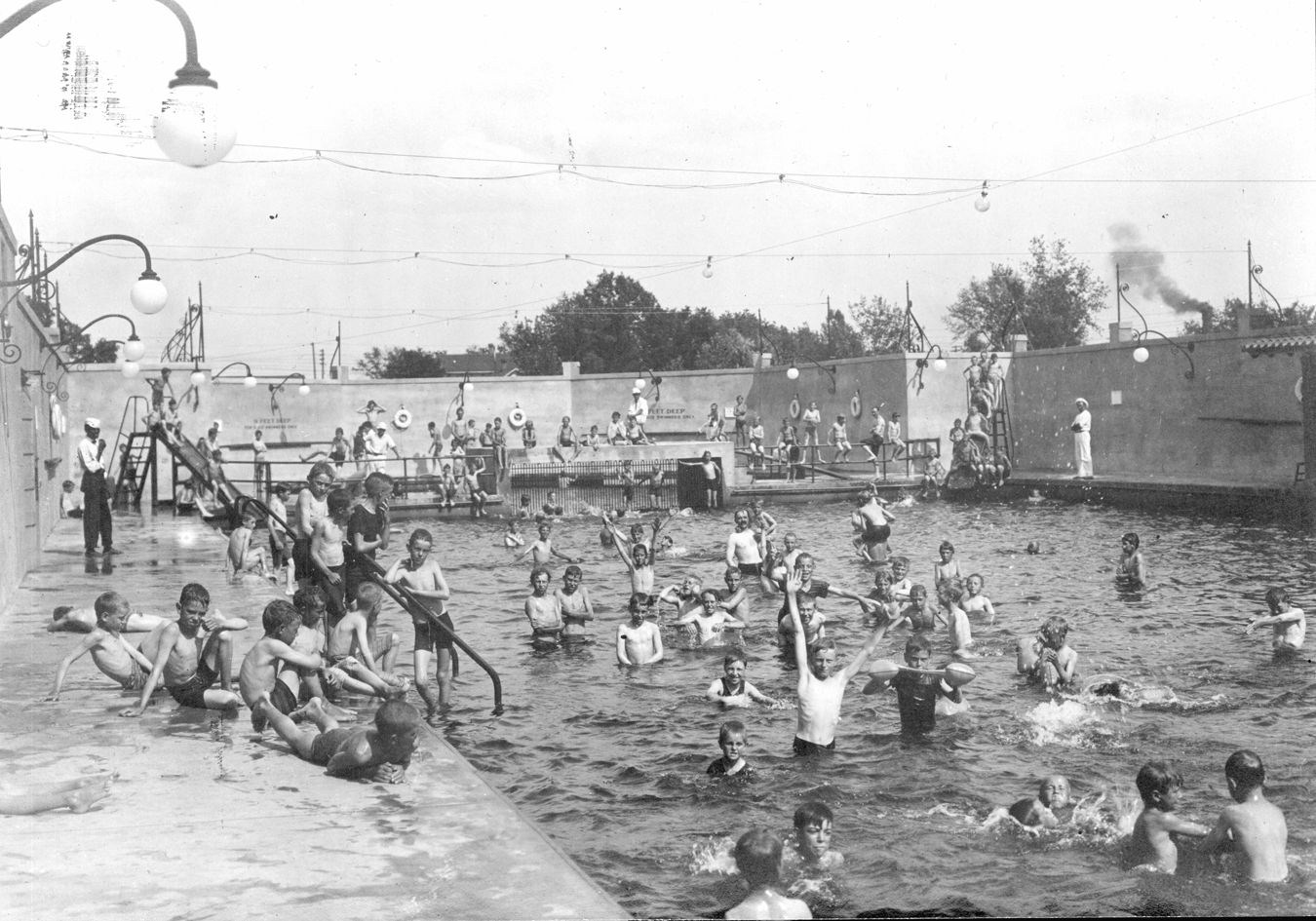
Webber Pool, year unknown. From the time it was built in 1910 until 1927, water was diverted form Shingle Creek to fill the pool. Beginning in 1927 the pool used filtered and chlorinated city water. In the early years, boys and girls used the pool at different times. One reason for the high wall around the pool was to prevent boys and girls from watching each other swim. In the 1930s, more than 1,500 children under the age of 14 used the pool every summer day. (City of Parks, Minneapolis Park and Recreation Board)
Did the Princess Depot burn down?
Filed under: Minnehaha Falls | Tags: Minnehaha Falls, Princess Depot
Comments (5) Most visitors to Minnehaha Falls have seen the little railroad depot, the “Princess” depot, that sits along the railroad tracks southwest of the falls. It was once owned by the Milwaukee Road but is now owned by the Minnesota Historical Society and operated by the Minnesota Transportation Museum. The little information available about the depot says that it was built in 1875. However last year while helping my daughter research a school paper we came across an article in the Minneapolis Tribune of March 7, 1891 that read in its entirety:
The Minnehaha Depot Burned
Shortly after 10 o’clock last night the Milwaukee depot at Minnehaha Falls took fire. Before the apparatus of the fire department could reach the place the flames had obtained too much of a start to be put out and the building, which was built of wood, was totally destroyed. It was a small structure, probably worth less than $1,000.
Subsequent searches of the newspaper revealed no more information on the fire or when the depot was rebuilt. Was the Princess Depot the one that burned or was there another Milwaukee depot at Minnehaha?
Not exactly a Minneapolis parks issue, but many visitors to the falls likely passed through that station.
David C. Smith

 Minneapolis Park History