Archive for the ‘Powderhorn Park’ Tag
Powderhorn Park Speed Skating Track: Best Ice in the United States
Filed under: Minneapolis parks, Winter Sports | Tags: Powderhorn Park, Speed Skating
 Comments (3)
 Many years before Frank Zamboni invented his ice resurfacer (in California!?), Minneapolis park board personnel had to prepare the speed skating track at Powderhorn Park mostly by hand for international competition and Olympic trials. They were very good at it.
Olympic medalist speed skater Leo Friesinger from Chicago (whom you already met in these pages here) had this to say after he won the Governor Stassen trophy as the 10,000 Lakes senior men’s champion in the early 1940s:
“It is a pleasure for me to return to Minneapolis and skate on the best ice in the United States.”
That was high praise for Elmer Anderson and Gotfred Lundgren, the park board employees who maintained the track at Powderhorn using this sweeper, a tractor-drawn ice planer and a bucket of warm water.

The ice sweeper that cleaned the Powderhorn speed skating track in the 1940s. Elmer Anderson (left) and Gotfred Lundgren kept the track in top shape.
They began to prepare the track 3-4 days before a meet by sprinkling it with water a few times. Then they’d pull out a tractor and a plane—a 36-inch blade—to smooth out any bumps from uneven freezing. The biggest problem was cracks in the ice. So the day before the race, Elmer and Gotfred would spend 8-10 hours filling small cracks by pouring warm water into them.
At times their crack-filling work continued right through the races. When large crowds showed up, and for some races attendance surpassed 20,000, the ice tended to crack more often. If Elmer or Gotfred spotted a crack during a race they’d hustle out with a bucket of water after skaters passed and try to patch it. The sweeper was used to remove light snow from the track.
Elmer and Gotfred, who began working for the park board on the same day 18 years before this picture was taken, agreed that the most speed skating records were set when the air temperature was about 30 degrees, which raised a “sweat” on the ice and produced maxiumum speed.
(Source: an undated newspaper clip in a scrapbook kept by Victor Gallant, the park keeper for many years at Kenwood Park, Kenwood Parkway and Bryn Mawr Meadows.)
It’s no wonder that speed skating (as well as hockey) eventually moved indoors to temperature-controlled arenas. But wouldn’t it be fun to see a big race at Powderhorn again?
David C. Smith
© David C. Smith
Minneapolis Park Memory: Sparks, shetlands and a muskrat
Filed under: Minneapolis Park Memory | Tags: Minnehaha Falls, Powderhorn Park
Leave a comment I lived at 3040 Longfellow Avenue South until I was nine years old, and I have fond memories of Minneapolis parks and lakes. We were a walking, rail-riding family, often hurrying to Cedar Avenue to catch the streetcar. Do you remember the overhead sparks?
My dad and his younger brother Bobby, who often stayed with us, would pull me on the toboggan all the way to Powderhorn Park to slide down the “big” hill. Family legend has it that I didn’t trudge up the hill hand-in-hand like most kids: I had to be carried. My mom took me by streetcar for ice skating lessons at the Minneapolis Arena, and Dad and I would carry our skates to Powderhorn Park to practice on the lake. Do you remember when it was so cold you could hear the ice all the way across the lake?
Of course, Minnehaha Falls was a fascination for the young me. Remember the pony rides? I’m sure I thought I was Dale Evans as those Shetlands made endless circles. A family outing at the Falls always included a long walk down (and up) the stairs built by the federal work-relief crews. I have pictures of me and Dad posed at those beautiful stonework rest stops.
Other bits and pieces of my Minneapolis park and lake memories include the swans of Loring Park, the Aqua Follies at Theodore Wirth, and canoeing in a borrowed canoe on Lake of the Isles, with my fellow paddlers trying to hit a muskrat with their paddles.
Pam Schultz
Minneapolis Park Memory: A Wonderful Gift
Filed under: Minneapolis Park Memory | Tags: Columbia Park, Lake Calhoun, Lake Harriet, Lake Nokomis, Minneapolis parks, Minnehaha Creek, Powderhorn Park
Leave a comment About two years ago, when our son-in-law was in the North St. Paul Library, he saw David Smith’s book about Minneapolis parks. He bought one and gave it to me for Christmas. We have enjoyed reading it and looking at the pictures.
Jim became acquainted with Minnehaha Park and Parkway when he came to freshman orientation at Hamline in 1948. He particularly remembers the beauty of the lilac trees. When we lived in Rosemount, we came to Nokomis Park to picnic, swim and sail with friends. When we moved to Columbia Heights, Jim started to bike daily, and a few times each summer, he biked the Grand Rounds. We biked it with a church group a time or two. We continued to do that when we lived in Champlin and in north Minneapolis.
The house we owned since 1985 was near Lake Harriet and we biked around that lake and also Lake Calhoun and Lake of the Isles. We slid in the snow and watched our grandson’s rugby games at Columbia Park. We enjoyed many picnics near each of those lakes and the Rose Garden, Hiawatha, Nokomis, Farwell, Powderhorn and Wirth. Sometimes there were only two of us; other times it was a family gathering. We celebrated many birthdays and events by having picnics at a park. Following Thanksgiving dinner at our house, most of the guests enjoyed a walk around all or part of Lake Harriet. A recent memory is walking with our five-year-old granddaughter to a bridge over Minnehaha Creek and dropping sticks into the water and watching them float away. We are glad that our new home is near the Parkway, Minnehaha Park and Lake Nokomis, so we can continue to enjoy our wonderful gift of parks.
Phyllis Minehart
Minneapolis Park Memory: Treasure
Filed under: Minneapolis Golf Courses, Minneapolis Park Memory, Minneapolis Parks: General | Tags: Hiawatha Golf Course, Lake Harriet, Minnehaha Park, Powderhorn Park
Comments (1) How I have enjoyed the Minneapolis parks: watching fireworks at Powderhorn Park; concerts at Lake Harriet, with picnics on the hill; swimming and canoeing at Calhoun; walking in Minnehaha Park and eating crab cakes at Sea Salt; walking and biking at Nokomis; watching my children play hockey at various parks, and baseball at McRae and Diamond Lake; teaching the children to skate at Diamond Lake; my sons in their early teens taking the bus from our home at 48th and Clinton all the way to Theodore Wirth Park to play golf; my boys golfing at Hiawatha and telling us that they played with two really nice “old guys.” (These “old guys” happened to be friends of ours from church and were our age, in their 40s.)
My son Glen would leave the house in the summer early in the morning, bike to Lake Harriet with his fishing equipment, climb on a tree branch overhanging the lake and stay until suppertime. He enjoyed being outdoors even if he didn’t catch fish.
But here is my most treasured memory: In 1945, my future husband took me canoeing at Calhoun and then into Lake of the Isles, and gave me my engagement ring.
Alice Streed

The Romantic Route (from City of Parks, Minneapolis Park and Recreation Board)
Minneapolis Park Memory: A Friend of Loring Park
Filed under: Minneapolis Park Memory | Tags: Loring Park, McRae Park, Minneapolis parks, Powderhorn Park, Theodore Wirth Park
Comments (1) After arriving in Minneapolis in September 1941, the first city park I became familiar with was Loring. I had come to enter nurse’s training at Eitel Hospital, and the park was right across the street. The park provided a beautiful view from patients’ rooms. It was also an oasis for student nurses, a place to relax in the summer or go skating on the lagoon in winter. Every nurse who has graduated from Eitel would have special memories of Loring Park.
The park looked different back in the forties. Old, tall trees grew along the edge of the lagoon. Now they are gone and tall grasses grow at the edge of the water. Bright red cannas blossomed in flower beds on the west side of the park. Now, “Friends of Loring” have created a large round garden on the northwest side called “Garden of the Seasons.” A variety of trees and flowers are in the center with benches and a brick path around it. Bricks can be donated in honor or memory of someone. A brick on the east side reads: “Eitel Hospital Nursing School — Class of 1944,” given in tribute to classmates, many of whom had served in the Army Nurse Corps in World War II.
In later years, my family and I enjoyed picnics at Minnehaha Park and viewing the beautiful Falls. Performances by the Aqua Follies at Theodore Wirth Park, and pop concerts at Lake Harriet on Sunday afternoons were great fun. My son as a teenager spent many winter evenings skating and playing hockey at McRae Park. On July 4th, we watched fireworks at Powderhorn Park. The park system provided something special for every season. My husband often said, “Minneapolis is the prettiest city I’ve ever seen.”
Ardelle Lande
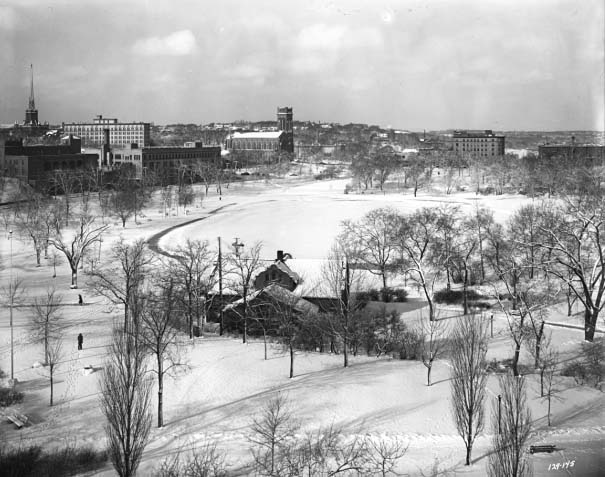
Looking west across Loring Park from Eitel Hospital, 1375 Willow Street, in 1939. (Norton and Peel, Minnesota Historical Society, NP129145)
Editor’s note: For more photos of Eitel Hospital visit the Photo Collection of the Minnesota Historical Society.
If you have a Minneapolis Park Memory, send it to minneapolisparkhistory[at]q.com. If you have a digital photo to accompany your memory, we’d love to see it.
Minneapolis Park Memory: Spectacular Powderhorn
Filed under: Minneapolis Park Memory | Tags: Minneapolis parks, Powderhorn Park
Leave a comment Powderhorn Park in south Minneapolis is a unique park with a large island in the middle of the lake. I lived about eight blocks from there, just the right distance for a walk. In the winter, my friend, Muriel, and I would tie the laces of our skates, carry them around our necks, and head for Powderhorn. It was a great place to skate around and around the island; we spent many days skating.
On Monday nights in the summer, we walked to the park to listen to the band concert (more important to us was to walk around and meet the boys). It was on one of those nights that I met my husband, and the first date I had with him was made there. That date never materialized, because I stepped on a bee while mowing the lawn and had to stay home. I’m not quite sure he really believed me, but we did get married a year or so later. Since he was in the service then and only able to get home a few times, we got married after only eleven dates.
July 4th was a big night at Powderhorn. All the families brought blankets and sat on the hills to watch the big fireworks display. The fireworks were lit on the island. One year there was a mishap; every one of the rockets went up at once. It made for a short, but spectacular event.
Fern Eidsvoog
Powderhorn Park and Augsburg Stories Converge
Filed under: Minneapolis Parks: General, Powderhorn Park | Tags: Murphy Square, Powderhorn Park, Speed Skating
Leave a comment A reader of recent posts on Murphy Square/Augsburg College and speed skating at Powderhorn Park put the two together and suggested a link to an article featuring U. S. Olympic speed skater Johnny Werket, who attended Augsburg. From the article we learn that a third Minneapolis park also played a role in the story: Longfellow Field was Werket’s home park.
Thanks for the tip.
David C. Smith
A premier speed skating track in a Minneapolis park
Filed under: Powderhorn Park, Winter Sports | Tags: Gene Sandvig, John Werket, Ken Bartholomew, Minneapolis parks, Powderhorn Park, Speed Skating
Comments (15) A scrapbook of newspaper clippings about speed skating from 1953 to 1956 was recently given to Dave Garmany the recreation coordinator at Powderhorn Park in Minneapolis. The scrapbook features articles on the speed skating scene in Minneapolis, the U.S. and the world in those years and includes several articles from Norwegian newspapers.
In addition to the newspaper clips were several programs from international speed skating events at the Powderhorn Park speed skating track, such as this one in 1953.

A cropped version of the cover photo, showing a massive crowd at a 1930s event at Powderhorn Park—likely the national championships in 1934, which were reportedly attended by 50,000 in two days—is in the collection of the Minnesota Historical Society.
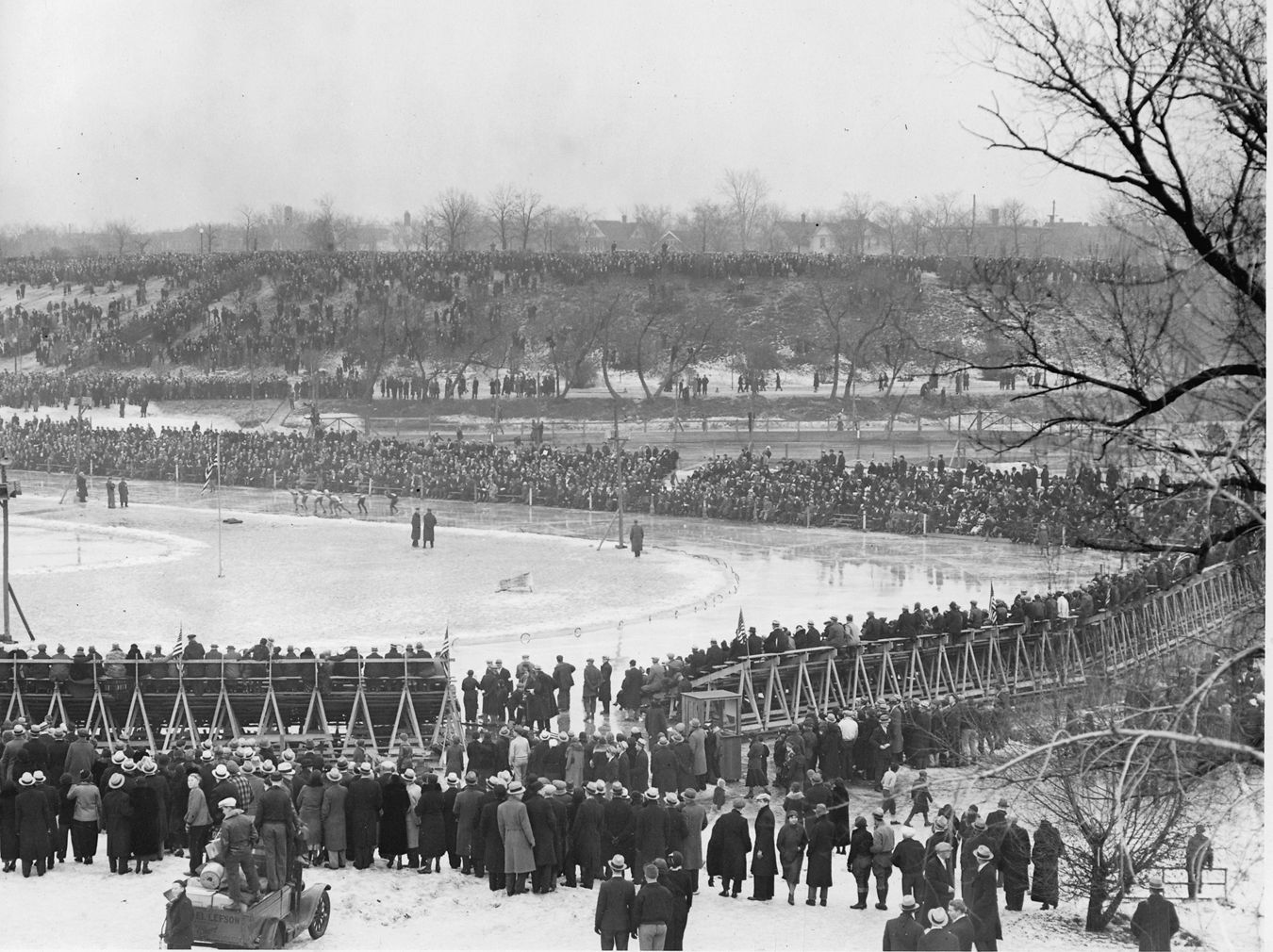
Huge crowds attended the National Speed Skating Championships held at Powderhorn Park in the 1930s and 1940s. (Minnesota Historical Society)
Most of the clips in the scrapbook were about the rivalry between Minneapolis skaters Ken Bartholomew and Gene Sandvig. Bartholomew won 14 National Outdoor Championships from 1939-1960. Sandvig was often runner-up in the 1950s after he had gotten out of the Army and enrolled at Gustavus Adolphus College. Bartholomew was a silver medalist for the U.S. in the Winter Olympics at St. Moritz in 1948. Sandvig skated for the U. S. in the 1952 Winter Games in Oslo and the 1956 Games at Cortina d’Ampezzo.

Planert skates were advertised in the 1953 speed skating program pictured above. The skates were not cheap. The list price for a pair of Planert’s “Olympic Model” skates in a 1955 ad was $60.
The skater featured in Planert’s ad, Leo Friesinger, was the bronze medalist for the U.S. in the 500 meters at the 1936 Olympics in Garmisch-Partenkirchen, Germany. Friesinger was from Chicago, which was also home to Planert.
Among other bits of info that caught my eye in news clips from Minneapolis Star and Minneapolis Tribune.
- Minneapolis high school athletic director Giffy O’Dell hopes to bring back speed skating as a regular sport in the Minneapolis high school sports program. January, 1954. (I never knew it ever had been part of that program.)
- Top Minneapolis skaters Ken Bartholomew and Gene Sandvig will not be challenged locally by two other elite Minneapolis skaters. Pat McNamara will return to Norway or will train in Japan. Johnny Werket is considering spending the winter in Japan. January, 1954.
- Werket and McNamara have created a new practice track early in the season on Augusta Lake in Mendota. They do not train at Powderhorn Lake. They prefer the European style of speed skating used in the Olympics. The European track is 400 meters compared to the standard American track (including the Powderhorn track) of 293 yards, four laps to a mile instead of six. Also in European skating all competitors race against the clock instead of against other skaters in a pack. (American-style speed skating at the time was in between the long-track and short-track skating in today’s Olympics. The Winter Olympics tried the North American pack-style of speed skating at the 1932 games in Lake Placid, New York. Canada and the U.S. won 10 of 12 medals skating that way. The 1936 games in Germany reverted to European-style racing against the clock — and Norway and Finland won 10 of the 12 medals. Pack speed skating returned to the Olympics as a separate demonstration sport, short track skating, in 1988 at Calgary and became a regular Olympic event in 1992 at Albertville.)
- Ken Bartholomew was a 14-time U.S. champion, but he skated for the U.S. Olympic team only once, winning a silver medal in 1948 at St. Moritz. He did not make the Olympic team again despite dominating the National Outdoor Championships for years. Werket was on the U. S. Olympic team in 1948, 1952 and 1956. McNamara skated in the Olympics for the U.S. in 1952 and 1956. Their greater success in making Olympic teams may have been partially due to training in the Olympic style of racing—although Gene Sandvig also made the Olympic team in 1952 and 1956. All three were also much younger than Bartholomew. A commentary in the Minneapolis Tribune after the Winter Games in Cortina d’Ampezzo in 1956 had this to say about the different styles: “The U.S. should adopt the Olympic system of competition—that is, a competition against time. True, it’s pretty dull for young Americans, as well as the few spectators who turn out. They (presumably young Americans and spectators) love the free-for-all scramble with all of its pushing, tugging, elbowing and the like such as popped up in the Nationals at Como over the weekend.” (The reference was to the races at Lake Como in St. Paul won by Bartholomew, in which Bartholomew and another skater got into a fight after the other accused Bartholomew of knocking him down. Bartholomew was obviously a racer, a strategist, not a time-trial expert that the Olympic style required. In other words, he was more Apolo Anton Ohno than Shani Davis, Eric Heiden or Dan Jansen.)
- One reason the Tribune advocated changing American racing to the Olympic style: the Russians had started to dominate international speed skating. It had begun with a surprise victory by the Russians at the world championships in Sapporo, Japan in 1954. The U.S. had failed to send a team. The U.S. State Department had declined to pay the travel costs of John Werket, Pat McNamara and a third skater from Chicago, Ken Henry, who was an Olympic gold medalist in 1952. The State Department determined that the request for funds was “not meritorious.” (Tribune, January 31, 1954) The Russian victory elicited this comment on the sports page: “The time is at hand when the athletic leaders of the free world had better take Russia’s bid for international supremacy seriously. The Commies proved in the last Olympic Games they have made greater strides in track and field than any other nation in the world. Over the week-end Russia did the unexpected by winning the world’s speed skating championships rather decisively, beating the best Norway and some other Scandinavian countries have to offer.” Russian dominance had grown at the 1956 Winter Games.
- The 1955 world championships were held in Moscow and Johnny Werket was one of three skaters to represent the U.S. after friends raised $700 to pay his expenses. Those three skaters were the first American athletes to compete in Russia after World War II, according to a February, 1955 Tribune article. Werket had high praise for the Russians. “Russians were tops,” said Werket, “as athletes, as hosts and as fans. It would be hard to find a fairer audience anywhere in the world.”
- Nearly all Minneapolis speed skating teams in the 1950s were sponsored by American Legion posts. Wenell, Laidlaw, Bearcat and Falldin posts all sponsored teams.

The 1955-1956 program for the Minnesota Speed Skating Association
Finally this item from the annual program of the Minnesota Speed Skating Association, 1955-1956:
Missing Skater News
- Tom Miller and Colleen Burke (Falldin American Legion Post team) married last June, Tom in U. S. Army, stationed in California
- Gene Sandvig (Bearcat) on Olympic Team
- Tom Hadley (Wenell) concentrating on studies, U of M on Evans Scholarship (Based on scholarship and golf proficiency)
- Janet Koch (Laidlaw) is now Mrs. Vasatka
- David Kahn (Wenell) out with knee injury suffered in football at Roosevelt Hi
- Dennis Boike (Laidlaw) at Nazareth Hall Prep Seminary studying for priesthood
- Tom Romfo (Wenell) recuperating from a bout with polio
For some reason, perhaps the mention of polio, the list seemed so 1950s. Poignant, too.
David C. Smith
© David C. Smith
Powderhorn Park Football
Filed under: Powderhorn Park | Tags: Football, Minneapolis parks, Powderhorn Park, The Parade
Comments (2) A recent visit to Powderhorn Park and a chat with recreation coordinator Dave Garmany turned up an excellent photo of the Powderhorn football team from 1925. Unusual for its time, it was labeled with the names and positions of the players.
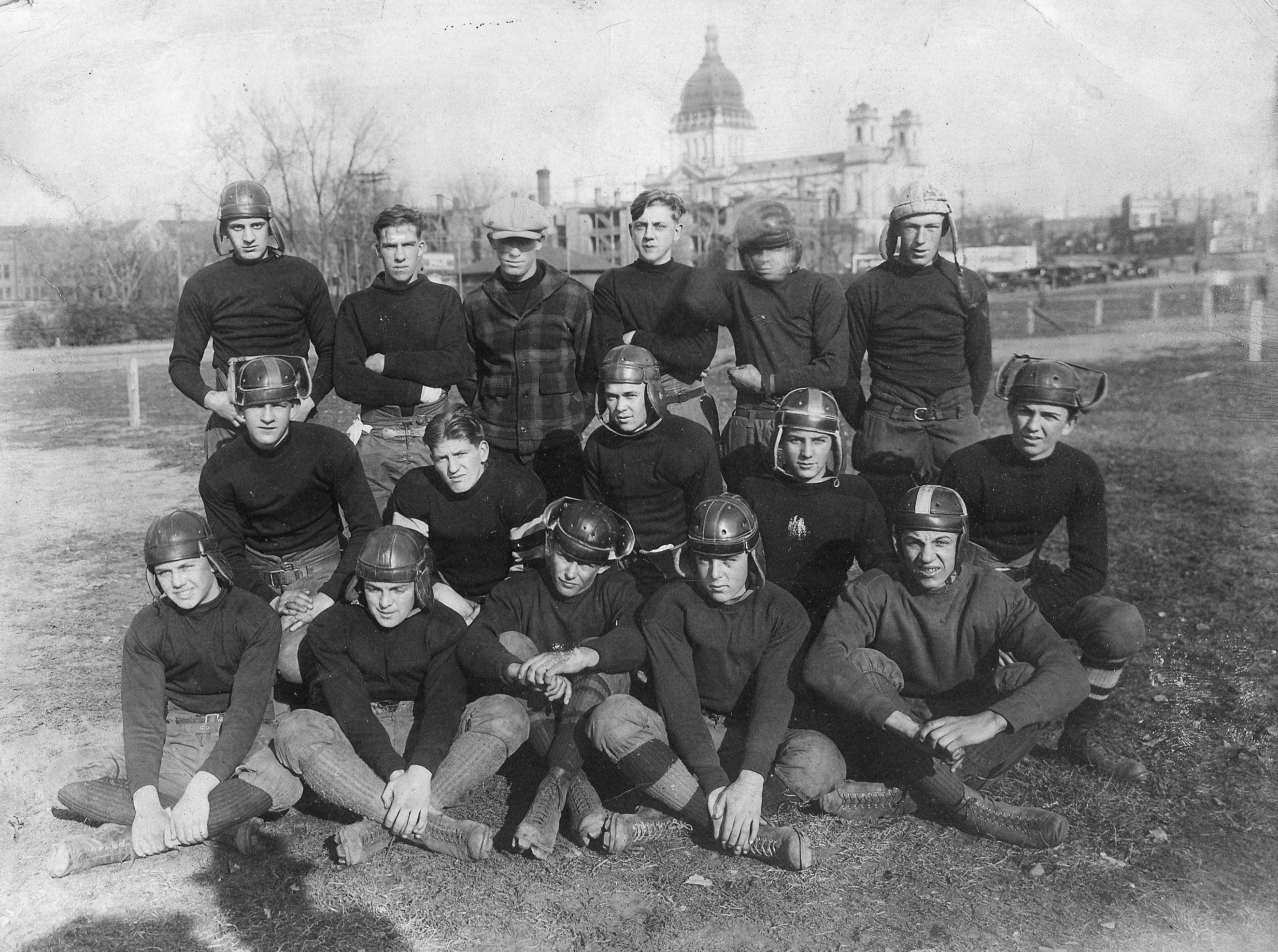
1925 Powderhorn Football Team at The Parade (Basilica in background). First Row L-R: Helmar Larson OB, Claude Casey FB, Manley Peterson LT, Kenneth Johnson RH, George Carlson RG. Second Row, L-R: Lee Blood RT, Joe Listered LE, John Larson RE, John Martin LE, Ed Mandeck LE. Third Row L-R: Frank Shogren LG, Hersel Johnson RE, Howard Shenessy Capt., Leonard Herlen RG, Walt Nordstrom LH, Al Dunning RH. (Minneapolis Park and Recreation Board)
The best part of the photo — for those not related to the players — is the location at The Parade, which is obvious because of the Basilica looming in the background. The year the photo was taken, 1925, was the year that the north end of Powderhorn Lake was filled in to create more athletic fields. I’ve spoken with one woman who remembered skating on the lake before the north end was filled. Do you remember that or know anyone who does?
The only other photo I’ve seen of early Powderhorn football players is this one from the collection of the Minnesota Historical Society.

Powderhorn football team, 1908 (Minnesota Historical Society)
Have you seen others? Let us know.
David C. Smith
 Minneapolis Park History