Archive for January, 2011|Monthly archive page
Glenwood Toboggan Slide II: 1887
Filed under: Minneapolis Parks: General, Winter Sports | Tags: Glenwood Park, Theodore Wirth Park, toboggan slide
 Comments (3)
 Since posting a newspaper photo of a toboggan slide on “Glenwood Hill” in 1887, I found this photo in the Minnesota Historical Society Visual Resources Database. This photo is purportedly of the same toboggan chute on the same hill in the same year, but they are obviously different places. The photo clipped from a newspaper had trees right up to the sides of the track.
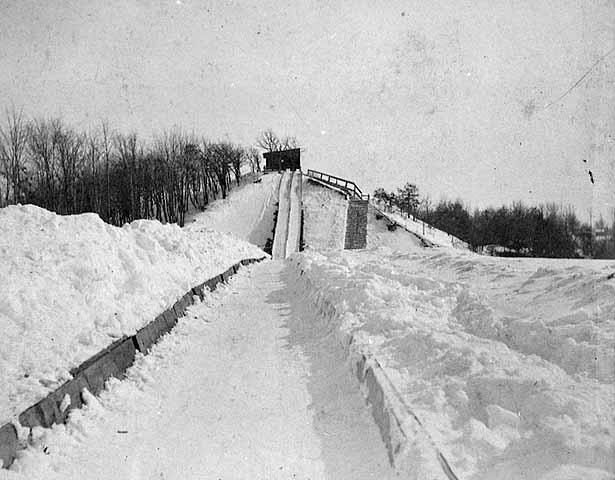
The North Star toboggan chute on Glenwood Hill, 1887. (Minnesota Historical Society)
Looking up the hill instead of down, gives a completely different prespective on the possible location of the slide. I doubt that the slide in this photo is in the same location as the ski jumps that were built after the park board acquired land in the vicinity. Any guesses as to the location of this toboggan slide? Or the other one? Which one is the real “North Star” chute?
In the same wonderful photo collection, I found this picture of the St. Paul toboggan slide in front of the State Capitol, which I referred to in my earlier post.

A 1957 photo of the toboggan slide I rode as a kid, a few years later, in front of the State Capitol. (Minnesota Historical Society)
David C. Smith
This is why we love our parks: Powderhorn Art Sled Rally
Filed under: Powderhorn Park, Winter Sports | Tags: Powderhorn Park
Leave a comment Creative use of space. It is the true gift of parks. If anyone ever needed convincing of the incredible benefits of public spaces, they should have been at Powderhorn Park yesterday for the 4th Annual Art Sled Rally. Thrills, chills and plenty of spills. Marvelous creativity. Wacky fun. It’s what a creative community can do when it has a place to do it.
Cheers to South Sixteenth Hijinks for the idea and energy. Be sure to click the link above to learn more about the event and organizers. Especially check out the sponsors and please support them.
I didn’t see all the sleds, but among my favorites were the bear from Puppet Farm, (picture a bear sliding on its stomach, and, yes, there was a child seated on top of the bear sled, too) and a wild dinner table on a sled, which I believe was called “Dinner at the Carlisle’s.” Other favorites were a couple of dragons, a dragon fly, a bunch of eyeballs and a London Bridge, which did indeed fall down. Some pictures are already posted on artsledrally.com from Dan Stedman. I hope others will soon follow.
The greatest tribute to the event and the people who made it happen: as we walked away my daughter asked, “Can we make a sled next year?”
David C. Smith
New Rodents at the U: Beavers, not Gophers
Filed under: Minneapolis Parks: General, Mississippi River | Tags: James Ford Bell Museum of Natural History
Comments (2) Beavers invade Minneapolis park near University of Minnesota!
That’s the gist of my favorite, undated newspaper clip from Victor Gallant’s scrapbook: Minneapolis Parks, 1923-1949. The article had to be from the late 1940s, I’ll tell you why in a moment.
Here’s the story. Three beavers have moved into the east river flats below the U. Need proof? They’ve been felling cottonwood trees along the river bank. Two dozen of them! (Cottonwoods are nobody’s favorite tree, in fact the park board once considered banning the planting of them in the city, but they do spring up on river banks and provide greenery and shade that is flood tolerant.)
The newspaper reports that the beavers are living under a sunken houseboat along the river bank. Park superintendent Charles Doell asks the game warden to remove the beavers so they don’t cut down more trees. (Seems to me it would have been smarter to remove the sunken houseboat to eliminate the avant garde urban beaver habitat.) But Dr. W. J. Breckenridge of the University’s Museum of Natural History points out the advantages of having a living natural history exhibit virtually on campus. Doell relents and instead of evicting Goldy’s cousins, he has a couple loads of poplar trees delivered to the riverbank so the beavers have something to eat other than living cottonwoods. It is believed that the beavers immigrated from known colonies on the Mississippi River at Dayton and Anoka. (Did they come over the falls or through the mill races?)
Big Yellow Taxi
That’s the first and last I’ve heard of beavers in Minneapolis. I suspect they didn’t stay long. I’m pretty sure that the article appeared between 1945 and 1949. It had to be after Doell became Superintendent in 1945 and before Gallant quit keeping the scrapbook in 1949. But I didn’t need to know that was the end of Gallant’s newspaper clipping to figure out that date, because it was in 1949 that the University and park board signed a ten-year agreement for the U to use the river flats as a parking lot. I’m guessing that the beavers wouldn’t have settled next to a busy parking lot. And if they had, everyone would have been happy to evict them if their gnawing was endangering cars instead of just trees. Nobody wants a cottonwood in their back seat, even if its young.
The U’s lease of the parking lot kept being extended beyond the original ten-year term. The park board didn’t take back the land for a park until 1976! Some cottonwood trees only live about as long as that lease lasted.

“They paved paradise and put up a parking lot.”
Do you know the official name of the park where the rodents lived for a while? It rhymes with beavers.
In 1894 the park board named the east river flats “Cheever’s Landing,” after the man who operated a ferry across the river there. I don’t believe the name ever has been changed officially.
And speaking of wildlife and the James Ford Bell Musuem of Natural History at the University of Minnesota, the coolest sculpture in the city is the wolf pack attacking a moose near the entrance to that museum. Worth a visit. Don’t jump when you see them.
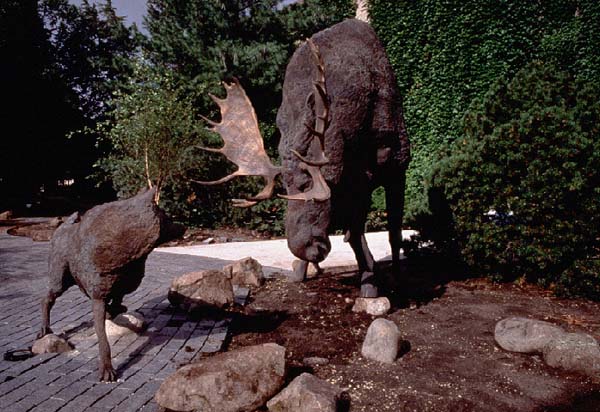
A partial view of the sculpture by Ian Dudley outside the James Ford Bell Museum of Natural History at the University of Minnesota (Photo: Tara C. Patty)
David C. Smith
© David C. Smith
Glenwood Toboggan Slide: 1887
Filed under: Minneapolis Parks: General, Winter Sports | Tags: Glenwood Park, Theodore Wirth Park, toboggan slide
Comments (4) It’s an old, wrinkled photo clipped from an unidentified newspaper, but it’s also the oldest photo I’ve seen of a toboggan slide in Minneapolis.

A privately run toboggan slide on “Glenwood” hill in 1887, years before the park board acquired land in the area.
The newspaper caption calls it the “North Star” chute and puts the date at 1887. That was two years before the first land (64 acres) was acquired for what was then Saratoga Park. The park was renamed Glenwood Park in 1890 and was renamed for Theodore Wirth in 1938. The majority of the land for the park we know today was acquired in 1909. I suspect that this hill was a part of that acquisition. Although I’m not certain, I think this slide was located near where the ski jumps were later built.
At different times the park board operated toboggan slides at Lake Harriet, Lake Calhoun, Glenwood (Wirth) Park, Columbia Park and Minnehaha Park. I don’t believe any of them were operated after the 1940s, but as always its difficult to discern from park board records when such services or programs were stopped.
The only toboggan slide I remember from growing up in the Twin Cities was the long slide erected on the approach to the State Capitol in St. Paul. I remember it being operated as a part of the St. Paul Winter Carnival. It was one of the highlights of winter life as a boy in St. Paul.
David C. Smith
Powderhorn Park Speed Skating Track: Best Ice in the United States
Filed under: Minneapolis parks, Winter Sports | Tags: Powderhorn Park, Speed Skating
Comments (3) Many years before Frank Zamboni invented his ice resurfacer (in California!?), Minneapolis park board personnel had to prepare the speed skating track at Powderhorn Park mostly by hand for international competition and Olympic trials. They were very good at it.
Olympic medalist speed skater Leo Friesinger from Chicago (whom you already met in these pages here) had this to say after he won the Governor Stassen trophy as the 10,000 Lakes senior men’s champion in the early 1940s:
“It is a pleasure for me to return to Minneapolis and skate on the best ice in the United States.”
That was high praise for Elmer Anderson and Gotfred Lundgren, the park board employees who maintained the track at Powderhorn using this sweeper, a tractor-drawn ice planer and a bucket of warm water.

The ice sweeper that cleaned the Powderhorn speed skating track in the 1940s. Elmer Anderson (left) and Gotfred Lundgren kept the track in top shape.
They began to prepare the track 3-4 days before a meet by sprinkling it with water a few times. Then they’d pull out a tractor and a plane—a 36-inch blade—to smooth out any bumps from uneven freezing. The biggest problem was cracks in the ice. So the day before the race, Elmer and Gotfred would spend 8-10 hours filling small cracks by pouring warm water into them.
At times their crack-filling work continued right through the races. When large crowds showed up, and for some races attendance surpassed 20,000, the ice tended to crack more often. If Elmer or Gotfred spotted a crack during a race they’d hustle out with a bucket of water after skaters passed and try to patch it. The sweeper was used to remove light snow from the track.
Elmer and Gotfred, who began working for the park board on the same day 18 years before this picture was taken, agreed that the most speed skating records were set when the air temperature was about 30 degrees, which raised a “sweat” on the ice and produced maxiumum speed.
(Source: an undated newspaper clip in a scrapbook kept by Victor Gallant, the park keeper for many years at Kenwood Park, Kenwood Parkway and Bryn Mawr Meadows.)
It’s no wonder that speed skating (as well as hockey) eventually moved indoors to temperature-controlled arenas. But wouldn’t it be fun to see a big race at Powderhorn again?
David C. Smith
© David C. Smith
And the answer is….French
Filed under: Landscape Architects, Minneapolis parks | Tags: Daniel Chester French, H.W.S. Cleveland, Horace Cleveland, William Merchant Richardson French, William Watts Folwell
Comments (3) In a post on December 29, 2010 I asked how these two pictures were related to the creation of Minneapolis parks.
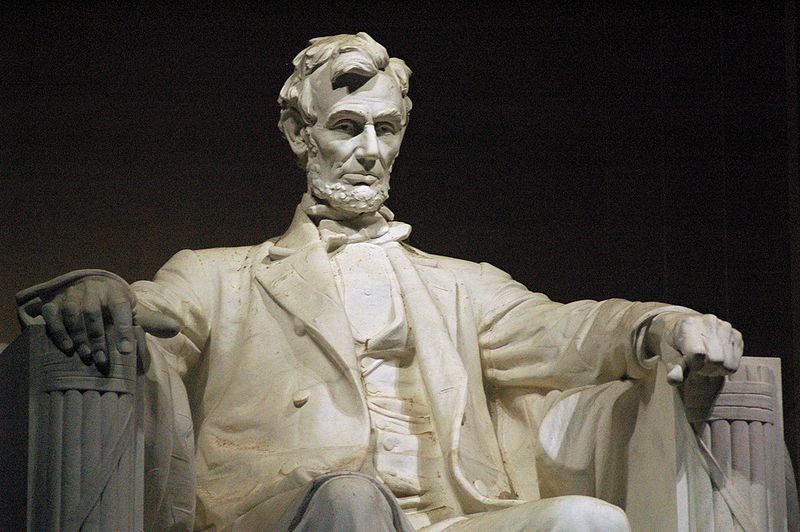
Abraham Lincoln, Lincoln Memorial, Washington, D. C. (Jeff Kubina)
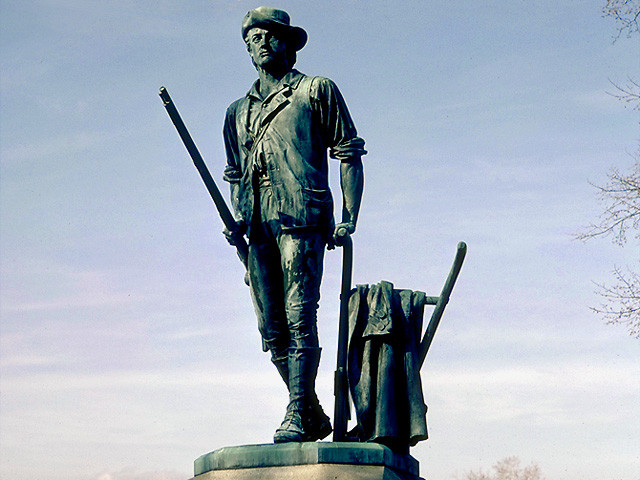
Minute Man, Minute Man National Historical Park, Concord, Massachusetts
Nobody has come up with the right obscure answer! So I’ll tell you.
The photos are of the most famous works of American sculptor Daniel Chester French. (The best example of French’s work in Minneapolis is the statue of John Pillsbury at the University of Minnesota.)
Here is the connection — and the key word is “related”:
Daniel Chester French’s older brother was William Merchant Richardson French. That’s this guy:
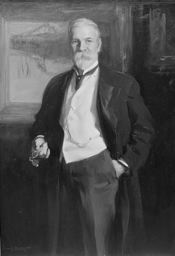
William Merchant Richardson French (Louis Betts, Art Institute of Chicago)
(Their father was Henry Flagg French who was the number two man in the U. S. Treasury Department. For eight months in 1881 he worked under Secretary of the Treasury William Windom, a U. S. Senator from Minnesota who resigned his Senate seat to become Treasury Secretary for President James Garfield. After those eight months, Windom resigned at Treasury and was elected to fill his own open seat in the Senate. He served as Secretary of the Treasury again from 1888 until his death in 1891.)
The important connection of William French to Minneapolis parks is that after graduating from Harvard in 1864 and a year at MIT studying engineering he moved to Chicago and met a man in the new and unusual profession of landscape gardening. It’s not clear how it came about, but in 1870 William French became the partner of a man thirty years older than he was. That pioneering landscape architect was Horace Cleveland.
Of course, young William, who was eager I’m sure to earn his keep with his much more experienced partner, went through his list of connections to identify potential clients. He likely recognized that one name on his list might provide useful contacts in a young city west of Chicago, Minneapolis. That contact was his cousin, George Leonard Chase, who was rector at the episcopal church in the small town of St. Anthony, which was springing up beside the falls of that name. Now it just happened that Chase had married one of the Heywood girls, Mary. And that was a funny thing because Chase’s best friend married Sarah Heywood, Mary’s sister. He and his best friend had lived together while they were students at Hobart College in New York. In fact, Chase had apparently had some influence with the regents of the University of Minnesota when they were hiring the university’s first president in 1869. Chase’s friend and brother-in-law by marriage was hired for that job. His name was William Watts Folwell.
Dr. Martin Luther King Park: The Naming of a Park
Filed under: Minneapolis Parks: General | Tags: Dr. Martin Luther King Park
Comments (1) The Minneapolis neighborhoods near Dr. Martin Luther King Park have become embroiled in an argument over the name of the park and whether that name confers special meaning on park land. At issue is whether designating a portion of the park as a dog park, where dogs could be off leash, would desecrate the memory of Dr. Martin Luther King, Jr.
Here are the facts as recorded from the Proceedings of the Board of Park Commissioners, January 1st to December 31st For Year 1968:
April 17: Under the heading “Petitions and Communications.” Minneapolis NAACP requests Nicollet Field be renamed “Dr. Martin Luther King, Jr. Memorial Park.” The board referred the request to the Planning Committee.
June 19: Also under “Petitions and Communications.” The Southside Activities Council expresses unanimous support for renaming Nicollet Field, “Martin Luther King. Jr. Memorial Park.”
October 9: After amending the park board’s Policy Statement to permit parks to be named after “persons of other than local significance” when “appropriate and desirable,” the board voted to change the name of Nicollet Field to “Dr. Martin Luther King Park.”
There is no explanation for the inconsistency of the use of Dr., Jr. or Memorial in the various proposals and the final resolution. But there has been no consistency in the use of Dr. or Jr. in general usage then or now.
I was curious about the origin of the park board’s Policy Statement on the naming of parks. I did find an entry in the Proceedings for May 2, 1934 that I believe established the board’s policy.
A bit of background: The park board had nearly completed the construction of a park across the street from the new post office downtown in 1934. It was a park the park board did not want to build, but was convinced to build by the City Council. The U.S. Postal Service wanted a new post office in Minneapolis, but was reluctant to build one without a proper approach or environment. The USPS wanted a park. The City Council finally persuaded the park board to go along. The park board did so reluctantly, especially given the colossal failure of The Gateway park only a couple blocks west.
So the park board had a new park, with a grand new statue — the Pioneers Statue, which was moved for a second time last summer to B. F. Nelson Park. All the park needed was a name. Everyone had suggestions, but three names seemed to generate the most interest.
Lafayette Park. May 20, 1934 would be the centennial of Lafayette’s death and some thought the park should be named for him and dedicated on that date.
Roald Amundsen Park. This was the choice of the Norwegian community. Amundsen, a Norwegian explorer, was the first to reach the South Pole in 1912 and had died in 1928 while on a rescue mission in the Arctic.
General Pulaski Park. The Polish community proposed naming the park for Kazimierz Pulaski the Polish soldier of the Revolutionary War who was credited with creating the first American cavalry unit. An effort to rename Bottineau Field for Pulaski had failed the year before.
Perhaps not wishing to offend any nationality, the Special Committee on Nomenclature offered a new policy for the park board on May 2, 1934. The statement noted that the City Council and the Board of Education had chosen to name streets and schools to perpetuate the names of Presidents, explorers of local and international fame, and artists, writers and scientists of world-wide importance, “all of which your committee believes to be commendable.”
“However, some official body should lay particular emphasis on perpetuating legendary and place names of local significance and the names of those of our own citizens who from time to time have played important parts in the molding of our city — its physical structure, its artistic and spiritual background.
“Our parks are admirably suited for such a purpose, and such a purpose most admirably furthers the work of this Board in instilling in the minds of the youth who frequent our parks the ideals of useful citizenship…Here is something intimate — some one of us has achieved honor — our fathers knew him — we know his descendants. We too might achieve such honor by leading exemplary and highly useful lives.”
So, the committee recommended that “your honorable Board restrict the names to those commemorating men and women of local civic achievement and historical importance and legendary and place names of local significance…”
The statement was adopted and apparently still in place in 1968. At the meeting after the policy was adopted (May 16, 1934), the same committee recommended the name “Pioneers Square” for the new park that until then had been referred to simply as “Post Office Square” or the more Orwellian “Block 20.”
It was this policy that the park board had to amend in October 1968 to be able to rename Nicollet Park, Dr. Martin Luther King Park.
By the way, Nicollet Park was not named directly for the French cartographer Joseph Nicollet. It was named for the avenue named for him, which formed the park’s western border.
David C. Smith
Minneapolis Park Memory: Lake Hiawatha
Living on the south side of Minneapolis for fifty years, the park at Lake Hiawatha is part of my memories, especially because my children were able to swim and enjoy picnics. The south side of the park was the setting for several family reunions, and we used several picnic tables set on a small hill. Here the kids could toss a few balls and the young tots could run freely and, of course, some could swim. It was a beautiful place to get together. A relative from California loved to walk around Lake Hiawatha, and she was so complimentary about the park and how well it was maintained.
Rose Trachy
Minneapolis Park Memory: Sparks, shetlands and a muskrat
Filed under: Minneapolis Park Memory | Tags: Minnehaha Falls, Powderhorn Park
Leave a comment I lived at 3040 Longfellow Avenue South until I was nine years old, and I have fond memories of Minneapolis parks and lakes. We were a walking, rail-riding family, often hurrying to Cedar Avenue to catch the streetcar. Do you remember the overhead sparks?
My dad and his younger brother Bobby, who often stayed with us, would pull me on the toboggan all the way to Powderhorn Park to slide down the “big” hill. Family legend has it that I didn’t trudge up the hill hand-in-hand like most kids: I had to be carried. My mom took me by streetcar for ice skating lessons at the Minneapolis Arena, and Dad and I would carry our skates to Powderhorn Park to practice on the lake. Do you remember when it was so cold you could hear the ice all the way across the lake?
Of course, Minnehaha Falls was a fascination for the young me. Remember the pony rides? I’m sure I thought I was Dale Evans as those Shetlands made endless circles. A family outing at the Falls always included a long walk down (and up) the stairs built by the federal work-relief crews. I have pictures of me and Dad posed at those beautiful stonework rest stops.
Other bits and pieces of my Minneapolis park and lake memories include the swans of Loring Park, the Aqua Follies at Theodore Wirth, and canoeing in a borrowed canoe on Lake of the Isles, with my fellow paddlers trying to hit a muskrat with their paddles.
Pam Schultz
McRae Park: Football Team Photos
Filed under: Minneapolis Parks: General | Tags: Football, McRae Park
Comments (14) Thanks to Ann Kegley, recreation director at McRae Park, for these photos of youth football teams from McRae. None of the players or coaches in these photos is identified. If you can identify anyone, send me a note. The team wore the jerseys of the Seaman Gilfoy VFW post. I can find little information online about that post. Did the post sponsor teams only at McRae Park or other parks, too?

McRae Park midget football team, 1963 (Minneapolis Park and Recreation Board)
I love it when people label photos. The next one is not even identified by year, but looking at hair styles, I’m guessing mid-1970s. Could the building in the background be Regina High School?

McRae Park youth football team, year unknown, but judging by hair styles probably mid-1970s. Photo may have been taken at nearby Regina High School. (Minneapolis Park and Recreation Board)
The final older football team photo we found was taken in 1979. The photo was also labelled “light cubs” apparently referring to the weight class in which the team played.
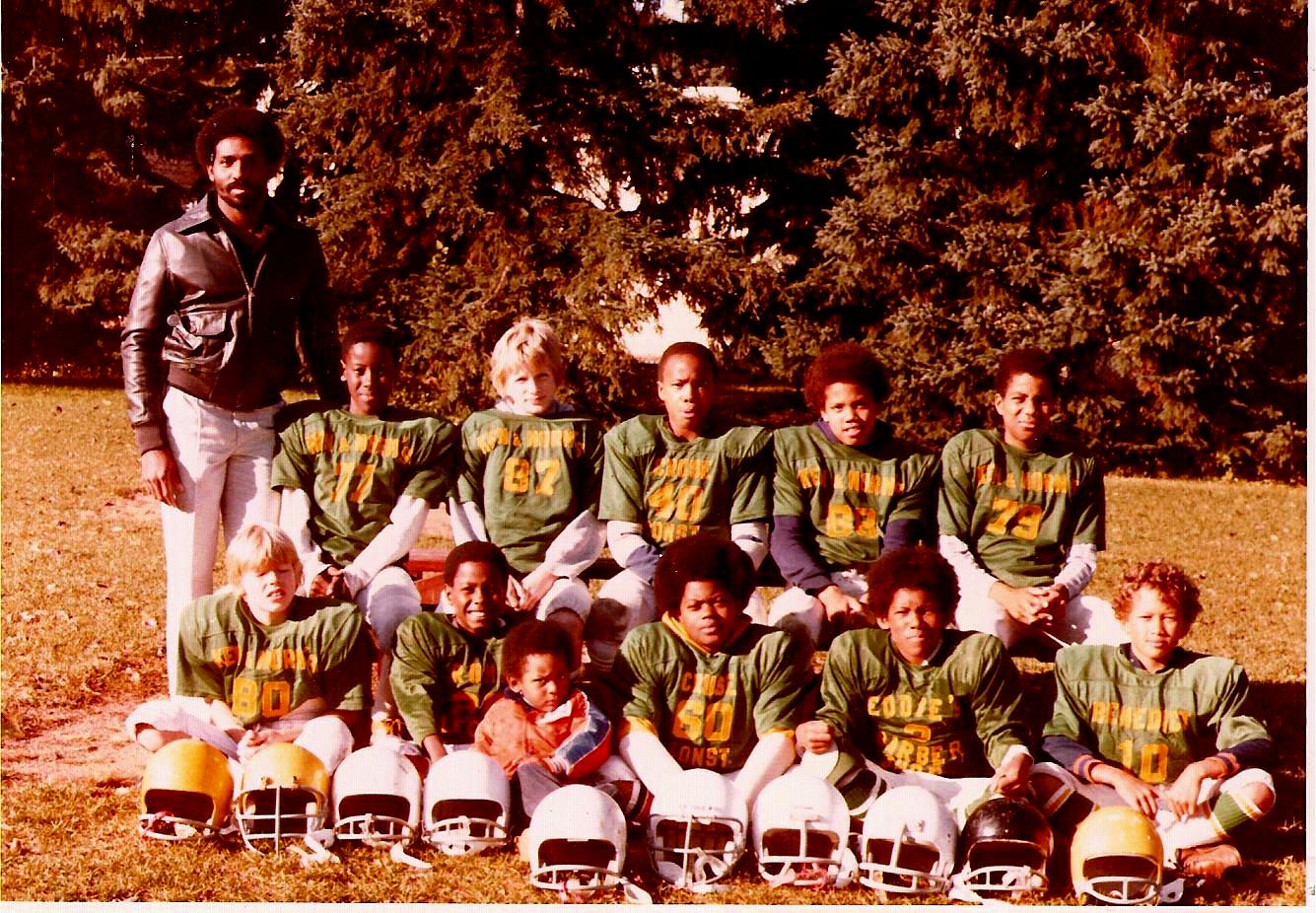
McRae Park youth football team, 1979 (Minneapolis Park and Recreation Board)
Does anyone know anything about any of the sponsors of the 1979 team: Ken and Norm’s, Cruse Construction, Eddie’s Barber Shop and Benedict?
I’d especially like to know who the coaches in these photos are. Could the coach on the left in the middle photo be Edward Solomon? Solomon was one of the better-known volunteer football coaches in the Minneapolis park system. He was a park commissioner 1996-2002. A new park southwest of Lake Nokomis was named for him in 2004.
McRae Park is unusual because it does not occupy all of the two square blocks on which it is located. The southwest corner of the park at 47th and Chicago is occupied by businesses. I have not found an explanation for why the park board didn’t acquire all of the land on those blocks — as it usually did. Ray N. Welter Heating moved to its present location on Chicago Avenue in the early 1940s not long before the land for the park was acquired in 1946. A person at the heating company told me the land that is now the park was a garbage dump when Welter moved its business to the site from Lake Street. Can anyone tell us the history of the street corner and why the park board didn’t buy all the land on that block? Some of the land for the park was purchased through condemnation; some was tax-forfeited land that the state owned and gave to the city.
David C. Smith
Florence Barton Loring
Filed under: Minneapolis Park Hero, Minneapolis Parks: General | Tags: Charles M. Loring, Florence Barton Loring, Loring Park, Minneapolis parks
Comments (8) Charles Loring was married to Emily Crossman for 38 years, to Florence Barton for only 27, but he probably knew Florence longer than he knew Emily.
The “Father of Minneapolis Parks” likely met Florence more than 30 years before he married her, but he may not have noticed her much at first. She was the daughter of his friend and business associate Asa Barton. Barton, like Loring, was an immigrant from Maine. (Barton also has his name on the Minneapolis map: Barton Avenue in Prospect Park.) Continue reading
Minneapolis Park Music: Loring Park, Horace Cleveland, by Gregory Reese
Filed under: Loring Park | Tags: H.W.S. Cleveland, Horace Cleveland, Loring Park
Leave a comment This is the only music I know of based on a Minneapolis park and the landscape architect who designed it. Gregory Reese composed “Loring Park, Horace Cleveland” for McNally Smith College of Music Art-inspired Music Project. Very cool. Have a listen while you stroll through the park. Or find a favorite bench.
Know of other music based on Minneapolis parks? A playground or two must have shown up in some rock or rap lyrics, no? I recall a reference to Holmes playground in a song, but can’t remember the group.
David C. Smith
 Minneapolis Park History