Archive for May, 2012|Monthly archive page
Sibley Triangle in Full Bloom
Filed under: Minneapolis parks | Tags: Northeast Minneapolis, Sibley Triangle
 Comments (4)
 Last fall I apologized to Robin Russell, the volunteer park steward who maintains the lovely Sibley Triangle in Northeast Minneapolis, for not getting a picture of her superb work. This is to make amends. These photos were taken on May 30 after a week of rain. Beautiful.

Sibley Triangle, May 30, 2012. Washington St. NE is on the right, 5th St. NE on the left.

Sibley Triangle from the east (Washington St. NE).
I’d love to hear from Robin and park stewards who beautify other parts of our park system. Tell us the story of your garden—and send photos.
David C. Smith
NOTE: Please see “Comments” for information on other gardens.
Bombers Over Lake Nokomis
Filed under: Minneapolis Golf Courses, Minneapolis Lakes, Minneapolis parks | Tags: Hiawatha Golf Course, Lake Hiawatha, Lake Nokomis, Wold Chamberlain Field
Comments (2) My favorite photo of Lake Nokomis was taken in 1932. The true subject of the photo was a squadron of Martin bombers visiting Wold-Chamberlain Field from Langley Field, Virginia, but beneath them is a fascinating scene of park developments.

The Martin Bomber was the first American airplane built specifically to carry bombs. First built during WWI, the biplane version of the bomber was replaced by a monoplane version designed in 1932. (Minnesota Historical Society)
The photographer isn’t listed in the Minnesota Historical Society’s database, but it may have been taken by J. E. Quigley Aerial Photography. Quigley produced most of the other aerial photos of Minneapolis from that era.
The bare ground at the left wingtip of the middle plane is the Hiawatha Golf Course under construction. The course didn’t open until 1934. Dredging in Lake Hiawatha had just been completed in 1931.
It doesn’t show up well at this size, but the Nokomis Beach is packed (beneath the front airplane). You can see the diving towers in the lake.
Also note how barren the Nokomis lakeshore is. It had been created from lake dredgings only 15 years earlier.
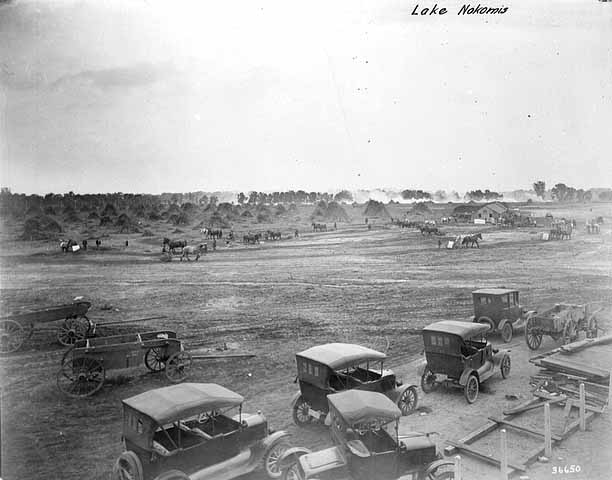
Four years after dredging was completed at Lake Nokomis and the dredge fill had settled, the park board cleared and graded the land. (Minneapolis Park and Recreation Board)
The dredge fill settled for four years before it was cleared of brush and willows that had grown up in the intervening years and the land was graded for athletic fields. The huge piles of brush in the background were burned. Of course the land was graded by horse teams. Even with that much time for the dredge fill to settle before it was graded, the playing fields continued to settle and were re-graded in the 1930s as a WPA project.
Even after ten years of tree growth, the lake shore doesn’t look very shaded in the 1932 photo.
The Cedar Avenue Bridge at the bottom of the aerial photo was the subject of great debate at the park board, Minneapolis City Council, the Hennepin County Board and Village Council of Richfield in the 1910s. Park superintendent Theodore Wirth’s plan for the improvement of Lake Nokomis in the 1912 annual report included rerouting Cedar Avenue around the southwest corner of the lake to eliminate a “very unsightly” wooden bridge over the edge of lake at the time. Even though the park board owned all the shores of the lake and the lake bed, the south end of the lake was then in Richfield, which is why the county and Richfield were involved in decisions on the bridge. Despite the park board position that building a bridge would be more expensive and less attractive, it was built—and paid for with Minneapolis bond funds—partly due to opposition by Richfield landowners to plans to reroute Cedar. By 1926 that line of opposition would have been partially removed when Minneapolis annexed about a mile-wide strip of Richfield that placed all of Lake Nokomis inside Minneapolis city limits.
David C. Smith
An Early Toro
Filed under: Minneapolis parks | Tags: Longfellow Field, Minneapolis Steel and Machinery Company, The Toro Company
Comments (1) I was just culling some old photo files and found a copy of an ad from Parks and Recreation magazine in 1921. I had clipped it thinking one day I might find a use for it. Well I already wrote the post I should have put it in — Longfellow Field — about the connection between Minneapolis Steel and Machinery Company and Toro and Toro’s shift from tractor engines to lawn care products. This must be one of the company’s earlier lawn mowers.
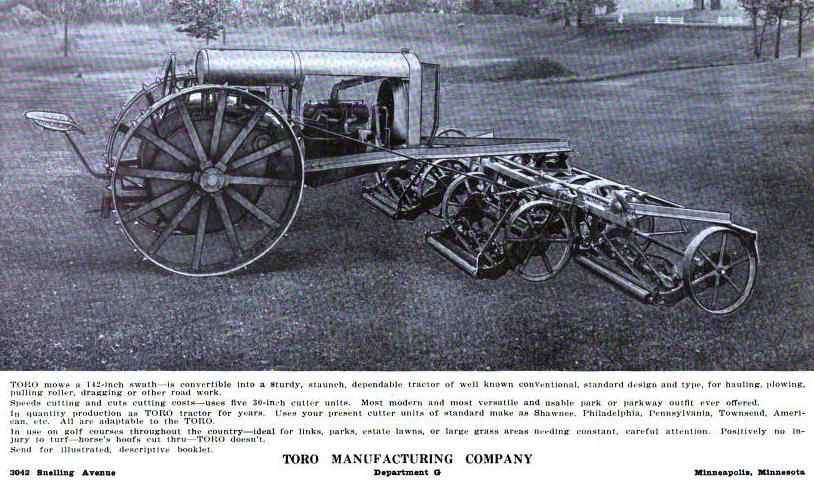
Toro was already selling lawn care tractors by 1921. (Parks and Recreation.)
But I forgot I had this image, so a month after it should have debuted, here it is. My favorite line in the ad copy is “Positively no injury to turf—horses hoofs cut through—Toro doesn’t.” Although those spikes on the big rear wheels look a bit destructive. Doesn’t offer all the modern-day comforts, does it?
Thanks again to Toro for contributing to improved baseball fields in Minneapolis parks.
David C. Smith
Note: Thanks to Bob Wolff for more history on The Toro Company, posted as a comment on David C. Smith page. Looking more closely at digitized Parks and Recreation magazines to respond to Bob, I discovered that the ad above appeared in 1921, not 1919 as I had originally posted.
Comments on Lyndale Pond comments (and a very hard quiz on Minneapolis parks)
Filed under: Minneapolis parks | Tags: Columbia Park, Lake of the Isles, Minneapolis Maps, Minnesota Digital Library, Powderhorn Park, Whittier Neighborhood
Comments (3) If you’re interested in the subject of a pond near Lyndale and Franklin, you might want to check out “comments” on the subject posted a few days ago. Some good information. Thanks to readers who responded and to Cheryl Luger for posing the questions in the first place.
I wanted to add that while investigating another subject I found an 1897 Minneapolis map produced by the city engineer that shows elevations. (A small section of that map is pictured below.) It’s also interesting to see where in the city you could get running water and why the city was installing water lines from a reservoir in Columbia Heights. Note the highest elevations in the city. To keep things in perspective the population of Minneapolis in 1900 was already more than 200,000. The 1890s was the first decade in four in which the population of Minneapolis didn’t nearly triple. Likely due to the depression set off in 1893.

Detail of 1897 Minneapolis map that shows parks, elevations, water lines and street car lines. (James K. Hosmer Special Collections Library, Hennepin County Library)
The complete map, as well as dozens more from around the state, are available at the Minnesota Digital Library, an excellent resource for researchers or the curious.
Unfortunately, this map has less topographical detail than the map suggested by Bill Payne in his comment on the previous article. It shows no remnant of the pond on earlier maps at Lyndale and 22nd, nor the depression that is noted there on the 1901 map Bill found. The 1897 city map shows elevation increments of 25 feet; the 1901 map shows increments of 20 feet, which may account for the difference.
Here’s the quiz
Many, many properties were added to the Minneapolis park system after this map was made in 1897. For instance, notice that there is no West River Parkway, nor a St. Anthony Parkway, nor a Victory Memorial Drive, and on and on. Most of the Grand Rounds hadn’t been built. (This map doesn’t even show Stinson Parkway, which did exist in 1897!) But there are three significant park properties on this map that are no longer park properties. Can you name them?
Click on “complete map” above, then zoom into various sections of the city to find the long-gone pieces of the park system. All were no longer park property by 1905. (Note: The island at the south end of Lake of the Isles is a good catch, but doesn’ t count because it’s still part of the lake and park. The same goes for the northern end of Powderhorn Lake, which once extended north of 32nd; it’s still part of the park. Same for Sandy Lake in Columbia Park; the lake is gone, but it’s still a park.)
Winner gets a free subscription to minneapolisparkhistory.com!
David C. Smith
NOTE (June 1, 2012): The contest is now over and Adrienne was the winner. She named Meeker Island in the Mississippi River as one park property on the map that is no longer. The other two were Hennepin Avenue South and Lyndale Avenue North. Both were parkways in 1897, but were given up by the park board in 1905. The city subsequently took responsibility for them as ordinary city streets.
CMPC: Park Property Monuments?
Filed under: Minneapolis parks, Minnehaha Creek | Tags: Minnehaha Creek
Comments (5) This week I was included in an e-mail discussion between MaryLynn Pulscher and Annie Olson at the park board and Daniel Fearn. Daniel had found two interesting metal markers in the ground near Minnehaha Creek.

Marker near Minnehaha Creek (Daniel I. Fearn)
Daniel wondered if CMPC was an acronym for City of Minneapolis Park Commission. My reaction, as well as MaryLynn’s, was that wasn’t likely because the park board until 1969 always marked everything BPC for “Board of Park Commissioners.” The Minneapolis was generally understood.
A web search, however, turned up a document from a Hennepin County Survey that indicates the CMPC stamp may have been used on park board survey monuments. On that document a monument with a similar marker found at 50th and Cedar during the Minneapolis City Survey in 1937 was called a “park board monument”
Do you know the real story of the CMPC markers? Have you seen other markers like this anywhere else in the city? Were they on park boundaries? Or do I have to call the county surveyor’s office to resolve this?
Send photos if you have ’em.
David C. Smith

 Minneapolis Park History