Archive for the ‘Minneapolis Parks: General’ Category
Alice Dietz and Bea Dunlap in 1939 Playground Pageant
Filed under: Minneapolis Park Hero, Minneapolis Park Memory, Minneapolis Parks: General | Tags: Alice Dietz, Farview Park, Playground Pageants
 Comments (3)
 I received this note and photo today from Bea Dunlap of Dallas, Texas, under the subject line, “Alice Dietz and me 75 years ago.”
“This picture was taken about 75 years ago (I am now 85 years old) when I was in a Park board pageant representing Farview Park. Me and almost ever kid in my block were Raindrops in a skit called Umbrella Man. The little ones were turtles who hid under a big umbrella until the “sun came out”. Our costumes were made of silver and blue crepe paper. My Mom sewed most of the costumes for our group.”
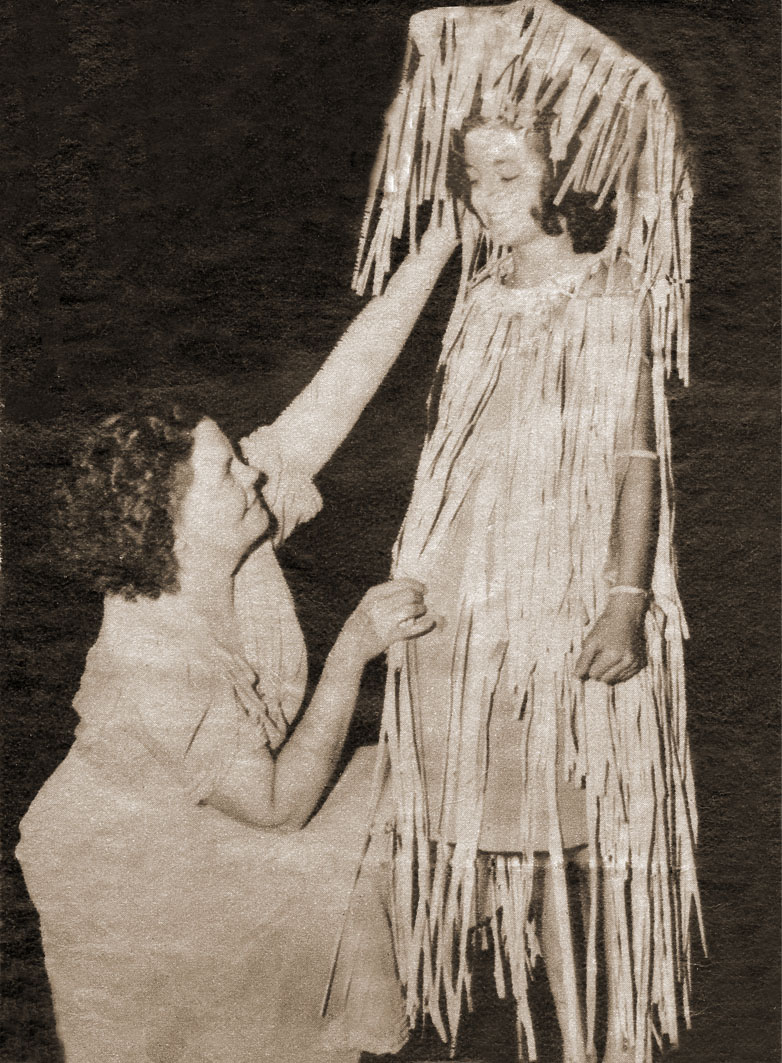
Alice Dietz, creator and director of the playground pageants, with ten-year-old Bea Dunlap from Farview Park in 1939. Bea is dressed as a raindrop. (Photo courtesy of Bea Dunlap.)
The playground pageants, held at the end of summer, included children from every park in Minneapolis. They were presented on the hillside above the Rose Garden at Lyndale Park. The pageants were created and directed by Alice Dietz. This was one of the last playground pageants. With the creation in 1940 of the Aquatennial, that became the focus of summer celebration in the city and the pageant was discontinued.
Thanks for the wonderful photo and information, Bea.
David C Smith
I Finally Made It!
Filed under: Minneapolis Parks: General, Tower Hill Park | Tags: Prospect Park, Tower Hill, Witch's Hat
Comments (6) I finally climbed the Witch’s Hat Tower in Tower Hill Park. The erstwhile water tower was completed in 1914 after the park was acquired by the Minneapolis Board of Park Commissioners. I have already written about the tower here and here and here. Today I’m just providing proof of my climb with photos and a few brief observations.
Most years the tower is only open one night a year, the night that Pratt School has its ice cream social, which was last Friday, but this year the tower will also be opened to celebrate the dedication of the tower 100 years ago. That will take place July 12 and 13. So you get an extra chance to see the view from the top this summer.

The view west toward downtown — and into the sun. Pratt School is at the bottom. I took the picture a little after 5 p.m. I didn’t have to wait in line to make the climb, but by the time I descended about 100 people were in line waiting their turn. (David C. Smith)
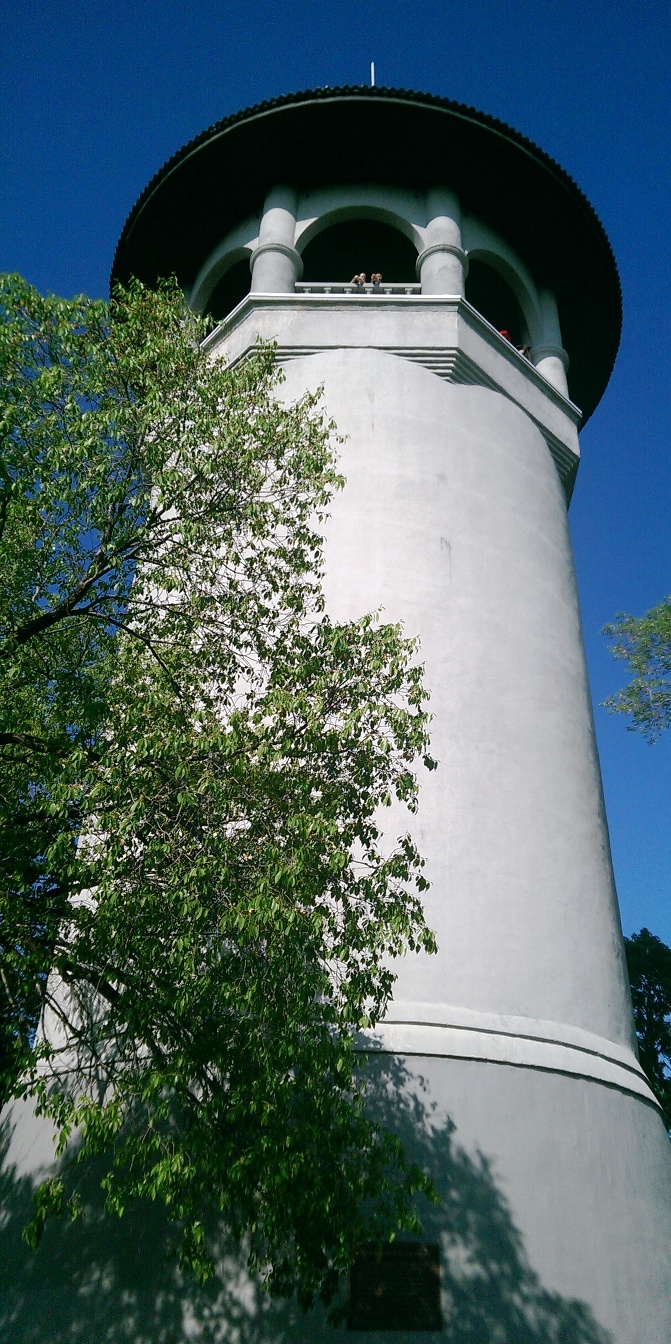
The Witch’s Hat from the terrace near the entrance to the tower. It was a perfect day for a view. It really is this white and sky really was this blue. My Dad, who turns 90 this year, chose not to climb the 100+ steps to the top of the tower, but still enjoyed the spectacular view from the terrace. Even if you miss the few chances to climb the tower, visit the park for beautiful views of the city. (David C. Smith)

The view from the Witch’s Hat to the southwest, across Prospect Park and the Mississippi River into South Minneapolis. This was my favorite view, in part, because of how well the Mississippi River is hidden. You can tell it’s there and you can see part of the railroad bridge over the river, but it is amazing how such a prominent and predominant geographical feature can be swallowed by the landscape. I couldn’t help but imagine the wildness of the view from here 150 years ago — before buildings and also before the Minneapolis park board planted hundreds of thousands of trees along city streets. Early writers note that what is now South Minneapolis, from the river gorge to the lakes in the southwestern part of the city, was mostly treeless prairie. The Tower Hill Park tennis courts are visible in the lower right corner. (David C. Smith)

The top of the stairs down the Witch’s Hat. (David C. Smith)

The spiral staircase of the Witch’s Hat. It was narrow enough that I had press up against the wall and suck in my (shrinking) stomach to pass people going the other way. The large deck at the top of the tower was intended to be a bandstand for concerts, but musicians had a difficult time getting their instruments up this narrow staircase. Imagine lugging a bass, bass drum or tuba up or down. But others were once able to enjoy the view any time. When the tower was first opened in 1914, the park board paid a park keeper to open the tower to the public five days a week. (David C. Smith)
If you took better photos than I did, please email them and I’ll post them here.
David C. Smith
© 2014 David C. Smith
Horace Cleveland Gets a Park!
Filed under: Minneapolis Parks: General | Tags: H.W.S. Cleveland, Horace Cleveland, Mississippi River Gorge
Comments (1) It could finally happen! I was delighted to learn that Minneapolis Park Commissioners Scott Vreeland and Steffanie Musich will introduce to the board this week a formal proposal to name all or part of the Mississippi River gorge in Minneapolis after Horace William Shaler Cleveland. He was the landscape architect who was so influential in the creation of the Minneapolis and St. Paul park systems and, especially, the protection and preservation of the incomparable river gorge as a park.

The cover of the park board’s 1905 annual report shows the Mississippi River gorge looking up river from the mouth of Minnehaha Creek at left. (Minneapolis Park and Recreation Board)
I can think of no higher or more appropriate honor for a man whose vision meant so much to life in this metropolis than to name this magnificent ribbon of untrammeled, still-wild green in his name.
Scott Vreeland has pointed out that the proposal he will read this week is only the beginning of the process that must gain approval now from many jurisdictions, from the Minneapolis Park and Recreation Board to the National Park Service. Perhaps it is indicative of Cleveland’s profound legacy that local, regional, state and national entities are now involved in the continued preservation and administration of the treasure the river gorge has become.
But it is a start. To read more about why I believe this is important, read my earlier articles here and here. Or click on Cleveland’s name in the tag cloud at right to learn a great deal more about this extraordinary person.
Thanks Scott and Steffanie for taking this step.
I hope all other organizations, public and private, that are interested in the river will support them.
David C. Smith
© 2014 David C. Smith
Perkins Hill Park Was Not Named for Frances Perkins
A few days ago Wendy Hajicek commented on an earlier post, mentioning her memories of Perkins Hill. Wendy asked if Perkins Hill was named for Frances Perkins the Secretary of Labor in the Cabinet of Franklin Delano Roosevelt. I had written in a historical profile of Perkins Hill for the Minneapolis park board’s website that the park was named for the Perkins Hill Addition, a property development. Park board proceedings from that era do not indicate that the name was ever formally approved. It is one of those “so-called” properties.
I had never heard before the possibility that the park had been named for Frances Perkins, so I quickly looked up the time frame of the acquisition to see if it would have been possible. The park was acquired in 1948 and Frances Perkins had served in Roosevelt’s cabinet from 1933 to 1945. The time period fit perfectly.
So then I went back to the plat maps from 1914, 1903 and 1892 that I consult so often from the Minnesota Digital Library and the Borchert Map Library at the U of M. I wanted to see how the property was named at those times. The name Perkins Hill Addition is on the 1903 plat map and the 1892 plat map notes that four adjoining parcels of land are owned by people with the Perkins surname. So it appears that the name is based in Minneapolis, not Washington, D.C.

Frances Perkins, Secretary of Labor, 1933-1945.
I haven’t looked up the Perkins family that owned, then subdivided, the north Minneapolis property in the late 19th century. Perhaps they were leading citizens of the community and I wouldn’t want to diminish their part in the early history of Minneapolis, but part of me was hoping that the park could have been named for Frances Perkins, the first woman to serve on a presidential cabinet and, therefore, the first to take a place in the line of succession for the presidency. A brief online exploration of her life suggests that she was influential in formulating Roosevelt’s labor policies, Depression-era work relief programs, and the creation of social security.
I’ll look for info on the Perkins family of north Minneapolis as well. If you know any of their story, let me know.
And as I mentioned in my reply to Wendy’s comment, I hope more people stop by Perkins Hill Park for a picnic or a visit. The view of the city is splendid. Does anyone have a photo to share?
David C. Smith
© 2013 David C. Smith
Approaching Lake Calhoun — A Couple Years Later
Filed under: Minneapolis Parks: General | Tags: Dean Parkway, Lake Calhoun
Comments (5) Julieann Swanson, Assistant Curator of Digital Collections and Archives at the University of Minnesota’s College of Design just sent a fabulous photo of the Lake Street, Dean Parkway, and West Calhoun Parkway intersection from about 1956 in response to my post earlier today. See Julieann’s comments on that post for more information on this photo and the Digital Content Library.
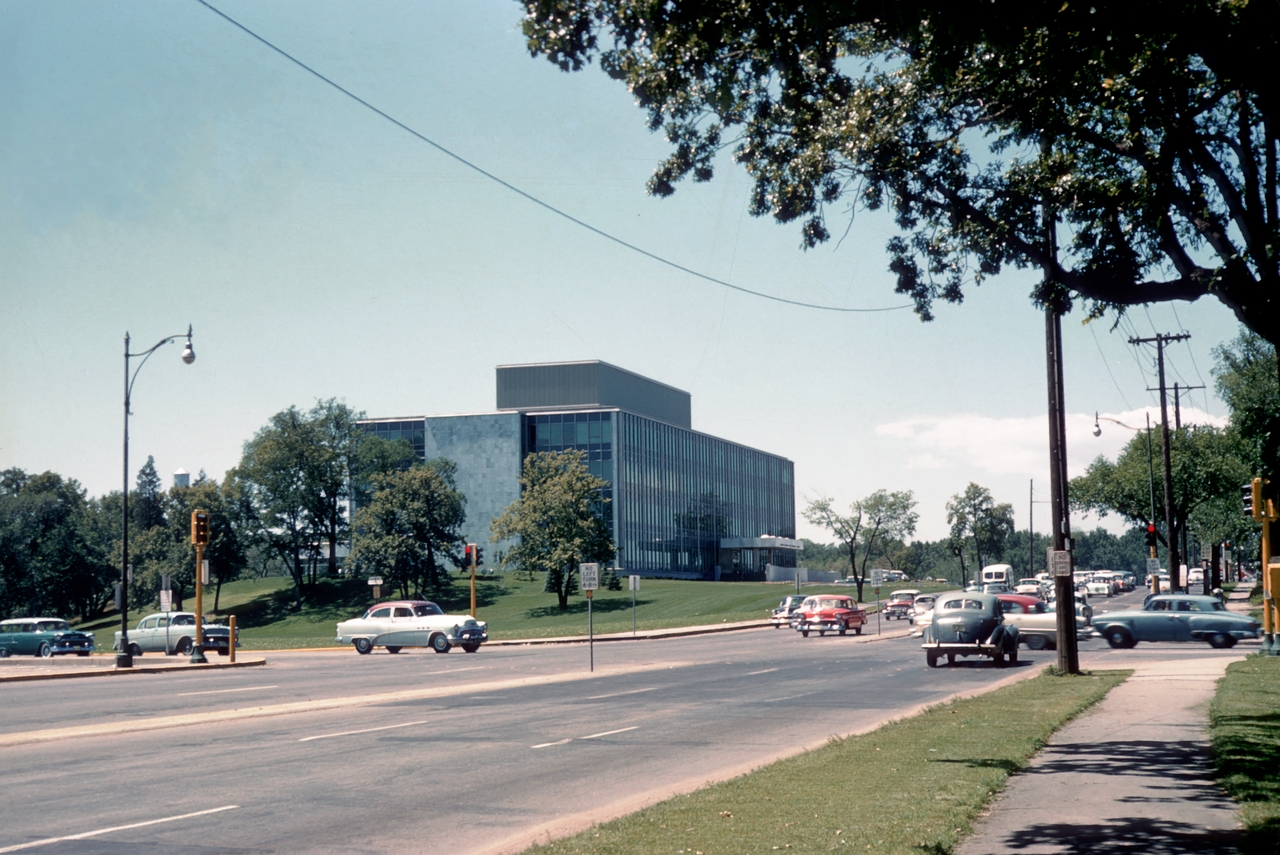
Looking west on Lake Street toward the intersection with Dean Parkway and West Calhoun Parkway. (Photo: University of Minnesota, Digital Content Library)
Julieann suggested that the photo is circa 1955, but I’ve advanced it a year to 1956, because I believe that is a red 1956 Chevy sitting at the east-bound stop light. And, yes, the traffic lights are quite visible in this photo! Would that car have been called, “Cherry”? I’m a little too young to remember ’50s slang.
Thanks, Julieann.
David C. Smith
© 2013 David C. Smith
Approaching Lake Calhoun
Filed under: Minneapolis Parks: General | Tags: Dean Parkway, Lake Calhoun, William Berry Parkway
Comments (7) Two photos from the 1950s, and two that are much older, show how people got to Lake Calhoun once upon a time. Both photos are from the Minnesota Historical Society’s online collection. I haven’t written about that collection in some time, but I continue to use it extensively for research on Minneapolis parks and other historical subjects. You should take a look if you haven’t before. It’s a treasure.
The first photo shows the intersection of Lake Street, Dean Parkway and West Calhoun Parkway, looking west.
Many Minneapolis parkways were once called “boulevards”, but that changed in 1968 when the Minneapolis park board renamed nearly all of them “parkways.” The park board wanted to create uniformity in treatment, but also believed that by calling them parkways, people would better understand that they were owned by the park board and were part of the park system. I still refer to them as boulevards at times, out of habit, as do many others. Curiously, Google maps hedges, labelling the road around the west side of Lake Calhoun “W Calhoun Pkwy” and “Calhoun Blvd”.
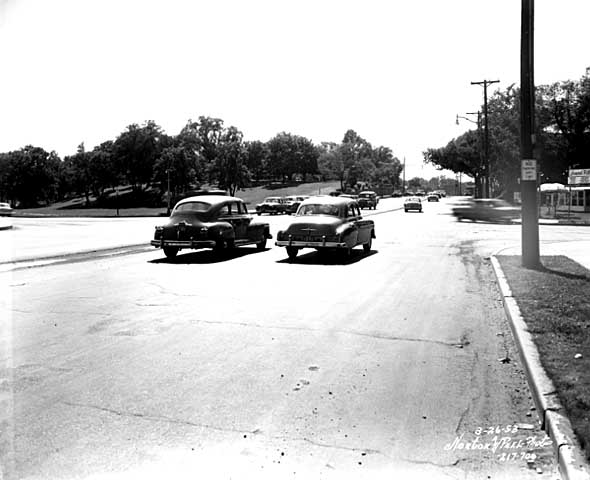
Travelling west on Lake St. at Dean Parkway. West Calhoun parkway begins at far left. (Norton and Peel, Minnesota Historical Society)
Note that the lot on the southwest corner of the intersection (upper left) is still undeveloped in 1953.
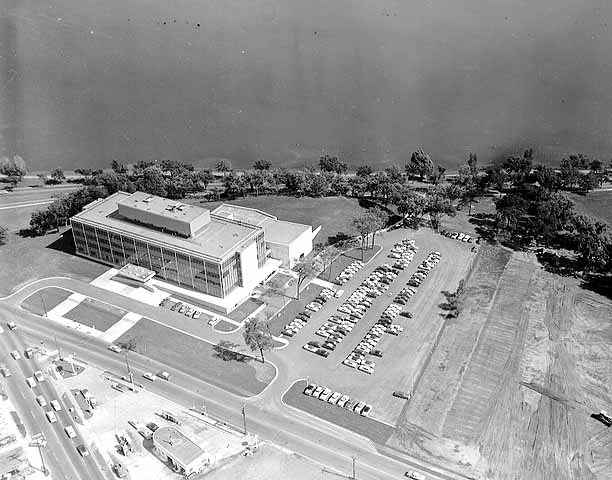
Aerial view, 1956. Excelsior Blvd. is in the foreground. Minnesota Historical Society)
The earliest photos I’ve found of the American Hardware Mutual Insurance Company building on the site are dated 1956, such as this aerial photo from the Minneapolis Star Journal Tribune.
The park board never owned that piece of land, although it would have been a good addition to the lake park. The park board reported in 1916 that the purchase of 93 acres on that corner was pending, but the deal never was completed. The land behind the building to the southwest was once a small bay of the lake, which the park board filled with material dredged from the lake bottom.
Perhaps it’s simply an issue of the resolution of this photo, but I don’t see traffic lights even though it appears that east- and west-bound traffic is stopped. The lights must have been installed about this time, because the city engineer had developed an initial plan for lights at this increasingly busy intersection in 1951.
The photo below was taken at the opposite, or southeastern, corner of Lake Calhoun at about the same time.

36th Street approaching the southeastern corner of Lake Calhoun, 1955. Lakewood Cemetery is on the left. (Norton and Peel, Minnesota Historical Society)
The photo is notable especially because the foundation of the street railway bridge over 36th Street still stands. This was the location of the rails that went to Lake Harriet and beyond to Excelsior and Lake Minnetonka. Of course, there were no traffic lights at the intersection of 36th and East Calhoun Parkway either.

East Calhoun Parkway in about 1890. Looking north from Lakewood Cemetery.(Minnesota Historical Society)
The trestle had been there since before the park board built the parkway. (See more on the Lyndale Railway Company at Lake Calhoun and Lake Harriet.) In the photo at right you can see the bridge foundation (far right), in front of the carriage turning east onto 36th Street. The fountain in the boulevard for watering horses was an interesting touch. So was the scalloped hedge between the parkway and the lake. Does anyone know when the street railway bridge supports were torn down?
Most of the earliest parkways around lakes ran right along the water’s edge. That feature of early parkways is more prominent in the photo below of the end of Calhoun Parkway in about 1905. At that time the parkway ended where it turned south to connect to Lake Harriet. The land behind the photographer in this photo was private land all the way around the west shore of the lake back to Lake Street and the top photo.

The end of Calhoun Parkway at the south end of Lake Calhoun in 1905. The road turned to the right, the future William Berry Parkway, connecting to Lake Harriet. (Minnesota Historical Society)
The photo below shows the approach to the north end of Lake Calhoun from about the same time period as the photo above.

The north shore of Lake Calhoun from Lake Street, facing west in about 1902. (Minnesota Historical Society)
This photo shows Lake Street facing west at the northeast corner of Lake Calhoun. This was before the park board acquired the north shore of the lake. The only park land around the lake at this time was Calhoun Parkway beginning at the left of this photo and continuing to the previous photo.
David C. Smith
A Missed Opportunity: The Witch’s Hat Is Closed for Another Year!
Filed under: Minneapolis Parks: General, Tower Hill Park | Tags: Frederick W. Cappelen, Tower Hill Park, Witch's Hat
Comments (6) 
The view from Tower Hill — at the base of the Witch’s Hat. Imagine the view from the observation deck above. (Talia Smith)
For years my “To Do in Minneapolis” list has included a climb that I have never made. And it’s not something I can do just any old day. We get one evening a year and that’s it. And once again I missed my chance. I wasn’t paying close enough attention that the Prospect Park/Pratt School Ice Cream Social was May 31. The night of that neighborhood party is the one time a year that the Witch’s Hat Tower on Tower Hill Park is open for climbing.
The climb would have been especially gratifying this year because it was the tower’s 100th birthday. The City of Minneapolis built the water tower on the hill, with the park board’s permission, in 1913. As explained before, the park was already named Tower Hill, at the request of neighborhood residents, when the Witch’s Hat water tower was built.
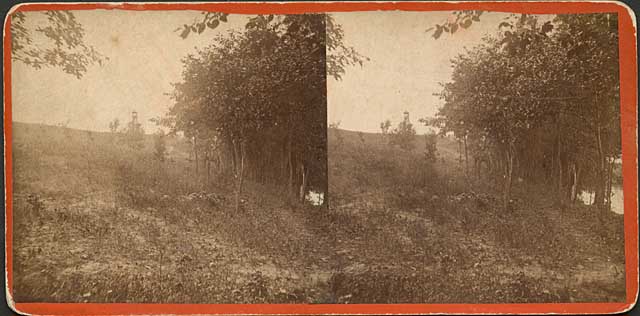
Since my earlier post on the Witch’s Hat, I found this stereopticon image of “Cheever’s Tower” dated 1858. (Minnesota Historical Society)
The Witch’s Hat tower was designed by Frederick Cappelen, as noted on a plaque that was put on the tower in 1999. I have a complaint about that plaque.
Cappelen is described on the plaque only as a “Norwegian architect.” Concise, but really misleading. Yes, he was Norwegian by birth, but he had immigrated to the United States at the age of 23 in 1880. He went to work for the City of Minneapolis in 1886 as a bridge engineer and in 1893 was elected Minneapolis’s City Engineer. He left that office in 1899, but was elected City Engineer again in 1913 and held that title until he died of complications from appendicitis in 1921. So, although Norway-born, he lived nearly his entire adult life in Minneapolis and during much of that time was a city employee.
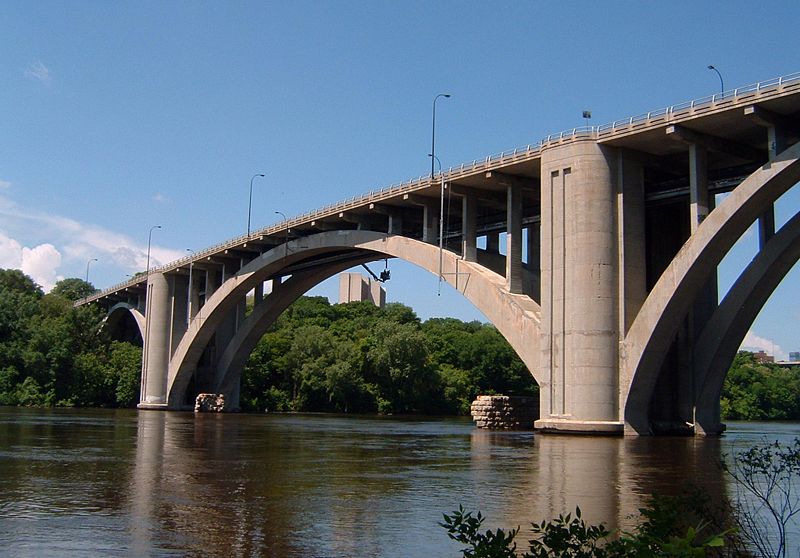
The graceful arch of the bridge was the world’s longest concrete span at the time it was completed in 1923. (Mulad)
Cappelen’s greatest achievements in Minneapolis had nothing to do with the Witch’s Hat. He was the designer of the Franklin Avenue Bridge over the Mississippi, which was completed after his death. At that time, the bridge was the longest concrete-span bridge in the world, with a central span of 400 feet. The bridge’s official name is F. W. Cappelen Memorial Bridge.
Cappelen was also a key figure in designing the city’s water distribution system from the 1890s into the 1900s. He was so well-known as a bridge designer and a water works designer that his obituary was included in both the Proceedings of the Society of American Civil Engineers and the Journal of the American Water Works Association.
Cappelen was a Public Servant
Here’s my complaint about the plaque. I have no problem with identifying him as a “Norwegian architect” despite the fact that he was as American as everyone else in the city. My problem is with not identifying him as a public employee, as the City Engineer, a description that has far more to do with our memory of him than that he was Norwegian by birth.
The omission of his status as a public employee is part of my larger complaint that too many people praise everything in the private sector and disparage everything and everyone in the public sector. Too many people have such blind reverence for business methods and profit motives that they cannot distinguish between public and private good and the sometimes vastly different challenges involved in each. Some public problems cannot be solved by methods designed to maximize private profits.
I have also witnessed first-hand brilliance, stupidity and sloth in both government and corporate worlds. I have known very successful business people whom I would not trust to walk my dog around the block for fear that they’d screw it up somehow — or sell my dog before they made it back. I have known public employees with whom I would trust my life.
I have no tolerance for people who assume that someone who gets his or her paycheck from a government entity is incompetent and that everyone who works for a profit-making enterprise is more industrious and resourceful.
I have as much tolerance — none — for those who assume the only reason we have parks at all was a conspiracy of capitalists to enrich themselves. This myopic view, in my recent experience, seems particularly prevalent among people writing doctoral dissertations and some of those advising them.
To emerge from our present political quagmire, we have to be better than those extremes.
If there is a valuable lesson in Minneapolis park history it is that a great variety of people, with disparate philosophies and political views, have worked together on issues of the common good and achieved marvelous results. They included “capitalists” who looked beyond self-interest and profit, and they certainly included talented and dedicated public servants — like Frederick William Cappelen, City Engineer.
I’m sorry I missed again a chance to climb the tower he imagined 100 years ago. I’ll have to settle for a walk over his bridge.
David C. Smith
NOTE (6/6/2013): abockheim raises an excellent point in a comment on the post I linked to above about the identity of the tower that led to the naming of Tower Hill. Can anyone shed light?

An illustration of the view from Cheever’s Tower in 1857 by Edwin Whitefield. The lithographer was W. Endicott & Co. (Digital gallery of the New York Public Library.)
Here’s the link to the above illustration. I can’t picture this view from the campus or Tower Hill.
© David C. Smith 2013
Minneapolis Sculpture Garden is 25
Filed under: Minneapolis Parks: General | Tags: Armory Garden, Minneapolis Sculpture Garden, The Parade
Leave a comment Happy 25th Birthday Minneapolis Sculpture Garden!
Sorry, I forgot to inform you of the original air date of tpt’s history of the Minneapolis Sculpture Garden. It premiered last Sunday evening on tpt/MN. The half-hour documentary was made to celebrate the 25th birthday of an extraordinary public space.
The program will air again at various times throughout the summer. Check tpt schedules or watch it here.
Producer Mark Fischer and executive producer Tom Trow did an excellent job telling the story; they even let me be in it!
The Sculpture Garden was a collaboration between the Minneapolis Park and Recreation Board, which owns and maintains the land, and the Walker Art Center, which designed the garden and selected the sculptures. It’s a Minnesota treasure.
The following photos show the transformation of part of the Sculpture Garden when the Armory Garden was created in 1913.

The southern half of the Sculpture Garden site before it was designated to become a garden in 1913, looking southwest, Armory in background, Walker Art Center site at left, Lyndale Avenue in lower left, Kenwood Parkway, now closed at right. (Minneapolis Park and Recreation Board)

The same site as above ready for planting for the 1913 convention of the Society of American Florists and Ornamental Horticulturists. (Minneapolis Collection, Hennepin Country Library)

The 1913 Armory Garden. The photo was taken from the Palace Hotel between The Parade and Loring Park. (Minneapolis Park and Recreation Board)
Whether you love the Sculpture Garden, or don’t really care, it is a remarkable use of parkland — one of many examples in the Minneapolis park system. As I said in the video, I think the transformation of one corner of a recreation park into an art park is a remarkable example of how the use of public land can — and should — change over time. It’s another tribute to the wisdom of those who envisioned the park system and the need to set aside land for public enjoyment. Because we own the land, we can adapt its use to meet our needs, however they may be defined and redefined. Brilliant!
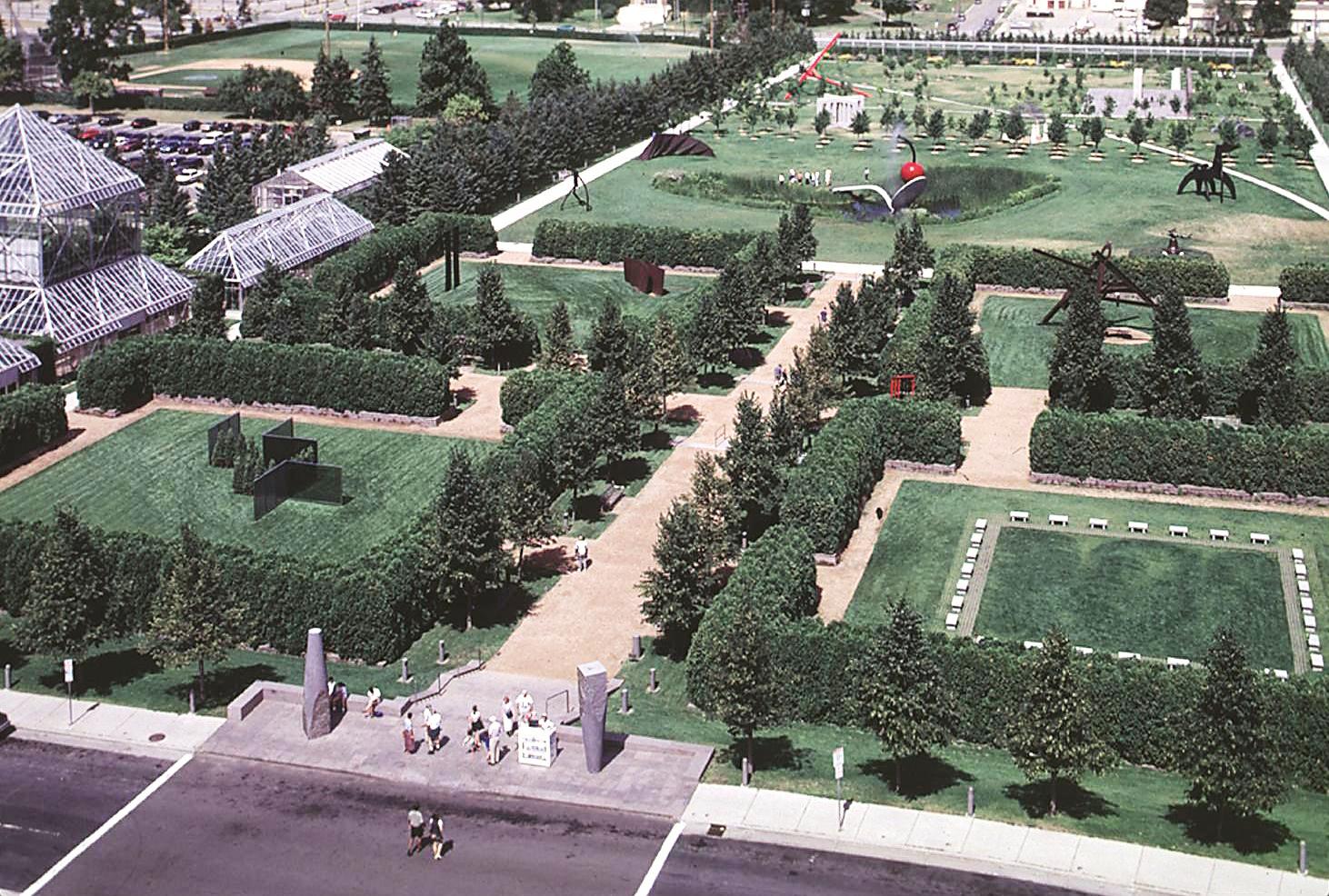
The same land in the photos above, but seen from the south. (Minneapolis Park and Recreation Board)
When’s the last time you visited the Sculpture Garden? Maybe it’s time to take another look.
David C. Smith
© 2013 David C. Smith
Friday Photo: Before the Mills Were Ruins
Filed under: Mill Ruins Park, Minneapolis Parks: General, Mississippi River | Tags: Mill Ruins Park, Mississippi River, Stone Arch Bridge
Comments (8) Let’s go down to the river one more time. I have many favorite pictures of the riverfront when it was the economic engine of Minneapolis, but this is probably at the top of my list.

The west bank of the Mississippi River in downtown Minneapolis, just below St. Anthony Falls, in 1885. (Minnesota Historical Society)
You can see just a dash of the still-new Stone Arch Bridge on the right margin of the photo. The channel here is all tail race — the water that ran out of the mills after generating power.
My favorite part of this photo though is the trestle and railroad tracks that ran between the mills and the river at essentially the level of city streets. Those tail races coming out of the mills are now a part of Mill Ruins Park. The trestle and tracks are gone, but I don’t know when they were torn down. Anybody?
Below are two shots (a 3-for-1 Friday Photo!, the biggest Friday Photo discount ever) of the tail races as they appeared probably in the 1950s.

Tail races, some of which are now visible in Mill Ruins Park. (MPRB)

A closer look at the trail races and water returning to the river after its work was done. (MPRB)
Both photos are undated. They show the water coming out of the tail races. They give a much better sense of the management of water power. I’m not sure of the functions of structures and workers at this point in the water power process.
These structures were razed and covered when the Upper St. Anthony Falls Lock and Dam was built in the 1960s.
For a marvelous 360-degree panorama of Mill Ruins Park and the adjacent lock and dam go here, courtesy of the National Park Service. Learn much more about the lock and dam — one of the biggest mistakes Minneapolis and the U. S. Army Corps of Engineers ever made — at the pages of the Mississippi National River and Recreation Area.
Have a look around the park — if spring ever comes. The transformation is amazing — and thought-provoking.
David C. Smith
© Copyright 2013
Friday Photo: West Riverbank from the Stone Arch Bridge
Filed under: Mill Ruins Park, Minneapolis Parks: General | Tags: Mill Ruins Park, Stone Arch Bridge
Leave a comment I don’t want to overdo the Stone Arch Bridge, but will run that risk with this photo found by Andrew Caddock at the park board. I showed the picture recently to a group of local history buffs and asked for guesses on when it was taken. Guesses ranged mostly from 1930-1960s. The real answer is ….
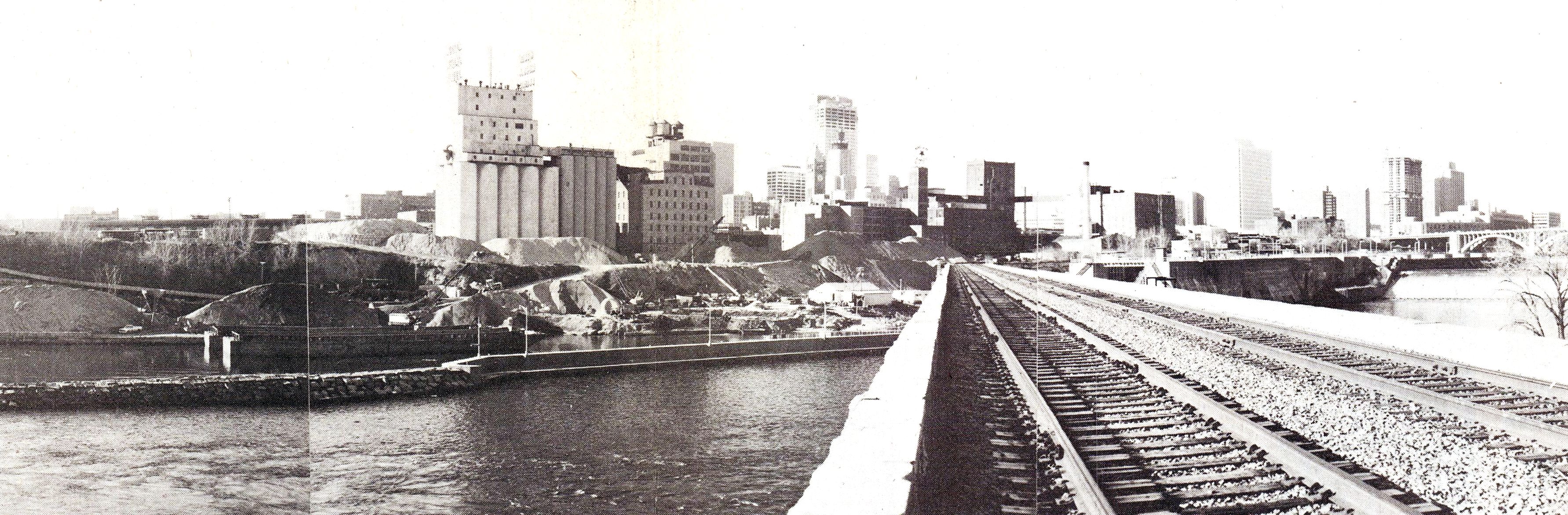
View from the Stone Arch Bridge. Click for larger image. (Jim Keane, Riverfront News)
…1980. Not that long ago.
The piles of sand and aggregate in front of the old mills were used to make concrete and were owned by Shiely Co. The materials were mixed on site and used in downtown construction projects; the sand and gravel could be transported at much lower cost by barge than by truck. The company first used the area for aggregate storage when it was making the concrete to build the upper lock and dam — on the right of the bridge — which was completed in 1965. Train traffic on the Stone Arch Bridge had stopped a couple of years before this photo was taken.
The photo appeared in the December 1980 issue of Riverfront News, a publication of the Minneapolis Riverfront Coordination Board, which included representatives of the major agencies of Minneapolis government.
The land under the sand piles is now Mill Ruins Park. The Guthrie Theater would be near the left edge of the photo
David C. Smith
Sisters of Chuckie: Powderhorn Park 1926
Filed under: Minneapolis Parks: General, Powderhorn Park | Tags: Doll Parades, Powderhorn Park
Comments (3) How did the cherished toys of one generation become scary to their great-grandchildren?
This photo raises the question. Doll buggy parades were big events at parks decades ago, especially in the 1930s. I’ve seen several photos of such events, some as recent as the 1970s. Yet, I’ve seen girls of today react very negatively to pictures of old dolls like these. They find them creepy. But aren’t these dolls more realistic and less creepy than many of the “fashion” dolls that girls play with now?

Dolls on parade at Powderhorn Park, 1926 (Minneapolis Park and Recreation Board)
Cool buggies, too. But with no children in sight? Yeah, they really are kinda creepy. The dolls look better with kids in the picture.

This Minneapolis Tribune photo from 1934, which includes girls from an unidentified park, is more appealing. (Minneapolis Photo Collection, Hennepin County Library)
Do you remember these events? Do you still have the dolls?
David C. Smith
The Worst Idea Ever #8: Power Boat Canal from Minnetonka to Harriet
Filed under: Minneapolis Lakes, Minneapolis Parks: General | Tags: 1911 Minneapolis Civic Celebration, Lake Harriet, Lake Hiawatha, Lake Minnetonka, Lake Nokomis, Minnehaha Creek, Minnehaha Falls
Comments (1) Ok, it wasn’t really a Minneapolis park project, but it still deserves a laugh: Minnehaha Creek converted into a 30-foot-wide power boat canal from Lake Minnetonka to Lake Harriet!

Lake Harriet could have been more like Lake Minnetonka.
Minneapolis was obsessed in the spring of 1911 with the upcoming Civic Celebration during which the channel between Lake Calhoun and Lake of the Isles would be opened. That was a very good thing. Huzzah, huzzah. But the attention it was drawing to the city also focused a lot of eyes on a very bad thing: Minnehaha Creek was nearly dry — in the spring! — which meant almost no water over Minnehaha Falls. Minneapolis could hardly celebrate the opening of the lake connection at the same time it suffered the ignominy of a dry Minnehaha Falls. The many out-of-town visitors anticipated for the celebration would surely want to see both. And let’s face it, a fifty-foot waterfall written about by a Harvard poet, which attracted visitors from around the world was a bit more impressive to most people than a short canal under a busy road and railroad tracks. The Minneapolis PR machine could call the city the “Venice of North America” all it wanted with its new canal, but visitors’ imaginations were still probably fueled more by the images of the famous poet’s noble heathen, beautiful maiden, and “laughing waters.”
The generally accepted solution to the lack of water over Minnehaha Falls was to divert Minnehaha Creek into Lake Amelia (Nokomis), drain Rice Lake (Hiawatha), dam the outlet of the creek from Amelia to create a reservoir, and release the impounded water as needed — perhaps 8 hours a day — to keep a pleasing flow over the falls. Unfortunately, with all the last-minute dredging and bridge-building for the Isles-Calhoun channel, that couldn’t be done in 1911 between April and July 4, when the Civic Celebration would launch.
Into this superheated environment of waterways and self-promotion stepped Albert Graber, according to the Saturday Evening Tribune, May 28, 1911. With the backing of “members of the board of county commissioners, capitalists, attorneys and real estate dealers”, Graber proposed to dredge Minnehaha Creek into a canal 30-feet wide from Lake Minnetonka to Lake Harriet. This would provide not only a water superhighway from Minnetonka to Minneapolis, and boost real estate prices along the creek, but it would also create a much larger water flow in Minnehaha Creek, solving the embarrassment of no laughing water.
“The plan, say the promoters, would enable residents of summer houses on the big lake to have their launches waiting at the town lake.”
Saturday Evening Tribune, May 28, 1911
Sure, there were problems. Not every plan could be perfect. The plan would require dismantling the dam at Gray’s Bay at the head of Minnehaha Creek, which might lower the level of Lake Minnetonka. But Graber and his backers had thought of that. The Minnesota River watershed in the area of St. Bonifacius and Waconia would be diverted into Lake Minnetonka — no problem! — which also solved another bother: it would reduce flooding on the Minnesota River.
The dam at Gray’s Bay had been operated by Hennepin Country since 1897. Many people then and now consider the dam the cause of low water flow in Minnehaha Creek, but the earliest reference I can find to low water in the creek was in 1820, when the soldiers of Fort Snelling wanted to open a mill on Minnehaha Creek, but were forced to move to St. Anthony Falls due to low water. That was even before two intrepid teenagers from the fort discovered that the creek flowed out of a pretty big lake to the west.
Graber estimated that dredging Minnehaha Creek would cost about $4,000 a mile for the nine miles between the two lakes. He and his backers, which included an officer of the Savings Bank of Minneapolis (who presumably had a summer house on the big lake and could put a launch on the town lake), provided assurances that the money to finance the project could be “readily found.”
The Evening Tribune article concluded with an announcement that meetings of those interested in the project would be held in the near future with an eye to beginning work before the end of the summer. Graber noted that his inspection of the project had been, no surprise, “superficial”, but that he would make a thorough report soon to his backers. I can find no evidence that the idea progressed any further.
The Board of Park Commissioners would have had no role in the plan, except, perhaps, allowing power boats to enter and be anchored on Lake Harriet. (I think they would have said no.) Park board ownership of Minnehaha Creek west of Lake Harriet to Edina wasn’t proposed until 1919 and the deal wasn’t done until 1930.
David C. Smith
© 2013 David C. Smith

 Minneapolis Park History