Archive for the ‘Minneapolis parks’ Category
Talmud Torahs vs. Swastikas
Filed under: Minneapolis parks | Tags: Football, Sumner Field, Talmud Torah
 Leave a comment
 The combination of words was eye-catching. And image-generating: holocaust, horrors. But on the sports pages of the Minneapolis Tribune? In 1921?
There they were, two teams competing in the 125-pound division of the Minneapolis Amateur Football Association: the Swastikas and the Talmud Torahs. But this was before the Nazis stigmatized the swastika, which had Sanskrit origins and had been used around the globe for millenia as a symbol of good luck or success. It was a good word, a positive symbol. It was only a year earlier that the German National Socialist Party had adopted the swastika as its symbol and it would be nine years more until Adolph Hitler created the famous red, white and black swastika flag.
I haven’t been able to find any information on who sponsored the Swastika team or what part of the city they came from. I know more about the Talmud Torah teams. The Talmud Torah was a Hebrew free school, established in 1893, that instructed Jewish children in Hebrew language and literature and the history and traditions of the Jewish people. Students attended the Talmud Torah after their regular day of study at public schools.

Talmud Torah, 725 Fremont Avenue North, ca. 1950, sponsored sports teams in park recreation leagues beginning in 1919. (Minneapolis Star Journal Tribune, Minnesota Historical Society)
In 1915 a new Talmud Torah opened on Fremont and Eighth Avenue North. The original Talmud Torah had been supported by the Keneseth Israel congregation, but the school in the new building had a wider base of support than a single congregation. According to an article in the Minneapolis Tribune, January 10, 1915, the school “will make Minneapolis famous as the only city in which practically all the people of the Jewish race have united in providing an institute … for Jews of any language and social condition.”
The first sports score I can find for the Talmud Torahs was a basketball victory at their gym in December 20, 1919, when they defeated the Eagle A. C. 56-4. Nice debut. (Minneapolis Tribune, December 21, 1919.) But the Talmud Torahs — that’s what newspapers called them, just as they referred to the “Bottineaus” or “Powderhorns” for teams representing those parks — showed up in the sports pages of the Tribune especially during the football season. That was presaged perhaps by an article in the Minneapolis Tribune, November 28, 1915, which announced that the Newsboys Club of some 300 boys “accustomed to the life of the streets” had been taken under the wing of the social settlement house also established at Talmud Torah and that they would be instructed by University students that were “expert in football.” Those newsboys may have been the foundation for later Talmud Torah teams. Perhaps the most famous newsboy of that neighborhood is Sid Hartman of the StarTribune sports page, although he isn’t quite old enough to have been in the club at that date.
The home football field of the Talmud Torah teams was Sumner Field, just two blocks east of the school on Eighth. The school sponsored one to three teams each year in the early 1920s.
The weight divisions in those days were determined quite differently from today, when most restrictions on youth football are based on a weight limit. Only players under a certain weight are allowed to play in that league. It was different in the late 1910s and 1920s. Then each team registered with 16 players on its roster. The players were weighed and the average weight of those players determined the league they played in. Leagues ranged from 95 or 100 pounds to 140 pounds. increasing in 5 or 10 pound increments, with a “senior” division in which weight did not matter. Also interesting is that the weight classes applied without apparent regard to age. For example, an article in the Tribune about a 135-pound league game in 1921 noted that the match-up featured several former All-City high school stars.
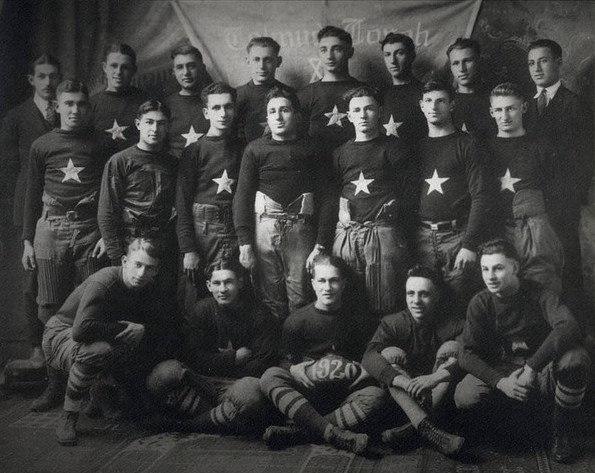
The first Talmud Torah football team, 1920 (Jewish Historical Society of the Upper Midwest, jhsum.com)
In 1920 the Talmud Torah team played in the 140-pound league and deep into the season was undefeated and unscored upon. In 1921 Talmud Torah had two teams, one played in the 125-pound league with the Swastikas — and won their division, a playoff with the winner of the other 125-pound division was snowed out — and the Talmud Torah Cubs played in the 100-pound league. The next year Talmud Torah sponsored three teams, one each in the 130-, 100- and 90-pound divisions.

In 1922, the Talmud Torahs were joined in park football by another Jewish team from the Judea A.C. Later Judea football teams were sponsored by the Emmanuel Cohen Center, a social service center established in 1924. The first Judeas team played in the 90-pound division — along with a Talmud Torah team — which is not likely the weight classification in which these fellows played.
The Rise of Activities Councils
If you happen by a soccer field in the fall or a park gym in winter now you’ll see nearly every team in uniforms with a name that ends in AC. Whether the uniform says WESAC, MFAC, SWAC, SIBAC, or something else, the AC stands for “activities council.” Activities councils — call them boosters or volunteers — associated with parks are a phenomenon that began with the creation of the Minnehaha Falls Activities Council (MFAC) serving Keewaydin Park in 1936. In the booklet, “Recommended Procedures for Park Area Recreation Councils” published by the park board in 1971, Robert Ruhe, park superintendent at the time, wrote that the councils were to his knowledge “unique among park and recreation departments in the United States.” The councils were and are independent of the park board recreation staff but work closely together to finance teams, buy equipment and provide coaches. The 1971 document lists the creation dates of 27 activities councils, many of which still exist.
While MFAC was the first booster club that promoted activities park wide, the idea of booster clubs was given a boost itself in 1951 and 1952 when new playgrounds were opened at Waite Park and Armatage respectively. Both school/park combinations were joint projects of the park board and the school board from the ground up. New parks were fertile ground for booster clubs and one was created at both parks. They were soon followed by the Southwest Activites Council (SWAC) in 1953 that covered two parks: Pershing and Linden Hills. SWAC was one of the most successful booster groups, providing a model for other parks. Two early activists in SWAC later became park commissioners, Inez Crimmins and Leonard Neiman, for whom the sports complex at Fort Snelling is named.
The booster clubs organized by park gradually replaced the more loosely managed efforts of players or businesses to put togther teams and secure equipment and create schedules. The job of organizing teams was more complicated then also because park recreation centers, other than the Logan Park Fieldhouse, were open and staffed only in the summer. There was no such thing as a year-round playground staff or recreation supervisors
For more photos and information about 1920s park football see this story about the football team from Bottineau.

This Camden team won the 1922 senior or open division of the Minneapolis Amateur Football Association managed by the park board recreation department.
David C. Smith
© David C. Smith
Northeast River Parks
Filed under: Minneapolis parks, Mississippi River | Tags: Edgewater Park, Gluek Park, Horace Cleveland, Mississippi River
Comments (4) I enjoyed a walk yesterday along the riverfront parks in northeast Minneapolis sponsored by the Minneapolis Riverfront Partnership. I told a few historical stories and park commissioner Liz Wielinski, Above the Falls committee member Mary Jamin Maguire, and Cordelia Pierson, executive director of the partnership, provided insights into park developments, past and future, along the river. We were also delighted to hear stories of the neighborhood from a few longtime residents of the area.
We visited Marshall Terrace, Edgewater Park, and Gluek Park and along the way we passed the newest, still unnamed, Minneapolis park at 2220 Marshall Street—a single lot from Marshall to the river purchased by the park board in 2010.
These are a few of the notes I made for my input into the program.
Marshall Terrace
Marshall Terrace was purchased in 1914. The first land chosen for a First Ward Park was a few blocks farther upriver, but neighborhood objections resulted in the park board asking for suggestions from residents and politicians for a better site. This eight-acre parcel further downriver was the result. (The park board also acquired the upriver acreage, but as a segment of a planned parkway across northeast Minneapolis, now St. Anthony Parkway, instead of a playground park.)
Park superintendent Theodore Wirth prepared these two plans for the new park, which were included in the 1915 Annual Report. (The same report included plans for nearby Bottineau Park.) Continue reading
Nearby Parks: Landscape architect Arthur Nichols and park fireplaces
Filed under: Landscape Architects, Minneapolis parks | Tags: Arthur Nichols
Comments (2) This is not about Minneapolis parks, but let’s not be parochial. These coincidences are too good to pass up—and they are little more than a stones throw from Minneapolis.
I recently came across more information on Arthur Nichols, a Minneapolis landscape architect I had written about here and another notable park fireplace: the Beehive in St. Louis Park.

Read more about this “beehive” fireplace at slphistory.org or follow the link at right.
Nichols designed a series of roadside parks along Highway 100 from St. Louis Park to Robbinsdale when Highway 100 was constructed in the late 1930s. Read more about those mostly paved-over parks at the website of the St. Louis Park Historical Society here.
The beehive fireplace is of interest not only because it’s a cool design that could accommodate three picnicking families at a time, but because it is similar in several ways to the Minnehaha Park incinerator I wrote about a few days ago. Like the incinerator it was built in 1939. The slphistory web page claims it was built by unemployed masons, which I assume means it was part of a government relief work program, much like the WPA which was responsible for the Minnehaha incinerator. The beehive and incinerator were also both made of locally quarried limestone, the beehive limestone from the Minnesota River bluffs near the Mendota Bridge and the incinerator limestone from at or near Minnehaha Park which is only a couple miles north.
What I have yet to learn is whether Arthur Nichols designed the beehive fireplace himself or just specified it in his park plans. If anybody knows, please fill us in.
David C. Smith
Minnehaha Park: The Incinerator and the Fireplace
Filed under: Minneapolis parks, Minnehaha Falls, Mississippi River | Tags: Minnehaha Falls, Minnehaha Park
Comments (13) A few months ago Mary MacDonald and Doug Rosenquist asked about fireplaces near 54th and Hiawatha in Minnehaha Park. Mary asked about the stone fireplace a few hundred yards down the path into the dog park and Doug asked about the brick fireplace nearer the road and north of 54th Street.

View of the fireplace from the path in the dog park.
Unfortunately I haven’t found any information on the massive stone fireplace. Not even MaryLynn Pulscher of the park board knows why it’s there or who built it—and if MaryLynn doesn’t know it’s a decent bet that no one does. Still, I’ll keep asking around. I hope one of our readers knows somebody who remembers something and can pass it along to the rest of us.
I have better news about the two-story incinerator. It was built in 1939 by a WPA crew. This is how it was described in the park board’s 1939 annual report:
“Along this roadway a concrete, limestone-faced incinerator was constructed at the old stone quarry site. This incinerator, the first of its kind in our park system, will burn the waste accumulated from the various picnic grounds in this section of the city. A continuation of improvements similar to these is contemplated for next year.”
Two photos of the incinerator are included in the 1939 annual report, but those photos would be hard to reproduce due to the low quality printing of the annual report that year. The 1931-1939 annual reports were not typeset and production values were low.

A stairway goes down behind the incinerator to a lower level where the fire could be stoked and ashes removed..
Despite a reputation for producing elegant and well-illustrated annual reports dating back to the earliest days of the park board (see praise for the park board’s annual reports from noted landscape architect Warren Manning here), the park board’s finances during the Great Depression would not allow anything above the barest minimum of expenditures on annual reports. I am still grateful, however, that photos were included in the reports during those lean depression years.
Until you can get to a library to find a copy of the report and see the original photos, I will provide this quick shot I took last week.
In materials and construction — concrete faced with limestone — the incinerator is similar to the other WPA construction projects in Minnehaha Park in 1939 and 1940, including bridges across Minnehaha Creek in the lower glen and retaining walls built along the creek. (You still have two days to vote for Minnehaha Park and Mill Ruins Park in the Partners in Preservation contest on facebook.)
The Old Stone Quarry Site
The most interesting part of the incinerator description, for me, is its location at the “old stone quarry site.” I remember seeing the photo below in the 1907 annual report and assumed that the quarry was in operation for several years. It appears that it was not. Continue reading
Letters from Theodore Wirth: Gardener Above All?
The letters Theodore Wirth wrote to his friends during his 1936 around-the-world voyage, which included a quote on the Calhoun Beach Club, reveal little about Minneapolis parks, but quite a bit about the man.
When Wirth retired as Minneapolis park superintendent in 1935—he was forced to retire due to civil service age rules—he travelled with his wife to Hawaii, Samoa—where he visited his son, a U. S. Navy officer—Fiji, New Zealand, Australia, South Africa, the Canary Islands, England and on to his boyhood home in Switzerland. Over the course of his travels he wrote ten “general letters” to his friends in Minneapolis. The first was dated December 15, 1935 from a ship sailing from Los Angeles to Honolulu and the last was dated September, 1936 from Winterthur, Switzerland, his home town.
As Wirth explained in General Letter No. 2:
There are so many of you back home that it is of course impossible for me to write to you all. Even if I could do so, it would mean that I would be writing on the same subject time and again. I bargained for a good solution of this problem with Mr. Bossen (his successor as park superintendent) and Miss Merkert (his secretary for many years) before we left home, and I am to write a general letter from time to time, which is to be typed and circulated as may be deemed advisable.
The very method of distributing his letters speaks to his Swiss efficiency, but the content of those letters reveals a good bit about the man as well. Most of his letters are inconsequential newsy travelogues, but I am struck that he was most passionate and enthusiastic about plants on many stops during his voyage.
From his first letter, when he wrote of visiting John McLaren, the famous superintendent of San Francisco parks, he singled out trees for comment. Of California’s Redwood State Park, which McLaren took him to visit, he wrote, “the big Redwood trees are worth a world’s trip to see.” It is the first of many references to the grand and unusual plant life he observed.
Of course he wrote also of parks, commenting on a new park being built in Honolulu, and city planning, noting that Adelaide, Australia was the best-planned city he’d ever seen or heard of. But many of his most detailed observations were about plants.
In New Zealand he makes note of the “elaborately planted” grounds at Lake Rotorua, the “gorgeous tree ferns” towering 50 feet above the undergrowth, even the high yields of New Zealand’s wheat farms.
Of a tour of Sydney’s botanical garden with the curator, he notes a fine specimen of Morton Bay Fig, Ficus Macrophylia with a crown 110 feet in diameter and begonias eight to ten feet tall, concluding “there is no end to what I could report along the lines of plant life here.” He writes that Sydney has much more land set aside for recreation and open space than Minneapolis—Australians are “enthusiastic devotees or every worth while sport”—but it is “sadly lacking” in street tree plantings.
Melbourne is “lavishly decorated with floral displays,” he writes, but he also recounts his travel to see gigantic gum (Eucalyptus) trees six to eight feet in diameter and 150 tall, a “truly majestic sight, not unlike our glorious Redwoods,” and notes that the tuberous begonias at the Fitzgerald Gardens there were the largest he had ever seen.
He writes with special enthusiasm about the bulb nurseries of Holland and how the bulbs were auctioned, mentioning that he had letters of introduction to three bulb-growers from his friend O. J. Olson, a St. Paul florist. He encouraged every florist to visit Holland in May.
Thank you, Sonia Abramson
Copies of the ten letters, 48 pages, Wirth sent to his friends were given to the park board in August 2011 by Ed Abramson. Ed’s aunt, Sonia Abramson, was an employee of the park board, working most of her life in administration. Sonia must have been among those who received copies of the letters after Miss Merkert typed them from Theodore Wirth’s handwritten originals. Ed and his sister-in-law, Cookie Abramson, discovered the letters after his aunt died in 1998 at age 93. Ed recalls that his aunt “loved doing what she did.” “She did a marvelous job for the city and the park board treated her well. It was a win-win,” he said.
Wirth makes two other references to things Minneapolis in his letters — in addition to his Calhoun Beach Club reference.
He provides this account of Pago Pago: “The Pago Pago harbor is not any larger than Lake Calhoun. Imagine the lake surrounded by abruptly-raising, densely wooded mountains from 1,700 to 2,200 feet high—absolutely landlocked—the entrance from the ocean not visible once you are in the harbor.”
He also notes that while sailing from Samoa to Fiji, one morning on deck he was “agreeably surprised” to run into Edward C. Gale, a prominent Minneapolis attorney, son of Samuel Gale and son-in-law of John Pillsbury. They travelled on the same ship until they reached Auckland, New Zealand.
Wirth’s ten letters conclude with a description of parks and playgrounds in Switzerland which suggests where Wirth’s views of parks originated. Among his observations:
“The forests of Switzerland are both the nation’s park and playground in the fullest sense of the word.”
“People flock to the woods singly and in droves to find their recreation.”
“The Swiss people are an exceedingly nature-loving nation — the natural scenic beauty of their homeland makes them so.”
“Playgrounds, as we so properly advocate, build and maintain in the States, are not as essential here in Switzerland.”
“The entire population is more or less self-taught in their practice of exercising, physical culture and body development.”
“Playground activities are managed by the school authorities.”
“Park construction and operation are better known here under the name of “Gardenbau” and the branch of government that has jurisdiction over all pertaining to it is the one of Horticulture.”
These claims tend to corroborate my impression that Wirth never quite understood the American affinity for organized ball games and competitive sports. While many, many neighborhood playgrounds were designed by Wirth, there was nearly always in his layouts a clash between his instinct to create gardens—at least visually pleasing spaces—and his recognition of the popular demand for playing fields.
Theodore Wirth accomplished many things as a park superintendent, but I believe, as these letters suggest, his first love was gardening and horticulture.
David C. Smith
Lake Calhoun Bath House and Calhoun Beach Club: From “Disfigurement” to National Register
Filed under: Minneapolis parks | Tags: Charles M. Loring, Lake Calhoun, Theodore Wirth
Comments (2) Charles Loring was the first to sound the alarm about businesses across Lake Street from the Lake Calhoun Bath House, but no one put the criticism so bluntly as Theodore Wirth.

The Calhoun Beach Club loomed over the beach and lake in 1940. The old three-level diving platform was a bit less timid than today’s rafts. (Minneapolis Tribune, Minnesota Historical Society)
Four days after the official dedication of the new bath house—with changing rooms, lockers and showers, not to mention $10,000 worth of sand on the new beach—Loring appeared in person at the August 5, 1912 meeting of the Board of Park Commissioners, a board he had once presided over, to plead for the park board to acquire the land across Lake Street from the beach before it became filled with “refreshment stands.” He wasn’t proposing a massive acquisition: the park board already owned Dean Parkway to the west and much of the land between Calhoun and Lake of the Isles to the east. Loring only wanted the board to buy the strip between Lake Street and the railroad tracks sandwiched between existing park lands.
It didn’t. Which gave rise to one of the most novel criticisms ever of a Minneapolis landscape. From one of the most unusual locations.
Writing from a ship sailing from Capetown, South Africa to the Canary Islands in 1936, Theodore Wirth wrote this about Durban, a South African city on the Indian Ocean (see Letters from Theodore post):
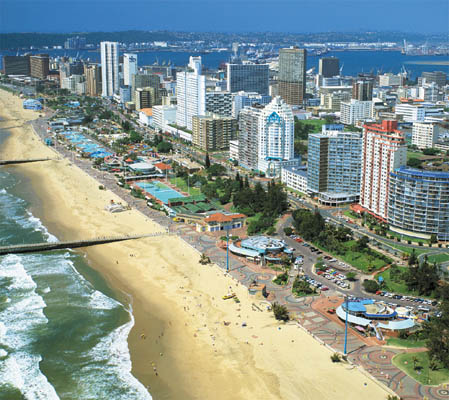
Modern Durban. The buildings might still be “monster rent barracks,” to use Wirth’s phrase, but the atmosphere at Durban’s beach has changed much more since 1936 than at Lake Calhoun. This photo looks nothing like what I remember from a visit in 1980.
Along the city side of the Durban Bay is the Marine Parade or Ocean Beach, flanked by a number of imposing modern buildings serving apartment and hotel purposes. The latter are called “flats” here and some of them are deserving of no better name, for they are anything but attractive. I am inclined to classify them as “monster rent barracks” — a still worse disfigurement of an otherwise attractive landscape than our Calhoun Beach Hotel at Dean Boulevard.
Theodore Wirth’s first opinion on the land across from the bath house was expressed in the 1912 annual report when he seconded the words of Loring and then board president Wilbur Decker encouraging the board to acquire the land to preserve it from commercial development.
Their fears may have been prompted by unpleasantness around Minnehaha Park in the early 1900s. Saloons and other commercial establishments near the falls had contributed to an objectionable environment in the park. In the 1905 annual report of the park board, president Fred Smith wrote that a new pavilion, changes in policing and support from the city administration had “done much to redeem Minnehaha from its unsavory reputation and make it a place where women and children can visit and enjoy their picnics without fear of molestation or insult.”
I can imagine that specter haunting Loring in particular, a man who had run for mayor of Minneapolis in 1882 on a strong anti-saloon platform. Loring also deserved most of the credit for the park board acquiring Minnehaha Falls, Lake Calhoun and Lake Harriet, the three jewels in the park crown at the time, and I’m sure he took a proprietary interest in their well-being, which would not have included “refreshment stands” nearby.
Despite their fears, the land across Lake Street from the immensely popular bath house — it was called the best beach between the oceans — was not filled with houses of debauchery. At least that’s the inference we can draw from another round of encouragement for the park board to acquire the land in 1917. Still it didn’t happen.
Another ten years passed before grand plans for the property took shape. It would become a residential building fitted with its own entertainment and recreation facilities. Curiously, the last mention of the development in park board proceedings is Wirth’s recommendation on April 20, 1927 that the board consent to a building permit for the facility as long as the building did not come within 15 feet of park property along Dean Parkway. The board agreed. Perhaps plans for the property were too far along for Wirth and the park board to fight, or they had no real alternative after taking no action themselves for 15 years
But perhaps Wirth’s objection in 1936 was not that the building was there, but that it was unfinished. Although construction began in 1927 the building remained unfinished and empty until 1946. In a bit of irony, the property Wirth worried would fall into private hands and the building which he said “disfigured” the lake was the site of a tribute dinner to him in 1946 before he moved from Minneapolis to San Diego for health reasons.
The Calhoun Beach Club was added to the National Register of Historic Places in 2003 for its architecture and engineering. The building now adjacent to the commercial and residential “club” was the focus of a fight in 1988 to limit the height of buildings around Minneapolis lakes. That battle resulted in a city ordinance that limits the height of such buildings. When the Calhoun Beach Club was first designed in 1927, at ten stories, it was the tallest building in the city outside of downtown.
David C. Smith
Horace W. S. Cleveland’s Real Estate: Pleasant Avenue and West 44th Street
Filed under: Landscape Architects, Minneapolis parks | Tags: Frederick Law Olmsted, H.W.S. Cleveland, Horace Cleveland
Comments (3) In a fascinating and sad letter to Frederick Law Olmsted, dated February 23, 1892, Horace W. S. Cleveland proposed that the two collaborate as writers on “professional themes.” (Frederick Law Olmsted Papers, Library of Congress.) Cleveland mentions that Olmsted had written in “complimentary terms” of Cleveland’s writing style and that Olmsted had also noted his own desire to write more, which was frustrated by many demands on his time and energy. (At the time, Olmsted was overseeing preparation for the grounds at Chicago’s Columbian Exposition and was about to take a six-month trip to Europe, in part, to regain his health.)
“Often the thought has come to me,” Cleveland explained, “that if I could join forces with you, we might together produce something that would be essentially serviceable to the public and your name would suffice to summon an audience who would not listen to me.”
Cleveland explained that his motive was primarily to make money.
“I have been able to do but little more than keep even with my expenses, but thank God I have done that and am entirely clear of debt, and own some real estate which I hope to dispose of whenever a new demand arises, and may be worth two or three thousand dollars. You perceive that in this situation it is impossible for me to fold my hands and wait the course of events. I am constantly trying to devise means to stave off the necessity of becoming dependent on others.”
There is no record of Olmsted’s response to Cleveland’s proposal, nor any evidence that the men ever did attempt to write anything together. The health of both men deteriorated rapidly over the next couple years. Witold Rybczynski in his biography of Olmsted, A Clearing in the Distance, notes that Olmsted was managing to save about $1,000 a year at the time.
The real estate Cleveland referred to was likely the two half-blocks of land northwest of the intersection of West 44th Street and Pleasant Avenue in south Minneapolis.

H. W. S. Cleveland is listed as the owner of 4.7 acres on West 44th Street between Pleasant and Harriet in the upper left corner of this section of an 1892 plat map of Minneapolis. (John R. Borchert Map Library, University of Minnesota. Go to http://map.lib.umn.edu/collections/digitizedplatbooks/minn1892index.htm for the complete map.)
If you know anyone who lives in the southern halves of the 4300 blocks of Pleasant, Grand and Harriet, they live on land once owned by one of the most important people in the history of Minneapolis.
The Washburn Park neighborhood at the bottom of the map above, often called “Tangletown,” was laid out by Cleveland.
David C. Smith
Yes, there was a Clarence Triangle.
Filed under: Minneapolis Park Memory, Minneapolis parks | Tags: Clarence Triangle
Leave a comment I just received this note from a reader who remembers Clarence Triangle in Prospect Park, which I wrote about recently. Thanks for the story.
Oh, there was a triangle there! I lived at 79 Bedford, across the street from the Triangle, at the foot of the hill that is Clarence. My parents bought the house in 1948, and sold it in 1975. Some time later, Dutch elm took most of the trees on Bedford, and they took out the curve at Bedford and Orlin (NOT an improvement in my opinion). I suspect when they modified the street, that is when they took out the triangle. I am guessing the late 1980’s?
It was a wonderful neighborhood to grow up in! As kids, we’d look out our living room window when it snowed, and watch the cars try to make it up the Clarence hill. They usually would, unless they met a car going downhill that would not move aside :) Cars were rear wheel drive then.
Lloyd Mann
Large Stone Fireplace in Minnehaha Dog Park?
Filed under: Minneapolis parks, Minnehaha Falls | Tags: Minnehaha Dog Park, Minnehaha Falls
Comments (7) Mary MacDonald recently wrote to ask for info on the large stone fireplace near the long path to the Mississippi River in the Minnehaha Dog Park off 54th and Hiawatha. She said she’s been unable to find any info on who built it and how old it is. Does anyone know? I don’t know anything about it. Leave a comment or e-mail me at the address below.
David C. Smith
Maybe it’s time for Puck to have a sniff.
Puck
Linking the Lakes: Making Minneapolis the Venice of North America
Filed under: Minneapolis parks | Tags: Lake Calhoun, Lake of the Isles
Leave a comment Happy Belated Centennial! Yesterday was the hundredth birthday of the channel that links Lake of the Isles with Lake Calhoun. It was the first of the navigable lake connections that later extended to Cedar Lake and Brownie Lake. Some background on those lake connections was featured in an earlier post on Lake Calhoun and Lake Harriet.
The “Linking of the Lakes” was turned into a civic celebration that lasted nearly a week. The event was conceived and planned by the Minneapolis Publicity Club. The idea for a civic celebration was apparently hatched in November 1910 at the Minneapolis Harvest Dinner, a more modest one-evening event. While the central event of the civic celebration was the linking of the lakes, it appears to have been pretense for a party.
“It is argued by the business men that in no better way can the city merchant get in more personal touch with his country customers than through the Civic celebration when, under the spirit of merrymaking and jollity, they come together.”
Minneapolis Morning Tribune, July 2, 1911
The park board knew exactly what the intent was when it passed a resolution on December 5, 1910 that “irrespective of the benefits which may accrue to the city through such a celebration, the occasion is of such peculiar interest and significance to this board, that every effort should be made to do its full part…”
The construction of a channel between Lake Calhoun and Lake of the Isles was not a particularly challenging or imaginative endeavor. As noted in the earlier post, the project had been considered for many years and treated as a done deal as early as 1899 by landscape architect Warren Manning in his recommendations for the Minneapolis park system. In engineering terms it was simpler than the dredging that had been going on for years at Lake of the Isles, both in the 1880s and 1900s. The only construction needed for the project were bridges over the excavated channel, which were not more challenging to plan and build than bridges elsewhere in the city — although the park board’s 1909 annual report included the admission that bridge construction estimates were 50 to 100 percent over budget.
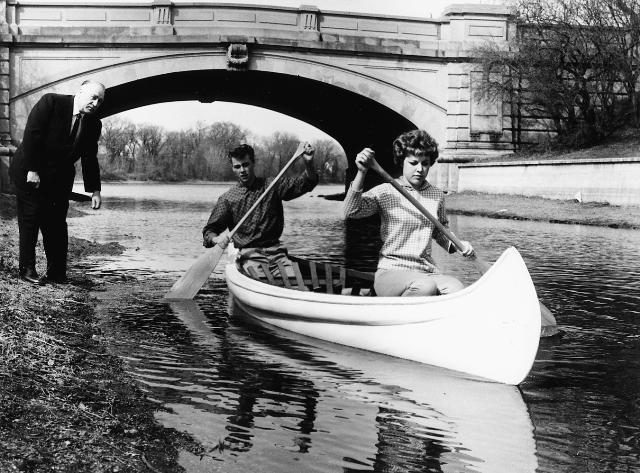
Park superintendent Howard Moore helps launch a canoe in 1960 to celebrate navigable water once again after a few years of a dry channel between Lake of the Isles and Lake Calhoun. (Minneapolis Park and Recreation Board)
Even the design competition for bridges, with a top prize of $800, had been disappointing. Park Superintendent Theodore Wirth wrote in the 1909 annual report, “With a few exceptions the designs submitted were not of the high-class character which it was thought the competition would bring forth.” The third prize was not even awarded. To make matters worse, the bridge over the channel from Lake of the Isles to Cedar Lake had to be partially torn down and rebuilt because it began to settle as soon as it was built, which delayed the connection of Isles and Cedar.
The connection of Lake of the Isles to Cedar Lake was finally completed in 1913, and Cedar Lake was linked to Brownie Lake in 1917. That final connection made possible a new feat of municipal athletic endurance: the swimming of the Chain of Lakes. The Minneapolis Morning Tribune, August 8, 1918 reported the setting of a new record when Dan Bessessen, the new captain of the University of Minnesota swim team and a life guard at Lake Calhoun, swam from the north end of Brownie Lake (off Superior Avenue then) to Thomas Avenue on the southern shore of Lake Calhoun in one hour and thirty-eight minutes. The swim was supervised by Frank Berry, the park board’s recreation director, who accompanied Bessessen in a boat that also carried four time keepers.
Despite the $125,000 price tag to link Isles and Calhoun, the park board appeared not to be profligate with funds. When Wirth submitted plans and an estimate for a park board float for the water parade during the celebration, it was defeated by a vote of 10-1 even though the City of Minneapolis was spending $500 for a float. Another request from Wirth to spend $200 to buy evergreen trees to temporarily cover the “unsightly” railroad embankment adjacent to the lagoon during the celebration was defeated by a vote of 11-0.
I think it’s debatable if the “Linking of the Lakes” was even the park board’s biggest role in municipal or state history in the spring and summer of 1911. I’d give top billing to another event that the park board didn’t initiate, but went along with: the donation to the park board by Clinton Morrison of the land for an art museum. The result of that transaction was the eventual construction of the Minneapolis Institute of Arts in Dorilus Morrison Park.
I love the channels that connect the lakes, which Jesse Northrop said would make Minneapolis the “Venice of North America,” but I think the construction of what has become an excellent art museum, while it might not make Minneapolis the “Florence of North America,” is still of greater importance to our city today. Even without the channels between lakes Minneapolis was still blessed with exceptional natural attributes. The art museum filled an otherwise unmet need at the time, despite Thomas Barlow Walker’s incredible art collection.
David C. Smith
Prospect Park Garden Club wins Triangle Award; Orlin Triangle is smallest park.
Filed under: Bryn Mawr, Minneapolis parks, Prospect Park | Tags: Bryn Mawr, Elmwood Triangle, Laurel Triangle, Orlin Triangle, Prospect Park, Rollins Triangle
Comments (1) An update on the smallest park triangles:
The beautiful triangles in Prospect Park are maintained by the Prospect Park Garden Club. I learned that in the delightful backyard of Mary Alice Kopf last Saturday during the Annual Garden Walk and Plant Sale sponsored by the Prospect Park Garden Club. Nobody I talked to in Prospect Park knew, however, why some triangles were taken over by the park board and others weren’t. So if you know…
I am certain now that Orlin Triangle is the smallest of the street triangles in the Minneapolis park system.

Orlin Triangle in Prospect Park is the smallest park in Minneapolis.
The second smallest is Elmwood Triangle at Luverne and Elmwood just north of Minnehaha Creek near Nicollet. Basic grass and tree — and two dead end signs. Seems a bit ominous.
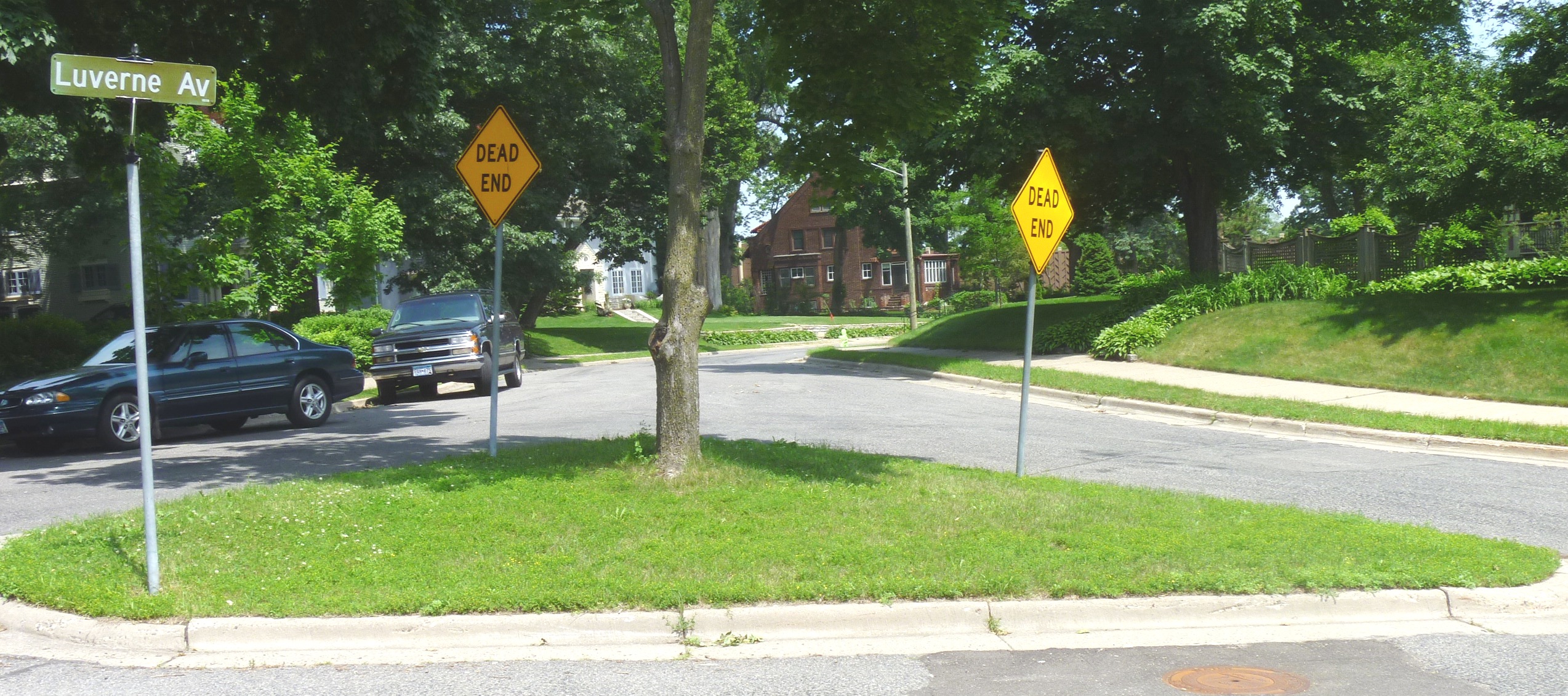
Elmwood Triangle, the second smallest park in Minneapolis, listed at 0.01 acre. Based on my rough measurements, bigger than Orlin Triangle.
The most attractive triangle park outside of Prospect Park is Laurel Triangle in Bryn Mawr. My next task is to find out who takes care of this park. Laurel Triangle was purchased by the park board for $700, most of which went to pay back taxes, in 1911, so it’s a little older park officially than the Prospect Park triangles.

Laurel Triangle, at Laurel and Cedar Lake Road, is beautiful too, in a wilder way than the Prospect Park triangles. So big it has two sidewalks and two stop signs. There’s a little stone bench next to the tree that I’d love to sit on with a cup of coffee.
Another of the smallest triangles is Rollins Triangle at Minnehaha and E. 33rd St. across from Peace Coffee. Quite a different environment on a busy thoroughfare and considerably larger than the smallest. Farther south, Adams Triangle on Minnehaha and 42nd, is one-third-acre, one of the larger triangles.

Rollins Triangle has a newspaper stand, a bus bench, vent pipes and a bit of a garden that’s overgrown. Definitely larger.
Most triangles are named for streets, but Rollins was named for the real estate development, Rollins Addition, in the neighborhood. It was taken over by the park board at the request of the city council in 1929 and officially named in 1931.
Someday soon I’ll visit the two remaining triangles listed at 0.01 acre in the park board’s inventory, Sibley and Oak Crest in northeast Minneapolis. But judging by their images on Google maps they are both larger than triangles shown here.
I purchased several plants for my yard at the Prospect Park Garden Sale at Pratt School. This whole business of planting triangles inspired me. And that was one objective of early park planners — to encourage us to replicate the pretty little public gardens on our own property.
David C. Smith
Lost Minneapolis Parks: A Fifth Prospect Park Triangle
Filed under: Lost Minneapolis Parks, Minneapolis parks | Tags: Midway Triangle, Prospect Park, Tower Hill Park, Witch's Hat
Comments (1) A fifth Prospect Park triangle was added to Minneapolis parks inventory in 1919 when the City Council turned over a 0.03-acre triangle at the intersection of Bedford Street and University Avenue S.E. The Minneapolis Board of Park Commissioners (BPC) instructed the superintendent to plant shrubbery on the triangle and to maintain it. It was named Midway Triangle. The City Council must have forgotten that it gave the land to the BPC—or ignored the fact—because in November 1944 the BPC adopted a resolution that “inasmuch as the intersection of University Avenue and Bedford Street, including what was formerly Midway Triangle, has been paved,” it was turning over the land to the City Council. There is still a remnant of the triangle at the intersection, just enough curbed space to hold a traffic signal, a light post and some signs.
The entire neighborhood might have looked quite different if the Minneapolis park board had acted on John Pillsbury’s proposal in 1887. Pillsbury was the former Governor of Minnesota and former Minneapolis park commissioner and still the president of the University of Minnesota’s Board of Regents at the time, who had just donated a $150,000 building to the University. He proposed that University Avenue be made a parkway from Central Ave. to the county line (the boundary with St Paul) and that from Oak Street east the parkway be 120 feet wide, or more than 50% wider than it is now.
That might have been spectacular, but it is also possible that a parkway on University Avenue would have suffered the same fate as early parkways on Hennepin Avenue from Loring Park to Lakewood Cemetery and Lyndale Avenue North from Loring Park to Farview Park. They were eventually abandoned by the BPC as parkways and returned to the control of the City of Minneapolis, because they carried too much traffic to be true parkways. I suspect the same would have happened to a parkway on University Avenue; it was a major thoroughfare. But it’s fun to speculate and try to picture a beautiful wide boulevard approaching the University of Minnesota from the east—in the shadow of Tower Hill.
David C. Smith
 Minneapolis Park History