Archive for the ‘Minneapolis parks’ Category
Keep Your Thomas Lowrys Straight
Filed under: Lost Minneapolis Parks, Minneapolis parks | Tags: Audubon Park, Douglas Triangle, Fremont Triangle, Lowry Place, Mt. Curve Triangle, Phelps Wyman, Seven Pools, Smith Triangle, Thomas Lowry, Thomas Lowry Park, Virginia Triangle
 Comments (4)
 Just to be clear: the Thomas Lowry Memorial is not in Thomas Lowry Park. Neither is it in Lowry Place. (See February 25 post: Lost Minneapolis Parks: Virginia Triangle.)
The Thomas Lowry Memorial, with his statue, was originally erected in 1915 on Virginia Triangle across Hennepin Avenue and a bit south from Thomas Lowry’s mansion on Lowry Hill. Thomas Lowry’s mansion was eventually purchased by Thomas Walker who then created the Walker Art Center on the site.
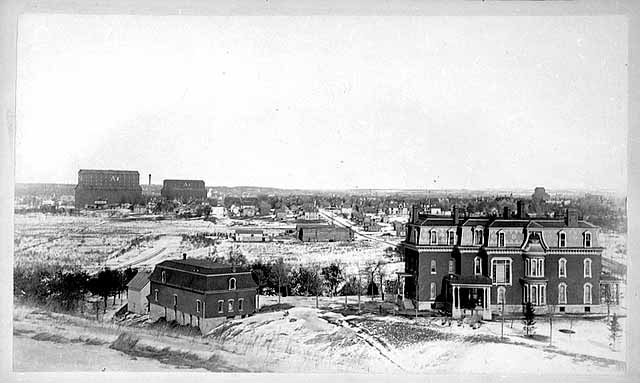
Thomas Lowry’s home in 1886 looking north over what is now The Parade and the Sculpture Garden. (Minnesota Historical Society)
When Virginia Triangle was erased in 1967 by freeway plans, Thomas Lowry’s statue was not moved to Thomas Lowry Park, because it didn’t exist yet, at least by that name. And it wasn’t moved to Lowry Place, also called Lowry Triangle, another lost park property, because it had already ceased to exist. Virginia Triangle was where northbound Lyndale and Hennepin avenues met at Groveland; Lowry Place was where they parted again at Vineland and Oak Grove.

Lowry Triangle is on the immediate left as you look north on Hennepin Avenue toward the Basilica. Oak Grove Street and Loring Park are on the right. Vineland Avenue, leading to the Walker Art Center, is on the left. Virginia Triangle and Thomas Lowry’s Memorial are directly behind you in 1956. (Norton and Peel, Minnesota Historical Society)
Lowry Triangle, officially named Lowry Place on May 15, 1893, was acquired by the park board from the city in 1892. The park board asked the city to hand over the triangle on November 2, 1891. It was slightly smaller than Virginia Triangle to the south. Lowry Place was at one time intended to be the home of the statue of Ole Bull that in 1897 ended up in Loring Park. Park board president William Folwell wrote to Thomas Lowry to ask if he objected to Ole Bull’s statue being placed across Lyndale Avenue from Lowry’s house on a park property that bore his name. Lowry replied that he appreciated the courtesy of being asked and had no objection. I don’t know why the statue was then placed in Loring Park instead. If you do, please tell. That’s not all I don’t know: I also don’t know why Lowry’s memorial was placed originally on Virginia Triangle instead of Lowry Triangle.
By the time the Lowry Memorial had to be moved in 1967 it was too late to shift it to the Lowry Triangle; that little patch of ground (0.16 acres) had already been acquired by the State of Minnesota in 1964 in anticipation of reconfiguring streets for the construction of I-94.
Moving the memorial to Thomas Lowry Park wasn’t an option then because at that time what is now Thomas Lowry Park at Douglas Avenue, Bryant and Mt. Curve was named Mt. Curve Triangles. That isn’t a typo, it was officially named Mt. Curve Triangles, plural, in November 1925 when its name was changed from Douglas Triangle. That was perhaps done to distinguish it from Mt. Curve Triangle, singular, which had been the name of a tiny street triangle at Fremont and Mt. Curve since 1896. That triangle was renamed Fremont Triangle in 1925, when the Mt. Curve name was shifted a few blocks east to Douglas Triangle. Mt. Curve Triangles was nearly 1.5 acres while Fremont Triangle was only .02 acre.

Thomas Lowry Park in 1925 when it was still Douglas Triangle, before it became Mt. Curve Triangles. You can find other images of the property at the Minnesota Historical Society’s Visual Resources Database, but only if you search for Douglas Triangle or Mt. Curve Triangle, not Thomas Lowry Park. (Hibbard Studio, Minnesota Historical Society)
To confuse matters, the popular name for the property was neither Douglas Triangle, nor Mt. Curve Triangles, nor Thomas Lowry Park, but “Seven Pools” after the number of artificial pools designed for the park by park commissioner and landscape architect Phelps Wyman in 1923.
Thomas Lowry and his name had nothing to do with Mt. Curve Triangles, other than the fact it was located on Lowry Hill near his old mansion, until residents in the neighborhood campaigned to have the park renamed for Lowry in 1984. (Lowry did ask the park board to improve and maintain the land in 1899, but his request was refused because the park board didn’t own the land then. It didn’t purchase the land until 1923.)
Given that there was no other place named Lowry to put the memorial to Thomas Lowry the park board chose Smith Triangle at Hennepin and 24th. That’s where it still is. The only connection between Smith and Lowry is that they probably knew each other.
Of course neither the Lowry Memorial nor Lowry Park are anywhere near Lowry Avenue, which is miles away in north and northeast Minneapolis. Lowry Avenue is much closer to the former site in Northeast Minneapolis of the Lowry School, which no longer exists either. Lowry School figured prominently in plans for Audubon Park in the 1910s. When Lowry School was built in 1915, Buchanan Street between the school and Audubon Park was vacated with the idea that the park would serve as the playground for the school.

Thomas Lowry School in 1916 showing Buchanan Street vacated between the school and Audubon Park at left. (Minneapolis Public Schools)
Those plans were never formalized. While the park provided space, it didn’t provide play facilities. Playground facilities weren’t developed at Audubon Park until the late 1950s. By that time Lowry School was already outdated and destined for closure. (For more photos of Lowry School click here.)
You can learn more about all of these park properties and how they were acquired, developed and named at the web site of the Minneapolis Park and Recreation Board.
David C. Smith
© David C. Smith
Elusive Minneapolis Ski Jumps: Keegan’s Lake, Mount Pilgrim and Glenwood (Theodore Wirth) Park
Filed under: Minneapolis parks, Winter Sports | Tags: Bryn Mawr, Glenwood Park, Ski Jumps, Skiing, Theodore Wirth Park
Comments (35) The Norwegians of Minneapolis had greater success getting their music recognized in a Minneapolis park than they did their sport. A statue of violinist and composer Ole Bull was erected in Loring Park in 1897.
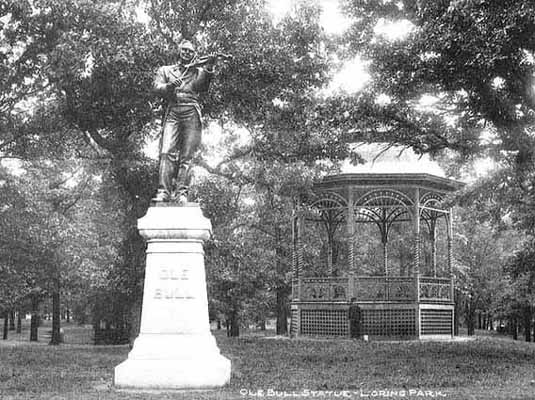
This statue of Norwegian violinist and composer Ole Bull was placed in Loring Park in 1897, shown here about 1900 (Minnesota Historical Society)
A ski jump was located in a Minneapolis park only when the park board expanded Glenwood (Theodore Wirth) Park in 1909 by buying the land on which a ski jump had already been built by a private skiing club. The photo and caption below are as they appear in the annual report of the Minneapolis Board of Park Commissioners for 1911.* While the park board included these photos in its annual report, they are a bit misleading. Park board records indicate that it didn’t really begin to support skiing in parks until 1920 — 35 years after the first ski clubs were created in the city.

Minneapolis, the American city with the largest population of Scandinavians, was not a leader in adopting or promoting the ski running and ski jumping that originated in that part of the world. Skiing had been around for millenia, but it had been transformed into sport only in the mid-1800s, around the time Minneapolis was founded. Ski competitions then included only cross-country skiing, often called ski running, and ski jumping — the Nordic combined of today’s Winter Olympics. Alpine or downhill skiing didn’t become a sport until the 1900s. Even the first Winter Olympics at Chamonix, France in 1924 included only Nordic events and — duh! — Norway won 11 of 12 gold medals.
The first mention of skiing in Minneapolis I can find is a brief article in the Minneapolis Tribune of February 4, 1886 about a Minneapolis Ski Club, which, the paper claimed, had been organized by “Christian Ilstrup two years ago.” That article said the club “is still flourishing.” Eight days later the Tribune noted that the Scandinavian Turn and Ski Club was holding its final meeting of the year. The two clubs may have been the same.
Ilstrup was one of the organizers two years later of one of the first skiing competitions recorded in Minneapolis, which was described by the Tribune, January 29, 1888, in glowing and self-congratulatory terms.
Tomorrow will witness the greatest ski contest that ever took place in this country. For several years our Norwegian cultivators of the noble ski-sport have worked assiduously to introduce their favorite sport in this country, but their efforts although crowned with success, did not experience a real boom until the Tribune interested itself in the matter and gave the boys a lift.
The Tribune mentioned the participation in the competition of the Norwegian Turn and Ski Club, “Vikings club” and “Der Norske Twin Forening.” The Tribune estimated that 3,000 spectators watched the competition held on the back of Kenwood Hill facing the St. Louis Railroad yard. Every tree had a dozen or so men and boys clinging to the branches, while others found that perches on freight cars in the rail yard provided the best vantage point.

The caption for this photo from the Minnesota Historical Society Visual Resource Database claims the photo is from the winter of 1887, but was almost certainly taken at the ski tournament held on Kenwood Hill late that winter in February, 1888.
The competition consisted of skiers taking turns speeding downhill and soaring off a jump or “bump” made of snow on the hill. Points were awarded for distance and for style points from judges.
The winners of the competition were reported as M. Himmelsvedt, St. Croix Falls, whose best jump was 72 feet, and 14-year-old crowd favorite Oscar Arntson, Red Wing, who didn’t jump nearly as far, but jumped three times without falling. Red Wing was a hot bed of ski-jumping, along with Duluth and towns on the Iron Range. (The winner was perhaps Mikkjel Hemmestveit, who along with his brother, Torger, came from Norway to manufacture skis using highly desirable U.S. hickory. The Hemmestveit brothers are usually associated with Red Wing skiing, however, not St. Croix Falls.)
A Rocky Start
Despite the enthusiasm of the Tribune and the crowds, skiing then disappeared from the pages of the Tribune until 1891, when on March 2, the paper reported on a gathering of thirty members of the Minneapolis Ski Club at Prospect (Farview) Park. “This form of amusement is as distinctively Scandinavian as lutefisk, groet, kringles and shingle bread,” the Tribune reported. “With skis on his feet a man can skim swiftly over the soft snow in level places, and when a slope is convenient the sport resembles coasting in a wildly exhilarating and exciting form,” the report continued. The article also described the practice of building snow jumps on the hill, noting that “one or two of the contestants were skilful enough to retain their equilibrium on reaching terra firma again, and slid on to the end of the course, arousing the wildest enthusiasm.”
The enthusiasm didn’t last once again. The Tribune’s next coverage of skiing appeared nearly eight years later — but it came with an explanation:
During recent winters snow has been a rather scarce article. A few flakes, now and then, have made strenuous efforts to organize a storm, but generally the effort has proven a failure. The heavy snow of yesterday was so unusual that it is hardly to be wondered at that there arose in the breasts of local descendants of the Viking race a longing for the old national pastime, skiing…The sport of skiing was fostered to a considerable extent in the Northwest, and particularly in this city, a few years ago, but the snow famine of late winters put a damper on it.
— Minneapolis Tribune, November 11, 1898
The paper further reported that the “storm of yesterday had a revivifying effect upon the number of enthusiasts” and that the persistent Christian Ilstrup of the Minneapolis Ski Club was arranging a skiing outing on the hills near the “Washburn home” (presumably the orphanage at 50th and Nicollet). The paper also reported that while promoters of the club were Norwegian-Americans, “they do not propose to be clannish in the matter.”
Within a week of that first friendly ski, Continue reading
Powderhorn Park Speed Skating Track: Best Ice in the United States
Filed under: Minneapolis parks, Winter Sports | Tags: Powderhorn Park, Speed Skating
Comments (3) Many years before Frank Zamboni invented his ice resurfacer (in California!?), Minneapolis park board personnel had to prepare the speed skating track at Powderhorn Park mostly by hand for international competition and Olympic trials. They were very good at it.
Olympic medalist speed skater Leo Friesinger from Chicago (whom you already met in these pages here) had this to say after he won the Governor Stassen trophy as the 10,000 Lakes senior men’s champion in the early 1940s:
“It is a pleasure for me to return to Minneapolis and skate on the best ice in the United States.”
That was high praise for Elmer Anderson and Gotfred Lundgren, the park board employees who maintained the track at Powderhorn using this sweeper, a tractor-drawn ice planer and a bucket of warm water.

The ice sweeper that cleaned the Powderhorn speed skating track in the 1940s. Elmer Anderson (left) and Gotfred Lundgren kept the track in top shape.
They began to prepare the track 3-4 days before a meet by sprinkling it with water a few times. Then they’d pull out a tractor and a plane—a 36-inch blade—to smooth out any bumps from uneven freezing. The biggest problem was cracks in the ice. So the day before the race, Elmer and Gotfred would spend 8-10 hours filling small cracks by pouring warm water into them.
At times their crack-filling work continued right through the races. When large crowds showed up, and for some races attendance surpassed 20,000, the ice tended to crack more often. If Elmer or Gotfred spotted a crack during a race they’d hustle out with a bucket of water after skaters passed and try to patch it. The sweeper was used to remove light snow from the track.
Elmer and Gotfred, who began working for the park board on the same day 18 years before this picture was taken, agreed that the most speed skating records were set when the air temperature was about 30 degrees, which raised a “sweat” on the ice and produced maxiumum speed.
(Source: an undated newspaper clip in a scrapbook kept by Victor Gallant, the park keeper for many years at Kenwood Park, Kenwood Parkway and Bryn Mawr Meadows.)
It’s no wonder that speed skating (as well as hockey) eventually moved indoors to temperature-controlled arenas. But wouldn’t it be fun to see a big race at Powderhorn again?
David C. Smith
© David C. Smith
And the answer is….French
Filed under: Landscape Architects, Minneapolis parks | Tags: Daniel Chester French, H.W.S. Cleveland, Horace Cleveland, William Merchant Richardson French, William Watts Folwell
Comments (3) In a post on December 29, 2010 I asked how these two pictures were related to the creation of Minneapolis parks.
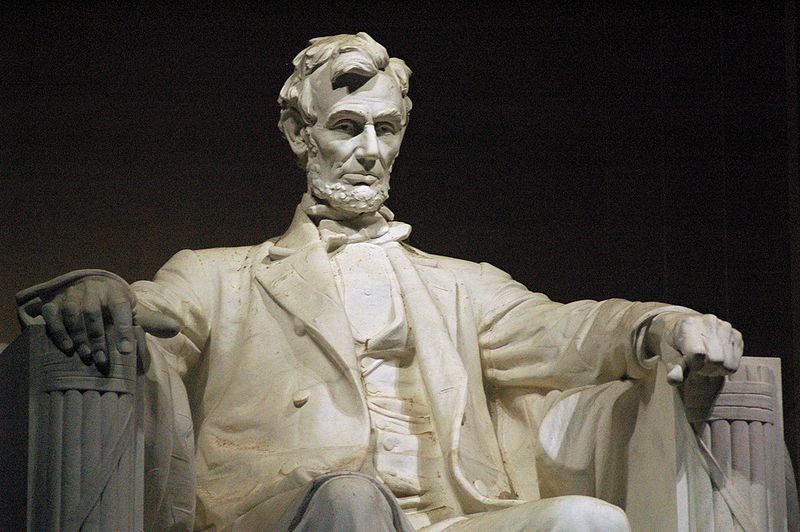
Abraham Lincoln, Lincoln Memorial, Washington, D. C. (Jeff Kubina)
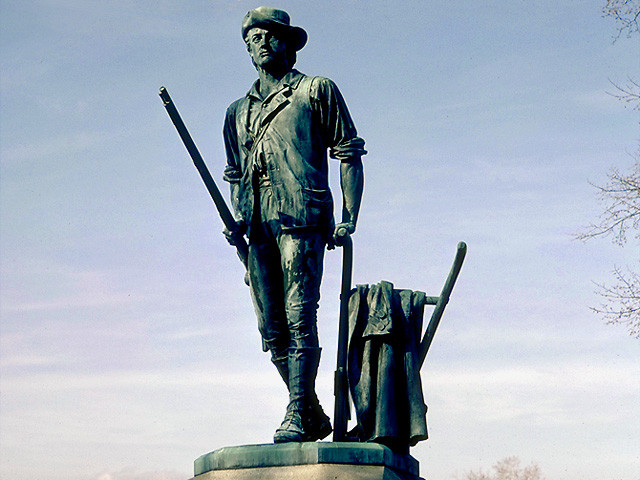
Minute Man, Minute Man National Historical Park, Concord, Massachusetts
Nobody has come up with the right obscure answer! So I’ll tell you.
The photos are of the most famous works of American sculptor Daniel Chester French. (The best example of French’s work in Minneapolis is the statue of John Pillsbury at the University of Minnesota.)
Here is the connection — and the key word is “related”:
Daniel Chester French’s older brother was William Merchant Richardson French. That’s this guy:
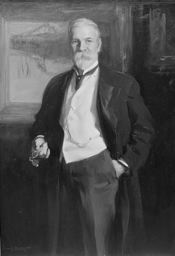
William Merchant Richardson French (Louis Betts, Art Institute of Chicago)
(Their father was Henry Flagg French who was the number two man in the U. S. Treasury Department. For eight months in 1881 he worked under Secretary of the Treasury William Windom, a U. S. Senator from Minnesota who resigned his Senate seat to become Treasury Secretary for President James Garfield. After those eight months, Windom resigned at Treasury and was elected to fill his own open seat in the Senate. He served as Secretary of the Treasury again from 1888 until his death in 1891.)
The important connection of William French to Minneapolis parks is that after graduating from Harvard in 1864 and a year at MIT studying engineering he moved to Chicago and met a man in the new and unusual profession of landscape gardening. It’s not clear how it came about, but in 1870 William French became the partner of a man thirty years older than he was. That pioneering landscape architect was Horace Cleveland.
Of course, young William, who was eager I’m sure to earn his keep with his much more experienced partner, went through his list of connections to identify potential clients. He likely recognized that one name on his list might provide useful contacts in a young city west of Chicago, Minneapolis. That contact was his cousin, George Leonard Chase, who was rector at the episcopal church in the small town of St. Anthony, which was springing up beside the falls of that name. Now it just happened that Chase had married one of the Heywood girls, Mary. And that was a funny thing because Chase’s best friend married Sarah Heywood, Mary’s sister. He and his best friend had lived together while they were students at Hobart College in New York. In fact, Chase had apparently had some influence with the regents of the University of Minnesota when they were hiring the university’s first president in 1869. Chase’s friend and brother-in-law by marriage was hired for that job. His name was William Watts Folwell.
Go Botts: Bottineau Athletic Club dominated Minneapolis park board sports for a decade
Filed under: Minneapolis parks | Tags: Bottineau Field, Marshall Terrace
Comments (2) The young men on the east side of the Mississippi River in northern Minneapolis didn’t need much incentive to become a powerhouse in Minneapolis sports. They just needed a field, and the name it gave them.
Bottineau Field in Northeast Minneapolis was purchased by the park board in 1915 to be a recreation park. Fields and a temporary shelter were laid out the next year. Although a more substantial recreation center or field house was recommended for the neighborhood, it wouldn’t get more than the wood frame warming house for 40 years. But that didn’t matter to a talented group of young athletes and their persistent manager, Charlie Cells. From the time the park was open for business in 1917 through 1926 a core group of athletes grew up together—and won a few trophies along the way. The Bottineau Athletic Club, popularly called the “Botts,” won eight park board football championships and ten more citywide titles in baseball, basketball, volleyball and diamondball. The same group of kids, then young men, played everything.
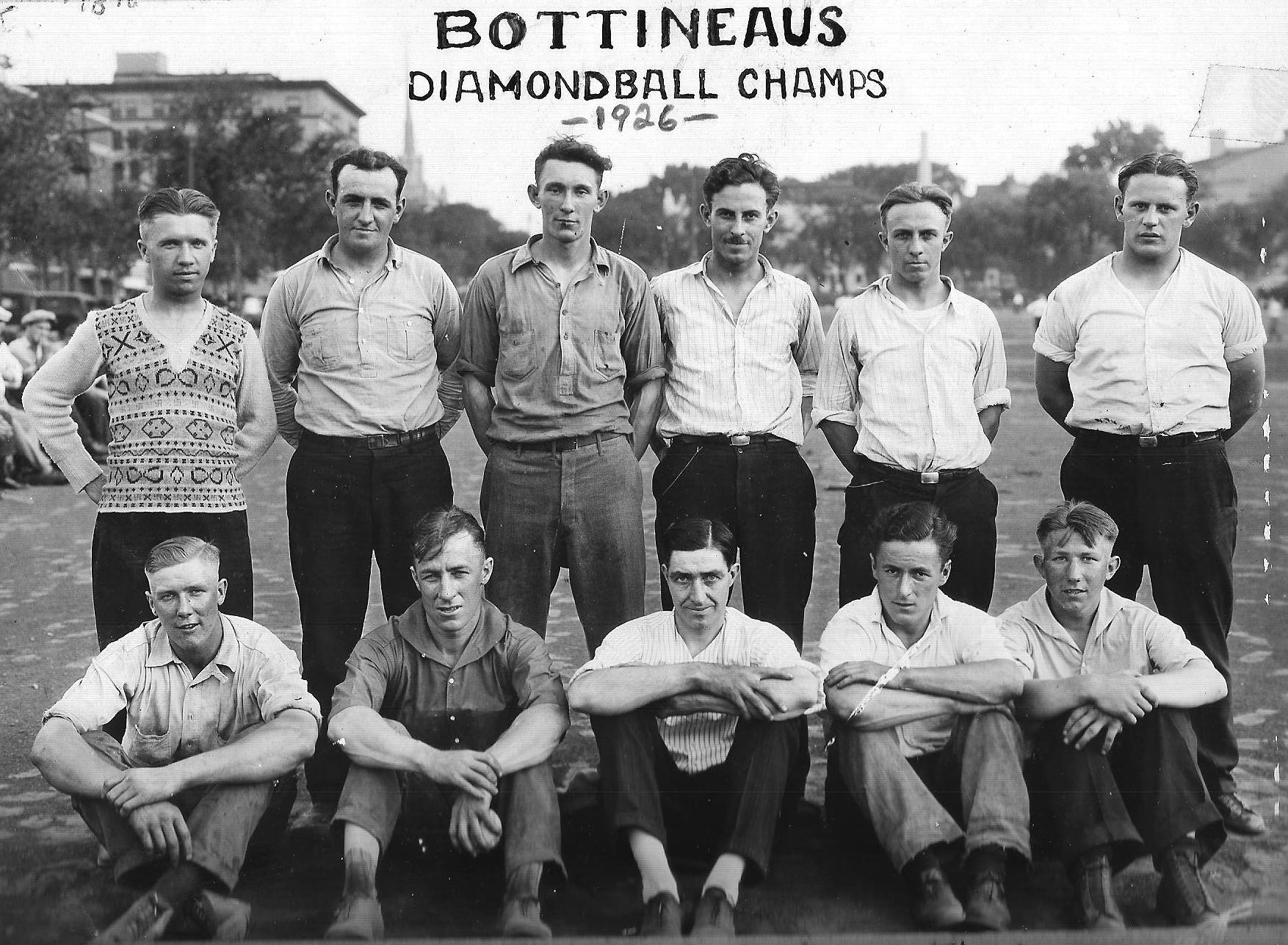
Bottineaus, Minneapolis diamondball champs, 1926, one of their last championships together. Front row (l-r): Carl Pearson, Tubby Burns, Haloran, George Besnah, Zig Bishop. Back row: Charlie Cells, Mgr., Pat Long, Boney Selinsky, Bloom Brothers, Swede Wilson. Manager Charlie Cells kept the scrapbook from which all of the “Bottineaus” pictures were copied. (Minneapolis Park and Recreation Board)
In addition to their Minneapolis championships, the Botts travelled the state to play the best basketball teams they could find and made it as far as the semi-finals of the Minnesota amateur baseball tournament in 1925.
This information is preserved in a scrapbook, “Bottineau ‘Cuts’ in Sports, Chas. A. Cells,” which comprises mostly newspaper clippings from 1925 and 1926. Most of the clippings are undated and appear to come from the Minneapolis Daily Star and Minneapolis Journal, although it is clear that some coverage of games played outside of Minneapolis, such as in Dawson and Ortonville, Minn., came from papers in those localities.
The highlight of the scrapbook and clippings is newspaper coverage of the battle for football supremacy in Minneapolis between the Botts and their nemesis from 1924-1926. Their rivals were also their neighbors, the Marshall Terrace team just up river. The Bottineaus and the Terraces, as newspapers called them, battled for the city title in all three of those years. The photo in City of Parks of a football game at Bottineau Field was of the city championship game between Bottineau and Marshall Terrace in 1926. The Minneapolis Journal estimated the crowd at 5,000.
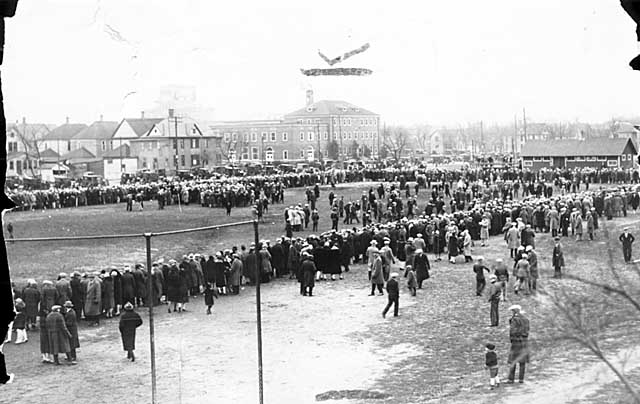
In the biggest game of the 1926 park league season perennial powerhouses Bottineau and Marshall Terrace played at Bottineau Field in front of a crowd estimated by the Minneapolis Journal at 5,000. The Botts defeated the Terraces on a 55-yard punt return by Charles Samek. (City of Parks, Minneapolis Journal, Minnesota Historical Society)
A similar crowd had witnessed the championship at The Parade a year earlier when special bleachers had to be erected for the big crowd.
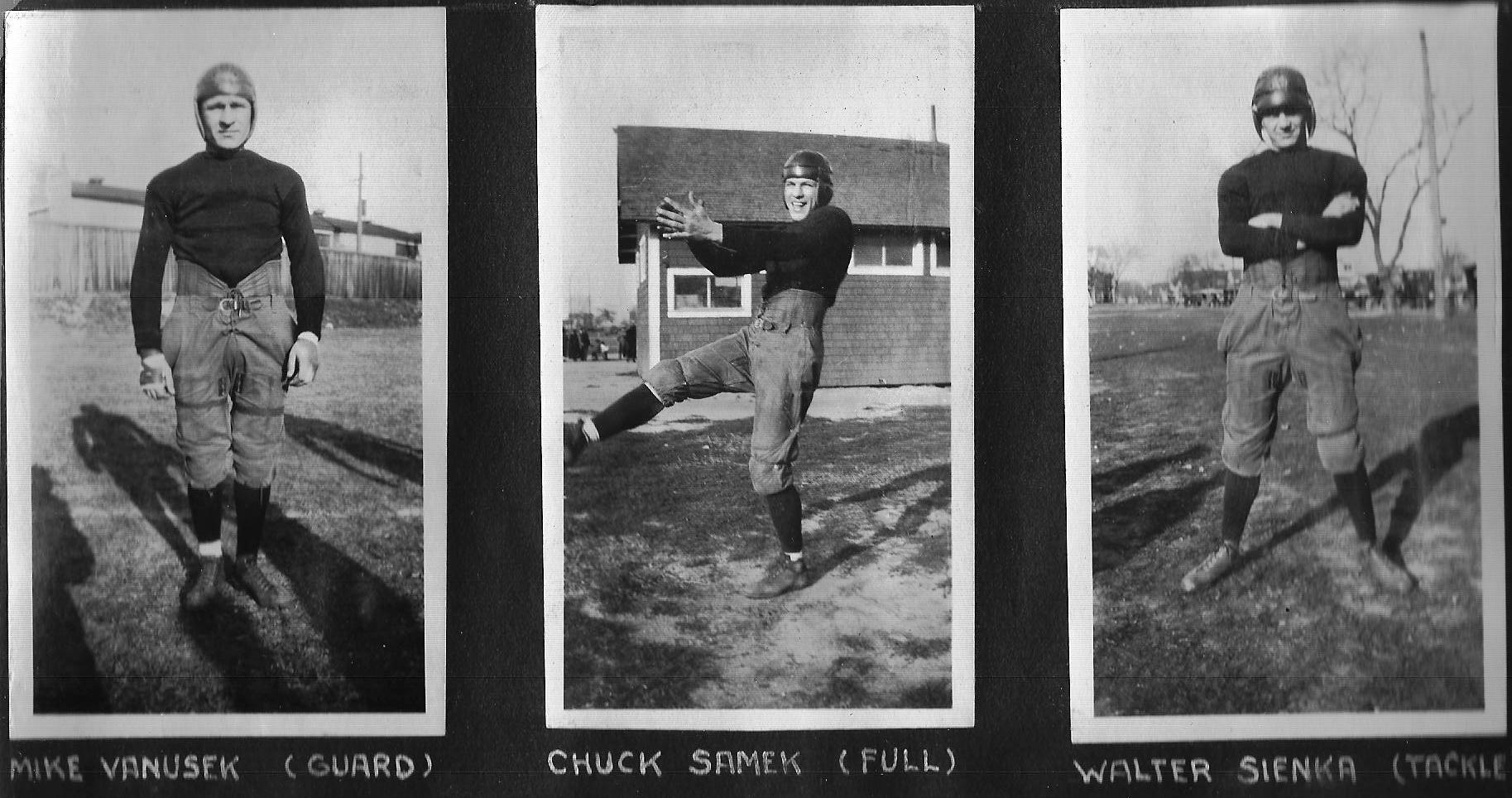
Bottineau football players, 1925. Mike Vanusek (guard), Chuck Samek (full), the hero of the 1926 game, and Walter Sienka (tackle). The building behind Samek is the Bottineau Field shelter that served the park 1916-1956. The original shelter did not have bathrooms. The park board moved two toilets from Loring Park to Bottineau in 1918. There is no record that indoor plumbing was added to this shelter before it was replaced in 1956. Does anyone remember toilets at the old Bottineau Field shelter? (Minneapolis Park and Recreation Board)
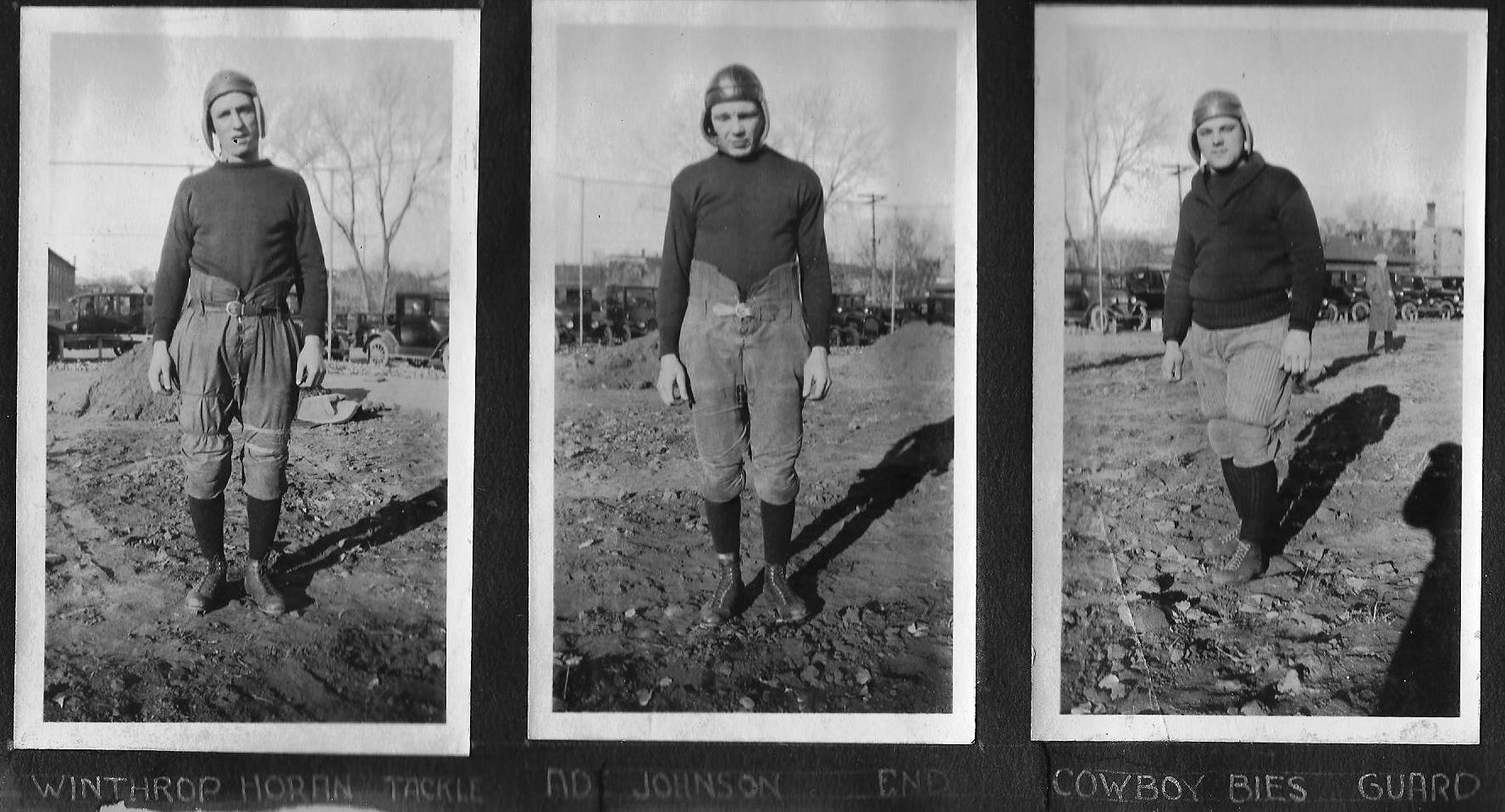
Bottineau football players, 1925. Winthrop Horan (tackle), Ade Johnson (end), Cowboy Bies (guard). I like the cars in the background. (Minneapolis Park and Recreation Board)
The Botts began in the junior division, but the players grew into the senior division winning consistently along the way. During the mid-1920s the Botts played a series of games against Gustavus Adolphus college from St. Peter. In 1924 the Botts prevailed 6-0 thanks to a blocked punt recovered for a touchdown. The scrap book contains one imposing image of a “giant” that played for Gustavus: Henry Goecken from South Dakota stood an amazing 6′ 4″ and weighed 198 pounds.
One reason for the Botts success over the years appears to be that they had at least one elite athlete: George Besnah.
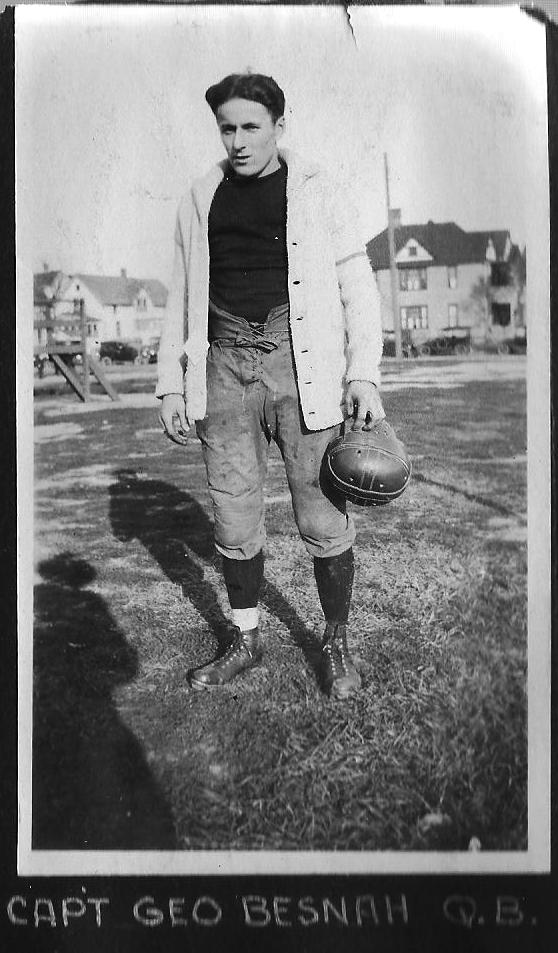
George Besnah was apparently the superstar of the Botts. He was the captain of the football team and a superb basketball player who played for a Chicago team in an early professional league. (Minneapolis Park and Recreation Board)
Newspaper clippings tell of Botts’ games in Mora, Sauk Center, Howard Lake, Dawson, Ortonville, Madison and Benson, and include requests for teams from Duluth, Redwood Falls and other towns to call Charles Cells to schedule games. One of those road games, presumably in Ortonville, prompted a reporter to write that the Botts had put on a “great exhibition of the court game.” The reporter went on to write:
But there was one player—George Besnah—who was the “cream of the lot” and his playing of the floor and his ability to dribble was well worth the price of admission. His play was a revelation, even more because he was not “out there” trying to make all the points himself, but to the contrary made fine use of his ability to pass to a teammate when such a play put his mate at better advantage.
Toward the back of Charlie Cells scrapbook, were a couple undated clips about George Besnah. The first one reported that Besnah, who had been playing for the Hopkins Independents, was in Chicago for a tryout with the Chicago Bruins in the American Professional League. The report continued that Besnah would be replaced on the Hopkins team by Joe Hutton and Fat Nordly, former Carleton College stars. (If you know Minnesota basketball, you know where this is going.)
Another clip delivered the news that Besnah had signed a contract to play with the Chicago Maroons of the National professional league. He was reported to have signed for $50 a game, a handsome sum, and would get into a Maroon uniform immediately. (There were two teams named the Chicago Maroons that I can find: one, was the University of Chicago, of Jay Berwanger and Amos Alonzo Stagg fame in football and the university team didn’t likely pay players (at least not that much!) ; and two, a team named the Chicago Maroons did play professionally, but it was a team of black players from Chicago. So I’m not sure exactly who Besnah signed with.)
Back to Besnah’s replacements on the Hopkins Independents. Joe Hutton went on to become the most successful basketball coach in Minnesota history in 35 years coaching at Hamline University. He won three national championships in the smaller college division, but Hamline played a high-level national schedule including games against NCAA champion City College of New York in Madison Square Garden and George Mikan’s DePaul team at Chicago Stadium. At one time seven of Hutton’s Hamline players were in the NBA, including Vern Mikkelsen, an NBA Hall of Fame player. Hutton was offered the job of coaching the Minneapolis Lakers, but chose to remain at Hamline.
(As a sophomore at Hamline I was looking for part-time work and was sent by the financial aid office to a house across Snelling Avenue from the university that needed painting. I was surprised to find that it was the home of Joe Hutton, who had retired as Hamline’s coach six years earlier. He wanted to hire a student to do his painting. While I painted, he told me basketball stories. He had recognized me from my freshman season playing basketball for Hamline; he still attended all the home games. I wish I had written down those stories.)
The other former Carleton star who was reported to replace Besnah on the Hopkins team was Carl Nordly who later became a professor and basketball coach at the University of Minnesota.
When the Botts finally decided to disband after the 1926 football season, Cells put a clip in the scrapbook that must have given him great pleasure. “Charles Cells, manager of the Bottineau Athletic Club,” the newspaper reported, “has been with the aggregation for many years and much of the credit for the splendid record of this group can be laid to Mr. Cells active interest and unselfish effort in bringing the organization to the highest point of perfection.”
Cells’ management of the club must have included fundraising, because in a clip about an appreciation dinner after one championship season, Cells thanked the businessmen of the East side for their support. Among the businesses he acknowledged were R. F. Bertch Furniture, Kozlak Bros. furniture dealers, Northeast Bakery, Bottineau Billiard Parlor, Hygienic Artificial Ice Co., Joe Schmidt Meat Co., Super Bros. drugs, Mergen’s Department store, East Side Bakery and Webster McDonald of McDonald Bros. (Another clip mentioned that one of the Botts trophies was on display at Mergen’s.)
Cells’ contribution to the Botts has now extended well beyond managing their varied teams: he left behind a scrapbook which gives us a glimpse of the exceptional group of athletes that grew up together on the east side of the river and dominated Minneapolis amateur sports for a decade.
David C. Smith
© David C. Smith
The “Brownie” in Brownie Lake
Filed under: Minneapolis parks | Tags: Agnes "Brownie" McNair Hull, Brownie Lake, Cedar Lake Parkway, Charles M. Loring, Minneapolis parks, William McNair, Wilson Park
Comments (2) In the historical profile I wrote about Brownie Lake for the Minneapolis Park and Recreation Board, I reported that I had found a handwritten note on an old park board document that attributed the lake’s name to the nickname of William McNair’s daughter. Now, I’ve also found a newspaper reference to that.
The Minneapolis Tribune of November 13, 1910 reported on the origin of the names of Minneapolis lakes. The article said Brownie Lake was taken from the nickname of Mrs. Louis K. Hull. Louis Hull, a prominent young attorney in Minneapolis, married Agnes McNair, one of two daughters of William McNair, on December 12, 1892.
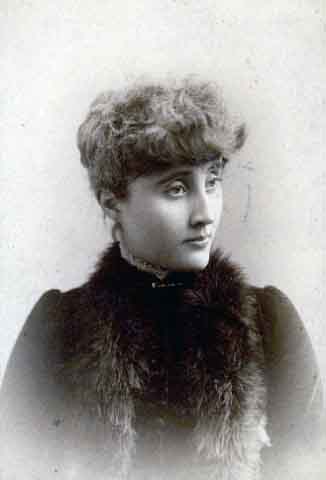
William McNair was an influential attorney and businessman in Minneapolis who had died in 1885. Among his many real estate holdings in the city was a 1,000-acre farm that stretched across much of near north Minneapolis to include Brownie Lake. At the time of his death he was said to be in negotiation with the park board to donate a 100-foot-wide strip of land for a parkway that would have extended from Lake of the Isles, around Cedar Lake, to Farview Park in north Minneapolis. It was said he already owned nearly all the land that would be required for that four-mile parkway. His obituary (September 16, 1885, Minneapolis Tribune) claimed that he was building a mansion at 13th and Linden (facing Hawthorne Park) that would rival W. D. Washburn’s “Fair Oaks” in south Minneapolis. Louise McNair, his widow, apparently finished it, judging by this photo. Whatever happened to it? Did it outlive Fair Oaks?

A curiosity about Brownie Lake: about half of the lake was platted into streets and “blocks.” The map of Cedar Lake and environs in the 1909 annual report of the park board shows Drew, Chowen and Beard avenues platted through Brownie Lake. Much of the land for Cedar Lake Parkway, and park board control of Cedar Lake, came from donations by McNair’s widow, Louise. She was the sister of McNair’s first law partner, Eugene Wilson, who was an important park commissioner and the attorney for the first park board. Hawthorne Park, where the McNair’s were building their mansion, was later renamed Wilson Park after Eugene Wilson. Wilson Park was condemned in the 1960s to become part of the I-94 interchange.

The park and playground west of Cedar Lake, which has always been known as Reserve Block 40, but never formally named, is in a neighborhood known as McNair Park. As residents of the Bryn Mawr neighborhood consider renaming Reserve Block 40, they could do worse than to keep the McNair Park name.
A final bit of Brownie Lake-related trivia: One of the pall bearers at William McNair’s funeral was Charles M. Loring. What makes that noteworthy in these days of political and philosophical rancor is that Loring and McNair were local leaders among Republicans and Democrats respectively. Clearly they were able to see past their political differences.
David C. Smith
© David C. Smith
The Good Old Days
The men and women of today who recall with lively joy the days when they played unwatched through the long summer days in meadow or woods or the old swimmin’ hole are likely to pity the youngsters of the present whose recreation is supervised and scheduled by grownups. For young dreamers with vigorous personalities there was something not to be duplicated in the lazy happiness of those days. But “other times, other customs.” City life of today is immeasurably more complicated: it has manifold possibilities for evil, numerous forces which make the child sophisticated before his time and which make a carefully planned constructive work necessary.
Overheard that discussion lately? Had it yourself?
The quote was taken verbatim from an article about park playgrounds in the Minneapolis Tribune, June 20 — 1920.
Do you have a story about playgrounds in the summer when you were a kid? Send it to me.
David C. Smith
Frederick Law Olmsted and Minneapolis Parks
Filed under: Landscape Architects, Minneapolis parks | Tags: Frederick Law Olmsted, H.W.S. Cleveland, Horace Cleveland, Minneapolis parks, Washburn Fair Oaks, William D. Washburn
Comments (3) How many Minneapolis parks did Frederick Law Olmsted design? How about his sons, Junior and JC? I believe the grand total is zero.
Some people have a mistaken notion that Olmsted, the godfather of American parks, played a role in the creation of Minneapolis parks. The impression was created in part by a letter Olmsted wrote to the Minneapolis park board in 1886 and by claims that Olmsted designed the grounds around William Washburn’s mansion Fair Oaks, which later became Washburn Fair Oaks Park.
A city claiming that Olmsted designed a park is akin to an inn in the East declaring “George Washington slept here.” A quick way to impress. The difference is that exhaustive records and correspondence document what Olmsted actually did, while there is little proof of where George laid his wooden teeth on any given night.
Continue reading
 Minneapolis Park History