The Preservation Instincts of Charles M. Loring
Filed under: Minneapolis parks, Minnehaha Falls | Tags: Charles M. Loring, Horace Cleveland, Minnehaha Falls
 Comments (2)
 Charles Loring’s view on preserving natural landscapes was so well-known that this anonymous poem appeared in the St. Paul Daily Globe on September 8, 1889 in a humor column, “All of Everything: A Symposium of Gossip About Minneapolis Men and Matters.”
A grasping feature butcher,
With adamantine gall,
Wants to build a gallery
At Minnehaha’s fall.He wants to catch the people
Who come to see the falls,
And sell them Injun moccasins
And beaded overalls.He wants to take their “phizes,”
A dozen at a crack,
With the foliage around them
And the water at the back.But the shade of Hiawatha
No such sacrilege would brook:
And he’d shake the stone foundations
Ere a “picter had been took.”C. M. Loring doesn’t like it,
For he says he’d like to see
The lovely falls, the creek, the woods,
Just as they used to be.
Loring had chaired a commission appointed by the governor to acquire Minnehaha Falls as a state park in 1885. The land was finally acquired, after a long court fight over valuations, in the winter of 1889. (The total paid for the 180-plus acres was about $95,000.) See City of Parks for the story of how George Brackett and Henry Brown took extraordinary action to ensure the falls would be preserved as a park.
The poem in the Daily Globe appeared because the park board was considering permitting construction of a small building beside the falls for the express purpose of taking people’s photos with “the water at the back.” And of course charging them for the privilege.
That proposal elicited a sharp response from landscape architect H. W. S. Cleveland who also opposed having any structure marring the natural beauty of the falls. Cleveland used language much harsher than the reserved Loring likely would have used. In a letter to his friend William W. Folwell, Cleveland wrote on September 5, 1889,
I cannot be silent in view of this proposed vandalism which I am sure you cannot sanction, and which I am equally sure will forever be a stigma upon Minneapolis, and elicit the anathema of every man of sense and taste who visits the place.
If erected it will simply be pandering to the tastes of the army of boobies who think to boost themselves into notoriety by connecting their own stupid features with the representation of one of the most beautiful of God’s works.
The preservation passion of Loring and Cleveland is evident today in the public lakeshores and river banks throughout Minneapolis. The next time you take a stroll around a lake or beside the river, or fight to acquire as parks the sections of the Mississippi River banks that remain in private hands, say a little “thank you” to people like Loring and Cleveland who saw the need to acquire lakes and rivers as parks more than 125 years ago—and nearly got them all.
And the photography shack was never built.
David C. Smith
University of Minnesota Honorary Degrees and Minneapolis Park Names
Filed under: Grand Rounds, Minneapolis Park Names, Minneapolis Parks: General | Tags: Edward Foote Waite, Thomas Sadler Roberts, William Watts Folwell
Comments (2) Here’s an exclusive club: William Watts Folwell, Thomas Sadler Roberts and Edward Foote Waite. Each has had a Minneapolis park property named for him, and each also received an honorary degree from the University of Minnesota.
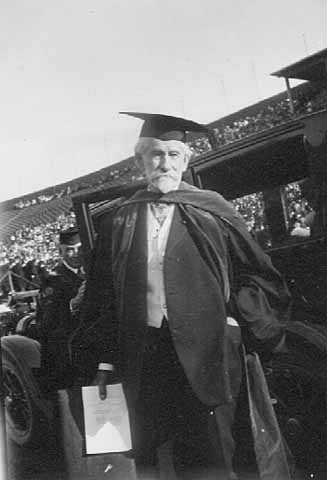
William Watts Folwell
1925 was a big year for Folwell when, at age 92, he received the first honorary Doctor of Laws degree ever awarded by the University of Minnesota and Folwell Park was dedicated in his honor. The name for the park had been chosen in 1917, but it took eight years for the park to be finished and dedicated.
Folwell was hired as the first president of the University of Minnesota in 1869. He was elected to the Minneapolis park board in 1888 and served on the board — many years as its president — until 1906. He was the first to propose the name “Grand Rounds” for the city’s ring of parkways.
He is pictured in 1925 when he received his honorary degree, apparently in ceremonies at Memorial Stadium. Photo: Minnesota Historical Society.
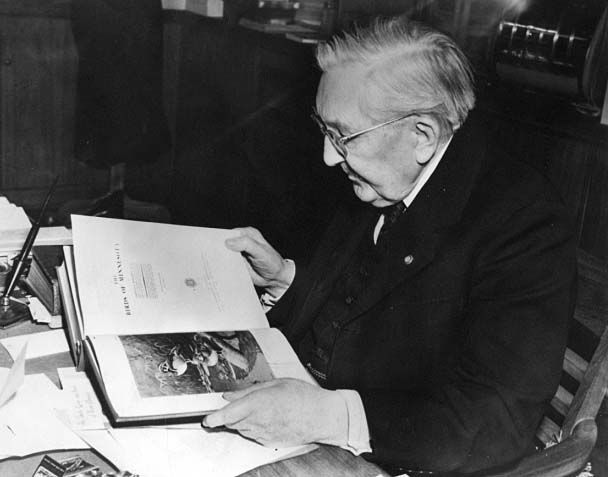 Thomas Sadler Roberts
Roberts was awarded an honorary Doctor of Science degree by the University of Minnesota in 1940, when he was 82. In the photo, taken sometime that year, he is perusing a book of Audubon prints.
The Thomas Sadler Roberts Bird Sanctuary in Lyndale Park near the north shore of Lake Harriet was named in his honor in 1947, a year after his death.
Roberts was a doctor known for his extraordinary capacity to diagnose unusual diseases and illnesses largely due to his prodigious memory. He retired from medicine in his 50s and devoted his time to ornithology. He taught at the University of Minnesota and was a director of the Museum of Natural History. Photo: Minnesota Historical Society.
 Edward Foote Waite
Waite received his honorary degree from the University of Minnesota and had a Minneapolis park named for him in the same year — 1949 — when he was 89. His Doctor of Science degree honored a legal career best known for years of service as a juvenile court judge in Minneapolis. But he was far more than a wise and compassionate judge; he helped shape the field of juvenile law in the United States.
Waite is less well-known for his five-month stint as Minneapolis’s police chief in 1902. It was not an easy job in the wake of a scandal known nationally as the “Shame of Minneapolis,” centered around corrupt Mayor Albert Ames and his brother Fred, whom he had appointed police chief. David P. Jones was appointed mayor to replace the fugitive Mayor Ames and turned to his friend, Waite, an assistant district attorney with no police experience, to clean up a corrupt police force and restore public faith in law enforcement.
Waite Park was developed along with Waite Elementary School as a joint project between the park board and school board from 1949-1951. The park and school opened for the 1950 school year but final improvements to the site were not completed until the following year.
Waite is pictured snowshoeing in about 1945 at the age of 85. Photo: Minnesota Historical Society. (See another photo of Waite at the school named for him.)
From this very exclusive list it would appear that the good do not die young.
David C. Smith
Recommended Reading from Horace W. S. Cleveland
Filed under: Landscape Architects, Minneapolis parks, Mississippi River | Tags: H.W.S. Cleveland, Horace Cleveland, Landscape Gardening
Comments (1) We haven’t had much of a winter yet in Minnesota, but it’s inevitable. When it comes and you’re imprisoned in your cozy den, your thoughts may turn to spring and the gardens you’ll plant or visit. To get you thinking about warmer weather, I’m providing a reading list from the man who envisioned Minneapolis’s park system and designed the first parks acquired by the Minneapolis park board in the 1880s.
In 1886, the secretary to the Minneapolis park board, Rufus J. Baldwin, apparently asked landscape architect Horace W. S. Cleveland to recommend books on his profession. It’s not clear if Baldwin was interested in furthering his own education (he was a prominent Minneapolis attorney) or if he was acquiring books for the park board. Below is Cleveland’s reply dated 23 Sep. 1886.
(All of the books Cleveland cited are now available free online at Google Books. The links in the letter take you to the online volume of the work cited.)
In considering your request that I would furnish you a list of desirable works on landscape gardening I find the subject growing in my mind so rapidly and attaining such dimension that the chief difficulty lies in making a judicious selection. The literature of the last century was especially rich in the discussion of the principles on which the art is founded. “Repton’s Landscape Gardening” is perhaps the ablest and most elaborate of the works of that date, but I think I learned more of first principles from the “Essays on the Picturesque, By Sir Uvedale Price,” than from any book.
It is doubtful however whether either of these books can be purchased in this country unless by chance at a second-hand store. “Loudon’s Encyclopedia of Horticulture,” contains perhaps the most detailed, practical instructions of any English work and is still a standard of reference and can be had in England though it has not been republished here.
“Downing’s Landscape Gardening” is at the head of all works on the subject in this country and is in fact a compilation and adaptation to our wants of all the essential principles of the best foreign writers. Next to that and in fact supplying much in which Downing’s work is deficient is “Country Life By Robert Morris Copeland.” He was for many years my partner and was a man of rare taste and skill, and his book is an admirable one. “Scott’s Suburban Homes,” is also an excellent treatise and full of judicious advice in regard to the arrangement of grounds and tasteful use of trees and shrubbery. These books can be procured of any of the leading booksellers or at the seed stores of the principal cities. In ordering Downing’s book, be sure to get the edition which has the appendix by Winthrop Sargent, which contains a vast amount of very valuable information.
I do not think of any other work directly devoted to the subject that would add to the value of what is contained in the above.
“The Horticulturist” during the time it was edited by Downing was rich in essays on different branches of useful ornamental gardening, but it is doubtful if a complete set could be had, and indeed the three works above enumerated comprise I think all the essential principles so far as they can be given by print and illustration.
If I think of others that would be desirable I will let you know.
The letter is signed, “Very truly yrs, H.W.S. Cleveland.”
(The original letter is in the files of the Minneapolis Park and Recreation Board at Special Collections, Minneapolis Central Library, Hennepin County Library.)
Amazing, isn’t it, that works Cleveland cited as unavailable in the United States in 1886 — or available at “the seed stores of principal cities” — are now free to anyone with access to a computer. Some people have a problem with a company such as Google having so much control over information — I just read The Googlization of Everything (And Why We Should Worry) by Siva Vaidhyanathan — and while I agree with concerns over the concentration of information control, the widespread availability of so much information, even as old and arcane as these texts, is an invaluable resource.
Happy reading.
David C. Smith
P.S. Minneapolis still doesn’t have a park named for Horace W. S. Cleveland — and we should. I’m still in favor of naming the west side of the Mississippi River Gorge for him.
Ostrich in the Park: This Month’s Contest
Here’s your chance to win a free subscription to minneapolisparkhistory.com. Do what the Minneapolis park board said it couldn’t afford to do—put an ostrich in a Minneapolis park. Of course the park board refused an offer to put real ostriches in parks, but all you have to do to be this month’s lucky winner is photoshop an ostrich into your favorite park picture and send it to us at minneapolisparkhistory[at]q.com.
An ostrich admiring Minnehaha Falls, canoeing in Lake of the Isles, stealing a golf ball at Gross, or skating at Logan Park. Imagine the possibilities.
The inspiration for this contest was an item in the February 24 issue of the Minneapolis Morning Tribune in 1913. The headline proclaimed:
No Ostriches This Year
Park Board Can’t Buy Birds
Yet Because of Slimness in
Public Pocket Book
“There are to be no ostriches imported this year to add to the attractions of the parks,” the Tribune reported. “Much though Superintendent Wirth would like to see the large birds roaming through the parks, he readily acquiesced when the park board, for reasons of economy, refused the offer of a California ostrich farmer to stock the parks with ostriches at relatively small cost. Mr. Wirth and some of the park commissioners hope, however, that by next year the board’s finances will allow the purchase of at least a limited number of ostriches.”
And John Erwin and Jayne Miller think they’re being squeezed by lack of funds!
If the park board had found the funds to buy ostriches in 1913, the birds would have joined deer, elk and buffalo that roamed the hillside at Minnehaha Park in the park board’s menagerie. The much larger animal collection kept at the Minnehaha Park from the mid-1890s—including bear, mountain lion, sea lions, alligators and exotic birds—were given to Fish Jones for his private zoo at Longfellow Garden in 1907. The park board kept the deer and elk at Minnehaha until 1923.
Wirth’s other notable contribution to the Minneapolis bestiary was the gray squirrel. Wirth imported the gray squirrels from Kansas in 1909 to replace the red squirrels he hired someone to shoot in Loring Park because they were eating songbird eggs. Wirth believed the less aggressive grays would make better neighbors. He noted in 1919 that the gray squirrels had extended their range throughout the city.
I doubt the ostriches would have been quite as adaptable. And I bet they would have made a bigger mess than the geese that many park visitors and neighbors despise.
Do you know what Fish Jones paid for the animals he got from the park board’s Minnehaha Park zoo in 1907? He had to provide free admission to his zoo one day a week—usually Saturday.
David C. Smith
The Two Pieces of Thomas Lowry Park
Filed under: Minneapolis parks | Tags: Lowry Hill, Mt. Curve Triangle, Phelps Wyman, Seven Pools, Thomas Lowry Park
Leave a Comment After an exchange of several e-mails with Bill Payne on the history of Thomas Lowry Park, I thought I should post the rest of what I know about the former Mt. Curve Triangles. (See the first of my exchanges with Bill in the comments section of the “About” page; and see the posts that generated his questions here and here.) After reading my posts and the historical profile of Thomas Lowry Park at the park board’s website, Bill questioned whether all of the park had ever been called Douglas Triangle before the park was officially named Mt. Curve Triangles on November 4, 1925. I think Bill is right that the larger part of the park—perhaps all of it—never had an official name until then.

On this 1903 map there is no “triangle” of land bounded by Bryant, Douglas and Mt. Curve, center right, at what would become Thomas Lowry Park. (John S. Borchert Map Library, University of Minnesota)
The questions arise because Thomas Lowry Park comprises two parcels of land acquired at different times: the tiny triangle—0.07 acre—bordered by Douglas Avenue, Mt. Curve Avenue and Bryant Avenue South and the much larger quadrangle—2.25 acres—between Douglas and Mt. Curve, Colfax and Bryant. This was before Bryant Avenue between Douglas and Mt. Curve was closed.
The 1903 plat map of Minneapolis at left doesn’t show a triangle of land at all east of Bryant. So it’s nearly certain that requests in 1899 from residents of the area, including Thomas Lowry, whose house is upper right on the map, that the park board maintain the grounds between Mt. Curve and Douglas apply to the lot between Bryant and Colfax. The park board denied that request because it didn’t own the land.
The park board’s first acquisition there is a bit cloudy. For all the details…
Stone Quarry Update: Limestone Quarry in Minnehaha Park at Work
Filed under: Minneapolis parks, Minnehaha Falls, Mississippi River | Tags: Christian Bossen, Minnehaha Dog Park, Minnehaha Falls, Minnehaha Park, Mississippi River, WPA
Comments (6) I was technically correct when I wrote in October that the park board only operated a limestone quarry and stone crushing plant in Minnehaha Park for one year: 1907. But I’ve now learned that the Minnehaha Park quarry was operated for nearly five years by someone else—the Works Progress Administration (WPA).
From early 1938 until 1942 the WPA, a federal program that provided jobs during the Depression, operated the quarry after “tests revealed a large layer of limestone of hard blue quality near the surface” in the park near the Fort Snelling property line at about 54th, according to the park board’s 1937 Annual Report. The WPA technically operated the plant, but it was clearly for the benefit of the Minneapolis park system.
“Although this plant is operated by the WPA, our Board supplied the bed of limestone, the city water, lighting, gasoline and oil, and also some small equipment, since it was set up primarily for our River Road West project, which included the paving of the boulevard from Lake Street to Godfrey Road, and also to supply sand and gravel to the River Road West Extension project (north from Franklin Avenue) where there was a large amount of concrete retaining wall construction.”
— 1938 Annual Report, Minneapolis Board of Park Commissioners
In 1938 the park board estimated that 85% of the product of the stone crushing plant was used on park projects, the remainder on other WPA projects in the city.
The quarry was established in an area that “was not used by the public and when the operations are completed, the area can be converted into picnic grounds and other suitable recreational facilities,” the park board reported. (I bet no one thought then that a “suitable” facility would include a place where people could allow their dogs to run off leash!)
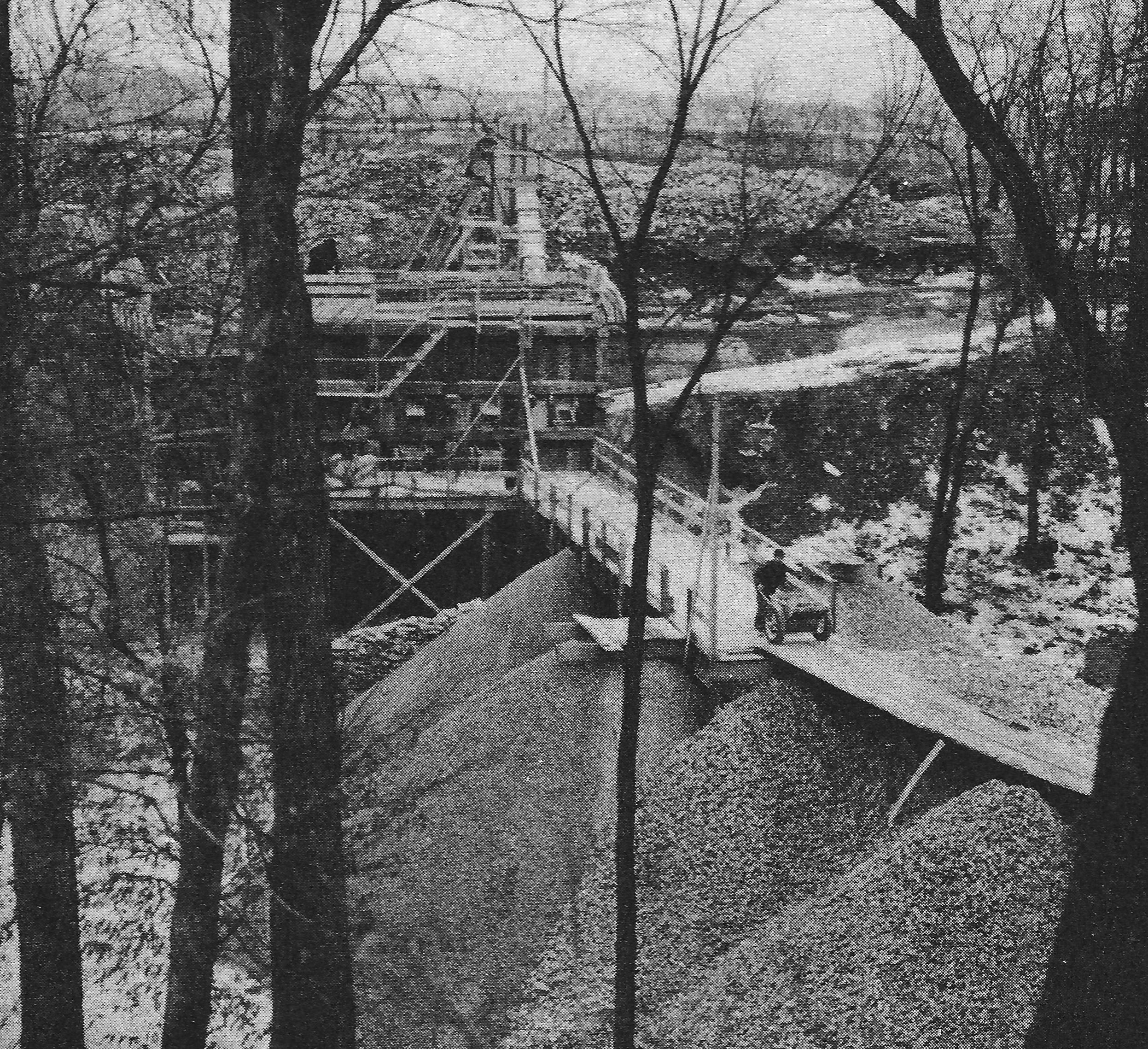
“The Stone-crushing Plant at Minnehaha Park” (1938 Annual Report, Minneapolis Board of Park Commissioners) Doesn’t look much like one of our favorite wild places, does it?
The plant consisted of “two large jaw crushers” and a conveyor that lifted the crushed rock to shaker screens over four large bins. It was operated by gasoline engines and was lit by electric lights so it could operate day and night. (The fellow with the wheelbarrow in the photo might have liked more conveyor.)
The crushed stone was used in paving River Road West and East, Godfrey Road and many roads, walks and tennis courts throughout the park system. The rock was also used as a paving base at the nearby “Municipal Airport,” also known as Wold-Chamberlain Field, which the park board owned and developed until it ceded authority over the airport to the newly created Metropolitan Airports Commission in 1944. According to the 1942 Annual Report of the park board, in four-and-a-half years the quarry produced 76,000 cubic yards of crushed limestone, 50,000 cubic yards of sand and gravel and 36,000 cubic feet of cut limestone.
The cut limestone was used to face bridges over Minnehaha Creek, shore retaining walls at Lake Harriet, Lake Nokomis and Lake Calhoun and other walls throughout the park system.
The plant was used to crush gravel only in 1938. The gravel was taken from the banks of the Mississippi River, “it having been excavated by the United States Government to deepen the channel of the Mississippi River just below the dam and locks.” After that, the WPA acquired the sand and gravel it needed from a more convenient source in St. Paul.
The project was terminated in 1942 near the end of the WPA. In his 1942 report, park superintendent Christian Bossen wrote in subdued tones that, “For a number of years, practically the only improvement work carried on was through WPA projects. In 1942, WPA confined its work almost exclusively to war projects: and under these conditions considerable work was done at the airport and a very little work was done on park projects.” The WPA was terminated the following year.
The next time you take your dog for a run at the off-leash recreation area at Minnehaha, have a look to see if there are any signs of the quarry and let us know what you find.
David C. Smith
Name That Park
1. This Minneapolis park is commonly refered to by a name that indirectly commemorates one of the most famous people in the history of the United States, a signer of both the Declaration of Independence and the U. S. Constitution.
2. The man for whom the park is named built this house at 5th Street and 12th Avenue SE in 1883.

5th St. and 12th Avenue SE, built 1883 (History of the City of Minneapolis, Atwater)
3. The namesake of this park, pictured below, was one of three civic leaders in Minneapolis in the 1870s and later who acquired their social, political and economic influence after serving in the Confederate army, unusual for this famously “Yankee” town.
This Kentuckian entered the Confederate army at age 19 and finished the Civil War as a prisoner of war. The other prominent Confederate soldiers in Minneapolis were Thomas Rosser, a Confederate general, who was the city engineer in 1878, and Phillip “P. B.” Winston, Rosser’s aide during the war, who was elected Minneapolis mayor in 1890. Winston married Katherine Stevens, the daughter of Minneapolis pioneer Col. John Stevens. Katharine donated the sculpture of her father that now stands near Minnehaha Falls.
In the History of the City of Minneapolis, Minnesota, Isaac Atwater addressed in 1893 this man’s Civil War service thirty years earlier:
A generation has passed since the war of the Rebellion. The survivors of its contests in arms have passed the meridian of life. Their animosities have softened, their judgments matured, and their love for a common Union strengthened, or if once alienated, has been restored. Those who once wore the blue fraternize with those who donned the gray, and the acrimonies which were once bitter between them have melted into common respect. Minneapolis entered into the struggle with enthusiasm and sent her choicest citizens to the front. But she has always been kind and tolerant to those who were on the other side. Her cosmopolitan citizenry cherish neither bigotry nor proscription…With courtesy and forbearance she received Mr.______ after the war was over and entrusted to him her dearest interests and placed upon him her chief honors. And no one born within her own limits, and following her tattered flags, could more loyally or honorably bear them than he.
More than a bit flowery, but apparently a subject that Mr. Atwater believed needed to be addressed. The man described served on the city council from the late 1870s, the first park board in 1883 and the school board 1884-1891. He was a trustee of Hamline University, a regent of the University of Minnesota, and president of the state agricultural society.
4. He made his fortune in lumber, but he also founded a planing and shingle company that bore his name and once occupied the property that is now a park.

This is the view of the mystery park looking east from Boom Island in 1901 — when Boom Island was still an island. (Minnesota Historical Society)
And the Answer Is…
The park in question has never been named officially, but it is commonly referred to as the B. F. Nelson site, after the company that occupied the property for nearly 100 years. The company was created by Benjamin Franklin Nelson in the 1880s.
B. F. Nelson was not one of the commissioners named in the legislation that created the Minneapolis Board of Park Commissioners in 1883, but shortly after the act passed the legislature and was approved by a referendum in Minneapolis, one of the named commissioners, Andrew Haugan, resigned. The other commissioners elected Nelson to take Haugan’s place until the first election of park commissioners in 1884. Since then park commissioners have been elected, although as in Nelson’s case, vacancies between elections are filled by a vote of the other commissioners. Nelson chose not to stand for election to the park board in 1884, opting instead for a seat on the school board.
Nelson was one of three park commissioners who resided east of the river—Samuel Chute and John Pillsbury were the others—who selected the site of Logan Park as the first east-side park in 1883.
David C. Smith
More Bassett’s Creek
Filed under: Minneapolis parks, Minnehaha Creek | Tags: Bassett's Creek, Minnehaha Creek, Neiman Sports Complex
Leave a Comment Interesting thoughts from readers on city and park board treatment of Bassett’s Creek:
Is it possible that Minneapolis spent as much or more tunneling Bassett’s Creek in an attempt to improve north Minneapolis than it spent building a parkway along Minnehaha Creek? Someone would have to go through financial reports to determine the city/Bassett’s Creek figures. Building two tunnels, the second one 80 feet beneath downtown Minneapolis, must have had a fairly hefty price tag. What if you threw in the federal and park board dollars from the time of Civilian Conservation Corps and Works Progress Administration projects in the 1930s until now on Bassett’s Creek above ground from Bryn Mawr into Theodore Wirth Park?
Perhaps the park board’s biggest missed opportunity in dealing with Bassett’s Creek was the decision to build a competition-quality youth sports complex—the one named for Leonard Neiman—at Fort Snelling instead of in Bryn Mawr/Harrison. I don’t recall what Bryn Mawr or Harrison residents thought of the idea when it was considered in the late 1990s. Does anyone remember that discussion? It would certainly be a better location for youth sports than the distant fields of Fort Snelling (for people living almost anywhere in Minneapolis—south, north, northeast, or southeast). Whether building that complex in the central city would have spurred other development or at least raised awareness of Bassett’s Creek is hard to say, but it could’ve been positive for the neighborhoods beside and above the creek.
David C. Smith
The Myth of Bassett’s Creek
Filed under: Minneapolis parks, Mississippi River | Tags: Bassett's Creek, H.W.S. Cleveland, Horace Cleveland, Minnehaha Creek, Mississippi River
Comments (24) I heard again recently the old complaint that north Minneapolis would be a different place if Bassett’s Creek had gotten the same treatment as Minnehaha Creek. Another story of neglect. Another myth.
You can find extensive information on the history of Bassett’s Creek online: a thorough account of the archeology of the area surrounding Bassett’s Creek near the Mississippi River by Scott Anfinson at From Site to Story — must reading for anyone who has even a passing interest in Mississippi River history; a more recent account of the region in a very good article by Meleah Maynard in City Pages in 2000; and, the creek’s greatest advocate, Dave Stack, provides info on the creek at the Friends of Bassett Creek , as well as updates on a Yahoo group site. Follow the links from the “Friends” site for more detailed information from the city and other sources.
What none of those provided to my satisfaction, however, was perspective on Bassett’s Creek itself after European settlement. A search of Minneapolis Tribune articles and Minneapolis City Council Proceedings, added to other sources, provides a clearer picture of the degree of degradation of Bassett’s Creek — mostly in the context of discussions of the city’s water supply. This was several years before the creation of the Minneapolis Board of Park Commissioners in 1883 — a time when Minnehaha Creek was still two miles outside of Minneapolis city limits. The region around the mouth of Bassett’s Creek was an economic powerhouse and an environmental disaster at a very early date — a mix that has never worked well for park acquisition and development.

Idyllic Minnehaha Creek, still in rural surroundings around 1900, quite a different setting than Bassett’s Creek, which had already been partly covered over by then. (Minnesota Historical Society)
“A Lady Precipitated from Bassett’s Creek Bridge”
Anfinson provides many details of the industrial development of the area around the mouth of Bassett’s Creek from shortly after Joel Bean Bassett built his first farm at the junction of the river and the creek in 1852. By the time the Minneapolis Tribune came into existence in 1867, industry was already well established near the banks of the creek. A June 1867 article relates how the three-story North Star Shingle Mill had been erected earlier that year near the creek. The next March an article related the decision to build a new steam-powered linseed oil plant near the creek on Washington Avenue.
Even more informative is a June 27, 1868 story about an elderly woman who fell from a wagon off the First Street bridge over the creek. “A Lady Precipitated from Bassett’s Creek Bridge, a Distance of Thirty Feet,” was the actual headline. (I’m a little embarrassed that I laughed at the odd headline, which evoked an image of old ladies raining down on the city; sadly, her injuries were feared to be fatal.) But a bridge height of thirty feet? That’s no piddling creek — even if a headline writer may have exaggerated a bit. The article was written from the perspective that the bridge was worn out and dangerous and should have been replaced when the city council had considered the matter a year earlier. Read more »
Horace Cleveland’s Friends: Five of Clubs
Filed under: Landscape Architects, Longfellow Field Park, Minneapolis Parks: General | Tags: Cornelius C. Felton, Five of Clubs, George Stillman Hillard, H.W.S. Cleveland, Henry Russell Cleveland, Henry Wadsworth Longfellow, Horace Cleveland, Longfellow Park, Sumner Field
Comments (1) Trivia to delight and amaze.
Can you name two Minneapolis parks named for members of the “Five of Clubs,” an informal sort of book club?
The “Five of Clubs” met informally at the suburban Boston home of Horace W. S. Cleveland’s brother, Henry, in the early 1840s. Horace lived with his older brother for a time and sat in on those “club” gatherings.
Answer: Sumner Field and Longfellow Field.
Sumner Field was named for Sumner Place, the street in north Minneapolis on which the park was built in 1911. Sumner Place was named for U. S. Senator Charles Sumner, famous for his opposition to slavery and for ensuring the rights of freed slaves during Reconstruction. Before he was elected to the Senate from Massachusetts, he was an attorney in Boston — and a member of the “Five of Clubs.”

Longfellow statue in a field near Longfellow Garden upstream from Minnehaha Falls, 2011. (Ursula Murray Husted, flickr.com)
Longfellow Field was named for Henry Wadsworth Longfellow, the poet and professor of modern languages at Harvard in the 1840s and also a member of the “Five of Clubs.” In 1855, Longfellow published his epic poem “Song of Hiawatha,” which made Minnehaha Falls famous around the world. Longfellow never visited Minnehaha Falls and the book was written 17 years before Horace Cleveland first saw the Falls.
Imagine Horace Cleveland’s astonishment if he would have been told that 110 years after his death he would be more respected in his field than Longfellow is in his.
The other members of the “Five of Clubs” were Cornelius C. Felton, professor and future president of Harvard University, and George Stillman Hillard, Sumner’s law partner and author and publisher.
A reminder: Minneapolis should have a park along the Mississippi River gorge named for Horace Cleveland.
For much, much more on Horace Cleveland, click on his name in the tag cloud at right. For the whole story of Horace Cleveland and Minneapolis parks read City of Parks.
Just curious. Any future Sumners or Longfellows or Clevelands in your book club?
David C. Smith
Talmud Torahs vs. Swastikas
Filed under: Minneapolis parks | Tags: Football, Sumner Field, Talmud Torah
Leave a Comment The combination of words was eye-catching. And image-generating: holocaust, horrors. But on the sports pages of the Minneapolis Tribune? In 1921?
There they were, two teams competing in the 125-pound division of the Minneapolis Amateur Football Association: the Swastikas and the Talmud Torahs. But this was before the Nazis stigmatized the swastika, which had Sanskrit origins and had been used around the globe for millenia as a symbol of good luck or success. It was a good word, a positive symbol. It was only a year earlier that the German National Socialist Party had adopted the swastika as its symbol and it would be nine years more until Adolph Hitler created the famous red, white and black swastika flag.
I haven’t been able to find any information on who sponsored the Swastika team or what part of the city they came from. I know more about the Talmud Torah teams. The Talmud Torah was a Hebrew free school, established in 1893, that instructed Jewish children in Hebrew language and literature and the history and traditions of the Jewish people. Students attended the Talmud Torah after their regular day of study at public schools.

Talmud Torah, 725 Fremont Avenue North, ca. 1950, sponsored sports teams in park recreation leagues beginning in 1919. (Minneapolis Star Journal Tribune, Minnesota Historical Society)
In 1915 a new Talmud Torah opened on Fremont and Eighth Avenue North. The original Talmud Torah had been supported by the Keneseth Israel congregation, but the school in the new building had a wider base of support than a single congregation. According to an article in the Minneapolis Tribune, January 10, 1915, the school “will make Minneapolis famous as the only city in which practically all the people of the Jewish race have united in providing an institute … for Jews of any language and social condition.”
The first sports score I can find for the Talmud Torahs was a basketball victory at their gym in December 20, 1919, when they defeated the Eagle A. C. 56-4. Nice debut. (Minneapolis Tribune, December 21, 1919.) But the Talmud Torahs — that’s what newspapers called them, just as they referred to the “Bottineaus” or “Powderhorns” for teams representing those parks — showed up in the sports pages of the Tribune especially during the football season. That was presaged perhaps by an article in the Minneapolis Tribune, November 28, 1915, which announced that the Newsboys Club of some 300 boys “accustomed to the life of the streets” had been taken under the wing of the social settlement house also established at Talmud Torah and that they would be instructed by University students that were “expert in football.” Those newsboys may have been the foundation for later Talmud Torah teams. Perhaps the most famous newsboy of that neighborhood is Sid Hartman of the StarTribune sports page, although he isn’t quite old enough to have been in the club at that date.
The home football field of the Talmud Torah teams was Sumner Field, just two blocks east of the school on Eighth. The school sponsored one to three teams each year in the early 1920s.
The weight divisions in those days were determined quite differently from today, when most restrictions on youth football are based on a weight limit. Only players under a certain weight are allowed to play in that league. It was different in the late 1910s and 1920s. Then each team registered with 16 players on its roster. The players were weighed and the average weight of those players determined the league they played in. Leagues ranged from 95 or 100 pounds to 140 pounds. increasing in 5 or 10 pound increments, with a “senior” division in which weight did not matter. Also interesting is that the weight classes applied without apparent regard to age. For example, an article in the Tribune about a 135-pound league game in 1921 noted that the match-up featured several former All-City high school stars.
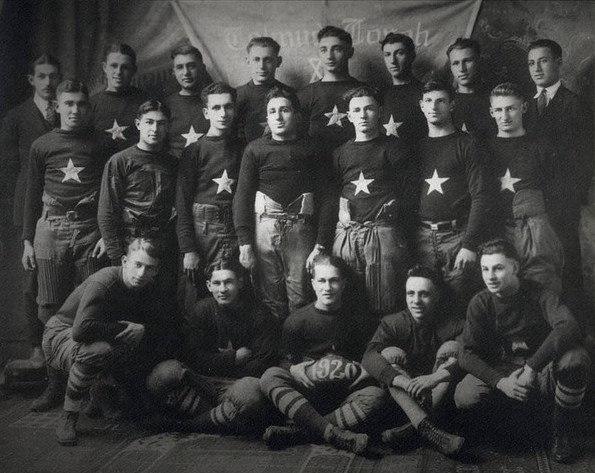
The first Talmud Torah football team, 1920 (Jewish Historical Society of the Upper Midwest, jhsum.com)
In 1920 the Talmud Torah team played in the 140-pound league and deep into the season was undefeated and unscored upon. In 1921 Talmud Torah had two teams, one played in the 125-pound league with the Swastikas — and won their division, a playoff with the winner of the other 125-pound division was snowed out — and the Talmud Torah Cubs played in the 100-pound league. The next year Talmud Torah sponsored three teams, one each in the 130-, 100- and 90-pound divisions.

In 1922, the Talmud Torahs were joined in park football by another Jewish team from the Judea A.C. Later Judea football teams were sponsored by the Emmanuel Cohen Center, a social service center established in 1924. The first Judeas team played in the 90-pound division — along with a Talmud Torah team — which is not likely the weight classification in which these fellows played.
The Rise of Activities Councils
If you happen by a soccer field in the fall or a park gym in winter now you’ll see nearly every team in uniforms with a name that ends in AC. Whether the uniform says WESAC, MFAC, SWAC, SIBAC, or something else, the AC stands for “activities council.” Activities councils — call them boosters or volunteers — associated with parks are a phenomenon that began with the creation of the Minnehaha Falls Activities Council (MFAC) serving Keewaydin Park in 1936. In the booklet, “Recommended Procedures for Park Area Recreation Councils” published by the park board in 1971, Robert Ruhe, park superintendent at the time, wrote that the councils were to his knowledge “unique among park and recreation departments in the United States.” The councils were and are independent of the park board recreation staff but work closely together to finance teams, buy equipment and provide coaches. The 1971 document lists the creation dates of 27 activities councils, many of which still exist.
While MFAC was the first booster club that promoted activities park wide, the idea of booster clubs was given a boost itself in 1951 and 1952 when new playgrounds were opened at Waite Park and Armatage respectively. Both school/park combinations were joint projects of the park board and the school board from the ground up. New parks were fertile ground for booster clubs and one was created at both parks. They were soon followed by the Southwest Activites Council (SWAC) in 1953 that covered two parks: Pershing and Linden Hills. SWAC was one of the most successful booster groups, providing a model for other parks. Two early activists in SWAC later became park commissioners, Inez Crimmins and Leonard Neiman, for whom the sports complex at Fort Snelling is named.
The booster clubs organized by park gradually replaced the more loosely managed efforts of players or businesses to put togther teams and secure equipment and create schedules. The job of organizing teams was more complicated then also because park recreation centers, other than the Logan Park Fieldhouse, were open and staffed only in the summer. There was no such thing as a year-round playground staff or recreation supervisors
For more photos and information about 1920s park football see this story about the football team from Bottineau.

This Camden team won the 1922 senior or open division of the Minneapolis Amateur Football Association managed by the park board recreation department.
David C. Smith
© David C. Smith
Northeast River Parks
Filed under: Minneapolis parks, Mississippi River | Tags: Edgewater Park, Gluek Park, Horace Cleveland, Mississippi River
Comments (4) I enjoyed a walk yesterday along the riverfront parks in northeast Minneapolis sponsored by the Minneapolis Riverfront Partnership. I told a few historical stories and park commissioner Liz Wielinski, Above the Falls committee member Mary Jamin Maguire, and Cordelia Pierson, executive director of the partnership, provided insights into park developments, past and future, along the river. We were also delighted to hear stories of the neighborhood from a few longtime residents of the area.
We visited Marshall Terrace, Edgewater Park, and Gluek Park and along the way we passed the newest, still unnamed, Minneapolis park at 2220 Marshall Street—a single lot from Marshall to the river purchased by the park board in 2010.
These are a few of the notes I made for my input into the program.
Marshall Terrace
Marshall Terrace was purchased in 1914. The first land chosen for a First Ward Park was a few blocks farther upriver, but neighborhood objections resulted in the park board asking for suggestions from residents and politicians for a better site. This eight-acre parcel further downriver was the result. (The park board also acquired the upriver acreage, but as a segment of a planned parkway across northeast Minneapolis, now St. Anthony Parkway, instead of a playground park.)
Park superintendent Theodore Wirth prepared these two plans for the new park, which were included in the 1915 Annual Report. (The same report included plans for nearby Bottineau Park.) Read more »
 Minneapolis Park History