Archive for the ‘Minneapolis parks’ Category
Minneapolis speedskating: Bearcat 8mm film from 1950s
Filed under: Minneapolis parks, Winter Sports | Tags: Powderhorn Park, Speed Skating
 Comments (4)
 Adam Martin has posted some fun 8mm film footage of the Bearcat American Legion Post speedskating team in Minneapolis from the 1950s on youtube.

Bearcat American Legion Skating Team. Appears to have been taken at Powderhorn Park. (Adam Martin)
Adam’s father—John—and uncles—Jim, Tom and Michael—skated for the Bearcat team, as he related in a recent comment on my first speedskating post.
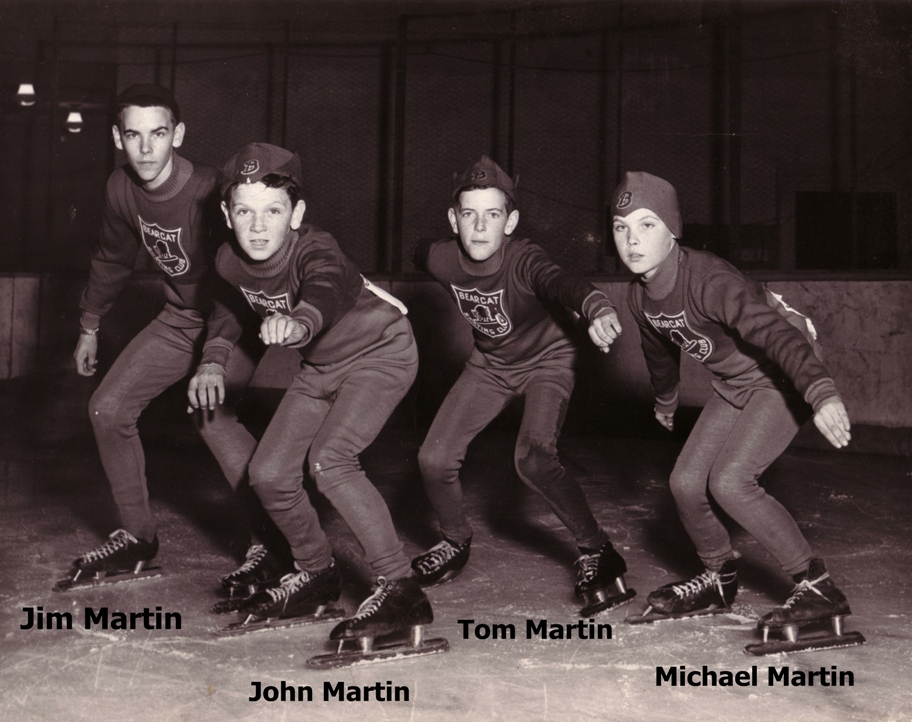
The Martin brothers who skated for the Bearcat team in mid-1950s. (Adam Martin)
Have a look at that post as well as others on speedskating, then click this link (or the youtube.com link in Adam’s comment): http://www.youtube.com/watch?v=c8ewShuJeEo
The first clips were shot at Powderhorn, I believe, but I don’t recognize where the clips at the end were from. Can anyone identify the other rinks featured — or tell us anything else about the clips Adam has provided?
Thanks, Adam.
David C. Smith
P.S. I just heard from Adam that his uncle identified the last clips as being shot in Winnipeg.
Toros Ready For Work
Bob Wolff from Toro provided three great old photos of Toro products at work in Minneapolis parks. (See previous stories here and here.)
The first two are tractors from 1939 on East Nokomis Parkway.

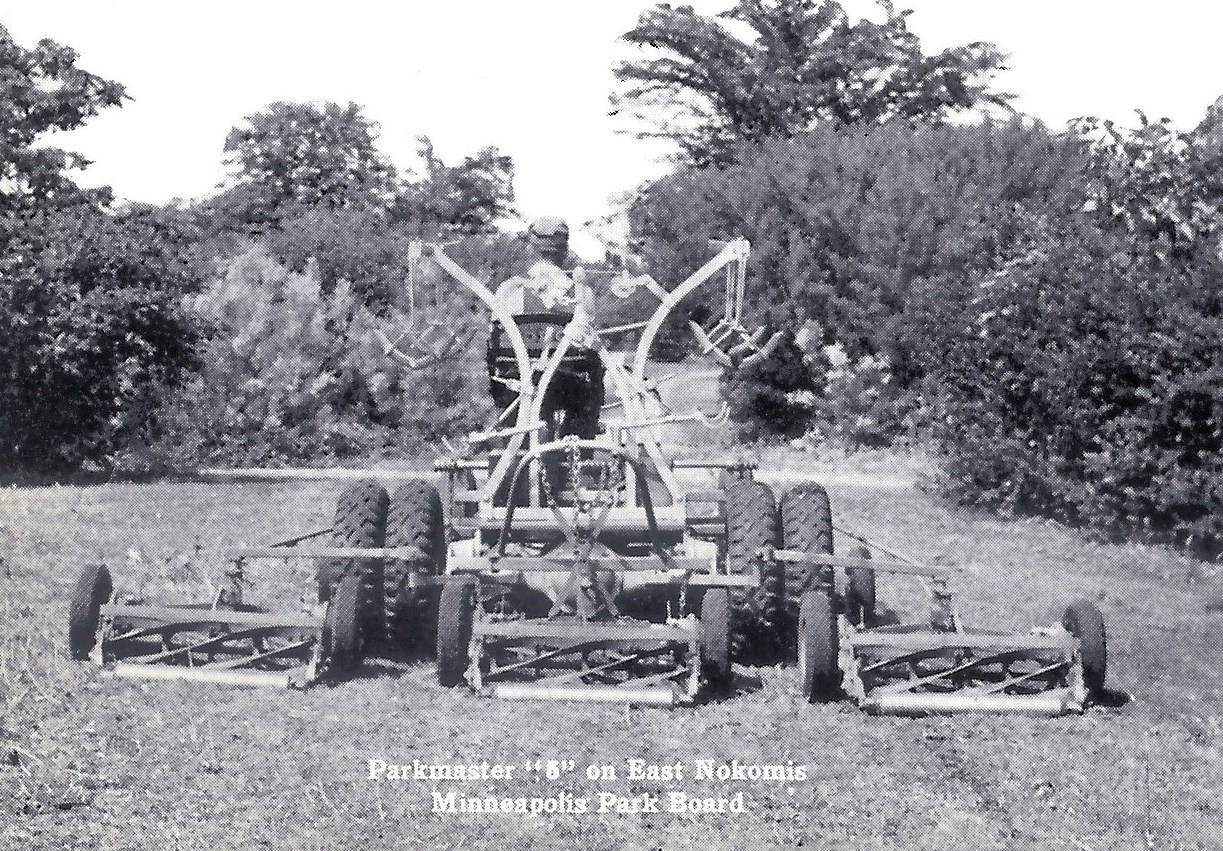
(Courtesy The Toro Company archives)
But best of all is this fleet of power reel mowers circa 1930. I love this picture. Can anybody identify any of the maintenance people in the photo? Every man wears a hat.
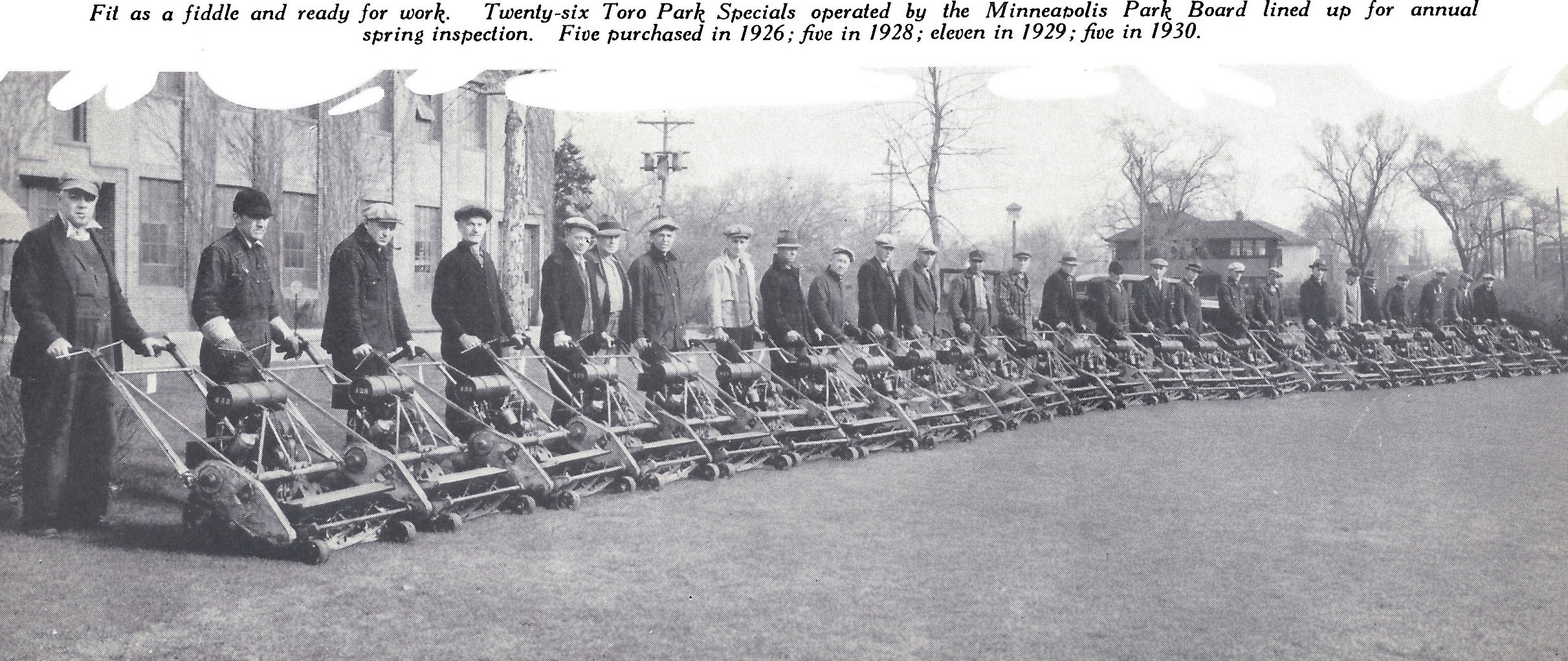
(Courtesy The Toro Company archives.)
Thanks, Bob
David C. Smith
The True Story of Sibley Triangle, by Robin Russell
Filed under: Minneapolis parks | Tags: Minneapolis parks, Northeast Minneapolis, Robin Russell, Sibley Triangle
Comments (3) I started tending this garden in 2006, but really took it on in 2007. In 2007, I was living in St. Anthony East neighborhood, and I lost my home to foreclosure. I didn’t want to leave my perennials behind, so I moved them to the triangle. In this same time period, another house in the neighborhood was demolished after a fire, and I was disappointed to learn that when that happens, any perennials or shrubs are ripped out, too. In 2007-2008 time period a lot of houses were being razed on primarily the North Side, so I got hold of the list of properties to be razed and went ‘plant rescuing’ before the bulldozers got in. I remember one afternoon it seemed like me and the bulldozers racing around the streets together! For awhile I kept a blog of my ‘guerrilla gardens’ (haven’t been able to keep up with it that past two seasons) and for the purposes of that blog, I dubbed Sibley Triangle “Foreclosure Park.” There are a number of really great specimens in the garden that I got from these rescue trips. Especially the ‘Hope for Humanity” rose. Well, maybe it’s not that variety, but I don’t want to hear about it. I like thinking it’s a Hope for Humanity. It seems fitting.
Before I took over the park, it had been abandoned for quite some time. Before that, St. Anthony East had a neighborhood garden group that installed the granite pavers and built the raised bed. The indigo baptisia is the plant that remains from this group. Water had been provided by ‘Phil,” a nearby homeowner, but after he either passed away or moved away, and there was no easy water access, the park was no longer cared for by this group. This is why I am such a pusher and shaker when it comes to making sure we continue to have affordable water for this space. Downtown in the water permits department I have been referred to as “the particular woman with the particular garden!” LOL. I am copying Kathy Kittelson on this e-mail as she was part of the aforementioned gardening group and she may have pictures.
I was told that when Our Lady of Lourdes parochial school was across the street from the Triangle (where the public housing building is now), that the Triangle had marble pits where the kids (probably boys) played marbles. I was told that if I kept digging, sooner or later I would find marbles, and in fact I have two that I have found there! If there is a way to get pictures of Our Lady of Lourdes School, maybe there would be pictures of the Triangle there. That would be a fun research project.
It is such an honor to take care of this space. It is really cherished by the neighbors, and is a destination spot that people now walk to. I learned that one neighbor even referenced it as a neighborhood amenity to a new tenant in the area!
My blog is guerrillagardensne[dot]blogspot[dot]com
Robin Russell
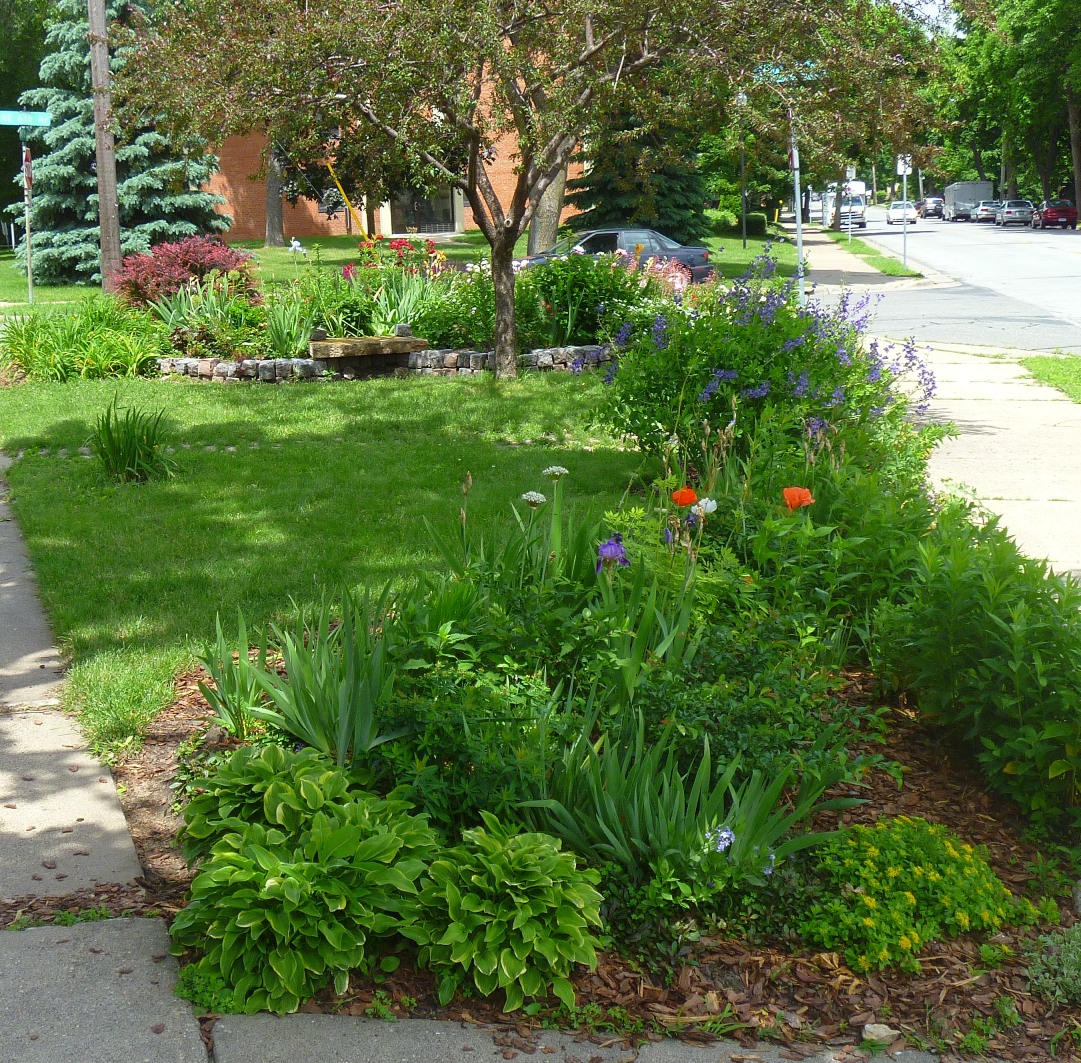
Another view of Robin’s garden from my May 30 visit. David C. Smith
NOTE: Thanks so much, Robin, for telling the story and for taking care of a space that we all can enjoy.
Does anybody have any photos of Our Lady of Lourdes school—or know of any? Let me know where I could find them, or send them to me and I’ll post them here.
David C. Smith
More Park Mysteries
I haven’t been able to write much here for the last month, because I’ve been working on other writing projects. Gotta make a living! I have plans to write very soon on the politics of the purchase of Minnehaha Falls, the philosophy of landscape architect and park commissioner Phelps Wyman (I promised more long ago!), two more remarkable people who donated land to the Minneapolis park system, and the extraordinary Minneapolis park commissioner who, among other things, wrote a book that was plagiarized by martial artist Bruce Lee. I’ll also publish my list of “Lost Minneapolis Parks.”
Excellent stories all. And all still part of our city’s life.
Until I get to it…
Adrienne was the only minneapolisparkhistory reader to correctly name a park property shown on the 1897 map of Minneapolis that is no longer a park. She named Meeker Island—an excellent find. Now she is enjoying a free subscription to minneapolisparkhistory.com.
The other two park properties depicted as parks in 1897 that are no longer were Hennepin Avenue South from Loring Park to 31st Street and Lyndale Avenue North from Western Avenue to Farview Park. Both were still parkways in 1897, but were turned over to the city in 1905 when it became evident that they would always carry too much traffic to be the parkways the park board had envisioned.
That was a tough question because the green in those parkways is a little hard to see on the map.
So I’ll give you three new questions, all based on photos.
Name the three park properties from which the following photos were taken. MPRB employees are eligible to win, too! All photos were taken May 30, 2012.
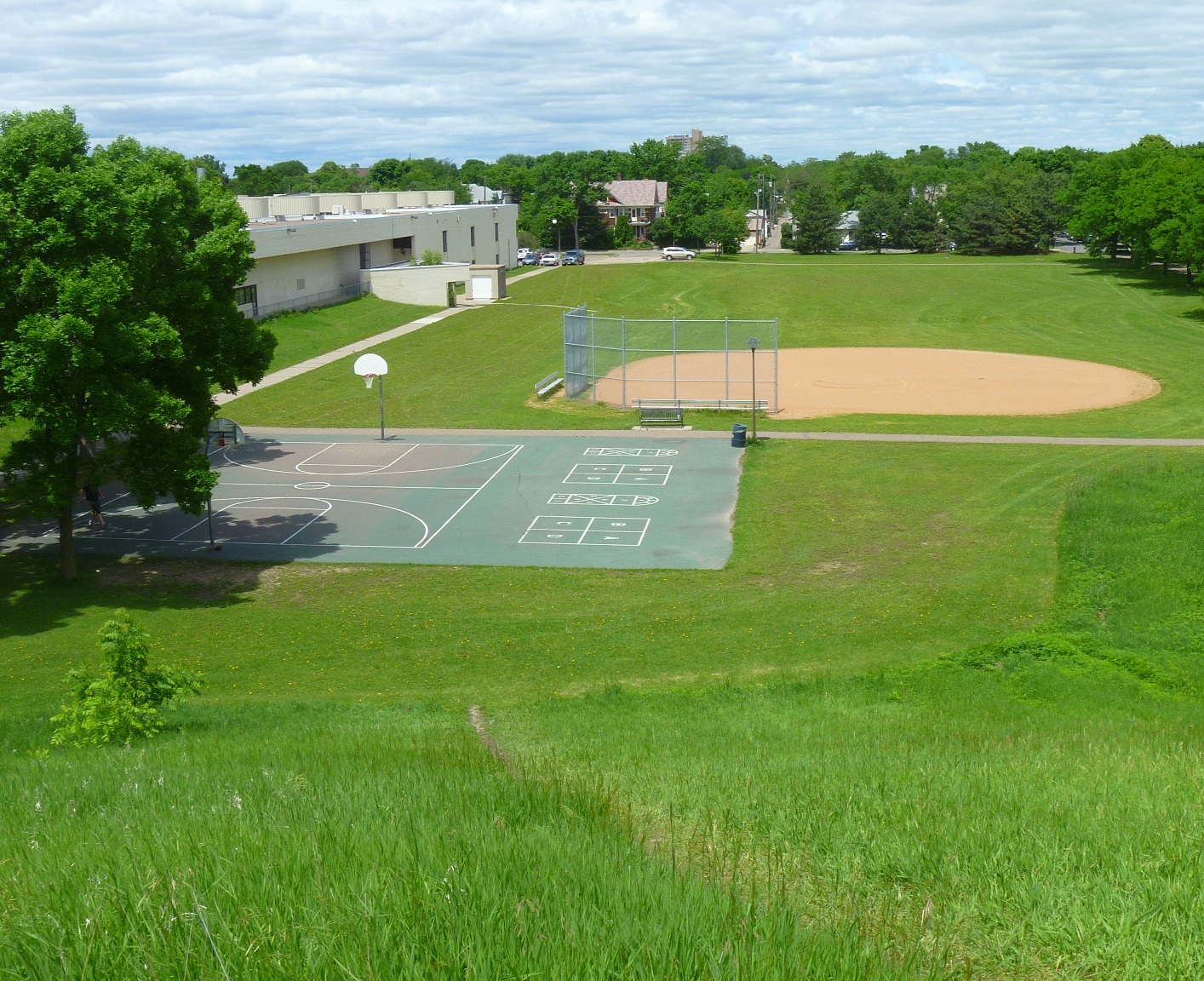
Bonus question: Where did all the dirt come from to make this hill?
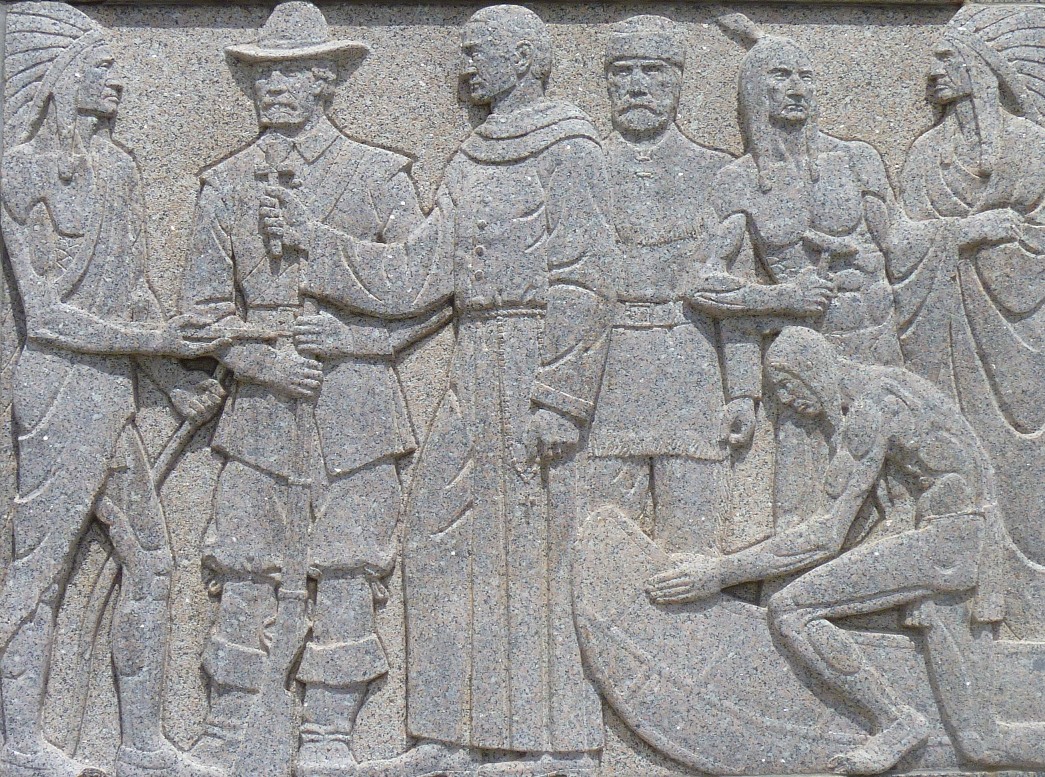
It’s not completely clear who the priest hopes to “save” here.

One of the best skyline views of Minneapolis.
Usual great prize of free subscription to minneapolisparkhistory.com for the first correct answers.
David C. Smith
Sibley Triangle in Full Bloom
Filed under: Minneapolis parks | Tags: Northeast Minneapolis, Sibley Triangle
Comments (4) Last fall I apologized to Robin Russell, the volunteer park steward who maintains the lovely Sibley Triangle in Northeast Minneapolis, for not getting a picture of her superb work. This is to make amends. These photos were taken on May 30 after a week of rain. Beautiful.
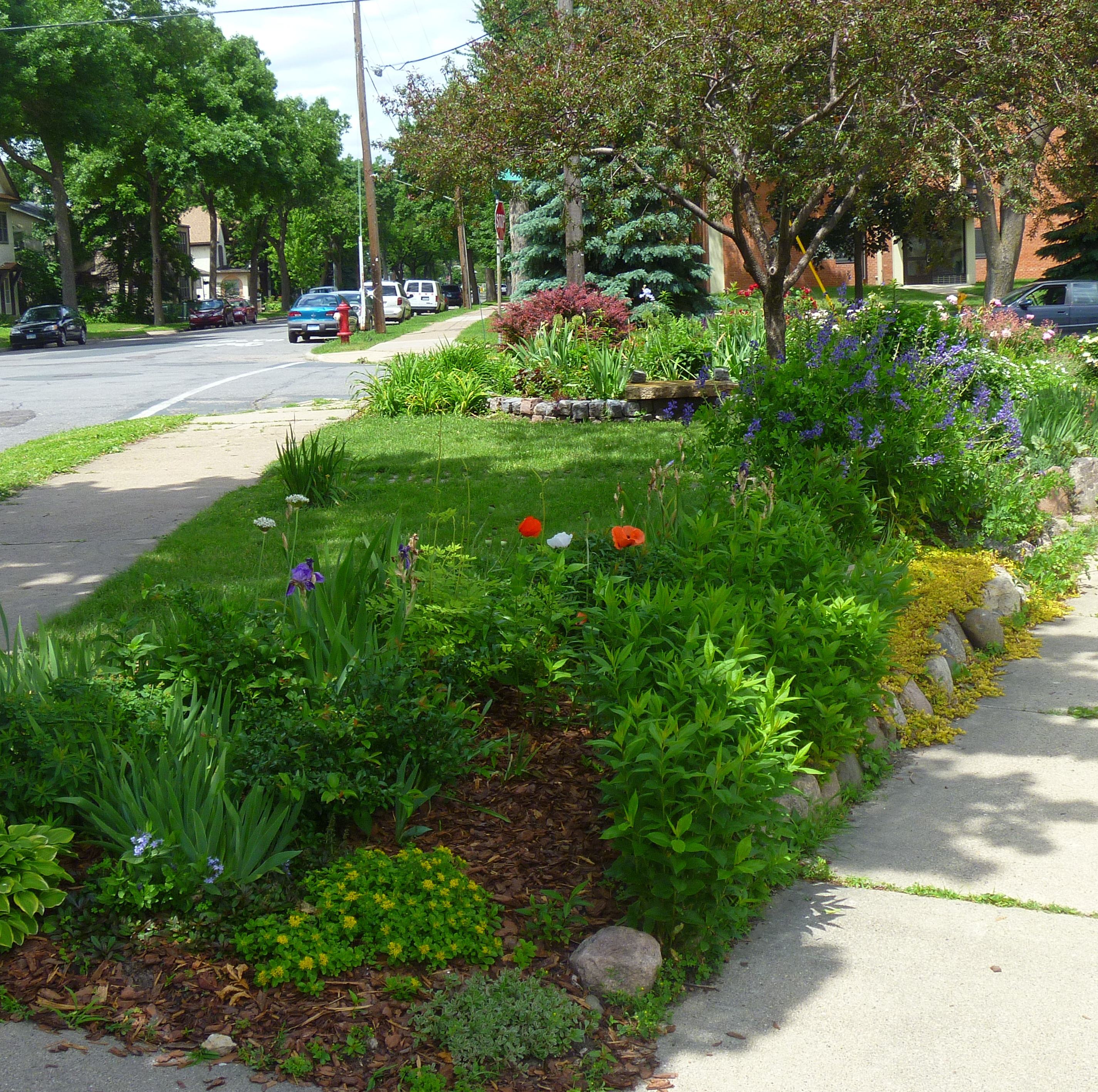
Sibley Triangle, May 30, 2012. Washington St. NE is on the right, 5th St. NE on the left.

Sibley Triangle from the east (Washington St. NE).
I’d love to hear from Robin and park stewards who beautify other parts of our park system. Tell us the story of your garden—and send photos.
David C. Smith
NOTE: Please see “Comments” for information on other gardens.
Bombers Over Lake Nokomis
Filed under: Minneapolis Golf Courses, Minneapolis Lakes, Minneapolis parks | Tags: Hiawatha Golf Course, Lake Hiawatha, Lake Nokomis, Wold Chamberlain Field
Comments (2) My favorite photo of Lake Nokomis was taken in 1932. The true subject of the photo was a squadron of Martin bombers visiting Wold-Chamberlain Field from Langley Field, Virginia, but beneath them is a fascinating scene of park developments.

The Martin Bomber was the first American airplane built specifically to carry bombs. First built during WWI, the biplane version of the bomber was replaced by a monoplane version designed in 1932. (Minnesota Historical Society)
The photographer isn’t listed in the Minnesota Historical Society’s database, but it may have been taken by J. E. Quigley Aerial Photography. Quigley produced most of the other aerial photos of Minneapolis from that era.
The bare ground at the left wingtip of the middle plane is the Hiawatha Golf Course under construction. The course didn’t open until 1934. Dredging in Lake Hiawatha had just been completed in 1931.
It doesn’t show up well at this size, but the Nokomis Beach is packed (beneath the front airplane). You can see the diving towers in the lake.
Also note how barren the Nokomis lakeshore is. It had been created from lake dredgings only 15 years earlier.
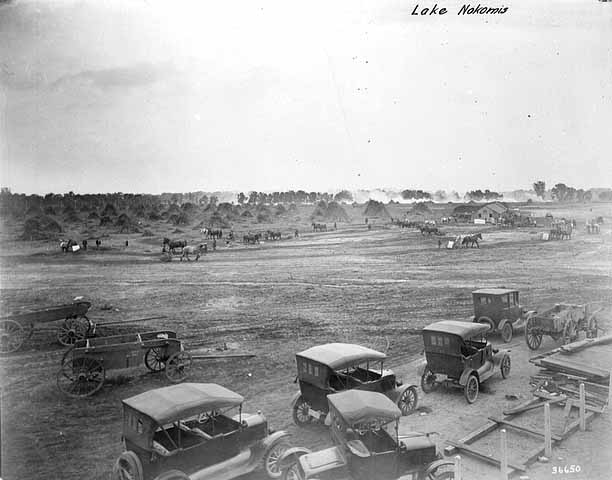
Four years after dredging was completed at Lake Nokomis and the dredge fill had settled, the park board cleared and graded the land. (Minneapolis Park and Recreation Board)
The dredge fill settled for four years before it was cleared of brush and willows that had grown up in the intervening years and the land was graded for athletic fields. The huge piles of brush in the background were burned. Of course the land was graded by horse teams. Even with that much time for the dredge fill to settle before it was graded, the playing fields continued to settle and were re-graded in the 1930s as a WPA project.
Even after ten years of tree growth, the lake shore doesn’t look very shaded in the 1932 photo.
The Cedar Avenue Bridge at the bottom of the aerial photo was the subject of great debate at the park board, Minneapolis City Council, the Hennepin County Board and Village Council of Richfield in the 1910s. Park superintendent Theodore Wirth’s plan for the improvement of Lake Nokomis in the 1912 annual report included rerouting Cedar Avenue around the southwest corner of the lake to eliminate a “very unsightly” wooden bridge over the edge of lake at the time. Even though the park board owned all the shores of the lake and the lake bed, the south end of the lake was then in Richfield, which is why the county and Richfield were involved in decisions on the bridge. Despite the park board position that building a bridge would be more expensive and less attractive, it was built—and paid for with Minneapolis bond funds—partly due to opposition by Richfield landowners to plans to reroute Cedar. By 1926 that line of opposition would have been partially removed when Minneapolis annexed about a mile-wide strip of Richfield that placed all of Lake Nokomis inside Minneapolis city limits.
David C. Smith
An Early Toro
Filed under: Minneapolis parks | Tags: Longfellow Field, Minneapolis Steel and Machinery Company, The Toro Company
Comments (1) I was just culling some old photo files and found a copy of an ad from Parks and Recreation magazine in 1921. I had clipped it thinking one day I might find a use for it. Well I already wrote the post I should have put it in — Longfellow Field — about the connection between Minneapolis Steel and Machinery Company and Toro and Toro’s shift from tractor engines to lawn care products. This must be one of the company’s earlier lawn mowers.
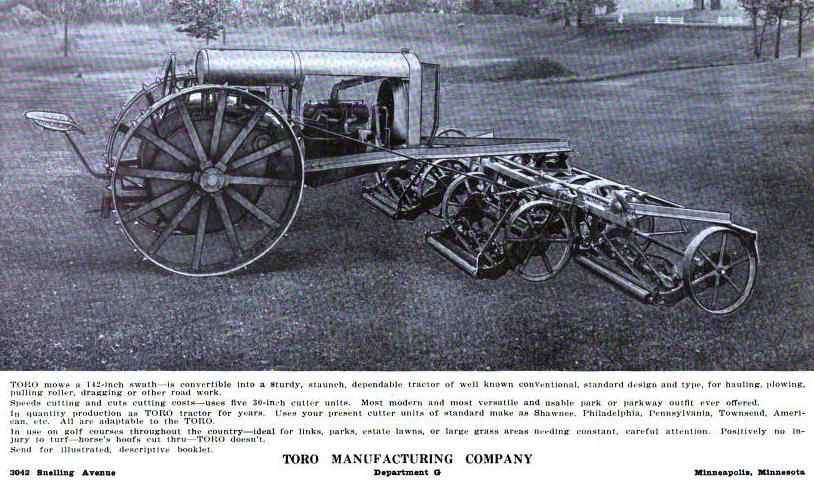
Toro was already selling lawn care tractors by 1921. (Parks and Recreation.)
But I forgot I had this image, so a month after it should have debuted, here it is. My favorite line in the ad copy is “Positively no injury to turf—horses hoofs cut through—Toro doesn’t.” Although those spikes on the big rear wheels look a bit destructive. Doesn’t offer all the modern-day comforts, does it?
Thanks again to Toro for contributing to improved baseball fields in Minneapolis parks.
David C. Smith
Note: Thanks to Bob Wolff for more history on The Toro Company, posted as a comment on David C. Smith page. Looking more closely at digitized Parks and Recreation magazines to respond to Bob, I discovered that the ad above appeared in 1921, not 1919 as I had originally posted.
Comments on Lyndale Pond comments (and a very hard quiz on Minneapolis parks)
Filed under: Minneapolis parks | Tags: Columbia Park, Lake of the Isles, Minneapolis Maps, Minnesota Digital Library, Powderhorn Park, Whittier Neighborhood
Comments (3) If you’re interested in the subject of a pond near Lyndale and Franklin, you might want to check out “comments” on the subject posted a few days ago. Some good information. Thanks to readers who responded and to Cheryl Luger for posing the questions in the first place.
I wanted to add that while investigating another subject I found an 1897 Minneapolis map produced by the city engineer that shows elevations. (A small section of that map is pictured below.) It’s also interesting to see where in the city you could get running water and why the city was installing water lines from a reservoir in Columbia Heights. Note the highest elevations in the city. To keep things in perspective the population of Minneapolis in 1900 was already more than 200,000. The 1890s was the first decade in four in which the population of Minneapolis didn’t nearly triple. Likely due to the depression set off in 1893.

Detail of 1897 Minneapolis map that shows parks, elevations, water lines and street car lines. (James K. Hosmer Special Collections Library, Hennepin County Library)
The complete map, as well as dozens more from around the state, are available at the Minnesota Digital Library, an excellent resource for researchers or the curious.
Unfortunately, this map has less topographical detail than the map suggested by Bill Payne in his comment on the previous article. It shows no remnant of the pond on earlier maps at Lyndale and 22nd, nor the depression that is noted there on the 1901 map Bill found. The 1897 city map shows elevation increments of 25 feet; the 1901 map shows increments of 20 feet, which may account for the difference.
Here’s the quiz
Many, many properties were added to the Minneapolis park system after this map was made in 1897. For instance, notice that there is no West River Parkway, nor a St. Anthony Parkway, nor a Victory Memorial Drive, and on and on. Most of the Grand Rounds hadn’t been built. (This map doesn’t even show Stinson Parkway, which did exist in 1897!) But there are three significant park properties on this map that are no longer park properties. Can you name them?
Click on “complete map” above, then zoom into various sections of the city to find the long-gone pieces of the park system. All were no longer park property by 1905. (Note: The island at the south end of Lake of the Isles is a good catch, but doesn’ t count because it’s still part of the lake and park. The same goes for the northern end of Powderhorn Lake, which once extended north of 32nd; it’s still part of the park. Same for Sandy Lake in Columbia Park; the lake is gone, but it’s still a park.)
Winner gets a free subscription to minneapolisparkhistory.com!
David C. Smith
NOTE (June 1, 2012): The contest is now over and Adrienne was the winner. She named Meeker Island in the Mississippi River as one park property on the map that is no longer. The other two were Hennepin Avenue South and Lyndale Avenue North. Both were parkways in 1897, but were given up by the park board in 1905. The city subsequently took responsibility for them as ordinary city streets.
CMPC: Park Property Monuments?
Filed under: Minneapolis parks, Minnehaha Creek | Tags: Minnehaha Creek
Comments (5) This week I was included in an e-mail discussion between MaryLynn Pulscher and Annie Olson at the park board and Daniel Fearn. Daniel had found two interesting metal markers in the ground near Minnehaha Creek.

Marker near Minnehaha Creek (Daniel I. Fearn)
Daniel wondered if CMPC was an acronym for City of Minneapolis Park Commission. My reaction, as well as MaryLynn’s, was that wasn’t likely because the park board until 1969 always marked everything BPC for “Board of Park Commissioners.” The Minneapolis was generally understood.
A web search, however, turned up a document from a Hennepin County Survey that indicates the CMPC stamp may have been used on park board survey monuments. On that document a monument with a similar marker found at 50th and Cedar during the Minneapolis City Survey in 1937 was called a “park board monument”
Do you know the real story of the CMPC markers? Have you seen other markers like this anywhere else in the city? Were they on park boundaries? Or do I have to call the county surveyor’s office to resolve this?
Send photos if you have ’em.
David C. Smith
Raise Your Hand If You’ve Visited Cavell Park
Cavell Park is one of the marvelous neighborhood parks that make Minneapolis so livable, but I would bet that few Minneapolitans know where it is or have seen it. I thought I should promote it a bit before I leave the topic of Minneapolis parks and WWI completely. The only connection in this case is the name of the park, because it didn’t become a park until 1968.

British nurse Edith Cavell was executed by the German army in 1915 for treason. (Wikipedia)
Edith Cavell was a British nurse running a hospital in Belgium at the outbreak of World War I. When the German army invaded Belgium, Ms. Cavell helped British, French and Belgian soldiers escape capture and reach safety in the Netherlands. As a nurse, she treated Allied and German soldiers, but her aid to escaping Allied soldiers led to her arrest and a charge of treason by the German army. She was held in prison for ten weeks as her case aroused outrage and indignation around the world. It did little good: she was executed by a German firing squad. Cavell— her name rhymed with travel—became a central focus of British propaganda efforts and, together with the German sinking of the passenger ship Lusitania, was used to depict the depravity of Germans, the barbarous “Huns” of an earlier article.

Edith Cavell School at 3425 Fillmore in 1948.
With the start of the 1918 school year, at the height of the Great War, the Minneapolis school board was faced with overcrowding at Thomas Lowry School in northeast Minneapolis. The solution was to build two temporary portable school houses in the district. In December 1918, less than a month after fighting in Europe ended, the school board suggested that what had been referred to as the Thomas Lowry Annex, be named for Cavell.
Edith Cavell School was a portable school building originally at Tyler and 35th Avenue NE. The portable school was closed in 1933 and a new, modest school was built three blocks east at 34th and Fillmore. That school, pictured above, closed in 1949. (See more photos on the history pages of the Minneapolis public schools website here.)
The park board had considered acquiring the site for a playground park in 1949, but in light of a 1948 cooperative agreement between the park board and school board to develop property together, the two boards opted to build a new school and park four blocks further east instead. That development became Waite Park and School.
The school board continued to own the Edith Cavell School site until 1968, when the park board acquired it for a new neighborhood park. It was the first of four former school sites acquired by the park board from 1968 to 1976. The park board also acquired the old school sites of Margaret Fuller School (now Fuller Park), Lyndale School (Painter Park), and Corcoran School (Corcoran Park), all during the controversial tenure of Robert Ruhe as superintendent of Minneapolis parks. A recreation shelter was built in the park in 1977. (I hope to write a good deal more about Ruhe. His style was abrasive, but his accomplishments were undeniable.)

Sledding at Cavell School about 1935. (Minnesota Historical Society)
For those of you who live in south or north Minneapolis and rarely venture across the river, I’d suggest a drive, hike or bike ride into northeast to visit Cavell Park. Audubon and Windom parks are worth visits too. They are all quite different from the mostly flat parks of south and north Minneapolis. If you are considering a bike ride, I’d recommend it only if you are a fairly strong rider because the hills of northeast could be difficult for some. The highest elevation in the city of Minneapolis is near Waite Park, so you’ll enjoy a good climb from the river.
Do you have a story about Cavell Park — or any of the great northeast neighborhood parks? We’d love to hear it as a coment on tis page. If you have photos, let me know; e’d love to see them.
David C. Smith
A Challenge for Wedge and Whittier Historians
Filed under: Minneapolis parks | Tags: Charles M. Loring, George Brackett, Lakewood Cemetery, Lyndale Avenue South, Whittier Neighborhood
Comments (9) A regular reader has asked a couple questions that I can’t answer, but perhaps someone else can. Why does Lyndale Avenue South from 19th to 24th street or so seem to run in a trench with the east-west cross streets rising steeply on both sides of Lyndale. Is there a geological explanation for it?
Also, was there ever a swampy area at Franklin and Lyndale, or nearby in Whittier, that was drained for park purposes? The park board was never involved in such an action, but perhaps an effort to create a playground or other playing field could have taken that direction before the park board took responsibility for playgrounds.
In the 1880s there was a baseball stadium that seated about 1300 near 17th and Portland, according to Minnesota baseball historian Stew Thornley, but that’s quite a distance east. Horace Cleveland was likely referring to that field when he wrote to William Folwell in 1884, “There’s no controlling the objects of men’s worship or the means by which they attain them. A beautiful oak grove was sacrificed just before I left Minneapolis to make room for a baseball club.” Cleveland’s words imply a clear dividing line between parks and playing fields. At that time, the two did not mix. (Folwell Papers, Minnesota Historical Society.)
The area a couple blocks northeast of Franklin and Lyndale—south of what became Loring Park—was the site selected by Charles Loring, William King, Dorilus Morrison and others for a private cemetery in the 1860s. Land speculators got wind of the plan, however, and drove the price of the land higher than the cemetery group would pay. Instead they looked for land further south and established Lakewood Cemetery in 1871 at its present site. Charles Loring wrote in a letter to George Brackett, both were among the founders of Lakewood, that the idea for a beautiful cemetery came to Loring as he buried his infant daughter in Layman’s Cemetery in 1863. (George Augustus Brackett Papers, Minnesota Historical Society.)
(Ask me a question about Minneapolis parks and I’ll probably work Loring and Cleveland into the answer!)
Any ideas on the topography of Lyndale Avenue South? Or a drained swamp near Lyndale and Franklin or elsewhere in Whittier?
David C. Smith
Who, Exactly, Were the “Huns”?
Filed under: Minneapolis parks | Tags: Francis A. Gross, Longfellow Field, Minneapolis Steel and Machinery Company, Theodore Wirth
Leave a comment Discussions of Minneapolis during World War I in a recent post have pointed to another factor that may have reinforced the willingness of the park board to sell the first Longfellow Field to Minneapolis Steel and Machinery as the company expanded to fulfill military contracts: Theodore Wirth, the superintendent of Minneapolis parks was a German speaker and, based on newspaper accounts from early in his tenure as parks superintendent in Minneapolis, he spoke English with a German accent.
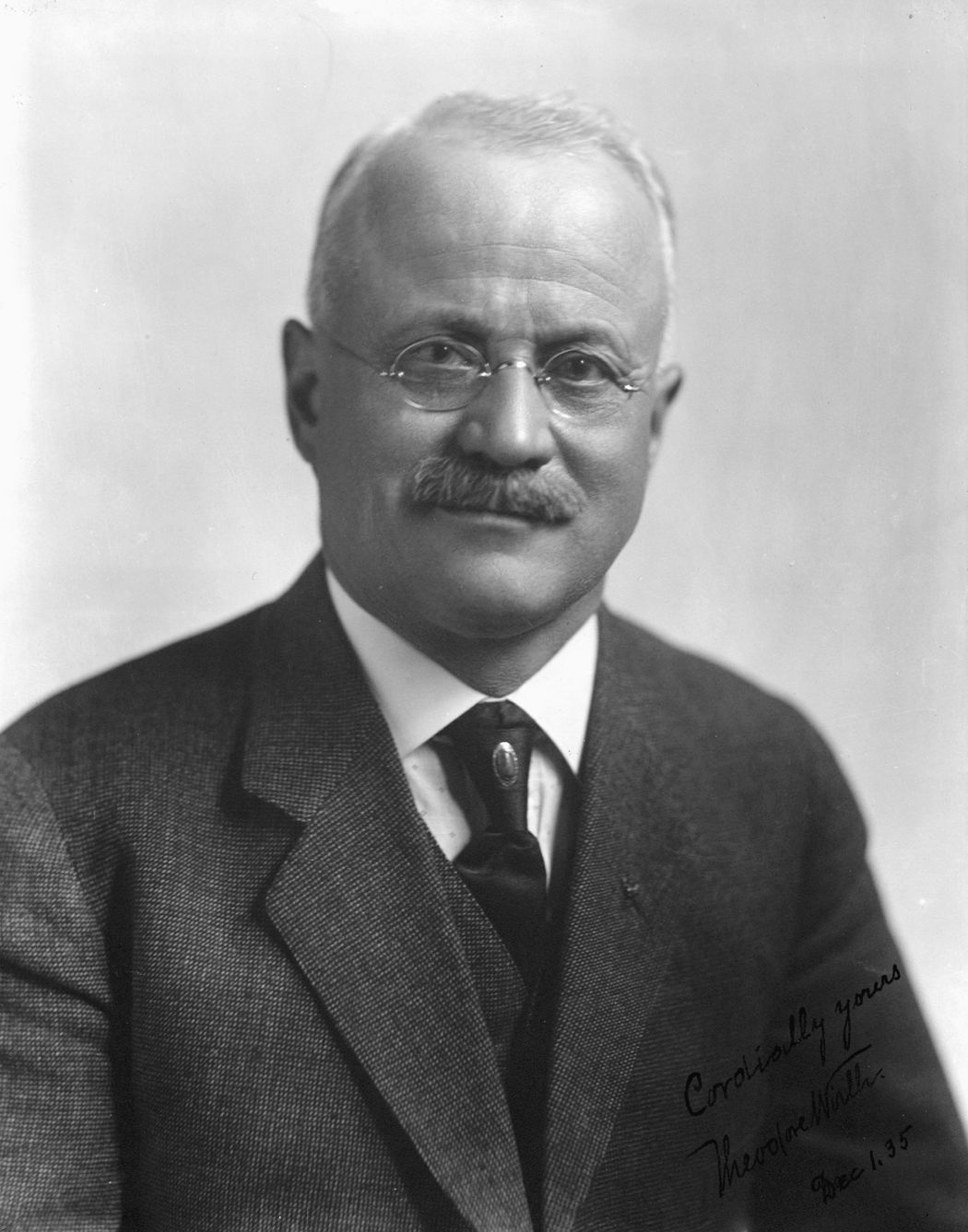
Theodore Wirth, Minneapolis parks superintendent, 1906-1935.
Not only did the president of the park board, Francis Gross, have close ties to German immigrants and descendants as president of the German-American Bank, and, presumably spoke German, based on accounts of his speeches, but the park board’s top administrator, Wirth, who was from Winterthur, Switzerland, only several miles from the German border, also spoke German. Seems suspicious, nein?
Even though Wirth had immigrated to the U.S. thirty years earlier, was not from Germany, and Switzerland was neutral during the war, I don’t know if those distinctions were known or made by most people. Could someone like Wirth have felt pressure to profess or demonstrate his “loyalty” to the U.S.—perhaps by agreeing to the sale of park land to a growing munitions maker?
Remember those were days of loyalty oaths, “Americanization” meetings, and arrests of “enemy aliens.” I recently read that the director of the Boston Symphony Orchestra, German-born Karl Muck, was arrested as an enemy alien in Cambridge, Massachusetts in March, 1918. He was accused of nefariously featuring too many German composers in his programs—damn that Beethoven!—and was suspected of using his score markings as a secret code. His claim that he was a naturalized citizen of Switzerland proved true, but didn’t keep him from being locked up in a prison camp in rural Georgia for 17 months. He had been offered a conducting job once by Kaiser Wilhelm. He was kept in prison for ten months after the end of the war that made the world safe for democracy, perhaps to ensure that he wouldn’t detonate a lethal Eroica in a crowded concert hall.
Wirth’s native tongue and the proximity to Germany of his hometown may have had no bearing on his standing in Minneapolis or on park board actions during WWI, but in a world where musicians could be locked up for their taste in fugues, it is not out of the question that it crossed someone’s mind. Especially when you read of speeches like those of former President Theodore Roosevelt on a stop in Minneapolis in October 1918. Minneapolis Tribune reporter George E Akerson wrote on October 8:
Theodore Roosevelt, American’s foremost private citizen, yesterday preached his gospel of thorough-going Americanism, to more than 15,000 persons in Minneapolis. At five different meetings, the former president, exhibiting all of his old time aggressiveness, delivered his message, never missing an opportunity to pillory the “Huns within our gates” along with the “Huns without.”

Theodore Roosevelt addressing more than 5,000 workers at Minneapolis Steel and Machinery, October 7, 1918. As WWI neared its end, Roosevelt urged vigilance against the “Huns within.” His black armband signified that he had lost a son in the war. (Minnesota Historical Society.)
Roosevelt was not referring specifically to Germans as much as to those he perceived as enemies of the U.S government, but that would have been a fine distinction to those reading the lead quoted above. The taint of all Germans, past and present, could easily be inferred. One of Roosevelt’s five speeches in his one-day stop in Minneapolis was at the munitions factory of Minneapolis Steel and Machinery, pictured above.
The derogatory “Hun” to describe Germans was derived from the Huns of Attila fame and equated with “barbarian.” Germans and Huns had little in common historically, but the term was a staple of Allied propaganda during the war. Some older warriors, such as Winston Churchill and Franklin Roosevelt, stuck with the term in WWII, but “Krauts” became the more popular alternative.
David C. Smith

 Minneapolis Park History