Archive for the ‘Minneapolis parks’ Category
Minnehaha Falls 1912: A Feather in the Cap
Filed under: Minneapolis parks, Minnehaha Falls | Tags: Minnehaha Falls
 Comments (3)
 Minnehaha Falls has been called the most-photographed site in Minnesota. Based on my study of photos and postcards over the last several years, I would agree. Still there’s often something a little different in the next photo I see — if not in the falls themselves, in something else that’s frozen in the moment the shutter opens.
Take this superb photo recently sent to me by Robert Henry. It was taken by his grand uncle Frank Prochaska, an amateur photographer, in 1912.

Minnehaha Falls, 1912 (Photographer: Frank Prochaska. Courtesy of Robert Henry.)
I like the photo because it shows someone on the bridge above the falls, the viewing platform to the left of the falls, which hasn’t existed for decades, a man and child near the cascade, and the wider flow of water over the lip of the falls. So much going on. But most of all I love the hats of the people on the stone-faced pedestrian bridge below the falls — and their postures. An instant of Minneapolis park history as six people witnessed it and Frank Prochaska captured it 103 years ago.
Thanks, Robert.
David C. Smith
Park Punctuation: King’s Highway, Bassett’s Creek or Beard’s Plaisance
Filed under: Minneapolis parks | Tags: Henry Beard, Joel Bassett, William King
Comments (3) One of those is wrong. One of the park property names—King’s, Bassett’s or Beard’s— shouldn’t have an apostrophe. I recently received an inquiry on one of those names and thought we might offer everyone this little quiz.
There are only two apostrophes found among all the official names of park properties in Minneapolis, not three. Which one is incorrect? The website of the Minneapolis Park and Recreation Board won’t be of much help.
William Smith King owned Lyndale Farm on the east shore of Lake Harriet. The highway named for him, a continuation of Dupont Avenue, runs past where his farmhouse and barns once stood in what is now Lyndale Farmstead Park. King was one of the most influential proponents of parks in Minneapolis and he served as a park commissioner in the 1880s. He later donated part of the Lake Harriet shoreline and much of the land for Lyndale Park just east of Lake Harriet
Joel Bean Bassett built his farm in the 1850s at the confluence of the Mississippi River and the creek in North Minneapolis named for him. The creek was sunk into a tunnel beneath downtown Minneapolis more than one hundred years ago. The name of the creek existed long before the park board acquired land along its banks in the 1930s.
Henry Beach Beard was an ordained minister who worked in Minneapolis primarily as a real estate developer. He owned much of the western shore of Lake Harriet and when the park board couldn’t afford to buy the lakeshore for a parkway, Beard and other landowners donated a strip of land around the lake for that purpose. Beard also donated the land for the picnic ground that now bears his name. By the way, “plaisance” is French for “pleasure”, or in this usage pleasure ground.
No other park named for a person—from Loring to Wirth, Brackett to Armatage—was encumbered with a possessive apostrophe.
David C. Smith
Something’s Missing at Lake Harriet
After my post yesterday of Margaret Hall’s letter and a Minnesota Historical Society photo of the tornado-damaged pavilion at Lake Harriet in 1925, I dug out my favorite Lake Harriet photo of all time. Notice what’s missing?

No pavilion!
This photo was taken very shortly after the Lake Harriet pavilion was destroyed. It’s the only photo I’ve seen of Lake Harriet’s north shore without a pavilion. A “temporary” replacement band stand was built the next summer so concerts could continue at the lake. That small band stand stood for 60 years.
A pile of rubble marks the spot in this photo where the pavilion once stood. It’s unlikely that a man as insistent upon beauty and efficiency as park superintendent Theodore Wirth would have allowed the rubble to remain for long, so this photo must have been taken in the few days after the storm in mid-July. Surprisingly, the storm appears not to have damaged the boat docks or boats, lending credence to claims that the pavilion was destroyed by a tornado, not straight-line winds.
Like many others who have developed an interest in local history, I have begun searching for photos that reveal more of the history of a place than one can find in written accounts. One of the best places to find photos — of a certain era — is on postcards. This photo comes from a vintage postcard I purchased. There is no attribution of the photo on the card. It was never mailed, although it was quite beat up. I cropped the creases and stains on the edges of this postcard.
If you have a favorite, non-commercial image of Minneapolis, especially parks, send me a scan or print and I’ll post it here. Please identify the photographer if at all possible.
David C. Smith
Memories of Lake Harriet
Filed under: Minneapolis Lakes, Minneapolis Park Memory, Minneapolis parks | Tags: Lake Harriet, Lake Harriet Pavilion, Lyndale Farmstead, Lyndale Park
Comments (8) The following letter, dated July 9, 2014, was addressed to the Minneapolis Park and Recreation Board:
On July 4, 2014 my daughter sent me pictures of two of my great grandsons enjoying the holiday at Lake Harriet. I recently celebrated my 95th birthday and those pictures brought a deluge of memories to me. My two sisters and I grew up on Bryant Ave. So. in the 4100 block, just a few blocks from Lake Harriet, Lyndale Park and Lyndale Farmstead.
One of my early memories is from the early 1920s when dinners were served in the old pavilion where the modern band shell now stands. It was July 8, 1925 and my father decided it looked too stormy to go to dinner at the pavilion. That evening a tornado struck the area and the pavilion was devastated. Several lives were lost when the pavilion collapsed. I was 6 years old but I remember walking around the lake several days later and seeing the damage to the trees and the lake shore.
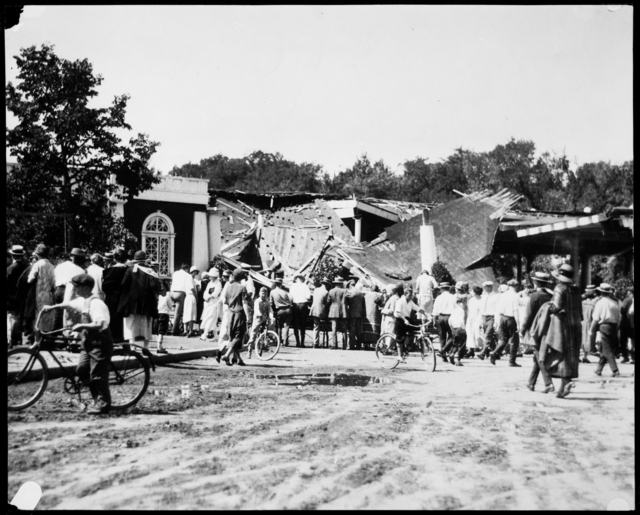
A storm destroyed the Lake Harriet Pavilion in 1925, resulting in two deaths. (Minnesota Historical Society)
There is no continuity to these memories as I write them down. Walking to the lake in the early spring and the scent and beauty of the lilacs along King’s Highway. The rose garden in summer which still looked the same in the pictures with the boys. The walk through the woods on the bridle path with the sounds and sights of the birds in the bird sanctuary.
The many picnics we had as a family by the lake and the band concerts that climaxed the day. The salt-water taffy, popcorn and balloons, the walk home along the lake shore through the park where it seemed there were always fire flies lighting our way. Often we left before the end of the concert and if the wind was right, we could hear the band playing the Star Spangled Banner and we knew the concert was over. All summer we swam at the 48th Street beach
I also recall when the launch on Lake Harriet was part of the Minneapolis Street Car Company and made stops at the docks at Penn. Ave., Morgan Ave., 48th Street and 43rd Street. We enjoyed coming from downtown on the Oak Harriet line and transferring to the launch at the pavilion for a cool ride home on a hot summer day, and a short walk home from the 43rd Street dock.
In the winter our sleds were on the easy slopes in the park adjacent to the rose garden. When we grew older, we advanced to Lyndale Farmstead and dared to slide on King’s Hill. At that park we skated all winter, played tennis in the summer and enjoyed the chrysanthemum gardens in the fall.
Another memory of Lyndale Park was the annual pageant with acts from every park in the city. The pageant was magic in the eyes of children.
Over the years I have made many trips back to the Bryant Ave. home. My mother and I would walk around the lake and my children and grandchildren would enjoy the same things I did as a child.
Theodore Wirth’s dream of a park within 6 blocks of every home in Minneapolis has been perpetuated and I, at 95, can from my home in Alaska live these memories.
Margaret J. Hall, Kodiak, Alaska
Note: I was given this letter recently at a meeting at the park board, so I wrote to Ms. Hall to ask her permission to reprint it here. Because the letter was nearly a year old and Ms. Hall was 95 when she wrote it, I wasn’t sure if I would get a response. I was delighted to receive a letter from her this morning granting permission to publish her letter.
She added:
When I got your letter I went to my computer and looked at your blog. (Yes, I do have a computer, but I still prefer letter writing.) More memories immediately came. My letter only included the parks within walking distance of our home and didn’t include the street car rides to Minnehaha Park and all its magic, Sunday rides to Loring Park, and to Powderhorn Park for the fireworks.
As I approach my 96th birthday on June 15th, I think of an ideal celebration: a picnic at Lake Harriet, a ride on the launch, and a band concert in the evening.
Thanks for sharing your memories with us, Margaret. So much has changed in the last century, yet some things endure.
David C. Smith
The Princess Depot at Minnehaha Falls
Filed under: Minneapolis parks | Tags: Charles Loring, Minnehaha Falls, Princess Depot, Richard Kronick
Comments (2) Guest post by Richard Kronick:
The Princess Depot is one of the best examples in the Twin Cities of the Eastlake style of architecture, which is named for the English architect and furniture designer, Charles Locke Eastlake.
In his 1872 book, Hints on Household Taste, Eastlake thundered against the florid and highly popular Italianate style:
“The so-called Italian style — now understood to include every variety of Renaissance design which prevailed in Rome, Venice, and Florence, from the sixteenth to the eighteenth century — has its aesthetic merits and its practical advantages. But they are merits and advantages which are unsuited to the age, to the climate, and to the country [Britain] in which they are reproduced. It does not require the judgment of an accomplished connoisseur to perceive that mouldings and carved enrichments which look well under the glowing effect of a Venetian sky, must appear tame and spiritless through the leaden atmosphere of London.” Hints on Household Taste, pp. 19-20.
Eastlake preferred Gothic Revival for buildings and Arts & Crafts (an outgrowth of the Gothic Revival) for furniture. He said Gothic automatically projected a sense of dignity and rectitude because it was based on church architecture. His book is illustrated with his furniture designs, which carpenters in England and America copied and adapted to their own needs in the 1870s and 80s.
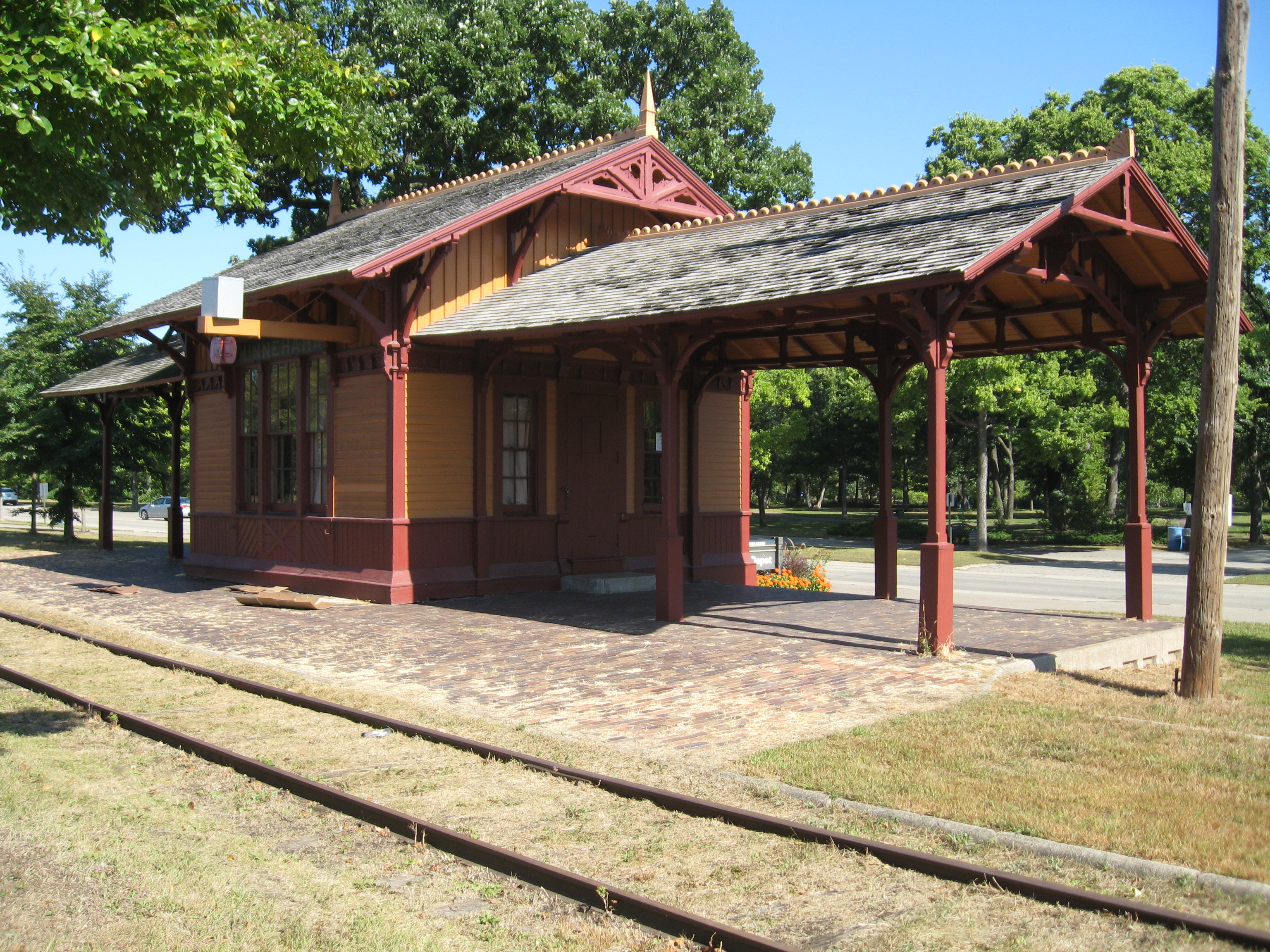
Princess Depot at Minnehaha Falls (Richard Kronick)
The style is characterized by relatively flat wooden surfaces (as compared with the more voluptuous Italianate style) covered with a combination of incised and built-up geometric patterns in rhythmically repeating borders between panels and on bargeboards and roof ridges.

Closeup of detail on Princess Depot at Minnehaha Falls. (Richard Kronick.)
Often, as in the Princess Depot, the crowning ornament is a complex wooden lattice-work inserted under the overhanging eaves — a tour-de-force by a master carpenter. The other great example of the style in the Twin Cities is the Charles Burwell House in Minnetonka Mills.
Richard Kronick
Note: Richard Kronick is a writer and architectural historian. He will be leading a walking tour of Red Cedar Lane in southwest Minneapolis on May 30 as a part of Preserve Minneapolis’s summer program.
If you didn’t get into Richard’s tour above, here’s more chances to join his tours. These are sponsored by Independent School District 728 (Elk River):
Two additional notes:
One of the earliest entries on this blog was essentially a question: Did the Princess Depot burn down in 1891? Recent information found by Karen Cooper, which she presented as a comment on that blog post, suggests that it was the “motor line” depot or waiting room, not the Milwaukee Road depot, that burned down as the Minneapolis Tribune had reported. I think that mystery is solved. The information Richard presents above also suggests that the depot’s architectural style was more consistent with the 1875 time of the original construction rather than with a depot that would have been rebuilt in the 1890s.
Richard’s mention of the Charles Burwell House in Minnetonka Mills reminds me that Burwell was the manager of the Minnetonka Mill in the 1880s, which was owned by Loren Fletcher and Charles Loring, who both played central roles in the development of Minneapolis parks. Even after Fletcher and Loring sold the mill, Burwell continued to work for them. I recall considerable correspondence in Minnesota Historical Society files among Loring, Burwell and William Watts Folwell in later years when proposals were on the table to change Minneapolis’s charter in a way that would have eliminated the park board. It was obvious from those communications that Burwell was acting as Loring’s employee and agent in those discussions. Charles Burwell named his first son Loring Burwell. You see, I can turn almost any topic into a tribute to Charles Loring!
David C. Smith
Last Minute Reminders: Minnehaha Falls and the Minneapolis Institute of Arts
Filed under: Minneapolis parks, Minnehaha Falls | Tags: Karen Cooper, Linden Hills History Study Group, Minneapolis Institute of Arts, Minnehaha Falls
Comments (2) In case you forgot.
Karen Cooper is speaking tonight at 7 at St. John’s Episcopal Church on Sheridan Ave. South and 42nd on Minnehaha Falls. Still plenty of time to grab a bite to eat and get to Linden Hills. Should be informative. Karen has promised some new revelations about the history of Minneapolis’s most famous park and she has a library of great photographs of the park and falls.
I will be speaking Saturday morning at 11 at the Minneapolis Institute of Arts. The title of my presentation is Arts and Parks: Culture and Beauty on the Frontier. I’ll talk about the indefatigable promoters of both fine arts and parks in the early history of Minneapolis.
Hope to see you at one or both.
David C. Smith
Minneapolis Park History Update
Filed under: Minneapolis parks, Minnehaha Falls, Mississippi River | Tags: Minnehaha Falls, Mississippi River Gorge, St. Peder's Danish Evangelical Lutheran Church
Leave a comment I enjoyed seeing many of you last Monday night at St. Peder’s Church for the Longfellow Community presentation on the Mississippi River Gorge. I promised Carolyn Carr that I would provide a brief synopsis of my presentation and post a few of the photos here. And I will. But first I wanted to post a photo I forgot to include in my presentation.
As a tribute to our hosts on Monday night, I wanted you to see this wonderful photo from the Hennepin County Library special collection. I haven’t given a proper plug to the library or the historical society in a while. They remain marvelous resources. If you haven’t visited Special Collections at the Central Library or the library at the Minnesota History Center in St. Paul, you really should. Take some time for the exhibits at the history center too. And for those of you who prefer to shop locally, you can buy your copy of City of Parks in their book store instead of online! Can’t beat that.

The congregation of St. Peder’s Danish Evangelical Lutheran Church at Minnehaha Falls in 1886 — before the falls became a park. Some parishioners must have had large families of daughters. (Hennepin County Library, Special Collections)
Thanks to the descendants of those in the picture, physically or spiritually, for providing the venue for last Monday’s meeting.
Speaking of special collections at the Central Library, it looks as if I may reprise—and embellish—my presentation on the Mississippi River Gorge at the Library on October 3. I hope to travel this summer to libraries in other parts of the country to continue my research into the life and work of H.W.S. Cleveland, so I may have some new nuggets for that presentation. I’ll keep you posted.
David C. Smith
Minneapolis Park History Live!
Filed under: Minneapolis parks, Mississippi River | Tags: City of Parks, H.W.S. Cleveland, Minneapolis River Gorge
Leave a comment One of my favorite Minneapolis park history topics, the Mississippi River Gorge, will be the subject of an illustrated presentation by yours truly next Monday night, March 23, at St. Peder’s Lutheran Church, 4600 E. 42nd St. The curtain rises at 7 p.m.
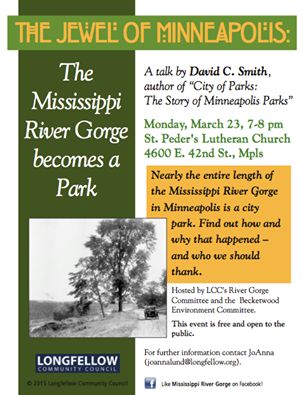
And if you want to hear more, on a different topic, I’ll be speaking at the Minneapolis Institute of Arts, Saturday, May 9. Click the link above and put it on your calendar. I’ll remind you!
I hope you’ll stop by, introduce yourself, ask the burning question that’s been nagging you about parks, or tell me your park story.
Copies of City of Parks will be for sale with all proceeds going to the Minneapolis Park and Recreation Board. I’d be happy to sign one for you.
David C. Smith
Monument Men: Minneapolis Park Board Property
Filed under: Minneapolis parks | Tags: Minneapolis Park and Recreation Board, Minnehaha Parkway, Northeast Athletic Field Park
Comments (1) I received a note today from Craig E. Johnson that might help solve a mystery from 2012 when I posted another note about an unusual marker found near Minnehaha Parkway.
“I’m a land surveyor and work for Clark Engineering in Golden Valley. We recently did a survey of the Northeast Athletic Field Park in Minneapolis where we found a monument similar to the ones you were asking about in a blog in 2012. I thought you might be interested in a photo, this monument was found on a park boundary.”
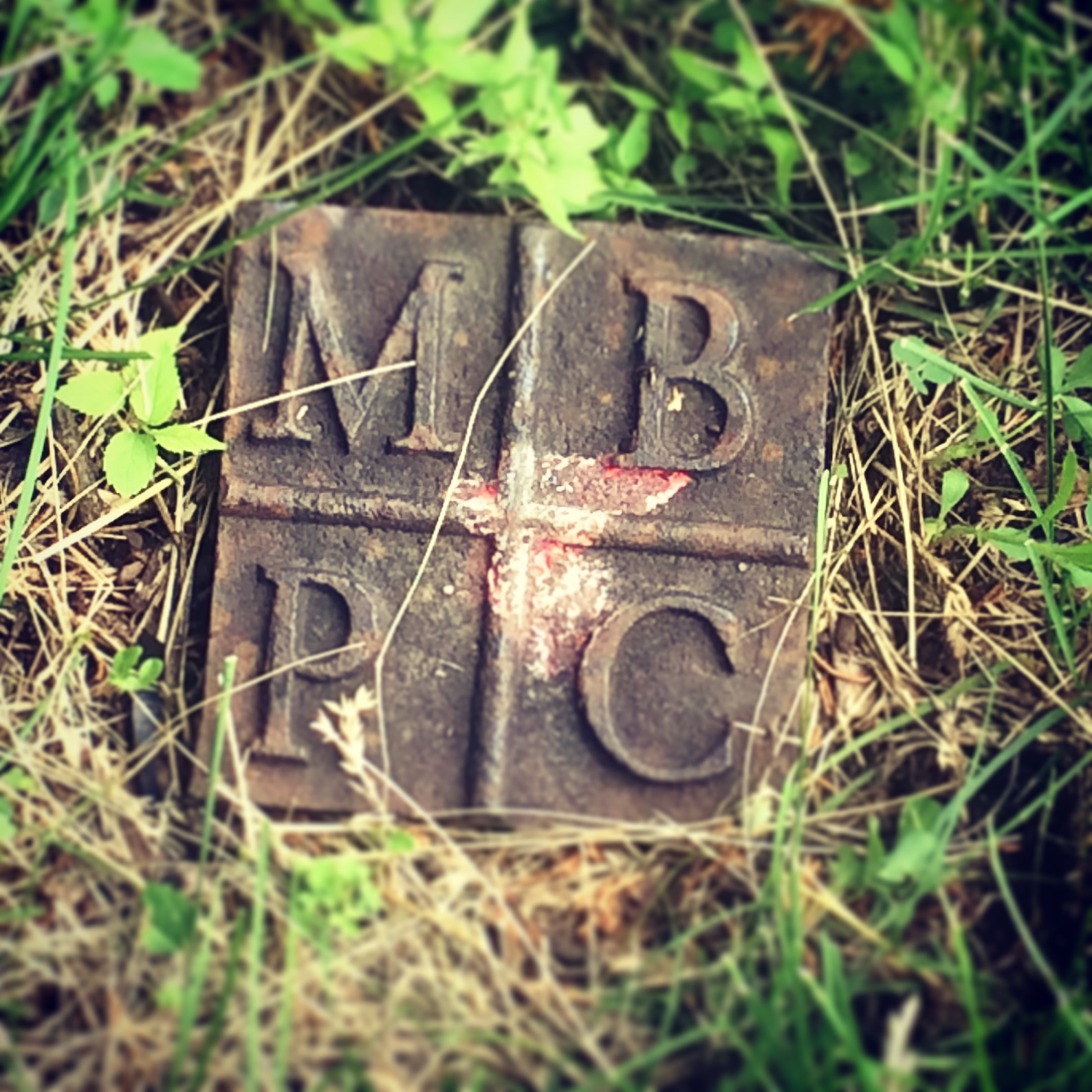
The property marker Craig Johnson found in Northeast Athletic Field Park is, he says, “almost certainly” a park boundary marker.
The letters MBPC on the marker probably stand for “Minneapolis Board of Park Commissioners”, the official name of the park board until 1969, when it became Minneapolis Park and Recreation Board or MPRB.
While the letters and type face on the marker found near Minnehaha Parkway are different—CMPC—the design is the same, which suggests they may be related. The Minnehaha Parkway marker appears much older, which would make sense as that property was acquired by the park board, therefore surveyed, about sixty years before Northeast Park. The park board acquired most of Northeast Park in 1941, at no cost, from the state of Minnesota as tax-forfeited property. Most improvements were delayed, however, until well after World War II.
To catch up with the exciting changes taking place now at Northeast ,visit the park board’s website.
Thanks for the info and photo, Craig.
David C. Smith
© 2015 David C. Smith
Minneapolis Park and Recreation Board Annual Reports and Proceedings Online
Filed under: Minneapolis Park History Resources, Minneapolis parks | Tags: Hathitrust, Hennepin County Library Minneapolis Collection, Minneapolis Park and Recreation Board, Minnesota Digital Library, Warren Manning
Comments (4) Something I’ve been meaning to do for some time: publish a list of and links to the annual reports and proceedings (minutes) of the Minneapolis Park Board that can be found online. These were scanned and published by Hathitrust and Google Books.
Here’s the really great news: the Park Board, Hennepin County Library and Minnesota Digital Library are talking seriously about scanning and publishing online more of the annual reports, even beyond those that are in the public domain (pre-1923). If that is done, it could include many of the maps, plans and images that have been skipped or scanned poorly in already published efforts. It could also include the informative and insightful reports of the 1880s and 1890s not yet scanned and listed below. That would be a marvelous service to historians interested in local parks as well as those investigating national and international park developments.
The list below corrects some labeling errors on the various sites. If you find any errors remaining in this list or know of any other sites that provide additional information, please send it to me and I will post it in comments or as a follow-up.
| Year | Document | Site |
| 1883 | 1st Annual Report | Hathitrust |
| 1888 | 6th Annual Report | Hathitrust |
| 1890 | 8th Annual Report | Hathitrust |
| 1892 | 10th Annual Report | Hathitrust |
| 1893 | 11th Annual Report | Hathitrust |
| 1895 | 13th Annual Report | Google Books |
| 1895-1902 | 13th-20th Annual Reports | Hathitrust |
| 1896 | Proceedings | Hathitrust |
| 1897 | 15th Annual Report | Hathitrust |
| 1897 | Proceedings | Hathitrust |
| 1898 | Proceedings | Hathitrust |
| 1899 | 17th Annual Report | Hathitrust |
| 1899 | Proceedings | Hathitrust |
| 1900 | 18th Annual Report | Google Books |
| 1900 | Proceedings | Hathitrust |
| 1901 | 19th Annual Report | Hathitrust |
| 1902 | 20th Annual Report | Hathitrust |
| 1903 | 21st Annual Report | Hathitrust |
| 1903-1909 | 21st-27th Annual Reports | Hathitrust |
| 1905 | 23rd Annual Report | Hathitrust |
| 1906 | 24th Annual Report | Hathitrust |
| 1907 | 25th Annual Report | Google Books |
| 1907 | Proceedings | Hathitrust |
| 1908 | 26th Annual Report | Hathitrust |
| 1909 | 27th Annual Report | Hathitrust |
| 1910 | 28th Annual Report | Hathitrust |
| 1910-1913 | 28th-31st Annual Reports | Hathitrust |
| 1910 | Proceedings | Hathitrust |
| 1911 | 29th Annual Report | Hathitrust |
| 1912 | 30th Annual Report | Hathitrust |
| 1913 | 31st Annual Report | Hathitrust |
| 1913 | Proceedings | Hathitrust |
| 1914 | 32nd Annual Report | Hathitrust |
| 1914-1916 | 32nd-34th Annual Reports | Hathitrust |
| 1914 | Proceedings | Hathitrust |
| 1915 | 33rd Annual Report | Hathitrust |
| 1915 | Proceedings | Hathitrust |
| 1916 | 34th Annual Report | Hathitrust |
| 1916 | Proceedings | Hathitrust |
| 1917 | 35th Annual Report | Hathitrust |
| 1917-1921 | 35th-39th Annual Reports | Hathitrust |
| 1918 | 36th Annual Report | Hathitrust |
| 1919 | 37th Annual Report | Google Books |
| 1920 | 38th Annual Report | Hathitrust |
| 1921 | 39th Annual Report | Hathitrust |
| 1922 | 40th Annual Report | Hathitrust |
Observation: these reports come from many libraries, but my favorite stamp is in the 1919 Annual Report from the library of landscape architect Warren G. Manning. Manning’s work around the country included several projects for the Minneapolis park board. Look in the 1899 annual report for Manning’s recommendations on the Minneapolis park system.
A note on using the annual reports and proceedings: search the annual reports first to find the years of acquisitions or improvements in specific parks, then go to the proceedings from those years to find more detail. Using the multi-year reports list above can speed general searches, but it’s easier to find specific references in the single-year reports.
Perhaps within this year many more park board records and images will be available online. Research will be so much easier!
David C. Smith
© 2015 David C. Smith
Frozen Falls: Minnehaha in Winter
Filed under: Minneapolis parks, Minnehaha Falls | Tags: Charles Zimmerman, Minnehaha Falls
Comments (8) A frozen Minnehaha Falls has always intrigued people. Many photos exist of the falls in winter, including those published recently in the StarTribune that created a ruckus. Several shots of the ice wall were popular as postcards in the early 1900s, such as the one below.
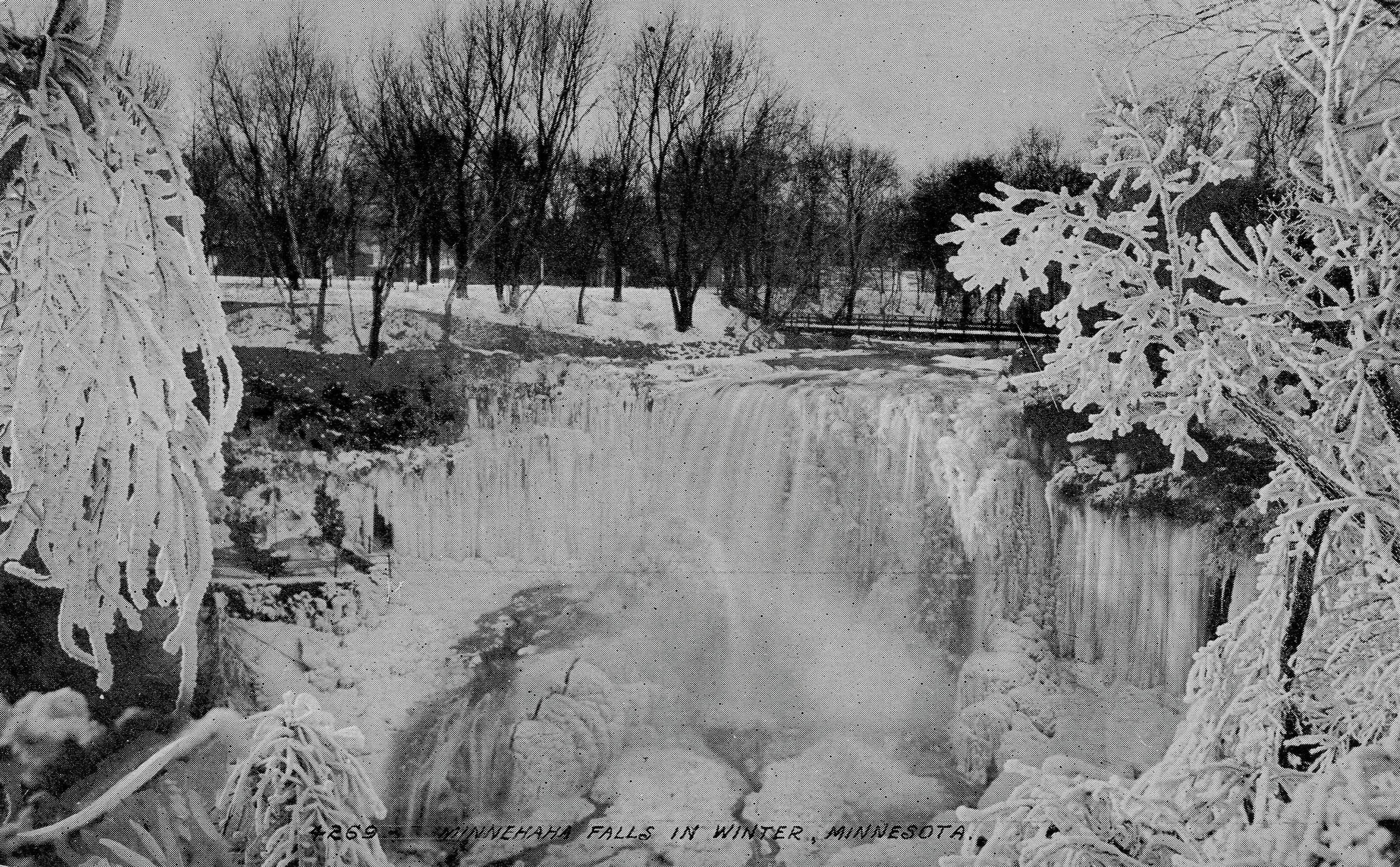
Minnehaha Falls on a postcard around 1910.
I recently received a photo from Edward Tobin Thompson of Maple Grove that I like as well as any.

Minnehaha Falls in January, 1899. (Photo courtesy Edward Tobin Thompson)
The photo, dated January 15, 1899, comes from an old family photo album. Ed doesn’t know who is standing at the foot of the falls, but it is likely the same man pictured on the park bench below, a photo that carries the same date and inscription on the back.

Resting on a bench in Minnehaha Park, January 1899. Judging from the hat, this may be the same man posing in front of the falls. (Photo courtesy Edward Tobin Thompson)
Ed guesses that the man is one of his Tobin ancestors. The Tobins immigrated from Ireland and settled in Wisconsin about 1846, he says. They later lived in the Upper Peninsula of Michigan before moving to Montana.

An imitation Minnehaha Falls? Date and place unknown. (Courtesy Edward Tobin Thompson)
Ed also sent this photo of a waterfall without a label from the same album and he wondered if it could be Minnehaha Falls as well. I don’t think so because in hundreds of pictures I’ve never seen the lip of the falls or the pattern of falling water like this, or the pool of water below the falls so large. Any opinions? Are you watching, Karen Cooper? (Karen has to be the world’s leading authority on images of Minnehaha Falls.) If not Minnehaha Falls, what falls? Any other cataracts in Wisconsin or Minnesota like this? Send in your guesses.
Danger Under the Falls
When photos appeared in the StarTribune recently of people behind the frozen falls, it brought to mind a story from Frank Leslie’s Illustrated Newspaper dated December 25, 1869, which was featured in Minnesota History, the magazine of the Minnesota Historical Society.

An engraving of photographer Charles Zimmerman being knocked unconscious by an icicle, November 28, 1869.
The article described a near tragedy when the falls wasn’t completely frozen. The article was illustrated by the engraving at right. This is how the events involving well-known photographer Charles Zimmerman were originally described in the newspaper:
“Wishing to obtain winter views of a place Longfellow has immortalized in his classic verse, Mr. Zimmerman passed under the falls. An hour later, a Mr. Haines, while exploring the rocks, happened to look behind the curtain of water as it leaped from the edge of the precipice to the abyss beneath and was startled by what he saw. A large icicle weighing between two and three hundred pounds, loosened by the thaw, had severed its connection with the roof above, and had fallen on Mr. Zimmerman, crushing him down, and leaving him insensible beneath it. Mr. Haines quickly relieved the prostrate artist, whom he found nearly frozen. Indeed, had succor been delayed half an hour longer, the unfortunate man would have most certainly died.”
The photographer conked on the head by the giant icicle, Charles Zimmerman, became one of the most prolific shooters of scenes in St. Paul and Minneapolis in the late 1800s. Most of his photographs were sold as stereoviews, the side-by-side photos that took on a 3D appearance when viewed through a stereoscope. If Zimmerman had perished that day under the ice of Minnehaha Falls we would not have nearly so thorough or enjoyable a record of life in Minneapolis in the 19th Century.
Don’t Be Left Insensible
I’d recommend that you not climb up under the falls either. (It is illegal!) Maybe you will do something memorable someday, as Charles Zimmerman did, if you live a little longer.
David C. Smith
© 2015 David C. Smith
1911 Minneapolis Civic Celebration: Junk Mail
Filed under: Minneapolis Lakes, Minneapolis Park Board, Minneapolis parks | Tags: 1911 Minneapolis Civic Celebration, Cedar Lake, Chain of Lakes, Kenilworth Lagoon, Lake Calhoun, Lake of the Isles, Southwest LRT
Leave a comment I have neglected these pages in recent months, yet I have so many good park stories to tell, some of them from readers. I will get to them soon I hope. In the last eight months I have discovered more fascinating information about Minneapolis parks and the people who created them than at any time since my initial research for City of Parks. But until I can get to those stories, I wanted to show you one of the more interesting bits of history I’ve encountered recently. Garish, but oddly charming.
The images below are of a promotional envelope used by a Minneapolis merchant in advance of the July 1911 Civic Celebration that was conceived primarily to celebrate the digging of the channel that connected Lake Calhoun with Lake of the Isles — as is noted at the bottom of the envelope. I found these images on an Ebay auction site and use them with permission of the seller of the envelope who sells mostly postal history under the name of “gregfree”. This envelope is for sale at an opening bid of $150 — more than I can pay. I appreciate gregfree’s willingness to let me share the image with you. Maybe you should buy it. If you do, thank him for me.

A promotional envelope used by a Minneapolis merchant. One of the objectives of the Civic Celebration was to give businesses an opportunity to contact, perhaps entertain and certainly solicit business from their clients throughout the region.
I love the background in green, a photo of the Stone Arch Bridge and Mill District, laid over a map of the city that shows the Chain of Lakes and Minnehaha Creek meeting the Mississippi River in the lower right corner.

The back of the envelope is an advertisement for Minneapolis, and from my perspective the lede is not buried — “Public Park System Unequalled.” That puts the emphasis exactly where it should be!
It’s nice to know that Minneapolis also had the lowest death rate in the United States. How that was measured, I’m not sure.
The coincidence of me finding this image now has a bit of Ouija-Board spookiness to it, because the lake connections have been on my mind — and in the news — a good bit lately. The channel that was celebrated 103 years ago between Isles and Calhoun has been in the news because the developer of a residential building at Knox Avenue and Lake Street has been pumping millions of gallons of water from a flooded underground parking garage into that channel, which has prevented it from freezing and caused considerable increase in phosphorous levels in the lake. More phosphorous means more algae. The Park Board and the City have sued to stop the pumping. Good! Such negligence on the part of a developer is astonishing. Hmmm, what do you think might happen if you put a parking garage below the water table between two lakes? I’m no engineer, but I think I’d be a tad suspicious of anyone who told me, “Hey, no problem.” The next time you hear people complaining about too much government regulation, ask them if it’s cases like this that they have in mind? I hope the Park Board uses every weapon at their disposal in this case to protect our lakes.
The other lake connection issue is not so clear-cut, but may be more important. That is the issue of tunneling under or bridging over the Kenilworth Lagoon that connects Lake of the Isles and Cedar Lake in order to build the Southwest LRT.
The history of other interests, public and private, wanting to take a little park land here or there for this or that good idea is long and sordid. For decades the park board has had to fight those who wanted just an acre or a little easement across park property. If the Park Board had acquiesced, all we’d have left of a magnificent park system would be a couple triangle parks. The reasons for taking park land have often been legitimate. For instance, I’m strongly in favor of better mass transit in Minneapolis and the entire Twin Cities metro area, but only if it doesn’t harm parks — or even the notion of parks. Is a tunnel or a bridge over Kenilworth channel better for the LRT? That question and a hornets nest of others, isn’t the right place to start. The only place to start in my very prejudiced opinion is with “Will it harm park property?” If the Park Board determines that the answer to that question is “Yes,” it is obliged to oppose those plans with all its might — regardless of how small the “harm.” Because in historical terms, “harm” seems more than precedent, it is invitation.
I have more to write about the issue. Did you know that the Park Board once went to the United States Supreme Court to prevent the State of Minnesota from taking Minneapolis parkland? True story. Til then quite an interesting envelope. Thanks again gregfree.
David C. Smith
© 2014 David C. Smith

 Minneapolis Park History