Friday Photo: Forgotten Field on Nicollet Island
Filed under: Minneapolis parks, Mississippi River | Tags: DeLaSalle High School, Nicollet Island
 Comments (2)
 Funny that in all the debate a few years ago about the football “stadium” for DeLaSalle High School on Nicollet Island, I don’t recall seeing the photo below of the island in 1947. I discovered this photo in Borchert Library’s Minnesota Historical Aerial Photos Online that I wrote about last week.
Nicollet Island clearly had a baseball field adjacent to the high school long before the park board acquired much of the island.

Detail of Nicollet Island, 1947, with a baseball field in the middle. For the full image go here, then click on the green push-pin north of Nicollet Island. (John R. Borchert Map Library, University of Minnesota)
I do recall great distress caused by the possibility of closing “historic” Grove Street across the center of the island in order to install the football field. But no one mentioned then that the eastern half of Grove Street that was to be closed had been historically (among other things) the left field fence of a baseball field. I had no idea. The things you learn from photos.
The photo demonstrates that some claims from both sides of the football field argument were wrong. Those who opposed the field in part for fear of losing a historic street were more than 60 years late to that argument. On the other hand, those who claimed that DeLaSalle, in its 100-year history, had never had a home athletic field were wrong, too. Maybe they didn’t have a football field to call home, although it looks as though one might have been squeezed in there in the ’40s, but they obviously did have a home baseball field at one time.
For the earliest plans for a park on Nicollet Island see previous posts on Horace Bushnell, the first person to suggest it, and the first ideas for parks upriver from St. Anthony Falls.
I don’t know who actually owned or maintained the field in the 1940s. Something to investigate. Some old “D” yearbooks must have more photos.
David C. Smith
© 2013 David C. Smith
Friday Photos: Thousands of Historical Aerial Views
Filed under: Minneapolis Park History Resources | Tags: Borchert Map Library, Minnehaha Auto Tourist Camp, Minnehaha Falls, Minnesota Historical Aerial Photos Online, University of Minnesota Digital Content Library
Comments (8) The closest thing to time travel. That’s what today’s photo recommendation gives you through more than 100,000 photos that allow you to track the growth of Minneapolis — and the rest of the state — from the sky.
I’m not aware of any larger local source of aerial photography than Minnesota Historical Aerial Photos Online (MHAPO). The collection is part of the John Borchert Map Library at the University of Minnesota. It was created by Joseph Koeller in consultation with the Borchert Library staff.
I’ve written before of the Borchert Map Library because I use their maps often, especially their plat maps of Minneapolis from 1892 and 1903, which I have on my “favorites” bar on my computer.
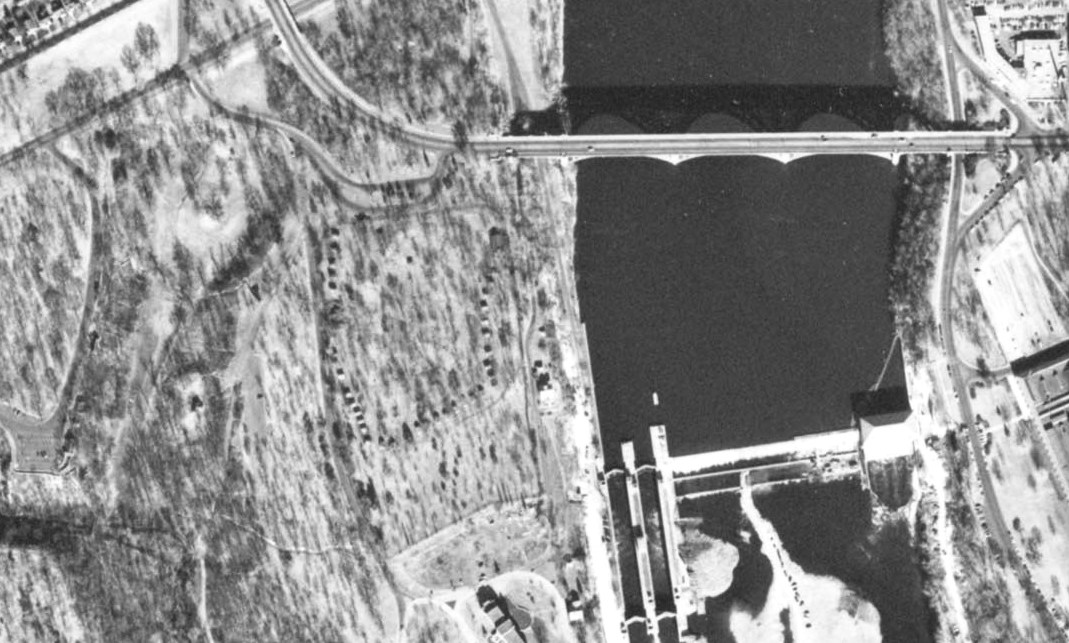
While researching the history of the auto tourist camp, which the park board operated at Minnehaha Falls from 1920s into the mid-1950s, I wanted to get some sense of the layout of the 35 cabins that were offered for rent on a nightly basis. I had never found any depiction of the layout of the camp until I found this photo from October 1953 at the MHAPO site. See the U-shape of dark dots on the bluff to the left of the Ford Dam? Gotta be those cabins. It’s the Wabun picnic area now. I’ll be writing more about the tourist camp soon.
For more recent aerial photos of many parts of Minneapolis and the metropolitan area, I go to the University of Minnesota’s Digital Content Library. Below are two photos from that collection using the search term “Minnehaha Park.” They provide a marvelous way to track changes in the landscape. The only shortcoming of this superb collection of images is that they are not dated.

Long ago you could drive up to the edge of Minnehaha Falls. You could watch the falls from your car. A park drive passed between the falls and the pavilion with the red roof.
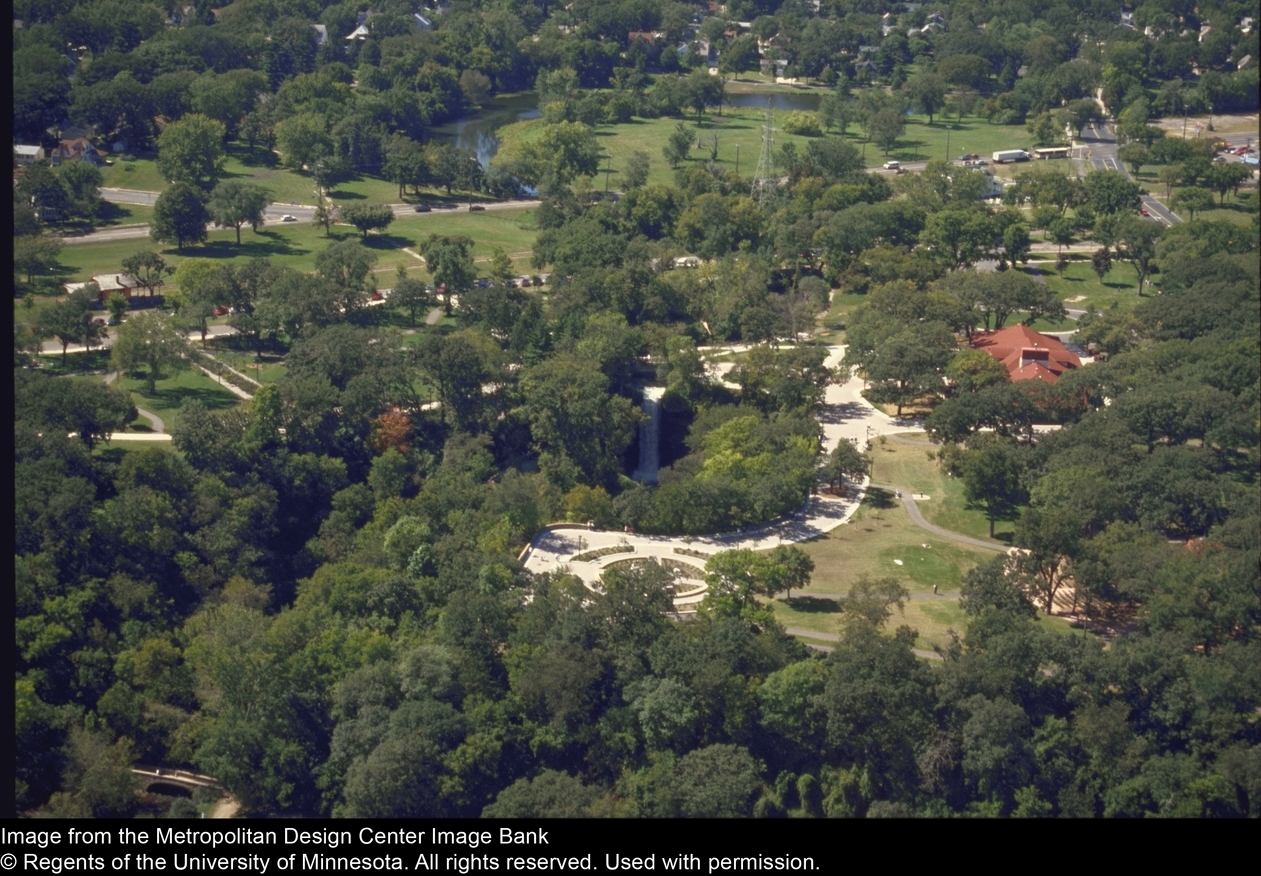
After the 1992 renovation of the park, the parking lot was moved away from Minnehaha Falls and cars could no longer drive right to the edge of the gorge. The former parking lot was replaced by the garden in this picture, which features some verses from Henry Wadsworth Longfellow’s “Song of Hiawatha”, to which the Falls owed its world-wide renown.
Note that both photos were taken before Hiawatha Avenue was expanded and put under a land bridge at Minnehaha Parkway (upper right corner of the photos) in the 1990s. Had the Minnesota highway department had its way, the horizontal stretch of green near the top of the picture would have become an elevated freeway in the 1960s. The Minneapolis park board went all the way to the U. S. Supreme Court in a successful effort to block that freeway. That is an important story of true park heroes, such as Robert Ruhe, Walter Carpenter, Ed Gearty and others, which I hope to tell in greater detail soon.
Some of the photos and maps in the Digital Content Library collection require login to see more than a thumbnail, but many permit viewing in greater detail by the general public.
It’s worth noting that both the Borchert and Digital Content Library collections are the product of our state university—a demonstration that all of us can benefit from the presence of a major university in our community. Our taxes at work! Yeah, I complain about taxes too, but things like parks and libraries and universities and historical societies contribute enormously to the richness of our lives. My life anyway. Nearly all the resources I draw on to produce these articles are public resources. They are available to all without charge. They are an important part of our heritage—and, I hope, our legacy.
David C. Smith
© David C. Smith 2013
Lofty Words, Lofty Ground: Portius C. Deming
Filed under: Minneapolis Park Hero, Minneapolis parks | Tags: Deming Heights, Deming Lake, Itasca State Park, Mary Gibbs, Portius C. Deming, St.Anthony Parkway
Comments (1) One of the lesser-known park heroes in Minneapolis history left us with inspiring advice —for both citizens and park commissioners. His most memorable words come from his writing in park board annual reports when he was the president of the Minneapolis Board of Park Commissioners 1915-1917. His most enduring actions to create parks and preserve nature’s beauty, however, had nothing to do with Minneapolis. We would honor his service to the state and city if we maintained more thoughtfully the park named for him.
Julius Caesar enriched the common people of Rome by bequeathing to them all his parks and gardens. The people of Minneapolis do not need await the death of an Emperor to enjoy such treasures. They possess them in their own rights. Every man or woman that walks beneath the refreshing shade, or treads the green grass of our parks, or rides upon their sparkling waters, or listens to strains of enchanting music in an environment of nature’s beauty — every boy and girl that gains health of body and mind within our playgrounds — every one of these can proudly say, “These parks are mine; I am joint owner of all these splendors.”
— Portius C. Deming, President, Minneapolis Board of Park Commissioners, 1915 Annual Report
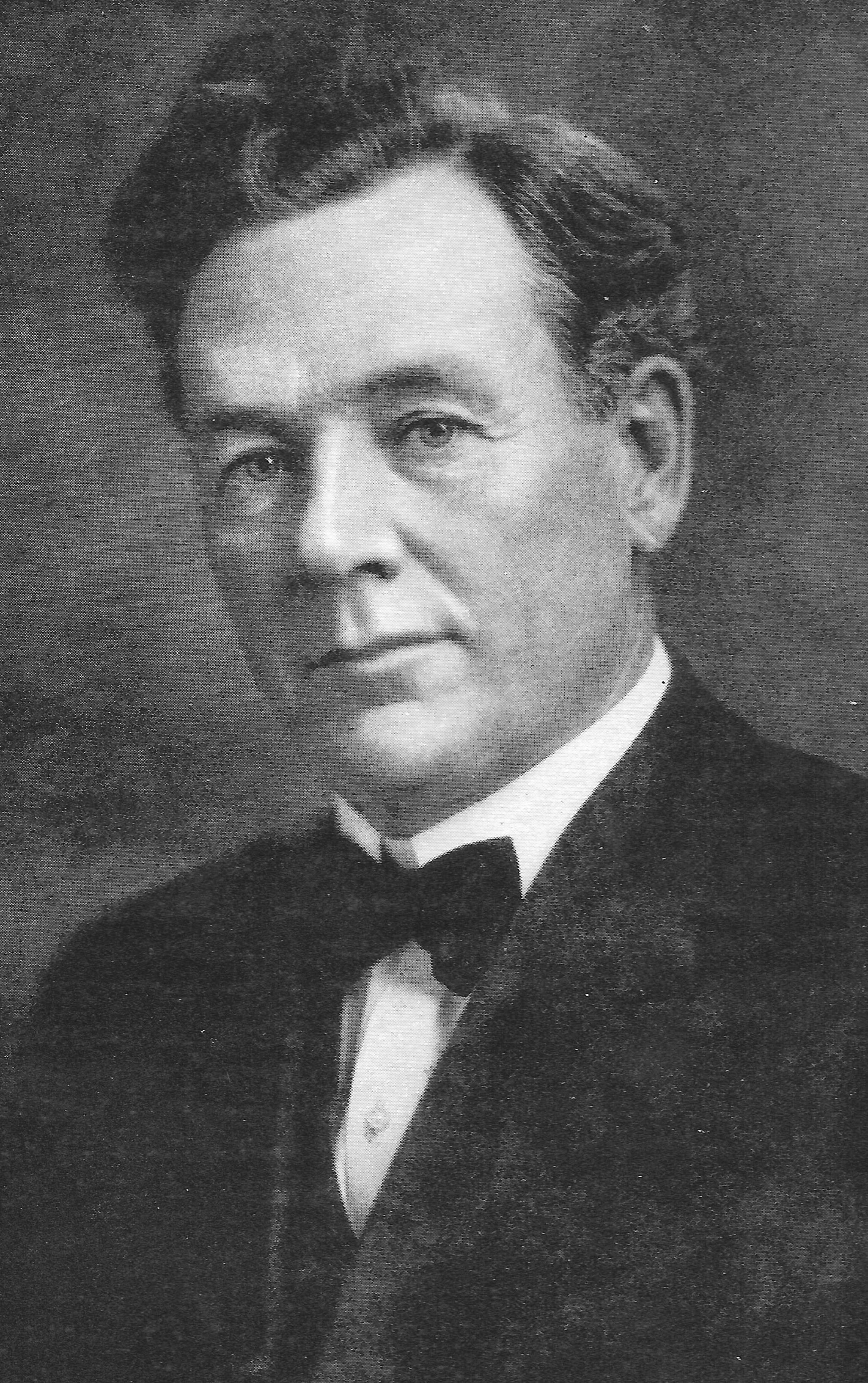
Portius C. Deming, 1916. Lofty hair, too. (MPRB)
Portius C. Deming was a realtor and insurance agent — the two professions went hand-in-hand in the years Minneapolis grew the fastest in the late 1800s. Deming lived on the corner of 23rd Ave. NE and Central Avenue and had his office a block away on the other side of the street. He was one of the men who helped put together the proposal for the park board to acquire what became Columbia Park in northeast Minneapolis in 1892. He was 38 at the time.
The creation of a large park, which included part of Sandy Lake, was certainly in Deming’s long-term business interest, although he was not a large landowner in the vicinity of the park and residential development had not reached within several blocks of the new park at the time. Most of the land near the park had not yet been platted into residential lots — and the Shoreham railroad yard was already quite extensive to the south of the new park. While sprawling railroad yards have never been converted into attractive scenery, the yard did provide the jobs that would support the construction of new houses, new businesses, and a flourishing community north of what was commonly called “New Boston” in northeast Minneapolis.
Still, as a business leader and realtor, Deming certainly would have appreciated the benefit to the city of a large park beside the only significant body of water in that part of the city. And William Folwell had argued convincingly for such a park only a year earlier when he applied the term “Grand Rounds” to the linked system of parks he supported.
Deming was elected to the park board in the fall of 1894 after he won the Republican Party nomination for the seat over the incumbent president of the park board, J. A. Ridgway. Ridgway would later become the secretary to the Board, a full-time position, a job he held for more than 20 years. (Deming’s wife was the niece of Adin Austin, one of the original 12 park commissioners when the Minneapolis park board was created in 1883.) Deming did not complete his six-year term as park commissioner, because he was elected to the Minnesota House of Representatives in November 1898. He had to relinquish his park board position when he took his seat in the House in January 1899.
It took very little time for Deming to make an impact in the House and leave a profound mark on the state.
Deming Lake
Driving north on Highway 71 about twenty miles beyond Park Rapids, you reach the southern entrance to Itasca State Park. You’ve already passed so many lakes since Park Rapids—Fishhook, Portage, Little Mantrap, Eagle, Island—not to mention “Christmas World”, and you are so eager to get to Lake Itasca and the slippery stones that create a path across the lake’s outlet stream, the modest beginning of the Mighty Mississippi, that you probably don’t notice the third lake on your left after you enter the park: Josephine, Arco, Deming. Yep, Deming as in Portius C. The lake once named “Danger”, was renamed to honor the legislator from Minneapolis who adroitly managed the passage of a law in 1899 that appropriated the first money for the state to buy private land within the 35 square miles that had been designated Itasca State Park in 1891.
The legislatures of Minnesota and the United States had already contributed the land they owned within the park boundary, and the railroads cut generous deals to convey their lands to the park, but about 8,000 acres still remained in private hands in a patchwork within the park boundaries, including several tracts bordering Lake Itasca itself. Deming and others believed that the additional land had to be acquired by the state before it was clear-cut of its majestic white pines. A “Stumpage State Park” had little appeal, particularly as a setting for the source of the continent’s mightiest river.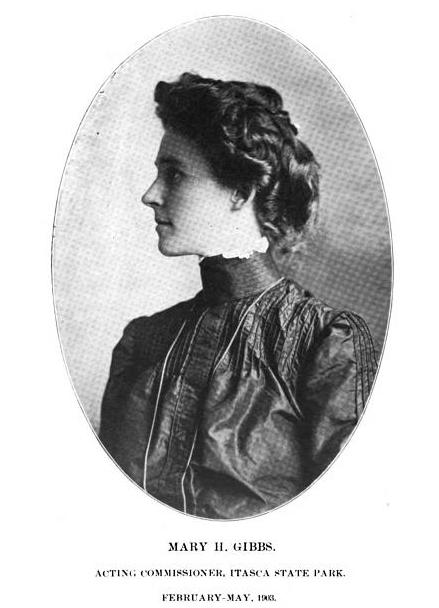
The “Deming Law”, which appropriated $20,000 for land purchases, didn’t end battles between park proponents and the lumber companies over rights to cut pine, create lumber roads across public park land, and dam Lake Itasca to float the lumber down the Mississippi River to Minneapolis saw mills. But it did establish a precedent and legal justification for action.
One of the great stories in Minnesota park history is how Mary Gibbs, in 1903, confronted the lumbermen and opened the dam they had built on the Mississippi River that was flooding the shores of Lake Itasca. Gibbs was the acting commissioner of Itasca State Park at age 24 after the previous commissioner, her father, died. She was quickly stopped from upholding state law by a local judge and promptly replaced by Governor Van Sant with someone more malleable to lumbering interests. Still, the young woman who had the integrity and courage to take on powerful interests is an inspiration. The visitors center in the park at the headwaters of the Mississippi is named for her.

Lake Itasca as log reservoir, 1903. (Illustrated History of Itasca State Park)
Despite the efforts of Deming, Gibbs and others like them, lumber companies opposed preservation efforts in the park effectively for many years. But Deming and Gibbs made a critical contribution to protecting natural resources, a forward-thinking effort that continues to provide benefits today.
For the in-depth story of efforts to protect the park, and Deming’s role, read the Illustrated History of Itasca State park by Jacob V. Brower here. Note whose picture is on the cover of this edition of the Collections of the Minnesota Historical Society. You can’t mistake the high hair of Portius C. Deming. That book is also the source of his signature.
From Park to Parole
Deming’s influence as a legislator was also significant as an advocate for the University of Minnesota, but the other piece of legislation with which his name is linked is the bill passed in 1901 providing for the possibility of parole for convicts with life sentences. The “Deming Bill” is also referred to as the “Youngers’ Bill”, because its practical effect was to provide for the parole of two infamous residents of Stillwater Prison who had been model prisoners for 25 years: Cole and Jim Younger.
The Younger brothers had been captured after the notorious robbery of the Northfield Bank by the James-Younger Gang in 1876. Cole and Jim Younger entered a plea of “guilty” in 1876 to the bank robbery and murder of a bank clerk to avoid the death penalty. If they had pleaded “not guilty” and been convicted, they could have been executed — and I don’t believe anyone, including them, ever claimed they hadn’t committed the robbery, although accounts of the robbery suggest they did not shoot the clerk. Another brother, Bob, also plead guilty to the charges, but died in Stillwater prison of tuberculosis in 1889. Following the passage of Deming’s Parole Bill, written solely for humanitarian purposes, the Youngers were paroled. (The only other prisoner who met the strict conditions of the bill was an old man who refused parole because he had been in prison so long he no longer knew anyone outside of prison and had no means to support himself. Prison was his home.) Jim Younger committed suicide a year after his release. Cole Younger returned to his Missouri home and lived until 1916.
The results of a quick search revealed only one other especially interesting piece of legislation sponsored by Deming. In 1903, he sought a legislative appropriation of $5,000 for victims of a famine in Sweden, Norway and Finland — an unusual venture into international relations. The bill did not pass.

As president of the park board, Deming presided over the dedication of The Gateway in 1915. He also commanded the podium at the dedication of two other memorials that year, one to Thomas Lowry at Virginia Triangle; the other to Gunnar Wennerburg at Minnehaha Park. (MPRB)
President of the Park Board
After three sessions in the legislature, Deming stepped away from politics for a few years until he was tapped by the Minneapolis park board in November 1909 to complete the unexpired term of park commissioner Milton Nelson, who had resigned. The other candidate nominated to fill Nelson’s post was a young banker from north Minneapolis, Francis A. Gross. While Deming prevailed in that selection process, Gross was elected by park commissioners to fill another unexpired term a few months later in May 1910. With a few interruptions, Gross served on the park board into the 1940s.
Following the expiration of the partial term that he was selected to fill, Deming stood for popular election for another term and during that term was elected President of the park board by his fellow commissioners for 1915 and 1916.
Deming’s focus as a park commissioner is not associated with any particular park developments, although the decade of his second stint on the board was an extremely productive time in Minneapolis park history: the lakes were linked with canals, land for the northern half of the Grand Rounds was acquired and the parkways partially completed, the Lake Calhoun bathhouse was constructed, Glenwood (Wirth) Park was developed, the land around Lake Nokomis was acquired and development began, the John Deere Webber Baths at Camden (Webber) Park were built, and playgrounds and neighborhood parks became an important focus. During this period, parks also became accepted as the appropriate venue for active, athletic recreation and the park board began to provide extensive athletic facilities for the first time, including the Logan Park field house.

The plaque set in a boulder in Deming Heights Park.
Portius Deming’s service to his city as a park commissioner ended in 1919 when he was 65. His place in park history was commemorated shortly after his death in 1930 when a ten-acre park commanding one of the highest points in Minneapolis, Grandview Park astride St. Anthony Parkway in northeast Minneapolis, was renamed Deming Heights.
Beyond a lake, a park and a plaque, we have Deming’s words to remember him by. I find especially appealing the excerpt quoted to open this article and the last paragraph he wrote for the 1915 Annual Report:
The story of the Board’s work for these past thirty-three years is impressed upon our City as upon on open book. Representing the whole people, this Body has conscientiously striven to do equal justice to all, to develop the park system in an equitable relation to the whole city, ever remembering the diverse uses for which parks are demanded and created. It has aimed to carry the opportunity for outdoor rest and recreation to every locality; it has acknowledged the supreme duty of acquiring and reserving for all the people the God-given lakes and streams, which are the City’s grandest heritage. This open book now presents to us an unwritten page. May it be as worthily filled as those which have preceded it.
— Portius C. Deming, 1915 Annual Report
Deming Heights
Deming Heights is—or could be—one of the most charming places in the Minneapolis park system. From the top of the hill—surpassed in elevation in all of Minneapolis only by a point a few blocks northeast near Waite Park—one can see a great distance in three directions. The only problem with the park is that it’s not nearly as spectacular as it should be.

The view from Deming Heights — without leaves. The downtown Minneapolis skyline is out there — somewhere.
If ever there were a place where some discretion should be used in cutting trees it is here. Why put parks on the highest ground with the most splendid views if we allow trees and brush to obscure the views we purchased? Especially when most of the trees obscuring that view are not the most desirable tree species and some are simply invaders. Can we not cut a tree of any kind? Much of the brush growing on the side of the hill should be cleared as well.

The stairway and path up Norwegian Hill.
I don’t even mind the dilapidated railing along the best staircase in the city. It has its own charm. But clear the brush and trim a few trees. Part of the park was purchased specifically to remove buildings that blocked the view from the crest of the hill. Now we allow scraggly trees to do what we would not let houses do.
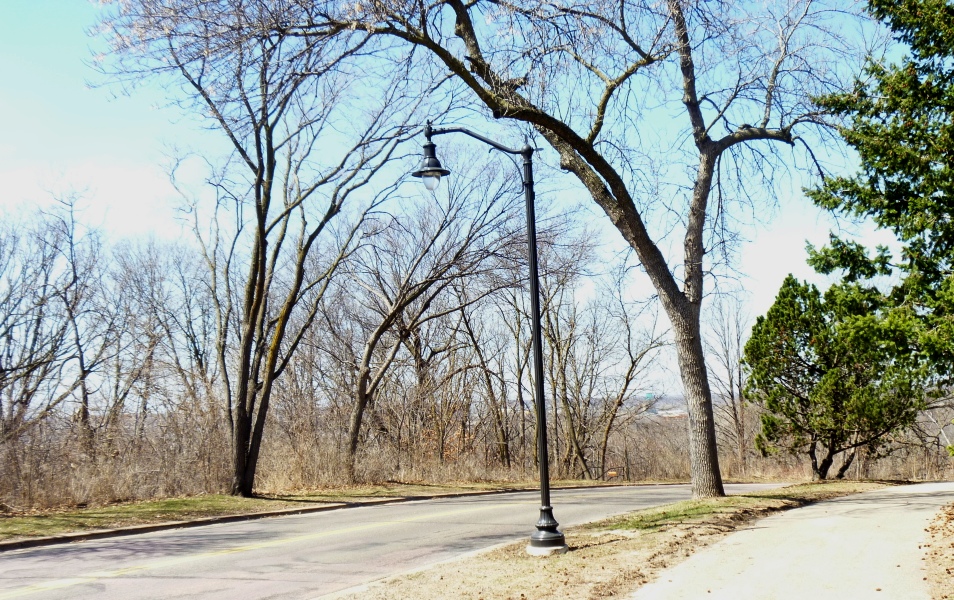
Fill in some leaves and there’s no view at all. Might as well be Deming Flats.
The park board has wonderful gardeners and foresters. They could make this view spectacular. Let’s let them. Something worthy of Portius C. Deming. If they need a hand clearing brush, I’ll help. My tribute to Mr. Deming.
David C. Smith
© David C. Smith 2013
Friday Photo: Before the Mills Were Ruins
Filed under: Mill Ruins Park, Minneapolis Parks: General, Mississippi River | Tags: Mill Ruins Park, Mississippi River, Stone Arch Bridge
Comments (8) Let’s go down to the river one more time. I have many favorite pictures of the riverfront when it was the economic engine of Minneapolis, but this is probably at the top of my list.

The west bank of the Mississippi River in downtown Minneapolis, just below St. Anthony Falls, in 1885. (Minnesota Historical Society)
You can see just a dash of the still-new Stone Arch Bridge on the right margin of the photo. The channel here is all tail race — the water that ran out of the mills after generating power.
My favorite part of this photo though is the trestle and railroad tracks that ran between the mills and the river at essentially the level of city streets. Those tail races coming out of the mills are now a part of Mill Ruins Park. The trestle and tracks are gone, but I don’t know when they were torn down. Anybody?
Below are two shots (a 3-for-1 Friday Photo!, the biggest Friday Photo discount ever) of the tail races as they appeared probably in the 1950s.

Tail races, some of which are now visible in Mill Ruins Park. (MPRB)

A closer look at the trail races and water returning to the river after its work was done. (MPRB)
Both photos are undated. They show the water coming out of the tail races. They give a much better sense of the management of water power. I’m not sure of the functions of structures and workers at this point in the water power process.
These structures were razed and covered when the Upper St. Anthony Falls Lock and Dam was built in the 1960s.
For a marvelous 360-degree panorama of Mill Ruins Park and the adjacent lock and dam go here, courtesy of the National Park Service. Learn much more about the lock and dam — one of the biggest mistakes Minneapolis and the U. S. Army Corps of Engineers ever made — at the pages of the Mississippi National River and Recreation Area.
Have a look around the park — if spring ever comes. The transformation is amazing — and thought-provoking.
David C. Smith
© Copyright 2013
Friday Photo: West Riverbank from the Stone Arch Bridge
Filed under: Mill Ruins Park, Minneapolis Parks: General | Tags: Mill Ruins Park, Stone Arch Bridge
Leave a Comment I don’t want to overdo the Stone Arch Bridge, but will run that risk with this photo found by Andrew Caddock at the park board. I showed the picture recently to a group of local history buffs and asked for guesses on when it was taken. Guesses ranged mostly from 1930-1960s. The real answer is ….
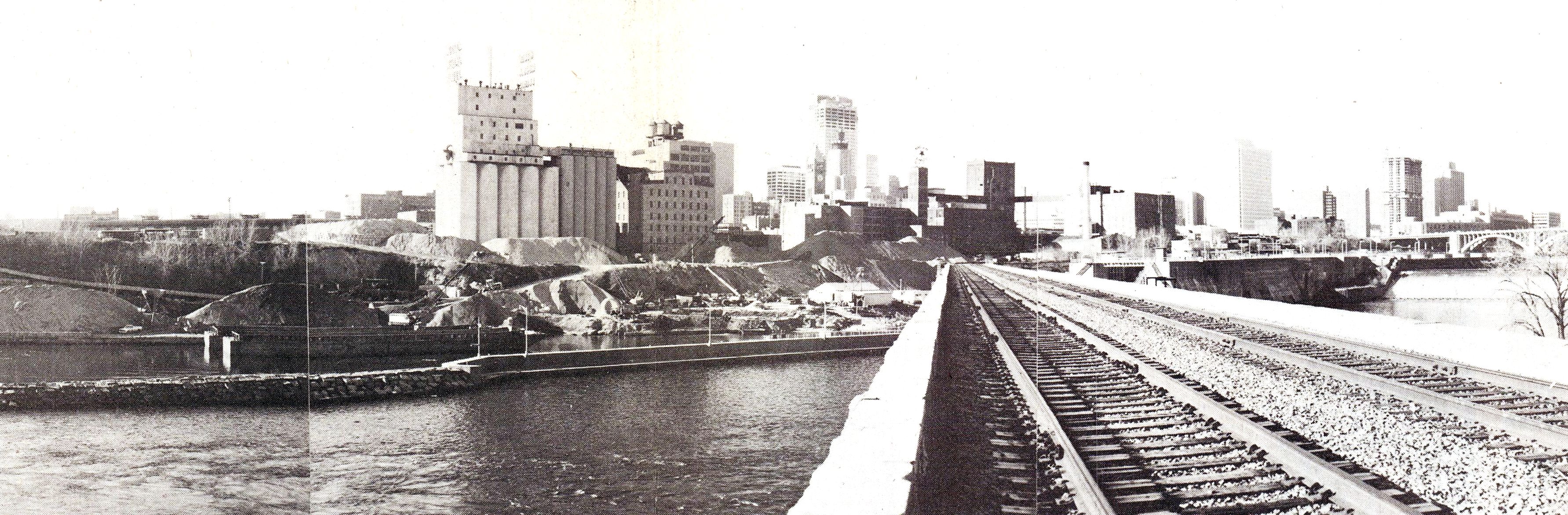
View from the Stone Arch Bridge. Click for larger image. (Jim Keane, Riverfront News)
…1980. Not that long ago.
The piles of sand and aggregate in front of the old mills were used to make concrete and were owned by Shiely Co. The materials were mixed on site and used in downtown construction projects; the sand and gravel could be transported at much lower cost by barge than by truck. The company first used the area for aggregate storage when it was making the concrete to build the upper lock and dam — on the right of the bridge — which was completed in 1965. Train traffic on the Stone Arch Bridge had stopped a couple of years before this photo was taken.
The photo appeared in the December 1980 issue of Riverfront News, a publication of the Minneapolis Riverfront Coordination Board, which included representatives of the major agencies of Minneapolis government.
The land under the sand piles is now Mill Ruins Park. The Guthrie Theater would be near the left edge of the photo
David C. Smith
Sisters of Chuckie: Powderhorn Park 1926
Filed under: Minneapolis Parks: General, Powderhorn Park | Tags: Doll Parades, Powderhorn Park
Comments (3) How did the cherished toys of one generation become scary to their great-grandchildren?
This photo raises the question. Doll buggy parades were big events at parks decades ago, especially in the 1930s. I’ve seen several photos of such events, some as recent as the 1970s. Yet, I’ve seen girls of today react very negatively to pictures of old dolls like these. They find them creepy. But aren’t these dolls more realistic and less creepy than many of the “fashion” dolls that girls play with now?

Dolls on parade at Powderhorn Park, 1926 (Minneapolis Park and Recreation Board)
Cool buggies, too. But with no children in sight? Yeah, they really are kinda creepy. The dolls look better with kids in the picture.

This Minneapolis Tribune photo from 1934, which includes girls from an unidentified park, is more appealing. (Minneapolis Photo Collection, Hennepin County Library)
Do you remember these events? Do you still have the dolls?
David C. Smith
Theodore Wirth, Francis Gross and Me: A Friday Photo and a Re-assessment
Filed under: Minneapolis Park Hero, Minneapolis parks | Tags: Francis A. Gross, Hubert H. Humphrey, Lyndale Park, Theodore Wirth
Comments (2) 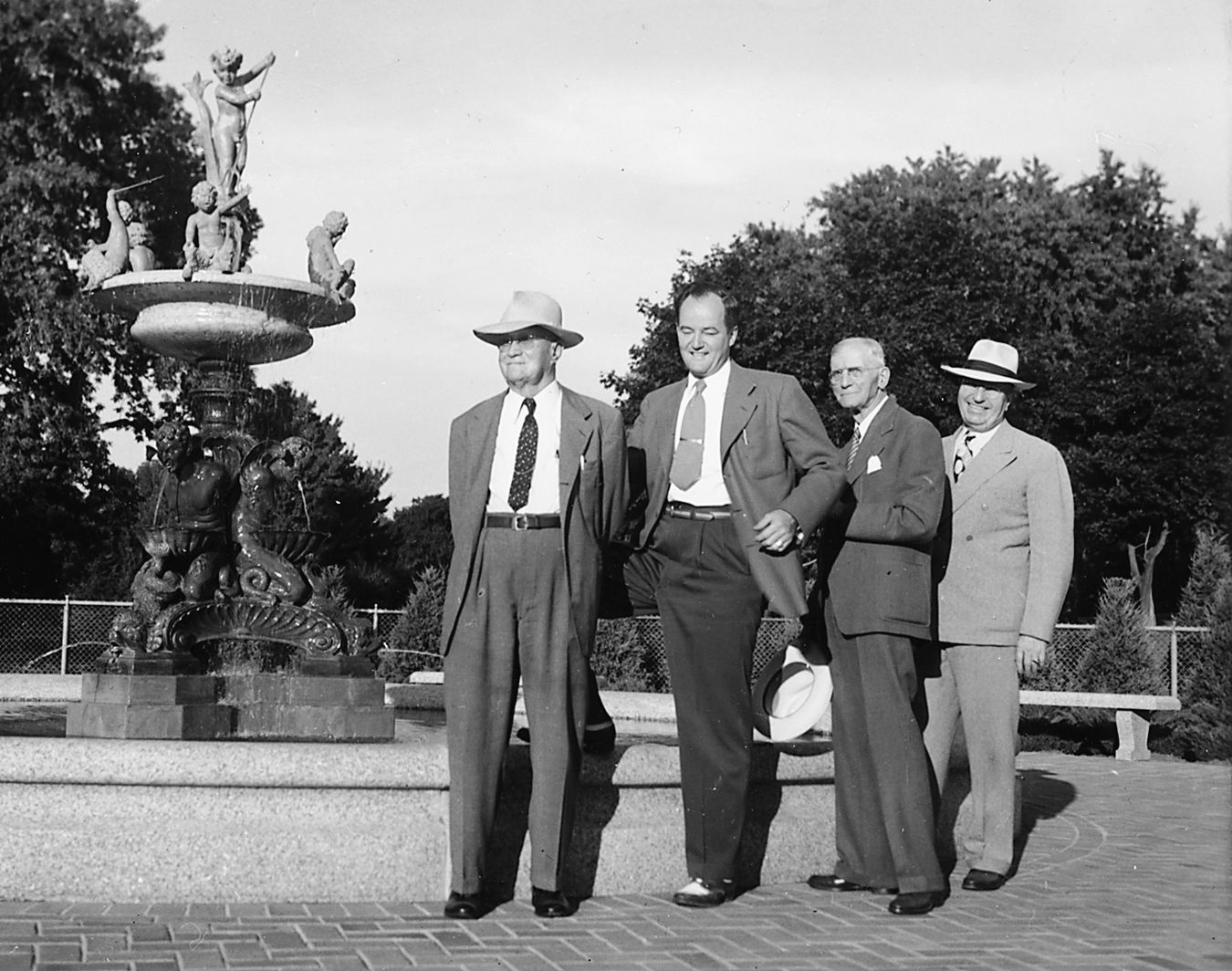
The dedication of Heffelfinger Fountain in Lyndale Park, 1947. This is the only photo I’ve seen of Theodore Wirth and Francis Gross together. They are joined by an even better-known Minneapolitan. From left: Park Superintendent Emeritus Theodore Wirth, Minneapolis Mayor Hubert H. Humphrey, Park Board President Francis A. Gross, Park Superintendent Charles E. Doell. Wirth was then 84 and Gross 77. The fountain had been discovered and purchased in Italy by Frank Heffelfinger, shipped to Minneapolis, and given to the park board. (Minneapolis Park and Recreation Board)
As I began my initial, intensive assault on Minneapolis park history in 2007 to write City of Parks, I was inclined to attribute the great success of our park system to Theodore Wirth — as so many people do. I had heard his name—attached as it was to a park, lake and parkway — for many years, and I promptly read his book on the park system—part history, part memoir.
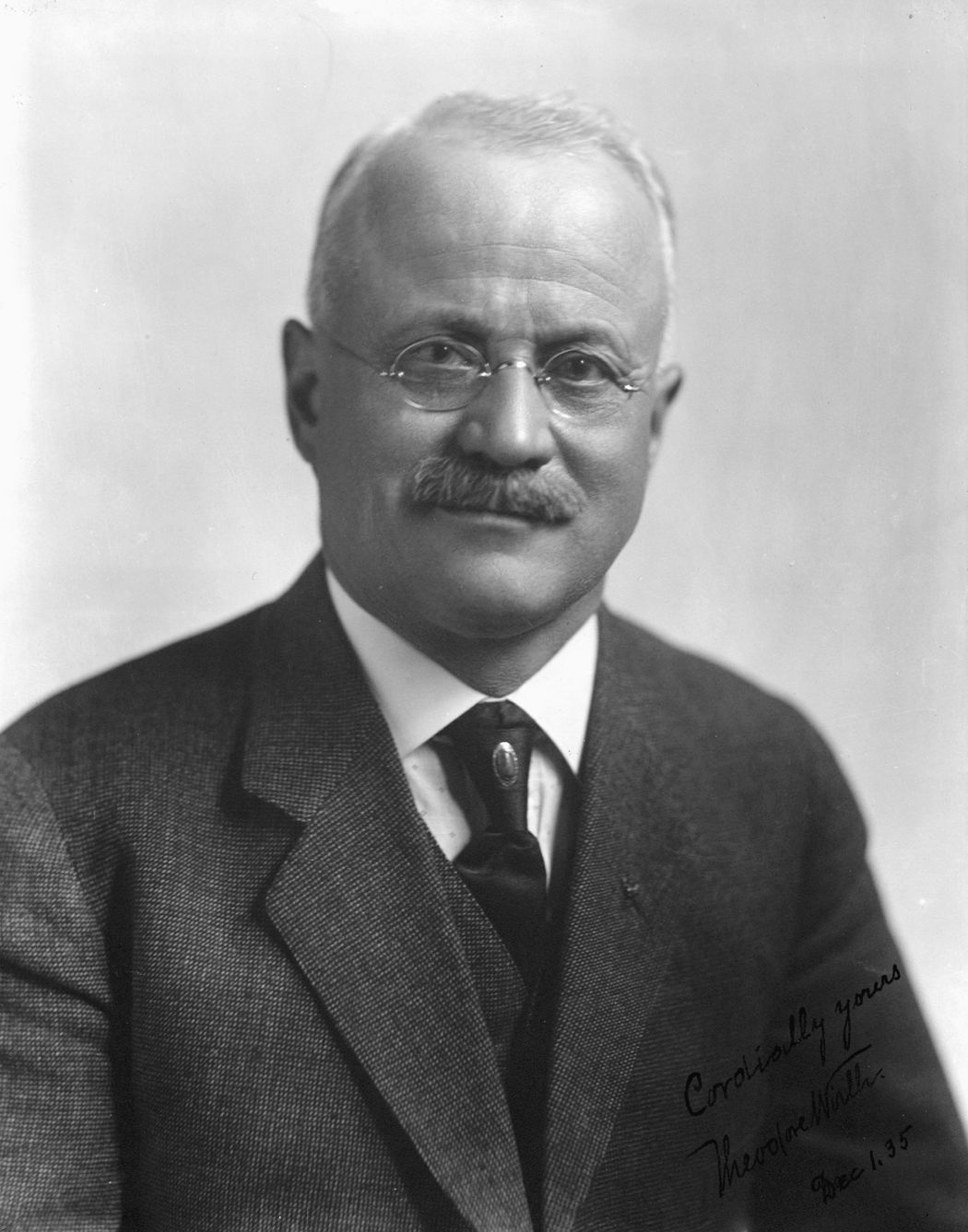
Theodore Wirth was superintendent of Minneapolis parks for 30 years, 1906-1935. (Minneapolis Park and Recreation Board)
It was the beginning of an up-and-down ride for me with Mr. Wirth and his legacy, one that I am reexamining in light of comments by Francis Gross in the autobiography he wrote in 1938.
I knew little about Wirth in 2007, but I did recall vividly being introduced to a Swedish gentleman at a party in Stockholm, Sweden in 1986 who, when he learned where I was from, gushed about what a great park planner Theodore Wirth had been. He knew much more about Wirth than I did and …Read more about how Francis Gross convinced me that Theodore Wirth was a good guy
Highlights, Lowlights and Unsolved Mysteries: 130 Years of Parks in Minneapolis
Celebrate the 130th birthday of the Minneapolis park system with me and the Linden Hills History Study Group, April 4, 7 p.m. at St. John’s Episcopal Church, 4201 Sheridan Avenue South. A $3 donation is suggested for those who aren’t members of the study group.
I’ll talk about the greatest accomplishments and most puzzling failures in Minneapolis parks since the Minneapolis Board of Park Commissioners was created by the Minnesota legislature and approved by Minneapolis voters on April 3, 1883. I’ll touch on many of the people, places and policies that have contributed to the fabulous park system we enjoy today — and I’ll also mention a few parks that might have been.
I hope you’ll join us.
David C. Smith
Friday Photo: How A Stone Arch Was Made
Filed under: Minneapolis parks, Mississippi River | Tags: Father Hennepin Bluffs, Mill Ruins Park, Stone Arch Bridge
Comments (5) The Stone Arch Bridge over the Mississippi River in downtown Minneapolis is becoming one of the iconic images of the city. Have you ever wondered how those arches were made? I have. So I found this photo of the bridge under construction. The deck of the bridge is maintained by the Minneapolis Park and Recreation Board, so let’s call it a park. Day and night the bridge provides the best views of the city. A hike over the bridge between Mill Ruins and Father Hennepin Bluffs, in either direction, is a must for visitors and residents.
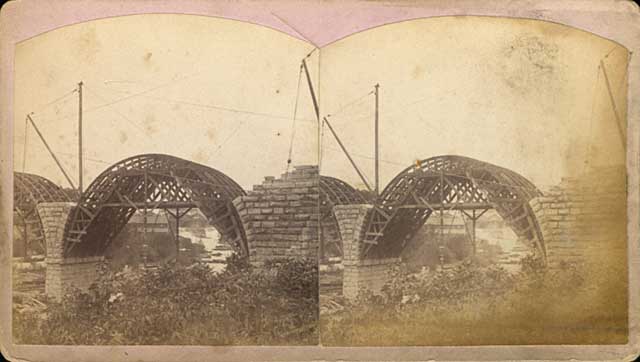
This stereoscope image shows the stone arches being built over forms in 1883. (Henry Farr, Minnesota Historical Society)
The two-track railroad bridge was being built at the time the park board was created in 1883.

The Stone Arch Bridge being completed in 1883. (Burlington Northern, Minnesota Historical Society)
This is another favorite shot of the bridge as it neared completion
David C. Smith
A Racetrack Before It Became a Park — and an Airport
Filed under: Minneapolis Airport, Minneapolis parks | Tags: Eddie Rickenbacker, Metropolitan Airport Commission, Snelling Speedway, Twin City Motor Speedway, Wold Chamberlain Field
Comments (8) Not many people would recognize this Minneapolis park property, which lies outside city limits and was acquired in 1928, twelve years after this photo was taken. There is some uncertainty about how much of this property is still technically owned by the Minneapolis Park and Recreation Board, but the property is administered by another agency.

Four-wide racing at the Snelling Speedway, 1916. (Minneapolis Park and Recreation Board.)
This is the famous Twin City Motor Speedway, or Snelling Speedway, in 1916, the second year of its three-year life. The speedway was named informally for its location adjacent to Fort Snelling. The infield of the two-mile concrete track was later used as a landing field for airplanes — and eventually became Minneapolis-St. Paul International Airport. The Minneapolis Board of Park Commissioners acquired the land in 1928 to develop it as an airport for the city. The task fell to the park board because it was the only agency of Minneapolis city government that could own land outside of city limits. (The law that permitted the park board to own land outside city limits was passed by the Minnesota legislature in 1885 to permit the park board to purchase land in Golden Valley for part of what eventually became Glenwood (Wirth) Park .) The park board built and ran the airport from 1928 until the Metropolitan Airports Commission was created in 1943, at which time the park board turned over administration of the airport. The park board had spent a significant percentage of its meager resources in those years developing the airport.
The enormous grandstands pictured left and center were built in 1915 to hold 100,000 people. The problem was that far, far fewer attended the few races held there. The first major race in 1915, a 500-mile race patterned after the Indianapolis 500, was widely promoted by the newspapers for weeks. The weekend of the race — the first weekend in September, just before the State Fair opened — the Minneapolis Tribune wrote that hotel rooms were impossible to find in the Twin Cities; hoteliers were referring unaccommodated visitors to private homes for a place to sleep. It was said to be the busiest weekend in the history of Minneapolis hotels with guests arriving from around the country. The Twin City Rapid Transit Company built a special spur track to the speedway to transport the crowds.
Unfortunately for the promoters, drivers, and the legions of workers who constructed the track and were not paid, attendance was much smaller than hoped. Society columns in the Tribune covered the rich and famous who attended the races and trumpeted this “innovation in divertisement” for the social elite, but the paper reported race attendance at only 28,000.
The 1915 race was a disappointment in every respect. The banked concrete track, heralded as the fastest and safest track in the world, was in fact extremely rough. The cars vibrated to pieces and the drivers didn’t fare much better. The champion Italian driver, Dario Resta, was reported to have denounced the roughness of the track “vociferously” after his first test drive during race week. If you know any Italian curse words, you could probably translate the “vociferously”. He was prescient, because his car didn’t survive much more than 100 miles on race day. But potential race fans didn’t know that ahead of time.
Neither could they have imagined the snoozefest that the race became. It only takes a glance at the race results to understand how tedious the day must have been for spectators. With only twenty cars starting the race and most of them falling apart or dropping out for mechanical reasons early on — having a “mechanician” riding along, the second person visible in the cars, didn’t prevent mechanical failures — there wasn’t much action despite the nail-biting finish of the race, which was won by 1/5 of a second. The Tribune, which had promoted the race so breathlessly, could hardly contain its excitement proclaiming in its headline Sept. 5, 1914, “Cooper Wins Closest Finish in History.”

Here’s part of the problem! 1915 500-mile race results. (Minneapolis Tribune, September 5, 1915)
An exciting finish didn’t make up for the rest of the race. The slow pace of the race, only 86 mph, dragged it out for nearly six hours, and the third place car was more than a half-hour behind the leaders. The Tribune blamed the pace on the fact that the cars of so many of the “most daring” drivers — “speed demons” — were incapacitated. Those drivers included the famous Italians Resta and Ralph De Palma and the American “Wild” Bob Burman. Picture only eight cars spread over a two-mile track, none of them travelling much faster, and some not as fast as, ordinary traffic on 35W and think of what you’d be doing to amuse yourself as a spectator. As stirring as the finish must have been with Cooper and Anderson pushing their matching Stutzes to the finish (the Stutz company dropped racing the next year anyway), most of the barely awake spectators headed for the exits before O’Donnell’s Duesenberg, manufactured in Minneapolis, came anywhere near the finish lap in third place.
Chandler and the great Barney Oldfield were still on the track — with no one in the stands and the sun about to set — plodding along more than an hour from finishing when they were mercifully flagged off the track in the dusk. The most notable thing about the Oldfield performance was that his relief driver — the drivers took breaks during the race — was the later World War I flying ace, Eddie Rickenbacker.
It’s no wonder that the Tribune concluded the next day, in a heroic effort at understatement:
“The crowd could not be called enthusiastic, the length of the grind and the heat probably preventing continuous hilarity.”
Prospective ticket buyers probably didn’t imagine the downside of what was then endurance racing. The greater problem was the cost of the tickets. Ticket prices were widely acknowledged as being much too high — the lowest ticket price was $2 and that didn’t include a seat, which cost another $2.50, the equivalent of what the park board paid workers for an 8-hour workday then.
(For more detail on the 1915 race, go here. Noel Allard reconstructs the race, and the era in racing.)
Lower Prices, More Hilarity
The speedway’s promoters realized that they had to reduce prices as well as the tedium of a 500-mile race the next year. For the 1916 Fourth of July race, admission to the bleachers was cut to $1.00 and prices for seats in the grandstand began at $2.00. In hopes of more hilarity, even if not continuous, the race was shortened to 150 miles. A full day of racing was also to feature races of 50, 20 and 10 miles.
The roster of drivers was much the same as 1915: Resta chose to race in Omaha and Burman had crashed and died two months earlier in a California race. Oldfield returned, but only in capacity of referee, while his former relief driver, “Rick” Rickenbacker, had his own car to drive. (I’m no expert on race cars of the era, but it’s possible that Rickenbacker’s white Maxwell is on the far left in the photo above.) St. Paul’s own Tommy Milton, known then for his success at state fair races, but who would win two Indy 500s in the 1920s, entered in a Duesenberg. The Tribune predicted the largest race crowd in Minnesota history.
It was not to be. While I haven’t found an attendance figure for the race, there couldn’t have been many fans buying tickets because the total gate was only $8,000. We know that because at the time the flag was supposed to drop on the first race, the promoters had not yet posted the $20,000 in prize money for the races and the drivers, obviously noting the sparse crowd, refused to race until the prize money was in trustworthy hands. After a two-hour delay that caused the 50-, 20-, and 10-mile races to be scrubbed, the promoter turned over the entire gate receipts of about $8,000 and wrote a $12,000 personal check to cover the rest of the prize money for the 150-mile race. And off they went down the stilll-rough concrete track, bouncing like the promoter’s check.
Ralph De Palma won the race by a 12-minute margin in a time of just under an hour and a half, or an average speed of a bit over 91 mph. He was one of only seven finishers, with Tom Milton finishing fourth.

By 1930 the Minneapolis park board had begun the transformation of the old speedway into an airport, but a segment of the old 2-mile oval still remained. The Mendota Bridge is upper right. Note the NWA hangar among the airport buildings. The landing strip was not on the old concrete race track, which was too rough. Airplanes landed on the grass in the infield of the old race track. (J. E. Quigley, Minneapolis Park and Recreation Board)
That was essentially the end of the Twin City Motor Speedway. Within two days the speedway had declared bankruptcy and never recovered. The speedway that cost more than $800,000 to build went into foreclosure in August of 1916. The owner of the Indianapolis Speedway, who was also a stockholder in the Twin City Motor Speedway, declined to purchase the track. By the spring of 1917 the track property was already being mentioned as a possible site for an airfield or training ground for the navy aviation corps. Both Dunwoody Institute and the University of Minnesota had proposed to begin training military aviators and a site was needed.
A group of race car drivers led by Louis Chevrolet — yes, that Chevrolet — organized a final race at the track in 1917, which the Tribune called a “revival” race. The patient was too far gone to be resuscitated, despite a victory by Ira Vail in the 100-mile race at the much-improved average speed of more than 96 mph. Less than three months later the Tribune reported that the receiver for the bankrupt speedway had rented a portion of the grounds to a hog farmer who was fattening 500 pigs by feeding them Fort Snelling garbage. The speedway was finished, but the land was about to be given over to the service of a whole different kind of speed — and eventually the Minneapolis park board.
David C. Smith
© 2013 David C . Smith
The Worst Idea Ever #8: Power Boat Canal from Minnetonka to Harriet
Filed under: Minneapolis Lakes, Minneapolis Parks: General | Tags: 1911 Minneapolis Civic Celebration, Lake Harriet, Lake Hiawatha, Lake Minnetonka, Lake Nokomis, Minnehaha Creek, Minnehaha Falls
Comments (1) Ok, it wasn’t really a Minneapolis park project, but it still deserves a laugh: Minnehaha Creek converted into a 30-foot-wide power boat canal from Lake Minnetonka to Lake Harriet!

Lake Harriet could have been more like Lake Minnetonka.
Minneapolis was obsessed in the spring of 1911 with the upcoming Civic Celebration during which the channel between Lake Calhoun and Lake of the Isles would be opened. That was a very good thing. Huzzah, huzzah. But the attention it was drawing to the city also focused a lot of eyes on a very bad thing: Minnehaha Creek was nearly dry — in the spring! — which meant almost no water over Minnehaha Falls. Minneapolis could hardly celebrate the opening of the lake connection at the same time it suffered the ignominy of a dry Minnehaha Falls. The many out-of-town visitors anticipated for the celebration would surely want to see both. And let’s face it, a fifty-foot waterfall written about by a Harvard poet, which attracted visitors from around the world was a bit more impressive to most people than a short canal under a busy road and railroad tracks. The Minneapolis PR machine could call the city the “Venice of North America” all it wanted with its new canal, but visitors’ imaginations were still probably fueled more by the images of the famous poet’s noble heathen, beautiful maiden, and “laughing waters.”
The generally accepted solution to the lack of water over Minnehaha Falls was to divert Minnehaha Creek into Lake Amelia (Nokomis), drain Rice Lake (Hiawatha), dam the outlet of the creek from Amelia to create a reservoir, and release the impounded water as needed — perhaps 8 hours a day — to keep a pleasing flow over the falls. Unfortunately, with all the last-minute dredging and bridge-building for the Isles-Calhoun channel, that couldn’t be done in 1911 between April and July 4, when the Civic Celebration would launch.
Into this superheated environment of waterways and self-promotion stepped Albert Graber, according to the Saturday Evening Tribune, May 28, 1911. With the backing of “members of the board of county commissioners, capitalists, attorneys and real estate dealers”, Graber proposed to dredge Minnehaha Creek into a canal 30-feet wide from Lake Minnetonka to Lake Harriet. This would provide not only a water superhighway from Minnetonka to Minneapolis, and boost real estate prices along the creek, but it would also create a much larger water flow in Minnehaha Creek, solving the embarrassment of no laughing water.
“The plan, say the promoters, would enable residents of summer houses on the big lake to have their launches waiting at the town lake.”
Saturday Evening Tribune, May 28, 1911
Sure, there were problems. Not every plan could be perfect. The plan would require dismantling the dam at Gray’s Bay at the head of Minnehaha Creek, which might lower the level of Lake Minnetonka. But Graber and his backers had thought of that. The Minnesota River watershed in the area of St. Bonifacius and Waconia would be diverted into Lake Minnetonka — no problem! — which also solved another bother: it would reduce flooding on the Minnesota River.
The dam at Gray’s Bay had been operated by Hennepin Country since 1897. Many people then and now consider the dam the cause of low water flow in Minnehaha Creek, but the earliest reference I can find to low water in the creek was in 1820, when the soldiers of Fort Snelling wanted to open a mill on Minnehaha Creek, but were forced to move to St. Anthony Falls due to low water. That was even before two intrepid teenagers from the fort discovered that the creek flowed out of a pretty big lake to the west.
Graber estimated that dredging Minnehaha Creek would cost about $4,000 a mile for the nine miles between the two lakes. He and his backers, which included an officer of the Savings Bank of Minneapolis (who presumably had a summer house on the big lake and could put a launch on the town lake), provided assurances that the money to finance the project could be “readily found.”
The Evening Tribune article concluded with an announcement that meetings of those interested in the project would be held in the near future with an eye to beginning work before the end of the summer. Graber noted that his inspection of the project had been, no surprise, “superficial”, but that he would make a thorough report soon to his backers. I can find no evidence that the idea progressed any further.
The Board of Park Commissioners would have had no role in the plan, except, perhaps, allowing power boats to enter and be anchored on Lake Harriet. (I think they would have said no.) Park board ownership of Minnehaha Creek west of Lake Harriet to Edina wasn’t proposed until 1919 and the deal wasn’t done until 1930.
David C. Smith
© 2013 David C. Smith
Friday Photo: Lake Calhoun North Shore
Filed under: Lake Calhoun, Minneapolis Parks: General | Tags: Lake Calhoun, Lake Calhoun Bath House
Leave a Comment One of my favorite photos of Lake Calhoun. The photo is undated, but I would estimate that it was taken in the late 1910s. The view indicates it was taken near the Minikahda Club on the west side of the lake looking northeast toward downtown. The photo was taken after the Lake Calhoun Bath House (center) was completed in 1912, but before a parkway was built on the west side of the lake, which occurred in the early 1920s.
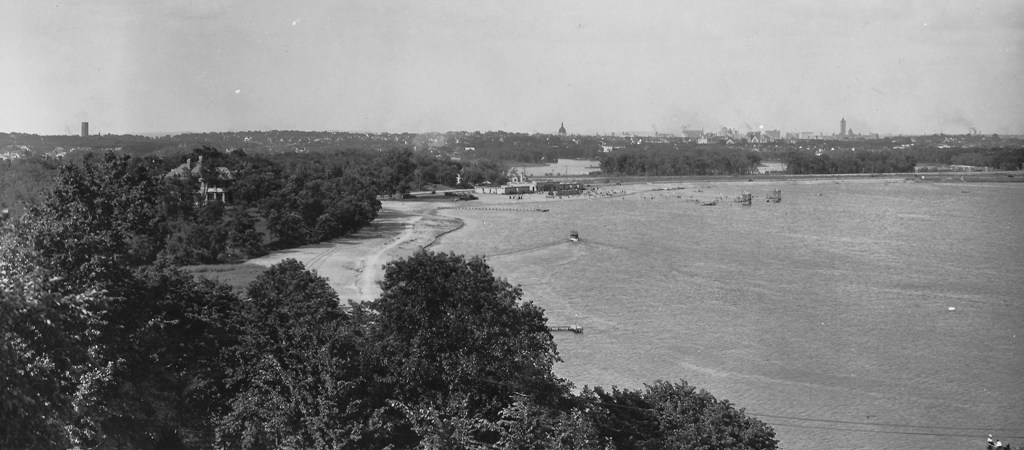
Lake Calhoun’s northwest shore and Bath House in late 1910s. Photo taken from Minikahda Club. Click to enlarge. (Minneapolis Park and Recreation Board)
Note how far into the lake the diving platforms were built.
One of things I like from this photo is a sense of the connection between Lake of the Isles and Lake Calhoun. There is some open land between them. This was taken a few years before construction began on the Calhoun Beach Club across Lake Street from the bath house.
Another remarkable feature of this photo is the prominence of the Basilica on the skyline west of downtown. The Basilica was dedicated in 1914.
This is the view that Theodore Wirth hoped could one day be incorporated into the park system if the Minikahda Club ever relocated. Wirth wrote in the 1906 Annual Report of the Board of Park Commissioners, his first, that this view was of “such scenic beauty that it is almost a crime to pass it unnoticed.”
David C. Smith
© David C. Smith

 Minneapolis Park History