Horace Bushnell’s Ghost
Filed under: Landscape Architects, Minneapolis parks | Tags: Charles M. Loring, H.W.S. Cleveland, Horace Bushnell, Jacob Weidenmann, Lyndale Farmstead, Nicollet Island, Theodore Wirth
 Comments (3)
 Horace Bushnell, one of America’s most influential theologians in the 19th Century, was among the first people to promote parks in Minneapolis. His ghost may still haunt us.
I don’t know if this is really a six-degrees-of-separation story—Bushnell and Kevin Bacon couldn’t have met—but there are quite a number of coincidences involved. They center on the famous Congregational minister from Hartford, Conn. who was also known for his early advocacy of city planning. And I mean really early. 1860s.
I’ll let you do your own research on Horace Bushnell’s sermons and books on theology, but here’s a sample of what he had to say on cities in his book Work and Play; or Literary Varieties in 1864:
The peoples of the old world have their cities built for times gone by, when railroads and gunpowder were unknown. We can have cities for the new age that has come, adapted to its better conditions of use and ornament. So great an advantage ought not to be thrown away. We want therefore a city-planning profession, as truly as an architectural, house-planning profession. Every new village, town, city, ought to be contrived as a work of art, and prepared for the new age of ornament to come.
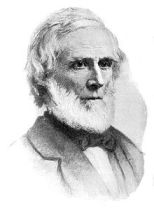
Horace Bushnell, famous preacher and theologian, encouraged Minneapolis to acquire parkland in 1859-60.
Bushnell expressed an idea well ahead of his time and also coined a phrase: this was one of the first uses of the term “city-planning.”
Of more parochial interest here is Bushnell’s advocacy for creating a park in Minneapolis. More specifically, he was the first to recommend that the towns of St. Anthony and Minneapolis acquire Nicollet Island to be a park. Only Edward Murphy, with his donation to Minneapolis of Murphy Square in 1857, can claim an earlier promotion of parks for the young city.
I only came across the story of Bushnell in Minnesota recently while investigating another subject. Sifting through old newspaper files, I found this comment from “Mr. Chute” (likely Richard, instead of Samuel) at a Minneapolis Board of Trade meeting as reported in the Minneapolis Tribune, February 3, 1874:
“Many of you remember Dr. Horace Bushnell, of Hartford, Conn., who spent a year with us in 1858-59 (sic). He was a gentleman of large heart, if not large means, who, seeing the necessity for a park in Hartford to accommodate the laboring man, whose firm friend he always was, procured and donated the ground to the city for a park, which is now the pride of that wealthy place. When Dr. Bushnell was here his constant burden was, you must secure Nicollet Island; it is a shame and a disgrace to neglect your opportunities; buy it at any price.”
I sought corroboration of Chute’s claim and found it in Isaac Atwater’s History of Minneapolis, Vol. 2. In a profile of Andrew Talcott Hale, the author was explaining that Hale came to Minneapolis from Hartford, Connecticut for his pulmonary health, inspired by the experience of Dr. Bushnell, when he provided this digression:
“While yet Minneapolis was a rural settlement, Dr. Horace Bushnell, of Hartford, Conn., visited it for the benefit of his health, impaired by serious inroads of pulmonary disease. After summering and wintering here, with excursions through out the unsettled prairies of the Dakota, during which he freely contributed by his pulpit ministrations, as well as enthusiastic advocacy of park improvements to the improvement of the morals and culture of the community, he returned to his work in Hartford apparently restored to health and vigor.” (Emphasis added.)
In the mid-1800s, Minneapolis was a destination for many people with pulmonary problems. It was thought that the dry air was a tonic for the lungs. Bushnell’s experience seems to substantiate that belief. He wrote of the Minneapolis climate,
“One who is properly dressed finds the climate much more enjoyable than the amphibious, half-fluid, half-solid, sloppy, grave-like chill of the East.”
Bushnell’s letters to his family, published in The Life and Letters of Horace Bushnell, provide some further descriptions of his life in Minnesota from July 1859 to May 1860. Among my favorite passages is this one on Lake Minnetonka:
“Well, I have talked a long yarn, telling you nothing about the Lake, the strangest compound of bays, promontories, islands and straits ever put together—a perfect maze, in which a stranger would be utterly lost.”
The advantages of Minnesota weather aside, two prominent Minneapolitans—Chute and Atwater—remembered Bushnell’s sojourn in Minnesota and they both recalled his commitment to the idea of parks in cities, Minneapolis included. He had already helped Hartford get one.
Hell without the Fire
The Hartford park referred to by Mr. Chute above was created in 1854 when Bushnell helped convince the residents of that city to approve spending more than $100,000 to purchase forty acres in the center of the city for a public park. That must have taken some doing because it was an abused, polluted tract—”tenements, tanneries and garbage dumps,” according to the Bushnell Park Foundation—that Bushnell himself called, “Hell without the fire.” It is considered the first publicly funded park in the United States.
When Bushnell returned to Hartford from Minneapolis after regaining his health in 1860, little had been done to convert the land into a useful park. So he turned to a friend and former parishioner, who at that time was considered to know something about parks. But Frederick Law Olmsted was occupied with his own park project; he was still working on his most famous creation, Central Park in New York. Pressed for a recommendation, Olmsted suggested landscape architect Jacob Weidenmann for the job.
Weidenmann was an immigrant from Winterthur, Switzerland. (Remember that.) Olmsted later wrote that the only two landscape architects in the U.S. he knew of who were qualified to advise park commissions, other than himself and his partner Calvert Vaux, were Weidenmann and H. W. S. Cleveland. Weidenmann was hired and spent eight years as superintendent of Hartford’s City Park, creating a much less formal park there than was typical in Europe. After Weidenmann’s work was done, Connecticut began building its state capitol adjacent to the park in 1872. It wasn’t until Horace Bushnell was dying in 1876 that Hartford renamed the park in his honor: Bushnell Park. He died two days later.
Meanwhile Samuel Clemens had taken up residence in Hartford in 1871 and had turned to writing fiction. His first novel, The Gilded Age, was co-written with Charles Dudley Warner, who was a Hartford park commissioner.
The Minneapolis Connection

Theodore Wirth in about 1900 (Picturesque Parks of Hartford, 1900)
How does this all tie back to Minneapolis? Through Theodore Wirth. As many other cities, including Minneapolis, had caught up to and passed Hartford on the park-o-meter in the 1890s, several of Hartford’s winners in the Gilded Age sweepstakes gave land to the city for parks. Albert Pope left 73 acres to the city for a park in 1894. The same year, Charles Pond left 90 acres of his estate for Elizabeth Park — his wife’s name — and threw in his house and half his fortune to maintain them. Henry Keney went Pope and Pond several hundred acres better that year and donated 533 acres for Keney Park. In 1895 the city purchased another 70 acres for Riverside Park and another 200 acres in the southern part of the city for what became Goodwin Park.
That was a lot of new real estate to whip into park shape. Hartford needed a park superintendent to manage its sudden riches. Hartford’s leaders must have had fond recollections of working with Weidenmann thirty years earlier because when they looked through applicants for the job, they picked someone from the same small town in Switzerland—Winterthur—that Weidenmann had called home. That man was Theodore Wirth.
When Wirth began the job in Hartford, his experience was mostly in horticulture, so Hartford hired Olmsted’s sons—Olmsted Sr. had already retired—as landscape architects for some of the first projects. But after a few years on the job working with the Olmsted firm, Wirth himself designed new park layouts for Elizabeth Park and Colt Park, another 100-plus acre park gift, this from the family famous for revolvers. With those park plans, Wirth established himself as a landscape architect as well as a gardener.
The only Hartford park Wirth did not manage was the enormous Keney Park, which was administered by its own Board of Trustees, separate from the Hartford park commission, and had its own park superintendent, George A. Parker. Wirth and Parker knew each other well. I believe that George Parker was likely responsible for Charles Loring meeting Theodore Wirth in 1905 when he was a committee of one of the Minneapolis park board looking for a replacement for retiring Minneapolis park superintendent William Berry. Parker was the likeliest link between Wirth and Loring because Parker was very active in the new national park organization, American Park and Outdoor Art Association, of which Loring was president 1898-1900. When Loring hired Wirth to become park superintendent in Minneapolis, Parker became the superintendent of all Hartford parks.
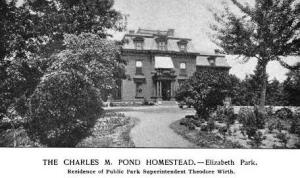
Theodore Wirth lived in the upper level of the former Pond house in Elizabeth Park in Hartford, Conn. The ground floor was open to the public. (Picturesque Parks of Hartford, 1900)
The home, at right, in Hartford’s Elizabeth Park also features prominently in an important decision in Minneapolis park history. The reason the Minneapolis park board built a residence for Theodore Wirth at Lyndale Farmstead in 1910 was to fulfill a promise made to Wirth by Charles Loring, when Loring was negotiating terms for Wirth to take the superintendent’s job in Minneapolis. Wirth had been provided housing in Elizabeth Park in Hartford and wanted a similar deal in Minneapolis. Wirth and family had lived in the upper level of the former home of Charles Pond on the estate Pond had bequeathed to the city. The ground floor and verandas of the Pond home were open to the public as shelters in the summer. The Hartford Public Library operated a small library in the building as well.
Elizabeth Park was also the site of Wirth’s earliest claim to fame: the first public rose garden in the United States, a feature he replicated at Lyndale Park near Lake Harriet in 1907.
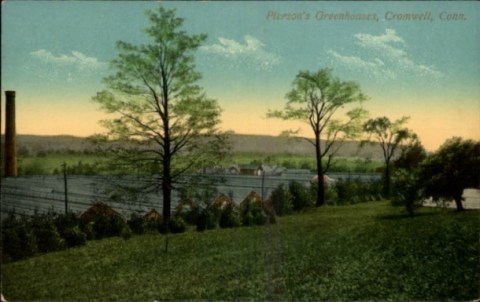
This turn-of-the-century postcard features one portion of the extensive greenhouses of A. N. Pierson, the “Rose King,” of Cromwell, Conn. about ten miles from Hartford. In 1895 Pierson won the gold medal at the New York Flower Show for a new rose, Killarney, that was beautiful and hardy. He also won 17 firsts and two seconds. “Roses became a profit-making flower, Pierson became the Rose King and Cromwell became Rosetown,” wrote Robert Owen Decker in Cromwell, Connecticut, 1650-1990. A profile of Pierson in American Florist in 1903 speculated, “There are so many rose houses in this establishment that it is doubtful the proprietor knows the exact number.” Pierson started a dairy with 65 cows just to supply sufficient manure for his growing houses. Pierson and Wirth were both vice-presidents of the Connecticut Horticultural Society 1899-1904. I would think it quite likely that Wirth’s very successful public rose garden, established in Elizabeth Park in 1903-4, drew on the cultivating research and expertise of Pierson, too. (Postcard photo: connecticuthistory.com)
Another peculiar connection between Horace Bushnell and Minneapolis parks might be appreciated only by people who have searched for information on the “Father of Minneapolis Parks,” Charles Loring. To begin with, Loring came to Minneapolis the same winter Bushnell was here and for the same reason. Loring had an unspecified health condition—likely a pulmonary malady—that caused him to come west from his Maine home. He tried Chicago first, then Milwaukee, and finally arrived in Minneapolis in the winter of 1860. Although he often spent winters in Riverside, California, he remained a resident of Minneapolis until he died here in 1922.
But an odd link to Bushnell goes further. A young Congregational minister from Hartford, a protege of Bushnell’s, became the founder of the Children’s Aid Society of New York. He publicized widely the plight of children in New York’s slums and, finally, in an attempt to improve the lives of those children he organized what came to be known as “Orphan Trains” that sent New York orphans to better lives, supposedly, with settlers in the west. His name was Charles Loring Brace. Perhaps it is only coincidence that Loring’s rationale for creating parks and playgrounds in Minneapolis was often that children needed places to play and grow.
A final link between Minneapolis and Horace Bushnell’s long visit here. For many years, local historians have turned to a number of late 1800s-early 1900s profiles of Minneapolis that included “vanity” or “subscription” biographies of prominent citizens. One of those, A Half-Century of Minneapolis, was compiled by influential Minneapolis journalist Horace B. Hudson. You’ve probably already guessed the middle name of Mr. Hudson, who was born in 1861, shortly after Dr. Bushnell’s visit here. Yes, his full name is Horace Bushnell Hudson.
More than 150 years have passed since Horace Bushnell implored the people of the little towns on either side of St. Anthony Falls to acquire Nicollet Island as a park. Many attempts have been made, several surveys completed, many speeches delivered in favor and opposed, and part of it acquired, but it’s never become the park Bushnell imagined. Horace Bushnell’s ghost might haunt us until we get it right.
David C Smith
© David C. Smith
Delineators in Minneapolis Park Plans
Filed under: Landscape Architects, Minneapolis parks | Tags: Charles E. Doell, Christian Bossen, Claude Gosslee, Harold Lathrop, I. Kvitrud, Superintendent's House, Theodore Wirth, Theodore Wirth House
Comments (5) When the park board employed its first full-time engineers it’s likely that those engineers also did the drafting or “delineating” of the plans for new parks. The assumption is supported by the attributions on the first plans published in Minneapolis park board annual reports that included someone’s name other than that of Theodore Wirth, who became superintendent of parks in 1906. In the 1908 and 1909 annual reports, the park system’s two engineers, A. C. Godward and W. E. Stoopes, were cited as both engineer and delineator and no other delineators were credited. There may have been none.
Brief biographical sketches of Godward and Stoopes are provided in a previous post on Engineers, so I’ll begin with the first delineator who was never cited as an “engineer” on a park plan. That man was…
I. Kvitrud. I haven’t even discovered his first name. (Note 11/29: Thanks to an anonymous tip, which I’ve confirmed, I learned that Mr. Kvitrud’s first name was Ingwald. Thanks, “T”. For the Google spiders, that’s Ingwald Kvitrud!) Kvitrud was identified as the delineator of three park plans in 1910 and 1912. He was an engineering graduate of the University of Minnesota and served as an officer of the Minnesota Engineering Society in 1910 and 1912. He was hired in 1914 as a full-time instructor in Drawing and Geometry at his alma mater and he was still employed there in 1919, his annual salary having increased in five years from $900 to $1500, according to University records.
The most interesting reference I’ve found to Kvitrud was in an article in the San Francisco Call, July 19, 1913. In a story datelined Minneapolis, Kvitrud was identified as the Minneapolis park board clerk in charge of selling material from the demolition of buildings for a park at The Gateway. Read more
Engineers in Minneapolis Park Plans
Filed under: Landscape Architects, Minneapolis parks | Tags: A.C. Godward, A.E. Berthe, Charles E. Doell, Frank Nutter, Minneapolis Landscape Architects, Theodore Wirth, W.E. Stoopes
Comments (3) I was curious about the people who created the park plans I featured in the Catalog of Minneapolis Park Plans, 1906-1935, which was presented in three installments recently (Vol. 1, Vol. 2, Vol. 3). The catalog identifies all the plans and drawings published in Minneapolis park board annual reports during the tenure of Theodore Wirth as Minneapolis’s park superintendent.
I’ve tried to piece together info on the men whose names appear on those plans as engineers or delineators using park board reports, newspaper archives, and miscellaneous documents found through online searches. I’m not aware of any other background information at the park board on the early engineering and planning staff.

The park board engineering staff about 1915 in their 4th floor offices in City Hall. From left: Alfred C. Godward, Charles E. Doell, Clyde Peterson, Herman Olson, Dick Butler, “Spud” Huxtable, “Spike” Miller and Al Berthe. (Minneapolis Park and Recreation Board)
The man whose name appears on almost all of the plans, Theodore Wirth, superintendent of parks, is already well-known. Most of the others, much less so—although two of them, Charles Doell and Harold Lathrop, became very well-known nationally as park administrators.
During that time, the park board employed no “landscape architects.” The profession was still relatively new. The American Society of Landscape Architects (ASLA) was founded in 1898 and the first university programs in the field were created at Harvard and MIT around the turn of the century. This was after the first generation of true landscape architects in the United States, led by Frederick Law Olmsted and H W. S. Cleveland, had already passed from the scene. Cleveland had been the Minneapolis park board’s advisor and landscape architect from the creation of the park board in 1883, and had helped define the profession in this country. The park board had also hired landscape architect Warren Manning on a few occasions from 1899-1904 to provide advice and park plans after Cleveland retired.
Theodore Wirth was likely hired as park superintendent in Minneapolis in part because he had some experience designing parks in Hartford, Conn. He is credited with the designs of Colt and Elizabeth parks in Hartford. (Early in Wirth’s time in Hartford, the landscape architect role was filled by the Olmsted Brothers, the firm run by the sons of Frederick Law Olmsted. The senior Olmsted was a native of Hartford.) Wirth certainly played the role of landscape architect in Minneapolis, but I’m not aware of him ever calling himself one. He was active in the American Institute of Park Executives, and its predecessor organizations, but never ASLA. For ten years, 1925-1934, Wirth’s name appears on park plans as “Sup’t & Engineer” even though he did not have a formal engineering credential—apart from a course at a technical school in his native Switzerland as a young man. That course may have focused more on gardening than engineering. His first jobs were as a gardener. I could only guess at Wirth’s reasons for taking the “Engineer” title on park plans for the first time at age 62.
During his long tenure in Minneapolis, Wirth built a staff of men with Civil Engineering degrees—all from the University of Minnesota—not landscape architecture degrees or training. The first landscape architect hired full-time by the park board was Felix Dhainin in 1938. (If anyone could tell us more about Dhainin, I’d appreciate it.)
Here’s what I learned about the engineers for the park board 1906-1935. I’ll get to the draftsmen and delineators in a later post. Turns out the most interesting of all the park board engineers wasn’t featured in annual report plans at all! Read on
Those Darn Cars!
Filed under: Minneapolis parks | Tags: Charles M. Loring, Lake Harriet Pavilion
Comments (1) “It is the sense of this Board that the practice of tooting Automobile horns, by way of applause, at the concerts given in the parks should be discontinued.”
Motion proposed by park commissioner Charles M. Loring and adopted by the Minneapolis Board of Park Commissioners, June 18, 1906.
A Railroad Town
Filed under: Minneapolis parks, Mississippi River | Tags: Above The Falls, Mississippi River, Stone Arch Bridge
Comments (1) To reinforce recent articles that addressed the dominance of railroads and mills along the Minneapolis riverfront, I found these photos from about 1920 to be fascinating. Both are from the photo collection of the Minnesota Historical Society, a fabulous resource for understanding how our city and state came to be. The collection includes other aerial photos by Paul W. Hamilton of Minneapolis and St. Paul from the same time. They’re worth a look.

The west bank of the Mississippi River in Minneapolis looking downriver from above St. Anthony Falls. Nicollet Island is far left, the Stone Arch Bridge upper left in about 1921 (Paul W. Hamilton, Minnesota Historical Society)

North Minneapolis at Plymouth and Washington looking east toward the Mississippi River and Plymouth Bridge in background. Railroads consumed a lot of land in about 1920 on the west bank. (Paul W. Hamilton, Minnesota Historical Society)
When you look at these pictures it’s obvious why the Civic Commission and the park board were interested in reclaiming the riverfront 100 years ago.
David C. Smith
The Makwa Club’s Lake Calhoun Toboggan Slide
Filed under: Minneapolis Parks: General, Winter Sports | Tags: Harry Perry Robinson, Lake Calhoun, Makwa Club, toboggan slide
Comments (4) A couple of months ago I posted photos of a toboggan slide at Lake Harriet in 1914. Now I’ve rediscovered a description I had saved long ago of a toboggan slide from an earlier time on a Minneapolis lake. The Makwa Club—makwa is the Ojibwe word for “bear”—built a toboggan slide at Lake Calhoun in 1888, according to the Minneapolis Tribune, January 22, 1888.
The Tribune reported that the Makwa Club was formed in 1885 and had its first toboggan slide on Lowry Hill near Thomas Lowry’s house. For the winter of 1888 the club built a much grander slide at Lake Calhoun. The Tribune reported, “The slide is much superior to any that has been built in Minneapolis before and is probably as fine as any that is in existence in the country.”
The other toboggan slides in the city that winter were maintained by the Flour City Toboggan and Snowshoe Club and the North Star Toboggan Club. (Newspapers of the time referred often to the toboggan “craze,” much like the bicycle craze that would soon follow, and the canoe craze that came after that. Today, I suppose, we text or tweet.) The Flour City slide was a 1,000-foot slide near Ridgewood Avenue that ended near Franklin and Lyndale. The North Star slide was west of the city in what is now Theodore Wirth Park.
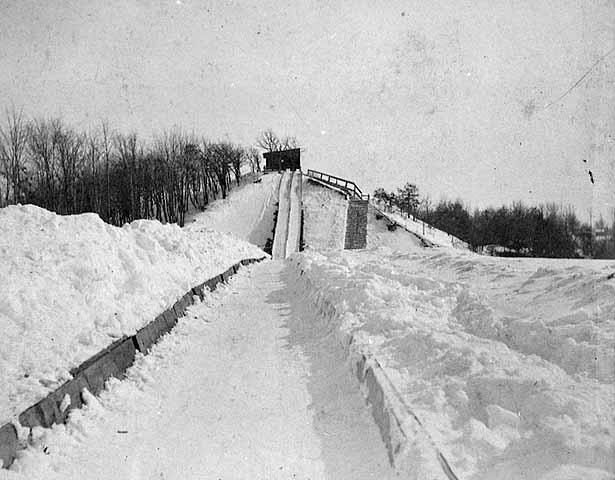
The only photo I can find of a toboggan slide from that era was the North Star chute on Glenwood Hill, 1887. (Minnesota Historical Society)
The Makwa slide was 220-feet long, running onto Lake Calhoun from the bluff on the east side of the lake where the Lyndale Hotel once stood. The slide had three chutes that had a drop of 55 feet and crossed both the street railway track—15 feet above the track—and Calhoun Parkway—24 feet above the road. (Yes, the Makwas did get the permission of the park board to build its slide over the parkway.) The slide met the lake ice about 50 feet out from the shore and the level runway continued 1,500 feet onto the lake. After a run of about 1/3 mile, toboggans hit roughed up lake ice that prevented them from running onto Lake Calhoun’s horse trotting track.
The grandest feature of the slide, however, “had never before been tried in any slide,” according to the Tribune: a wooden warming house and starting platform at the top of the slide, 10 feet off the ground. The front of the warming room was made almost entirely of glass and looked straight down the slide. The slide was illuminated by five electric lights.
The Makwas even had an arrangement with the motor (trolley) company by which the 7:40 train out from town every evening stopped at the foot of the slide to drop off club members and the 9:57 train made a special stop at the same place to pick them up for a return to the city after an evening of mirth. The slide was for the use of club members only.
The Makwa uniform was breeches and blouse of heavy gray French wool and stockings, toque and sash of cardinal. The membership of the club was limited to 200 and included many of the best-known young men of Minneapolis. The president of the club in 1888 was English journalist Harry P. Robinson, who was featured in an earlier article about his close friend John S. Bradstreet. Bradstreet was a Makwa, as was park commissioner Eugene Wilson.
The problem with the Makwa’s grand slide was that no one was willing to pay for it. In 1891, the Tribune reported that a lawsuit had been filed—in what it called the “Makwa mess”—by the man who built the slide in an attempt to recover his costs from the officers of the defunct club. Makwa Club members had been assessed $10 each to pay for the slide in 1888, but most didn’t pay. Some claimed that the officers of the club did not have the authority to spend the money on the slide. (I wonder if these claimants used the slide!) Of the $800 charged to build the slide, only about $300 had been paid. The Makwa directors, including Robinson, then sued individual members who hadn’t paid up. The Tribune reported on only two of those cases: one was not contested and the other lost on a technicality.
One of the “chief forms of pleasure that the belles and bloods of the city indulged in” that winter through “the most select of all the clubs” ended up being a free toboggan ride for most of them. (Tribune, March 20, October 18, December 22, 1891.)
By the fall of 1891, however, Makwa president Robinson had married the daughter of one of the wealthier men in Minneapolis, Thomas Lowry, so he may have found the means to pay the builder of the toboggan slide that was “much superior” to any other in Minneapolis.
If you’ve ever seen a picture of the Makwa Club’s Lake Calhoun toboggan slide, please let us know. We’d love to see it.
David C. Smith
© David C. Smith
Bryn Mawr Golf Course Update
Filed under: Minneapolis Golf Courses, Minneapolis parks | Tags: Bryn Mawr, Golf, Interlachen Golf, Minikahda
Comments (2) I recently met with Joe Bissen who is writing a book on lost Minnesota golf courses. We walked around the Bryn Mawr neighborhood trying to determine the location of the old clubhouses of the Bryn Mawr Golf Course. The course, which existed from 1898 to 1911 near the Penn Avenue-Cedar Lake Road intersection, spawned both the Minikahda and Interlachen clubs before it closed and the course disappeared.

Golfing at Bryn Mawr in 1898. (Minnesota Historical Society)
The Bryn Mawr course had two clubhouses. The first was located at 95 Elm Street, now Morgan Avenue South, which had been a private residence of the Woodburn family before it was purchased in 1898 and converted into a clubhouse. The second clubhouse was built nearby. Bissen has found the address of the second clubhouse in 1908 to be 97 Oliver Avenue North.
Here’s the challenge. At that time Superior Avenue, what is now roughly I-394, was the dividing line between north and south street addresses, but now that dividing line is about a half-mile north at Chestnut Avenue. What was once Oliver Avenue North in Bryn Mawr is now Oliver Avenue South. Can anyone shed light on the present address of what was once 95 Oliver Avenue North? Joe and I suspect it was in the 400 or 600 block of what is now Oliver Avenue South. (Futher complicating addresses in the neighborhood there are no 500 addresses—straight from 490s to 600s!)
Can any Bryn Mawr historians solve this puzzle? Let me know and I’ll put you in touch with Joe. Would property abstracts show old addresses? And why (when) was Bryn Mawr moved from north to south?
Joe Bissen is researching lost golf courses throughout the state, so if you know of other courses, such as the Camden Golf Club in north Minneapolis, which disappeared with hardly a trace, Joe would like to know more about them.
David C. Smith
The First River Plans: Long Before “Above the Falls” and “RiverFirst”
Filed under: Minneapolis parks, Mississippi River | Tags: Above The Falls, Charles M. Loring, H. W. S. Cleveland, Hall's Island, Horace Cleveland, Mississippi River, RiverFIRST, St.Anthony Falls, William Watts Folwell
Comments (2) 
“I have been trying hard all Winter to save the river banks and have had some of the best men for backers, but Satan has beaten us.” H. W. S. Cleveland to Frederick Law Olmsted on efforts to have the banks of the Mississippi River in Minneapolis preserved as parkland, June 13, 1889 (Letter: Olmsted Papers, Library of Congress. Photo: H. W. S. Cleveland, undated, Ramsey County Historical Society)
Considerable time, effort and expense—$1.5 million spent or contractually committed to date—have been invested in the last two years to create “RiverFirst,” a new vision and plans for park development in Minneapolis along the Mississippi River above St. Anthony Falls. That’s in addition to the old vision and plans, which were actually called “Above the Falls” and haven’t been set aside either. If you’re confused, you’re not alone.
Efforts to “improve” the banks of the Mississippi River above the falls have a long and disappointing history. Despite the impression given since the riverfront design competition was announced in 2010, the river banks above the falls—the sinew of the early Minneapolis economy—have been given considerable attention at various times over the last 150 years. There’s much more
Pushball at Powderhorn
Filed under: Minneapolis parks | Tags: Powderhorn Park, pushball
Comments (2) Does anyone remember “pushball”? This photo was taken at Powderhorn Park, but the date isn’t marked. It looks like a fair number of kids were left standing and watching.
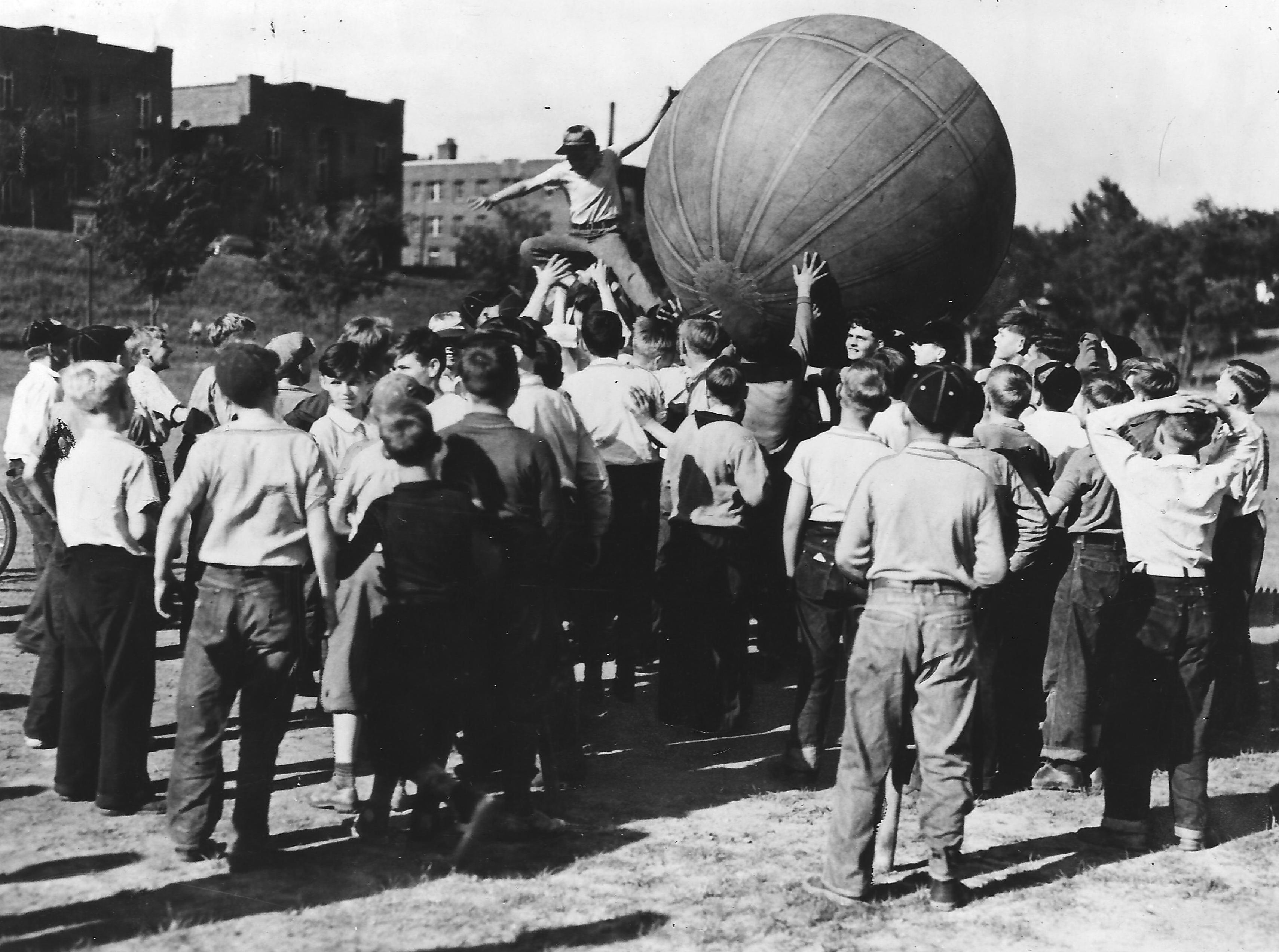
This is “Pushball.” The apartments in the background appear to be those on Powderhorn Terrace just north of the park. Date unknown. (Minneapolis Park and Recreation Board)
Any guesses on the date?
Do you remember any other playground games that aren’t played anymore? Got pictures?
David C. Smith
Low River Redux
Filed under: Minneapolis parks, Mississippi River | Tags: Ford Dam, Mississippi River, St.Anthony Falls, Stone Arch Bridge
Comments (2) The dry weather this year is evident on the Mississippi River at St. Anthony Falls. A couple weeks ago I posted an aerial photo of St. Anthony Falls when it was very dry in 1955. The water levels on the river appear to be similar now. Larry Dillehay sent this photo taken on the afternoon of October 2. The concrete apron at the Falls isn’t quite dry, but there’s not enough water flowing to make a ripple at the bottom. The horseshoe dam above the falls is now completely out of the water. What a gorgeous day—again.
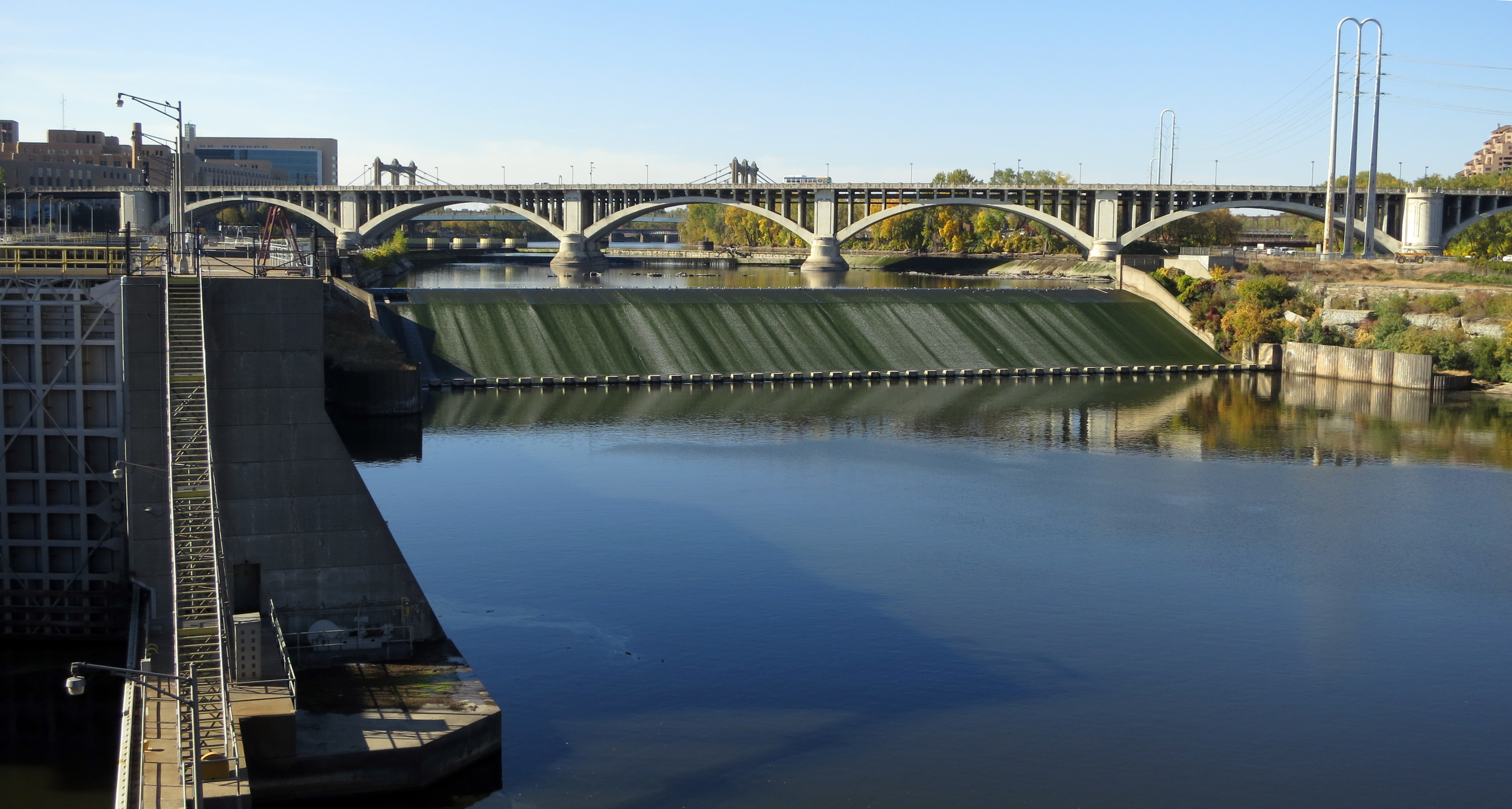
St. Anthony Falls in a very dry year, as seen from the Stone Arch Bridge, October 2, 2012. (Photo: Larry Dillehay)

Horseshoe dam exposed, with Nicollet Island in background. From 3rd Avenue Bridge just upriver from St. Anthony Falls, October 2, 2012 (Photo: Larry Dillehay)
David C. Smith
Postscript: Both the horseshoe dam and Lock and Dam #1, or Ford Dam, were repaired while the water was at this level, suggesting that while the summer had been very dry, the water levels had been lowered intentionally by the U.S. Army Corps of Engineers to facilitate mainteneance.
Catalog of Minneapolis Park Plans: Volume III, 1926-1935
Filed under: Landscape Architects, Minneapolis Park History Resources, Minneapolis parks | Tags: A.E. Berthe, Harold W. Lathrop, Minneapolis park designs, Theodore Wirth
Comments (2) The thirty annual reports produced while Theodore Wirth was superintendent of parks in Minneapolis—1906-1935—were rich in detail and illustrations. Those reports included 328 plans, designs and maps of parks and park structures. The publication of those plans usually coincided with the acquisition or development of new properties or the improvement of older ones, so they are a good guide to where to find some discussion of those park properties in annual reports or proceedings. So, long ago I catalogued all of those plans in one document to create a searchable guide to park development during those years. I have relied on that list for the last few years and assumed other researchers and park lovers would find it useful as well. I’ve already posted the first twenty years worth of plans, and today is Volume III, 1926-1935.

Detail of a plan published in the 1912 annual report showing a proposed canoe house on a peninsula in Lake Harriet. (1912 Annual Report, Minneapolis Board of Park Commissioners)
The plans published in annual reports were not the only plans created by the park board staff in the years Wirth was superintendent of parks. They are mostly conceptual plans, rather than working plans. The park board requested many of the plans specifically as park commissioners considered various park proposals and possibilities.
The number of employees in the park board’s engineering department are not published in every annual report, but in most years for which that info is provided, it appears that one or two draftsmen were employed. A few of their names appear as “Delineator” or “Del.” on the plans. Sometime in the near future, I’ll provide a guide to some of the names of the people who helped prepare plans.
The titles of the plans are verbatim as they appear on plans. I’ve also copied dates, names and titles as they appear, but have added some punctuation to make them easier to read. Parenthetical comments identify current park names or mention important plan elements.
The annual reports from 1931 to 1935 were not typeset in order to cut costs during the Depression. The reports also contained very few plans or illustrations, not just to reduce printing costs, but because the park board had no money to spend on improving parks. Read more »
Catalog of Minneapolis Park Plans: Volume II, 1916-1925
Filed under: Landscape Architects, Minneapolis Park History Resources, Minneapolis parks | Tags: A.C. Godward, A.E. Berthe, Minneapolis park designs, Theodore Wirth
Comments (3) A few days ago I published the first installment (1906-1915) of a Catalog of Minneapolis Park Plans presented in the annual reports of the Minneapolis park board while Theodore Wirth was superintendent of Minneapolis parks (1906-1935). Today I publish the second installment of plans and drawings in annual reports covering 1916-1925.
Along with this “volume” I want to add a dedication and explanation: I am publishing this list of plans for anyone to use, like the rest of the research I have posted here, partly out of my interest in the subject and our civic history. But I also want to acknowledge former park superintendent Jon Gurban’s role in my research. When Jon informed me in early 2007 that I had been selected to write the history of the first 125 years of the Minneapolis Park and Recreation Board—the book City of Parks was the result—he had one request. He asked that, in addition to writing the book, I would share with park board staff and him other useful, important and interesting information that I uncovered in my research. While conducting research just to write my book proposal that winter, I had found several items that I had brought to his attention that I thought were fascinating. He said that my enthusiasm for those finds and my willingness to share them were factors in me getting the assignment.
So this Catalog of Minneapolis Park Plans is published with a nod to Jon Gurban, in my experience an honorable man treated dishonorably by some with whom he shared a passion for Minneapolis parks.

This plan for the Minnehaha Stone Quarry from the 1919 annual report is representative of the plans listed below. (Minneapolis Park and Recreation Board)
Remember that many of the plans presented in annual reports were conceptual plans and many were not implemented or were revised extensively. Most of the plans were created by park superintendent Theodore Wirth, with exceptions as noted. It would be a mistake, however, to assume because Wirth created the plans that the ideas for the parks also came from him. Some of the plans grew from Wirth’s own vision, while many other plans were requested by the park board or were concepts that had been bouncing around for some years.
This catalog will be most useful for park planners and historians, but also provides many insights into our park system for casual observers or fans of particular parks. After I publish the last third of the catalog (soon), I’ll provide a bit of information on the various individuals who are credited on these plans—as well as some others who weren’t given credit.
The titles of the plans are verbatim as they appear on plans. I’ve also copied dates, names and titles as they appear, but have added some punctuation to make them easier to read. Parenthetical comments identify current park names or mention important plan elements. /s/ indicates a signature.
A quick explanatory note: 1925 was the first year that Theodore Wirth added “engineer” to his title on park plans. That doesn’t indicate a new credential for Wirth, but the departure of A.C. Godward as the park board’s engineer. Godward had taken the job of Engineer for Minneapolis’s new City Planning Department in June 1922, but continued to supervise engineering at the park board, too. When Godward left the park board completely in 1925, his assistant, A. E. Berthe, kept the title Assistant Engineer and Wirth took the Engineer title himself. Despite Wirth’s praise for Berthe’s work, and Berthe being listed in annual reports as “head” of the engineering department, he remained the Asst Engr to Wirth until 1935, when Berthe was listed as Park Engineer or Civil Engineer and Wirth as General Superintendent.
 Minneapolis Park History