Charles Loring: “We must control the lake.”
Filed under: Loring Park, Minneapolis Lakes, Minneapolis parks | Tags: Charles M. Loring, Florence Barton Loring, Lake Calhoun, Lake Harriet, Lake of the Isles, Minneapolis parks, Minnehaha Falls
 Comments (3)
 If you have read my history of the Minneapolis park system, City of Parks, you may recall that Charles Loring’s efforts to acquire land around lakes Harriet, Isles and Calhoun remain a subject of speculation. No one has ever found a clear strategy or well-documented plan by Loring, the first president of the Minneapolis Board of Park Commissioners, to acquire the lakes, even though he spent the better part of several years in getting those complicated real estate deals done. I focused mostly on Loring’s desire to create a parkway from Loring Park, then still called Central Park, around the lakes to Lake Harriet, which had been acquired already for the fledgling park board largely by gift. Even the generous gift of land around Lake Harriet by Henry Beard, James Merritt, Charles Reeve and, ultimately, William King, was prompted by the desire to have a parkway around the lake, which accounts for the limits of the original gift: a strip of land only 125 feet wide around Lake Harriet—just enough for a walking path, a carriage way and a few trees or flowers to dress it up.
A new discovery suggests, however, that Loring had much more in mind than parkways. As part of the ongoing project to inventory the park board’s historical records with the goal of making them more accessible to researchers, I recently found a letter written by Loring in 1886 that sheds more light on his thinking about the lakes.
The letter, dated June 14, 1886 and addressed to park board secretary Rufus Baldwin, discusses Loring’s views on what needs to be done to acquire land at Lake of the Isles. Loring notes that Alfred Dean, who owned much of the land that had to be crossed by a parkway at Lake of the Isles, had already told Loring he could do whatever he wished. Loring then wrote,
“My opinion is that we do not want the land on the outside, but do want it next the lake. As the plat now is, the boulevard goes around the little marsh thus.”
Loring then includes a small drawing.

Charles Loring’s letter to Rufus Baldwin, June 14, 1886
He is very explicit, writing on the road next to the lake “This is what we want” and concluding bluntly, “We must control the lake.”
This evidence that Loring was thinking far beyond parkways is reinforced by the concluding page of his letter when he addresses a new topic: boats on Lake Harriet. He notes that a steamer has been placed on the lake and he has asked the owner to remove it, but adds that after talking with “Judge Fish”—park board attorney Daniel Fish—Loring doesn’t want legal questions raised yet about “rights on the water”. Clearly, Loring is thinking about park board control not just of boulevards around the lake, but activity on the lake as well. His earlier comment, “We must control the lake”, takes on even greater significance.
We may owe even more to Charles Loring and his vision than we previously knew.
While on the subject of Loring I want to mention a note I received a while ago from, William Scott, the great-great-nephew of Charles Loring’s second wife Florence Barton Loring. You can read more about his family’s relationship with the Bartons and Lorings in the “Comments” section here.
This is the carte de visite of Florence Barton that he refers to. Thanks to William Scott for sharing the photos below.

Florence Barton, date unknown. (Beal Art Gallery, Harold W. Scott Collection, courtesy William Scott)
This must have been taken long before she married Charles Loring at age 45 in 1895. Read much more about Florence Barton Loring here.
William Scott also sent a photograph of family and friends at Minnehaha Falls in about 1910. Love those hats! The new bridge with the boulder face over a concrete structure was brand new in 1910. Appears to be a dry year.

David C. Smith
© 2016 David C. Smith
Shared History: Edina’s Early Days
Filed under: Lake Harriet, Landscape Architects, Minneapolis Parks: General, Minnehaha Creek | Tags: Edina History, H.W.S. Cleveland, Horace Cleveland, Minnehaha Creek
Comments (4) Edina and Minneapolis share more than France Avenue—and history buffs aren’t restricted by city boundaries.
Henry Brown played an important role in the history of Edina as well as the history of Minnehaha Falls as a Minneapolis park.
There is a Chowen Park in both Edina and Minneapolis.
Minnehaha Creek flows through Minneapolis parkland before it gets to Edina — and, of course, all of Minnehaha Creek after it leaves Edina on its way through Minneapolis to Minnehaha Falls and the Mississippi River is parkland.
The Interlachen neighborhood grew up around a golf course created by golfers who had outgrown their nine-hole Bryn Mawr course near downtown Minneapolis.
That’s just a taste of the rich information on Edina history—and Minneapolis history— on the web site of realtor Ben Ganje. Go to the neighborhood directory on his site then look at the right margin for a list of Edina neighborhoods. Each of Edina’s 45 official neighborhoods is profiled with historical info and interesting bits of trivia.
I read about Todd Park because of my interest in famous diva Emma Abbott, a Minneapolis girl made good. Her father was one of those first interested in developing this part of Edina.
Why was I interested in Emma Abbott? She was buried next to her husband in Oak Grove Cemetery in his home town, Gloucester, Mass. Their monument is the most impressive in that cemetery, which I visited this fall.

Emma Abbott’s memorial in Oak Grove Cemetery, Gloucester, Mass. Designing the cemetery was one of H.W.S. Cleveland’s first commissions as a landscape architect in 1854. (Photos: David C. Smith)
Laying out Oak Grove Cemetery was one of the first commissions Horace William Shaler Cleveland received as a landscape architect.  He was hired for that job, with his young partner Robert Copeland, in 1854. The next year they tackled the design of the much more prestigious Sleepy Hollow Cemetery in Concord, Mass., the eventual resting place of many of the great writers of early America: Ralph Waldo Emerson, Henry David Thoreau, Louisa May Alcott, Nathaniel Hawthorne and his wife, Sophia, who was a childhood friend of Horace Cleveland.
More Edina History of Interest to Minneapolitans
Another Edina neighborhood profile I liked was Creek Knoll, which borders Minneapolis and was first promoted as a residential development for its nearness to Lake Harriet.
Also check out the profile of Morningside, a neighborhood that was also subdivided and developed partly because of the rapidly rising prices of residential lots nearer Lake Harriet in the early 1900s.
For those of you interested in park history in general, you might want to read about park development at Pamela Park, Bredesen Park and also the land once owned by four-term Minneapolis mayor, George Leach, that became Braemar Golf Course. The Lake Cornelia history also presents some of the challenges of park making as well as stormwater management that face cities as well as suburbs.
Can you still catch northern pike in Centennial Lakes?
Worth a look if you want to know more about our southwestern neighbor—and our metropolitan area from water management and freeways to shopping centers.
David C. Smith
Arts and Parks: Part II
Filed under: Minneapolis parks | Tags: Minneapolis Institute of Arts, Washburn Fair Oaks, William D. Washburn
Comments (9) Another of my favorite recent photo finds is a good intro to my next speaking engagement on Minneapolis park history this Saturday.
I recently found this photo of the Washburn Fair Oaks mansion built by William Washburn in 1883.

Washburn Fair Oaks mansion, probably in the 1880s. Looking west across Third Avenue South in foreground. (W.S. Zinn)
Compare it to this photo taken two Sundays ago from about the same vantage point across Third Avenue South.

Washburn Fair Oaks Park looking west across Third Avenue South.
Now turn about 90 degrees left and you get this image of the Minneapolis Institute of Arts.

Minneapolis Institute of Arts looking southwest across Third Avenue South.
I’ll be talking about both parks and arts, and how many of the same people created Minneapolis’s parks and its art institutions at the Washburn Library on Lyndale Avenue, Saturday, November 21 at 10 a.m. My presentation is being hosted by the Minnesota Independent Scholars’ Forum, but the event is free and open to the public.
For more information visit here. Hope to see you Saturday.
If you want to know more about the landscaping of the Washburn Fair Oaks grounds, you can begin here. Of course, the story features H.W.S. Cleveland.
David C. Smith
The Demise of the 10th Avenue Bridge
In response to the previous post on Charles Tenney’s photos of Highland Avenue and the 10th Avenue Bridge, MaryLynn Pulscher sent her favorite photo of the 10th Avenue Bridge. It’s a fascinating bit of history itself. We don’t know the origin of the photo but believe it’s from a newspaper. If anyone knows who took it or where it was published, please let us know so we can give proper attribution.
David C. Smith
Lost Minneapolis Parks: Highland Oval
Filed under: Lost Minneapolis Parks, Minneapolis parks | Tags: Charles A. Tenney, H.W.S. Cleveland, Highland Oval, Horace Cleveland, Oak Lake, Samuel Gale, Stone Arch Bridge
Comments (1) The elegant neighborhood on the hills surrounding Oak Lake—now the site of the Farmer’s Market off Lyndale Avenue—has been gone for decades. Oak Lake itself was filled in 100 years ago. You can read the whole story here. The latest news: I finally found a picture of one of the five small parks in the Oak Lake Addition. I give you Highland Oval.

The title on the photo is “Highland Avenue, Oak Lake Division”, but the open space in the middle of the photo can only be Highland Oval. The view is looking northwest. Tiny, isn’t it? But the effort to preserve any open green space in rapidly expanding cities was a novel concept. (Photo by Charles A. Tenney)
The photo was probably taken in the mid-1880s, before the park board assumed responsibility for the land as a park. The land was designated as park in the 1873 plat of the addition by brothers Samuel and Harlow Gale. Although I have no proof, I believe it likely that H.W.S. Cleveland laid out the Oak Lake Addition, owing largely to the known relationship between Cleveland and Samuel Gale. The curving streets that followed topography and the triangles and ovals at street intersections were hallmarks of Cleveland’s unique work about that same time for William Marshall’s St. Anthony Park in St. Paul and later for William Washburn’s Tangletown section of Minneapolis near Minnehaha Creek. It was also characteristic of Cleveland’s work in other cities.
Photographer Charles A. Tenney published a few series of stereoviews of St. Paul and Minneapolis 1883-1885. He was based in Winona and most of his photos are of the area around that city and across southern Minnesota.
Highland Oval was located in what is now the northeastern corner of the market.
As happy as I was to find the Highland Oval photo, my favorite photo by Tenney tells a different story.

10th Avenue Bridge. (Photo by Charles A. Tenney)
At first glance, this image from Tenney’s Minneapolis Series 1883 was simply the 10th Avenue Bridge below St. Anthony Falls, looking east. The bridge no longer exists, although a pier is still visible in the river. What makes the photo remarkable for me are the forms in the upper left background being built for the construction of the Stone Arch Bridge. (See a closeup of the construction method here.) The Stone Arch Bridge was completed in 1883 — the same year the Minneapolis Board of Park Commissioners was created.
Nearly 100 years after the bridge was built, trains quit using it and several years later the park board, Hennepin County and Minnesota reached an agreement for the park board to maintain the bridge deck for pedestrians and bicyclists, thus helping to transform Minneapolis’s riverfront—a process that continues today.
Note also the low level of the river around the bridge piers. This was long before dams were built to raise the river level to make it navigable.
David C. Smith
© 2015 David C. Smith
Hiawatha and Minnehaha Do Chicago
Filed under: Minneapolis parks, Minnehaha Falls | Tags: Daniel Chester French, Hiawatha and Minnehaha Statue, Jakob Fjelde, Minnehaha Falls, Ole Bull Statue, William Watts Folwell
Leave a Comment The World’s Columbian Exposition in Chicago hosted the debut of Minneapolis’s most famous sculptural couple, Hiawatha and Minnehaha, in 1893.
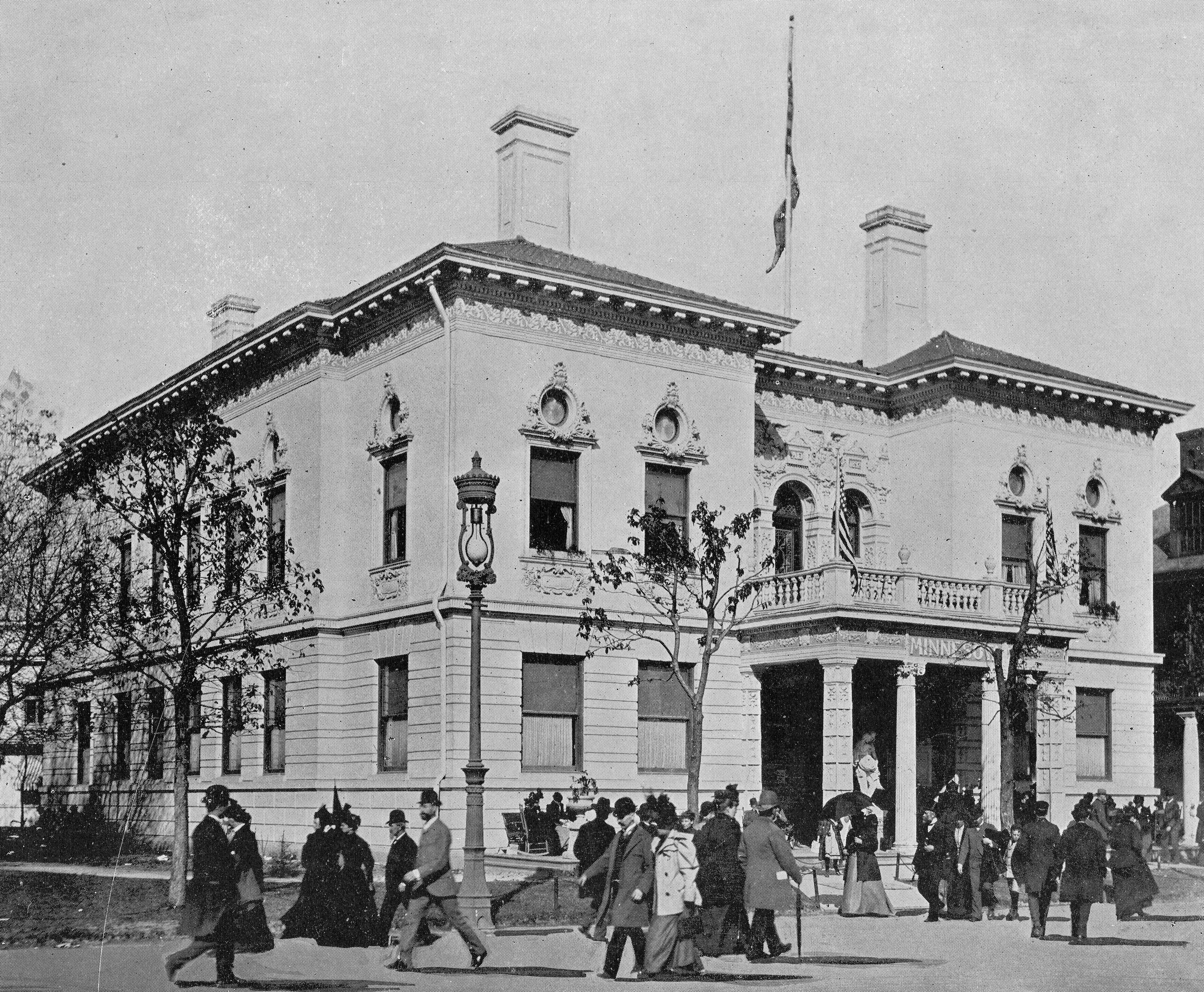
The Minnesota building at the World’s Columbian Exposition in 1893 featured Jakob Fjelde’s sculpture of Hiawatha and Minnehaha in the vestibule.
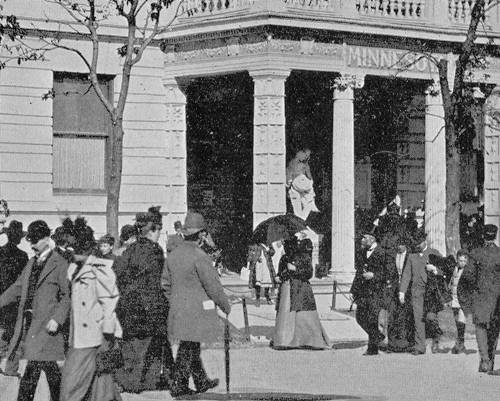
Zoooom.
Hiawatha and Minnehaha greeted visitors to the state’s pavilion in their modest plaster costumes nearly two decades before sculptor Jakob Fjelde’s pair took their much-photographed places on the small island above Minnehaha Falls in their bronze finery in 1912.

Hiawatha and Minnehaha in their customary place above Minnehaha Falls. This photo, from a postcard, was probably taken in the 1910s. I chose this picture not only because Hiawatha appears to be climbing a mountain of rocks to cross the stream, unlike today, but also because it is a Lee Bros. photo, the same photographers who shot the photo of Fjelde below.

Jakob Fjelde, Lee Bros., year unknown. I like the cigar. (Photo courtesy of cabinetcardgallery.wordpress.com)
Jakob Fjelde was largely responsible for two other sculptures in Minneapolis parks. He created the statue of Ole Bull, the Norwegian violinist, in Loring Park in 1895. He also created the drawing that Johannes Gelert used after Fjelde’s death to sculpt the figure of pioneer John Stevens, which now stands in Minnehaha Park. Fjelde also created the bust of Henrik Ibsen, Norway’s most famous writer, that adorns Como Park in St. Paul. Fjelde’s best-known work other than Longfellow’s lovers, however, is the charging foot soldier of the 1st Minnesota rushing to his likely death on the battlefield of Gettysburg.

Fjelde’s simple commemoration of the sacrifice of Minnesota men at a pivotal moment in the Civil War. The sculpture was installed in 1893 and dedicated in 1897. (Photo: Wikipedia)
These thoughts and images of sculpture in Minneapolis parks were prompted in part by my recent post on Daniel Chester French, but also by another letter found in the papers of William Watts Folwell at the Minnesota Historical Society. Just two years after Fjelde’s successes with his sculptures for Gettysburg and Chicago, he wrote a poignant letter to Folwell in July 1895 seeking his support for an “extravagant” offer. Fjelde proposes to the Court House Commission, which was developing plans for a new City Hall and Court House, that he create a seven-foot tall statue of the Chief Justice of the U.S. Supreme Court, John Marshall, and a bronze bust of District Court Judge William Lochren, both for the sum of $1,400. Fjelde calls the price of $1,000 for the Marshall statue “1/3 of its real value.” He explains his offer to Folwell:
“Anyone who knows a little about sculpture work will know that the sums above stated are no price for such a statue but as I for the last six months have been unable to get any work to do at all and have wife and four children to take care of and in spite of utmost economy, unable to make both ends meet, I am obliged to do something extravagant, if only I can get the work to do.”
Fjelde adds that $400 for a bronze bust of Lochren would only pay for the bronze work, meaning that he would be creating the bust free. He writes that he is willing to do so because by getting Lochren’s bust into the Court House, “it might go easier in the future to get the busts of other judges who could afford to give theirs, so I would hope that would give me some work later on.”
He concludes his plea by noting that with his proposition, “The Court House would thereby get a grand courtroom hardly equalled in the U.S.”
Although I have not searched the records diligently, I have not come across anything to suggest that the Court House Commission accepted Fjelde’s offer. That may be because barely two weeks after writing his letter, the Norwegian Singing Society, led by Fjelde’s friend, John Arctander, began to raise money for a statue of Ole Bull. Fjelde began work on that statue in 1895. When all but the finishing touches were completed on the image of the Norwegian maestro the next spring, Fjelde died. He was 37.
I can’t leave another sculpture story without returning a moment to Daniel Chester French. In a longer piece on French a couple of weeks ago, I noted that when his Longfellow Memorial at Minnehaha Falls didn’t materialize, he moved on to create an enormous sculpture for the Chicago World’s Fair. Here it is in its massive splendor. It stood 60 feet tall,

Daniel Chester French’s Republic looms over the Columbian Exposition.
French’s Chicago sculpture was much larger than Fjelde’s, but Fjelde’s sculpture eventually found a home at Minnehaha Falls, where French’s proposed sculpture of Longfellow did not.
David C. Smith
© 2015 David C. Smith
Prospect Park Memories
Filed under: Minneapolis Park Memory | Tags: Luxton Park, Prospect Park, Tower Hill Park
Leave a Comment Joan Pudvan’s comment on the previous post reminded me to share a wonderful image of Tower Hill that she sent to me.

Tower Hill, by Opal Raines, in about 1944. This is the cover illustration of Memories of Prospect Park, edited by Joan Pudvan. (Image courtesy of Joan Pudvan)
For more memories of a neighborhood, Prospect Park in southeast Minneapolis, and two parks, Tower Hill and Luxton, I’d encourage you to have a look at the book Joan put together, Memories of Prospect Park, in 2001. The book is a compilation of memories from many people covering the years 1910-1950. The book is available at the Minneapolis Central branch of the Hennepin County Library and the Minnesota Historical Society Library in St. Paul.
David C. Smith
BPC: Board of Park Commissioners or Buttered Pop Corn?
Filed under: Minneapolis Park Memory | Tags: North Commons, Webber Park
Comments (9) I recently received a note from Marge Siers who wrote about her memories of growing up in Minneapolis parks. Her dad, Earl Baker, was a park board employee from 1952 into the 1980s. She wrote of her father:
He took care of Marshall Field and Bottineau Field in northeast Minneapolis and later was in charge of Webber Park in north Minneapolis. My dad loved his job and took great pride in caring for his parks. He remembers when the guys would get on a wagon going from park to park to cut the grass and rake leaves when all that work was done by hand and there were about 5000 acres of lawn. When we were kids, many Sunday drives were spent checking out the parks and how they were being kept. Dad could tell by looking at the grass if mower blades needed sharpening or if they were cutting unevenly or cutting too short. And, yes, Monday morning those problems were taken care of (he still does this today).

The dam on Shingle Creek next to the old pool and library at Webber Park, where Earl Baker worked. The wall at right surrounded the pool. The pool was built originally to be filled with water from the creek, but as the creek became polluted, city water was used. Marge Siers didn’t know when this photo was taken or who took it, but remarked that in her childhood “photo taking cost money so they were reserved for special occasions.”
Marge wrote that she and her siblings remember going to work with their dad and playing all day in the park or ice skating all day during winter vacations.
Two of her dad’s vivid memories were of an older colleague who told about maintaining the Minneapolis airport in its early days — yes it was owned and operated by the Minneapolis park board. His colleague told of planes buzzing the maintenance building to get someone to turn on the runway lights. Earl also recollected a frantic, but successful, effort to keep an oil spill out of Shingle Creek when vandals damaged tanks in the pump house at the Webber Pool.
Marge also recalled the times when she and her siblings would help set up folding chairs for events at North Commons. Stencilled on the back of each chair was “BPC”, which they pretended stood for “Buttered Pop Corn.” In fact, it was the mark of the “Board of Park Commissioners”, the official name of the park board from 1883 until it was changed in 1969 to the Minneapolis Park and Recreation Board or MPRB. When the BPC was created, active recreation — things like running, jumping, climbing, swinging or playing ball games — was not considered appropriate behavior in parks. Parks were for quiet rest and relaxation in beautiful surroundings.
The memories of Marge and Earl put in context the park board’s current efforts to secure needed funds for maintaining and operating neighborhood parks throughout the city. TImes change, needs change and we constantly ask for more and better services at facilities that play central roles in so many of our lives. Now we have incredible public spaces for many types of recreation from the most active to the most tranquil — even if the park board no longer owns an airport.* Those spaces, which were created to meet needs, often demands, expressed by us, can’t be maintained without funding.
Thanks for the memories Marge and Earl.
David C. Smith
© 2015 David C. Smith
* The latest calculation from Renay Leone, park board real estate attorney, is that the park board still owns about 35 acres of land under the runways at Minneapolis-St. Paul International Airport.
Encore at the Library: The Jewel of Minneapolis
I hope you’ll be able to come to the Minneapolis Central Library on Saturday afternoon, October 3, from 2-3 pm for my encore presentation on how the Mississippi River Gorge in Minneapolis became a park. I first addressed the topic last winter in the Longfellow neighborhood.
Smith – Mississippi River Gorge
I think many people overlook what a spectacular asset has been preserved for our health and enjoyment. So often the emphasis on the Mississippi River in Minneapolis is on reclaiming the river at and above St. Anthony Falls—and that is an exciting development that is overdue—but I think we take for granted the truly unique resource that was preserved for us below the falls. I don’t know that a similar riverfront exists in an urban environment anywhere else in the world. Come and say “thanks!” with me to some people with extraordinary vision and persistence more than 100 years ago.
We would welcome any of our friends across the river in St. Paul to join us, because while my focus is on Minneapolis park history, St. Paul deserves equal credit in preserving the river gorge. As always, there will be plenty of time after my remarks to discuss park and river history.
David C.Smith
Update for Historians and Grammarians
Filed under: Minneapolis parks | Tags: Bassett's Creek, Beard Plaisance, Historic Minneapolis Tribune, King's Highway, Minnesota Reflections, Theodore Wirth
Leave a Comment A brief Minneapolis park history update. Essential for Minneapolis historians. Trivial for grammarians.
Grammarians first: King’s Highway, Bassett’s Creek, but not Beard’s Plaisance. (This apostrophic comment was begun here.) The “pleasure ground” was originally named “The Beard Plaisance.” Perhaps the ground had been Henry Beard’s, but without pleasure. Who knows? By the time the transfer of title to the land from Beard to the park board took place, Beard’s assets were in receivership—not much pleasure in that—and the park board did end up writing his receiver a check for about eight grand. But it’s never been clear to me if that payment was for The Beard Plaisance, Linden Hills Parkway or the Lake Harriet shoreline, all of which belonged to Beard at one point. (Beard built the city’s first consciously “affordable” housing for laborers and their families. He built a block of apartments on Washington Avenue—complete with a sewage system, before the city had one—near the flour mills.)
By the way, King’s Highway was a name given by the park board to a stretch of Dupont Avenue when it asked the city to turn over that section of street as a parkway. The park board did not name Bassett’s Creek; the name was commonly used as the name for the creek about 75 years before the park board acquired the land for a park with that name.
More trivia before we get to the important stuff. The Beard Plaisance is one of four Minneapolis park properties with “the” as part of the official name. There is another with a “the” that is widely used, but was not part of an officially approved name. Can you name the other three parks with an official “the”? Bonus points for naming the one with an unofficial “the”.
Spoiler: I’ll type the names backward to give you time to think. edaraP ehT, llaM ehT, yawetaG ehT. The park property with an unofficial “the”: selsI eht fo ekaL. The lake was named long before the park board was created, and it’s usage was so widely accepted that the park board never had to adopt or approve the name—much like Calhoun, Harriet and Cedar.
Speaking of lake names, which Minneapolis lake had the most names? I’d vote for Wirth Lake, or Theodore Wirth Lake for sticklers. Previously it had been Keegan’s Lake and Glenwood Lake. Part of the original Glenwood Park, which became Theodore Wirth Park, was first named Saratoga Park, but that didn’t include what was then Keegan’s Lake.
Now the Big News for Historians
Historic Minneapolis Tribune. The digital, searchable historic Minneapolis Tribune is now back online. Thank you, thank you to all the people at the Hennepin County Library and the Minnesota Historical Society who worked hard to make this happen. Here’s the link. Woo-hoo! (Thanks to Wendy Epstein for bringing this to my attention.)
Minnesota Reflections. The Minnesota Digital Library has posted about 150 items from park board annual reports at Minnesota Reflections. The items scanned were fold-out plans, maps, charts, tables and photos that could not be properly scanned during the efforts of Google Books, Hathitrust and other libraries to digitize annual reports. Most of the fold-outs had been printed on very fragile tissue paper, so digitization has not only made them accessible, but will preserve them. I hope you have a chance to look at some of them. All were produced while Theodore Wirth was Superintendent of Minneapolis parks, when he was also the landscape architect. So they are especially useful as a means of examining his view of parks and his design priorities.
Keep in mind that most of the plans Wirth presented in annual reports were “proposals” or “suggestions” and many were never built as he first proposed. Some designs were fanciful, others represented an ideal or a wish list of amenities from which the park board usually negotiated more modest facilities. During most of Wirth’s tenure, neighborhood parks were only developed if property owners in the area agreed in advance to pay assessments on their property. Property owners essentially had veto power over park designs they considered extravagant. As plans were scaled down and the price of improvements dropped, more owners were willing to approve the assessments. Wealthier neighborhoods were more likely to approve park facilities than poorer ones, and neighborhoods with more homeowners were more likely to approve plans than neighborhoods with more apartment owners.
After several of his plans were rejected for the improvement of Stevens Square, a residential area that then, as now, was primarily apartment buildings, an exasperated Wirth urged the park board to consult not only landlords, but their tenants as well.
If you’re looking for plans relating to specific parks, you might want to consult the index of annual report plans (foldouts as well as those printed on a single-page), which I published a couple of years ago in Volume I: 1906-1915, Volume II: 1916-1925 and Volume III: 1926-1935.
There will be much more to come from the Minneapolis Park and Recreation Board on the Minnesota Reflections site, including Annual Reports and Proceedings in the public domain that are not yet on Google Books or Hathitrust, as well as, we hope, many more published after 1922. We also hope that many historical photos of Minneapolis parks will be added to the site.
Minneapolisparks.org. In case you missed it, the park board introduced a completely new website at minneapolisparks.org this spring One advantage of the new design from a history perspective is that the historical profile of each park property is accessible from its individual park page. You no longer have to download the profiles of all 190 or so parks to get the ones you want. Have a look. The park histories are a good starting point for more research. If you have questions or corrections — or interesting sidebars — on anything in those histories let me know, and I’ll either publish them here or, as appropriate, pass the corrections on to park board staff.
Since the new park pages were introduced, the links to those park histories in my posts here for the past five years are broken. I will try to update them soon, but with more than 230 articles published here, it may take me a while to get to them all.
David C. Smith
Minnehaha Falls 1912: A Feather in the Cap
Filed under: Minneapolis parks, Minnehaha Falls | Tags: Minnehaha Falls
Comments (3) Minnehaha Falls has been called the most-photographed site in Minnesota. Based on my study of photos and postcards over the last several years, I would agree. Still there’s often something a little different in the next photo I see — if not in the falls themselves, in something else that’s frozen in the moment the shutter opens.
Take this superb photo recently sent to me by Robert Henry. It was taken by his grand uncle Frank Prochaska, an amateur photographer, in 1912.

Minnehaha Falls, 1912 (Photographer: Frank Prochaska. Courtesy of Robert Henry.)
I like the photo because it shows someone on the bridge above the falls, the viewing platform to the left of the falls, which hasn’t existed for decades, a man and child near the cascade, and the wider flow of water over the lip of the falls. So much going on. But most of all I love the hats of the people on the stone-faced pedestrian bridge below the falls — and their postures. An instant of Minneapolis park history as six people witnessed it and Frank Prochaska captured it 103 years ago.
Thanks, Robert.
David C. Smith
Park Punctuation: King’s Highway, Bassett’s Creek or Beard’s Plaisance
Filed under: Minneapolis parks | Tags: Henry Beard, Joel Bassett, William King
Comments (3) One of those is wrong. One of the park property names—King’s, Bassett’s or Beard’s— shouldn’t have an apostrophe. I recently received an inquiry on one of those names and thought we might offer everyone this little quiz.
There are only two apostrophes found among all the official names of park properties in Minneapolis, not three. Which one is incorrect? The website of the Minneapolis Park and Recreation Board won’t be of much help.
William Smith King owned Lyndale Farm on the east shore of Lake Harriet. The highway named for him, a continuation of Dupont Avenue, runs past where his farmhouse and barns once stood in what is now Lyndale Farmstead Park. King was one of the most influential proponents of parks in Minneapolis and he served as a park commissioner in the 1880s. He later donated part of the Lake Harriet shoreline and much of the land for Lyndale Park just east of Lake Harriet
Joel Bean Bassett built his farm in the 1850s at the confluence of the Mississippi River and the creek in North Minneapolis named for him. The creek was sunk into a tunnel beneath downtown Minneapolis more than one hundred years ago. The name of the creek existed long before the park board acquired land along its banks in the 1930s.
Henry Beach Beard was an ordained minister who worked in Minneapolis primarily as a real estate developer. He owned much of the western shore of Lake Harriet and when the park board couldn’t afford to buy the lakeshore for a parkway, Beard and other landowners donated a strip of land around the lake for that purpose. Beard also donated the land for the picnic ground that now bears his name. By the way, “plaisance” is French for “pleasure”, or in this usage pleasure ground.
No other park named for a person—from Loring to Wirth, Brackett to Armatage—was encumbered with a possessive apostrophe.
David C. Smith
 Minneapolis Park History